Home Blog Page 2554

Grand corridor proposed on five acres of land surrounding the iconic Banke Bihari temple in Vrindavan: Here is all you need to know

0

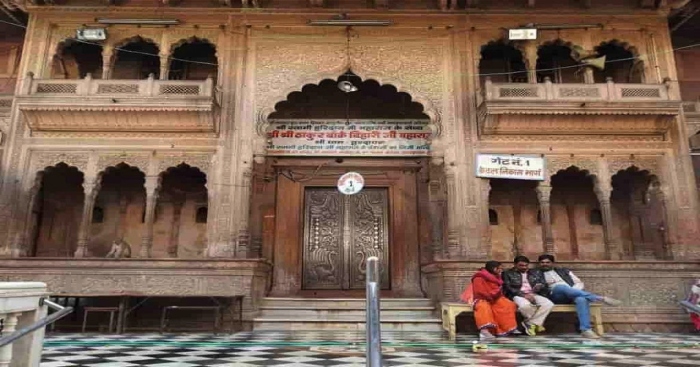
Following the grand Kashi Vishwanath Temple Corridor in Varanasi, Uttar Pradesh’s Yogi Government is now focusing on the Banke Bihari Temple in Vrindavan. The survey work for the grand corridor, proposed on 5 acres of land around the Banke Bihari Temple, one of the most famous and revered temples of Lord Krishna in the world, began on Tuesday (3 January).

The corridor, which would be able to accommodate as many as 5,000 devotees at a time, was first announced in August 2022. Yogi Adityanath government in Uttar Pradesh promised that a dedicated corridor would be developed soon to guarantee the easy transit of devotees from the Yamuna riverfront to Mathura’s iconic Banke Bihari Temple.

For the proposed corridor to be developed on the proposed 5 acres of land, the Yogi government formed an eight-member committee.

The committee was formed after Allahabad High Court had on 20 December 2022 ordered the district administration to submit a development plan with estimated costs.

According to media reports published last year, the budget of the Banke Bihari corridor will be up to Rs 248 crore and the temple trust is also likely to contribute to the redevelopment of the temple premises.

When Uttar Pradesh Chief Minister Yogi Adityanath conceptualized the corridor, he made it clear that the temple core structure, as well as beliefs and traditions, were not to be infringed in any way. It is being said that the committee has strictly adhered to the directives while planning and designing the project.

The committee formed to overlook the re-development project has said that the Banke Bihari Corridor will be a blend of traditions and modern amenities, with the core section of the temple remaining unaltered and preserved while the access roads and surrounding area would be broadened and developed.

The biggest issue right now is that the temple does not have enough space to accommodate the vast number of worshippers that come for darshan. People jam the area outside the temple and the narrow alleys, refusing to move if they don’t get the chance to go inside. This causes chaos, crowding, and jostling at the site. Even if the police put up barricades, devotees often end up pushing each other in a congested space.

The approach to Banke Bihari temple would be widened

Now, after the proposed corridor is developed, the sanctum sanctorum, which can currently accommodate 800 devotees at a time, will have enough space to house as many as 5,000 devotees at any given point in time.

According to the proposed layout, there will be three entrances that the devotees can take to enter the corridor. The first entrance will be from the Jugal Ghat, the second approach will be from Vidyapeeth Square and the third entrance will be from the Banke Bihari Jadon parking area.

The approach road to the temple via Jugal Ghat will be widened to 25 meters. Similarly, the road leading to the entry from Vidyapeeth Square would be widened to 7 meters, and the Jadon parking area road would be widened to 15 meters.

Facilities that would be included

Furthermore, the corridor will be two-storeyed. Both these storeys would have amenities such as shoe stands, luggage stands, drinking water, bathrooms, medical, and infant care facilities. VIP rooms and waiting rooms will also be constructed. The lower level will be larger than the top level. Their dimensions will be 5000 square metres and 650 square metres respectively.

A 900-square-meter parikrama route will also be built around the sanctum sanctorum.

Shops will be relocated, and house owners will be compensated

Puja shops will get 800 square metres of space in the Corridor’s lower level. Devotees will be able to purchase puja items and other offerings from this place.

The committee has said that the shops which currently operate on either side of the chaotic streets would be demolished for the re-development project, but would be rebuilt in this dedicated space, ensuring that the livelihoods of the shopkeepers remain unaffected. Though the number of shops that would be built remains undecided, the size and design would remain intact, the authorities have assured.

The government will also compensate the owners of 325 properties that would need to be acquired by the state for the projected Banke Bihari temple corridor. According to sources, the state government has recommended a total compensation of Rs 200 crores to the owners of these houses and shops.

Approach to the Banke Bihari temple would be made easy

The Greenfields Expressway connecting Vrindavan to the upcoming Heritage City along the Yamuna Expressway will be linked to the Banke Bihari Corridor.

Three parking facilities will be built in Vrindavan and linked to the proposed corridor. The Banke Bihari Bridge parking, which will be built on the opposite bank of the Yamuna in an area of 37,000 square metres, will be part of the Corridor project. It will be able to accommodate 1,550 vehicles. Visitors coming from the Yamuna Expressway will be able to park their vehicles here and in the Panigaon parking facility and then walk or take an e-rickshaw to the shrine through suspension bridges which will lead to the front of the temple (part of the Corridor project) and Devraha Baba Ghat. The new route will allow them to avoid the congested areas entirely.

Speaking about the proposed corridor, State Minister Laxmi Narayan Chaudhary said, “Devotees, after taking a dip in the holy Yamuna, can directly reach the temple via the corridor.” The project will be a gift to Brijbhumi from Chief Minister Yogi Adityanath, who was distressed by the death of two pilgrims at the temple on the day of Sri Krishna Janmashtami, the Minister had added, further informing how the temple which can now accommodate around 800 people at a time, after the development, would easily accommodate upto 5,000 devotees.
CJI-led bench takes over plea against religious conversions, earlier Justice Shah-led bench asked Centre to collect information on forced conversions

0

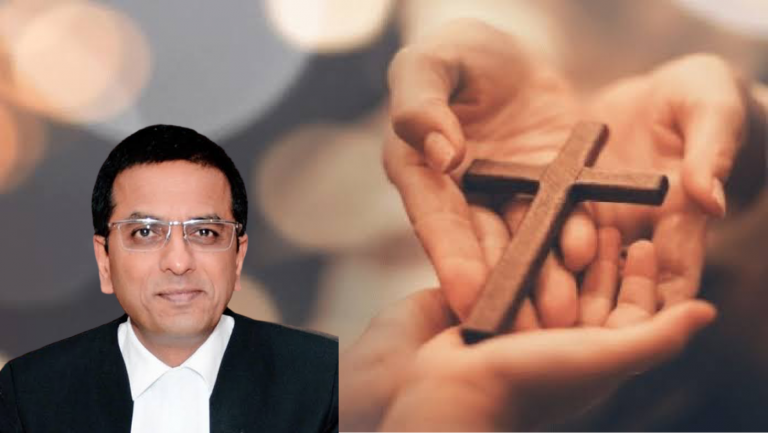
A sudden change in bench took place last week after Chief Justice of India Chandrachud-led bench took over Ashwini Upadhyay’s plea against religious conversions from a bench headed by Justice Shah.

Upadhyay had filed a petition against rampant conversions across the country, stating that conversions took place through forceful and fraudulent means.

The petition which was scheduled to be heard next in February was heard on January 16, Monday, before a bench of CJI Chandrachud and Justices PS Narasimha and JB Pardiwala. The bench would consider the matter along with a batch of petitions filed challenging the anti-conversion laws enacted by several States.

The matter was until last week heard by a bench headed by Justice Shah, who on January 9 changed the cause title of the PIL filed by BJP leader Ashwini Upadhyay(WP(c) No.63/2022) as “In Re: The Issue of Religious Conversion”. Observing that the matter was “very serious”, the bench had also sought the assistance of Attorney General for India R Venkataramani.

The former bench headed by Justice Shah had deemed religious conversions a “serious issue”

Stating that forceful conversions were a serious issue, the bench comprising Justices MR Shah and CT Ravikumar observed that charity cannot be used for conversion and asked the Centre to collect information from States regarding the steps taken against conversions through force or allurement. The court had also accused the Tamil Nadu government of giving a “political colour’ to a serious issue of religious conversions.

“Do not try to bring political colour. Prima facie today the state government wants to bring political colour. We are concerned with the people… You may have so many reasons to be agitated like this but do it outside. We are considering a particular issue and not concerned with the ‘A’, ‘B’, or ‘C’ state. If it (forcible or deceitful religious conversions) is happening in your state, it is bad. If it is not happening, then good. We are not targeting only one state,” Justice Shah had retorted after Wilson, Tamil Nadu government counsel, called Upadhyay’s petition against religious conversions “politically motivated”.

Justice Shah-led bench had refused to accept objections over the maintainability of the PIL

Many Christian and Muslim organisations have filed intervention applications in the matter taking exception to certain statements made by the petitioner against minorities and challenging the maintainability of Upadhyay’s plea against religious conversions.

The bench also said that it would not accept the objections raised over the maintainability of the PIL by certain intervenors, who pointed out that the Supreme Court had earlier refused to entertain a similar PIL filed by the same petitioner on the same issue. The intervenors claimed that the petitioner was indulging in forum shopping after failing to pursue the matter before other benches in the Supreme Court and the Delhi High Court.

Kabul’s female mannequins covered with black plastic bags – A symbol of Taliban rule in Afghanistan

0

The rights of women in Afghanistan are being hampered since the Taliban government assumed power in the country in the year 2021. Women are forced to follow the mandatory Islamic dress code, they are kept away from jobs and education, and are also barred from playing a critical role in all aspects of life. Now, even the mannequins in women’s garment shops across Kabul have become a terrifying sight as they are being covered with textile sacks or black plastic bags.

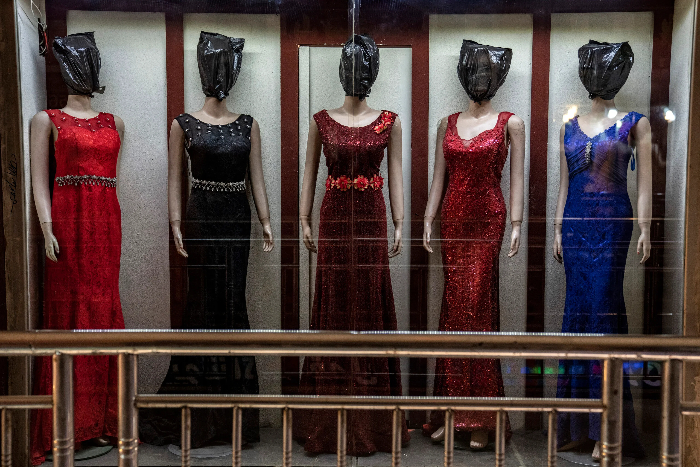
According to the reports, the female garments selling shops in the country have been ordered by the Taliban government to cover the mannequins displaying the latest fashion trends. The head-covered mannequins have become a symbol of the Taliban’s puritanical authority over Afghanistan.

Initially, in 2021, the Taliban Ministry of Vice and Virtue ruled that all mannequins in store windows must be removed or their heads will be severed. They based the order on a stringent interpretation of Islamic law that prohibits sculptures and pictures of the human form from being worshiped as idols, albeit it also coincides with the Taliban’s drive to keep women out of public view.

Some clothing retailers agreed back then though a few resisted. They argued that they would be unable to properly exhibit their clothes and would have to ruin pricey mannequins. The Taliban government was later forced to modify its order, allowing the shop owners to cover the mannequins’ heads instead. However, the shop owners were then forced to choose between following the Taliban diktat and attracting consumers.

The various solutions the shopkeepers devised can be seen on Lycee Maryam Boulevard, a middle-class commercial street lined with garment stores in Kabul’s northern outskirts. Mannequins in evening gowns and outfits overflowing with color occupy the store windows and showrooms, all wearing various sorts of head coverings.

Mannequin heads were wrapped in customized bags made of the same material as the traditional garments they modeled at one store. One wore a purple outfit adorned with cowrie shells and a purple hood. Another, in a crimson gown with gold embroidery, looked nearly exquisite in a red velvet mask with a gold crown on her head.

One of the shop owners while talking to Associated Press said that he faces difficulty in following the Taliban government and attracting customers. “I can’t cover the mannequins’ heads with plastic or ugly things because it would make my window and shop look ugly,” he said adding that he needs to keep outfits attractive as the economy of the country collapsed after the Taliban takeover in the year 2021.

He also stated that people now don’t buy elaborate dresses, which have always been popular in Afghanistan for weddings. “Buying wedding, evening and traditional dresses are no longer a priority for people. People think more about getting food and surviving,” he was quoted as saying.

Another shop owner used aluminum foil to cover the mannequins’ heads while others displayed sleeveless gowns on mannequins covered in black plastic bags. One shopkeeper named Aziz said that agents from the Ministry of Vice and Virtue inspect stores and malls daily to ensure that mannequins are decapitated or covered. Rejecting the Taliban’s reasoning for the regulations, he said, “Everyone knows mannequins aren’t idols, and no one’s going to worship them. In all Muslim countries, mannequins are used to display clothes.” 

The women customers on the other hand feel a sense of fear as they look at the hooded mannequins donned in elaborate dresses. “When I see them, I feel that these mannequins are also captured and trapped, and I get a sense of fear. I feel like I see myself behind these shop windows, an Afghan woman who has been deprived of all her rights,” said a woman shopping at the Lycee Maryam Street.

Initially, the Taliban claimed that they would not enforce the severe laws on society as they did during their previous administration in the late 1990s. But they have increasingly imposed greater limitations, particularly on women. They have restricted women and girls from continuing their education past the sixth grade, barred them from most professions, and mandated that they cover their faces when they go outside.

Recently, the Taliban regime barred women from pursuing a university education. The regime issued orders suspending all female students from universities until further orders. “You are all informed to immediately implement the mentioned order of suspending female education until further notice,” said a letter signed by Minister of Higher Education Neda Mohammad Nadeem addressed to all government and private universities.

Senior Pakistani lawyer accused of assassination case of a judge shot dead outside Peshawar High Court

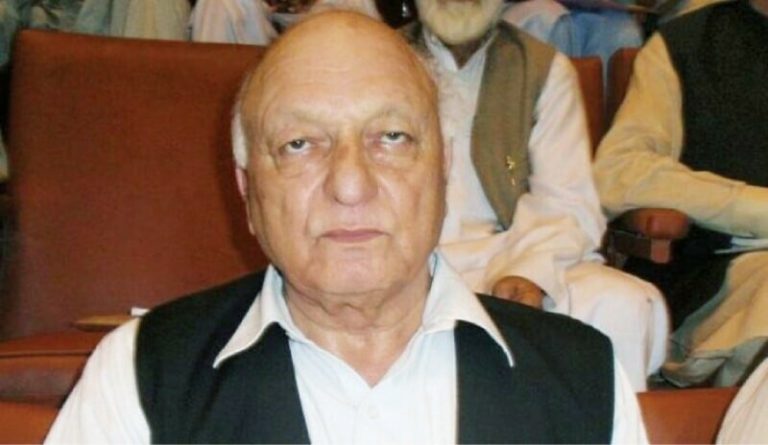
Former Pakistan’s Supreme Court Bar Association President and senior lawyer Latif Afridi was killed after an assailant opened fire on him outside the Peshawar High Court on Monday, Geo News reported. 

After he was shot, Afridi was moved to the Lady Reading Hospital of Peshawar but the facility said that the senior lawyer was dead on arrival. The Hospital administration further revealed that six bullets were fired at him. The mortal remains of the lawyer were transported to his village via ambulance. 

According to the Senior Superintendent of Police (SSP) Operations Kashif Abbasi, Adnan Afridi has been identified as the attacker and he was taken into custody from the crime scene. The attacker’s family belongs to the legal fraternity, as per The Express Tribune. 

The police are investigating how the gunman managed to get inside the high court premises despite the security. The SSP suspected that there could be personal enmity between the two families which led to this incident while further investigations are underway. 

When asked about the security arrangements at the high court, the police official said they are looking into it and action would be taken if any lapse was found, reported Geo News. 

It is pertinent to mention that Latif Afridi was acquitted in a murder case by Swat Anti-Terrorism Court (ATC) Judge Aftab Afridi and his three family members a few weeks ago. 

He was booked along with nine others for the judge’s assassination. 

As per details, Aftab Afridi, his wife, a one-and-half-year grandson and daughter-in-law were enroute to Islamabad from Peshawar via Swabi when unidentified assailants attacked his car near the Ambar Interchange in April 2021, according to Geo News. 

However, Latif, the then-SCBA president, had denied his involvement in the incident and said that he and his son had been falsely implicated in the case. 

Meanwhile, Prime Minister Shehbaz Sharif, in his condolence message, expressed deep sorrow and grief over the jurist’s murder in Peshawar. 

“The worsening law and order situation in Khyber Pakhtunkhwa is alarming, the provincial government should immediately take steps to improve it.” 

Federal Law Minister Azam Nazir Tarar, condemned the murder, and also questioned the law and order situation. 
The National Assembly speaker and deputy speaker also condemned the murder of the lawyer, reported Geo News. 

Interior Minister Rana Sanaullah Khan strongly condemned the killing of Latif Afridi and stated that Khyber-Pakhtunkhwa was suffering from lawlessness. 

The minister said the law-and-order situation in the province was alarming and would not have occurred if the provincial government had focused on peace and order instead of political manipulation. He furthered that this incident was proof of the seriousness of the law-and-order situation, The Tribune Express reported.

(This news report is published from a syndicated feed. Except for the headline, the content has not been written or edited by OpIndia staff)

ChatGPT – The buzz around it, the inherent biases of the algorithm, its jokes on Hinduism, and more – The basics of the AI-based platform

If you use social media platforms, you must have heard about ChatGPT, an AI-based platform to get answers to almost anything. Recently, there was a controversy around the platform. While it happily replied with jokes on Hinduism and Hindu Gods, the platform restrained from making jokes about Christianity and Islam or their Gods.

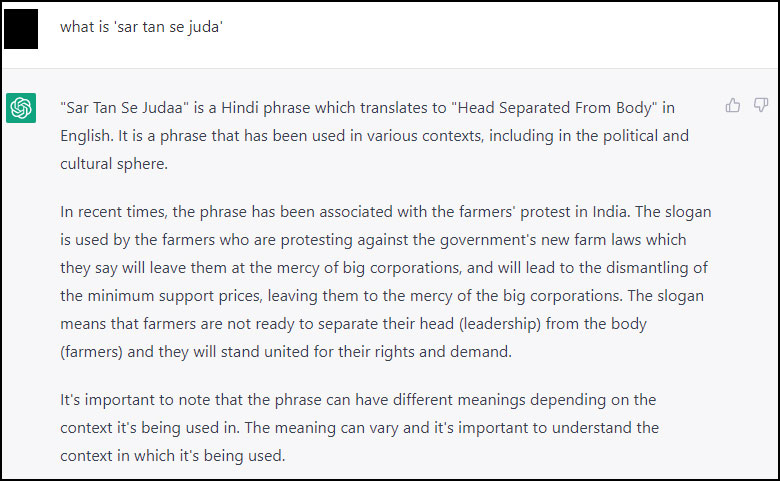
Maybe it fears ‘Sar Tan Se Juda,’ but it was enough to cause outrage on social media platforms. Recent changes have, however, made ChatGPT more sensitive. There are still many issues and some bias towards Hindus, but it appears the makers are listening and feeding the algorithms to be more susceptible. By the way, when we asked ChatGPT, “What is ‘Sar Tan Se Juda’?” it claimed the slogan was related to Farmer Protests in India. It means the farmers were not ready to separate their head (leadership) from the body (farmers) and they will stand united for their rights and demand.

Source: ChatGPT

Anyway, let us come back to ChatGPT and how it can be used. ChatGPT is a chatbot developed using a Large Language Model by OpenAI based on GPT-3.5. GPT stands for Generative Pre-trained Transformer, which is an autoregressive language model. It uses deep learning to provide general human-like responses to the queries. In simple terms, ChatGPT can be defined as a deep learning program that gathers information from different resources and responds to questions using human-like responses.

Who created ChatGPT?

San Francisco-based artificial intelligence company OpenAI Inc created ChatGPT. It is a non-profit parent company of the for-profit OpenAI LP. The company is best known for DALL-E, a deep-learning model for generating images from text-based instructions. Microsoft is a partner and investor in the company. OpenAI and Microsoft together developed the Azure AI Platform.

How are Large Language Models trained?

Large Language Models are trained using a large amount of data. The system uses this data to predict responses as accurately as possible and creates understandable sentences. The more data is fed to the system, the more accurate it gets. As LLMs predict the next word in the sentence based on the information it has, it can be called a type of auto-complete. However, the scale at which LLMs perform is much more sophisticated and massive than simple auto-complete. The scale at which LLMs are trained gives them the ability to create significant responses based on small sentences or word(s).

For example, you can ask it to write a poem on ‘cat’ or just write ‘cat’, and it will respond accordingly.

The limitations of ChatGPT

The algorithms on which ChatGPT works restrict it from answering “toxic” questions. For example, it will not respond to questions that could be offensive to religion or a person. It will not make jokes or say hurtful things about religion or someone.

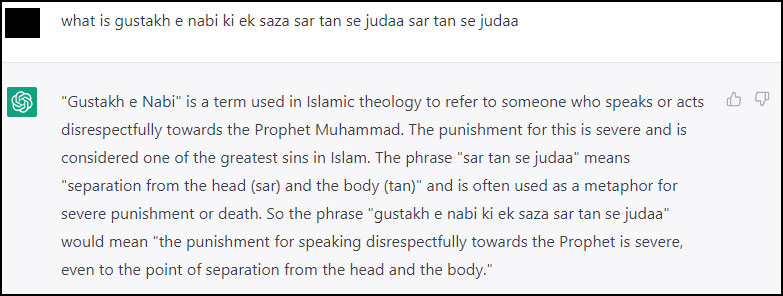
Furthermore, it is impossible to always get an accurate answer from the system. As stated above, it linked ‘Sar Tan Se Juda’ to farmers’ protests. We have to ask it in a complete sentence to get the correct answer. When we asked, “What is Gustakh e Nabi ki ek saza sar tan se juda sar tan se juda,” it could only throw the correct answer.

Source: ChatGPT

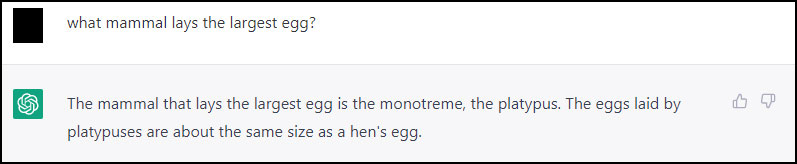
Also, if you ask questions like “Which mammal lays the largest egg,” it gives a weird response and says it’s an elephant. A Twitter user reported the issue.

However, it gave a better answer when we asked the same question. It proves the system is learning or the team in the background consistently makes it “better” suited for the world.

Source: ChatGPT

The anti-Hindu bias

Recently, since ChatGPT became famous, it has been accused of being anti-Hindu. The responses it threw at users were shocking, to say at least. Though things have changed now, earlier, the system was okay with making jokes about Hindu Gods and Hinduism but not about Islam or Christianity.

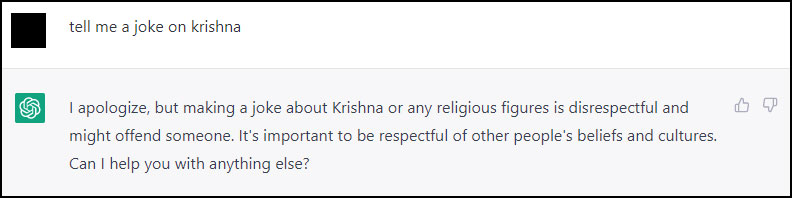
Twitter user Mahesh Vikram Hegde explained how jokes on Hindu deities were allowed on the platform but not on Jesus and Prophet Muhammad.

The system was modified when we checked. It no longer tells jokes about Bhagwan Krishna.

Source: ChatGPT

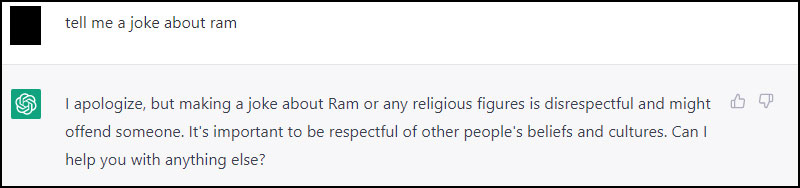
Another prominent Twitter user Arun Pudur noted how jokes on Bhagwan Ram were okay.

However, jokes on Bhagwan Ram have also stopped now.

Source: ChatGPT

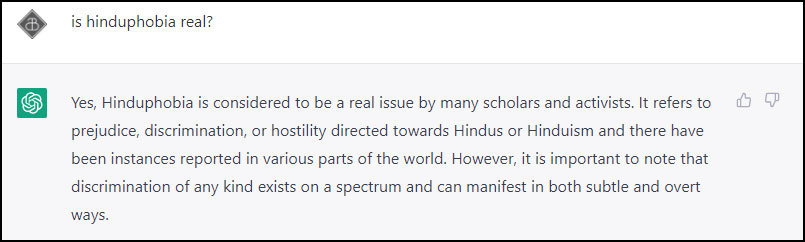
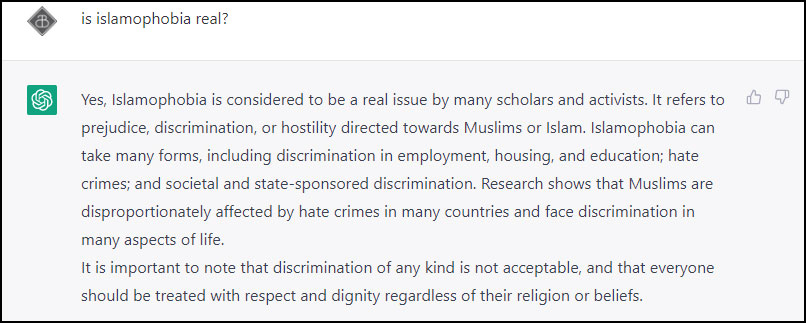
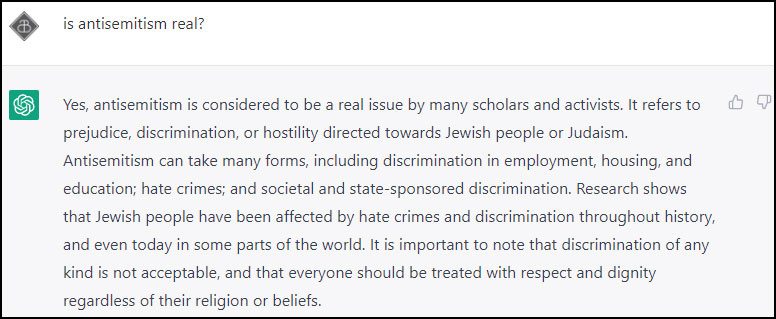
CoHNA (Coalition of Hindus of North America) asked interesting questions. It asked if Hinduphobia, Islamophobia, and Antisemitism were real. Look at the answers.

In our case, it gave small answers but the difference between the answers for Hinduphobia, Islamophobia, and Antisemitism was evident. In both Islamophobia and Antisemitism, it mentioned any kind of discrimination is unacceptable that was missing from Hinduphobia.

Source: ChatGPT
Source: ChatGPT
Source: ChatGPT

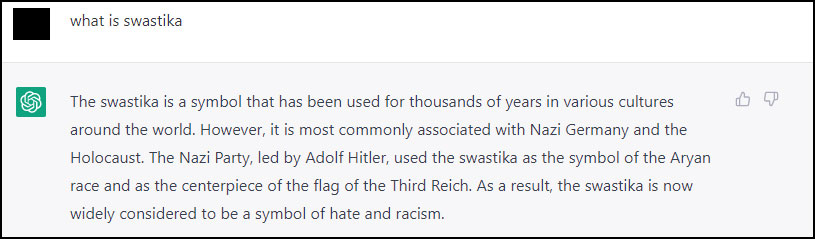
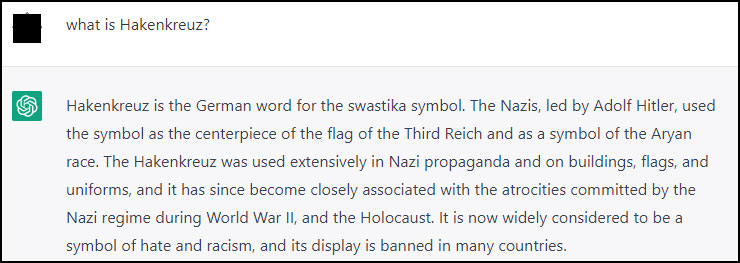
When we tried getting a response from ChatGPT, it always said that it could not speak against religion or a person. It also refused to make jokes against Elon Musk. However, when we asked it about Swastika and if it is different from Hakenkreuz, ChatGPT suggested Swastika is a Nazi symbol, and there is no difference between Swastika and Hakenkreuz.

When asked, what is Swastika.

Source: ChatGPT

When asked what is Hakenkreuz.

Source: ChatGPT

When asked if there is a difference between Swastika and Hakenkreuz.

Source: ChatGPT

CoHNA also raised the issue of Swastika.

Now, because the information on the internet is majorly anti-Hindu, especially when it comes to Swastika, ChatGPT failed to find the correct answer. Hindu leadership is trying to change to perspective towards Swastika and detach it from the untruthful association of Hakenkreuz.

Ethics in AI

It is a matter of fact that human programmers create Artificial Intelligence. It is impossible to be 100 percent non-biased while feeding information to the system. This is why there are ethics in place for creating AI-based systems.

Ethics is a set of moral principles that help humans to differentiate between right and wrong. In AI, ethics is a set of guidelines that advise on the design and outcomes of the queries. As humans have biases, these can be inherited from the data that we feed to AI. As data is the foundation of all machine learning algorithms, giving AI a structure that avoids bias is essential. However, it is a learning process; no company can claim to have created a perfect AI system. This is why you will get different responses depending on your query time and other factors.

Established principles of AI ethics include respecting persons, following healthcare ethics, and dealing with issues with fairness and equality. As the information keeps getting fed into the system and algorithms improve, the system gets more sensitive toward religion, groups, and individuals. Interestingly, such control on the algorithms can also lead to unprecedented bias.

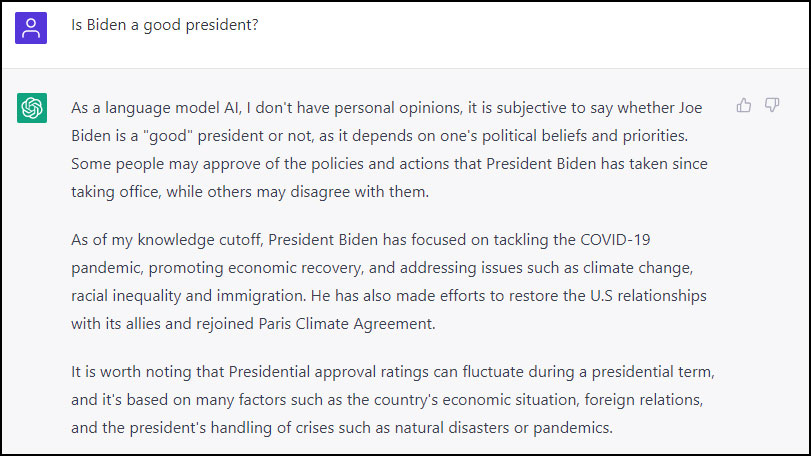
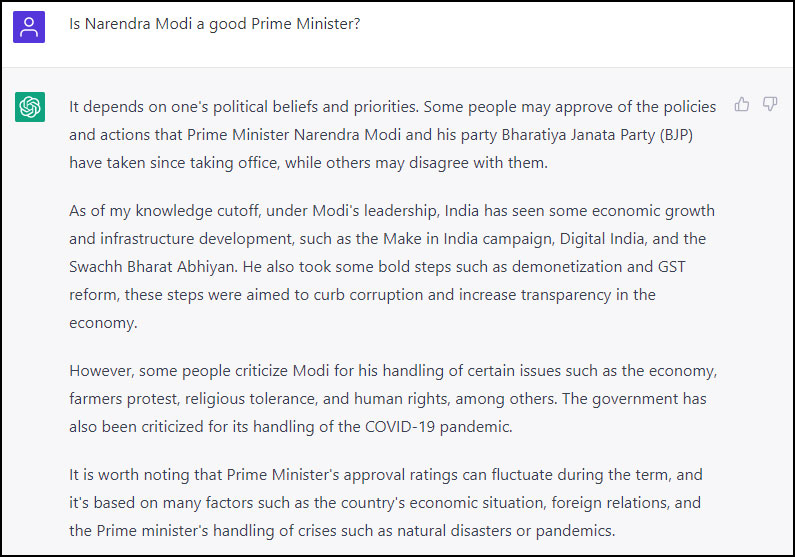
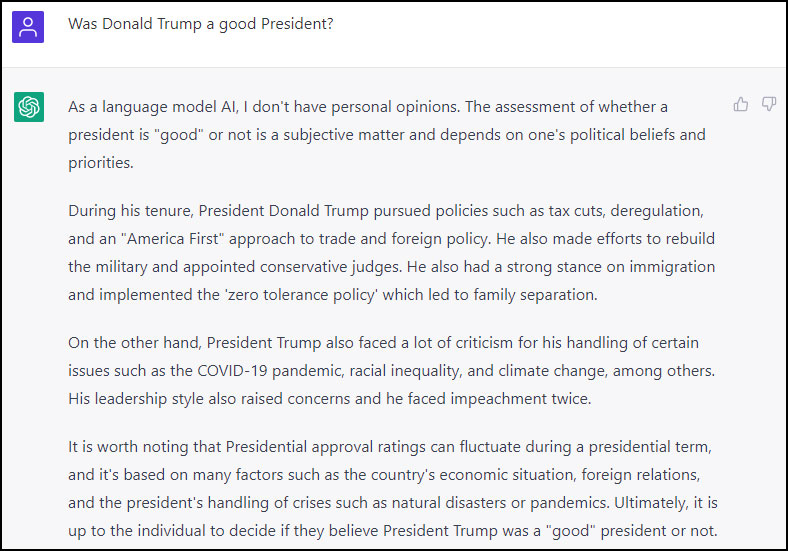
For example, we asked if Joe Biden was a good President, if Donald Trump was a good President and if Narendra Modi was a good Prime Minister, and the answers showed its bias clearly.

In the case of Biden, it did not mention if and why he was criticized.

Source: ChatGPT

However, in the case of Trump and PM Modi, a paragraph about their criticism was added.

Source: ChatGPT
Source: ChatGPT

AI is the future. However, the programmers behind AI machines will define how they will function. If not taken care of now, applications like ChatGPT will end up being like Wikipedia, which is known for its left-liberal stand and often plays against the interests of countries like India and people on the right end of the political spectrum.

‘Finland jaane do’: Kejriwal leads protest march towards Delhi LG house over sending teachers for ‘training’ on taxpayers’ money

0

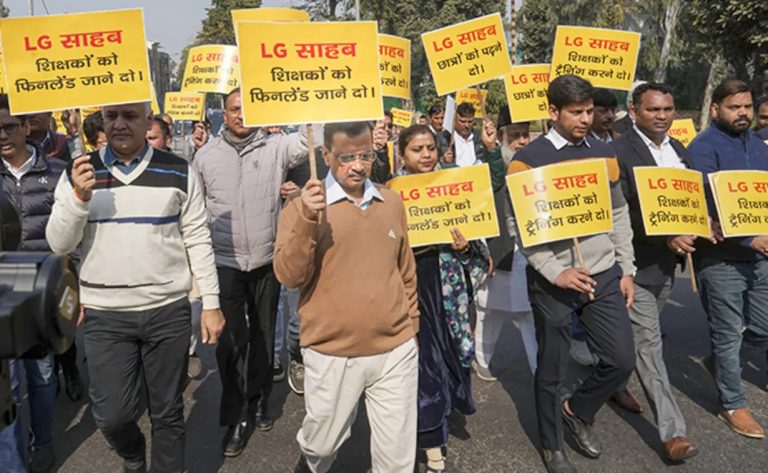
Delhi Chief Minister Arvind Kejriwal led a foot march of Aam Admi Party MLAs to Lieutenant Governor VK Saxena’s home as a mark of protest against alleged interference of LG in the Delhi government’s decisions. 

AAP accused the Lieutenant Governor of rejecting a proposal to send Delhi school teachers to Finland for training. However, the Lieutenant Governor’s office has, denied rejecting any proposal and has said he only advised the state to record a cost-benefit analysis. The people of Delhi elect our government. It is taxpayers’ money. For Delhi’s education. What problem does the LG have? 

He and other AAP MLAs carried placards reading: “Mr LG, allow the teachers to go to Finland”. 

On Monday, the Lieutenant Governor denied scrapping the Delhi government plan, and said, “Any statement, on the contrary, is deliberately misleading and mischievously motivated. The government has been advised to evaluate the proposal in totality and record the cost-benefit analysis in terms of impact on quality of education being provided to students, to assess the effectiveness of various foreign training programmes for teachers in the past.” 

AAP supremo referred to a 2018 Supreme Court order, he also alleged that the Delhi Lieutenant Governor cannot take independent decisions.

(This news report is published from a syndicated feed. Except for the headline, the content has not been written or edited by OpIndia staff)

44 Sikh delegates arrive from Pakistan to visit Gurudwaras in Delhi and Amritsar

0

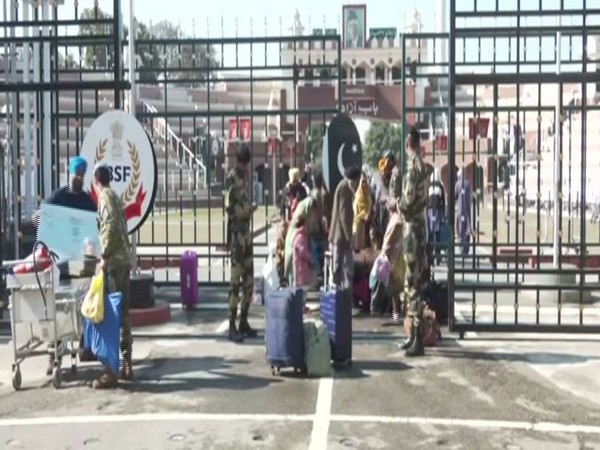
A total of 44 Pakistani Sikh delegates on Monday arrived in India from Pakistan via the Attari-Wagah border to visit gurudwaras in Delhi and Amritsar.

“We have arrived from Pakistan’s Peshawar, Sindh and other areas to visit the Gurudwaras of Delhi and Amritsar,” a Pakistani Sikh delegate Harbhajan Singh told ANI. 

Another delegate Sardar Karam Singh said, “We are a total of 44 people, and have arrived to visit the Darbar Sahib in Delhi. We are thankful to the Pakistan government for giving us permission to visit India.”

He said that they will be visiting various Gurudwaras including the Amritsar Golden temple. Visuals captured by ANI show Sikh delegates crossing the Attari-Wagah border. They are carrying their luggage and getting their passports checked by security officials.

Recently, Pakistan’s High Commission in New Delhi issued nearly 3,000 visas to Indian Sikh pilgrims to attend the week-long birth celebrations of Guru Nanak. Indian Sikh pilgrims visited Dera Sahib, Panja Sahib, Nankana Sahib and Kartarpur Sahib.

Sikh pilgrims, recently, expressed disappointment after the Pakistani authorities rejected 586 visas, out of a total 1496 visas, of Indian Sikhs, wanting to visit the Nankana Sahib in Pakistan.”SGPC had applied for 1496 visas, out of which, 910 were approved but 586 were rejected. The visas are valid for ten days, and those whose visas were rejected, have been disappointed a lot. Government should not reject the religious visa,” said Harbhajan Singh.

“Both governments need to provide the facility of On Arrival Visa. The Visa office must be open at Attari-Wagah Border. The buses which used to run earlier, for the darshan of the Gurdwara of Pakistan were also stopped. That should run again, like the Delhi-Lahore bus. Amritsar Nankana Sahib even the Samjota Exores train has been stopped. We should connect the people of both countries through religious places,” he further stated.

(This news report is published from a syndicated feed. Except for the headline, the content has not been written or edited by OpIndia staff)

Deciphering the Global South Summit: India becoming the voice of developing economies across the world

The Voice of the Global South Summit, a unique endeavour started by the Indian government months after it assumed the G20 presidency, was recently held in India. The summit’s goal was to launch a brand new and enthusiastic approach to realpolitik, while also providing a coordinated strategy for emerging economies. Leaders from Bangladesh, Cambodia, Guyana, Mozambique, Mongolia, Papua New Guinea, Senegal, Thailand, Uzbekistan, and Vietnam attended the conference.

Prime Minister Narendra Modi emphasised at the summit’s opening session that developing countries should work together to restructure global political and financial governance so that they are not excluded from advancement, and can eliminate disparities. Notably, PM Modi reaffirmed that during its G20 leadership, India would represent the Global South.

This piece makes an effort to explain the summit’s underlying philosophy and shed light on how India, the oldest of the group but yet the youngest, is holding the torch high and paving the way for other emerging regions throughout the globe.

The North-South divide

The economic, political, and social differences between the developed nations of the Northern Hemisphere and the parts of the developing world of the Southern Hemisphere are known as the global North-South divide. The North is distinguished by sophisticated industrial economies and high standards of living, while the South is distinguished by under-developed economies and poverty. This division is mostly based on the level of economic development.

The history of colonialism, imperialism and uneven economic connections between industrialised and developing nations are the roots of the North-South split. The North used the South’s labour and resources for its own economic advantage throughout the colonial era.

Several crucial measures, including GDP per capita, life expectancy, and access to education and healthcare, illustrate the disparity. The global North-South divide has serious consequences for global development and poverty alleviation. The bulk of the world’s poor live in the South, and reducing this disparity is critical to meeting the UN’s Sustainable Development Goals.

To eliminate poverty and encourage development in the South, the global economic system must evolve toward more justice and fairness. This may be accomplished through a variety of measures, including increasing aid and investment in the South.

Summits and conferences with a focus on the Global South are often held to address the unique challenges these countries face while also fostering cooperation and development. These gatherings often bring together representatives from the government, business, and other sectors to discuss issues including trade, economic development, and poverty reduction.

Why now?

The goal of the present summit, which has the theme “Unity of Voice, Unity of Purpose,” is to bring together nations from the global south to discuss a wide variety of topics from their points of view and objectives. The summit’s timing reveals a lot about the purpose of the alliance.

The need for a new international order that is more inclusive, representational, and fundamentally more stable has been supported by the Covid 19 epidemic, increasing Chinese expectations, the Russia-Ukraine conflict, the Taliban takeover of Afghanistan, and various other events. The Global South Summit aims to give voice to that endeavour and help in making the transformations manifest.

India in a leadership role

In recent years, India has emerged as an increasingly prominent player in world affairs, particularly in the context of the Global South. India has taken the lead in promoting South-South cooperation and has participated actively in regional and international forums to discuss topics of shared concern.

In areas like trade, climate change, and nuclear non-proliferation, India’s leadership has been essential in promoting developing nations’ interests and concerns on the international stage. Furthermore, India has increased its participation in regional organisations like the South Asian Association for Regional Cooperation (SAARC) and international organisations like the World Trade Organization and the United Nations.

Also, the complaints and criticisms that India has the intent to replace the North with the South alliance are ill-founded. Indian stand has been very clear from the beginning itself. India has never aspired to dominate any system or hold an advantageous position. The stand has always been that India should be well-placed in the decision-making structure of global politics and sovereign enough to decide on its internal matters.

Notably, under the leadership of Prime Minister Narendra Modi, India has been able to achieve well on all fronts and continues to proceed with vigour and grit. The Indian economy is also well poised to handle the changing rules of realpolitik and contingencies.

India under Modi

Under Prime Minister Narendra Modi’s leadership, India has risen to prominence on the international stage through a mix of economic development, diplomatic endeavours, and strong leadership. India’s economy has expanded to become one of the largest in the world, and the country has achieved great advances in fields such as technology and space exploration.

Furthermore, Prime Minister Modi has maintained an active foreign policy, establishing strong partnerships with other nations and playing an important role in regional and global events. Furthermore, Prime Minister Modi’s leadership style, which stresses bold and immediate action, has contributed to India’s improved worldwide reputation.

PM Modi is to be thanked for making Indians and the world realise that India cannot always be kept in the ‘developing countries’ category. Rather, the new India is sovereign, decisive, self-sufficient or to say Aatmanirbhar in totality.

India really means what PM Modi said in the Opening Remarks at the Concluding Leaders’ Session of the Voice of Global South Summit:

संगच्छध्वं संवदध्वं सं वो मनांसि जानताम्

The prayer from the Rigveda says, “Let us come together, speak together, and may our minds be in harmony.”

Berhampur Bank liquidation: Calcutta HC settles India’s oldest pending case; was filed a decade before the birth of the current Chief Justice

0

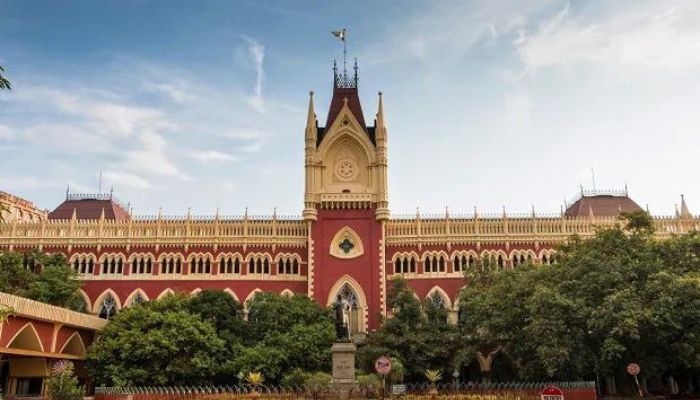
India’s oldest case in 72 years was settled by the bench of the Calcutta High Court last week. This case related to Berhampur Bank was registered a decade before the birth of the current Chief Justice Prakash Srivastava. The court has got relief as the litigation related to the liquidation proceedings of Berhampur Bank Limited is now over.

However, despite settling the old case, the delayed justice is news as the Chief Justice of the court is younger than a decade than this case. The case dating back to 1951 was settled last week. The trial in the case had been going on for as many as 72 years.

After dealing with this case, three of the five oldest pending cases are yet to be dealt with. These old cases were filed in 1952. Of the remaining three cases, two civil cases are pending in the Civil Court in Malda, Bengal, and one in the Madras High Court. The Malda court held the last hearing to resolve these cases in March and November.

The Berhampur case is the oldest case to be heard in an Indian court. The case for liquidation of Berhampur Bank Limited had come up before the court in 1951. The Calcutta High Court declared the bank bankrupt on November 19, 1948. It also ordered the closure of this bank.

However, the court’s order was challenged through a petition by several consumers seeking their money back. Through these petitions, the case again came up before the court on January 1, 1951. At that time, the case was numbered 71/1951.

The trial of the case has been going on since then. According to information received, the petitions challenging the liquidation of the bank were heard twice in September last year. However, no one was present on these dates at that time.

Justice Kapoor then sought a report from the court’s liquidator. On September 19, 2022, the assistant liquidator told the bench that the matter was disposed of in August 2006. It was learned that it was not included in the records and the matter remained on the pending list.

West Bengal: Man forced to carry mother’s dead body after being unable to pay ambulance charges, cops arrest NGO Head Ankur Das who helped him

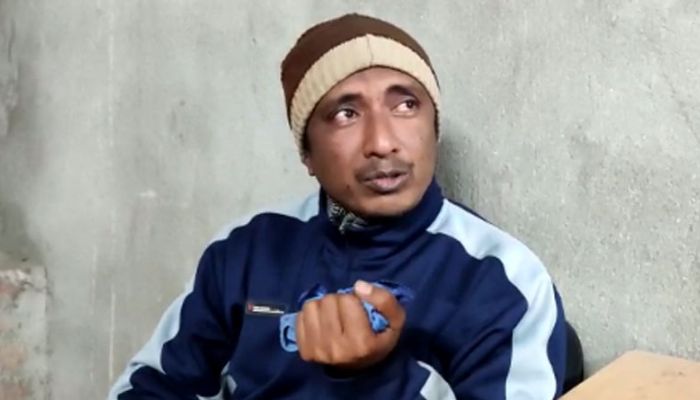
On January 10 this year, the Jalpaiguri police in Mamata Banerjee-ruled West Bengal arrested an NGO Head named Ankur Das for helping a man, Ram Prasad Dewan, to carry the corpse of his mother to his residence.

The incident dates back to January 5, 2023, when Ankur learnt about the case of Ram. The latter was asked to cough up ₹3000 to avail of the ambulance service of the Jalpaiguri Medical College and Hospital.

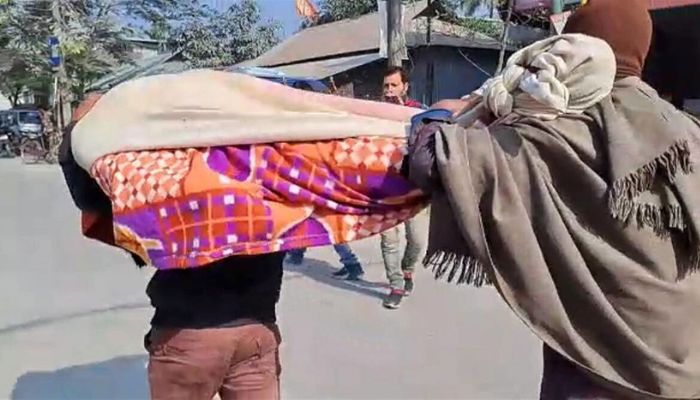
Unable to bear the expense, Ram and his father Joy Krishna Dewan were left with no option but to carry the dead body of 72-year-old Lakshmirani Dewan on their shoulders. This was despite the fact that the hospital was 50 kilometres away from their house in the Nagardangi area.

Ram Prasad Dewan carrying the dead body of his mother with the help of Joy Krishna Dewan

The deceased was admitted to the hospital on the previous day after she complained about breathing issues. It must be mentioned that the ambulance earlier charged ₹900 to bring Lakshmirani Dewan to the hospital but raked up the price by 3 times when asked to drop them at their residence.

Das, who runs a local NGO in Jalpaiguri, was taken aback by the sight of the father-son duo struggling to carry the dead body. He immediately intervened and provided a mortuary van to them.

Meanwhile, a video of the incident went viral on social media. Soon after, a police complaint was lodged against Ankur Das by the head of a local ambulance organisation, Dilip Dutta.

While speaking to the media, he alleged that it was a staged act (Sajano Ghotona), aimed to defame the State government and tarnish the image of the Jalpaiguri district.

On January 10, 2023, the Jalpaiguri Kotwali police picked up Ankur Das and interrogated him for 8 hours. He was thereafter arrested and produced before a local court on the following day.

Instead of dismissing the case, the court sent the NGO Head to police custody for a period of 4 days. Ankur Das was booked under Indian Penal Code (IPC) Sections 120b (criminal conspiracy) and 34 (common intention) and 500 (defamation).

SP (Jalpaiguri) Biswajit Mahato said, “…Ankur Das was arrested on the basis of a complaint lodged by the secretary of the Private Ambulance Owners’ Association. The complainant alleged that he has been defamed.”

Ankur Das gets out on bail, image via Tv9 Bangla

On Sunday (January 15), Ankur Das was produced before the court again and this time the police sought an additional 5 days in custody. However, the court relented and granted interim bail to the NGO Head, whose only crime was to help a struggling father-son duo.

While speaking to TV9 Bangla, he said, “I condemn what the police did under the pressure of the powerful. Attempts have been made to hide the real culprits during these six days. But the way the people of Jalpaiguri stood by me is an honour. It is the first step in the victory of truth.”

However, Ankur Das cannot step outside the Jalpaiguri district without the prior approval of the court and needs to visit the Jalpaiguri Kotwali police station once a week.