Home Blog Page 2837

‘I would have shot them in head’: TMC leader Abhishek Banerjee says police showed unnecessary restraint in stopping BJP’s Nabanna Chalo rally

0

On Thursday, Trinamool Congress MP Abhishek Banerjee lauded the state police for targeting the BJP workers during the Nabanna Chalo march and said that he would have shot the protesters in the head, had he been present at the site. “I salute the officer for his patience and his handling of the riots. If I was there, I would have shot them in the head”, Banerjee said on September 14.

According to the reports, West Bengal CM Mamata Banerjee’s cousin and Lok Sabha MP Abhishek Banerjee visited Kolkata (central) ACP Debjit Chatterjee who suffered injuries during the rally. After seeing Chaterjee who is undergoing treatment at the state-run SSKM hospital, Abhishek Banerjee turned furious and used disparaging language toward the BJP workers.

He accused the BJP workers of creating a ruckus in the state during the Nabanna Chalo rally and said that the state police unnecessarily showed restraint to handle the rally with ‘patience’. “If the police wanted to teach the stone-pelters a lesson, they could have opened fire on them. The game would have ended even before it had started. But that didn’t happen. The very fact that the police showed restraint in the face of adversity is the biggest change in our system”, he was quoted.

This is moments after West Bengal Chief Minister Mamata Banerjee criticized the protest led by the BJP on September 13 and compared the BJP workers to goons. “The public has been harassed by the BJP workers. The police could have shot at the protesters. But that was the last resort and was not necessary”, Banerjee said praising the state police for ‘managing’ the situation in a restricted manner.

Mamata Banerjee also alleged that the BJP leaders from the state had called goons from other locations to deliberately create mayhem in the state during the Nabanna Chalo rally. “Political protests are not done in such a violent manner. You (BJP) will bring goons from outside the state and use them for violence. That is unacceptable. You will carry guns and bombs in your bags. Is this a way to protest?”, she was quoted while leveling allegations over the state BJP.

Meanwhile, BJP leader Amit Malviya slammed Banerjee for her statement by sharing a video of the West Bengal police pelting stones at the BJP workers and tweeted, “This is West Bengal Police, in gross violation of policing manual to control public protests, like jihadis, is pelting stones at political protesters during the Nabanno Chalo Abhiyan. Home Minister Mamata Banerjee said the police was ‘restrained’ and didn’t fire at the protesters”.

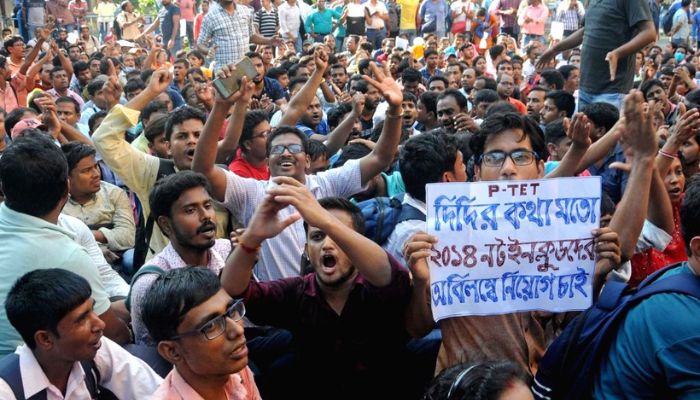
The BJP on Tuesday conducted a ‘Nabanna Chalo’ (march to secretariat) mega rally to condemn the TMC-led government and its alleged corrupt practices in the state of West Bengal. LOP Suvendu Adhikari was supposed to lead a rally from Satraganchi, while Sukanta Majumdar, the party’s state president, was supposed to lead one from Howrah Maidan. Meanwhile, former state BJP head Dilip Ghosh was supposed to lead the workers from College Street.

However, the West Bengal Police said that the party had taken no permission for such a rally and stopped several BJP workers from participating in it. Widespread incidents of Police excesses in Howrah and Kolkata were also reported amid the rally. The Police also arrested thousands of BJP workers. They detained Suvendu Adhikari, the Leader of the Opposition and other leaders like MP Locket Chatterjee, Rahul Sinha, Taapshi Mondol, and Dibankar Gharami.

The BJP workers then reached the Police headquarters in the Lalbazar area and also opposed the Police action taken against several BJP leaders. The Police then deployed water cannons and lobbed tear gas shells at the protest site to disperse the BJP workers. The Police lathi-charged them in Santragachi, Howrah Maidan, Mahatma Gandhi Road, and Rabindra Sarani and also were seen misbehaving with the women who wanted to join the BJP in the rally.

It was earlier reported that several BJP workers had sustained injuries in the Police attack. BJP leader Swapan Dasgupta was also injured amid the party’s mega-protest in West Bengal against Mamata Banerjee-led Trinamool Congress (TMC) government. “They fired tear gas shells and lathi-charged protesters. I got pushed by a policeman. A peaceful demonstration was attacked in this fashion. The initial attack was by police. It looked like a pattern the way police attacked”, Dasgupta had said after being injured. He further slammed the TMC-led government and stated that the whole country should know the true face of this Bengal government.

Meanwhile, Bengal BJP president Sukanta Majumdar also criticized the TMC-led government and claimed that crude bombs and stones were hurled at his party workers. Majumdar who was supposed to lead the march from the Howrah Maidan was also detained by the Bengal Police.

Notably, many police officers have also been reported injured during the attack first launched by the West Bengal Police. TMC alleges that ACP Debjit Chatterjee who is undergoing treatment at the state-run SSKM hospital was beaten by the BJP workers. A case of a murder attempt has been filed in connection with the incident.

India dodges global economic slowdown, exports grew by 19.7% in April-August over the same period last year

After India banned the export of wheat and broken rice, and in light of the ongoing Russia-Ukraine war that has impacted global trade, there is a perception that there is a decline in exports from India which will have a negative effect on the Indian economy. There were concerns about the reduced growth rates in exports to Europe and USA, as the western countries are still facing supply chain problems that emerged during the Covid-19 pandemic. But despite such factors, Indian exports have shown healthy growth.

In spite of a prolonged Russia-Ukraine conflict, the disruptions in the supply chain, high inflation rates and demand slowdown in some of the major economies, the Indian exports of merchandise have held well to register 17.7% growth in April-August this year, against the corresponding period last year. Overall export, both merchandise and services, grew by 19.7% in that period.

The amount of merchandise exported was $ 164.44 billion in April-August 2022, and the export of services was valued at $260.46 billion. However, India continued negative trade balance due to higher imports, which stood at (-)$11.42 billion.

For the month of August only, the export grew from $53.83 billion in August 2021 to $57.47 billion in August 2022, registering a growth rate of 6.75%. Among these, merchandise export grew by 1.62%, while services grew by 15.12%.

The electronics sector continued to achieve impressive growth, as export of electronics showed positive growth with a 54.7% increase in the period April to August compared to the same period last year.

Exports of tobacco products showed the highest growth in August, which grew from $72.29 million in August 2021 to $127.51 million in August 2022, growing by 76.39%. Similarly, Oil Meals grew by 73.68% YoY for August.

India’s agricultural exports too have been doing well with marine products registering a growth of 7.6%, meat and dairy products registering a growth of 13.6%, fruits and vegetables exports grew by 8.8%, cereal preparations and processed food products grew by 30.6%, coffee registered a growth of 36.7%.

However, exports of some of the products have come down in the same period. Some of the sectors that have seen a dip are cotton yarns/fabrics/made-ups where exports have declined by 32%, in iron-ore exports have declined by 90% and in handicrafts there has been a decline by 36%. But the drop in exports in cotton yarn and iron ore has contributed to meeting the domestic demands and has helped domestic manufacturing.

The country’s exports have also been successful in diversifying their exports from the traditional economies to non-traditional countries, such as Indonesia (37.8% growth), Brazil (64.6% growth), South Africa (52.4% growth), Australia (31.6% growth), France (38.9% growth). This gives the confidence that Indian exports will sustain the momentum that it had gathered in 2021-22.

The Indian government is confident of the fundamentals of the Indian economy being in a very strong position and its ability to tackle global headwinds, if any, a source in the government said. The country has seen a sustained improvement in demand conditions boosting new order intakes and this has pushed output growth to the second highest in 9 months.

The S&P Global India Manufacturing Purchasing Managers Index (PMI) has signalled a strong sentiment toward India’s manufacturing growth. The survey by S&P shows that factory orders rose at the quickest pace since last November, boosted by strengthening demand conditions, new client wings and advertising.

This sentiment has been supported by GST collections that rose 28% year on year to around Rs.1.43 lakh crores in August. This suggests a pickup in economic activity as well as the success of the GST Council in improving compliance. In the first quarter of the current financial year, The GDP has grown by 13.5% which has been the fastest in a year. The numbers suggest that the country is well on track to achieve a 7.5% GDP growth which has been estimated by many agencies.

From SSB base camp to deserted fields, Madarsas and Mazars cropping up everywhere between UP’s Balrampur and Jarwa border in Nepal: Ground Report

Several recent ground reports by OpIndia have shown that demography is changing rapidly along India’s border with Nepal. The number of mosques and madarsas is constantly increasing. From August 20 to 27, 2022, an OpIndia team visited several areas in Nepal bordering India to observe the ground situation. What follows here is the tenth episode of the series of reports documenting the facts noticed by the OpIndia team.

We also travelled to the border areas of the Balrampur district to find out more about the mosques, madarsas, and mazars that are rapidly growing there. You can read our report on the problems brought about by the growing Muslim population in the urban areas of the Balrampur district here. OpIndia’s Hindi report on the same can be read here.

When we were reporting in the border regions, we focused on Tulsipur, the last and largest market on the Nepal border in the Balrampur district. From here, we acquired information regarding the places of worship that could be seen along the borders of the Barhni, Jarwa and Shravasti districts.

Mosque seen at a distance of 1 km from SSB base camp

As we travelled towards the borders in the direction of Tulsipur from Balrampur town, the headquarters of the paramilitary SSB (Sashastra Seema Bal) camp, whose jawans are 24X7 guarding the Nepal border, we noticed a sizable mosque on the main road itself. The mosque was strategically positioned in between the SSB camp and the Kotwali police station, which was quite surprising. There are also important institutions like the District Court around this mosque.

Mosque seen at a distance of 1 km from SSB base camp

Shiva Nagar area has two mosques

Nearly 5 kilometres from Balrampur city, as we travelled in the direction of Tulsipur, we noticed two mosques in the Shiva Nagar neighbourhood. The distance between the two mosques was approximately 1 km. One of them was built right in the centre of a vacant field and was clearly visible from a distance. It is worth noting here that this route also connects the international border like Barhni and Jarawa with Lucknow, the capital of Uttar Pradesh.

One of the mosques in Shiva Nagar

The second mosque is clearly visible just a few meters away from this mosque.

Second mosque is just a few meters away from the first mosque

Mazar right next to the main road

We saw a mazar after travelling a little further along this path. On the road leading to the tomb, some cows were spotted. The mazar’s state gave the impression that colour and light had been restored to it. However, no one in the area knew its history.

2 Mosques situated in the Laukahawa village

We came upon the settlement of Laukahawa while travelling along the Jarawa border, around 4 kilometres before Tuslipur market. From the main road itself, we could see 4 towers in this settlement. According to CP Mishra, a local resident, the area is predominately Muslim and has both mosques and madarsas.

Mazar and mosques in Laukahawa village

Madrasa as soon as you enter Tulsipur Block in Balrampur District 

The Devipatan Temple at Tulsipur is a very famous and highly revered temple in the district. Devotees continue to travel here from all over the world. We noticed a madarsa as soon as we arrived in this temple town. The madarsa named Jamiat Banat Al Salahit Sin was situated on the main road heading to the border village of Jarwa.

Madarsa in Tulsipur

At the entrance to Tulsipur market, we noticed another madarsa as we moved toward Jarwa. This madrasa was known by the name Madarsa Ahle Sunnat Faizul Uloom. The green-painted madarsa was shut and none of the students was present.

Madarsa Ahle Sunnat Faizul Uloom

On the main road outside Tulsipur market, we saw another building, on which something was written in the Arabic language. However, we could not find out what the building was used for.

Many shrines and places of worship on Tulsipur-Jarwa road

As we moved from the Balrampur-Tulsipur route to the Tuslipur-Jarwa road, we spotted several mosques, madarsas, and mazars along this roughly 15 km long stretch leading to Nepal. Here, it was notable that while the people’s homes were in shambles, the mazars and mosques were in immaculate condition.

Mosque on the Jarwa road

We spotted numerous Idgahs (places of worship) at isolated places, where there were no inhabitants nearby. When we asked the people walking by who frequented these places of worship, some stated that there were weekly fairs held there, while others indicated it happened once a month.

An Idgah situated in an isolated area

We noticed a dargah on the outskirts of Tulsipur as soon as we left the market. We were told that the dargah is visited by more Hindus than Muslims. We were also told that the monthly turnover of incense sticks, chadarposhi, and other items at that dargah is in lakhs of rupees.

Dargah situated outside Tulsipur market

While driving towards the Jarwa border, we could see pucca and new mazar structures coming up in open and deserted areas.

Another distinguishing aspect of these mazars was revealed to us by the locals who told us how initially a concrete structure was constructed in the location. Then, a large amount of the surrounding area was paved expanding the area of the mazars. Most of the time, this construction can be seen practically reaching the main thoroughfare, the locals informed.

An Idgah seen right next to the main road

On our way to the Jarwa border, we noticed that shrines were not only placed along the route but also in the middle of settlements. We noticed such mosques in a number of villages.

Mosques situated bang in the middle of the villages
Madrasatul Muda

We also noticed many madarsas along the Jarwa border road. Many students were present as well at these madarsas.

A creeping Islamisation of Nepal and its border areas appears to be underway, with Islamists steadily establishing their foothold in distant villages, including those on the Indian border. In the first four parts of this series, OpIndia documented the demography change ongoing in Nepal, as well as the worrying surge in the number of mosques and madarsas in the Himalayan nation’s border villages. Additionally, we also spoke about the rising incidences of love jihad in Nepal, as well as its Delhi connection and smuggling and various other notorious activities that are threatening India’s border with Nepal.

The first report in this series can be read here in Hindi: कभी था हिंदू बहुल गाँव, अब स्वस्तिक चिह्न वाले घर पर 786 का निशान: भारत के उस पार भी डेमोग्राफी चेंज, नेपाल में घुसते ही मस्जिद, मदरसा और इस्लाम – OpIndia Ground Report

The same report can be read here in English: Demographic change hits other side of the border too, Mosques and Madarasas mushroom in former Hindu dominated areas in Nepal: Ground report

The second report in this series can be read here in Hindi:  घरों पर चाँद-तारे वाले हरे झंडे, मस्जिद-मदरसे, कारोबार में भी दखल: मुस्लिम आबादी बढ़ने के साथ ही नेपाल में कपिलवस्तु के ‘कृष्णा नगर’ पर गाढ़ा हुआ इस्लामी रंग – OpIndia Ground Report

The same report can be read here in English: Islamic flags flying atop houses and mosques, madarsas influencing businesses: The creeping Islamisation of Nepal’s Krishnanagar

The third report in this series can be read here in Hindi:  नेपाल में लव जिहाद: बढ़ती मुस्लिम आबादी और नेपाली लड़कियों से निकाह के खेल में ‘दिल्ली कनेक्शन’, तस्कर-गिरोह भारतीय सीमा पर खतरा – OpIndia Ground Report

The same report can be read here in English: Rising cases of love jihad in Nepal and its Delhi connection, smuggling plaguing India’s border with Nepal: Ground report

The fourth report in this series can be read here in Hindi: बौद्ध आस्था के केंद्र हों या तालाब… हर जगह मजार: श्रावस्ती में घरों की छत पर लहरा रहे इस्लामी झंडे, OpIndia Ground Report

The same report can be read here in English: Steady rise in mazars and madarsas adjoining Buddhist places of worship in UP’s Shravasti near Indo-Nepal border: Ground report

The fifth report in this series can be read here in Hindi: महाराणा प्रताप के साथ लड़ी थारू जनजाति बहुल गाँव में 3 मस्जिद, 1 मदरसा: भारत-नेपाल सीमा पर बढ़ती मुस्लिम आबादी का ये है ‘पैटर्न’ – OpIndia Ground Report

The same report can be read here in English: Rising number of mosques, madarsa along Indo-Nepal border: Ground report on Islamisation of village of Tharu tribe that fought along Maharana Pratap

The sixth report in this series can be read here in Hindi: बौद्ध-जैन मंदिरों के बीच दरगाह बनाई, जिस मजार को पुलिस ने किया ध्वस्त… वो फिर चकमकाई: नेपाल सीमा पर बढ़ती मुस्लिम आबादी – OpIndia Ground Report

The same report can be read here in English: Dargah and mazar built around Buddhist and Jain temple premises, illegal mazar once demolished surfaces again: UP’s Shravasti near Nepal border

The seventh report in this series can be read here in Hindi: हनुमान गढ़ी की जमीन पर कब्जा, झारखंडी मंदिर सरोवर में ताजिया: नेपाल सीमा पर बढ़ती मुस्लिम आबादी, असर UP के बलरामपुर में – OpIndia Ground Report

The same report can be read here in English: Muslim encroachment of temple land, Karbala built in temple compound, and more: Ground report on Islamisation underway along the UP-Nepal border

The eight report in this series can he read here in Hindi: पुरातत्व विभाग से संरक्षित जो जगह, वहाँ वक्फ की दरगाह-मजार: नेपाल सीमा पर बढ़ती मुस्लिम आबादी, मुसीबत में बौद्ध धर्मस्थल – OpIndia Ground Report

The same can be read here in English: Mazars built at places protected by Archaeological Department along India-Nepal border, Buddhist shrines in trouble- OpIndia Ground Report

The ninth report in this series can he read here in Hindi: 2 मीनारों वाली मस्जिदें लोकल, 1 मीनार वाली अरबी पैसे से… लगभग हर गाँव में मदरसे: नेपाल बॉर्डर के मौलाना ने बताया इसमें कमीशन का खेल – OpIndia Ground Report

The same can be read here in English: Mosque with two minarets funded locally, another one funded by Saudi Arabia, Maulana at Nepal border speaks about construction mafia, foreign fundings and more

‘God told me it is ok to join BJP’: Former Congress leader and ex-CM of Goa Digambar Kamat

Former Congress leader and ex-CM of Goa Digambar Kamat, who along with seven of 11 Congress MLAs in Goa switched to the ruling BJP Wednesday, told the media that he has switched to the saffron party fold after taking permission from God and God ‘agreed’.

The comment came when he was asked about the ‘pledge of loyalty’ he and other Congress leaders had taken in the month of February, days before the Goa election.

“About the oath which I had taken before God, I have gone before God and the Goddess and said that this (joining BJP) is in my mind. What should I do? In Goa, we have a system of taking prasad. Then God said you go ahead, don’t worry,” Kamat told reporters in Panaji, as he walked out of the state BJP headquarters on Wednesday afternoon.

On September 14, eight out of eleven MLAs of Congress in Goa, including former Chief Minister of Goa Digambar Kamat and leader of opposition Michael Lobo joined Bharatiya Janata Party (BJP).

With the shift of eight MLAs, Congress was reduced to three MLAs in the state. BJP, which has 20 MLAs out of 25 MLAs of NDA, is set to improve its number. Reports of Congress MLAs leaving the party came at the time when Congress leader Rahul Gandhi was on the “mission” to “jodo” India via his ‘Bharat Jodo Yatra.’ The eight ‘rebels’ also had a meeting with the Goa CM Pramod Sawant.

After defecting to BJP Wednesday, the former Goa Chief Minister stated that he believes in God and though they had taken an oath not to leave the Congress prior to the election, he gave himself an easy out. “I went to the temple again and asked God what to do. God told me do whatever is best for you,” he told the media.

Congress asks Goa members to take ‘pledge of loyality’, Digambar Kamat had said ‘serious about this and will not allow any party to poach our MLAs’

Interestingly, in the run-up to the February 14 Goa Assembly elections, the Congress took 36 of its election candidates to the Mahalaxmi temple in Panaji and the Holy Cross Shrine in Bambolim on January 22, while the 34 men went to the Hamza Shah Dargah in Betim to promise that if elected, they would not defect.

The Congress candidates had taken the ‘pledge of loyalty’ in Rahul Gandhi’s presence. Congress had then, extensively publicised the pledge in order to reassure voters that its MLAs would not swap sides this time.

The Congress candidates made the same declaration in an affidavit signed in the presence of top party leader Rahul Gandhi on February 4.

At the time, Kamat said, “We are very serious about this and will not allow any party to poach our MLAs. We are god-fearing people. We have full faith in the Almighty. Hence, today we have taken a pledge that we will not defect.”

“We have taken a promise in front of temple, mosque and church. Today, we are taking an oath in front of Rahul-ji, our boss,” Sankalp Amonkar, another defectors, had said at the time.

The grand old party, which has been in opposition in Goa, since 2012, had reportedly asked its members to swear the ‘pledge of loyalty’ in order to avoid a rehash of the 2019 defection, in which ten of its 15 MLAs switched to the BJP overnight.

However, just six months later, in July, the Congress found itself in the midst of another defection storm. It had then accused Kamat and then-LoP Michael Lobo of colluding with the BJP to organise the defection of at least eight of its 11 MLAs and removed Michael Lobo from the position of the leader of opposition in the Goa state legislative assembly.

IPAC passed common plan of Parliamentary Action against China, to address the violation of human rights and to develop alternate supply chains

0

On September 14, the Inter-Parliamentary Alliance on China (IPAC) agreed on a common plan of action to address the Chinese government’s activities with respect to other nations and its own citizens. IPAC, which is an organization of legislators from countries around the world, adopted the communiqué on Wednesday to set out a plan to defend human rights and hold CCP accountable for the human rights violations in China and Hong Kong.

60 legislators from 30 countries attended the meeting.

The plan also aims to safeguard the rules-based international system, strengthen democracies internationally, and support Taiwan and Ukraine. Furthermore, the communiqué included the need to make efforts to move critical supply chains away from PRC.

In the press note issued by IPAC, the group said, “Since its foundation in June 2020, IPAC has grown from 8 founding legislatures to 29, spanning five continents. Among the legislators attending are the network’s newest members from Ukraine, whose accession to the network was announced at a press conference on Capitol hill.”

Senator James Paterson, IPAC Co-Chair for Australia, said, “This document sets out a clear pathway to help democracies resist coercion and intimidation from Beijing. Only by acting together can we hope to preserve and maintain the values we hold so dear, which were paid for by the sacrifices of previous generations. We leave the summit stronger than ever, determined to continue and deepen collaboration within this extraordinary network, and determined to implement this important communique in each of our countries.”

Source: IPAC

Ukrainian IPAC Co-Chair Oleksander Merezhko MP, who is the latest member of IPAC, said, “After February 24, I realized that in our struggle against Russia’s aggression, we can only count on democratic countries, including Taiwan, but not on the PRC which in effect has sided with Russia in a “no limits” partnership. It is my firm belief that today more than ever, democracies should support each other in order to survive. This alliance to me is about the solidarity of those who believe in democracy and human rights, and who understand the danger posed by neo-totalitarianism to the democratic free world.”

IPAC’s communique on China

Inter-Parliamentary Alliance on China (IPAC) was founded in June 2020. Its aim is to promote reform in to approach of democracies toward the People’s Republic of China (PRC). Since its establishment, the group has raised concerns over the practices of PRC within its borders, such as human rights violations against Uyghur Muslims, and across borders.

Its communique noted, “after two years of campaigning and considerable growth of the network, the 30 legislatures of IPAC are united in pursuing the following plan to safeguard democracy and defend universal rights.”

It noted that the human rights records of the PRC government have been on a deteriorating path. Still, the Chinese government continues to deny basic rights, including freedom of expression, thought, conscience, and religion, to its citizens. Furthermore, mass surveillance, arbitrary detention, and enforced disappearances against opponents of its rule are on the rise.

They explicitly highlighted “the industrial scale human rights abuses taking place in the Uyghur Region, where a growing body of legal opinion finds credible evidence for mass atrocity crimes, alongside ongoing abuses in Tibet and the dismantling of Hong Kong’s rights and freedoms” in particular.

IPAC noted that the UN High Commissioner on Human Rights, Michelle Bachelet, has failed to obtain access to the Uyghur Region that is facing atrocities at the hands of the Chinese government. They said, “No country can be allowed to violate human rights with impunity. IPAC will continue to call for our governments to act to hold the PRC government to account for its abuses.”

The communiqué also talked about the economic influence PRC has gained over the years in the backdrop of the Belt and Road Initiative. They noted, “In recent years, the PRC has sought to use its economic influence to coerce other states into acquiescence. As recent disputes with several nations have shown, the PRC practices formal and informal trade bans, popular boycotts, and other coercive trade techniques to achieve its political aims. Similarly, the PRC has used its Belt and Road Initiative to exert leverage over-indebted nations like Sri Lanka and Malaysia and to secure political support within multilateral institutions. Such coercive diplomacy is unacceptable and has no place in a rules-based international order based upon reciprocity and mutual respect.”

To counter China’s influence and put a curb on human rights violations, IPAC called for Reducing strategic dependency on the PRC through building diverse and resilient supply chains. They further suggested “Scrutinising and limiting exports and technology transfer of specific sensitive equipment and technologies to the PRC, in particular, where there are grounds to suspect undesirable use relating to internal repression, the interception of communications or surveillance.”

They also called for developing an alternative to PRC’s One Belt, One Road initiative and expanding programs such as “the Global Investment and Infrastructure Partnership, the EU’s Global Gateway Initiative, the Three Seas Initiative, and other similar endeavours initiated by Japan, India, and other countries to provide sustainable routes to development for emerging economies.”

Source: IPAC

Furthermore, IPAC also expresses concerns over the increasing influence of China on Hong Kong and Taiwan. Also, it expressed concerns over the support China is providing to Russia following the military action against Ukraine.

BJD MP Sujeet Kumar and Congress MLA Ninong Ering are members of the IPAC.

Lakhimpur Kheri: Two minor Dalit girls dragged, raped, strangulated and hanged, Junaid, Sohail, Arif amongst six accused arrested

On Thursday, the Uttar Pradesh Police arrested six persons named Junaid, Sohail, Arif, Hafiz, Karimuddin and Chhotu (Gautam) for sexually assaulting two minor Dalit girls and brutally murdering them in the Lakhimpur Kheri area of Uttar Pradesh. The police officer investigating the case said that the accused Junaid was shot in his leg when he tried to run away during his arrest.

According to the reports, the incident is said to have happened on Wednesday when two accused named Sohail and Junaid dragged the two Dalit girls aged 15 and 17 to the sugarcane field and brutally raped them. The girls were later murdered and hanged on a tree with their dupattas after they forced the boys to marry them.

Officer Sanjeev Suman confirmed the incident and addressed the media to inform them that the deceased were allegedly friends with the accused. “The girls were introduced to the boys by one Chhotu who stays in their neighbourhood. The boys developed a friendship with the women and took them to the fields on their bikes. There Sohail and Junaid sexually assaulted the women and murdered them after they insisted on marriage”, the police stated.

The police added that after the three men murdered the girls, they called two more men, Karimuddin and Arif. Now the five men, in a bid to destroy evidence, hanged the girls. He added that the further investigation in the case is underway.

Five accused except Chhotu hailed from Lalpur village while Chhotu was the neighbour of the two girls. Accused booked u/s IPC 302, 376 & POCSO Act.

Jungle Raj back in Bihar? After the mass shooting in Begusarai, Bhagalpur businessman shot dead by unknown criminals, police clueless

0

On Wednesday, unknown criminals shot dead a businessman in Bhagalpur, Bihar, just one day after another firing incident where two riders had fired at multiple people. Four bullets struck the businessman. Following the incident, the miscreants escaped. The police are currently investigating the crime.

According to Bhagalpur SSP Babu Ram, a businessman was shot dead in the district’s Nathnagar. Four rounds struck him. The attackers had come to kill the man, and more investigation is underway.

According to media reports, a silk trader was fired upon by criminals on Kebilal Road in Nathnagar police station area at around 10.45 pm on Wednesday night. The injured businessman died on the way to the hospital. The deceased has been identified as Afzal Ansari, the 35-year-old son of Haji Irshad, a resident of Momin Tola Ward 05. Afzal was a silk merchant.

Fear prevails among the locals due to this incident on NH-80 main road. The criminals carried out this incident just 300 meters away from the police station and escaped via the Champa Nala bridge. Local people told that six criminals had come on three bikes.

Begusarai mass killing

Earlier on Tuesday, two bike-borne miscreants carried out the firing incident at several places on National Highway 28 and 31 in Begusarai, Bihar. The miscreants shot 11 innocent people while travelling over a distance. One of them died on the spot. While the rest were injured. The injured are being treated in various hospitals.

The CCTV footage of the firing incident in broad daylight has also come to the fore. The criminals who shot at 11 people are still absconding. After this shooting incident, there is an atmosphere of panic among the people. Many people are avoiding going out of the house out of fear. At the same time, the police are conducting raids from place to place but till now no success has been achieved.

Meanwhile, Superintendent of Police Yogendra Kumar said regarding this incident that all the people who were recently released from jail are being identified, and all the suspects are being traced among them. Patrolling cars have been checked and 7 vehicles were found to be negligent in duty, the officers of the vehicles have been suspended. 

Bihar CM Nitish Kumar gives ‘caste color’ to the recent killings

Bihar chief minister Nitish Kumar when confronted by media over the incident in Begusarai and the Bhagalpur businessman’s killing, he claimed that all this is a conspiracy and that only the people of backward castes and minority communities are being targeted. BJP leader Sushil Kumar Modi slammed Nitish Kumar for going a casteist angle to the killing, he also questioned the competence of the Bihar police and investigative agencies. 

Death of ASI Yunus Khan, his multiple wives, several children and “propaganda”: How these Muslims are the real ‘Islamophobics’

On the 10th of September, news emerged that ASI Yunus Khan, who was posted at the Delhi Crime Branch, had been found dead in his residence. There were no injury marks found on his body. When the body of the ASI was discovered, it was immediately sent for a post-mortem to ascertain the cause of death.

The body of Yunus Khan was found at the residence that he shared with his second wife and the three children he had with her. He fathered 7 children with his other wife.

News agency ANI tweeted these details without a word of opinion or a shred of value judgement.

“An ASI of Delhi Police, Yunus Khan, was found dead with no injury on his body at his residence on Mirdard Road. Body sent for post-mortem. Posted with Crime Branch, Kamla Market, Yunus is survived by 2 wives & 10 children”, tweeted ANI.

This tweet, by all accounts, was completely factual and also adhered to a standard practise by several media houses to indicate who survives the individual, who has been found dead.

ANI has in the past added this information with several such news items. Here are some examples.

Tweets by ANI
Tweets by ANI

The information of the kin that survives a deceased police officer or army official is added essentially to add an element of empathy – he served the nation, he laid his life down in the line of duty and he has left behind a family that you must remember. These men and women aren’t just names, aren’t just statistics of the several serving officers we lose, battling crime and terrorism, but real people – people whose families will grieve their absence forever.

The purpose of ANI’s tweet was perhaps precisely that. A police officer was found dead and people must remember that they leave a family behind. However, the tweet did not go down well with those who fancy themselves as the protectors of Islam and the Muslim community.

Mohammad Zubair, one of the founding propagandists of AltNews, who is out on bail, took umbrage to the tweet, claiming that ANI was spreading ‘propaganda’.

He claimed that ANI was far more interested in reporting about Yunus Khan’s multiple wives and children instead of plainly reporting about his death. Zubair basically insinuated that ANI was attempting to inspire hate against Khan by sliding in the information about his 2 wives and 10 children. Since Zubair and his co-religionists simply love to chart everything to Islamophobia and anti-Muslim propaganda, this tweet by ANI too, was bracketed in the same category.

With the innocuous tweet of a “fact-checker” taking umbrage with facts, several other trolls descended to cry “Islamophobia”. Here are just a couple of examples.

The argument that Zubair made was, of course, that some Hindus on Social Media were mocking the part about Khan being survived by 2 wives and 10 kids, and for the purpose of this article, let us concede that these Hindus are “Islamophobic“, though, a phobia is an irrational fear and the fear of a religion that espouses “sar tan se juda” slogans can hardly be called irrational.

One has to, however, wonder why Muslims themselves found this tweet problematic. It is a fact that Yunus Khan had 2 wives and 10 children. It is not a figment of ANI’s imagination. It is also a fact that polygamy is one of the essential tenets of Islam. In fact, one of the reasons that Muslims are opposed to the Uniform Civil Code is basically to preserve their right to marry multiple women. When the Supreme Court was set to hear pleas to ban Polygamy and Nikah Halala, the All India Muslim Personal Law Board had categorically stated that these are essential practices in Islam.

In their plea, the AIMPLB argued that Mohammedan law is founded essentially on the Holy Quran and the Hadith of the Prophet, and thus it cannot fall within the purview of the expression ‘laws in force’, as mentioned in Article 13 of the Constitution.  “personal laws do not derive their validity on the ground that they have been passed or made by a legislature or by other competent authority”, and that the “fundamental source of personal laws is their respective scriptural texts”, the board said to SC. This was in 2020.

In 2018, AIMPLB said, “First, the way Halala has been presented in the court is not in accordance with Shariat. This is a thought developed on the basis of media reports, which have no relation to reality. Second, we agree that marriage to four women is allowed in Islam and has Quranic sanctions, but there are certain conditions which need to be adhered to for polygamy which the courts need to be aware of and last when the court considers a live-in relationship as a legal relationship where a man can even have 12 partners then why the court does has a problem with a man having four wives?”

Of course, there are some scholars who advocate legal modernism in Islam and say that the Quranic texts only allow polygamy in exceptional circumstances. In fact, the Supreme Court in 2015 said that Polygamy has no sanction in Islam. Now, whether the Supreme Court should get into what finds sanction in the Quran or not when an overwhelming majority of Muslims, Maulanas and authorities in Islam say it does, is the matter of a separate debate. What is established beyond a reasonable doubt is the fact that Polygamy is widely practised in the Muslim community, representatives of the Muslim community, like the AIMPLB, have said that it finds Quranic sanctions and the community, by and large, is against legal modernism or alternate interpretations of their practice, however, regressive they might be.

Once this is established, the reason for widespread embarrassment when this truth is pointed out becomes far more perplexing. Regardless of whether the Hindus are mocking this practice or not, why must a pious Muslim be ashamed of practises that he believes are ordained by the Quran? When Zubair says that pointing out a mere fact about a deceased individual is “propaganda” against Muslims, one has to wonder if a large section of the Muslim community is the greatest proponent of Islamophobia.

Are these Muslims, including Zubair, calling out ANI for their tweet actually Islamophobic, to an extent that a practice sanctioned by Islam, according to AIMPLB brings shame to them when mentioned in simple reportage? Do they want tenets held close by the Islamic community to never be spoken about because they are, in reality, embarrassed of the tenets of Islam and are, therefore, Islamophobic?

In fact, the term Islamophobia itself reveals the true intent of the Muslim Brotherhood in coining this term and the Muslim community happily furthering it. Islam as a religion has to be open to criticism and it is completely rational to be scared of certain aspects of Islam or even be amused by certain aspects because they are not in tune with the age we live in. One may want to fight “Muslimphobia” and if that is the aim, the phrase used has to be that and not Islamophobia. When one shuts down all criticism of Islam and even deems quoting the Hadiths as blasphemy and mentioning simple facts about a Muslim man having multiple wives and children as “propaganda”, one can safely argue that it is not the non-Muslim who is Islamophobic but those taking offence who are truly Islamophobic since they have a fundamental problem with their own texts being quoted. 

Canada: Swaminarayan Temple in Toronto vandalised, defaced with pro-Khalistan and anti-India slogans

On Wednesday, in an unprovoked attack, some Khalistani terrorists defaced BAPS Swaminarayan Temple in Toronto with anti-India slogans. Several videos circulating on social media showed slogans of ‘Khalistan Zindabad, Hindustan Murdabad’ painted on the walls of the temple.

Indian High Commission in Ottawa, on Thursday, condemned the acts of vandalism at the BAPs Swaminarayan Temple and urged the Canadian authorities to take necessary action. 

“We strongly condemn defacing of BAPS Swaminarayan Mandir Toronto with anti-India graffiti. Have requested Canadian authorities to investigate the incident and take prompt action on perpetrators,” the High Commission of India in Ottawa Tweeted.

Patrick Brown, Mayor of Brampton voiced his disappointment with the vandalism. “This type of hatred has no place in Canada’s GTA. Let’s hope that the criminals involved are promptly brought to justice,” he tweeted.

Canadian MP Chandra Arya demands action against those targeting Hindu temples

According to Chandra Arya, a Canadian Member of Parliament, Hindu Canadians are rightfully concerned about the hate crime targeting Hindu temples. “Vandalism of Toronto BAPS Shri Swaminarayan Mandir by Canadian Khalistani extremists should be condemned by all. This is not just an isolated event. Canadian Hindu temples have been targeted in the recent past by these kinds of hate crimes. Hindu Canadians are legitimately concerned,” Arya said in a tweet.

This is not the first case in which Hindu temples have been targeted by extremists in Canada. In February this year, six Hindu temples were attacked in Toronto.

The attackers stole money from donation boxes as well as ornaments from the stolen idols. The attacks on the temples began on January 15, with an unsuccessful break-in at the Shri Hanuman Mandir in Brampton, a GTA town. The miscreants tried again and have since gone on a tirade.

Dumka murder: Victim’s family returns appointment letter by Jharkhand Govt for the job of a peon in a private company for victim’s sister

On September 14, the family of Dumka Murder Case victim returned the appointment letter given to the victim’s elder sister by the Jharkhand government after they learned that the appointment letter was not for a government job but for an 11-month contract job of a peon in a private company.

The appointment letter was handed over by Jharkhand Mukti Morcha MLA Basant Soren, who came to console the family on September 11. The victim’s family has demanded justice for their daughter and a government job for the victim’s elder sister. Notably, the victim, who was a teenage Hindu girl, was burnt alive while sleeping in her home by Shahrukh Hussain and his friend for ignoring his advances.

As per reports, the family members said when they received the appointment letter, they did not notice what job it was for. As per their knowledge, the elder sister was supposed to get a job in the consumer forum. When they went to the consumer forum and inquired about the job, they discovered that the elder sister was not given a government job. She was appointed on an 11-month contract through outsourcing for a private company. The forum employees reportedly informed the father that they were not paid salaries for 7-8 months.

Learning what had happened to them, the victim’s father approached the district collector’s office and returned the appointment letter. The family has now demanded justice for the victim first. They urged for a death sentence for the accused. The family added after that, their elder daughter should be given a government job. Earlier on September 11, Basant Soren had tweeted that he had handed over the appointment letter to the victim’s sister.

Aaj Tak quoted Dumka District Collector Ravi Shankar Shukla saying the victim’s elder sister was still a minor, and once she attains the age of 18, the government will provide a data entry job in Dumka Library.

Dumka Murder Case

The 15-year-old minor was a resident of Dumka and was burnt alive by two accused named Shahrukh and Naeem. The accused allegedly poured petrol on her from the window of her bedroom when she was fast asleep. She was taken to the hospital shortly after the incident and on August 28, she succumbed to her burn injuries.