Home Blog Page 3229

Former Punjab Congress Chief Sunil Jakhar joins BJP, says ‘Congress supports casteism, BJP offers equality’

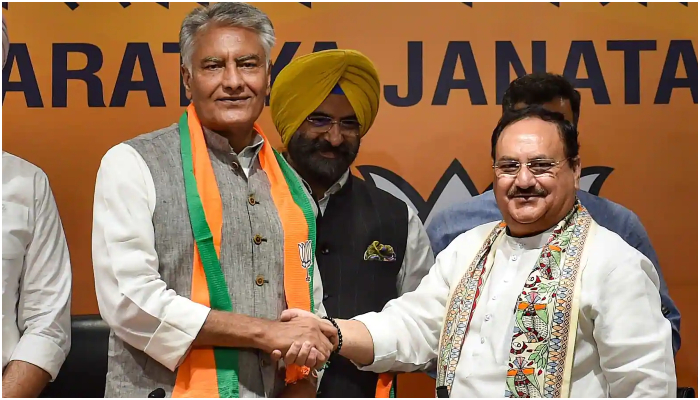
On Thursday, Sunil Jakhar, senior Congress leader and former chief of its Punjab unit formally joined the Bharatiya Janata Party days after he quit the Congress. “There is an element of casteism in the Congress but BJP has equality for all,” he said on May 19 in presence of BJP President JP Nadda.

According to the reports, Nadda officially inducted Jakhar into the party and stated that he would play a critical role for BJP in Punjab. “I welcome Sunil Jakhar to Bharatiya Janata Party. He is an experienced political leader who made a name for himself during his political career. I am confident he will play a big role in strengthening the party in Punjab”, he said.

On May 14, Jakhar had quit Congress and had said that Congress leaders sitting in Delhi were responsible for ruining the party in Punjab. In a 35 minute long Facebook Live video named ‘Dil Ki Baat’, he had urged Rahul Gandhi to retake control and had warned him to distance himself from sycophants. “Congress is facing an existential crisis. Good luck and goodbye”, he had noted.

The saga actually began on November 10, 2021, when former state Congress president Sunil Jakhar called Punjab CM Charanjit Singh Channi a ‘really compromised CM’. He also had said that CM Channi was not an asset as portrayed by the party leadership.

The Congress leadership then on April 11 issued a show-cause notice to Jakhar for ‘breaching the party discipline’. The Congress disciplinary committee also removed him from all the party posts and alleged that Jakhar was involved in some anti-party activities. The former MP May 14 also castigated Sonia Gandhi for issuing a show-cause notice despite him not holding any position in the party.

“I don’t hold any post (in the party). I have an ideology. I want to ask Sonia Gandhi that being Congress president, doesn’t she know that I hold no position in the party? Then why a show-cause notice is being given to me?”, he had said on the day he quit the Congress party.

On Thursday, while joining the BJP, Jakhar revealed that he was deliberately sidelined from Congress because he had pointed out that the party can’t treat Punjab in percentages and divides people over caste. “I had a 50-year-old relationship with Congress, my family has been with the party for three generations since 1972. I considered it family”, he said reiterating that there is an element of casteism in Congress, but BJP has equality for all. “You can remove Sunil Jakhar from a party post but can’t silence him”, he said addressing the Congress party.

The statement by Jakhar came at a time when the Congress party was holding the ‘Chintan Shivir’ in Udaipur, a last ditched attempt to relaunch itself ahead of the crucial 2024 general elections. Jakhar commenting on the ongoing mess in the Congress party had said that the ‘chintan shivir’ was merely a formality and should have been called ‘chinta shivir’, or a gathering to express concerns. “But the worry was nowhere to be seen. If there had really been a sense of worry, there would have been a committee on the party’s poor show in Uttar Pradesh,” he had said in the video message.

He had also questioned why Harish Rawat, the former chief minister of Uttarakhand, was appointed as the party in charge of Punjab. “Harish Rawat ji had one foot in Punjab and the other in Dehradun”, he had remarked. Rawat was to a considerable measure responsible for the party’s failure in Punjab, according to Jakhar, although he did not want to blame him entirely.

The former Punjab Congress head also blamed the party’s defeat on party leader and Rajya Sabha MP Ambika Soni. He accused her of leading Rahul Gandhi, the party’s leader, astray, not only in Punjab but also in other states. Jakhar claimed Soni wanted to divide Hindus and Sikhs, and questioned why she hadn’t been kicked out of the party. “There can be no resurgence of the party unless you get rid of leaders like Ambika Soni,” he had said. `

After Jakhar quit, former Punjab Congress Chief Navjot Singh Sidhu had called him an asset worth his weight in gold and had urged the grand old party not to ‘lose’ him. “The Congress should not lose Sunil Jakhar. Is an asset worth his weight in gold. Any differences can be resolved on the table”, he had tweeted.

Jakhar joining BJP is of importance as he is one of the important non-Sikh political leaders of Punjab. Reports mention that he might be sent to the Rajya Sabha from Punjab.


Apple adopts UPI for payments and subscriptions for India market, will no longer use credit and debit cards

In a recent communication with Apple product users, the company has asked them to shift to UPI or Net Banking for payments. In the mail, Apple mentioned that the step has been in the light of Reserve Bank of India’s (RBI) regulations under which the companies cannot store credit or debit card details for purchases or subscriptions.

Twitter/RMantri

The email to the customers read, “In light of upcoming Reserve Bank of India regulations, starting June 1, credit and debit cards can no longer be used for purchases or subscriptions on the App Store or other Apple services. Apple will no longer store card information on file — protecting your payment method is our top priority.”

Suggesting to shift to UPI or Net Banking, the letter further read, “To avoid interruptions to your subscriptions and other purchases, please do the following:

1. Add UPI or Net Banking as a payment method.

2. Add funds to your Apple ID balance.

Your subscriptions will continue as long as you have a sufficient balance. If you are an Apple Music, TV+, iCloud+ or third-party subscriber and we cannot renew your subscription, your subscription will automatically expire.”

The RBI regulations

The changes in the payment methods have been brought into the light by RBI regulations issued in 2020. The banking regulator had said that the e-commerce companies or subscription platforms would not be able to store the card information of the users. It asked the platforms to replace it with a card tokenization method or Card on File Tokenization (CoFT).

RBI had asked the platforms to replace each debit or credit card number with a randomized token number if the user wants to use it for recurring payments. The platforms had requested RBI to provide time to implement changes. The date was extended from January 1, 2022 to June 30, 2022.

It is noteworthy that platforms like PayTM have already implemented the change, and a few months back, it had started asking users to allow storing card information as per new guidelines. All the cards that were not allowed by the user were removed from the list available in the user’s payment information.

Europe, US on alert over detection of Monkeypox cases: What is the virus, symptoms and its transmission across the globe

The US Centers for Disease Control (CDC) and Prevention along with the Massachusetts health officials recently confirmed the first human case of Monkeypox in the US. Few cases of the virus have also been reported in the United Kingdom, Portugal and Spain. Since its advent in the 20th century, the Monkeypox virus has emerged only in Africa and parts of the west due to migration, the recent rise in cases has raised a nascent alarm worldwide.

What is Monkeypox?

Monkeypox is a rare disease that is caused by infection with the monkeypox virus. It belongs to the same family of Orthopoxvirus viruses that also includes smallpox and cowpox viruses. In 1958, two outbreaks of a pox-like disease occurred in colonies of monkeys kept for research in the Democratic republic of Congo. The Monkeypox virus was first discovered among these monkeys and thus derives its name from the same.

However, it was only in 1970 that the first human case of monkeypox was recorded in the Democratic Republic of the Congo (DRC). Since then, monkeypox has developed its transmittance among people in central and western African countries. The virus has seen a constant presence in Cameroon, the Central African Republic, Cote d’Ivoire, and the Democratic Republic of the Congo – which has reported the largest infections so far, apart from Gabon, Liberia, Nigeria, the Republic of the Congo, and Sierra Leone.

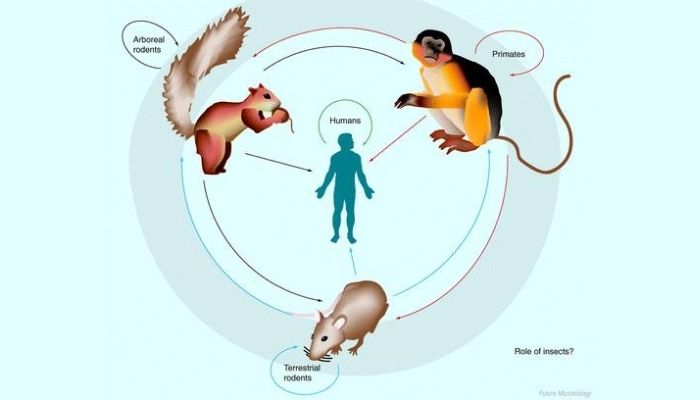
The main reason for the transmission of the disease outside Africa, according to the CDC, is international travel or the import of animals. This has led to the presence of Monkeypox cases in the US,  Israel, Singapore, and the United Kingdom. As of now, the original source of monkeypox virus culture is unknown. The researchers believe that African rodents and non-human primates like monkeys, squirrels and rats harbour the virus and infect humans as well.

What are the symptoms?

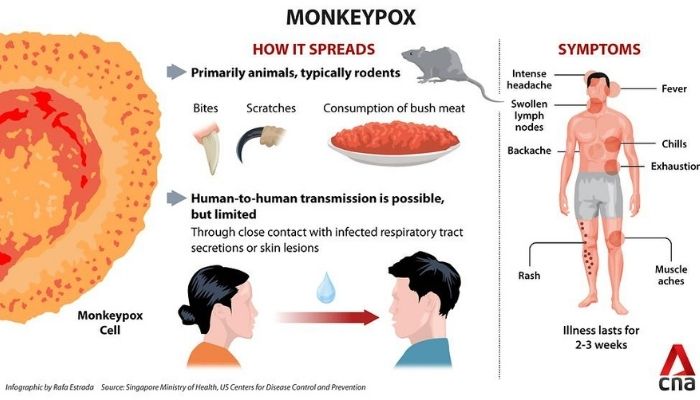
The primary symptom of Monkeypox is that the virus that causes visible bumpy rash or pox all over the body. Apart from the pox, Monkeypox can result into fever and severe body ache. Other symptoms include fever, headache, muscle rashes, swollen lymph nodes, chills and exhaustion.

Rashes in form of pox or blisters develop all over the body distinctively, that look like chickenpox or syphilis. The Rash often begins on the face and then spreads to other parts of the body including the genitals. The rash develops all over the body and goes through different stages. It finally develops into a sab and eventually falls off. Those infected with the virus show symptoms within five days and the infection generally lasts for 21 days. 

Infographic by Rafa Estrada: Singapore Ministry of Health

Fatality rate

The Monkeyvirus has two major strains, namely the fatal Congo strain with up to 10% mortality and the West African strain, which has a fatality rate of 1% in the total cases. The cases detected in the UK are of the West African strain. Australia is currently investigating its first case. Case fatality rates are found to be higher among children. WHO says that in certain recent incidents, case fatality rate has been found to be 3% to 6%.

The spread

The Monkeypox virus is contagious in a sense that it spreads through close contact. The preliminary causes from which the spread among humans was evident were spillovers from animal hosts and in between humans. While the monkeypox virus does not spread easily among people, the cases in which transmission has occurred, has been generally through contact with the body fluids, blood, monkeypox sores, and items that have been contaminated with fluids or sores of patients.

The Spread of Monkeypox. Source: Medicine Future

Scientists have observed that the virus can also spread through respiratory droplets following a prolonged physical contact. Thus, Monkeypox can enter the body through broken skin, respiratory tract, or through sensory organs like nose, eyes and mouth.

According to the UK Health Security Agency (UKHSA), people without symptoms of Monkeypox are not considered infectious. However, the agency had advised that on a precautionary basis, those who have been in close proximity of the infected patients should to ensure that if they become unwell with the primary symptoms, they should contact the doctor immediately.

The current situation

Today, Health officials in Massachusetts have detected a monkeypox infection in a man who has been hospitalized, but maintains a good condition. Reportedly, the infected man recently returned from Canada while his close contacts are already being traced. Amidst the growing outbreak of monkeypox worldwide, 14 confirmed cases have emerged from Europe so far across the UK, Spain and Portugal. Meanwhile, 24 others are also being probed for infection.

With the first confirmed case of Monkeypox in US, the health department has alerted the nation and is further investigating 6 other cases for the said infection. According to Dr Jennifer McQuiston, a senior official at USA’s CDC, a number of cases have been detected among gay and bisexual men considering the high probability of regular skin contact among the community.

“I think our concern is that given that you do have four cases among men who have sex with men, that we probably need to be thinking about messaging to our STI clinics, about what to be on the lookout for, what to be alert for,” McQuiston said. The CDC is individually monitoring more than 200 individuals for the virus in 27 states and other countries. While the US thinks its travel links with the UK has developed hidden transmission links, In Britain, only one case has travel links back to Nigeria which was the first case reported in the country.

As on May 16, the total tally of Monkeypox cases in the UK was seven. In Europe, Portugal itself has spotted five cases of the virus and is probing 15 cases. Infections in Portugal are found mostly among young men. The Health department in Spain is probing eight people of who all are either gay or bisexual men. Mateo Prochazka, an STI expert and head of UKHSA team has claimed the pattern of spread is highly suggestive of spread in sexual networks.

The Cure

Jynneos, a vaccine registered in the US has been licensed to prevent monkeypox infections in the country. Doctors have suggested that given the virus’ similarity to smallpox, the jabs and drugs against it are also effective.

As Subramanian Swamy targets Modi govt for not repealing Places of Worship Act, read how he had supported it in parliament while BJP had opposed

With the discovery of a Shivling and several other Hindu idols and symbols inside the disputed structure of Ghanvapi mosque in Varanasi, the debate over the legitimacy of the Places of Worship (Special Provisions) Act, 1991 has again taken the centre stage. As Hindu organisations increase efforts to reclaim ancient Hindu temples destroyed and replaced with mosques by Muslim invaders, demands to repeal the controversial act has gained momentum.

Disgruntled BJP leader and former Rajya Sabha MP Subramanian Swamy, who these days does not leave an opportunity to attack the Modi govt, today decided to use the act to criticise the BJP govt at the centre. In a tweet, he commented that “Even after 8 years as PM with absolute majority in Lok Sabha and de facto majority in Rajya Sabha, Modi has failed to withdraw the 1991 Places of Worship Act by moving Parliament for its deletion. It was expected of him.”

For last few years the controversial politician has been opposing the Places of Worship Act, last year he had even filed a petition at the Supreme Court of India against the act. He had filed the plea challenging the constitutional validity of the act enacted by the PV Narasimha Rao government in 1991.

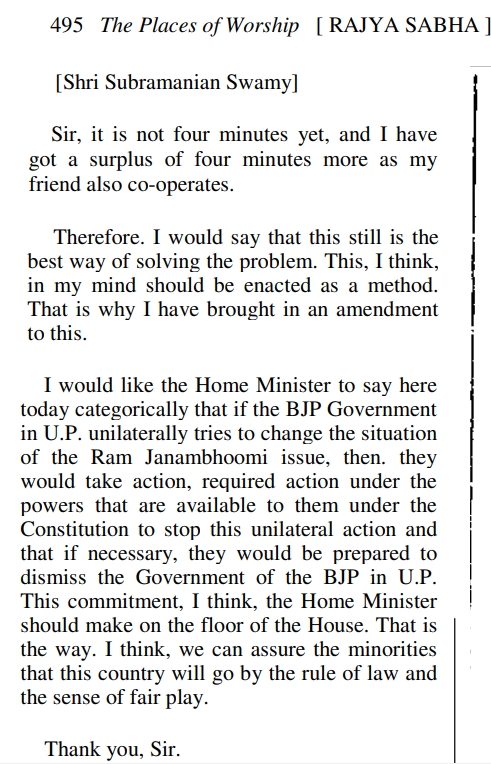
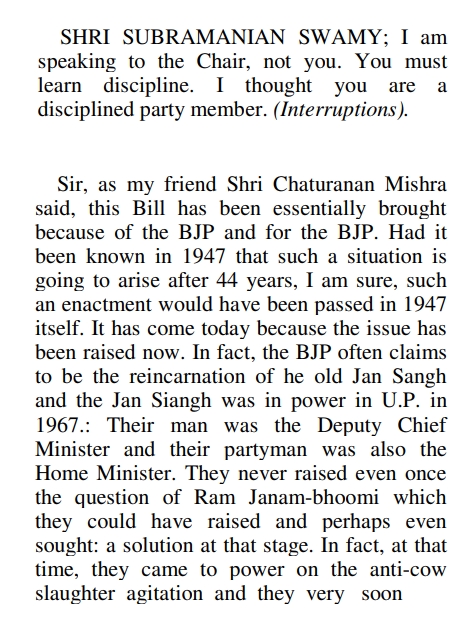
However, his recent stand on the act is a massive U-turn, because before the act was passed by the parliament, Subramanian Swamy had enthusiastically supported the bill. During the debate on the bill in Rajya Sabha on 12 September 1991, he had said that this was the best way of solving the problem. The problem was, the Ram Janmabhoomi movement across the country at that time.

Screenshot from Rajya Sabha debate text

Supporting the bill and insisting that the Babri structure must be preserved as a mosque, Subramanian Swamy had even suggested that the central government should take action if the BJP govt in Uttar Pradesh tries to change the situation of the Ram Janmabhoomi issue. “If necessary, they would be prepared to dismiss the Government of the BJP in U.P.” he had added in his address in Rajya Sabha.

Screenshot from Rajya Sabha debate text

Blaming the BJP and the Ram Mandir movement for the act, Swamy had said, “This Bill has been essentially brought because of the BJP and for the BJP. Had it been known in 1947 that such a situation is going to arise after 44 years, I am sure, such an enactment would have been passed in 1947 itself.”

During the debate, Swamy had claimed that ‘idols and the pictures were brought into the Babri structure in a sneaky manner’, and had claimed that there was never any Ram Mandir at that site.

While Swamy criticised BJP for not repealing the act he had supported, the party had strongly objected to the bill inside and outside the parliament. BJP leader Uma Bharti had led the party’s objection to the bill during the debate in parliament, saying that the matter of religious places can’t be settled in courts.

Objecting to locking the status of religious places as on 15th August 1947 under the Places of Worship Act, she Uma Bharti had said that the provision was pigeons closing their eyes to advancing cats. “This maintenance of status-quo of 1947 will mean preservation of tension for the coming generations”, the BJP leader had correctly predicted in her speech.

Interestingly, during her speech, Uma Bharti had commented on Gyanvapi, and had said that the Aurangzeb had deliberately kept some part of the ancient Kashi Vishwanath temple in the disputed structure of the mosque, to remind Hindus about their fate. “Was not the intention of Aurangzeb behind leaving remnants of the temple at the site of the mosque, to keep reminding Hindus of their historical fate and to remind coming generations of Muslims of their past glory and power?” she had said.

It is true that after coming to power, BJP could have taken steps to repeal the act the party had opposed when it was passed three decades ago. While ordinary citizens, especially Hindus who want restoration of ancient Hindu temples, can complain about BJP not taking any step in this regard in the last eight years, Subramaniam Swamy lacks any moral authority to criticise BJP over the matter. Swamy had completely supported bill as seen in parliamentary records, and he had also objected to the Ram Mandir movement. Therefore, he can’t be taken seriously when he opposes the Act now.

‘Adhai Din Ka Jhonpra’: Ajmer’s oldest mosque stands over the ruins of a Sanskrit pathshala with Hindu and Jain temple features

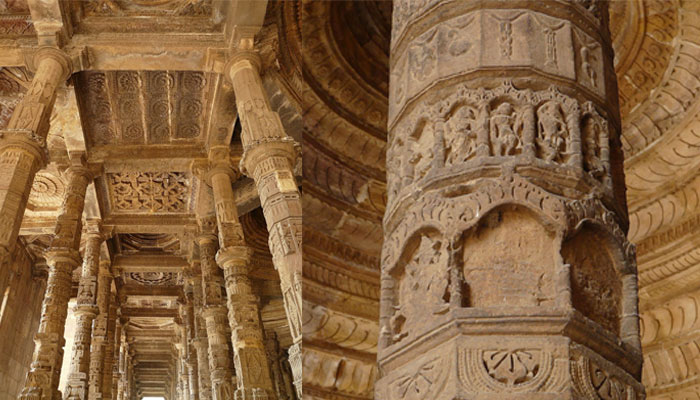
The rich culture of Indian civilization was destroyed by the Islamic invaders for centuries. One of the oldest examples of the atrocities that were faced in the hands of Mughals is Adhai Din Ka Jhonpra, which literally means ‘Shed of two and half days. In the city of Ajmer, Rajasthan, the mosque ‘Adhai Din Ka Jhonpra’ stands tall under the supervision of the Archaeological Survey of India (ASI).

Though it is visited by hundreds of tourists, the structure is still used by Muslims for Namaz. To understand how it is clear evidence of Islamic atrocities, it is essential to tell its story and what one may find on visiting the site.

History of Adhai Din Ka Jhonpra

Originally a magnificent Sanskrit College (Saraswati Kanthabharan Mahavidyalay) with a temple dedicated to Mata Saraswati, the Hindu Goddess of Knowledge and Wisdom, the building was commissioned by Maharaja Vigraharaja IV. He was a king of the Shakambhari Chahamana or Chauhan dynasty.

As per several documents, the original building was square-shaped. It had a tower at each corner. There was a temple of Mata Sarawati on the western side of the building. In the 19th century, a tablet was found at the site that dated back to 1153 CE. Experts believe that based on the tablet, it can be inferred that the original building was constructed sometime around 1153.

Some local Jain legends, however, state that the building was commissioned by Seth Viramdeva Kala in 660 CE. It was constructed as a Jain Shrine and celebrated Panch Kalyanaka. It is noteworthy that the site has elements of both Jain and Hindu architecture of that time.

The conversion into a mosque

As the story goes, in 1192 CE, Muhammad Ghori defeated Maharaja Prithviraj Chouhan and took over Ajmer. He ordered his slave general Qutb-ud-Din-Aibak to destroy temples in the city. The legend said he had ordered Aibak to construct a prayer section of the mosque on the temple site within 60 hours so that he could pray. That attributes to the name ‘Adhai Din Ka Jhonpra’. However, some experts believe that it was just a legend, and it took several years to complete the construction of the mosque. The name, according to them, came from the two-and-a-half-day fare that takes place in the mosque every year.

There is an inscription at the central mihrab of the mosque that mentions the date of completion as Jumada II 595 AH that converts to April 1199 CE of the English calendar. Later, Qutb-ud-Din-Aibak’s successor Iltutmish beautified the mosque in 1213 CE. He added a screen wall in the mosque. There is an inscription of his name on the northern minaret along with the construction supervisor Ahmed ibn Muhammad al-Arid’s name on the south arch.

Notably, it is not easy to differentiate which part of the mosque was originally a Saraswati Temple and Sanskrit School as ruins from around 25-30 Hindu and Jain temples were used in the construction of the mosque.

Sita Ram Goel’s report on the mosque

Famous Historian Sita Ram Goel mentioned the mosque in his book ‘Hindu Temples: What Happened To Them’. He attributed to the book ‘Asar-Us-Sanadid’ by author Syed Ahmad Khan in which he had mentioned that the mosque of Ajmer, i.e. Adhai Din Ka Jhonpra, was constructed using the materials from Hindu temples.

Alexander Cunningham’s report on the mosque

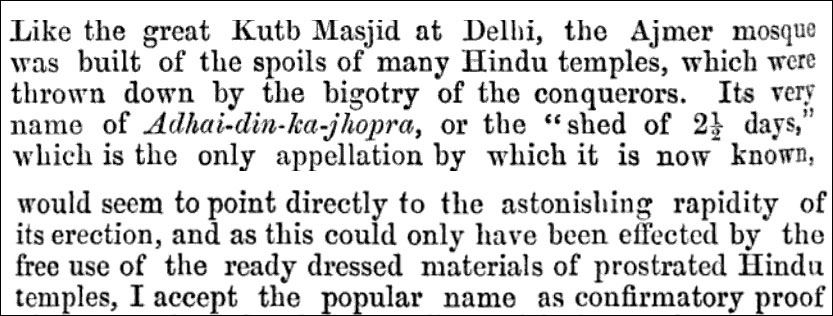
Alexander Cunningham, who was commissioned as Director-General of ASI in 1871, presented a detailed account of the mosque in ‘Four Reports Made During the Years, 1862-63-64-65’. He mentioned that upon inspecting the site, he found that it was built with the ruins of many Hindu temples. He said, “Its very name ‘Adhai Din Ka Jhopra would seem to point directly to the astonishing rapidity of its erection, and as this could only have been affected by the free use of the ready dressed materials of prostrated Hindu temples.”

Four Reports Made During the Years, 1862-63-64-65, Volume 2 By Alexander Cunningham/Google Books

Cunningham further attributed James Tod, a Lieutenant-Colonel of the British empire who had visited the mosque, in the report. Tod had said that the whole building could have been originally a Jain Temple. However, he also found many pillars with four-handed figures on them that could not have been Jain by nature. Beside those sculptures, there was a single figure of Goddess Kali.

Four Reports Made During the Years, 1862-63-64-65, Volume 2 By Alexander Cunningham/Google Books

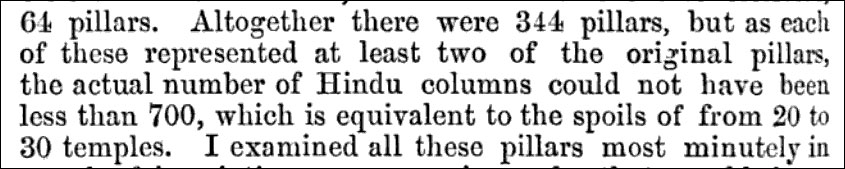
He added, “Altogether, there were 344 pillars, but each of these represented at least two of the original pillars. The actual number of Hindu columns could not have been less than 700, which is equivalent to the spoils of from 20 to 30 temples.”

Four Reports Made During the Years, 1862-63-64-65, Volume 2 By Alexander Cunningham/Google Books

‘Conservation’ of Hindu sculptures

As per reports, till the 1990s, there were several ancient Hindu sculptures scattered inside the mosque. In the 90s, the ASI moved them to a secure location to preserve them. How the sculptures were preserved was explained by a Twitter user who recently visited the place.

In a tweet thread, Twitter user Dharmik Stance clicked a few photographs of a closed room inside the premises. He said, “Some rooms have been sealed by ASI on the premises. Have a look at what I saw from the cracks.” The photographs and video added by the Twitter user show the sorry state of the ancient sculptures inside those rooms.

The video and photographs were clicked in March 2022. Upon zooming the photographs, one can clearly see the sculptures of Hindu origin. One of the stones in the room can be seen marked by ASI as AJR5 AJP/92/99.

Other mentions by netizens

In 2015, the popular handle ‘Reclaim Temples’ posted about the mosque and wrote, “Adhai Din Ka Jhonpra, Ajmer was a magnificent Jain temple, until Islamic invader Ghori converted it into a Masjid.”

Another Twitter user neutr0nium published a thread on the mosque. He mentioned that it was ignored for a long time after conversion into a mosque and renovated by Maratha king Daulat Rao Sindhia in the 18th century. However, it remained a mosque. In 1947, ASI took control of the site.

He mentioned that the site does not have any information boards placed by ASI explaining its history. He said, “ASI board just stats that it’s a mosque constructed by Qutubdin and the oldest surviving monument of AJMER.” It is unfortunate that despite being clearly a site that was previously a Sanskrit School and a Hindu and Jain temple, ASI failed to mention the history anywhere at the site and attributed it just to a mosque.

Author Sanjay Dixit wrote, “Adhai Din Ka Jhonpra mosque in Ajmer is an early instance of demolition of temples. Built at the instance of the Sufi saint Moinuddin Chishti, allegedly peaceful and secular, by razing a temple of goddess Sarasvati and a Vidyapeeth by Qutubuddin Aibak after Prithviraj’s defeat.”

The painful history of Hindu temples razed to build mosques

There are thousands of sites across India where mosques and other Muslim structures were built after destroying temples. These structures were built using temple materials and/or stand on temple sites. Babri Mosque (handed back to Hindus to build Bhavya Ram Mandir), Gyanvapi Mosque (disputed structure in Varanasi), and Shahi Idgah (disputed structure of Mathura residing inside Krishna Temple complex) are some of the prime examples. Historian Sita Ram Goel has documented around 1,800 such sites in his book Hindu Temples: What Happened To Them. A brief about the book can be read here.

‘Bhagwan Sri Krishna Virajman’: Mathura district court reverses civil court order, allows petition seeking removal Shahi Idgah disputed structure

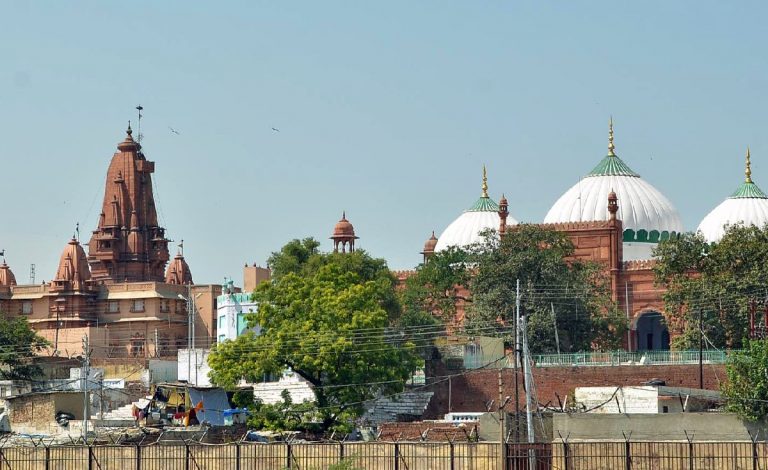
Coming as a major development in the Shri Krishna Janmabhoomi-Shahi Idgah mosque case, a Mathura court Thursday allowed the plea to remove the disputed structure of the Shahi Idgah Mosque near Krishna Janmabhoomi for hearing. Lucknow resident Ranjana Agnihotri had filed the lawsuit as the “next friend of the infant Lord Krishna” of the Keshav Dev temple.

The suit had been filed in the name of Bhagwan Sri Krishna Virajman. The civil court in Mathura had on September 30, 2021, dismissed a lawsuit filed asking for the removal of the Shahi Idgah mosque and transferring the 13.37 acres of land to Bhagwan Sri Krishna Virajman. With today’s order, the plea by Ranjana Agnihotri can be restored.

According to reports, the Court ruled that the suit to remove the Mathura Shahi Idgah Mosque is maintainable on the ground that it was built over the Krishna Janmbhoomi land. The matter has been sent back to the civil court to be heard on merits.

On May 16, after a Shivling was unearthed in the disputed Gyanvapi structure in Kashi, a plea was filed in a Mathura court, requesting that the Shahi Idgah Masjid be sealed and that security be deployed to protect Hindu sacred artefacts from being vandalised.

Advocate Mahendra Pratap Singh, who represents five claimants in the Krishna Janmabhoomi-Shahi Idgah Masjid lawsuit, had referenced the retrieval of the Shivling from the Gyanvapi mosque in his appeal.

In his appeal, advocate Mahendra Pratap Singh argued that there are remnants of Lotus, Sheshnag, Om, Swastik, and other Hindu religious symbols in the actual sanctum sanctorum. He added that some of them have already been destroyed, and the defendants are currently attempting to vandalise the others.

He stated that if the evidence is eliminated, the basis for the dispute would be lost, and the petitioners will suffer tremendous damage. As a result, he asked the court to prohibit individuals from visiting the mosque property.

In another key development pertaining to the Shri Krishna Janmabhoomi-Shahi Idgah Mosque dispute, the court had agreed to hear a plea seeking videography of the disputed Shahi Idgah mosque. Notably, after the Varanasi court ordered a day-to-day survey of the disputed structure Gyanvapi Masjid, a similar application has been filed in the court of civil judge (senior division) in Mathura on Friday seeking the appointment of a commissioner to survey the structure, Shahi Idgah masjid, built on Sri Krishna Janmabhoomi.

Notably, on May 5, the Mathura court had also reserved its verdict in the Shri Krishna Janmabhoomi – Shahi Idgah Mosque dispute case of Mathura and said that the case would be decided on 19th May 2022. A petition had been filed in a Mathura court seeking ownership of 13.37 acres of land of Shri Krishna Janmabhoomi, which also sought removal of the Shahi Idgah Mosque built in Shri Krishna Janmabhoomi.

In the recent past, there has been a growing demand among Hindus to reclaim Kashi and Mathura, along with Ayodhya. Taking back the Muslim-occupied sites of Kashi Vishwanath temple and Krishna Janmabhoomi temple at Mathura has now become a priority for various Hindu groups in the country.

Krishna Janmabhoomi land dispute case

According to the petitioners, a part of the Shri Krishna Janmabhoomi temple which was spread on 13.37 acres of land was demolished and the Shahi Idgah mosque was constructed. They have demanded the removal of the mosque and the return of the land for the temple.

In the case of Shri Krishna Janmabhoomi and Shahi Idgah dispute, nine cases have been filed in the Mathura court so far.

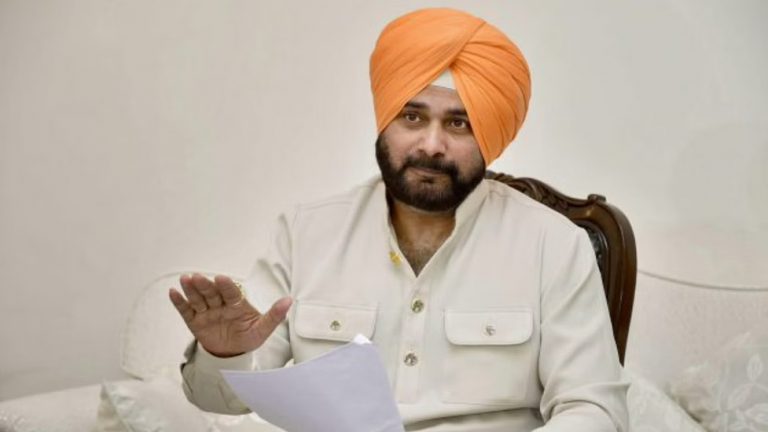
Supreme Court awards one-year jail term to Congress leader Navjot Singh Sidhu in 1988 road rage case

In a big blow to Congress leader and former cricket Navjot Singh Sidhu, the Supreme Court of India today sentenced him to one year of imprisonment for a 1987 road rage case. The apex court overturned its 2018 judgement reducing the punishment for Sidhu in the case, after a review petition was filed by the family of Gurnam Singh, the victim who had died in the incident in 1988.

In 2018, a Supreme Court bench of Justice J Chelameshwar (retired) and Justice SK Kaul had ruled that the offence of Sidhu didn’t amount to Culpable Homicide not amounting to murder, and had let him go with just a fine of Rs 1000, reducing the sentence from 3 years imprisonment imposed by the High Court.

Accepting the review petition by the family of Gurnam Singh, a Supreme Court bench of Justices A. M. Khanwilkar and Sanjay Kishan Kaul has now sent Sidhu to jail for one year. The bench said, “We have allowed review application on the issue of sentence. In addition to fine imposed, we impose a sentence of imprisonment of one year to be undergone by respondent 1”.

The court had reserved its verdict in the case in March this year.

Saying that Sidhu had knowingly caused the death, the bench said, “The material on record leads us to the only possible conclusion that we can reach that the first accused voluntarily caused hurt to Gurnam Singh punishable under Section 323 IPC”.

On December 27 1988, Sidhu and one of his friends had beaten Patiala resident Gurnam Singh for allegedly blocking his vehicle. While Gurnam Singh was taken to a hospital, he was declared dead. Sidhu and his friend Rupinder Singh Sandhu were booked in the case.

In 1999, the Patiala district and sessions court had acquitted them citing lack of evidence. The state govt had appealed against it, and the Punjab and Haryana High Court found them guilty in 2006, and had awarded three-year jail term. In 2007, the Supreme Court had stayed the conviction on Sidhu’s appeal, and in 2018, the apex court had reduced the term to Rs 1000 fine, while Sandhu was acquitted.

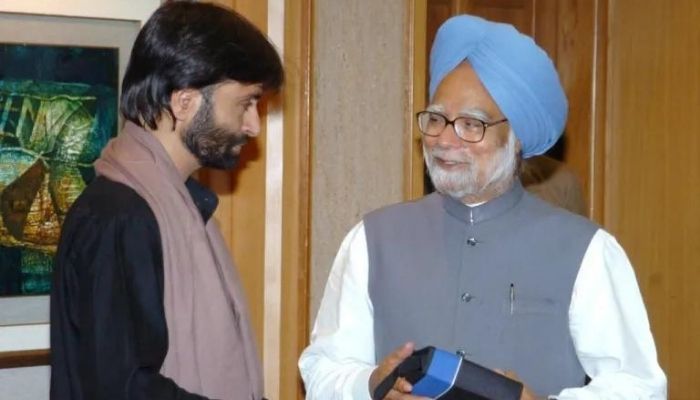
Yasin Malik convicted by special NIA court for terror funding activities in Jammu and Kashmir, charged under UAPA

Kashmiri separatist terrorist Yasin Malik has been found guilty in a terror funding case. While convicting Malik, the NIA court has stated that the quantum of punishment in the case will be decided on 25th May 2022. Malik had pleaded guilty earlier in the case, admitting that he has been associated with terror funding activities in Jammu and Kashmir.

On 10th May 2022, Yasin Malik pleaded guilty to all charges, including those under the stringent Unlawful Activities and Prevention Act (UAPA), before a Delhi Court in a case related to terrorism and secessionist activities in Jammu and Kashmir that convulsed the Valley in 2017. Yasin Malik had admitted that he was involved in terrorist activities, had also hatched criminal conspiracies, and that the sedition clauses against him were also correct.

Yasin Malik told the court that he did not wish to challenge the charges against himself under Sections 16 (terrorist activity), 17 (raising funds for terrorist activities), 18 (conspiring to commit terrorist activity), 18 (conspiring to commit a terrorist act), and 20 (being a member of a terrorist group or organization) of the UAPA and sections 120-B (criminal conspiracy) and 124-A (sedition) of the Indian Penal Code.

Under the sections under which a case is registered against Yasin, he can get a maximum punishment of lifelong imprisonment. Yasin Malik has been active in Kashmir politics. He is one of the key instigators and secessionist leaders in the Kashmir valley.

Malik is in jail since 2019 as a part of the crackdown against the anti-India and secessionist elements in the Valley in the aftermath of the Pulwama attack. He was later remanded to the NIA custody and was shifted to Delhi’s Tihar jail from Jammu’s Kot Balwal jail.

He is the chief of the Jammu and Kashmir Liberation Front (JKLF), an outfit that was banned shortly after the Pulwama terror attack.

Malik is also accused of kidnapping former Union Home Minister Mufti Mohammed Saeed’s daughter Rubiya Saeed in 1989 and of killing 5 IAF personnel in early 1990. He is also allegedly involved in the killing of Justice Neelkanth Ganju, the judge who had ordered the death sentence for JKLF terrorist Maqbool Bhatt, and the murder of the former director of Doordarshan Kendra in Srinagar, Lassa Kaul.

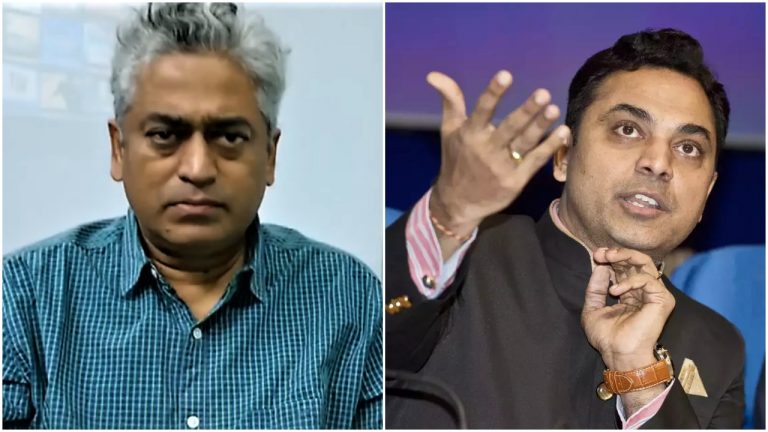
Former CEA Dr KV Subramanian schools Rajdeep Sardesai for negative portrayal of India’s macroeconomic situation, cites inflation numbers

India Today news anchor Rajdeep Sardesai, who has a rich history of facing humiliation on live television, had to confront a similarly embarrassing situation on Wednesday after former Chief Economic Adviser to the Government of India KV Subramanian schooled him for cherry-picking specific data sets to portray India’s macroeconomic situation in a negative shade.

On Wednesday, Rajdeep Sardesai hosted former CEA and economist Dr KV Subramanian on his show to discuss the Indian macroeconomic situation amidst the ongoing global economic crisis that emanated from the Ukraine-Russia war.

Discussing the issue of rising inflation in the last few weeks, Rajdeep Sardesai claimed that the inflation rates have skyrocketed in the previous 13 months and asked whether it was due to global factors or if something was wrong with the policies of the government. However, instead of citing the Consumer Price Index data, the global benchmark index to measure inflation, Rajdeep Sardesai put out the Wholesale Price Index data to fearmonger about the price rise.

However, former CEA Dr Subrmanian was quick to politely correct the controversial news anchor saying it was incorrect to cite WPI data to suggest that the inflation was high in the country. Citing the data, Dr Subramanian said that the CPI is very much controlled in India compared to advanced economies. He also pointed out how CPI was at around 6 per cent in December, compared to 7.5 per cent at present, an increase that is not that substantial compared to the advanced economies.

Dr Subramanian also noted that the inflation rate in the United States is at a 40-year-high of 8.5 per cent, which traditionally has 2 per cent inflation. He also put out similar facts pertaining to the inflation rates in advanced economies such as the United Kingdom, where inflation is at a 30-year-high and in Germany, where the rates have spiked to a 26-year high.

According to the former CEA, the expansionary monetary and fiscal policy in these economies post-Covid pandemic was one of the major reasons for the high inflation, which added to the ongoing Russia-Ukraine crisis. He suggested that such global factors have been majorly responsible for the rise in the inflation rates, contrary to the claims put out by Rajdeep Sardesai that the inflation spike is due to the local factors and policies of the Modi government.

Dr Subramanian clarified to the viewers saying that the retail inflation is basically in food and energy, especially in pulses and edible oils. He suggested that the factors such as a ban on the export of palm oil by Indonesia and the supply side glut in the wheat market due to the war in Ukraine, a major producer of wheat, as the causes responsible for the sudden spike in retail inflation, which is measured through CPI in the country.

He repeatedly stressed that the global factors are causing the rise in price values of certain commodities as against the perception portrayed by Rajdeep Sardesai that it is more intrinsic. However, Rajdeep Sardesai continued to pin the blame on the government for the inflation rates spike, leaving the economist infuriated.

“I have done interviews with you over the last several years; you tend to focus only on the negatives even when there are many positives. The current inflation is primarily due to global factors,” quipped Subramanian as he stressed the fact that India was the only country in the world that was successfully managing the supply-side shock. The economist also stressed that there are global factors over which India has no control.

As Rajdeep Sardesai kept persisting that macroeconomic fundamentals were in bad shape and demanded the host to provide some good news about the economic growth, Dr Subramanian put out data to show how the economic situation in the country during the UPA rule had deteriorated compared to the strong fundamentals during the Modi era.

“During the global financial crisis, Rupee had depreciated by 56 per cent, retail inflation was in double digits for over 18 months, the fiscal deficit was 2.5 times more than the peer economies, the Current Account Deficit was at 6 per cent, and we were in fragile five. In contrast, what have we delivered is a fiscal deficit at 90 per cent of the peer economies and a Current Account Surplus. So how much good news do I need to give you so that you stop portraying in a negative manner in the last six-seven years?” Dr KV Subramanian schooled Rajdeep Sardesai.

The former CEA also cautioned the viewers about the negative portrayal of the Indian economic situation and added that the prices of commodities have eased up in the last few days and added that the global factors contributing to the higher inflation would eventually start to ease out, giving some relief.

Yet again, Rajdeep Sardesai picked up selective data on foreign exchange reserves to suggest that there was a decline in the reserves in the last few months. Responding to cherry-picking of the data, Dr Subramanian once again schooled Rajdeep Sardesai, asking him to focus on the fact that the foreign exchange reserves are at a historic high.

The former Chief Economic Advisor also assured that the macro-economy has done really well in the recent weeks and added that these are external shocks, when they ease-out, the situation will be better.

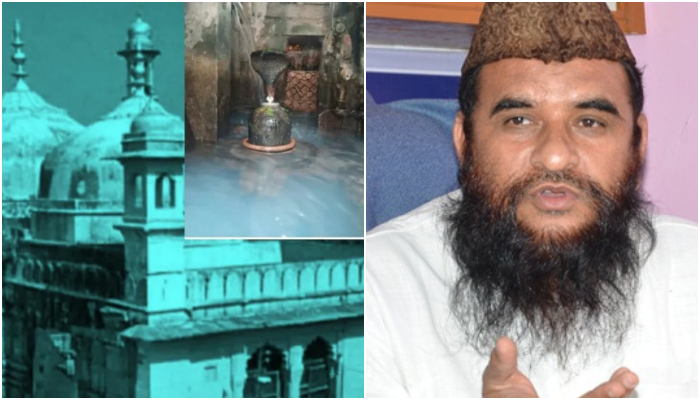
‘Hinduism is no religion’: Says Maulana Sajid Rashidi, justifies social media mockery of Shivling in Gyanvapi case

Adding harsh, invalid, and distorted ‘facts’ to the ongoing Gyanvapi-Shivling row, Maulana Sajid Rashidi, the President of All India Imam Association, on May 19 stated that the Hindu religion is no religion in the first place and that people were unnecessarily being happy over the Shivling discovered in the disputed structure of Gyanvapi Masjid. He blatantly termed the Shivling as a ‘fountain’ and made several attempts to demean the Hindu culture and belief.

In an exclusive interview with activist Amber Zaidi, the Maulana accused the judiciary of issuing a biased order in favour of Hindus. “No court in India has the right to interfere in the religious places existing since the year 1947 and no court can allow petitions that defy the Places of Worship Act. In this case, the court allowed the petition, allowed a videography survey, and has now interfered in the religious practices of mosques by barring entry of Muslims in Wuzukhana. Wuzu is the most important part of Namaz and Court is responsible for ruining the Islamic religious practice here”, he alleged.

Maulana Sajid Rashidi also criticised the Supreme Court and Justice Ranjan Gogoi for delivering the Ayodhya verdict in favor of Hindus. He said that the Court did not deliver the judgment on the facts, it used the special powers and gave away the land to Shri Ram Janmabhoomi Teerth Kshetra. “The decision was biased. Gogoi had his eyes on Rajya Sabha then. The decision was not based on the ASI survey or other relevant facts”, he alleged.

He also added that the Gyanvapi Masjid has been in existence since the rule of Mughal Emperor Akbar and was not built by Aurangzeb by demolishing a temple. “No temple was demolished. There is no Shivling there. The structure recently discovered is part of an old fountain and not a Shivling”, he claimed. Supporting his belief, he said further, “Why would older Islamic rulers act so dumb to destroy the temple and preserve the Shivling for more than 100 years? If they had plans to destroy the temples, why would they keep the Shivling!”.

When activist Amber Zaidi asked ‘why were people from the Muslim community mocking the Shivling and hurting the religious sentiments of Hindus over social media’, Maulana Rashidi claimed that Hindus had themselves attracted the mockery. “Calling fountain a Shivling is in itself a big joke. Why won’t people make fun of it? They (Hindus) should understand that every dome-shaped structure cannot be a Shivling”, he said blatantly reiterating that Hinduism was never a religion. (Time stamp: 17.10)

Maulana Rashidi’s warning Hindus in past-

Maulana Sajid Rashidi is known for his ‘scholarly’ opinions that mostly are anti-hindu and difficult for the civic society to acknowledge. On January 8, he had passed several warnings that Ayodhya’s Ram Mandir might be demolished by some Mohammad Bin Qasim in future. He had tried to articulate mythical fantasy that leftists in India continue to peddle in order to whitewash the crimes of tyrannical Muslim rulers who invaded India.

Rashidi had said that Muslim kings who ruled India in the past were benevolent and secular rulers, who not only built mosques for their Muslim subjects but also built temples and generously donated for the upkeep of existing Hindu religious places. He had made similar controversial remarks during the Bhumi pujan of the Ram Temple in August 2020.

He had then said that a mosque will be rebuilt after demolishing the Ram Mandir. He also had claimed that Prime Minister Modi had ‘violated the constitution’ by visiting the Ayodhya temple event. A complaint was later filed against the Islamic cleric for making provocative statements against Hindus and for issuing threats to demolish the under-construction Ram Mandir at Ayodhya.

Shivling found in disputed Gyanvapi structure-

A court-monitored survey of the disputed Gyanvapi structure found a Shivling inside the Wuzukhana of the mosque. The Wuzukhana is a place inside a mosque where Muslims wash their hands and feet before offering namaz. The apex court on Tuesday issued orders to protect the site from where the Shivling was discovered from the disputed structure. The order also denies entry of Muslims in Wuzukhana, disallowing washing of their feet and spitting on the Shivling. Supreme Court however also maintains that the order in any manner should not restrict or impede the right of the Muslims to use the Mosque for religious purposes.