Home Blog Page 3423

Indian government initiates evacuation from war-torn Ukraine through Romania, 470 students brought back home so far: Details

On Friday (February 25), the Indian government successfully evacuated 470 Indian students from war-torn Ukraine through the Romanian border. Despite multiple advisories by the government to Indians to leave Ukraine in the lead-up to the full-scale invasion by Russia, about 18000 students are still stranded in the Eastern European country.

As per reports, the first batch of 470 Indian students boarded a bus from the city of Chernivtsi to the Porubne-Siret border. Officials belonging to the Ministry of External Affairs (MEA) thereafter facilitated their travel from the Siret in Suceava County to the Romanian city of Bucharest for their onward journey to India.

In a tweet on Friday, the Indian embassy in Kyiv had informed, “Today afternoon more than 470 students will exit Ukraine and enter Romania through the Porubne-Siret border. We are moving Indians located at the border to neighbouring countries for onward evacuation. Efforts are underway to relocate Indians coming from the hinterland.”

It further informed that the evacuation process was organised in close coordination with Indian embassies in Romania, Poland and Hungary. On Friday, MEA spokesperson Arindam Bagchi had also shared a video of Indian students after they were evacuated from Ukraine to the neighbouring country.

Air India to operate flights to Hungary, Romania on February 26

Reportedly, the Indian Ministry of External Affairs is also making preparations to evacuate stranded students through the Poland-Ukraine border. Moreover, Air India will operate flights between Delhi and Mumbai to Bucharest in Romania and Budapest in Hungary on Saturday (February 26) to facilitate the evacuation process to India.

Earlier this week, Air India evacuated 242 Indians from Ukraine. On Thursday, one Air India flight to Kyiv was returned back, following the Russian invasion of Ukraine. Meanwhile, the Indian Civil Aviation Ministry had written to airline companies to resume flights from India to countries that share a land border with Ukraine.

Indian Embassy in Kyiv issues new advisory to Indian nationals

On Saturday, the Indian embassy in Kyiv issued a new advisory to students and other Indian nationals, currently stranded in Ukraine. “All Indian Citizens in Ukraine are advised to not move to any of the border posts without prior coordination with Government of India officials at the border posts (helpline numbers established) and the Emergency numbers of Embassy of India, Kyiv,” it said.

“The situation at various border checkpoints is sensitive and the Embassy is working continuously with our Embassies in our neighbouring countries for coordinated evacuation of our citizens. Embassy is finding it increasingly difficult to help the crossing of those Indian nationals who reach border checkpoints without prior Intimation,” read the advisory.

Screengrab of the new advisory by Indian embassy

The Indian embassy pointed out that staying in Western Ukraine is relatively safer compared to reaching border checkpoints, without prior knowledge of the situation. It concluded, “All those currently in the Eastern sector are requested to continue to remain in their current places of residence until further instructions, maintain calm, and stay indoors or in shelters as much as possible, with whatever food, water and amenities available and remain patient. Avoid unnecessary movement.”

MEA spokesperson Arindam Bagchi also apprised stranded Indian nationals in Ukraine about the teams assisting them in the war-torn country and in neighbouring border nations.

According to a report by the Republic World, the Union Minister of State for External Affairs V Muraleedharan has informed, “The MEA is taking steps to bring back about 18,000 Indians including students from Ukraine. As the air space in Ukraine is closed, alternative arrangements are being made for the evacuation of Indian nationals. The central government will ensure the safety of all Indians.”

He further added, “I spoke to Malayali students in Ukraine on phone. Indian students in the southern areas of Ukraine have told us that they are getting food, water, and power. Students and parents should not panic. Our government has brought back Indians even from places like Iraq.”

‘India is evacuating students stuck in Ukraine but Pakistan is not doing anything’: Pakistani students

Pakistani students stuck in Ukraine have lamented their government’s indifference to their predicament amidst an escalating military offence carried out by the Russian forces. They have alleged that while India is actively evacuating its students in Ukraine via Hungary, the Pakistani government is doing little to rescue stranded Pakistanis.

“There is a lot of bombing and military operations going on here and that’s why we want the Pakistani government to provide us security and a passage to safer places…because we are seeing that the Indians are rescuing their stranded students through the Hungary border. They are getting the Hungary border opened to rescue students stuck in Ukraine but no such measure is taken by the Pakistani government,” said a Pakistani student while talking to the ARY News channel.

St. Stephen’s College’s Gender studies Cell releases abusive statement, opposes invite to SC lawyer J Sai Deepak by leadership cell

On February 25, 2020, Supreme Court lawyer J Sai Deepak confirmed on Twitter that Delhi’s St. Stephen’s College’s Gender Studies Cell has ‘vehemently opposed’ the invitation extended to him by the college’s leadership cell to speak about his new book, India that is Bharat – Coloniality, Civilization, and Constitution.

In a Tweet thread, the Supreme Court advocate J Sai Deepak shared screenshots of the despicable post written by the students of the Gender Studies cell of St. Stephen’s College against him, while opposing the invitation extended to him by another department of the same college.

He Tweeted, “Free speech. Diversity of ideas. Toleration. Inclusion. Gender Studies cell of St. Stephen’s College. Vande Mataram,” while sharing the screenshots of the post shared by students of the Gender Studies cell of St. Stephen’s College.

In the statement, the students of the Gender Studies cell of St. Stephen’s College used reprehensible terms like ‘bigoted’, ‘sexist’, ‘casteist’ and ‘misogynistic’ for the senior SC lawyer while opposing the invite. The students of the Gender Studies cell department went on to call J Sai Deepak Islamophobic for his public opinion on the recent Burqa row that snowballed into a major controversy, largely due to the perennial efforts of the left-liberal intelligentsia to create a fear psychosis in the minds of Muslims, painting a dystopian picture about the current state of affairs and painting the centre as working against the Muslims.

Interestingly, instead of holding recalcitrant Muslim girls who are bent on visiting colleges and schools in burqas, in violation of established rules and regulations, the liberals have blamed college authorities and administration for the current imbroglio, alleging that Muslim girls being denied entry to institutions is a part of a sinister plan of the government to target Muslims.

Statement issued by Gender Studies Cell

Moreover, owing to J Sai Deepak’s public positions on the Sabarimala verdict, Citizenship Amendment Act and Article 370, some students of St Stephens College “condemned the invitation, called for a cancellation of his lecture and a boycott in case the event is still continued with”.

Statement issued by Gender Studies Cell

J Sai Deepak, a Supreme Court advocate, is a significant voice in Indian affairs. In fact, owing to Mr J Sai Deepak’s public positions on the Citizenship Amendment Act, Article 370 and on illegal migration, Jamia Millia Islamia had also in 2020 cancelled J Sai Deepak’s lecture which was to be conducted on ‘Minority rights’. It is worthy to note that Jamia Millia Islamia was at the heart of the anti-CAA protests that turned violent in November with Islamists joining in and indulging in unbridled stone-pelting, arson and vandalism. Ironically, the ‘protests’ were launched in the name of defending Constitutional values.

The US shared intelligence with China on Russia’s troop buildup near Ukraine, China shared the info with Moscow: Reports

0

In the last three months, the United States officials met high-level Chinese officials over half a dozen times in a bid to use China’s influence to convince Russia not to carry out military attacks on Ukraine.

According to a report by the New York Times, senior Biden administration officials held urgent meetings with the Chinese diplomats and presented them intelligence showing Russia’s troop buildup around Ukraine. The US officials also appealed to the Chinese to convince Russia not to invade, NYT quoted US officials as saying.

In response, the Chinese officials, including the Foreign Minister and the Ambassador to the United States, ignored American officials, saying they did not see any Russian invasion of Ukraine coming.

The Biden administration was desperate to stop Russians and thus shared intelligence with China on Russia’s troop buildup in hopes that President Xi Jinping would step in. The officials privy to this information said that the Biden administration shared high-level info with its adversary to gain support from China to stop Russian President Vladimir Putin from invading Ukraine.

However, the Chinese government repeatedly rebuffed the efforts and instead turned over the intelligence data to Moscow.

The US officials believe that their information was relayed to Russia by China, noting that the Biden administration was trying to sow division between China and Russia.

Information sharing began after Biden-Xi meet in November

The Biden administration’s diplomatic outreach to China began after President Biden met Chinese President Xi Jinping in a virtual meeting on November 15. Apparently, the Biden administration shared information in a diplomatic exchange from December 2021, warning China that Russia was preparing to attack Ukraine.

Following the productive meeting between heads of the state, the American officials decided that the Russian troop buildup around Ukraine presented the most immediate problem that China and the United States should work together to try and defuse the tensions.

A week later, White House officials met with the Chinese ambassador to the United States Qin Gang at the Chinese Embassy. They informed the ambassador that US intelligence agencies had detected a gradual encirclement of Ukraine by Russian forces, including armoured units. 

During the subsequent meetings, the Biden administration shared the intelligence and told the ambassador that the United States would impose tough sanctions on Russian companies, officials and businesses entities in the event of an invasion. The US officials said the sanctions would also damage China’s interests because of its commercial ties with Russia.

The US subtly warned the Chinese that it was in the best interest of China to persuade Putin to stand down. However, Qin was sceptical and suspicious, an American official said. The talks with the Chinese ambassador went on at least three more times.

Secretary of State Antony J Blinken spoke to Chinese Foreign Minister Wang Yi about the troop buildup on Monday, the same day Putin ordered the troops to enter the Russia-backed territories of Ukraine.

In fact, the sharing of intelligence at high-level continued up until Wednesday, when Russian military forces launched “special military operations” throughout Ukraine.

Russia’s ‘military operations’ against Ukraine

On Thursday, Russian President Vladimir Putin announced limited military operations against Ukraine. In a televised address, Russian President Vladimir Putin declared the special operation to be conducted in East Ukraine.

Putin had added explicitly that Moscow did not plan on occupying Ukraine. He said the military action he announced would seek to “demilitarise” and “denazify” Ukraine and came in response to threats from Ukraine.

According to Ukraine’s border guard agency, the Russian military entered the country from neighbouring Belarus. The Russian forces crossed Belarus to enter Ukraine from the North, said Ukraine’s Ministry of Internal Affairs. The Northern border forces in Ukraine have come under attack by Russian troops.

India abstains on UNSC resolution that condemns Russia’s action against Ukraine, Russia vetoes the resolution

On Saturday, Russia vetoed a United Nations Security Council resolution that condemned its aggression against Ukraine and demanded the immediate withdrawal of its troops.

According to the reports, the UN Security Council voted on the draft resolution on Friday to “deplore” Russia’s “aggression against Ukraine”. The resolution was sponsored by the United States and Albania, which was supported by several other nations, including Poland, Italy, Germany, Estonia, Luxembourg and New Zealand.

The draft Security Council resolution, sponsored by the US, said it demanded that Russia “immediately cease its use of force against Ukraine” and “immediately, completely, and unconditionally withdraw all of its military forces from the territory of Ukraine within its internationally recognized borders.”

The draft also asked Russia to reverse its decision to recognise two separatist states – Donetsk and Luhansk in eastern Ukraine as independent entities.

Eleven countries voted in favour of the resolution, while three countries, India, China and the United Arab Emirates, abstained from the voting. Sources have told media that by abstaining, India retained the option of reaching out to relevant sides in an effort to bridge the gap and find the middle ground with an aim to foster dialogue and diplomacy.

However, Russia, which is the current president of the Security Council, vetoed the resolution.

The draft resolution will now be expected to be taken up by the 193-member UN General Assembly.

India is deeply disturbed by the recent turn of events in Ukraine: India’s UN Representative

India abstained from United Nations Security Council resolution that criticised Russia’s action against Ukraine.

Addressing the emergency session of the UNSC, TS Tirumurti, Permanent Representative to the United Nations, said that India is deeply disturbed by recent turn of developments in Ukraine and said that India urges that all efforts be made for the immediate cessation of violence and hostilities.

“No solution can ever be arrived at the cost of human lives,” India’s Permanent Representative to the UN Ambassador TS Tirumurti said.

“No solution can ever be arrived at at the cost of human lives. We are also deeply concerned about the welfare of the Indian community, including a large number of students, in Ukraine. The contemporary global order has been built on the UN Charter, international law and respect for the sovereignty and territorial integrity of states. All members need to honour these principles and find a constructive way forward. Dialogue is the only answer to settling disputes. However, daunting it may appear at this moment,” TS Tirumurti told the United Nations as Russia vetoed the US-drafted resolution.

The senior diplomat also added that it is a matter of regret that the path of diplomacy was given up. For all these reasons, India has chosen to abstain from this resolution, he added.

According to ANI, India, by abstaining from voting, has retained an option of reaching out to relevant sides in an effort to bridge the gap and find the middle ground with an aim to foster dialogue and diplomacy.

Russia’s ‘military operations’ against Ukraine

On Thursday, Russian President Vladimir Putin announced limited military operations against Ukraine. In a televised address, Russian President Vladimir Putin declared the special operation to be conducted in East Ukraine.

Putin had added explicitly that Moscow did not plan on occupying Ukraine. He said the military action he announced would seek to “demilitarise” and “denazify” Ukraine and came in response to threats from Ukraine.

According to Ukraine’s border guard agency, the Russian military entered the country from neighbouring Belarus. The Russian forces crossed Belarus to enter Ukraine from the North, said Ukraine’s Ministry of Internal Affairs. The Northern border forces in Ukraine have come under attack by Russian troops.

‘We should not bank on US help in confrontation with China’: How CDS Gen Rawat’s words about ‘Atmanirbharta’ holds true amidst Russian invasion of Ukraine

On Thursday (February 24), Russia launched a full-scale invasion in Ukraine, months after deploying over 1 lakh security forces at the border. The military strikes on the first day resulted in 137 fatalities. The ongoing crisis in Ukraine not just threatens world peace but also shifts the balance of power in Eastern Europe.

As the world watches in sheer anticipation, Ukrainian President Volodymyr Zelensky lamented how the Western Nations had deserted Ukraine at such a crucial time. President Zelensky said, “We have been left alone to defend our state. Who is ready to fight alongside us? I don’t see anyone. Who is ready to give Ukraine a guarantee of NATO membership? Everyone is afraid.”

Although the United States had initially helped the Eastern European country with shipments of lethal assistance, it has confined itself to economic sanctions and lip service after the Russian invasion of Ukraine. There are no talks of inducting Ukraine as a member of the coveted North Atlantic Treaty Organisation (NATO) or providing on-ground military support to it.

Countries, which are not part of military pacts and international treaties prior to a bilateral/multilateral conflict, are often left to fend for themselves at the time of crisis. For a nation such as India which chose the Non-Aligned Movement (NAM) after Independence instead of siding with any superpower, it underlines the significance of self-reliance (Atmanirbharta).

General Bipin Rawat had cautioned about not depending on US during confrontation with China

This crucial aspect was highlighted by late Chief of Defence Staff (CDS) General Bipin Rawat in an interview with journalist Sandeep Unnithan of India Today in October 2021.

Screengrab of the news report by India Today

On being asked by Sandeep Unnithan about India’s strategic partnership with the United States, General Bipin Rawat emphasised, “The US is trying to support us. They feel that they need us in their confrontation with China…The sense I got was that if they confront China, they may need a lot of logistics support and bases.

He further added, “The engagement is basically because of China. (Ever) since this confrontation with China started, the US realised that the Indian political leadership is also inclined to take on China. With that (our standing up), the Philippines too has stood up to them.” The Chief of Defence Staff was speaking about India’s border standoff with the neighbouring Communist regime.

General Bipin Rawat had, however, cautioned the government to not ‘rely’ on US support and instead focus on tackling China on its own (Atmanirbharta). “Will the US help us in a confrontation with China?” asked the interviewer. The late CDS had responded, “That we should not bank on. We should not work on that premise to say that the US will fill this void of mine.”

Under the able leadership of Gen. Bipin Rawat, the self-reliance in all three wings of Indian armed forces, air, naval and land was of utmost importance. He was a strong votary of self-reliant India and was instrumental in starting indigenous production of many arms and equipment within India.

India becoming ‘Atmanirbahar’ in defence sector

Amidst the ongoing crisis in Ukraine and the lack of military intervention by the West, journalist Sandeep Unnithan recounted his interview with late CDS General Bipin Rawat and his message of ‘self-reliance.’ He tweeted, “Lessons from Ukraine: If you’re not a treaty ally, you’re on your own. New Delhi has internalised this for some years now…”

Given that India is not a member of NATO, it cannot expect military intervention on its behest by its Western allies against a foreign aggressor. It will have to defend its territory and uphold its sovereignty without expecting much help, beyond statements of condemnation. This came to light during the 2017 Dokhlam crisis and the Galwan Valley skirmish of 2020 with the Chinese PLA.

As India faces an expansionist neighbouring nation, it becomes imperative to develop ‘self-reliance’ in defence manufacturing. The government has been investing heavily in its defence sector, especially since the BJP came to power in 2014. As per a report in The Times of India, India’s defence budget has been increasing annually at an average rate of 9% since 2010-2011.

Increased defence spending by Indian government between 2010-2021, graphic via The Times of India

Besides, the Defence Ministry has also approved proposals worth Rs 7,965 crore for modernization of the Armed Forces under ‘Make in India’. Furthermore, Defence Ministry in its statement said, “All of these proposals (100 per cent) are under ‘Make in India’ with focus on design, development and manufacturing in India”. 

According to the Minister of Defence, Rajnath Singh, in the past seven years, India has exported defence-related products worth Rs 38,000 crore, now the government wants to achieve the defence export target of Rs 35,000 crore by 2024-25, adding that the country is exporting defence equipment to around 70 countries.

Given the defence export potential of India, indigenization can also give a big boost to the Indian economy. The efforts of the involved stakeholders, policymakers and successful implementation of the self-indigenization campaign will be pivotal in realizing this dream.

Kashmiri women break their silence over prevalent institutionalized sexual abuse by Islamic terrorists in the valley

Women in Kashmir have finally spoken up about the horrific crimes they have witnessed as a result of escalating Islamic militancy and terrorism in the region. The amount of attention given to the opposite side of the narrative pales in comparison to the pain of these ladies, who sob as they remember what they went through.

Their sorrow never made it to the public eye in a society like Kashmir, which is essentially conservative and highly patriarchal at its roots. These women have spoken out about how they have been sexually abused by Islamic militants who profess to be morally superior in their jihad.

A report published by The Diplomat details the harrowing tale of these victims, who were sexually abused by the Islamic terrorists in the valley. Here are the accounts of a few women who describe how they were subjected to prolonged harassment by Islamist terrorists. (To keep their identities hidden, their names have been changed.)

Afroza from Baramulla

Afroza stated that like the militants anywhere else, they also sought food from the locals. “First they came asking for food and shelter, then they demanded this and that,” said Afroza. “We gave them the best we could arrange but over time, they started to come frequently,” she added.

She said that when they started offering them food, they made it a habit to come and ask for everything. Later on, they came and occupied one of the rooms in their house. “In our tiny home, we only had two rooms, and they took over one of them. We ladies were confined to the kitchen for the whole day,” she said

Islamic women
Afroza(Source: The Diplomat)

They used to call her by different excuses. “Bring us water, they’d request from their room,” she said. “And they’d grab me and start fondling and heckling me as soon as I walked in. I was about 12 years old at the time. I was completely unaware of what was happening to me. All I knew was that something wasn’t right and that it hurt. And it went on like way for a long time,” she adds remembering the mental and physical trauma she faced during those times.

Afroza’s younger sister, who was just 9 years old at the time, was also teased by the jihadists. When their father pleaded that they leave the children alone and not torment them, they brought him to the market the next day and openly shot him.

Bismah from Kupwara

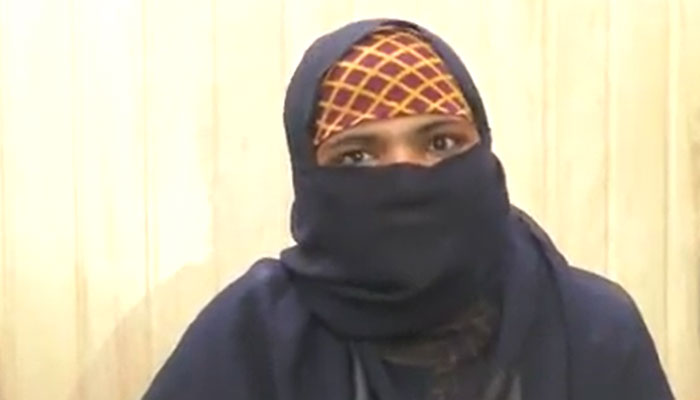
Bismah recalled the night when her husband, a driver, was assassinated on suspicion of being an informant. “They took me forcibly just after he was killed. I was abused in every manner conceivable…Torture and humiliation on an unimaginable scale,” she said.

Islamic women
Bismah(Source: The Diplomat)

“The murder of my husband wasn’t enough revenge,” she remarked. ” Neither was the first gang rape. “My torment went on for years after that. The nightmare that began when I was 18 lasted until I was 27,” she added. “Injustice… Plain Injustice… Only Allah knows how much I have suffered… Suffered in every way possible,” she remarked, her eyes welling up with tears.

Chasfeeda from Uri

When asked about why she did not complain about such heinous crimes against her, Chasfeeda, who hails from Uri said “To whom would I report? I was impoverished, ignorant, and powerless. Nobody was interested in listening to what I had to say. In such cases, no one takes the poor’s side.”

Islamic women
Chasfeeda.(Source: The Diplomat)

A group of terrorists who visited her village on a regular basis took her husband away under the guise of some work. “They camped in front of our house and refused to go. They urged me to feed them and ate every crumb of what I had at home. They refused to leave even after they had finished eating. They then pushed their way onto me and raped me,” she said.

“I’m not sure what group they belonged to or what their politics were.  However, whatever morality and piety they preach is false. Simply to deceive people. Only Allah knows what wickedness lies hidden in their souls,” she added. She explained, tearfully, that this had gone on for three to four years.

“There were so many of them that raped me… I’ve lost count. In the dim light, I couldn’t determine if it was four or eight individuals at a time. They ate away at me until all of my flesh was taken clean off, leaving me bone dry,” she said this while displaying her skinny hands and explaining that she works in someone’s home.

Fatima from Ganderbal

The militants initially arrived in Fatima’s home in Ganderbal in 2005, when she was only 14 years old. “The militants came on the door and requested water,” she explained. “When we opened the door, they noticed me. They sought out any opportunity to visit us from then on,” she added.

Eventually, her father, day labour, was killed not far from their house. With the guardian of the house no longer there, she became easy prey. “They came to our house, stripped me naked, and requested me to sleep on the bed with them. When I resisted, they just grabbed my hair and dragged me down,” she added.

In a tone of misery, she said “After a while, all I asked was that they not take me on the cold, hard floor – my back couldn’t handle it, and the unborn baby inside me would die, I told them.  But they did not listen.”

“Is it jihad? Is this their piety?” she said in a tone of anger. “I was spoilt – no man wanted to marry me,” Fatima tried to explain. “As a result, they married me to a handicapped, wheelchair-bound first cousin from another village.  They didn’t stop even then. They discovered my new address and began to visit there as well. They didn’t stop even after I’d had my first child with my spouse and was expecting my second,” She added in her closing remarks.

Fatima had significant pregnancy difficulties and spinal damage as a result of the extended violent sexual assault.

The Jihadi atrocities in the valley

Jihadist-Islamist militancy arose as a popular movement in the valley even before the displacement of Kashmiri Pandits in the 1990s. Separatist leaders and Islamic fundamentalists echoed their voices to mobilise support for the movement which was spread to seek liberation from the Indian State.

People, particularly women, were encouraged to lend a hand to the jihadists by feeding, washing, and providing shelter and support to those who fought against the Indian forces.

Numerous extremist political figures in Kashmir also urged women to dedicate their bodies to the terrorists fighting the “holy war”, becoming “proud wives” and mothers. Women-led movements such as the Dukhtaran-e-Millat demanded that harsh Shariah be implemented, and women were beaten for not adhering to dress codes and Islamic morality standards.

However, what turned out of these actions is nothing but the continued oppression of women and people who opposed such views. The politics in the valley refused to acknowledge any such atrocities committed by fundamentalists and Shariah upholders.

‘Muslim women who do not wear hijab are ‘sinners’, will face Allah’s wrath on Judgment Day’: Petitioner’s lawyer to Karnataka HC

As the Karnataka High Court heard the hijab case for the 10th consecutive day on Thursday, senior advocate AM Dar, appearing for the hijab-wearing students argued in the Court of law that wearing hijab is an essential part of Islam and that those who don’t wear one are considered as sinners in Islam.

He also said that the Court was not being properly guided on Quran. “According to Quran”, Dar appearing for Muslim girls said, “non-covering by a woman will mean the lady will be sent to the place where there will be wrath on Judgement Day to give hisaab. We have to be ready to face Judgement. To cover the head is an essential religious practise for us”.

Dar further narrated a story from Prophet Mohammed’s life to prove his point of women becoming sinners if they don’t wear hijab. Dar said, “In 1621, our Prophet was spiritually and physically taken during the night to the Allah in the heaven by Gabriel. During the journey, Prophet saw some women crying and asked Gabriel why were they so sad”.

“Gabriel told him, and this is narrated in the Quran and covered in the Hadith also -‘These are women of your Ummah, who were seen not wearing cover on their head and chest’. Prophet saw serpents around their neck, around their hair. The Prophet said – ‘I will pray to God to forgive them’. Gabriel said – ‘Unless Allah forgives them, your prayers will not matter because they have committed a sin’”, he was quoted.

He added that the religion believed in the narration and hijab was actually to protect women from the day of the Judgement. “Whatever Prophet has said is binding. How can we ignore it? Then we are not Muslims. Hijab is mandatory in Islam and has come from Quran”, he reiterated pleading that the petitioners only wanted a headscarf and not a full burqa.

According to the reports, Advocate AM Dar stated that no public order would be disturbed merely because a Muslim girl wore the hijab. He collated the situation to the Hindu religion and said that “If someone desecrates the image of Lord Ram or any Hindu goddess, then it is a public order issue. If you desecrate the image of another religion, then it hurts feelings and it can be public order. But simply covering the head; how does it cause a public order issue?”.

He added that India is neither a Hindu Rashtra nor an Islamic republic. It is a democratic, sovereign, secular, republic where rule of law must prevail. Meanwhile, the Karnataka government informed the court that an FIR had been registered against the members of the Campus Front of India (CFI) for their involvement in the case pertaining to the Government Pre-University Girls College in the Udupi district.

Karnataka hijab row

The hijab controversy in Karnataka gained momentum in the first week of January after eight Muslim girls were denied entry to classes in a Udupi college because they were wearing hijab. The college authorities had informed that the hijab was not a part of the uniform dress code mandated for the students.

The Muslim girls, adamant about wearing hijab, then filed a petition in High Court seeking permission to attend classes with hijab. They stated that wearing the hijab was their ‘fundamental right’ granted under Articles 14 and 25 of the Indian Constitution and ‘integral practice of Islam’.

The controversy spiralled as Hindu students in Karnataka styled with saffron scarves around their necks, protested against Muslim girls continuing to wear Hijab to the college. Tensions also prevailed at some educational institutions in Udupi, Shivamogga, Bagalkote and other parts as incidents of stone-pelting and violence were reported from various parts of the state.

‘Let go off now, it’s been 2 years since the Delhi riots’: Locals fight shy of talking about victims Dilbar Negi, Ankit Sharma; family, witness leave the city

It’s been two years but the memory bank of the Delhi Riots that saw multiple waves of bloodshed and properties of Hindus being destroyed in the year 2020 does not fade away. The riots that began on February 23 in the year 2020 witnessed huge chaos in North East Delhi as the Muslim rioters targeted Hindus with sticks, stones, swords or pistols.

The two brutal incidents that created distress among the Hindu community all over India were murder tales of Dilbar Singh Negi and IB Officer Ankit Sharma. On Thursday, marking the second yearly observance of the grieving riots, team OpIndia visited the Shiv Vihar, Karwal Nagar area and the Chandbagh area in North East Delhi where the most destruction was inflicted.

Shiv Vihar is the locality in which 20-year old Dilbar Singh Negi was brutally murdered by a Muslim mob and the Chandbagh area is the one where houses and shops of nearby Hindus were targeted from the building of AAP Councilor Tahir Hussain. Ankit Sharma, who worked for the Intelligence Bureau, was brutally murdered in this area.

Dilbar Negi who belonged to Uttarakhand had shifted to Delhi six months before the riots broke out. He used to work at Anil Sweet House and was having lunch when the Muslim mob attacked him with the sword, cut him off and burnt him alive inside the sweets shop.

In the first picture, the warehouse in which Dilbar Negi was burnt, which was later renovated. The second picture of Anil Sweets House

Son of Anil Pal, the owner of Anil Sweet House revealed to OpIndia that the family of Dilbar Negi had been offered help by the Uttarakhand State government. He also said that the Pal family had provided monetary help to Negi’s family. Refusing to give further details, he said that whatever happened was in the past and it was better to let it go off. “Let it go now, it has been two years since the riots and now there is peace here. It doesn’t look like something horrifying like that will ever happen again here”, he said.

Charge Sheet in Dibar Negi murder case of Delhi 2020 riots

Dilbar Negi was brutally murdered and his dead body was found in mutilated and charred condition in Anil Sweet House, Brijpuri on February 26. In the month of June 2020, the Crime Branch of the Delhi Police had filed a charge sheet in the case and charged 12 people for murdering Negi. The charge sheet confirmed that a Muslim mob community had come from the Brijpuri Pulia side of North East Delhi and started targeting the properties of Hindus till the late night of 24 February. Police had said that the mob had set fire to a sweet shop named Anil Sweets from where the police recovered Dilbar Negi’s body on February 26.

Where is IB Officer Ankit Sharma’s family?

While walking down the silent lanes of Chandbagh area in North East Delhi, team Opindia found that the house owned by the family of IB officer Ankit Sharma is close to AAP leader Tahir Hussain’s house. While locals informed that Sharma’s family had sold their property and left Delhi, the tenant residing in the house said that the family moved to Gaziabad after the riots. “Ankit Sharma’s family has moved somewhere near Ghaziabad. Now they come here sometimes only to collect the rent”, he said.

The dead body of IB constable Ankit Sharma was recovered from a ditch behind the house of AAP leader Tahir Hussain in Chandbagh. His body was then sent for autopsy by the authorities, the report of which revealed the horrific brutality that was inflicted on him before his body was dumped.

The autopsy report said that Ankit Sharma was stabbed over 400 times and his body had been mutilated beyond belief. He had stab wounds all over his body and not even a single portion of it was spared. He was stabbed for four to six hours, by possibly as many as six individuals together. Moreover, his intestines were ripped apart. Forensic doctors had reportedly said that they hadn’t seen such nightmarish mutilation in their lives.

The local people further refused to talk about the brutal murder but stated that they were unaware of the fact that Ankit Sharma was an IB officer until they heard of his death. Ankit Sharma had joined the IB in 2017 and his rank was that of a Security Assistant. It was reported that during the riots, Ankit Sharma was dragged into the house that belongs to Tahir Hussain by a Muslim mob along with two others. The family of Sharma had held the Aam Admi Party responsible for Ankit Sharma’s brutal murder.

An FIR had been registered against Tahir Hussain under section 302(a) of the IPC for the murder of Ankit Sharma, on a complaint filed by Ankit’s family. However, when Opindia on Thursday inquired about Pradeep Verma, the eyewitness of Ankit Sharma’s murder case, the locals informed us that he had left the area too.

Russia-Ukraine war: Vladimir Putin ready to send a delegation to Minsk for dialogue with Kyiv

0

In a major development, the Kremlin on Friday said that Russian President Vladimir Putin is ready to send a delegation to Minsk to hold discussions with Ukraine as Russian forces approach Kyiv on the second day of Moscow’s invasion.

According to reports, Kremlin spokesperson Dmitry Peskov said that a Russian diplomatic delegation, including Foreign Ministry, Defence and Administration officials, could be sent to Minsk for talks with Ukraine. The development came after the Russian President turned down Ukraine President Volodymyr Zelenskyy’s offer for talks, demanding that Kyiv ‘surrender’ first. 

As per claims made by the Russian military, their forces have seized a strategic airport located outside the Ukrainian capital, asserting that Kyiv has been cut off from the west. The Gostomel (Hostomel) Airport was reportedly the site of intense fighting between Ukrainian and Russian troops.

Russian Foreign Minister Sergey Lavrov had earlier in the day that Russia would be willing to undertake negotiations through diplomatic channels if Ukraine’s army agrees to surrender. “We suggested talking about security guarantee last December with Zelenskyy. We want to have joint talks and make joint efforts to look forward to a joint security guarantee. He is well aware of the facts involving Ukraine, and should not pass on the blame at Russia,” Lavrov said.

Russia launches ‘military operations’ against Ukraine, Zelensky says 137 killed in the Russian offence

A day after Russia launched a full-scale invasion in Ukraine, the President of the Eastern European country, Volodymyr Zelensky, informed on Friday (February 25) that a total of 137 people (including civilians) were killed in Russian military strikes.

On Thursday (February 24), Russian President Vladimir Putin announced limited military operations against Ukraine. In a televised address, Russian President Vladimir Putin declared the special operation to be conducted in East Ukraine.

Putin had added explicitly that Moscow did not plan on occupying Ukraine. He said the military action he announced would seek to “demilitarise” and “denazify” Ukraine and came in response to threats from Ukraine.

According to Ukraine’s border guard agency, the Russian military entered the country from neighbouring Belarus. The Russian forces crossed Belarus to enter Ukraine from the North, said Ukraine’s Ministry of Internal Affairs. The Northern border forces in Ukraine have come under attack by Russian troops.

Court finds Tennis star Leander Paes guilty of domestic violence against partner Rhea Pillai

0

A metropolitan magistrate court in Mumbai has held in its order that tennis legend Leander Paes committed various acts of domestic violence against his former partner Rhea Pillai.

According to the reports, the court held Leander Paes guilty of domestic violence charges and asked him to pay a monthly rent of Rs 50,000, in addition to monthly maintenance of Rs 1 lakh to Rhea Pillai if she chooses to leave their shared residence. Metropolitan magistrate Komalsing Rajput had passed the order earlier this month.

“There would be an additional increase of 5% every year, from the month of March 2023, so that Pillai shall not be compelled to knock on the doors of court again and again for enhancement of the amount of maintenance and house rent to meet the inflation, till the date up to which the said order remains in force,” added the court.

Model-turned-actor Rhea Pillai had filed a domestic violence case against Leander Paes in 2014, seeking relief and protection under the Protection of Women from Domestic Violence Act. Pillai had said that she was in a live-in relationship, akin to marriage, with Leander Paes for eight years.

She had claimed that Leander Paes had “caused verbal, emotional and economic abuse, which resulted in tremendous emotional violence and trauma” through his acts and conduct.

Hearing the plea, the magistrate said, “It is proved that the respondent caused various acts of domestic violence.”

However, the court added that the monetary relief would be available to Pillai only if she chooses to live separately and not continue to live in their shared residence at Bandra. The court also ordered Paes to pay an additional amount of Rs 1 lakh to cover legal fees and expenditures and asked him to pay for their daughter’s sustenance, education, and other essentials.

The magistrate said that with Leander Paes’ career in tennis almost over, it would cause ‘serious prejudice’ for making him pay maintenance to Rhea Pillai when living in a rented home.