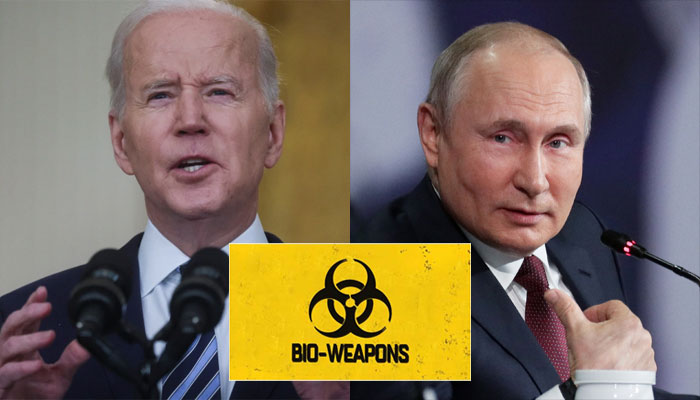
On March 6, the Russian Defense Ministry said they found evidence of a US-financed military biological program developed in Ukraine during the ongoing military operation. Igor Konashenkov, the spokesman of the Russian Defense Ministry, said, “In the course of the special military operation, evidence of the Kyiv regime’s hasty measures to conceal any traces of the military biological program finance by the US Department of Defense in Ukraine has been revealed.”
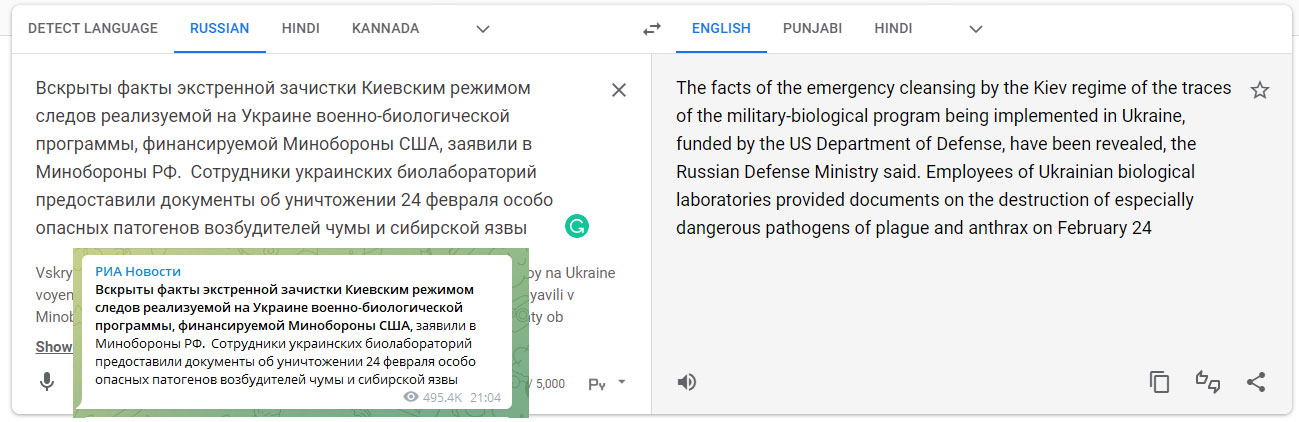
RIA Novosti, a Russian state-owned domestic news agency, shared the details of the information released by the Russian Defense Ministry. The agency quoted Konashenkov saying they received information from employees of Biolabs that deadly pathogens were urgently destroyed on February 24. These pathogens included plague, anthrax, cholera, tularemia and other lethal diseases infecting agents. When Russia began its military operation in Ukraine, an instruction was issued by the Ukrainian health ministry to urgently destroy the pathogens in their possession, as per the Russians.
Screenshot from RIA’s account translated from Russian to English using Google Translate.
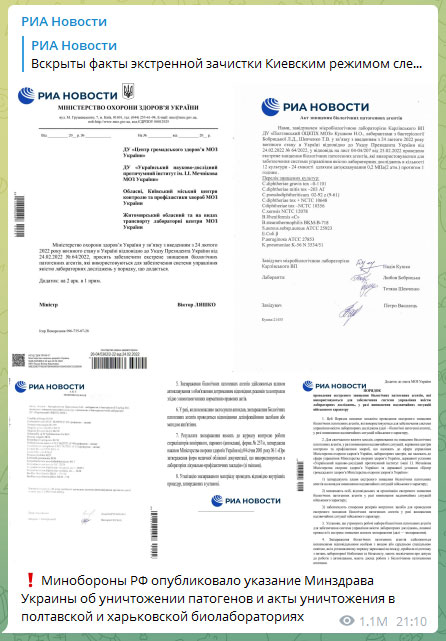
He said, “Obviously, after the launch of the special military operations, Pentagon became afraid that secret biological experiments in Ukraine will be exposed. We will share the results of the analysis of the documents we have received in the near future. Some of them, in particular the Ukrainian health ministry’s instruction to destroy pathogens and certificates of completion from the Kharkiv and Poltava bio laboratories we are publishing right now.”
Documents shared by Russian Defense Ministry. Source: RIA
The Russian Defense Ministry said they received a series of documents that confirmed that Ukrainian Biolabs that were in close vicinity of Russian territory were developing biological weapons components. The ministry further claimed to prevent the disclosure of the work carried out in these labs by the United States and Ukraine that was in clear violation of Article 1 of the UN Convention on the Prohibition of Bacteriological (Biological) and Toxin Weapons, the Ukrainian authorities instructed the labs to eliminate the stock of dangerous pathogens.
Russia has accused the US to fund and operating Biolabs in Ukraine
On several occasions, Russia has accused the US and Ukraine of developing bio-weapons close to its borders. In 2021, while talking about the inability of the World Health Organisation to establish the origin of the Covid-19 virus, Russian Security Council Secretary Nikolai Patrushev told a Kommersant reporter that Russia believed the US was developing bio-weapons near its borders.
He claimed Russia has good reason to believe that the US was developing bioweapons in Ukraine. “Not a day goes by at the headquarters of the Organization for the Prohibition of Chemical Weapons (OPCW) in The Hague that the Americans and their allies do not come forward with another chapter of the anti-Russian chemical dossier,” he added.
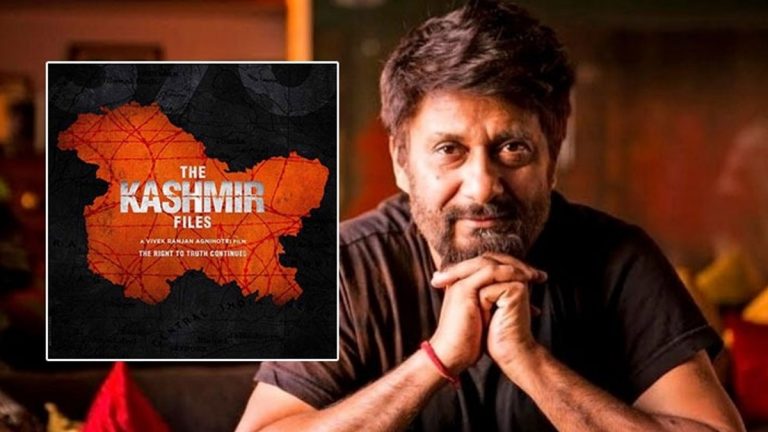
Vivek Ranjan Agnihotri’s The Kashmir Files releases this Friday, March 11. Last evening a special screening was held in Delhi which I had the privilege of attending. I am not a film critic, so the following is not a film review. Plus, how do you ‘review’ tragedies of people who have lived the trauma? These are a collection of my thoughts on seeing something on screen that sent a chill down my spine.
“Nirwa, the atrocities inflicted on us dismissed by the media, politicians and academics of India and it took someone 32 years to tell our story,” a Kashmiri Hindu friend of mine tells me. He and his family lived in camps in Jammu for a few years after the Islamic terrorists backed and supported by Pakistan as well as some Indian politicians whose hearts beat for Pakistan, unleashed terror. “You watched a virtual depiction of our reality, our lived trauma packed in less than 3 hours and that made you cry, we have lived through it,” he tells me.
There is nothing in the film we don’t already know. That the terrorists like Yasin Malik got tacit support and endorsement from those in power and the ‘intellectuals’ is not a secret.
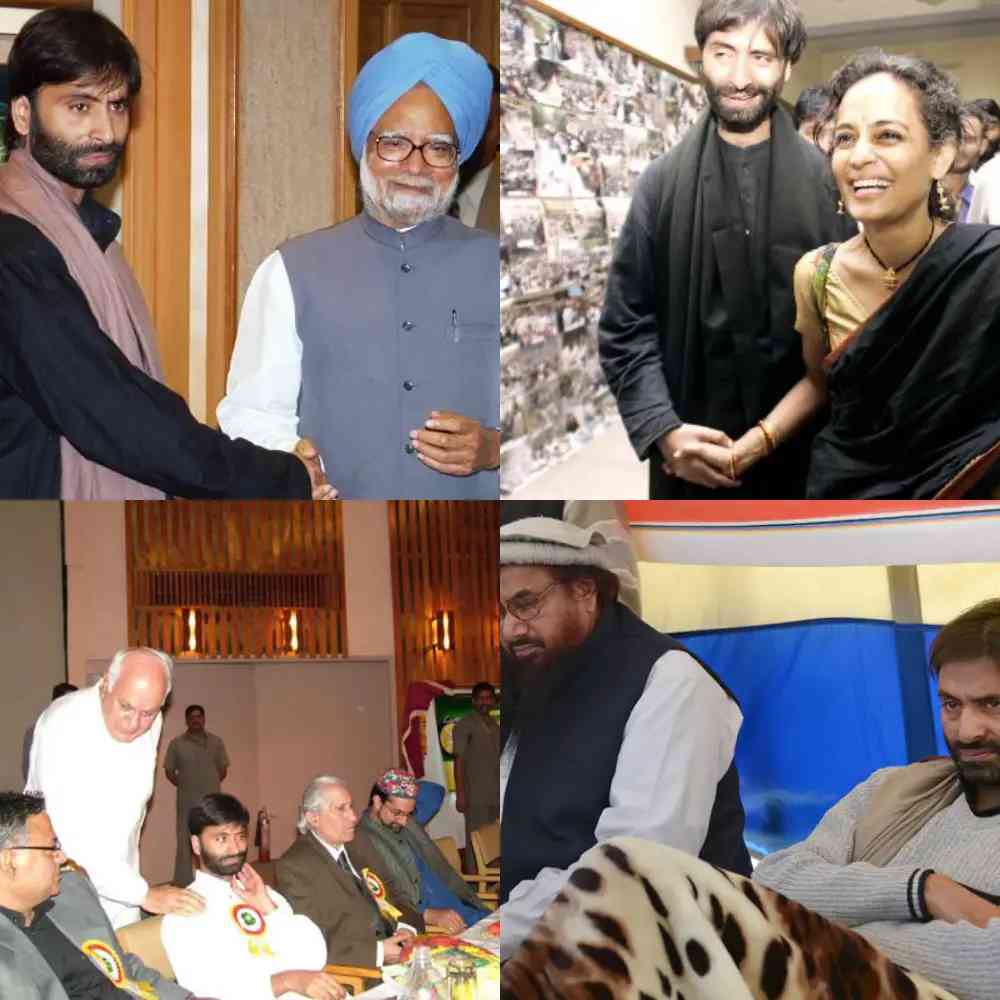
Terrorist Yasin Malik with the then PM Dr Manmohan Singh, Arundhati Roy (author and ‘activist’), Farooq Abdullah (ex-Kashmir CM) and Hafeez Saeed (terrorist)
Just look at the happy faces. Dr Manmohan Singh, the then Prime Minister of India invited JKLF terrorist Yasin Malik ‘for talks’. He had also met Dr Singh in 2006 where he had claimed he asked the government to hold talks with ‘militant leaders’. Essentially, the Congress ruled government negotiated with terrorists. Yasin Malik is one of the terrorists belonging to Jammu Kashmir Liberation Front (JKLF).
Another JKLF terrorist, Farooq Ahmad Dar alias Bitta Karate confessed on camera that he had killed 20 Kashmiri Hindus.
He apparently got ‘orders’ to kill Kashmiri Hindus from other top terrorists of JKLF. The first person he killed was Satish Kumar Tickoo, who was also his friend.
Speaking of which, the Kashmiri Hindu friend of mine tells me how at one point, a few years after the exodus, he along with his mother went back to their old home to get some paperwork done. They went to his mother’s friend’s house for tea and snacks. The friend had promised to take care of the house and keep things safe for them. Except, when they left, his mother was silent for a while. While having tea it had dawned on her that the carpet they were sitting on was from their old home they had left behind.
The stories of Muslim neighbours turning on their Hindu neighbours are so many from the valley that they are now unbelievable. Except, when you see the particular scene in the film which shows this deceit it leaves you with stunned silence. The scene is brutal on so many levels that the liberal cynic in me wanted to sometimes dismiss it as creative freedom. I had to remind myself that no, this actually happened.
That Islamists chanted ‘Ralive, tsalive, galive’ ‘convert (to Islam), run or die’ on the streets of Kashmir. That they announced these from the loudspeakers of the mosques, asking Kashmiri Hindu men to leave the valley, leaving behind their women so that they can finally have their ‘azaadi’ (freedom). As Mithun Chakraborty very correctly said in the film that ‘Azaadi’ is the song of terrorism. It is, therefore, shocking when one saw the same ‘azaadi’ chants, most of which were raised by Muslim mobs on the streets of Delhi in 2019-2020. The ‘liberals’ of India, too, have romanticised the idea of ‘freedom of Kashmir’. Except, because they live in their bubble and echo chamber, they don’t realise that the terrorists’ slogans they are chanting actually want to ‘free’ Kashmir from the ‘kafirs’.
What is even more astonishing is that it took someone 32 years to tell the story of Kashmiri Hindus. Minus the romanticisation of terrorism or justifying them picking up arms. Even then, there are people who believe there was no exodus, that there was no genocide, that Kashmiri Hindus were not forced out of their homes but they left at their own free will. Many have ‘justified’ the exodus claiming how the ‘monopoly’ of Kashmiri Hindus in government jobs irked the Muslims who were ‘oppressed’ and hence they picked up arms. In 32 years, we haven’t quite heard of the Kashmiri Hindus picking up arms despite having survived rapes, witnessing murders, living in absolute poverty after being driven away from homes and countless cruelty inflicted upon them by Islamists.
Those who forget history are condemned to repeat it. Whether Vivek Agnihotri’s The Kashmir Files is a cinematic brilliance or not is not the question here. The fact that he dared to make a movie about something that is pushed under the rug for 32 years now itself deserves an applaud. Every Indian must watch this movie, not only because it is very well made with brilliant performances but because we need to know what our school history books have not taught us.
So that ‘azaadi’ chants do not drive away more Hindus from their homes and that when the time comes when Kashmiri Hindus return to their homes in the valley, their wounds are healed.
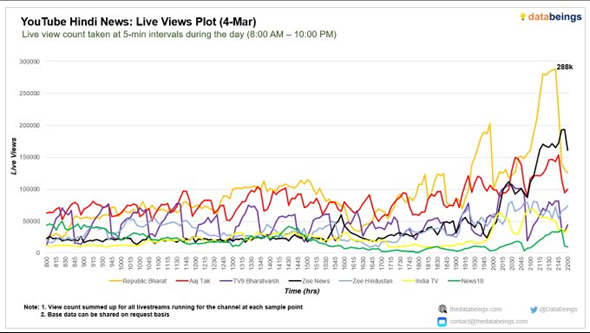
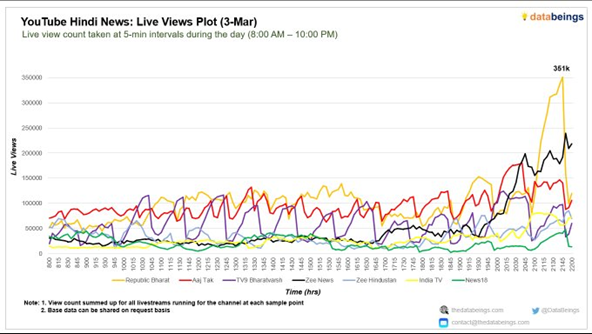
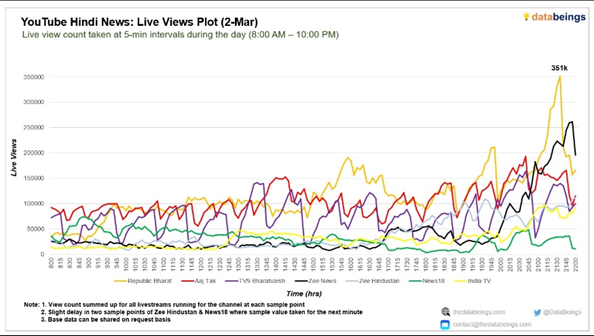
Republic Bharat leads in live viewing on YouTube, according to daily figures given by Data Beings, a data analytics business. It is the most-watched live channel on YouTube for most of the day, especially during prime time, outperforming all other rivals.
The figures were released on Twitter by Data Beings, who presented the viewership data of several Hindi news stations and their views from 8 AM to 10 PM. The numbers clearly show that live views of Republic Bharat range from 50 to 280 thousand, with peak viewing times exceeding 350 thousand views.
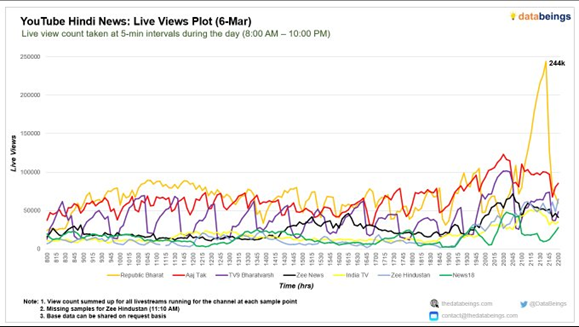
According to Data Beings, Republic Bharat dominated for most of the day on YouTube Hindi News Live Views on March 6, with Aaj Tak moving ahead in select non-prime times. On Republic, the peak time crossed 244 thousand views.
Live Views on March 6
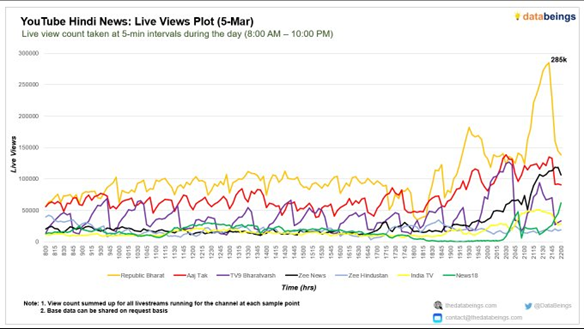
The YouTube Hindi news live views on March 5 showed an upward trend, with Republic Bharat continuing to top even the non-prime slot since March 1. On Republic, the peak viewership reached 285 thousand.
Live Views on March 5
Republic Bharat took the lead on March 4 in both prime and non-prime samples. There was a contest with Aaj Tak for a few non-prime spots. The peak view was recorded 250 thousand for Republic.
Live Views on March 4
On March 3, the viewership of Republic Bharat continued to lead with it reaching 351 thousand views in the peak hours.
Live Views on March 3
Similar trends were noted on March 2, where there was a close contest visible between Republic Bharat and Aaj Tak but the former dominated the prime-time segment with over 351 thousand views.
Live Views on March 2
Republic Bharat lags in monthly and weekly viewership
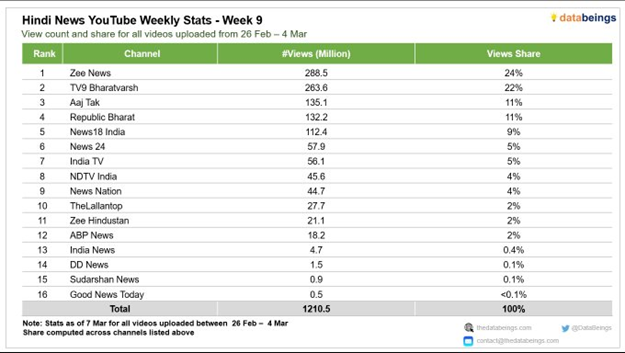
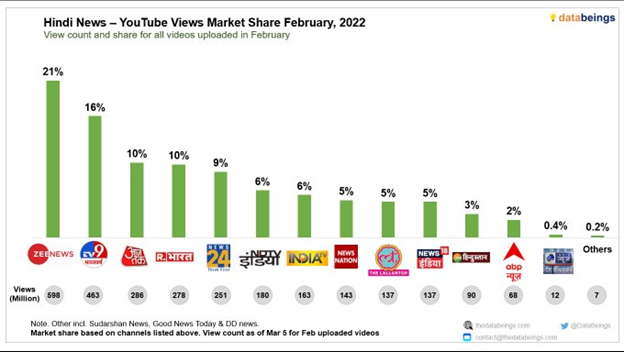
From the data mentioned above, it is clearly discernible that Republic Bharat is the leading Hindi news channel viewed live on YouTube. However, it is notable that it is lagging in the monthly and weekly views gained on any YouTube video.
In weekly viewership, data sampled and analyzed shows that Republic Bharat is in the top 5 watched news channels on YouTube but is not in the first position as seen in live real-time viewership. The image below shows the weekly data from February 26 to March 4.
Weekly data from February 26 to March 4
Similarly, in monthly viewership, data sampled and analyzed shows that Republic Bharat is in the top 5 watched news channels on YouTube but is not in the first position as seen in live real-time viewership. The image below shows the monthly viewership data for February. Zee News bags the top position in both these categories.
Monthly viewership data for February
What does this data imply?
It is necessary to comprehend what these patterns entail. Rising live viewership indicates that the channel is being seen more frequently in real-time and that its users do not choose to watch dated news content.
According to the findings, Republic Bharat viewers prefer to watch the channel live during the day, especially during prime-time hours. Monthly and weekly viewing lags suggest that other channels’ news videos are seen more after they are uploaded rather than in real-time.
High monthly and weekly viewership of any channel implies people watch the channel more when it is not live. It may be accomplished by uploading a segment of the news as a separate video and disseminating it using various search engine optimization techniques.
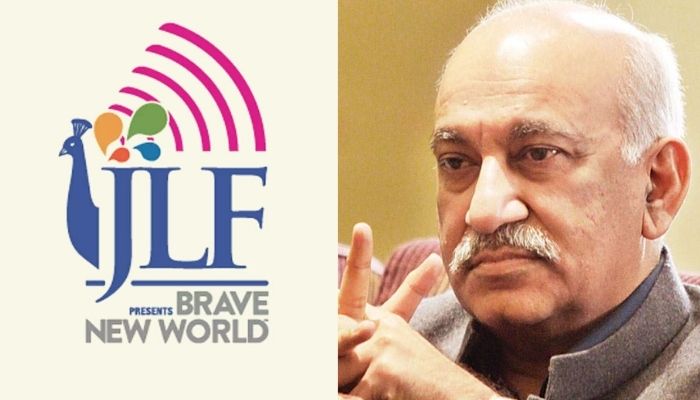
Veteran journalist and former BJP Minister MJ Akbar was recently removed from the speaker’s list at the virtual edition of Jaipur Literature Festival (JLF), over ‘unproven’ accusations of MeToo levelled against him in 2018. JLF 2022 is scheduled to be held virtually between March 5 and March 14 this year.
The development came at the backdrop of ‘liberal outrage’ on social media, prompting the organisers of JLF to take such stringent action. The controversy, over the selection of MJ Akbar as a speaker, began after ‘journalist’ Peter Griffin posted about it on Twitter.
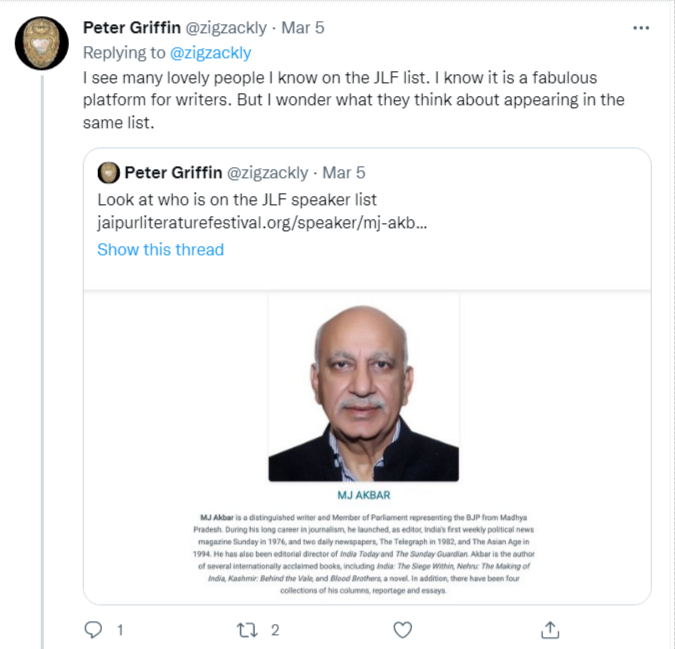
In a tweet on Saturday (March 5), he wrote, “Look at who is on the JLF speaker list.” Griffin had posted the screenshot of the ‘speaker bio’ page of MJ Akbar. He remarked, “I see many lovely people I know on the JLF list. I know it is a fabulous platform for writers. But I wonder what they think about appearing in the same list.”
Screengrab of the tweet by Peter Griffin
Liberals demand removal of MJ Akbar as JLF speaker
Following his tweet, liberals demanded the de-platforming of journalist MJ Akbar from the virtual event of Jaipur Literature Festival 2022.
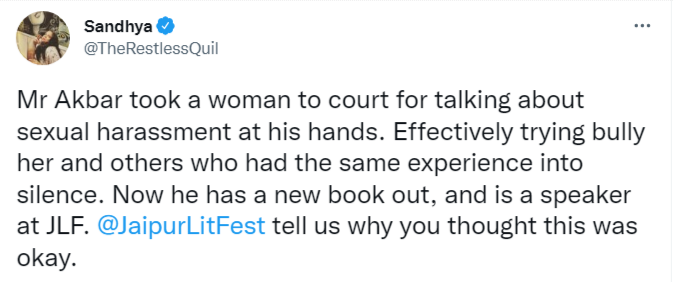
‘Writer’ Sandhya tweeted, “Mr Akbar took a woman to court for talking about sexual harassment at his hands. Effectively trying (to) bully her and others who had the same experience into silence. Now he has a new book out and is a speaker at JLF. @JaipurLitFest tell us why you thought this was okay.”
Screengrab of the tweet by Sandhya
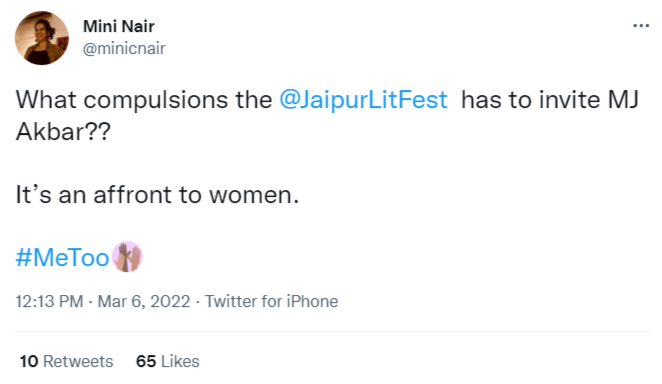
“What compulsions the @JaipurLitFest has to invite MJ Akbar?? It’s an affront to women,” tweeted author Mini Nair.
Screengrab of the tweet by Mini Nair
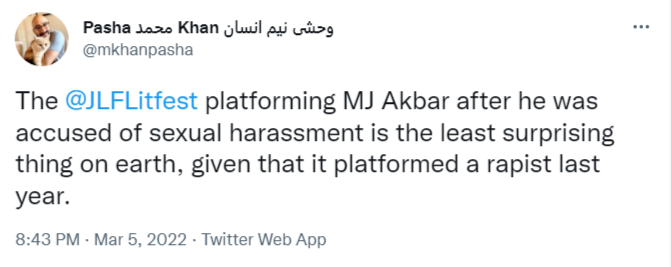
Urdu language professor Pasha Khan accused the organisers of the Jaipur Literature Festival of harbouring rapists and alleged sexual predators. “The @JLFLitfest platforming MJ Akbar after he was accused of sexual harassment is the least surprising thing on earth, given that it platformed a rapist last year,” he alleged.
Screengrab of the tweet by Pasha Khan
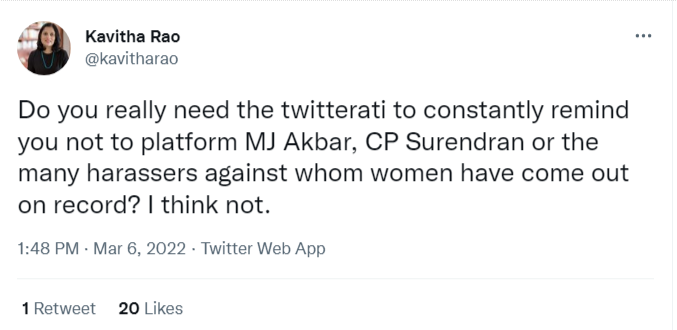
“Do you really need the Twitterati to constantly remind you not to platform MJ Akbar, CP Surendran or the many harassers against whom women have come out on record? I think not,” wrote another ‘author’ Kavitha Rao.
Screengrab of the tweet by Kavitha Rao
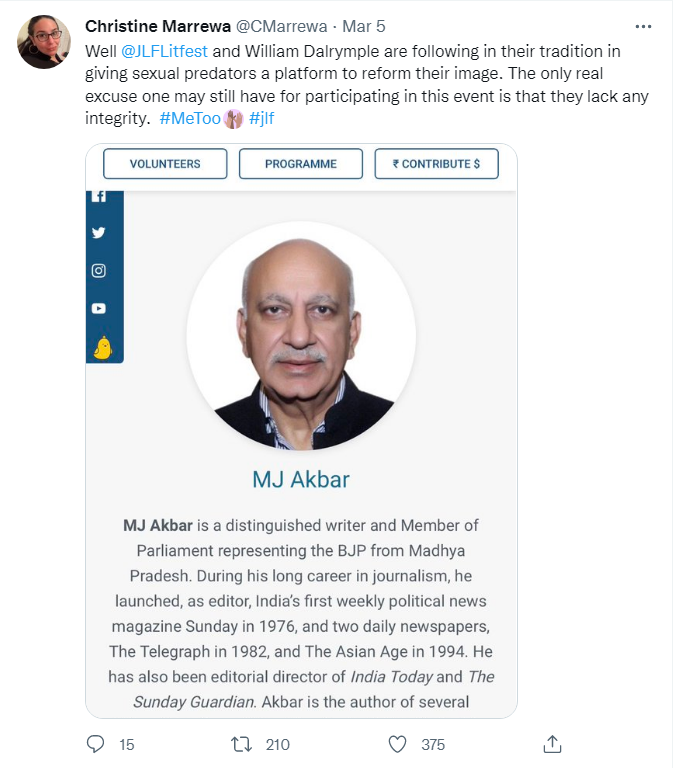
Postdoctoral Fellow at Columbia University Christine Marrewa, claimed that the acclaimed Jaipur Literature Festival has a ‘tradition’ of providing a platform to sexual predators to ‘reform their image’. She tweeted, “The only real excuse one may still have for participating in this event is that they lack any integrity.”
Screengrab of the tweet by Christine Marrewa
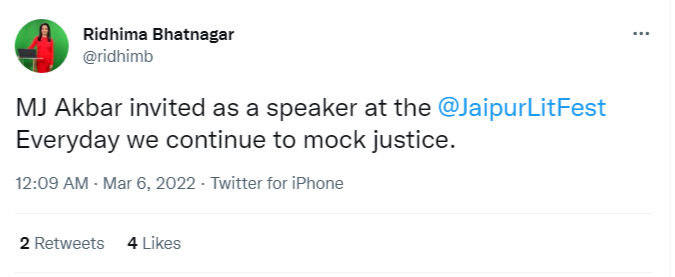
CNN News18 anchor Ridhima Bhatnagar alleged that inviting MJ Akbar as a speaker at the Jaipur Literature Festival was a ‘mockery’ of justice.
Screengrab of the tweet Ridhima Bhatnagar
Jaipur Literature Festival remove page featuring MJ Akbar as ‘speaker’
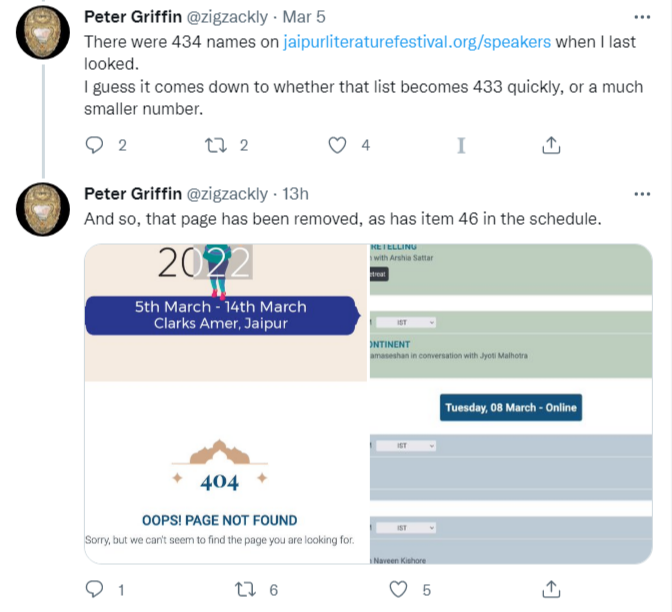
Liberals on social media were successful in exercising their veto power. ‘Journalist’ Peter Griffin, who had started the controversy, informed that the name of the former Minister was removed from the list of speakers at the virtual event.
“There were 434 names when I last looked. I guess it comes down to whether that list becomes 433 quickly, or a much smaller number…And so, that page has been removed, as has item 46 in the schedule,” he informed.
Screengrab of the tweets
MeToo movement and liberal immunity to William Dalrymple
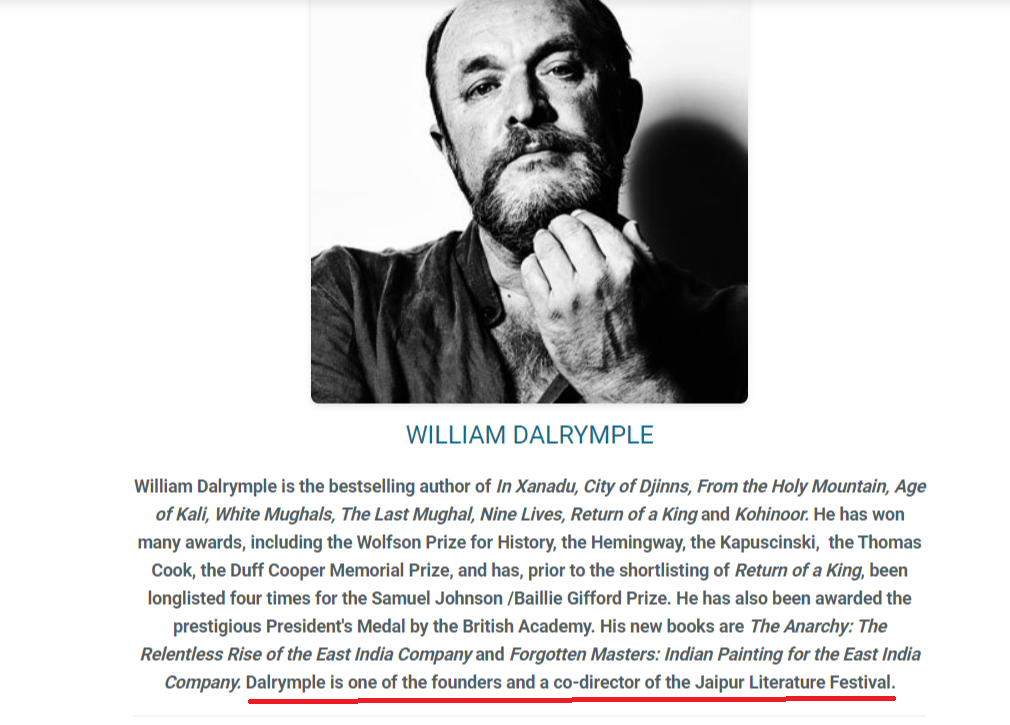
Interestingly, the website of Jaipur Literature Festival features ‘author’ William Dalrymple as one of its founders and co-Director. This is despite the fact that he has been accused of sexually predatory behaviour by multiple women.
In October 2018, Scroll employee Karnika Kohli put out a cryptic tweet asking whether everyone will remain silent over William Dalrymple. Women who felt uncomfortable around him or while talking to him over the social media platforms took the hint, and a few came forward to tell their stories.
The most detailed version of his behaviour towards young women was posted by one Preetha. She said that he sent her a random friend request on Facebook, which, as his fan, she did not find alarming. However, he started to compliment her a lot which made her feel uncomfortable.
He also asked her out for dinner and drinks. When she told him she would think about going out for dinner with him, “he replied with many winks and kiss smileys,” she said. She said that she should have snapped when he randomly asked her for dinner and called him out for being creepy.
To her post, many people said that it should have been taken as normal as it is not wrong for someone to ask a woman out for dinner or drinks that forced Preetha to write a long note. She said, “It is disheartening not at all shocking that men are questioning my intentions instead of Dalrymple’s in this case although other women have shared that they have heard of/had similar encounters with him.”
Screengrab of the author profile of William Dalrymple
She further added that refusing to admit his actions are not similar to the actions of a new male colleague as a new colleague will have a reason to know her better than William did not have. After telling him that she was his fan, his actions felt like “he is exerting his power, unlike the colleague.”
Another user MissKandpal concurred what Preetha had to say. She said she was asked to meet over dinner as well. Author and political analyst Shubhrastha also pointed out unsolicited messages from Dalrymple and said her cold reply might have saved her from such dinner requests.
In October 2018, multiple women took to social media platforms and called out their sexual predators across industries like media, advertising, academia, the film industry and even the comedy circuit which prides itself in being the ‘liberal’ voice of India. While MJ Akbar has been de-platformed, liberals ensured that William Dalrymple continues to remain the co-Director of JLF. This is despite the multiple allegations of #MeToo against him.
Raipur Police has released a multi-point press release over the arrest of journalist Nilesh Sharma. Outlook’s journalist Ashutosh Bhardwaj shared screenshots of the release issued by the Raipur Police. It has been claimed by the police that they have found incriminating material on Sharma’s phone including evidence of blackmailing, pornography and fake news.
Raipur police’s press release today on journalist Nilesh Sharma arrest:
His ph has porn clips. He was in touch with prostitutes; was chatting in objectionable language with women and men.
Sharma, who was arrested on March 2 under Section 504, 505, 505 (1) (b) and 505 (2) of the Indian Penal Code, had applied for bail but it was rejected by the lower court. Sharma’s website is down since his arrest.
Nilesh Sharma- arrested this week & bail denied by the lower court in Chattisgarh.
His website is down since his arrest.
This was the satirical article for which he’s in jail, so much for freedom of speech.
— Vishnu Vardhan Reddy (@SVishnuReddy) March 6, 2022
‘Sharma illegally obtained call records’
The Police claimed to have found additional evidence on his phone that they had confiscated from him at the time of the arrest. The Police alleged Sharma gained access to someone’s call records via a Police Officer. As per the law, only investigating agencies can get access to someone’s call records that too after submitting a request with a valid reason. However, in this case, the call records were obtained illegally. The Police Officer who provided the call records is under the scanner as well.
The Police claimed Sharma took money from many people on the pretext of getting work done and there were chats where they have asked him to return the money as the work was not done. The Police added that those people will be questioned during the investigation.
‘He was in touch with prostitutes and forwarded pornographic cotent’
Raipur Police further alleged Sharma had pornographic content on his phone and forwarded it to several people which is an offence under the IT Act. The Police might question those who received pornographic content from Sharma.
The Police alleged he was in contact with prostitutes and used objectionable and indecent language while talking to some women. “Similar chats were also found between Sharma and other men,” the Police claimed.
‘Evidence of fake news found’
The Police alleged they found a chat between Sharma and other people that indicated they were working together with an agenda to spread fake news. “All of them will be questioned,” said the Police.
‘He blackmailed under the guise of journalism’
The Police further alleged Sharma used his position as a journalist to blackmail and intimidate several people. The Police would question the victims later during the investigation.
‘Confidential documents found’
The Police alleged to have found official confidential documents on Sharma’s mobile phone. The Police said such documents can only be obtained with the help of a government officer or employee. Further investigation would be done on how he gained access to such documents.
The arrest of Nilesh Sharma
On March 2, journalist Nilesh Sharma was arrested by Raipur Police in Chhattisgarh for his popular political satire. He was accused of spreading fake news. Sharma, who is the editor of the web portal indiawriters.co.in and print magazine ‘India Writers’, uns a popular series based on political satire in the name of ‘Gharwa Ke Mati’. The series uses fictional characters resonating with the Congress leaders and MLAs in Chhattisgarh.
A little known Congress worker Khilwan Nishad complained to Sharma and accused him of using derogatory language against the Congress leaders of the state. The cyber cell of the Police immediately acted upon the complaint and arrested Sharma late in the night.
Nishad accused the journalist of favouring the BJP and the RSS and said that he is a part of ‘Godi media’. He alleged that through his show ‘Gharwa Ke Mati’, Sharma is deliberately using derogatory language against the Congress leaders. “The portal indiawriters.co.in is spreading negativity and drawing a wedge among the leaders and office bearers of Congress”, he added in the FIR. Nilesh Sharma was produced before a local court and was arrested on Thursday evening.
Notably, the same web portal ran a similar series that was highly critical of the then Raman Singh-led BJP govt. Earlier in the month of October, two journalists of another web portal were arrested for allegedly publishing content against the Congress lawmakers in the state and extorting money from them.
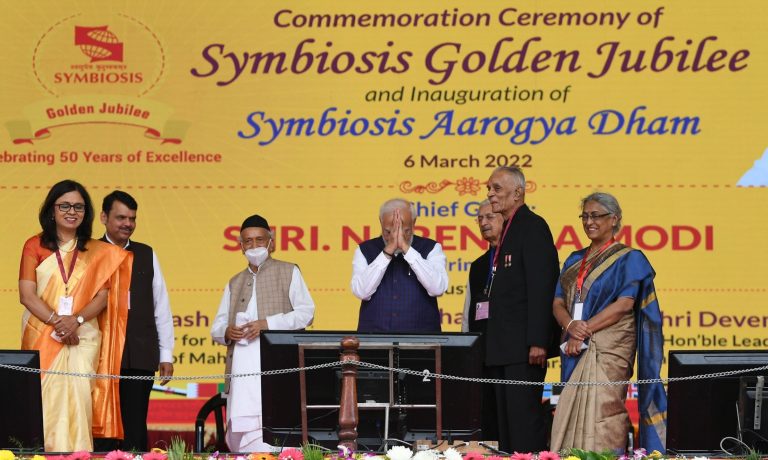
On Sunday 6th March 2022, Prime Minister Narendra Modi suggested students take advantage of start-ups in various sectors of as India is the third-largest start-up ecosystem in the world. He was addressing the students on the occasion of the inauguration of the Golden Jubilee celebration of the Symbiosis University in Pune. PM Modi said that the present generation is fortunate enough to not have suffered the damaging impact of the earlier psychology which was largely defensive and dependent.
Emphasizing the changing mood of the nation, PM Modi said, “If this change has come into the country then its first credit also goes to all of you, the youth of our country.”
He added, “Students are representing the generation in front of which there are infinite opportunities. Today our country is one of the largest economies in the world. The world’s third-largest start-up ecosystem is in our country today. Missions like Startup India, Standup India, Make in India and Self-reliant India are representing your aspirations. Today’s India is innovating, improving, and influencing the whole world. India is now on the way to becoming a global leader in those sectors in which the country did not even think of moving forward on its own feet earlier.”
Explaining this point further he said, “The example of mobile manufacturing is in front of us. Till a few years ago, mobile manufacturing for us, and so many electronics like this meant the same thing – import! Bring it from anywhere in the world. But today the situation has also changed. India has emerged as the second-largest country in the world in mobile manufacturing. Seven years ago there were only 2 mobile manufacturing companies in India, today more than 200 manufacturing units are engaged in this work.”
Quoting another example of the defense sector, PM Modi said, “In the defense sector, for decades, we were believing that we can rely on what other countries will give us. In the defense sector also, India, which was earlier recognized as the world’s largest importer country, is now becoming a defense exporter. Today, two major defense corridors are being built in the country, where modern weapons will be made, to fulfill the defense needs of the country.”
In his detailed speech, PM Modi further said, “In the 75th year of independence, we are moving ahead with the new goals of building a new India. Our young generation has to lead this campaign. Today, from the software industry to the health sector, from AI and AR to automobile and EV, from quantum computing to machine learning, new opportunities are being created in every field. From Geo-Spatial Systems, Drones to Semi-conductors and Space Technology, reforms are being done continuously in the country.”
PM Modi underlined his vision saying, “These Reforms are not for making Government’s record, these Reforms have brought opportunities for you. And all I can say is that Reforms are for you, for the youth.”
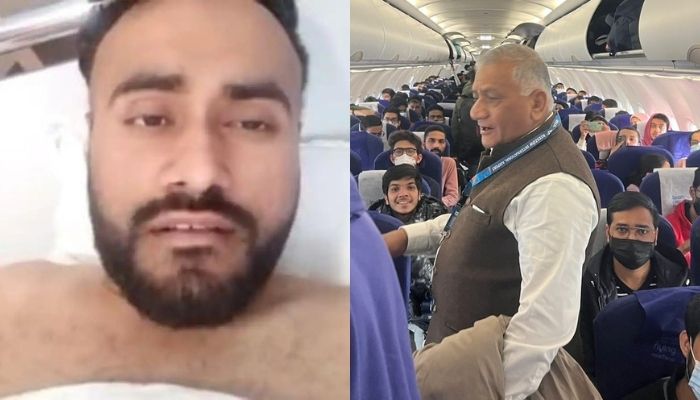
General VK Singh has announced on Twitter that Harjot Singh, the Indian national who sustained bullet injuries in Kyiv will return to India on a flight on March 07, 2022. Harjot Singh, an IT specialist from Delhi suffered injuries after being shot in Kyiv while he was on his way to Lviv. Singh is currently undergoing treatment at a hospital in Kyiv after he was admitted after being hit by a bullet in a fight.
हरजोत सिंह वह भारतीय हैं जिन्हें कीव में युद्ध के दौरान गोली लग गई थी। अफरातफरी में इनका पासपोर्ट भी गुम गया था।
सहर्ष सूचित कर रहा हूं कि हरजोत कल भारत हमारे साथ पहुंच रहे हैं।
— General Vijay Kumar Singh (@Gen_VKSingh) March 6, 2022
On February 27, 2022, in the week when the Russian invasion of Ukraine had just kicked off, Harjot Singh was trying to flee the Ukrainian capital and was injured after he was shot at during a fighting. Confirming the news, Gen VK Singh had told that Singh was immediately rushed to a hospital in Kyiv. While being treated at the hospital Harjot pleaded to the Indian government to make arrangements for him to return to India. He requested, “Since I have got a new life, I want to start afresh. Want to spend time with my family,”
It doesn’t matter if you send a charter (plane) after death…God has given me a second life, I want to live it. I request the embassy to evacuate me from here, provide me facilities like a wheelchair, help me with documentation…: Harjot Singh pic.twitter.com/m5EVdjVhD6
Following this update, Union Minister of State, General VK Singh has now confirmed that Harjot will be returning back to India on a flight scheduled tomorrow. The minister is overlooking the rescue operation of Indian nationals in Poland as a part of the Indian Government’s Operation Ganga. As of now, 21000 Indians have left Ukraine, of which reportedly 19920 have reached India through the rescue operation carried out by the Indian government.
Delhi’s Chhatarpur-resident Harjot Singh is an IT specialist and he was in Ukraine for higher studies. He was stuck by two bullets, one on a leg and the other on his chest. Govt of India will bear the expenses of his medical treatment.
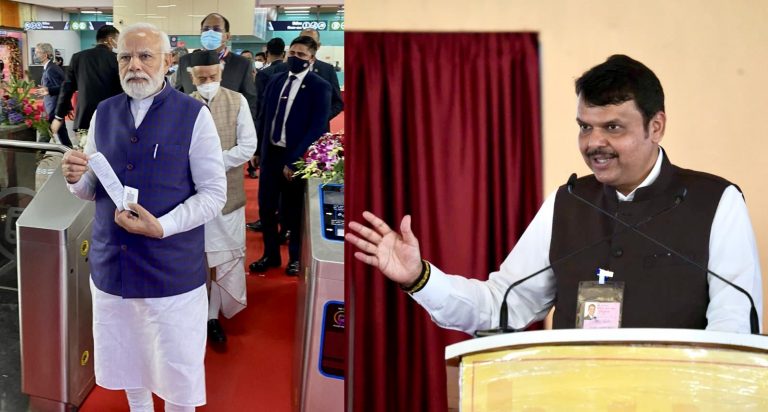
Former CM of Maharashtra and current opposition leader in the state Devendra Fadnavis has apologized for not buying a metro ticket on Pune Metro and has requested metro authorities to accept payments from him. He said this while speaking in the program organized in Pune for the inauguration of the Pune metro by PM Narendra Modi on 6th March 2022. Pune Metro project was initiated by Devendra Fadnavis in 2014 when he had become the CM of Maharashtra. The Metro project was today inaugurated by PM Narendra Modi.
While speaking on this occasion, Devendra Fadnavis has said, “For Pune today is the day of fulfilling the dream. Because today, Pune’s own metro has run. The first ticket of this metro is bought by mister prime minister by mobile payment and he has travelled in the metro. Therefore we feel embarrassed that we have travelled without having bought any ticket. So I request the metro authorities to please collect the payment from us. The PM buys a ticket and we travel without one, which is not the right thing.”
Devendra Fadnavis further said, “There were so many difficulties in this work. But we had established this Maha Metro company for this work. And Maha Metro has completed the Pune metro project in record break time. Most importantly, this is the first metro in the country with 50 revenue from a non-peer box. I thank you honorable PM Modi Ji, for you passed the project to clean the local river of Pune. In upcoming times, there will soon be 100 percent clean transportation using electric and CNG buses in municipal transport. We will see Pune’s new identity as a city with good public transport service.”
Devendra Fadnavis added, “Honorable Prime Minister sir, you have passed a metro project in Nashik and the second phase of Nagpur metro as per my request. I thank you for that. I congratulate the Pune municipal corporation for the new statue of Chhatrapati Shivaji Maharaj in the corporation office premises.”
PM Modi (@narendramodi) buys ticket before travelling on Pune Metro.
After inaugurating a 12 km section of Pune Metro, PM Modi had taken a ride in the inaugural metro service by personally buying ticket at the ticket counter. He had travelled from Garware College to Anand Nagar after flagging off the train.
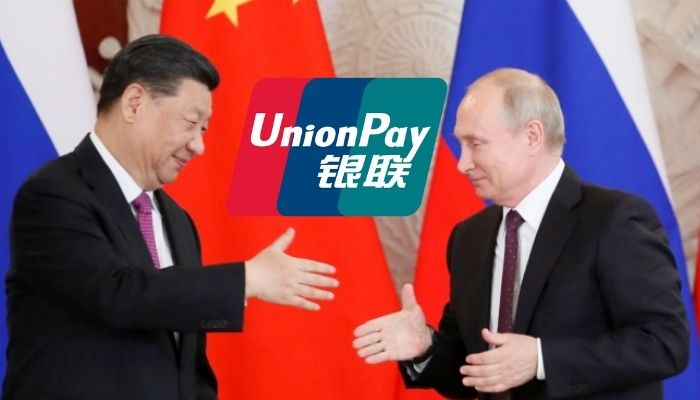
Several Russian Banks would soon start issuing banking cards using the system of Chinese operator ‘UnionPay’ along with Russia’s own Mir network. This came soon after American companies including Visa and Mastercard suspended their operations in Russia on March 5, as part of sanctions imposed by US govt over the invasion of Ukraine by Russia.
Prominent Russian Banks including Sberbank which is Russia’s biggest money lending institution along with Alfa Bank and Tinkoff have decided to use Chinese credit Card company UnionPay’s mechanism to issue credit and debit cards to their customers. An announcement for the same was made on Sunday.
#BREAKING: Russia’s state owned Sberbank is to replace VISA and MasterCard with a new “MIR” card system in partnership with China’s Unionpay. #Dragonbear
The Russian banks need to use an alternate payment network as major American networks Visa and Mastercard will no longer work in the country, inconveniencing millions of ordinary Russians who have nothing to do with Putin’s decision to invade Ukraine. American Express and Paypal also have announced that they are suspending their operations in the country.
On Saturday, U.S. payment companies namely Visa.Inc, MasterCard.Inc and Pay Pal suspended their operations in Russia saying they would work with clients and partners to cease all transactions there. This would terminate all the transactions happening using MasterCard and Visa cards in the country. After the Western sanctions imposed on Russia which have frozen the country’s central bank’s assets worth $640 billion, the pulling out of payments firms is touted to be an increased worry for Russians who are bracing unprecedented inflation, economic hardships and shortage of essential imported goods.
What happens now?
Ever since its annexation of Crimea in 2014, Russia has taken steps to curtail its financial dependence on the West. Sberbank Rossii PAO, Russia’s largest lender said that the moves by American payment companies would not hinder Russian customers as transactions in Russia pass through its local domestic National Payment Card System which does not depend on foreign payment systems.
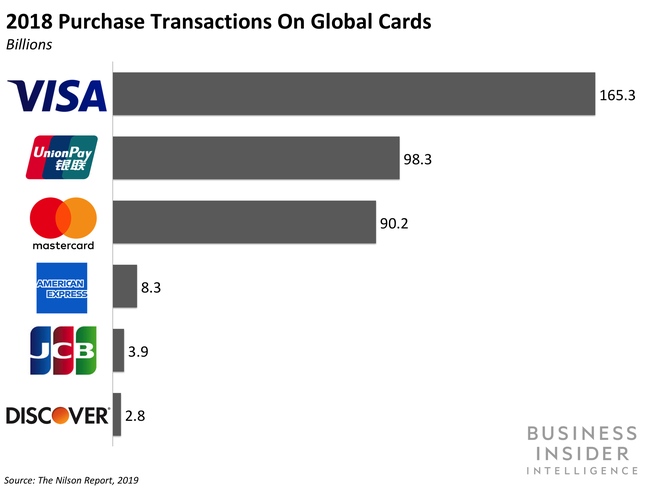
Along with Russia’s own banking payment system MIR which was launched in 2015, Chinese company UnionPay will be managing the card payment systems of Russian banks. As ATMs and business corporations in Russia will no longer support cards supported by foreign companies, Russian customers will have to switch to newer debit/credit cards issued by Russian banks supported with MIR and UnionPay. Notably, UnionPay already have significant presence in Russia, and a large number of Russians already use UnionPay cards issued by several Russian banks.
According to an UnionPay note issued in 2017, more than 85% ATMs accepted UnionPay cards for withdrawing Russian roubles. The company had said that about 600,000 POS terminals and 100,000 ATMs accepted UnionPay cards, and the numbers must have gone up in the last four years. Therefore, the transition from American companies to UnionPay should be smooth.
What is UnionPay ?
UnionPay which kicked off in 2013, is a Chinese payments managing company that issues banking cards and deals with operations related to banking transactions. With international recognizance in more than 180 countries, UnionPay International (a Global level subsidiary of China UnionPay) has issued banking cards in more than 70 countries. Headquartered in Shanghai, the company will soon operate in Russia in partnership with Russia’s local MIR.
Source: Business Insider
Amidst Russia’s global isolation, China has emerged as a key player in developing economic bonds with Russia. China and Russia also share close bilateral ties in trade which recorded a rise of 35.9% last year with total trade at $146.9 billion. The dragon also reverted to its own currency while pursuing trade with Russia with an aim to limit the US Dollar. The strategic bilateral partnership which has been underlined after Russia’s isolation by the West has is being termed the ‘DragonBear game’.
Amid the Russian invasion of Ukraine, the Denmark government is planning to exempt the Ukrainian refugees from the controversial ‘jewellery law’. Rasmus Stoklund, immigration spokesperson for the Social Democratic government, was quoted by Danish newspaper Ekstra Bladet saying the law should not be applied to the Ukrainians who come to Denmark to escape Russian military action.
The ‘jewellery law’ was passed in 2016, under which the police was allowed to confiscate valuables and cash above 10,000 kroner (Norwegian currency) which is equivalent to USD 1,100 approx from the migrants and asylum seekers. The valuables collected from asylum seekers were to be used to fund their stay in Denmark,
Since its launch, the law has faced criticism from across the globe. When the law was passed in 2016, Independent had quoted Per Fiig, the chief of the National Police Immigration Centre, saying “Danish police are paying daily attention to whether those asylum seekers and foreigners we encounter, who are here illegally, have valuables that can help to finance the costs of their stay. Now, police have found valuables that could be seized.”
Though it was passed in 2016, based on reports of 2019, the law was almost never implemented. Especially when it comes to jewellery, nothing was confiscated from the immigrants. The aim of the law was to fund the stay of the immigrants and asylum seekers in Denmark using valuables of the refugees themselves.
In Denmark, the majority of the refugees came from war-torn Syria at the time when the law was enacted. Speaking about the case of Ukrainian, Stoklund justified the plan to waive off the law suggesting they were regional neighbours of Denmark. He said, “The jewellery law is made for if you leave the nearby region where you are safe, and travel through (other) safe countries. But that is not the case for Ukrainians. We are in their nearby region.”
Demark plans to enact special residency law for Ukrainians
Another specific step that Denmark plans to take for Ukrainian refugees is to amend its rules for allowing them to stay for a longer duration. Currently, Ukrainians can stay in Denmark for 90 days without Visa. Though it is unclear what the changes would mean the government is set to introduce a bill to make it easier for the Ukrainians to stay in Denmark. Also, the government is planning to make amendments in Danish Labour Law to make it welcoming for the Ukrainian refugees.