Gearing up for the upcoming UP elections, Asaduddin Owaisi, president of the All India Majlis-e-Ittehadul Muslimeen (AIMIM) claimed at a rally that his life’s mission is to create political leadership for Muslims not only in Uttar Pradesh but also in every part of the country where Muslims reside.
मैं उत्तर प्रदेश अपने अना की तस्कीन की ख़ातिर या अपनी मक़बूलियत में इज़ाफ़ा करने के लिए नहीं आया हूँ बल्कि मुसलामानों की एक आज़ाद सियासी क़यादत बनाने आया हूँ। – बैरिस्टर @asadowaisihttps://t.co/c8IontrQ5F
In his address, the AIMIM leader also asked if the people have forgotten about the various Muslim conquests of the past. He listed the conquest of Mecca, Siege of Ta’if and Battle of Karbala among others. Owaisi asserted that the Muslims have crossed rivers of blood in the past and that in the foundation of Islam, there is blood of their ancestors.
He also claims that there is no reason for the Muslims to fear and says, ‘…Whenever someone is born in this world after staying in her mother’s womb for 9 months, Allah writes the destiny of that child and no one can take its life unless Allah decides…’
He further adds, ‘..This is our country…remember this is our country. Our ancestors gave life for the freedom of this country.’
Owaisi also pointed out that Muslim Ulema prescribed Jihad against British rule and asked if those sacrifices of the Muslims of the past would be forgotten because of fear. He said, ‘…If you want to create fear, then create the fear of Allah…’
Owaisi then said, ‘…We will fight for our rights, and we are not saying that we will bring stars from the sky or bring land from the moon. What we are saying is that Majilis flag would waver in the land of Nanpara in Uttar Pradesh.’
Uttar Pradesh is set to go to polls early next year, with Chief Minister Yogi Adityanath seeking reelection from the BJP. The BJP has allied with the Nishad Party ahead of the polls.
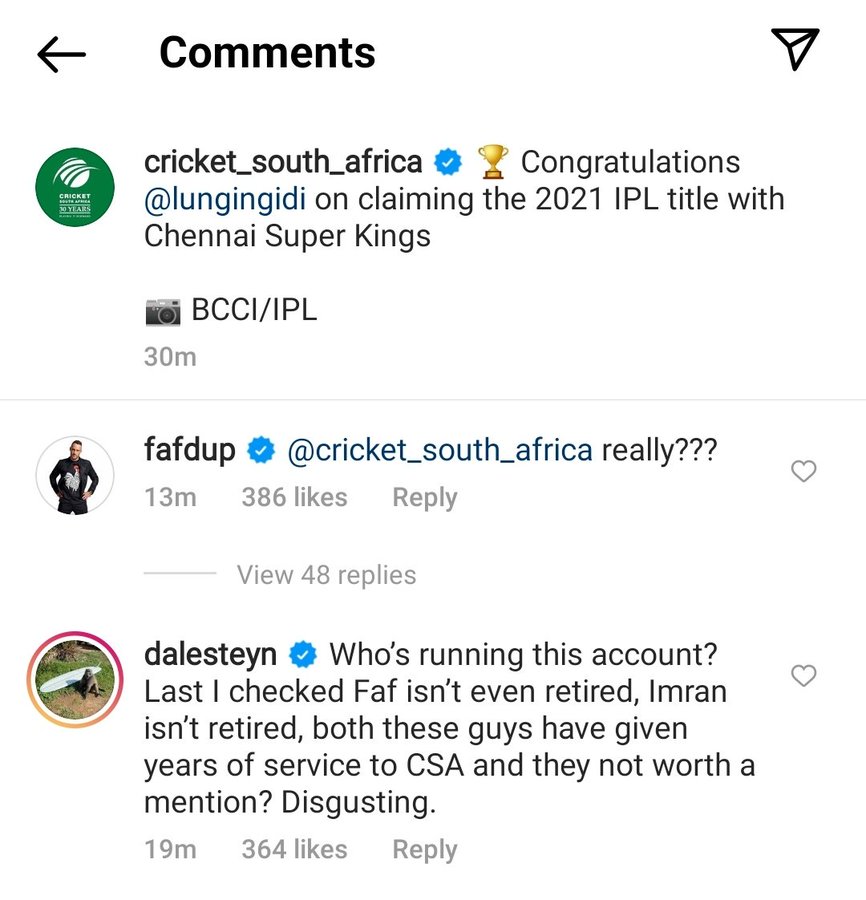
Cricket South Africa (CSA) has stirred a massive controversy after a contentious post on its social media accounts. After Chennai Super Kings (CSK) won their 4th Indian Premier League (IPL) title on Friday, CSA congratulated Lungi Ngidi for the win, a pacer with CSK.
However, Cricket South Africa conspicuously left out Imran Tahir and Faf Du Plessis from the post, who both play for CSK, drawing sharp criticism from former cricketers and fans alike. Ngidi played only 3 matches in the IPL this season, picking 5 wickets at an economy rate of over 10.
Faf Du Plessis, on the other hand, scored over 600 runs in the tournament, missing out on the Orange Cap, awarded to the highest run getter, by a whisker to teammate and and opening partner Ruturaj Gaikwad.
On Instagram, former South African pacer Dale Steyn called the post disgusting for not mentioning Tahir and Du Plessis. The latter expressed his shock as well.
Dale Steyn outraged by CSA post
On Twitter, Dale Steyn said that Cricket South Africa has opened “a can of worms for themselves” with the post on Instagram and Twitter. The post has apparently been deleted from both the platforms.
CSA opening a can of worms for themselves with their Twitter and Instagram. Whoever’s running those accounts needs a talking too.
Terrible from Cricket South Africa – Imran Tahir and Faf Du Plessis are modern day greats for them and they have treated them so badly in last few years. pic.twitter.com/xHU0s343nr
Faf Du Plessis will not be playing for South Africa in the T20 World Cup that is set to begin in a few days time. On his absence from the T20 squad, selection convener Victor Mptisang had said, “Faf has got a wonderful record but we wanted to be consistent in the selection and this is the group of players we have gone with. When you’re working with free agents, you have to come together that works for both the team and the free agents, they’re obviously attracted to various leagues and then the squad has its own requirements on how they build towards a World Cup.”
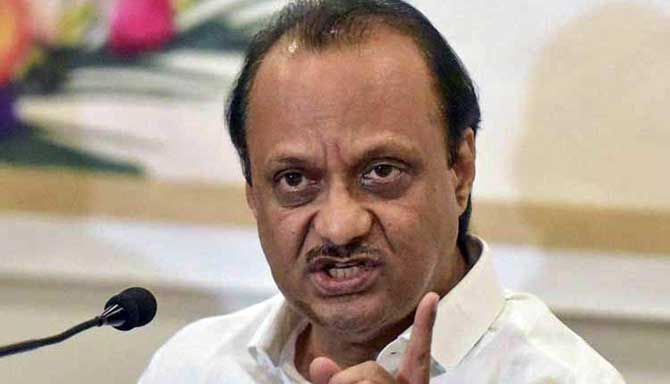
The Income Tax department on Friday said that it has found unaccounted income of Rs 184 crore after its searches on October 7 at multiple premises of two real estate groups in Mumbai linked to the family of Maharashtra Deputy Chief Minister Ajit Pawar.
Without explicitly naming Ajit Pawar or his relatives, the tax department said the evidence it gathered during raids on 70 premises spanning across Mumbai, Pune, Baramati, Goa and Jaipur pointed towards several prima-facie unaccounted and benami transactions. The department said suspiciously procured funds were used to buy properties at these places, besides making investments in a sugar mill.
The IT department on Friday had issued a statement saying “incriminating documents evidencing unaccounted income of about Rs 184 crore of the two groups have been found.”
“The search action has led to the identification of transactions by these business groups (builders) with a web of companies which, prima facie, appear to be suspicious. A preliminary analysis of the flow of funds indicates that there has been an introduction of unaccounted funds in the group by way of various dubious meth-ods like the introduction of bogus share premium, suspicious unsecured loans, receipt of unsubstantiated advance for certain services, collusive arbitration deals out of non-existent disputes. It has been observed that such a suspicious flow of funds has taken place with the involvement of an influential family of Maharashtra,” the IT department said in the statement.
Sources who are privy to details of IT raids told Times of India that they had noticed dubious transactions related to Ananta Merx Pvt Ltd, the company of Ajit Pawar’s son Parth, which was incorporated last year with its registered office address being Nirmal Building at Nariman Point. During the searches conducted on October 7, the agency had seized more than Rs 2.1 crore in unaccounted cash and jewellery worth Rs 4.3 crore.
Ajit Pawar says he is upset over involvement of his sisters in the IT raids
Earlier this month, the tax agency had raided a firm where Pawar’s Son, Parth is a director, along with a few firms owned by Pawar’s sisters, real estate firms linked to Pawar, and premises of directors of four sugar mills across the state that were allegedly linked to the Pawar family.
Pawar was then unflustered by the raids but was upset that his sisters were being involved in the searches. “Raids were carried out on my sisters’ houses. Jarandeshwar sugar factory directors have been raided. This is very low-level politics. Just because they are related to me, they are being harassed. Sharad Pawar was also troubled in a similar manner. I don’t know why these raids are being conducted,” he had said.
Ajit Pawar had further added, “my only grief is that they conducted raids on the premises related to my three sisters. One of them stays in Kolhapur and the other two in Pune.”
Ajit Pawar’s uncle and NCP supremo Sharad Pawar had also weighed in on the raids carried out by the Income Tax department. He had then accused the Centre of blatantly misusing central agencies to destabilise the Maha Vikas Aghadi government led by Uddhav Thackeray. “The Centre is employing the use of CBI, ED, NCB, and IT department to intimidate MVA leaders but now they have been pressed into service to target relatives of top leaders of the Congress, NCP and Shiv Sena,” he had said on Wednesday this week.
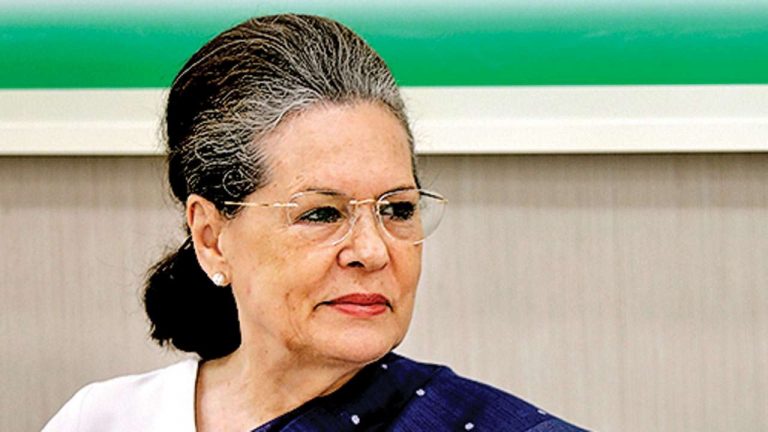
After a consistent delay, the elections for the next national president of the Indian National Congress (INC) will likely be held in September 2022, almost a year later, sources said on Saturday. The post of Congress president has remained vacant since party leader Rahul Gandhi resigned after the 2019 Lok Sabha polls. Since then, Sonia Gandhi is leading the party as interim president.
Party general secretary KC Venugopal announced that the election of the AICC president will be held between August 21, 2022, and September 20, 2022.
Despite almost a year remaining for the elections to take place, Sonia Gandhi, the interim president of the Congress, today attempted to put herself forth as the only viable contender for the position. She made her intention clear at the key meeting of the Congress Working Committee (CWC) that was chaired by interim party chief Sonia Gandhi and attended by 52 party leaders on Saturday, October 16.
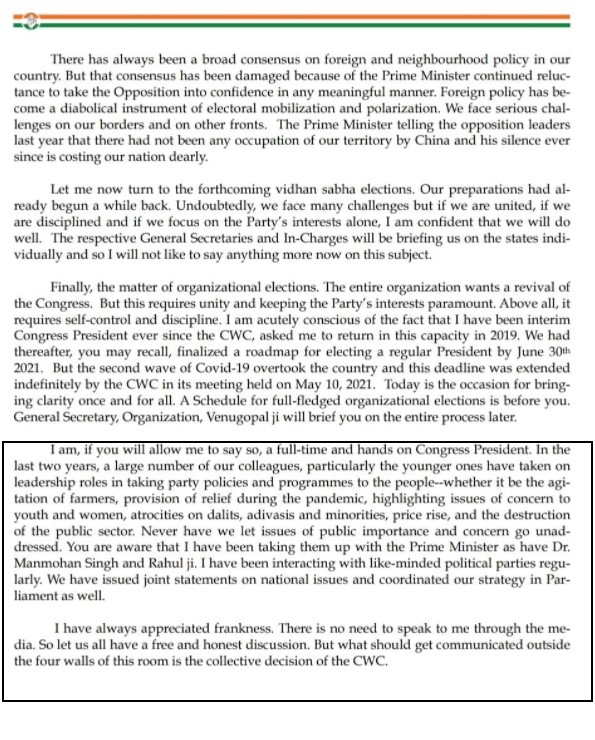
In her opening remarks at the Congress Working Committee (CWC) meeting, Sonia Gandhi said: “I am, if you will allow me to say so, a full-time and hands-on Congress President.”
Sonia Gandhi added that in the last two years since she has taken up the role of the interim president she has never let any issue of public importance or concern go unaddressed.
Excerpt from Sonia Gandhi’s opening statement at CWC meeting held today
“You are aware that I have been taking them up with the Prime Minister as have Dr Manmohan Singh and Rahul ji. I have been interacting with Like-minded political parties regularly. We have issued joint statements on national issues and coordinated our strategy in Parliament as well.
I have always appreciated frankness. There is no need to speak to me through the media. So let us all have a free and honest discussion”, added Sonia Gandhi, attempting to position oneself as the most deserving candidate for the position.
Notably, Congress was due to elect a full-fledged party president by June 2021 end. However, the CWC in its meeting held on May 10, 2021, had deferred the election citing the second wave of COVID-19. The party had then not fixed a timeline for the next election.
Rahul Gandhi to consider becoming Congress president
In the meantime, Rahul Gandhi has also said that he will consider becoming the Congress party president again. Reportedly, was requested by senior leaders to become the president at the CWC meeting today, and he said that he will consider the same. He also said that he needs clarity at the level of ideology from party leaders. The ANI report further added that some leaders suggested that Rahul Gandhi should become the working president till the elections for the post are held.
Senior party leader Ambika Soni said after the meeting that everyone in the party unanimously agreed that Rahul Gandhi should become the party president.
Sonia Gandhi never gave up Congress’ reigns
Interestingly, Sonia Gandhi has continued to be the interim President of Congress since August 2019 as the party has to date not elected a full-time party president.
She was made the ‘interim’ party president in 2019 after Rahul Gandhi had quit as party president after the defeat in the 2019 general elections. While Rahul Gandhi was adamant that the party president’s post should not go to a Gandhi and should go to a younger leader, eventually his 72-year-old mother was made the leader again.
Prior to him, Sonia Gandhi herself had held the post of party president till December 2017. In fact, she served as the party head for almost twenty years.
When she had become the Congress president for the first time in 1998, the then Congress chief Sitaram Kesri was reportedly locked up in a bathroom in Congress headquarters at Akbar Road so he could not stop Sonia Gandhi from entering the office with her supporters to take over as the party president.
After she was made the interim president of the party in 2019, her tenure had come to an end last year on 10th August 2020. However, she continued to be the interim President of Congress as the party had not elected a full-time party president till then.
Maharashtra Chief Minister Uddhav Thackeray on Friday took a swipe at the Narcotics Control Bureau stating that while the agency is recovering little quantity of drugs, the Maharashtra police have recovered drugs worth Rs 150 crore.
“They call people caught sniffing a pinch of Ganja mafia. All they are interested in is to catch celebrities, get their pictures clicked and make some noise,” Uddhav Thackeray said in his Dussehra speech while speaking on the ongoing drugs issue in Mumbai after the arrest of Bollywood superstar Shah Rukh Khan’s son Aryan Khan in connection with a cruise rave party.
Without naming the narcotics agency and the central government, Uddhav said an attempt is being made to defame Maharashtra as a hub of drugs. He also pointed out the drugs seizure at the Mundra port earlier last month when the DRI recovered narcotics from two containers from a cargo consignment. Speaking at Shiv Sena’s annual Dussehra rally at Shanmukhanand Hall in Mumbai, Thackeray asked, “Is it (drugs seizure) only happening in Maharashtra? Drugs worth crores was seized from Mundra Port.”
“Maharashtra is being looked at through a different lens. While we are being targeted, why are places like Uttar Pradesh, where rapes happen, not criticised as well?” Uddhav said adding that politicians who have now lost power are trying to malign the state’s image like ‘jilted lovers sometimes throw acid on a girl who spurns them’. “If you are calling the Mumbai Police ‘mafia’, then what will you term the UP Police?” Thackeray asked.
Ex-Mumbai Commissioner accused former Maha HM of asking controversial cop Sachin Vaze to collect Rs 100 crore per month
Thackeray’s defence of the Mumbai Police came months after allegations of graft were levelled against the police force by the former Mumbai Police Commissioner Param Bir Singh, who had alleged that former Home Minister Anil Deshmukh had asked controversial cop Sachin Vaze to collect Rs. 100 crore every month from bars, restaurants and other establishments. Singh had made the allegations in a letter addressed to Maharashtra CM following which Anil Deshmukh had to submit his resignation.
In the letter, Param Bir Singh said, “Sachin Vaze, who was heading the Crime Intelligence Unit of the Crime Branch of Mumbai Police was called by Shri Anil Deshmukh, Hon’ble Home Minister, Maharashtra, to his residence several times in the last few months and repeatedly instructed to assist in the collection of funds for the Hon’ble Home Minister.”
Param Bir Singh further stated that staff members of Anil Deshmukh were also present during the episode. He stated, “The Hon’ble Home Minister expressed to Shri Sachin Vaze that he had a target to accumulate 100 crores a month. For achieving the aforesaid target, the Hon’ble Home Minister told Shri Sachin Vaze that there were about 1750 bars and restaurants and other establishments in Mumbai and if a sum of 2-3 lakhs was collected from each of them, a monthly collection of 40-50 crores was achievable.”
Aryan Khan drug case
On Sunday, October 3, Aryan Khan, Arbaaz Merchant and many other people were detained from a luxury cruise liner where a rave party was going on. As per reports, cocaine MD, charas and MDMA pills were found on Khan and others with him.
Khan has been remanded to NCB custody till the 7th of October. Arbaz Seth Merchant and Munmun Dhamecha were also sent to NCB custody along with Aryan. Later, they were denied bail and sent to 14 days of judicial custody. Khan’s bail order has been reserved by the court till October 20.
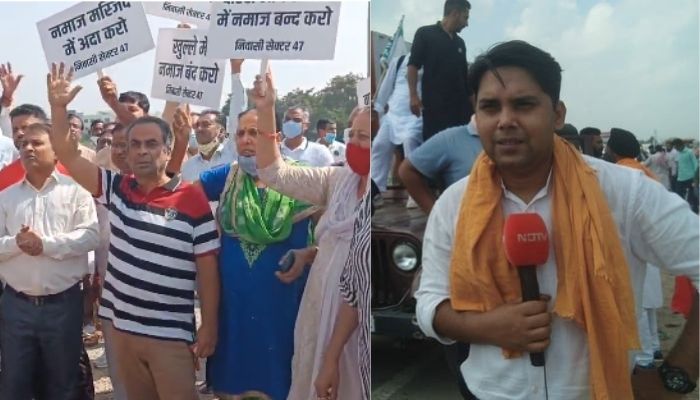
Hours after residents of Gurugram staged a peaceful protest against the offering of Namaz in public spaces, an NDTV journalist resorted to demonising Hindus and legitimising the nuisance created by public Namaz.
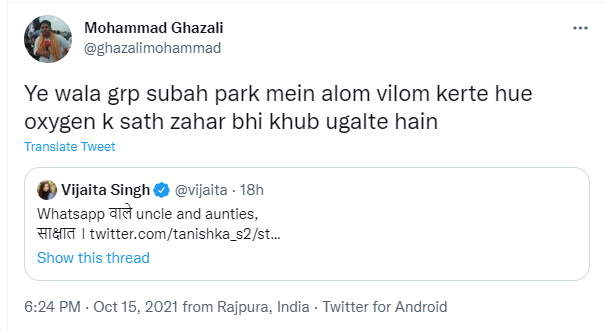
In a tweet on Friday (October 15), NDTV journalist Mohammad Ghazali stated, “Ya wala grp subah park mein alom vilom kerte hue oxygen k sath zahar bhi khub ugalte hain (This group of people do yoga during mornings in parks. Looks like they exhale venom along with oxygen).” Through his remarks, Ghazali rebuked the Hindus for objecting to Muslims praying at a public ground. Interestingly, he did not find anything wrong with the behaviour of his co-religionists creating law and order situation in the area.
Screengrab of the tweet by Mohammad Ghazali
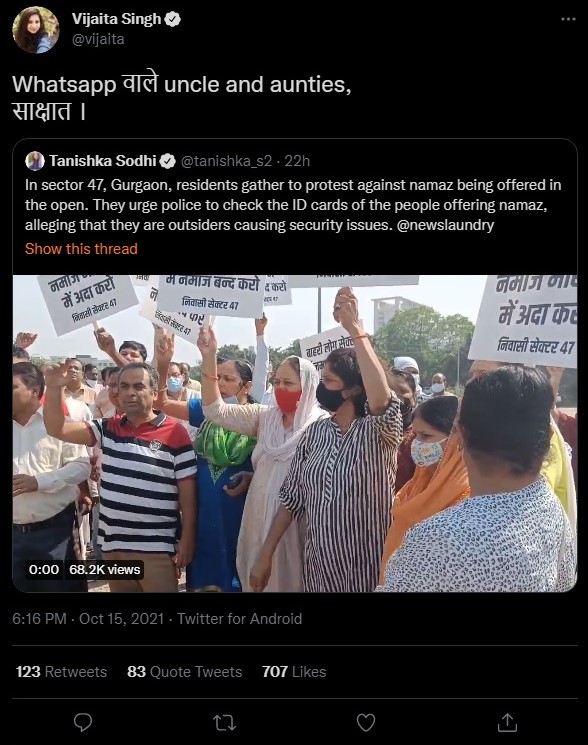
Mohammad Ghazali was responding to a tweet by ‘journalist’ Vijaita Singh.
Screengrab of the tweet by Vijaita Singh
Reportedly, the residents of Gurugram continued their peaceful protest against the offering of Namaz at a public ground opposite the State Vigilance Bureau office in Sector 47 for the fourth consecutive week. On Friday (October 15) afternoon around 100 people carrying placards, singing bhajan and raising slogans came to the ground. They were carrying a portable speaker and a mic.
They were also shouting slogans against Manohar Lal Khattar government for failing to stop namaz in public places. Their placards read ‘Namaz ki jagah khaali karo’ and they kept chanting and singing ‘Bharat Mata ki Jai’ and bhajans. There was heavy police deployment and they were stopped 100 meters away from where namaz was being offered.
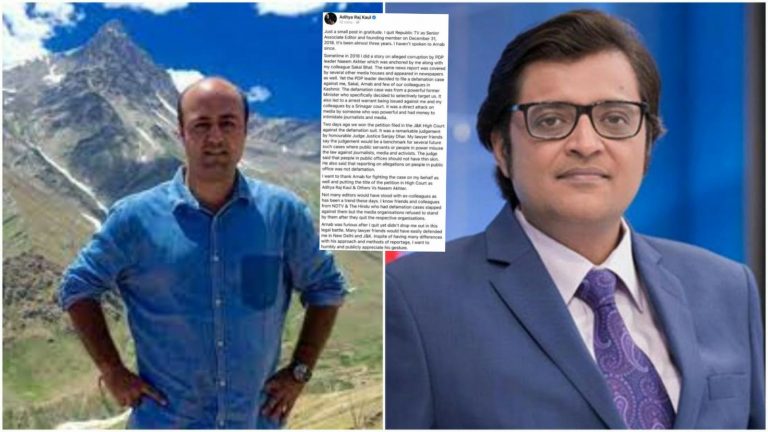
Two days after the Jammu and Kashmir High Court quashed a 2018 defamation case against Republic TV editor-in-chief Arnab Goswami, journalist Aditya Raj Kaul, Sakal Bhatt and others, Kaul has penned a heartfelt post in gratitude of the Republic TV chief.
In his social media post dated October 16, Aditya Raj Kaul thanked Arnab Goswami for standing by him and fighting the defamation case on his behalf, despite him not being associated with Republic TV anymore.
“I want to thank Arnab for fighting the case on my behalf as well and putting the title of the petition in High Court as Aditya Raj Kaul & Others Vs Naeem Akhter”, wrote Kaul, adding that not many editors would have sided with ex-colleagues as is the trend in today’s world.
“Not many editors would have stood with ex-colleagues as has been a trend these days”, wrote the journalist.
Kaul claimed that he knows friends and colleagues from media organisations such as NDTV and The Hindu who have had defamation cases filed against them, but that the media organisations refused to stand by them after they left the organisations.
“Arnab was furious after I quit yet didn’t drop me out in this legal battle”, wrote Aditya Raj Kaul, adding that he wants to publically and humbly appreciate Arnab’s gesture.
The full post written by journalist Aditya Raj Kaul is as follows:
Just a small post in gratitude. I quit Republic TV as Senior Associate Editor and founding member on December 31, 2018. It’s been almost three years. I haven’t spoken to Arnab since.
Sometime in 2018 I did a story on alleged corruption by PDP leader Naeem Akhter which was anchored by me along with my colleague Sakal Bhat. The same news report was covered by several other media houses and appeared in newspapers as well. Yet the PDP leader decided to file a defamation case against me, Sakal, Arnab and few of our colleagues in Kashmir. The defamation case was from a powerful former Minister who specifically decided to selectively target us. It also led to a arrest warrant being issued against me and my colleagues by a Srinagar court. It was a direct attack on media by someone who was powerful and had money to intimidate journalists and media.
Two days ago we won the petition filed in the J&K High Court against the defamation suit. It was a remarkable judgement by honourable Judge Justice Sanjay Dhar. My lawyer friends say the judgement would be a benchmark for several future such cases where public servants or people in power misuse the law against journalists, media and activists. The judge said that people in public offices should not have thin skin. He also said that reporting on allegations on people in public office was not defamation.
I want to thank Arnab for fighting the case on my behalf as well and putting the title of the petition in High Court as Aditya Raj Kaul & Others Vs Naeem Akhter.
Not many editors would have stood with ex-colleagues as has been a trend these days. I know friends and colleagues from NDTV & The Hindu who had defamation cases slapped against them but the media organisations refused to stand by them after they quit the respective organisations.
Arnab was furious after I quit yet didn’t drop me out in this legal battle. Many lawyer friends would have easily defended me in New Delhi and J&K. Inspite of having many differences with his approach and methods of reportage, I want to humbly and publicly appreciate his gesture.
J&K HC quashes 2018 criminal defamation case against Arnab Goswami and others by PDP’s Naeem Akhter
The Jammu and Kashmir High Court on Wednesday, October 13, quashed a defamation complaint filed by Peoples Democratic Party (PDP) leader Naeem Akhtar against Republic TV’s Arnab Goswami and journalist Aditya Raj Kaul, among others. Quashing the defamation proceedings pending before the court, the single-bench of Justice Sanjay Dhar observed that “reporting allegations about the official duties of a public figure cannot be considered defamatory.”
The court was hearing a 2018 defamation complaint filed by the senior leader of Peoples Democratic Party (PDP), Naeem Akhter, against the Editor-in-Chief of Republic TV, Arnab Goswami, journalist Aditya Raj Kaul, Sakal Bhatt and others.
The complaint against Goswami and Kaul, who was then an anchor for Republic TV, was filed in July 2018 under sections 499 (defamation) and 500 (punishment for defamation) of the Ranbir Penal Code before the court of Chief Judicial Magistrate, Srinagar by Peoples Democratic Party (PDP) leader Naeem Akhtar.
Apple has removed a popular Quran app from its app store in China that permitted users to read or listen to the Quran. ‘Quran Majeed’ is claimed to have hosted illegal content, although it is not clear what the controversial contents precisely were. The app was removed following a request by government officials.
‘Quran Majeed’ was developed by Pakistan Data Management Services. The developer told the BBC, “According to Apple, our app Quran Majeed has been removed from the China App store because it includes content that requires additional documentation from Chinese authorities”.
“We are trying to get in touch with the Cyberspace Administration of China and relevant Chinese authorities to get this issue resolved,” PDMS added. The app has close to one million users in China.
Apple refused to comment on the matter and directed BBC to its ‘human rights policy’, which says, “We’re required to comply with local laws, and at times there are complex issues about which we may disagree with governments.”
Meanwhile, Audible (Amazon’s audiobook service) and some apps for reading the Bible have also reportedly disappeared from the Apple Store. Audible apparently removed its app in China “due to permit requirements.” AppleCensorship, a watchdog website that monitors such developments, was the first to detect the removals.
Islamic groups have accused Apple of enabling China’s persecution of its Muslim population. “If American corporations don’t grow a spine and stand up to China right now, they risk spending the next century subservient to the whims of a fascist superpower,” said Edward Ahmed Mitchell, the national deputy director of CAIR, a group whose links to Islamist outfits are well known.
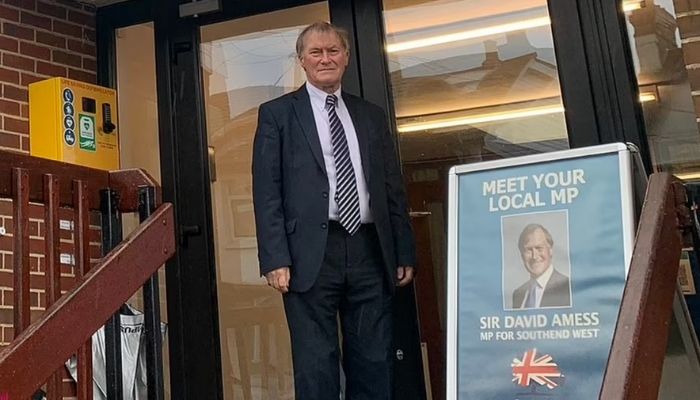
On Friday (October 16), a 69-year-old British Conservative MP Sir David Amess was assassinated by a 25-year-old Islamic terrorist of Somali descent in Leigh-on-Sea in Essex. Sir Amess remained a Conservative leader for about 40 years and represented the Southend West constituency.
As per reports, the Parliamentarian was holding a ‘constituency surgery’ at the Belfairs Methodist Church, which is located at Eastwood Road North. It was a common practice for Sir Amess to meet his voters on Friday and address their concerns. The 25-year-old radical Islamist blended into the crowd and waited patiently for his turn. Although he hailed from Somalia, he had acquired British citizenship. At around 12:05 pm, the accused leapt onto Sir David Amess and stabbed him with a knife. The Conservative Party MP was attacked 12 times, following which he collapsed on the ground. The police were called in and reportedly they arrived within minutes.
While he lay in a pool of blood, paramedics tried their best to save him. Sir Amess succumbed to his injuries at around 3 pm, before being taken to the hospital. While speaking about the incident, a Conservative Councillor John Lamb stated, “He was doing a surgery in the Methodist church here to speak to local people and pick up on their problems. I’m told that when he went in for his surgery there were people waiting to see him, and one of them literally got a knife out and just began stabbing him.”
Islamic terrorist did not flee the crime scene
According to eyewitnesses, the Islamic terrorist made no attempt to flee the crime scene and waited ‘calmly’ for the police to arrive. Scotland Yard has stated that they will treat the assassination as a ‘terror attack linked to Islamic extremism.’ In this regard, the police raided two houses in London and took the Somali terrorist in custody. The cops are of the belief that the perpetrator acted on his own accord and was possibly radicalised during the Coronavirus lockdown. The police have appealed to the public to provide evidence (CCTV footage, dash cam videos) pertaining to the case.
Act of Islamic terrorism, says police
The Metropolitan Police has said that the killing of the Conservative MP was an act of terrorism linked to Islamic extremism.
“The fatal stabbing in Leigh-on-Sea has tonight been declared as a terrorist incident, with the investigation being led by Counter Terrorism Policing,” the police said. The statement issued by the Metropolitan Police added, “The early investigation has revealed a potential motivation linked to Islamist extremism.”
Boris Johnson paid homage to Sir David Amess
In a video message, Boris Johnson shared condolences with the family of Sir David Amess. Remembering him as ‘one of the kindest’ politicians, the British Prime Minister remarked, “David was a man who believed passionately in this country and in its future. We’ve lost today a fine public servant and a much-loved friend and colleague. (He had an) outstanding record of passing laws to help the most vulnerable”
All our hearts are full of shock and sadness at the death of Sir David Amess MP.
In light of the attack, Home Secretary Pritish Patel has directed the police to review security arrangements of all Parliamentarians.
Mosques in UK preach Taliban, ISIS-like lifestyle of the ultra-orthodox community
Noted professor and political advisor Ed Husain, a former radicalised Muslim, had earlier come up with a fascinating study about how mosques in the United Kingdom were trying to control Muslim-dominated areas in the country. He had explained the community’s efforts to enforce Taliban-like lifestyle in major cities of the United Kingdom, reported Daily Mail.
In his latest book – ‘Among The Mosques: A Journey Across Muslim Britain‘, author and political advisor Ed Husain had documented in detail how Islamic societies in the UKwere slowly occupying households in the country and were enforcing strict Taliban-like rules.
The author had documented how areas like Bolton, Dewsbury and Blackburn were described as ‘a different universe’ and had observed how a Muslim could spend months with no contact whatsoever with mainstream ‘white’ Britain’ in certain parts of the British cities. Among the areas Ed visited was Blackburn, the global hub for the Deobandis and the Tablighi Jamaat.
“The horrific image of Lakhbir’s dead body should haunt each of us. It should haunt each and every ‘peaceful protestor’ who didn’t do anything to stop it. It should haunt each and every soul who betrayed the gurus by being a tool and witness of oppression. It should haunt every human who boasts of humanity and equality in society. It should haunt every ideology that failed to save him. It will haunt me, as I assumed that he was in a safe space. No space is safe for us. No system is safe for us. We can’t risk our lives on any brahminical structure or system anymore. I failed Lakhbir Singh. We failed Lakhbir and his family and the families of thousands of our people. And we’ve been continuously failing them, us and ourselves”, read an Instagram post by one Ambedkarite after the brutal killing of Lakhbir Singh by Nihang Sikhs at the Kundli border, where ‘farmers’ are protesting.
The operative word in the post was, of course, the “Brahminical structure or system” and the post opened with how it should haunt every “peaceful protestor” who did not do anything to stop the lynching and every soul who “betrayed the gurus by being a tool and witness to oppression”.
Lakhbir Singh who was brutally murdered by Nihang Sikhs had reached the farmer protest site at the Kundli border a week ago. The locals have been reported as saying that he was there to do sewa and was often seen in the Gurudwara set up at the protest site.
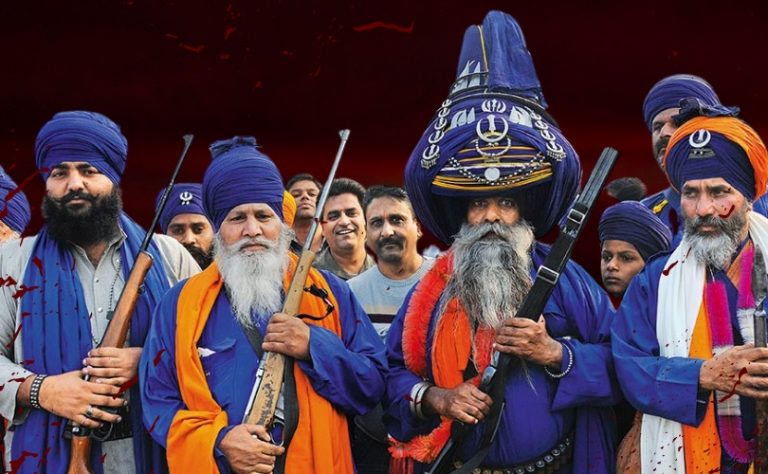
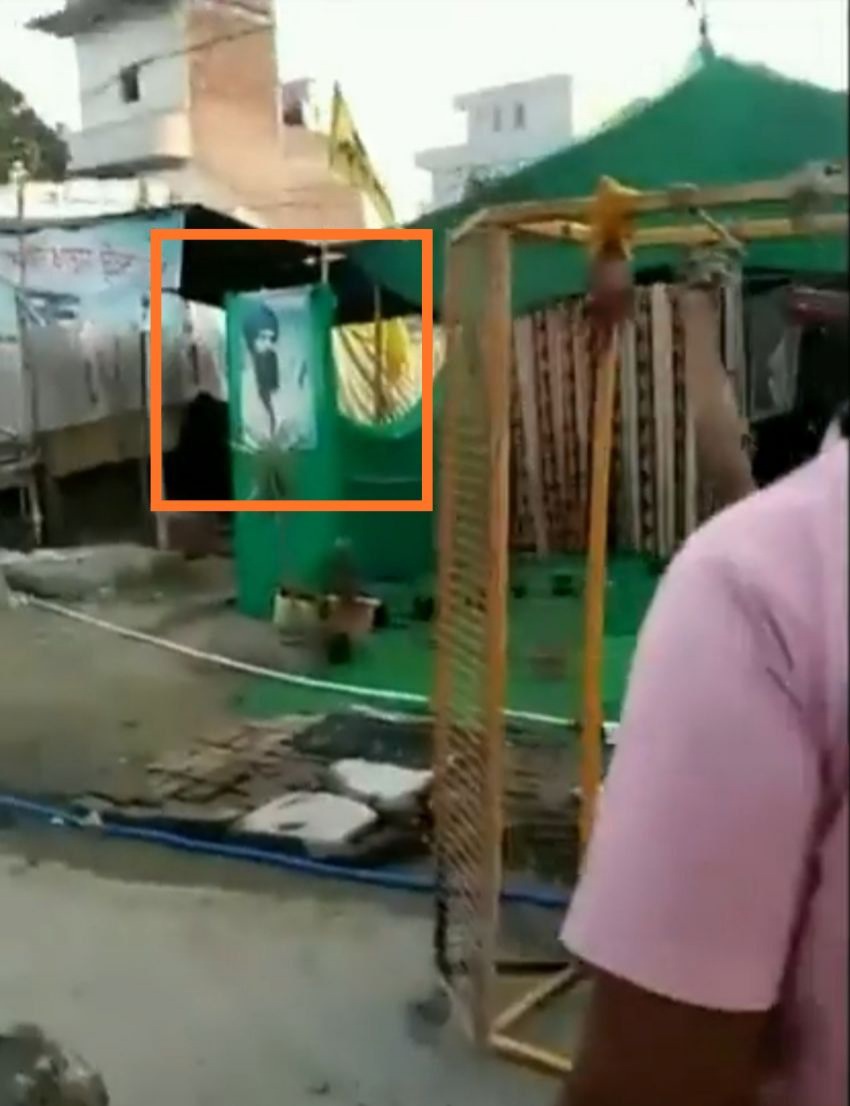
Essentially, Lakhbir Singh was a Punjabi himself who was at the protest site to do ‘sewa’. He was murdered by Nihang Sikhs who are considered to be the warrior class established by Guru Gobind Singh himself. The protestors at the site are also Sikhs, the staunchest kinds. In fact, the protest site even has Khalistanis who want an ‘independent Punjab’ and worship Khalistani terrorist Jarnail Singh Bhindranwale, who murdered thousands of Hindus. When a video of Lakhbir Singh went viral, hung from the police barricade, one could see the poster of Bhindranwale in the background.
Screengrab of the video where poster of Bhindranwale is visible
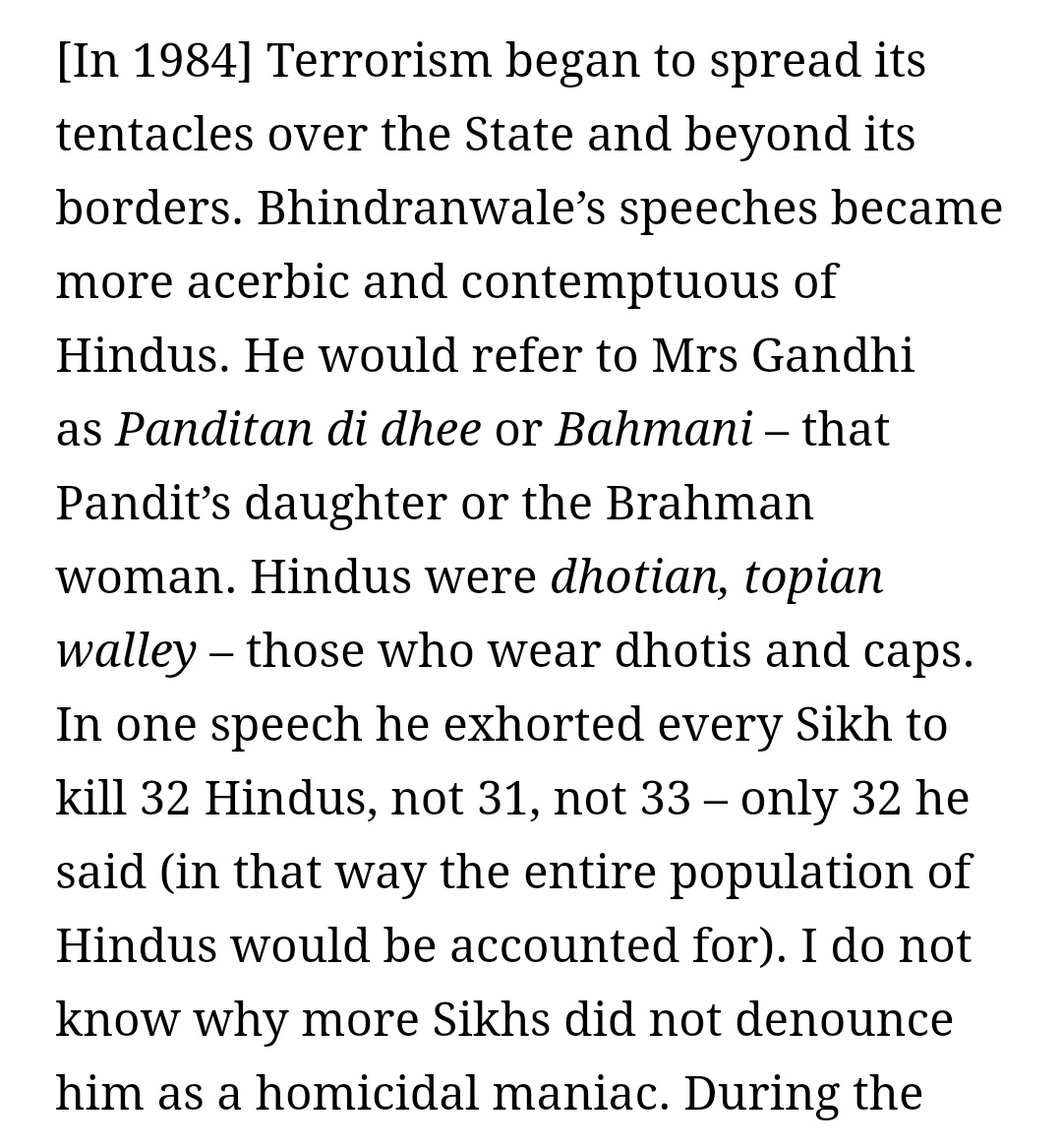
The Khalistan movement and Jarnail Singh Bhindranwale itself was extremely anti-Hindu and anti-Brahmin. In his book, Khushwant Singh wrote about how the Khalistan movement was anti-Hindu.
Khushwant Singh’s book
Bhindranwale would, in derision, call Indira Gandhi a ‘panditain’ or ‘Bahmani’. In his speeches, he had asked to kill 32 Hindus so the entire Hindu population would be “taken care of”. He used to call Hindus as Dhotian and Topian wale.
It is recorded history that Khalistanis had thrown a cow head inside the Durgiana temple.
In 1982, in what was a completely unprovoked attack, the Dal Khalsa “activists” threw a severed cow head inside Durgiana temple. pic.twitter.com/IAGQqpkX7Z
n 1982, Khalistani radicals hung tail of a cow inside the Mahakali temple of Patiala. Devotees were shocked to see the tail of a cow hung inside the Garba Griha of the temple.
In 1982, Khalistani radicals hung tail of a cow inside the Mahakali temple of Patiala. Devotees were shocked to see the tail of a cow hung inside the Garba Griha of the temple. pic.twitter.com/K6ldeIkVZW
With the Khalistani movement being anti-Hindu and anti-Brahmin specifically, it is a wonder how the murder of a Sikh man by Sikh radicals became a burden that Hindus and/or Brahmins have to bear.
Hindus or even Brahmins or even Dalit Hindus had nothing to do with the brutal incident at the Kundli border.
But that Instagram post was not the only one blaming the ‘caste politics’ of Hindus for the incident. Several other Ambedkarites started playing their caste politics to bring Hindus down.
Dilip Mandal, who sees caste everywhere and has been accused of discriminating against Brahmin students took to Twitter to say that Dalits are oppressed everywhere, sometimes for touching food, sometimes for ‘idols’ and sometimes for books.
कोई खाना छू देने पर मार देता है, कोई मूर्ति छूने पर पीट देता है, कोई धार्मिक किताब छूने पर मार देता है। साबित करो कि तुम लोग आदमी ही हो।
Quoting a video of one of the Nihangs talking about how Sikhs murder people who insult the Guru Granth Sahib, Ambedkarites said that the truth is that he was murdered because he made the book impure by touching it, since he was a Dalit Sikh. While that maybe what the Nihangs had thought, the incident had nothing to do with Hindus.
The fact is Lakhbir Singh was killed for touching a religious book. It get polluted by the touch of a SC labourer. So they killed him to maintain the purity. Shame! #JusticeForLakhbirSinghpic.twitter.com/9ShP1Y0xDh
Lakhbir was killed bcoz he was a SC labourer and touched a religious book. The argue of ‘बेअदब’ (insult) reflects their caste supremacy as they thinks that a SC polluted the book by touch. #JusticeForLakhbirSinghpic.twitter.com/fO99BIKUUw
While caste discrimination is a reality among Sikhs, the insinuation of the posts were extremely clear. They repeatedly equated the Nihangs considered Dalit Sikhs as impure while drawing a false equivalence to Hindus in an attempt to tarnish Hinduism.
The bane of Dalit Activists of our times is that they hardly stand for the rights of the marginalised and speak up for Scheduled Caste individuals who might be getting persecuted. What they do is, instead, stand against Hinduism and every incident is turned into a caste battle just to pull Hindus down. The insinuation that Lakhbir Singh was killed because of the “Brahminical structure” was evident from the first Instagram post and most other posts that tried to distract from the main issue – Pious Sikhs who were a part of the farmers protest brutally murdered a man at the protest site of Samyukt Kisan Morcha.
The blame for the shocking incident lies with the Sikh community, the Nihangs and the “farmers” who have indulged in rampant violence ever since the protests against the three farm laws began.
The disingenuity of their argument is apparent when they wish to compare the “upper caste Jatt Sikhs” to Brahmins, insinuating that the “upper caste Sikhs” follow the Brahminical structure.
One recalls how Mukesh, a Brahmin man was burnt alive only a few months ago by these very Farmers and Jatt Sikhs.
Mukesh, 42, was the eldest of Jagdish Chandra’s three children. On June 16, 2021, Mukesh succumbed to burn injuries after fellow farmer protestors allegedly set him ablaze at the Tikri border protest site. Villagers had then alleged that Mukesh’s murder was a conspiracy to make him appear as a ‘martyr’ against the farm laws.
OpIndia talked to the bereaved mother, who is still finding it hard to come to grips with the reality that her son was allegedly killed by agitators pretending to be fighting for the rights of farmers. Shakuntala, Mukesh’ mother remembers her son left the house on Wednesday evening for a walk to the nearby field. When we asked her who killed her beloved son, Shakuntala says the protesters killed him. Mukesh had that evening gone for a walk to the nearby field, where farmers protesting against the three farm laws had put up their tents.
Even when Mukesh had been killed, the ‘farmers’ had tried to divert any responsibility from themselves and tweeted an unclear video, claiming that the farmers had not set Mukesh on fire. However, OpIndia had accessed his dying declaration where he clearly said that it was the “farmers” who had set him on fire.
It would appear that every time brutality is unleashed by these farmers, there foot soldiers attempt to shield the movement by floating a grand narrative that diverts attention from the real issue. When Mukesh was murdered by the farmers, the grand narrative was that a conspiracy was being hatched to “defame” the farmers movement. Even now, when Lakhbir Singh was murdered, several individuals claimed that he was sent by the “agencies”.
It would now seem like the Ambedkarites have resorted to shielding the farmers by talking about “caste construct” and blaming Hindus for an incident that was perpetrated by the Nihang Sikh at the site of the farmers’ protest. While caste exists among Sikhs, the murder of Lakhbir Singh certainly has nothing to do with Hindus or Brahmins. It is a product of Khalistani elements and Nihang Sikhs being a violent lot and the farmers protest harbouring terrorists who first killed Mukesh, a Brahmin man and have now murdered Lakhbir Singh. Any attempt to divert the conversation from the culpability of Khalistani elements and the farmers themselves is one that whitewashes the crime and denies justice to Lakhbir.