Home Blog Page 3908

From improved road connectivity to scenic mountains that are now accessible, Arunachal Pradesh CM shows how the state has transformed under Modi govt

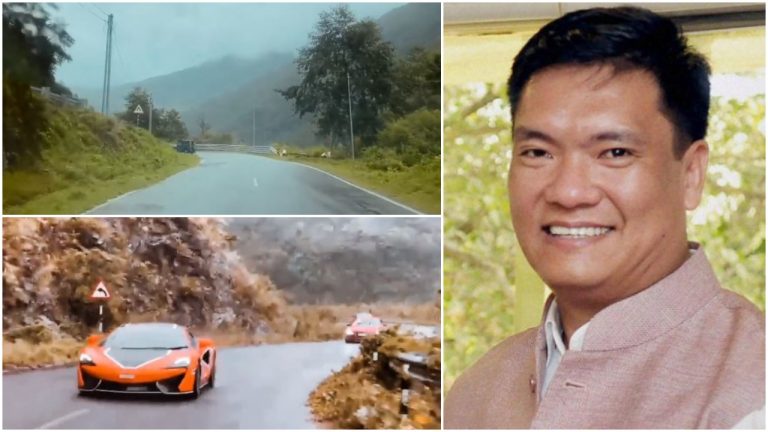
Pema Khandu, the Chief Minister of Arunachal Pradesh, has taken to Twitter to share some delightful pictures and videos of how the vast areas and roads in the state have been transformed after the BJP government has accelerated strategic infrastructure projects in Arunachal Pradesh and other northeastern states.

Captioning his Tweet: “Mera desh badal raha hai…aage badh raha hai” shared a snippet of the picturesque and pristine newly constructed Trans Arunachal Highway connecting Roing to Namsai (86km) over NH13 and NH15. The CM informed that the distance between Roing to Namsai, which” earlier took 7-8 hours crossing numerous streams and rivers, and trudging dodgy roads”, can now be covered in merely one hour.

On September 20, the CM shared pictures of supercars cruising through some of the finest roads in eastern Arunachal. “Supercars are back cruising through some of the finest roads in eastern Arunachal, speeding straight and negotiating fine curves. Here the luxury sports-car vrooms past the highways in Dambuk, Roing, Tezu, Namsai and Changlang”, wrote Pema Khandu while sharing a video of the supercars racing past the highways.

Similarly, on September 17 the CM had also shared a snippet where supercars were seen making their way through the highways of Arunachal.

Recently, Arunachal Pradesh had gained limelight after supercars owned by businessman Gautam Singhania arrived in the state for cruising through its scenic landscapes. The arrival of cars was another testimony of the improved road transport and connectivity in the state in recent years.

The CM periodically keeps posting pictures and videos of the Trans Arunachal Highway, the pet project of the current BJP regime to connect all the remote border locations of Arunachal Pradesh.

The majority of the nearly 1,600 km highway is now open for traffic. It is believed that there is no other road in the country that compares to the Trans-Arunachal Highway in terms of beauty, landscape, road conditions, and wilderness. Not only is the road exciting to drive on, but the landscape and the scenery it guides you through will also leave you awestruck.

On September 17, the Arunachal Pradesh Chief Minister took his followers on a tour of the beautiful and meandering road that leads to his home in Tawang. “To my home – to Tawang. Reached my hometown today travelling through the scenic road”, wrote Khandu, while sharing his extraordinary journey through the exemplary Trans Arunachal Highway.

Intending to promote and create awareness around Arunachal Pradesh while also inviting tourists to the Covid-19 free state, Arunachal Pradesh CM Pema Khandu had in April 2021 flagged off the 15-day Trans Arunachal Drive 2021- a road trip from Namsai in the eastern part of the state to Tawang in the west.

The highway has connected 12 of the current 16 district headquarters, while an 848-kilometre link route connects the remaining four districts and the state capital.

The North-East states of India had long been neglected by previous governments. However, the Modi government has been very focused on developing connectivity and economic activities in the states to bring prosperity and development for all.

Started in 2008, the actual work of the construction of the Trans Arunachal highway began in late 2013 and was sped up during the Modi government. It is now nearly complete, with the exception of a few sections from Seppa to Yazali.

Both CM Pema Khandu and Union Minister Kiren Rijiju often share scenic pictures from Arunachal Pradesh, portraying the beauty of the hill state and how under the Modi government, the easternmost state of India is developing rapidly.
Remembering Bengal’s Pritilata Waddedar on her death anniversary, who chose to die at 21 than being caught by British

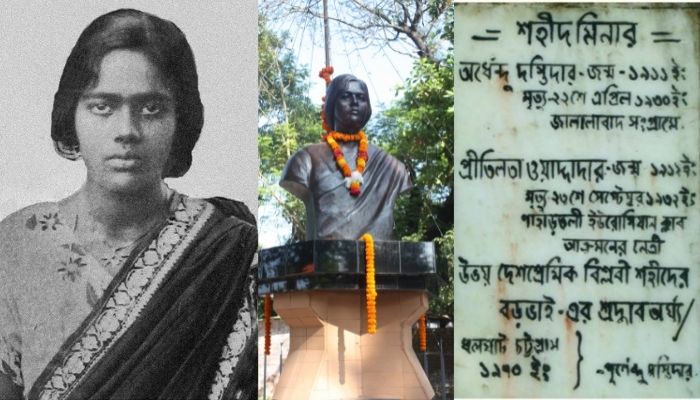
History is replete with examples of valour, grit and determination exhibited by India’s freedom fighters against the British Raj. While some of them featured prominently in history textbooks, others never received their deserved recognition. Even freedom fighters, who put down their lives for their motherland, also disappeared into oblivion. Such has been the case of Bengal’s first female martyr, Pritilata Waddedar. She made the supreme sacrifice on this day (September 23), 89 years ago.

Born to Jagabandhu Waddedar and Pratibha Devi on May 5, 1911, in Chittagong (present-day Bangladesh), Pritilata Waddedar was a bright student since her childhood. Her father was a clerk at the Municipality Offices and barely managed to make ends meet. Despite financial difficulties, Jagabandhu Waddedar provided his daughter good education. “My hopes are bound up with you”, he would often tell Pritilata Waddedar. She exhibited signs of ‘striking intelligence’ as a student at the Khastagir girl’s school in Chittagong.

Pritilata completed her matriculation in 1927, followed by her Intermediate examinations in 1929. She had secured the first rank among all candidates from the Dhaka Board. She joined the Bethune College of Kolkata to pursue her bachelor’ degree in Philosophy. It was around that time when her father lost his job, leaving the family’s responsibility on the shoulders of Pritilata Waddedar. She continued to pursue her education but her degree was withheld by the British authorities. Her degree was later awarded posthumously on March 22, 2012, by the University of Calcutta.

Pritilata Waddedar and her entry into revolutionary organisations

After completing her Bachelors degree, she returned to Chittagong and became the Headmistress of a high school named Nandankaran Aparnacharan School. During her Intermediate at Eden College, Pritilata began taking a keen interest in revolutionary activities and had joined freedom fighter Lila Nag in Dipali Sangha. Bengal in the 1930s had shunned Gandhi’s idea of ‘non-violence.’ Revolutionary organisations, espousing armed struggle against the British regime, had gained centrestage in Bengal.

Pritilata Waddedar was introduced to Masterda Surya Sen and Nirmal Sen, by one of her revolutionary brothers. It was rare for women in those days to be accepted in revolutionary groups. Pritalata Waddedar was not only accepted but was trained in fighting and leading attacks. Her inclusion into the Dhalghat camp of the Jugantar group, run by Surya Sen himself, drew the ire of fellow revolutionary leader Binod Bihari Chowdhury. However, Sen understood that it would be easier for a woman to transport arms without raising suspicion.

Although her inclusion was initially meant to deceive the British authorities, Pritilata Waddedar soon rose the ranks in the group. During the Chittagong Armoury raid of April 18, 1930, Pritalata Waddedar was successful in destroying telephone lines, telegraph office. Besides Surya Sen, she was also inspired by revolutionary Ramakrishna Biswas. He was serving prison time in Alipore Central jail for killing rail officer Tarini Mukherjee mistakenly, although his target was the General Inspector of Police (Chittagong) Craig.

Pritilata Waddedar was firm in her resolve, willing to die for the motherland

Owing to her deception skills, she was able to meet Biswas in jail about 40 times without raising any suspicion. Pritilata Waddedar easily passed off as his elder sister. When Biswas was hanged to death in 1931 by the British authorities, the incident fuelled her revolutionary ideas even more. Freedom fighter Kalpana Dutta shared her experience with Pritilata Waddedar in her book, ‘Chittagong Armoury raiders : Reminiscences.’

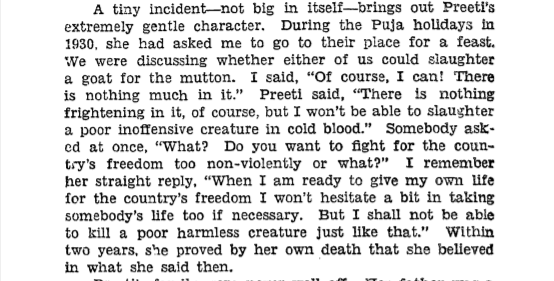
Excerpt of the book

She narrated how Waddedar was reluctant to sacrifice a goat on Durga Puja, thereby making fellow revolutionaries question her ability at armed struggle. “Do you want to fight for the country’s freedom too non-violently or what?”, Pritilata was asked. She replied, “When I am ready to give my own life for the country’s freedom, I won’t hesitate a bit in taking somebody’s life too if necessary.” The incident went on to show the resolve and the fire of patriotism that was burning in her heart.

The raid on Pahartali European Club

Pritilata Waddedar had a narrow escape when she went to meet Surya Sen on June 13, 1932. His hideout was surrounded by the British troops, leading to a confrontation. Although some revolutionaries were martyred, the duo managed to escape. The British authorities got alerted and they put her up on the list of ‘most wanted’ revolutionaries. Sen instructed Pritilata to remain underground for someone while the group hatched other plans. Masterda wanted to target a racist, white supremacist club named ‘Pahartali European Club’. The notice board outside the club read, ‘Dogs and Indians not allowed.’

The torched ‘Pahartali European Club’, image via Wikimedia

Revolutionaries, including Pritilata Waddedar, were tasked to conduct a raid and destroy the club on the fateful day of September 23, 1932. She was to lead a group of 40 people. Pritilata disguised herself as a Punjabi man while others wore shirts and lungis. The revolutionaries laid siege on the club at 10:45 pm and set it on fire. During the raid, one woman was killed while four other men were injured. The revolutionaries came under a counterattack from the police officials stationed inside the club.

Martyrdom and aftermath

Pritilata was injured by a bullet wound. To avoid being captured by the British, she consumed a pill of potassium cyanide. Her martyrdom at the tender age of 21 years sent waves of inspiration for other revolutionaries in Bengal. Kalpana Dutta recounted in her book how Surya Sen was against the idea of handing potassium cyanide capsules to Pritilata Waddedar.

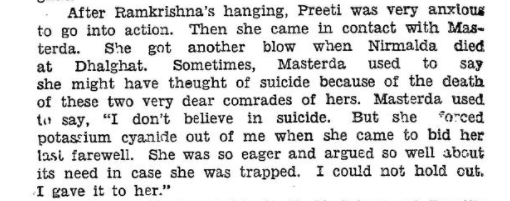
Excerpt from book

“I don’t believe in suicide. But she forced potassium cyanide out of me when she came to bid her last farewell. She was so eager and argued so well about its need in case she was trapped. I could not hold out. I gave it to her,” Masterda narrated. The participation of Pritilata Wadedar and her eventual martyrdom, therefore, became crucial as the armed revolution was largely a men’s affair.

Excerpt from book

Through her example, she sent out a message to the women of Bengal that they can march shoulder to shoulder with men in liberating the country from the British. In her book, Kalpana Dutta recounted how the parents of Pritilata Waddedar were devasted at her loss. “People of Chittagong have not forgotten Preeti or her great sacrifice. They point out her father to any stranger and say, ‘He is the father of the first girl who gave her life for our country,” she concluded.

References: Dutt, K. (1945). Chittagong Armoury Raiders: Reminiscences. India: People’s Publishing House.

Mundra Port drug seizure: Drug smugglers’ modus operandi revealed, Pakistani smugglers’ involvement suspected

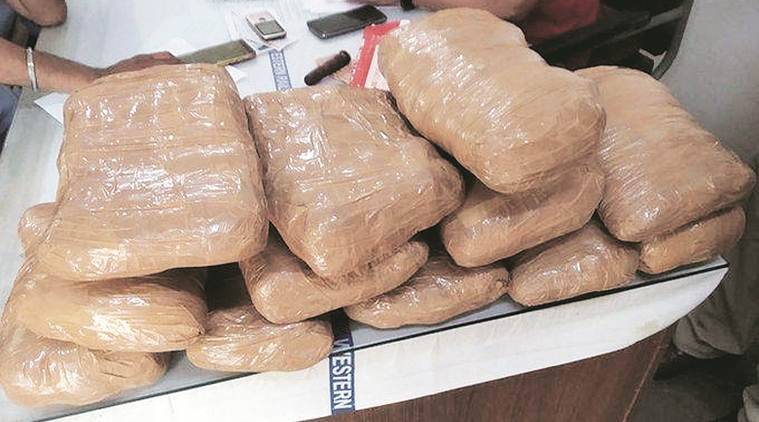
Revelations in the the 3,000 kg drug seizure from Mundra Port in Gujarat suggest that Pakistani nationals may be involved in the smuggling racket.

As reported by New18 Gujarati, the Pakistani drug smugglers would send the drugs to Iran where the further transactions are carried out at the Konarak port in Iran. Of the seven Iranian nationals arrested in the drug seizure, one of the accused has earlier been arrested by at least 3-4 countries in drug smuggling. Satellite phones and other communication devices are recovered which the authorities are currently investigating.

Report further suggests that they would come up with unique ways to smuggle drugs. The smugglers would put the drugs in fishermen’s net and throw in the sea to save hoodwink the authorities. As per R K Rajput, PI, ATS, the drug smugglers would also hide the drugs inside the cavities of the boat when Indian Coast Guard would come for verification and would pretend to be fishermen.

As per reports, further investigations have revealed that the Andhra firm that has been registered as official recipient of the drugs, had earlier imported similar consignment from Afghanistan in June this year. That consignment too was sent by M/S Hasan Husain Ltd and declared as containing ‘semi-processed talc stones’. The invoice was in the name of one Kuldip Singh, from Alipur, Delhi.

The Directorate of Revenue Intelligence (DRI) has taken custody of Chennai-based Machavaram Sudhakar and his wife Govindaraju Durga Purna Vaisali. The latter is the proprietor of the firm M/s Aashi Trading Company which is registered in Andhra Pradesh’s Vijaywada. The DRI is also conducting investigations in New Delhi, Chennai, Coimbatore, Ahmedabad, Mandvi, Gandhidham and Vijayawada.

Indian Express report states that the DRI told a Bhuj court that the consignment was of Afghan origin and that the accused were in touch with “Afghan and Irani nationals” and there was need to probe “probable threat perception involved”.

Sudhakar informed DRI that the firm was started in August last year and the consignment was received from Hasan Husain Ltd in Afghanistan through their local representative ‘Amit’. For this consignment, Sudhakar reportedly received two sets of documents and when he inquired from his Iranian contact ‘Javed’, he was informed that the consignment weighed 300 kgs extra than what the liner recorded. Hence, there were two sets of documents.

Reports suggests that two more such consignments that were on their way here have since been diverted. The Enforcement Directorate (ED) has also filed a money laundering case under the Prevention of Money Laundering Act (PMLA).

Islamists of Raza Academy triggered by Saudi Arabia’s decision to open cinema halls in Madina city, call for protests

The kingdom of Saudi Arabia, under its Vision 2030 plan, has allowed the building of cinema halls and entertainment centres in the city of Madina. Madina is a major Islamic pilgrimage centre and is regarded as the second holiest city in the Islamic faith.

The decision by the Kingdom of Saudi Arabia is part of a strategic framework to reduce the dependence of the country on oil and diversify it to other sectors such as health, education, recreation and tourism. However, the decision is being frowned upon by fundamentalist Muslims across the world, especially in India and Pakistan.

The outrage started after Mufti Muhammad Taqi Usmani, Pakistani Islamic scholar, former judge, and current Vice President and Professor of Hadith at Darul Uloom Karachi, quote-tweeted a November tweet of Municipality of Al-Madinah Al-Munawwarah and said, “Now there are plans to set up ten cinema halls in Madina too.” The tweet mentioned that they are planning to build 28 shops, ten cinema halls, 32 restaurants, 2 locations for entertainment, 19 open areas, and more on King’s Road. The project was expected to be completed in 14 months. The commercial establishments, however, will be outside the boundary of the holy place, as per reports.

The latest name to have jumped into the controversy is the infamous Raza Academy of Mumbai. They are running a campaign on social media platforms urging King Salman of Saudi Arabia to take back the decision. In the poster shared in the campaign, Raza Academy has demanded to impose a ban on cinema halls in Madina Shareef.

Following the trend, Mohsin Raza wrote, “Muslims go to holy cities to ask forgiveness from Allah not to commit sins by watching movies.”

One Farid Khan wrote, “Ban Cinema In Madina Shareef. Shame On You, Saudi Govt. Shame On You, King Salman.”

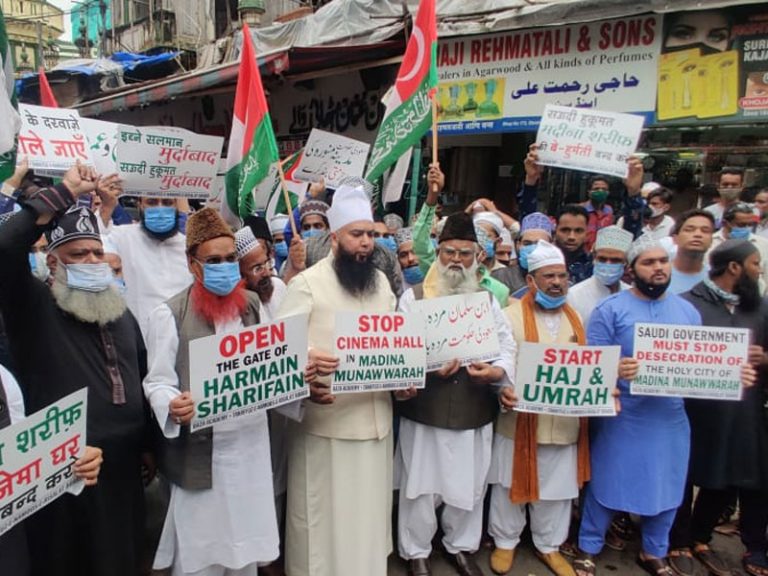
Raza Academy held a protest march and staged a demonstration outside Minara Masjid, Mumbai against the Saudi government’s decision to open cinema halls in Madina Shareef. The protestors were heard raising slogans, “Saudi Hukumat Murdabad”. They also held placards that read, “Saudi Government Must Stop Desecration of The Holy City of Madina Munawwarah” and more.

Another user claimed the move to start cinemas in Madian will disturb the peace of Muslims.

A brief background of Raza Academy

Raza Academy is not an unknown name to the controversies. In February 2021, the academy forced BBC to issue an apology for hurting the sentiments of Muslims as they ‘displayed a portrait of Muhammad’. In October 2020, Raza Academy threatened to file a case against the Maharashtra government if they did not give permission to carry out the Eid-e-Milad procession during the Covid pandemic. In December 2020, Saeed Noori, the founding member of Raza Academy, had claimed that the Chinese vaccine contains pork and urged the Indian government not to order it. In May 2020, Saeed Noori and 125 other people were booked for violating social distancing norms amidst the Covid-19 pandemic.

In August 2011, Raza Academy had staged a morcha at Azad Maidan ground to protest against the alleged atrocities on Muslims in Assam and Myanmar, which later turned into a riot. Some violent elements had vandalised public property and attacked police personnel. Resulting in damages and injuries. 2 persons had died in retaliatory firing by police.

Rana Ayyub claims she had given ₹96 lakh to a Delhi hospital which was returned due to ‘political pressure’, but her numbers and arguments do not add up

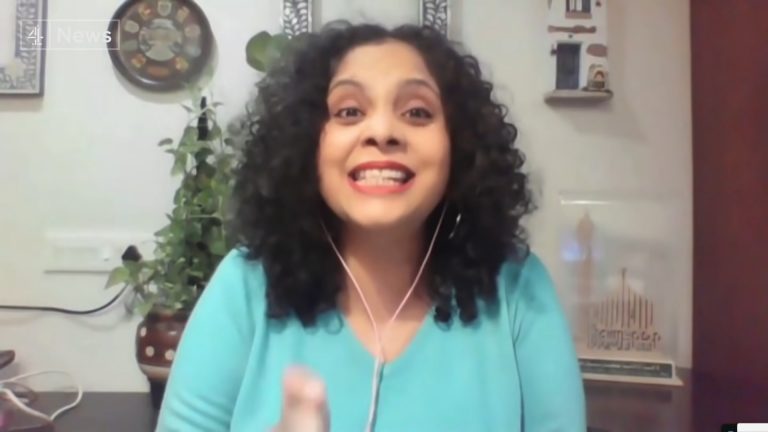
After the three fundraising campaigns run by journalist Rana Ayyub came under probe for violation of FCRA rules and non-utilisation of collection fund, Ayyub penned an article on Washington Post yesterday defending herself. However, she made a claim in her article which raises even more questions regarding the campaigns she ran on Ketto.

She claimed that the FIR filed against her by the Hindu IT cell was part of a vendetta against her, aiming to discredit her in the eyes of her readers and the country. She claimed that the group which has complained against her is very influential, followed on social media by Prime Minister Narendra Modi and almost his entire cabinet.

Responding to the allegations that she has not utilised all the money she had collected in her fundraising campaigns, Rana Ayyub claimed that she had given a cheque for $130,000 to a New Delhi hospital that was building a children’s ward ahead of the third wave of the coronavirus. However, the hospital returned the cheque to her due to political pressure, she claimed. She adds that the hospital management was concerned about her criticism of the government.

As she has not named the hospital, it is difficult to tell political pressure from which political party she is talking about. While there are some hospitals in Delhi run by the Central govt, most hospitals, including the private hospitals, come under the control of the Delhi government, which is run by the Aam Aadmi Party.

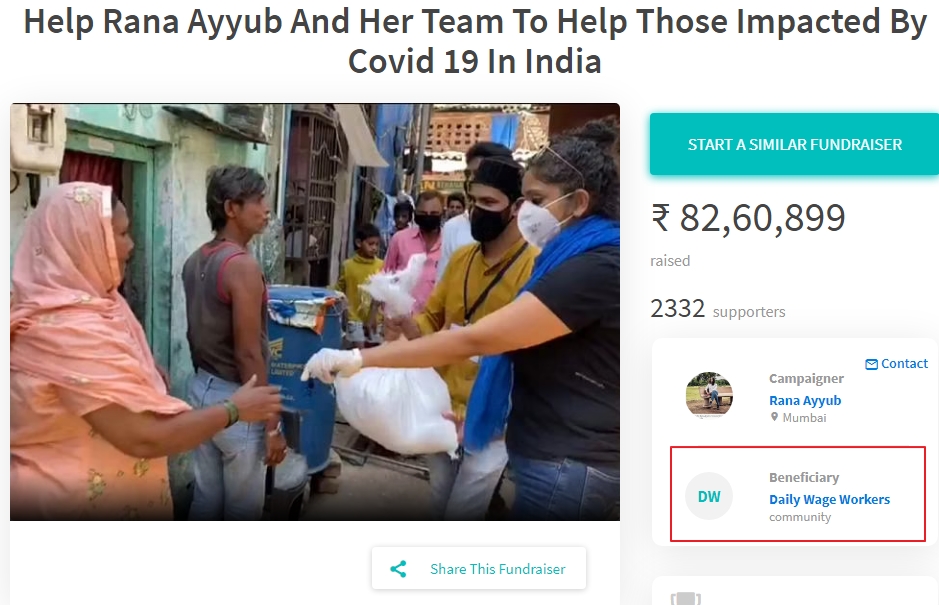
However, the major anomaly in her argument is the claim that she had given $130,000 to a hospital, which was returned to her. This means she had given almost ₹96 lakh to one single hospital. Now the anomaly is, this amount is more than the entire amount she has collected to help those impacted by Covid-19 in India, which was her third fundraising campaign on Ketto. In this campaign, a total of ₹82,60,899 was collected by Rana Ayyub, which means there is a shortfall of more than ₹10 lakh.

Moreover, her third campaign was to help Covid-19 affected people, not to donate money to hospitals, which are not the same things, even though related. The Ketto campaign page says that the beneficiaries of the campaign her daily wage earners. How can she give the money raised for daily wage earners to a hospital?

The fundraising was meant for daily wage earners, but Rana Ayyub says she gave the amount to a Delhi Hospital

In the campaign, she had clearly stated that she will be helping people impacted by Covid-19, and the Ketto page on the campaign says that she has provided for close to 1300 families using the fund. She also claimed that she returned ₹60 lakh to foreign donors as she did not have FRCA registration, which would be from all the three campaigns she ran on Ketto. Amidst this, the numbers do not fit. If she helped 1300 families from the ₹82.4 lakh collected, returned foreign currency donations around ₹20 lakh (dividing ₹60 lakh in three campaigns), from where she had given ₹96 lakh to the Delhi Hospital?

And, if indeed she had given the money to a hospital and it was returned due to ‘political pressure’, why it was not revealed earlier? A hospital returning donation of almost a crore for political pressure will be big news, and the political party which put the pressure will attract huge outrage at the time of a global pandemic. At the time when governments were seeking donations from the public for Covid-19, including the PM CARES fund, any news of a hospital returning money for political pressure would have invited huge backlash, but still, it was never revealed by Rana Ayyub, which raises the question, why.

Now coming back to the question of where did she get the ₹96 lakh when most of the third campaign fund was already spent, someone may argue that it was a leftover amount from the first two campaigns. But that is also not possible, because the amount collected and spent in the first two campaigns does not match with this amount.

In her first campaign for slum dwellers and farmers, she had collected around ₹1.25 crore, and she had claimed on the campaign page that the entire amount was exhausted. The second campaign for relief work for Assam, Bihar and Maharashtra had raised ₹68 thousand, which was used to send ration kits to flood-affected people, she claims.

Another point to be noted that if she had given as big as an amount like ₹96 lakh to a Delhi hospital, it was never mentioned in any of the updates in the campaigns. Such a big donation, and the alleged refund by alleged political pressure, both should have been published widely by Rana Ayyub, given her access to global media, but it was never done.

Rana Ayyub also mentioned in her Washington Post article that “a big portion was paid in taxes, leaving less for the needy”. By this, she wants to blame the govt for taking tax from money collected for the needy. While this seems a valid argument, the fact is that she would not have to pay taxes had she followed rules. Rana Ayyub has complete disregard for Indian laws, and she violated multiple Indian laws in her three fundraising programs, which has landed in her trouble, not any vendetta by any political party.

Not only she accepted foreign currency donations without mandatory FCRA registration, she also ran the campaigns as personal campaigns. As the campaigns were not run through a registered NGO, the money in the campaigns were collected by Rana Ayyub personally, and it was up to her how she spends the money. In the absence of a registered NGO which enables tax exemption on the collected amount, she has to pay tax on the raised fund, that is as per the current law of the country applicable to all. Had she run the campaigns through an NGO with FCRA registration, she could have utilised the foreign donations and could have saved the tax amount too.

According to an email sent to donors of the campaigns by Ketto in the last week of August, there was a total tax liability of ₹90 lakh on the fundraising campaigns, and a total of around ₹1.44 crore was lying in the accounts. This means ₹54 lakh was lying spent unused till a month ago.

It is interesting to note that Rana Ayyub herself says that she was trying to tie up with FCRA registered NGOs so that her campaigns can be run through them to comply with the laws, but she was unable to find one. Given that India is filled with left-liberal NGOs, many of them with FCRA registration, given that none of them came forwarded to associate with her tells a lot about the credibility among her own folks. It reminds us of the episode when the anti-Modi media houses had refused to publish her ‘Gujarat Files’, which was also thrashed by the Supreme Court.

On why liberals go crazy when PM Modi goes abroad and why Sonia Gandhi is not on social media

On an average day, Indian liberals manage to find fault with something or the other about when PM Modi wakes up, what he eats for breakfast, what clothes he wears and so on. It allows them to carry on their lives with a very peculiar sense of victimhood. Why does Narendra Modi live like he is a successful person? More precisely, how dare he act like his father was rich?

But each time the Prime Minister goes abroad, something very special seems to happen to his detractors. Forever on the margins of sanity, this is one thing that drives them over the edge. Have you ever wondered why?

The origins of this complex are multi-layered. At a basic level, they are unhappy about losing some of the privileges that used to come with being unelected members of India’s ruling class. In the UPA era, these people would fly for free on the Prime Minister’s official jet. You can find some of these old pictures still floating around on the internet. The unelected power elites striking crazy poses, backslapping each other and generally having a great time at the expense of the common Indian. But if you think about it, it wasn’t really about the wining and dining, though I am sure they enjoyed that too. It was about exclusivity.

Not any more. If they want to fly to America, they will have to buy a ticket, go to the airport, go through security like anyone else and step on a commercial flight. How middle class…

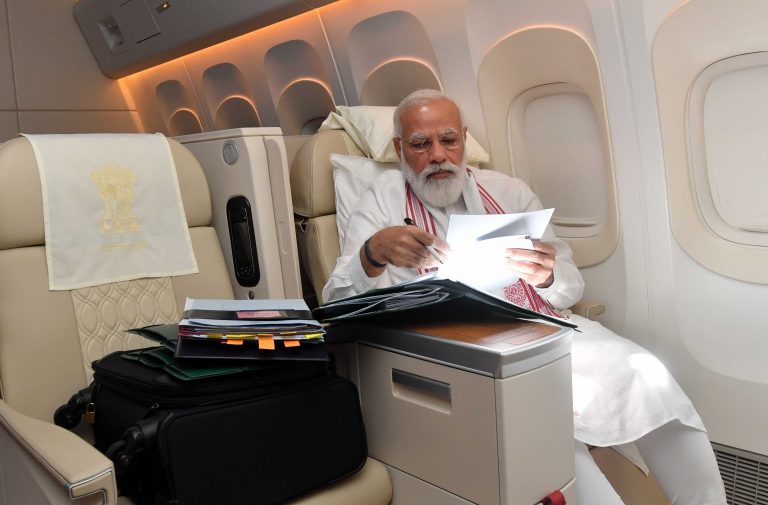
Nowadays, when the Indian Prime Minister goes overseas, these people only get to see him board the plane. When he reaches his destination, they again see the images on TV. Sometimes, the Prime Minister will share a pic or two from on board the aircraft. It is all they will get to see, just like everyone else. No more on board exclusive access, no cultivating contacts and no currying favors. The days of a journalist picking up the phone to fix cabinet portfolios are well and truly over. Of course they are angry.

But there are deeper reasons for their unhappiness. The sight of world leaders welcoming PM Modi, with all the rights and privileges of the Prime Minister of India, is too much for them to bear. It reminds them of two back to back general election elections, in which they not only lost, but failed to make the grade to become an official opposition. At one point, Nehru used to have these privileges, which he then passed on to his daughter. In turn, she passed them on to her son and then his wife, who bestowed them on a placeholder for ten years. But now, Modi has all of that.

For decades, especially during the Nehruvian era till 1991, overseas travel used to be a status symbol. The children of the power elites couldn’t possibly make it in the hypercompetitive Indian education system. So there used to be this pipeline from elite boarding schools in India to colleges in Europe & America. The dynasty itself uses this pipeline even today. Historically speaking, they have all flunked out of college in the West. But the point is that they failed in the West, not at some college in India. As the alma mater of one of these later powerful college dropouts notes on its website, they made lots of ‘friends’ during their stay at the institution. That was the whole point. Not education, but status and contacts.

Where else are you going to come across a Nobel Laureate in economics, who takes one look at your last name and says that you would make an excellent future Prime Minister of India?

But Modi does not owe his rise to his last name, to his contacts, nor to a failed half-hearted attempt at a foreign college education. That’s why when he goes abroad, the old elites go crazy. During the UPA years, one of their favorite refrains was that Modi couldn’t get a US visa. That is why 65 MPs wrote to the President of the United States, begging him to deny Modi a visa. By the way, any updates on that?

This brings me to one of the favorite refrains of media liberals. Why does PM Modi not do a press conference?

Good question. With elected officials, we need as much accountability and transparency as possible. But could you pinpoint exactly what makes a press conference so special? What is a press conference? If PM Modi held a press conference tomorrow, could you go and ask him anything that is on your mind?

Not exactly. Because, you probably don’t have a press identification card. And so, if you really want answers, you could approach one of the members of the media. And if they take pity on you, maybe they will ask the Prime Minister! In other words, you are dependent on a group of people who see themselves as nobles.

These nobles feel like they should be close to power. These nobles believe that elected officials should be specially answerable to them. They are really angry because the PM is not sitting down in a room and answering their questions. It doesn’t matter that the government runs a Press Information Bureau for them. It’s not enough special treatment. They need more. The Prime Minister himself must present himself in their court. Because they are above the Prime Minister and also the people. Their concerns are automatically the concerns of the people.

This reminds me. The year is 2021. You no longer need these nobles as a class. If you have concerns, you can raise them on the internet in an instant, using social media. Now it is true that there are literally over a billion people out there and your specific concern is not likely to be addressed this way. If that is the problem, how is a press conference the solution? How is it better if some unelected nobles get to ask questions instead of you?

And finally, have you noticed that Sonia Gandhi does not have a social media handle? Isn’t it odd? She is President of the Indian National Congress. Crores of people live in states run by her party. Should they not have a chance to address her directly? What about the people of her own constituency? What about people in general? As president of India’s main opposition party, doesn’t she want to listen to their concerns so that she can raise them with the Central Government?

You know the answer already. You know that the Congress cannot the bear the thought of common people speaking directly to Sonia Gandhi. Even if it’s just an appearance, a social media handle run by her office staff.

This is what liberal privilege is. For ten years, Sonia Gandhi was at the helm of this country and she never did a press conference. Nobody ever asked, either. She is perhaps the only politician in a major democracy today who is not on social media, but nobody notices. Our minds have been conditioned to believe that nobody should ever question Sonia Gandhi.

From press conferences to junkets on the PM’s official plane, it was all about catering to a class of nobles. They don’t have that any more. They are angry.

Kerala: Kozhikkode Akashvani radio station refuses to play drama on Veer Savarkar despite AIR directives

0

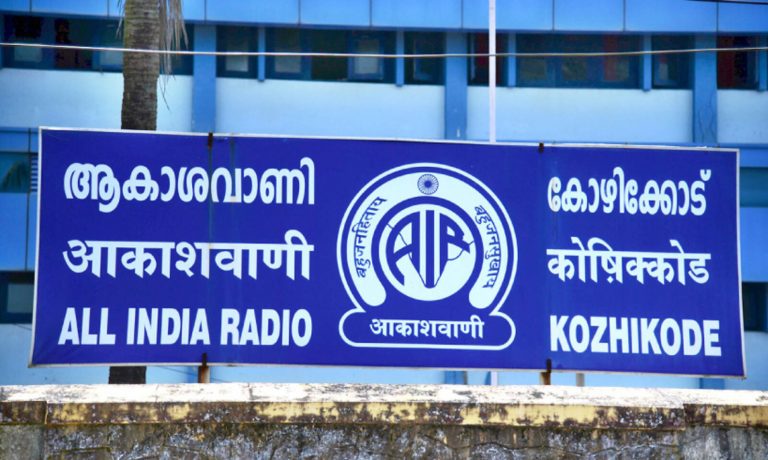
The Kozhikkode Akashvani radio station has refused to play a drama on Veer Savarkar which was scheduled to go on air this Friday. According to a Janmabhumi report, the Kozhikkode radio station master has informed the Thiruvananthapuram radio station about the decision. 

Reportedly, the station head gave the ‘rise in coronavirus infections amongst employees’ as the reason to cancel the broadcast. 

The All India Radio had issued directives to all state units of Akashvani to broadcast a drama on Veer Savarkar in the ongoing national drama festival. While the main script was given by the AIR, the stations were supposed to translate it into their local language for broadcast. 

Kerala has eight radio stations, and each was to prepare the drama on a rotational basis. 

The dislike for personalities like Veer Savarkar and MS Golwalkar in Kerala is not new. Earlier this month, Kerala Students Union, the student wing of Congress, had taken out a march and had burnt copies of the Kannur University syllabus that carried extracts from Savarkar’s “Hindutva: Who is a Hindu” and others. 

The student wing also accused the University of implementing and enforcing the Sangh Parivar or RSS agenda.

The controversy arose after extracts from Savarkar’s book, Golwalkar’s “Bunch of Thoughts” and “We or Our Nationhood Defined” and portions from Deendayal Upadhyaya’s “Integral Humanism” were included in the syllabus of MA Governance and Politics at Kannur University. 

However, Prof Gopinath Ravindran of the University had rubbished the allegations and stated that the students must learn about all ideologies. “We have included the works of Gandhiji, Nehru, Ambedkar and Tagore. The syllabus also includes the works of Savarkar and Golwalkar. Let students learn and understand the basic text behind all ideologies,” he said, asserting that there is nothing wrong in learning about Savarkar and M S Gowalkar.

#MeToo: Comedian Sanjay Rajoura accused of sexual harassment and coercion for sex by a woman

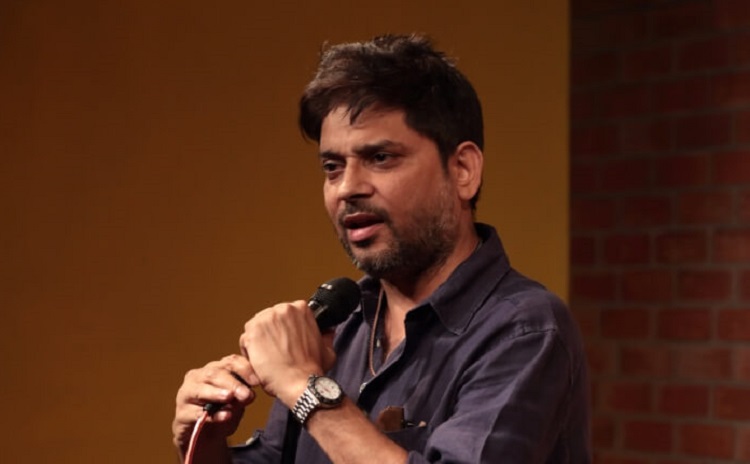
‘Comedian’ Sanjay Rajoura has been accused of sexual harassment by a woman in her early 20s. The woman has taken to Instagram to accuse the comedian of sexual abuse. Rajoura is a member of the comedy collective ‘Aisi Taisi Democracy’.

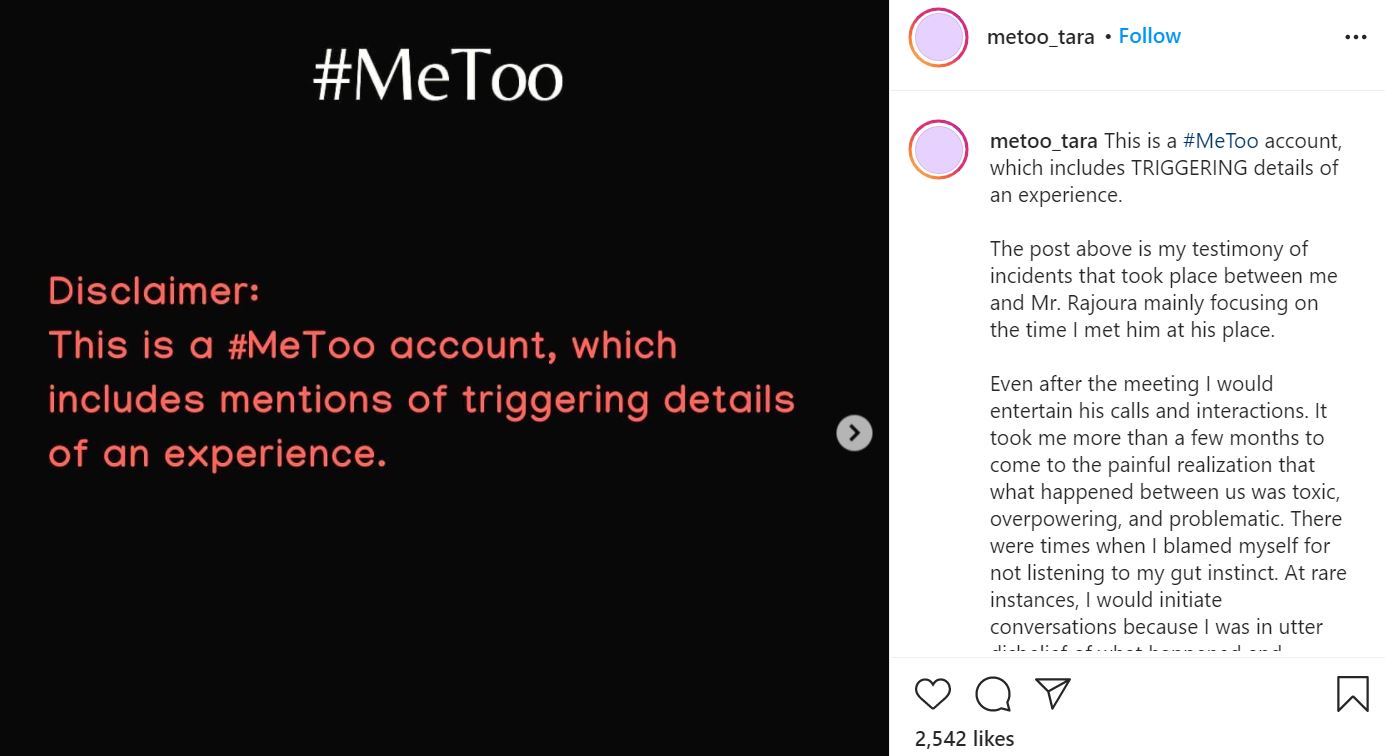
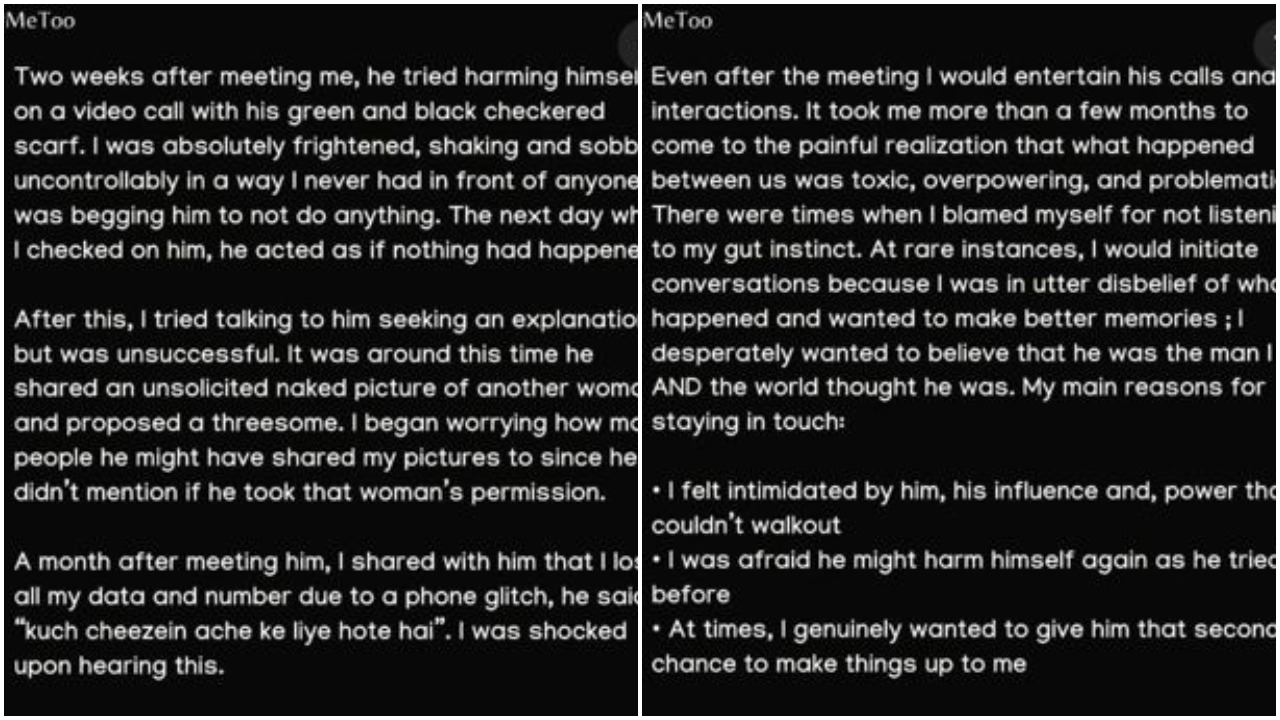
Screenshot of Tara’s Instagram post dated September 23

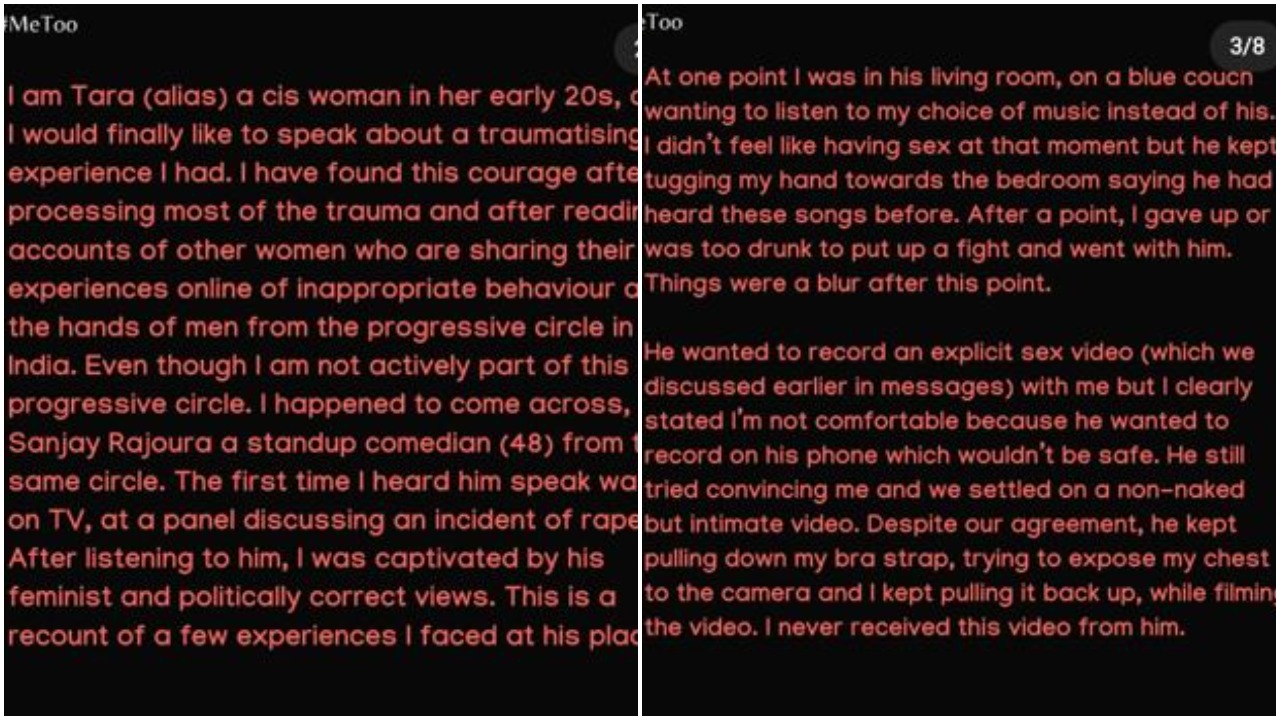
On September 23, the woman, who used the alias ‘Tara’ in her posts, revealed that Rajoura had reportedly coerced her into having oral sex in a public place despite her reservations. She also accused him of requesting nudes from her and posting an unsolicited nude image of a woman, proposing a threesome.

Screenshot of Tara’s Instagram post dated September 23

The woman wrote that for months she kept overlooking the advances since she admired the comedian for his work. His public persona clouded her judgement, she admitted. She was intimidated by the fact that Rajoura knew a lot of influential people from the film fraternity. In the post, the victim opens up on how she also kept overlooking the sexual advances made by Rajoura because she looked at his public persona as a “feminist man”.

She alleged that Rajoura would ask her to send him “unsafe” and naked pictures. “Even when I told him that it was too soon or made excuses expressing hesitancy, he was persistent and found loopholes to my excuses.”

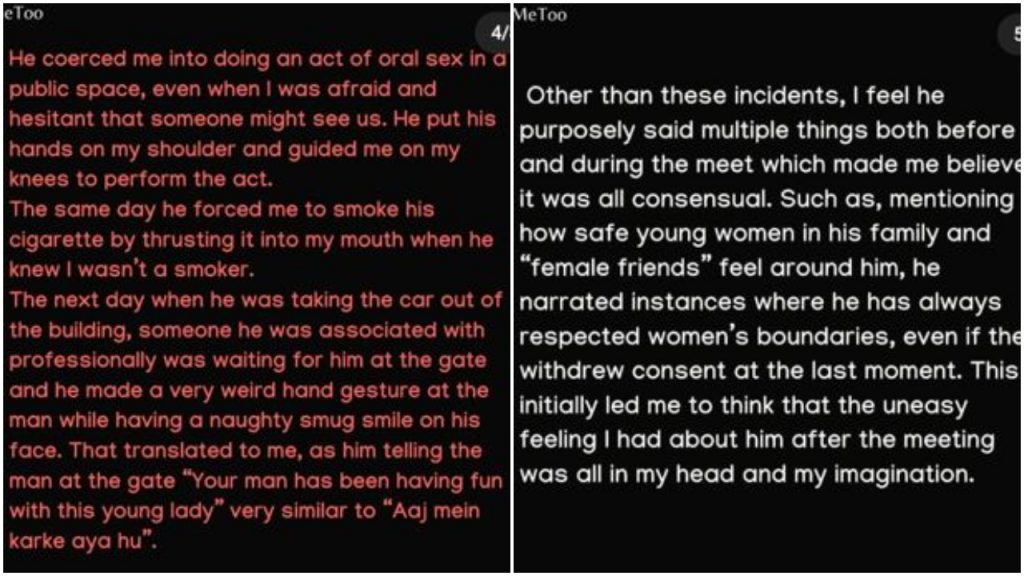
The victim goes on to reveal how the comedian coerced her into performing oral sex at a public place. “He put his hand on my shoulder and guided me on my knees to perform the act,” wrote Tara.

Screenshot of Tara’s Instagram post dated September 23

Tara further said that the next day, Rajoura met someone he was professionally associated with at the gate of his building while taking out his car from the parking. She said that Rajouri “made a very weird hand gesture at the man while having a naughty smug smile on his face. That translated to me as him telling the man at the gate ‘You’re man has been having fun with this young lady’, very similar to ‘Aaj mein karke aaya hu'”.

Screenshot of Tara’s Instagram post dated September 23

She added that even after their meeting she continued to entertain his calls and interact with him. “It took me more than a few months to come to the painful realization that what had happened between us was toxic, overpowering, and problematic. Adding that she felt intimidated by him, his influence and power, the woman said she couldn’t walk out.

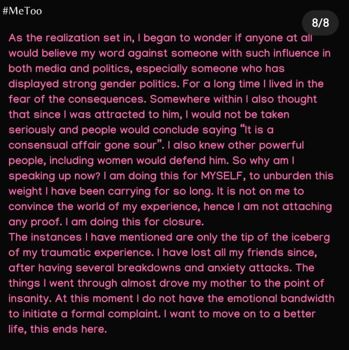
Screenshot of Tara’s Instagram post dated September 23

“So why am I speaking up now? I am doing this for MYSELF, to unburden this weight I have been carrying for so long. It is not on me to convince the world of my experience, hence I am not attaching any proof. I am doing this for closure,” she wrote

She ended that post by saying: “The instances I have mentioned are only the tip of the iceberg of my traumatic experience. I have lost all my friends since, after having several breakdowns and anxiety attacks. The things I went through almost drove my mother to the point of insanity. At this moment I do not have the emotional bandwidth to initiate a formal complaint. I want to move on to a better life, this ends here.”

Rajoura has not responded to the allegations yet.

Derogatory comments against Hindu Gods, casteist slurs: Sanjay Rajoura’s idea of ‘comedy’

Prior to this, the ‘comedian’ Sanjay Rajoura was in trouble after a complaint was filed against him on May 4, 2020 for mocking Hindu gods and goddesses and hurting religious sentiments.

Rajoura had made derogatory remarks against Lord Ganesha and Lord Shiva after which a complaint was filed against him with the Mumbai Police by Hindu activist Ramesh Solanki.

Rajoura also has a history of abusive behaviour on social media. He has resorted to name-calling and threatening other Twitter users only because they don’t agree with his views. He has also displayed his casteist behaviour on Twitter by abusing the Brahmin and Rajput communities.

Here, we should recollect how in 2018, when the MeToo movement had gripped India, various film and media personalities, including stand up comics, were exposed by women. From ‘comedian’ Varun Grover to abusive Kunal Kamra to the co-founders and collaborators of comedy platform All India Bakchod were all were accused of sexual misconduct.

Delhi restaurant Aquila responds to ‘No Saree’ controversy, says guest had created nuisance, slapped staff

On September 20, a 10-second video emerged on social media platform in which staff of a restaurant named Aquila in Delhi was seen stopping a woman identified as Anita Choudhary from entering as she was wearing a saree. The staff member in the video was seen saying, “saree is not a smart casual” dress.

The footage drew strong criticism from across sections, and the restaurant started to get negative reviews on all platforms. On the other hand, some netizens stood by the restaurant and said being a private entity, they have the right to admission on their premises. The incident took place on the night of September 19.

The incident triggered a wide social media debate, where many people denounced the restaurant for its colonial mentality and denying entry to a patron wearing Saree. Aquila is located in Delhi’s upscale Khel Gaon Marg. After Wednesday’s social media buzz, it started receiving a barrage of negative reviews on food delivery platforms.

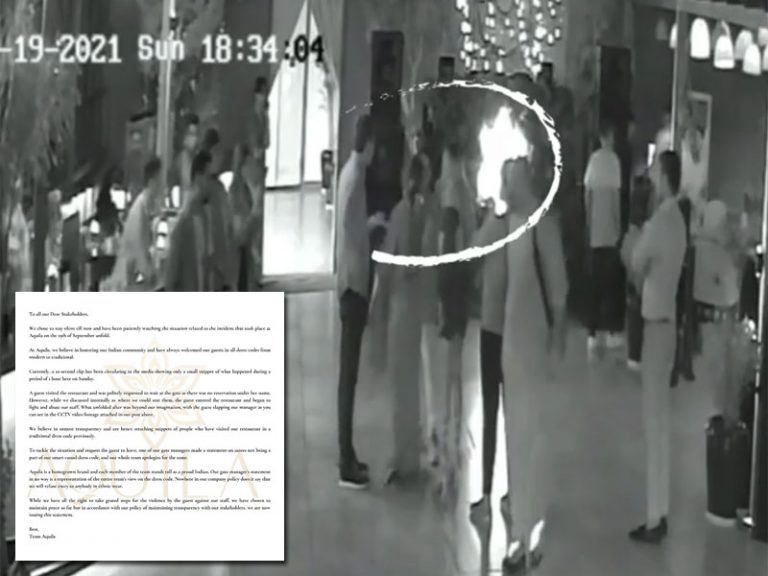
Later on Wednesday, Aquila issued a statement on its Instagram profile. In the statement, the restaurant said that the 10-second video is just a snippet of what had happened on the day of the incident. They also published a couple of videos to show their side of the story.

In one of the videos, the patron who claimed she was stopped from entering the restaurant because of saree as attire was seen slapping one of the staff members of the restaurant.

The restaurant said that the excuse their staff member gave for not allowing them to enter was not in sync with the restaurant’s policies. However, they could not have allowed someone on the premises who had allegedly assaulted a staff member. The statement reads, “To all our Dear Stakeholders, We chose to stay silent till now and have been patiently watching the situation related to the incident that took place at Aquila on September 19 unfold.

At Aquila, we believe in honouring our Indian community and have always welcomed our guests in all dress codes, from modern to traditional. Currently, a 10-second clip has been circulating in the media showing only a small snippet of what happened during a period of 1 hour here on Sunday.

A guest visited the restaurant and was politely requested to wait at the gate, as there was no reservation under her name. However, while we discussed internally where we could seat them, the guest entered the restaurant and began to fight and abuse our staff. What unfolded after was beyond our imagination, with the guest slapping our manager, as you can see in the CCTV video footage attached in our post above.

We believe in utmost transparency and are hence attaching snippets of people who have visited our restaurant in a traditional dress code previously. To tackle the situation and request the guest to leave, one of our gate managers made a statement on sarees not being a part of our smart casual dress code and our whole team apologies for the same.

Aquila is a home-grown brand, and each member of the team stands tall as a proud Indian. Our gate managers statement in no way is a representation of the entire teams view on the dress code. Nowhere in our company policy does it say that we will refuse entry to anybody in ethnic wear.

While we have all the right to take grated steps for the violence by the guest against our staff, we have chosen to maintain peace so far, but in accordance with our policy of maintaining transparency with our stakeholders, we are now issuing this statement.”

The restaurant stated that the 10-second clip where a staffer was seen saying Saree is not smart casual wear, does not reflect the establishment’s policy as they have multiple instances of Saree-wearing guests being welcomed. They stated that the guests in the video had created a nuisance after being told that no reservation was available and as seen in the CCTV footage, had even slapped the manager.

Counter statement by the patron

A Twitter user named aryaminii, has claimed that the lady in the saree was her mother. She claimed that her mother had only pushed the staff members and not ‘slapped’. She had also acknowledged that they had arrived late, past their reservation time and were told that no seats were available. She also alleged that her mother was confronted by ‘bouncers’ and was misbehaved with by staff.

Both restaurant and the family are getting support and hate at the same time on social media platforms.

AIMIM faces strong objections after its posters term Sambhal in UP as the land of the ‘Ghazis’

0

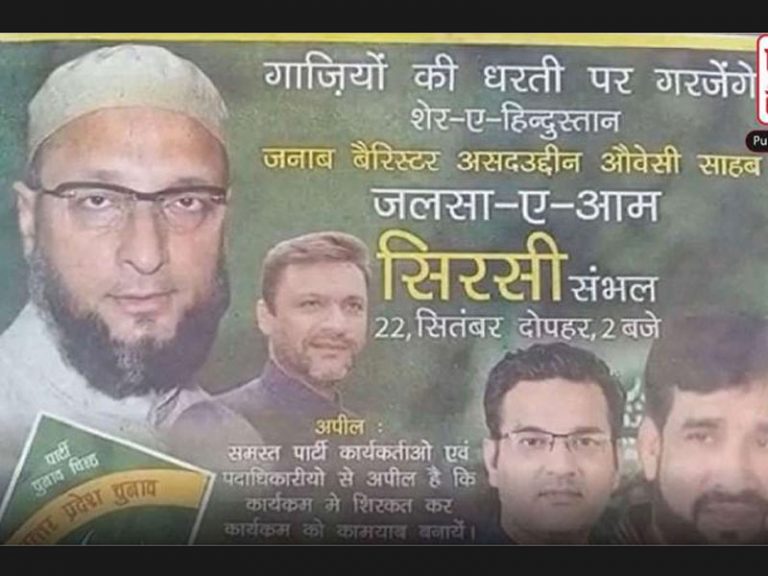
Tension erupted in the Sambhal region of Uttar Pradesh after posters of All-India Majlis-e-Ittehadul Muslimeen (AIMIM) called it the land of “Ghazis”, referring to the Islamic invaders. Bharatiya Janata Party strongly objected to the language used in the posters. After the controversy, the posters were removed by the workers of AIMIM.

The posters were reportedly spotted ahead of AIMIM chief Asaduddin Owaisi’s public rally in Sirsi. Rajesh Singhal, Vice President, UP West Unit, BJP, raised objections on the posters and said Sambhal was never the land of ‘Ghazis’. He said, “This is an election stunt of Owaisi, and we will not allow them to succeed in their intentions. None of the cities in India belonged to the ‘ghazis’, and we will not allow them to become one.”

He further asserted that Sambhal finds its place in the mythology as well. He said, “In the Puranas, Sambhal finds mention in connection with the Kalki incarnation (of Lord Vishnu). If Sambhal is mentioned as the land of the ‘Ghazis’ in the Quoran, then I will quit politics.”

The poster politics of AIMIM

A similar controversy had erupted earlier when a poster of AIMIM had called Ayodhya by its old name Faizabad. At that time, Owaisi was to attend a political rally in Ayodhya. Paramhans Das, Mahant, Tapasvi Chavni had warned AIMIM to remove the posters else they would not allow Owaisi to enter Ayodhya. Iqbal Ansari, who was one of the parties in the Ayodhya Land Dispute, had warned Muslims of Uttar Pradesh not to get lured by Owaisi. He urged Owaisi not to play with the sentiments of the Muslims.

Owaisi targeted SP and BSP for poor performance in Lok Sabha elections

During his rally in Sirsi, Owaisi claimed that the people of UP would not choose Yogi Adityanath for the second term as Chief Minister of the state. Targeting CM Yogi for his ‘Abba Jaan’ remark, AIMIM Chief called himself “the father of the poor and weak, the brother of women.”

Owaisi also targeted Samajwadi Party and Bahujan Samaj Party and questioned them on their poor performance in the Lok Sabha elections. He said, “In the Lok Sabha elections, we did not field a single candidate, yet we are blamed that they (SP-BSP) got only 15 seats. They should come on a stage and have a one-to-one debate on this.”

AIMIM is planning to contest 100 seats in upcoming Assembly Elections in UP next year in alliance with Om Prakash Rajbhar-led Bhagidari Sankalp Morcha.