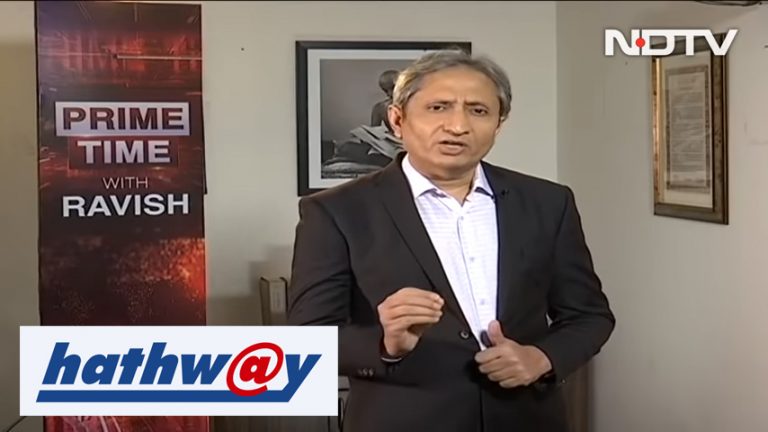
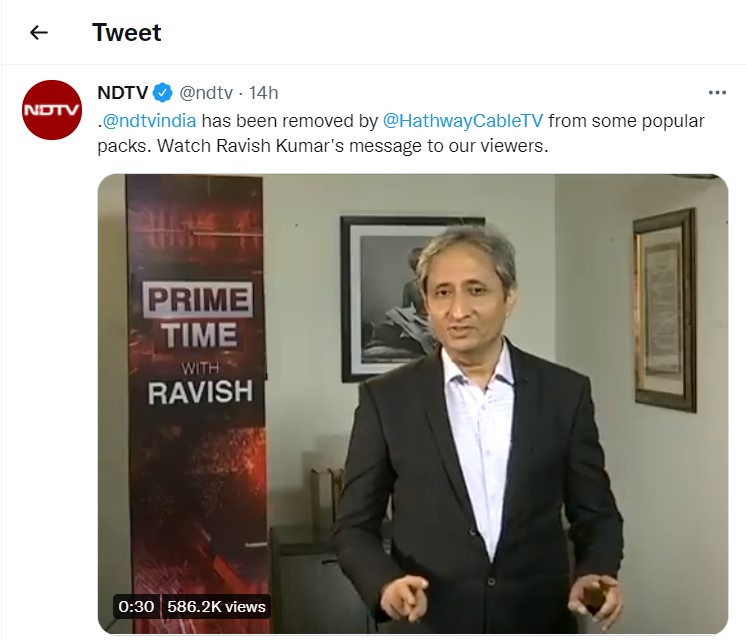
The self-proclaimed ‘only righteous journalist on this earth’ and the executive of fake news factory, Ravish Kumar of the NDTV India on Friday night appeared with a short video of him and informed that Hathway Cable TV has removed NDTV from some popular packs.
This video has been uploaded by NDTV on its Twitter account.
Ravish Kumar in this 1.38 minutes video alleged that Hatchway Cable has removed his channel as a part of a conspiracy to blackout the channel so that the contents of the channel don’t reach the audience. He said that NDTV prepares its programs with lots of effort, but now people are being prevented to watch these programs.
Ravish Kumar also claims that he and NDTV are different from others, explaining how he and his team tirelessly work and burn the midnight oil to bring his Prime Time show. He then takes a dig at other news channels stating that he is different from the rest of the news channels that organize fights in the name of debate by picking idle persons from the club.
He continues his monologue stating that conspiracies have been made to stop the well-researched content of his team to reach the audience. Ravish Kumar who himself is the poster boy of surrogate journalism boasts that when the rest of the media houses are killing the dream of a democracy of millions of Indians, he and his team brings the truth.
Ravish Kumar bemoans “today’s programme will not reach you,” as if India stops to watch his prime time which India had witnessed during the telecast of the serials Ramayana and Mahabharata. At the end of the video, Ravish Kumar urges the audience to call and message Hatchway Cable to restore NDTV India to watch prime time.
The NDTV anchor delivered his speech if his channel has been blocked on the Hatchway Cable, calling it a conspiracy. But the NDTV tweet itself says that the channel has only been removed from some popular packs, which means that the channel is still available on the cable network. It is not a secret that NDTV is one of the least popular news networks, with very low viewership. Accordingly, Hathway may have removed the NDTV India channel from some packs.
But the fact is that NDTV India remains available on the network, and it has not been blocked by the cable network as alleged by Ravish Kumar. People willing to watch the channel can subscribe to it individually, or subscribe to a pack that includes the channel, like a pack of Hindi news channels.
As usual, Ravish’s catharsis ended up giving comic relief and no wonder majority of netizens applauded Hatchway Cable for this ‘good riddance’.
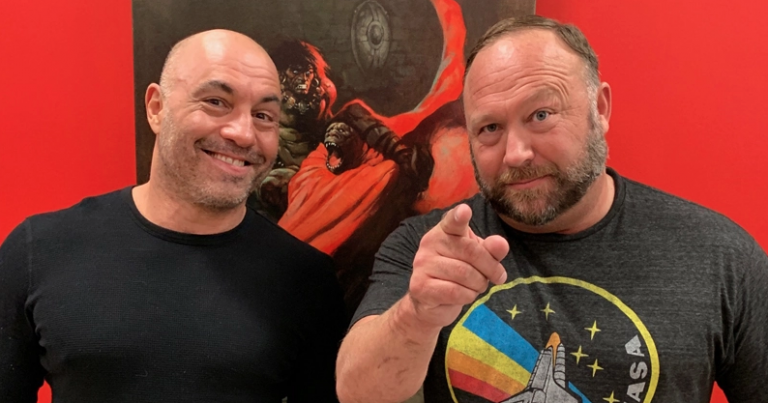
Famous conspiracy theorist Alex Jones consumed Ivermectin live on air in order to dispel the ‘horse dewormer’ propaganda the Left has been peddling against the drug. The inexplicable series of events was initiated after Joe Rogan caught Covid-19 and said that he had taken Ivermectin.
Video: Alex Jones goes off on the left, takes ivermectin live on air to dispel media’s “it’s horse dewormer” talking point. pic.twitter.com/JQeZzIyzzN
Joe Rogan in a video on Instagram had said that he was taking Ivermectin after catching Covid-19. Since then, he has reportedly recovered from the disease.
Alex Jones appeared in his usual eccentric avatar for Infowars, a media initiative he founded. “This is Ivermectin,” he declared before going on to say, “See this? See this Fauci? See this Bill Gates?” During his rant, he called some people “b*st*rd murderers” although it is not clear who he was referring to.
Continuing his rant, he said, “You wanna suppress me? You wanna kill me? You godd*mned demon.” Then he went on to mount a passionate defense of Joe Rogan, who is a friend of his and he has appeared multiple times on his podcast.
What is the deal with Ivermectin?
For some reason, there is a bizarre propaganda underway in the United States of America to brand Ivermectin a “horse dewormer” despite the fact that a version of the drug is known to be used for human treatment.
The propaganda appears to have been triggered by an ambiguously worded tweet by the US Food and Drugs Administration. The tweet, sharing a FDA report that elaborated on ‘Why You Should Not Use Ivermectin to Treat or Prevent COVID-19’, said, “You are not a horse. You are not a cow. Seriously, y’all. Stop it.”
Source: Twitter
The FDA blog said, “FDA has received multiple reports of patients who have required medical attention, including hospitalization, after self-medicating with ivermectin intended for livestock.” It said, “The FDA has not authorized or approved ivermectin for use in preventing or treating COVID-19 in humans or animals. Ivermectin is approved for human use to treat infections caused by some parasitic worms and head lice and skin conditions like rosacea.”
The blog also stated, “Currently available data do not show ivermectin is effective against COVID-19. Clinical trials assessing ivermectin tablets for the prevention or treatment of COVID-19 in people are ongoing.”
Thus, quite clearly, authorities in the US are testing whether the drug is effective against Covid-19. Moreover, it is clearly not only a “horse dewormer” drug, as claimed by the Left. The FDA did highlight the fact that they have received reports of people consuming the animal version of the drug but the Left in the USA is on a crusade to brand the drug as a “horse dewormer” altogether.
At the same time, it is safe to assume some people did consume the animal drug with expectedly disastrous consequences. Needless to say, any drug should only be consumed on the advice of qualified physicians and it is extremely dangerous to self-medicate without taking professional advice.
The ‘horse dewormer’ propaganda that Alex Jones wanted to bust
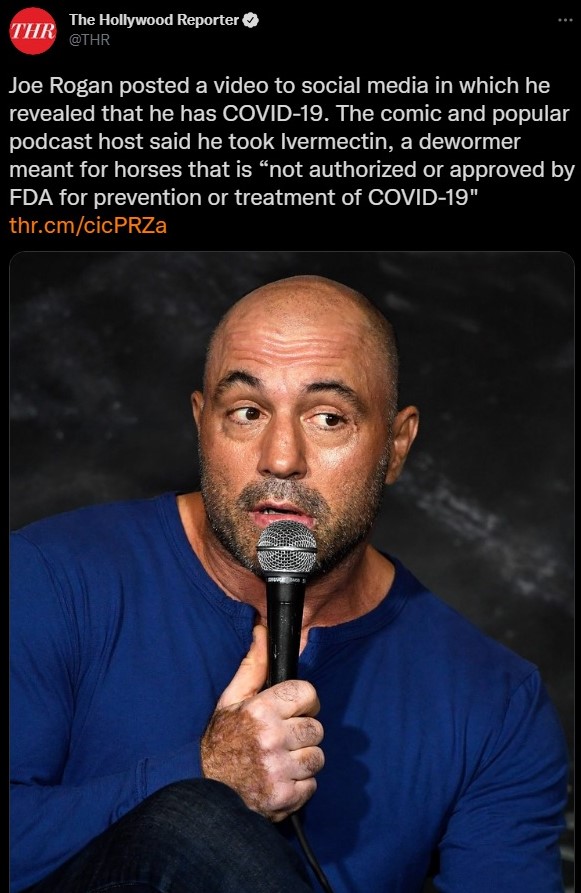
The Hollywood Reporter falsely claimed on Thursday that Joe Rogan had consumed a ‘horse dewormer’ drug, when it is evidently certain that the podcaster took the version of the drugs meant for humans.
Source: Twitter
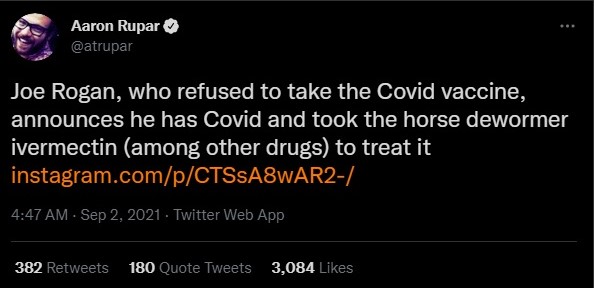
Vox journalist Aaron Rupar also falsely accused Joe Rogan of consuming a ‘horse dewormer’.
Source: Twitter
The propaganda to brand Ivermectin as such is widespread across the American Left. While it is perfectly reasonable to suggest that people should not consume the drug for Covid-19 treatment, to delegitimize it altogether appears equally dangerous. Furthermore, even the CDC recommends the drug for specific treatment for US bound refugees.
Ivermectin for Covid-19 treatment
There are some governments that have used Ivermectin to treat Covid-19. The Uttar Pradesh Government, which has been highly successful in containing the pandemic, has used the drug to combat the disease.
Earlier in May, the UP Government had announced that they had recommended the drug for “prophylactic and therapeutic” use.
Uttar Pradesh State Surveillance Officer Vikssendu Agrawal had said, “Uttar Pradesh was the first state in the country to introduce large-scale prophylactic and therapeutic use of Ivermectin. In May-June 2020, a team at Agra, led by Dr Anshul Pareek, administered Ivermectin to all RRT team members in the district on an experimental basis. It was observed that none of them developed Covid-19 despite being in daily contact with patients who had tested positive for the virus.”
Crediting the drug for the low positivity and death rate in the state, he had said, “Despite being the state with the largest population base and a high population density, we have maintained a relatively low positivity rate and cases per million of population”.
“Once the second wave subsides, we would conduct our own study as there has been an emerging body of evidence to substantiate our timely use of Ivermectin from the first wave itself,” he told the Indian Express.
Agra District Magistrate Prabhu N Singh also credited Ivermectin for the state’s success against Covid-19.
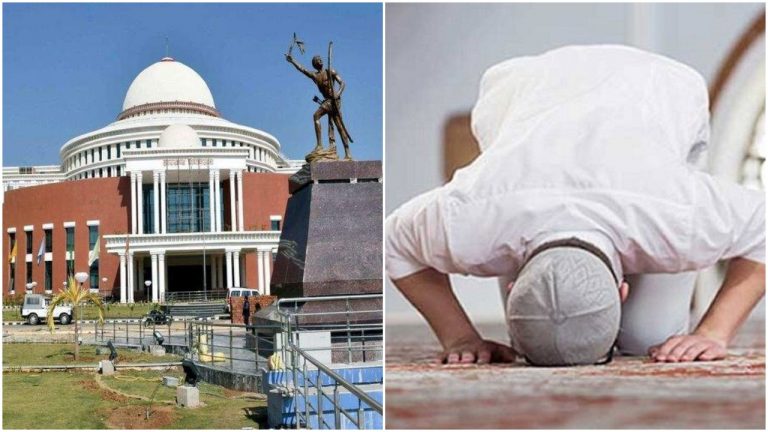
In a major controversy, the Jharkhand Assembly has decided to reserve a separate room inside the Jharkhand Vidhan Sabha to offer Namaz.
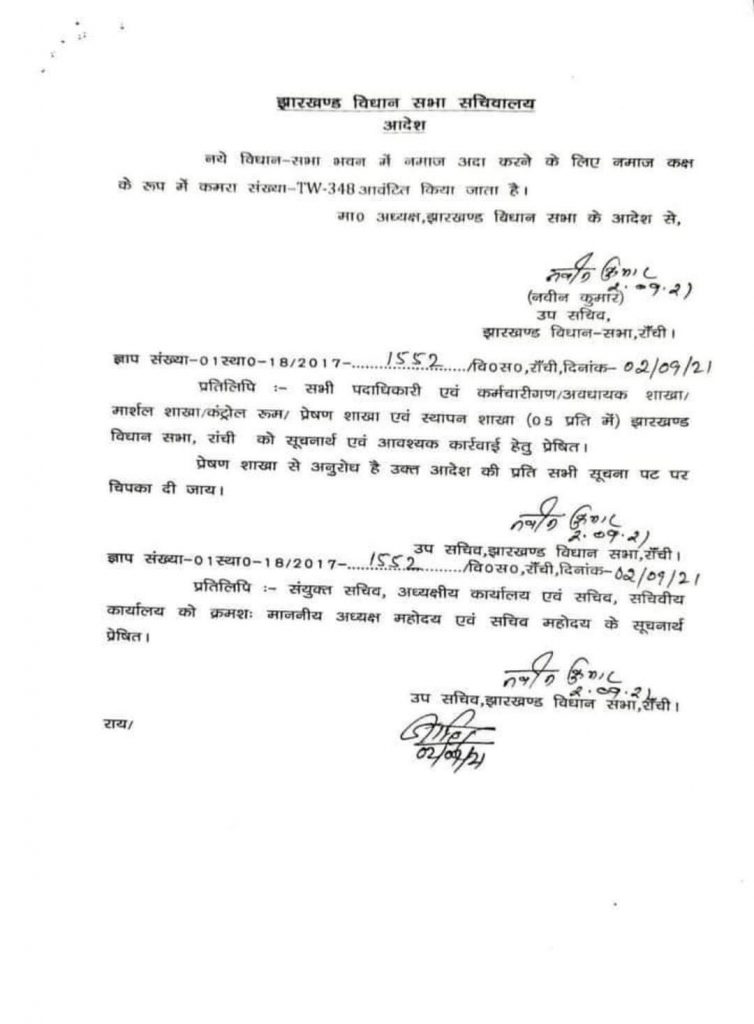
The Jharkhand Legislative Assembly Secretariat has issued an order on September 2 stating that room number TW 348 in the new Assembly building of Jharkhand will be allotted for Muslims to offer the Namaz. The order was issued by Naveen Kumar, the Deputy Secretary of the Jharkhand legislative assembly.
In an order issued on September 2nd, it is stated that room number TW 348, in the new Assembly building of Jharkhand, has been allotted to offer the Namaz: Jharkhand Vidhan Sabha Secretariat
Presently, the 81 member Jharkhand Legislative Assembly has four Muslim MLAs. Two Muslim MLAs are from the Congress party- Irfan Ansari and Alamgir Alam. The other two – Dr Sarfaraz Ahmad and Haji Hussain Ansari – belong to Jharkhand Mukti Morcha (JMM).
The decision of the Jharkhand Assembly Speaker to allot a dedicated space for Muslims inside a secular institution such as Vidhan Sabha has evoked a strong response across the state.
BJP objects, demands a temple inside assembly premises.
BJP, the largest opposition party in Jharkhand, has slammed the Jharkhand government for its controversial decision and said that a separate room should also be allotted to Hindus in the state Assembly recite Hanuman Chalisa.
BJP leader Babu Lal Marandi said that the temple of democracy should stay as the temple of democracy only. He added that the allotment of a separate room at the assembly for Namaz is wrong.
“If Muslims can offer Namaz in a separate room, why can’t Hindus be allowed to recite Hanuman Chalisa (in a separate room). I urge the Secretary of Jharkhand Legislative Assembly that five rooms or a hall be allowed to Hindus to recite Hanuman Chalisa,” another BJP leader said.
Former speaker and BJP leader CP Singh has also made similar demands and said that a Hanuman Temple should be built in the Assembly premises.
I’m not against Namaz room but then they should also build a temple at Jharkhand Vidhan Sabha premises. I even demand that Hanuman Temple should be set up there. If Speaker approves we can build the temple at our own cost: Former speaker & BJP leader CP Singh pic.twitter.com/5YBEDWgGBM
“I’m not against Namaz room, but then they should also build a temple at Jharkhand Vidhan Sabha premises. I even demand that Hanuman Temple should be set up there. If Speaker approves, we can build the temple at our own cost,” he said.
Meanwhile, responding to the allegations, JMM spokesperson Manoj Pandey reportedly said that no mosque has been constructed inside the assembly, but only a room has been arranged for offering prayers. He claimed that this system is not a new one.
The JMM spokesperson said that the new building was built during the BJP rule, and if BJP has so much love for Hindus, then a temple should have been built inside the assembly premises then. He added that the arrangements have been made for Muslim MLAs to offer Namaz in the Vidhan Sabha on Friday. Pandey added that if anyone wished to recite Hanuman Chalisa on Tuesday, then the room will be arranged for them too.
In 2019, Prime Minister Narendra Modi had inaugurated the new building of the Jharkhand Assembly at Kute gram. The three-storey building, constructed at the cost of Rs 465 crore, is the first paperless Assembly in the country.
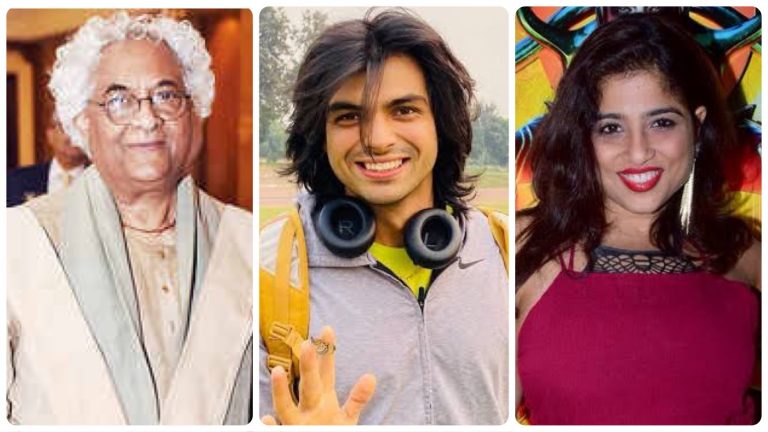
There seems to be no end to the harassment that javelin thrower Neeraj Chopra had to endure after racking up a gold medal at the recently concluded Tokyo Olympics. After Neeraj toughed out what appeared to be a brutally agonising video call with RJ Malishka Mendonsa and her female colleagues, he was subjected to harassment once again. This time, it was by a relatively lesser-known ‘Art Historian’ Rajeev Sethi, who presumptuously probed the Olympic Gold medalist with questions related to his sex life.
Naturally, such unwarranted questions had Neeraj at his wit’s end, with discomfort writ large on his face. He tried to navigate the uncomfortable question by sarcastically responding that his heart was overwhelmed by the question. It might have even led Chopra to contemplate if he had signed up for this Indian Express event to answer such deeply personal questions.
Nevertheless, the clip of the event when Rajeev Sethi inquires about Chopra’s sex life instantly went viral on the internet, with scores of people slamming Indian Express, the organiser of the event, and Rajeev Sethi for making the Olympic Champion uncomfortable with his prying questions.
If you thought Malishka was Cringe WATCH Rajeev Sethi go a STEP FURTHER ? He asked Neeraj Chopra : “How Do you Balance your Sеx Life with your training??” Disgusted Neeraj replied “Aapke question se mera mann bhar gaya” #NeerajChopra#RajeevSethipic.twitter.com/qwVd7hAot4
Before asking the question, Rajeev Sethi exclaimed, “What a handsome young man you are!” Then he goes on to say that crores of Indians want to ask him something but are hesitant. Then he proceeds to ask, “How do you maintain a balance between your sex life and athletic training? I know this is a weird question.”
Uncomfortable with the question, Neeraj Chopra responded, “Sorry, sir. I have said sorry, you can know my answer from that.” Rajeev Sethi did not stop there and proceeded to elaborate his question in further detail, expressing a great desire to know more about the Gold Medalist’s sex life.
When the art historian attempted to apologise for the question, a disgusted Neeraj Chopra replied, “My heart is overwhelmed by your question.”
RJ Malishka Mendonsa of Red FM dances for Olympic Gold Medalist Neeraj Chopra, asks him for ‘jhappi’
Now, this was not the first time that the athlete had to endure an unpleasant experience. A couple of weeks back, RJ Malishka along with her Radio FM staff broke out into an impromptu jig to the tunes of ‘Ude Jab jab zulfein teri’ and asked for an online bear hug from the Olympic Gold medalist.
In an exclusive interview with Chopra on the Red FM channel, Malishka was seen putting up a ‘dance show’ for him along with other staff members. Despite Chopra looking uncomfortable, the radio jockey and her team did not stop from gyrating to tunes of ‘Ude Jab jab zulfein teri.’ The Olympic gold medalist smiled awkwardly through the ‘performance’.
The radio jockey later even took to her social media accounts to gloat over the ‘performance’ she and her female office colleagues had performed during their interview with the Olympic Gold medalist, notwithstanding the possibility that Chopra might have been inwardly cringing and feeling awkward for what he had to put up with.
Before Malishka Mendonsa rose to prominence for objectifying Neeraj Chopra, Times Now journalist Navika Kumar had also become the subject of social media criticism after she kept on pestering the 23-year-old Olympian about his relationship status, prompting netizens to call her ‘gossip aunty.’
Rajeev Sethi consumed by perverse obsession to pry about Neeraj’s sex life
Weeks later, Neeraj found himself in a similar predicament after ‘Art Historian’ Rajeev Sethi asked him to elaborate on his sex life, asserting that crores of Indians are curious about it.
First of all, it is a bit far-fetched to claim that “crores” of Indians wanted to know about Neeraj Chopra’s sex life. It’s humanly impossible to survey billions of Indians in such a short span of time to seek what they want to ask from Neeraj Chopra.
In all probability, most of the people surveyed (assuming that Sethi might have sought questions to be asked to Neeraj Chopra on his social media accounts), would have been curious to know about how Chopra prepared for the event, what his thoughts were while participating in the competition and how he felt after winning a gold medal for the country.
The interview should have been restricted to exploring those facets of Neeraj’s life, not about a prurient inquiry into his sex life, which is, anyway his personal matter and not for the discussion of the entire world. Neeraj, or for that matter any athlete, alone holds the prerogative of discussing their sex life, if and when he or she feels comfortable sharing details about it.
In fact, in order to add credence to his intrusive question seeking details of Chopra’s sex life, Sethi cited the supposed inquisitiveness of billions of Indians who were allegedly interested in knowing about the athlete’s sexual matters.
Lesser-known ‘Art Historians’, Radio Jockeys leech off Neeraj’s fame and achievement
Whether crores of people want to know about something or not, journalists, webinar hosts, anchors, RJs and others don’t go around shedding their sedate behaviour and put their interviewees in awkward situations. What Sethi did to Neeraj was, without a shred of doubt, beyond the pale. And his response to the question, his body language, the sarcastic undertone of his response—all elicited how uncomfortable Neeraj was with Sethi’s line of questioning.
However, it seems that lesser-known ‘Art Historians’, ‘Radio Jockeys’ and other inconsequential individuals like to indulge in cringe-worthy and scandalous behaviour with popular celebrities, as a part of a publicity stunt to stoke outrage, which in turn helps them in catapulting themselves out of the abyss of obscurity.
Sethi’s pestering questions to Neeraj Chopra about his sex life appears to be an attempt by the ‘Art Historian’ to banish his state of obscurity and propel himself towards relevance. Fewer people knew about Rajeev Sethi before his interview with Neeraj Chopra. After the video clip of his interaction with the Olympian went viral, there are obviously more people talking about him than they were before the interview.
Neeraj’s professional life should be the focus, not his sexual life
Neeraj has brought the elusive Gold medal for the country. He even might be having a dashing personality. Some might even find him charming and endearing. But that is no sanction for the exploitative media and individuals to profit off Neeraj’s achievements by sexualising him and peppering him with questions he is visibly uncomfortable answering.
Perhaps, it’s time for the media and people like Sethi to shift their attention from prying too inquisitively about an athlete’s sexual life to the amount of hard work, dedication and practice he has invested in the sport to win a gold medal at the prestigious Olympics. This would not only save them from the ensuing embarrassment of making their interviewee uncomfortable, but it would also help in inspiring thousands of other athletes out there who are dreaming of representing India and winning a gold medal for her in the world’s largest sporting competition.
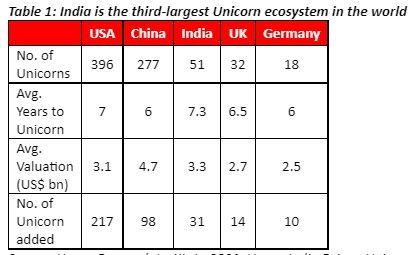
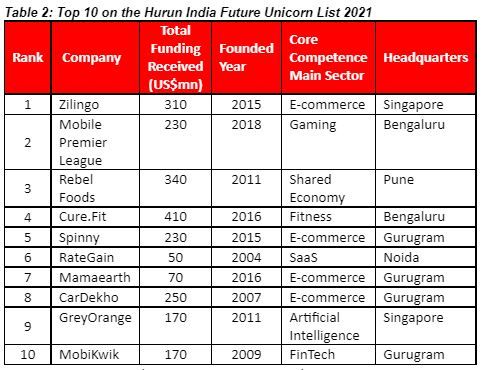
Hurun India released the Hurun India Future Unicorn List 2021 on September 2, 2021 which ranks start-ups founded in 2000s, with a worth of at least US$200mn, or INR 1,500 crores. India is listed as the third largest Unicorn system in the world with 51 Unicorns, 32 Gazelles and 54 Cheetahs.
According to the Hurun India Research institute, the Unicorns are those start-ups which are founded after 2000 and have a valuation of US$1bn, the start-ups Gazelles are expected to reach the Unicorn status in 2 years while Cheetahs are expected to reach the Unicorn status in 4 years. Regulatory filings and feedback are received from entrepreneurs, active India focused VC funds and angel investors.
According to Times Now, Hurun India report said, “Although the Indian start-up ecosystem is growing, some of the start-ups, who reach a certain scale migrate from India, in search for better regulatory incentives and risk capital availability. For instance, some of the best Enterprise SaaS companies are born in India but “flipped” to the USA. This is a lost opportunity for India and it is important that these start-ups are incentivized to stay back in the country.”
Source: Hurun Research Institute
Anas Rahman Junaid, MD and Chief Researcher, Hurun India said on the matter, “Preparing the Hurun India Future Unicorn List 2021 has been one of the most daunting tasks, primarily due to the positive hyperactivity in Indian start-up ecosystems. For instance, 5 start-ups that we had as Cheetahs at the beginning of our research, jumped straight to Unicorn valuations. The list has inputs from India’s start-up investor ecosystem including some of the top VC funds and hence could serve as a good source for investors and family offices to understand more some of the most exciting start-ups in the country.”
He also added, “2021 also registered start-up IPOs, starting with Nazaara Tech, followed by Zomato and others who have filed including Paytm, Freshworks, Nykaa and so on. IPOs present exit opportunities for investors and encourage more Indian High Networth Individuals to allocate a meaningful portion of their investment into start-ups.”
“India is home to more than 600 million internet users and is expected to have 900 million users by 2025. The adoption of internet in rural areas will further compliment the rise of technology start-ups. Fintech companies operating in mobile payments, insurance, blockchain, stock trading and digital lending will grow further to capitalize the internet penetration,” Junaid said.
Source: Hurun Research Institute
PM Narendra Modi had taken the initiative to promote start-ups when he announced the “Start Up India” on August 15, 2015, an initiative to establish India as a start-up hub.
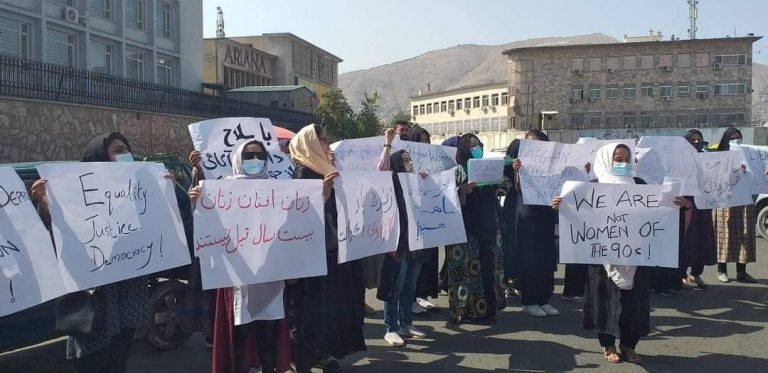
A women’s protest in Kabul, Afghanistan turned violent after the Taliban prevented the protesters from marching to the presidential palace in the city. The protesters alleged that the Taliban attacked them with tear gas shells.
According to the protesters, Taliban forces used tear gas to stop the protest.#TOLOnews
Women have been protesting in Afghanistan demanding “equal rights and full participation in political life.” The protesters took to the streets on Friday as well.
According to CNN, “a group called the Women’s Political Participation Network marched on the street in front of Afghanistan’s Finance Ministry, chanting slogans and holding signs demanding involvement in the Afghan government and calling for constitutional law. Footage showed a brief confrontation between a Taliban guard and some of the women, and a man’s voice could be heard saying, ‘Go away!’ before chanting resumed.”
There have been concerns regarding women’s rights in Afghanistan ever since the Taliban regime took over the country. The Jihadist outfit is known to enforce a fundamentalist interpetration of the Islamic Shariah law.
Indian Engineering and Construction major Larsen and Toubro (L&T) has won a prestigious contract from the British Royal Navy for developing designs for Fleet Solid Support ships. The Defence Ministry of the UK has announced that four consortia of companies, including L&T, have been awarded the contract to build three new Fleet Solid Support (FSS) ships for the British Royal Fleet Auxiliary, the logistics arm of the British Royal Navy.
The four consortia have been awarded Competitive Procurement Phase (CPP) design contracts worth around £5 million each. The four consortia which have been awarded the contracts are Larsen and Toubro with UK company Leidos Innovations, Serco with Damen, Team Resolute that includes Harland & Wolff and BMT, and Team UK that includes Babcock and BAE Systems.
The winners of contracts will now develop their design proposals and explain how they will fulfil the specified requirements. After assessment of these proposals, the final bidder will be selected and the contract to manufacture the ships will be awarded. The preferred bidder is expected to be announced by the fourth quarter of next year and a contract is expected to be announced in 2023. The total cost of the FSS program is pegged at £1.6 billion ($2.2 billion).
Fleet Solid Support Ships are support ships for Aircraft Carriers, which supply dry items like ammunition, explosives and food to the carriers. The new FSS ships will provide logistical support to the Queen Elizabeth-class aircraft carriers, enabling them to stay at sea for longer without the need to return to shore for replenishment of supplies. The new ships will replace ageing RFA Fort Austin and RFA Fort Rosalie of the Royal Navy.
According to the RFP issued for the program, the FSS ships are required to have a total cargo capacity of up to 7,000 m3 (250,000 ft3), should be able to sail at a sustained speed of 18 knots without resupply, and they must be capable of delivering non-bulk logistic material whilst underway and making 12 knots through the water and transferring single loads of up to 5 tonnes.
India’s campaign at the Tokyo Paralympics is one of the country’s extraordinary achievements. Indian athletes have been on a record-setting spree so far, with the medal tally standing currently in double-digit –a first for India, not just at the Paralympics but also in the Olympics.
India had sent 54 athletes to compete in nine sports, including Archery, Athletics (Track and Field), Badminton, Swimming, Weightlifting, among others. This is the biggest-ever contingent India has sent to any Paralympics.
So far, India has won 15 medals – three gold, seven silver and five bronze medals. Currently, India is placed 34th on the medals tally. The Tokyo Paralympics 2020 will conclude on September 5, when Indian athletes will compete at the remaining events. On Sunday, the closing ceremony of the Paralympic Games will be held.
Here’s the list of Indian athletes who won laurels at the ongoing Tokyo Paralympics:
Gold Medal:
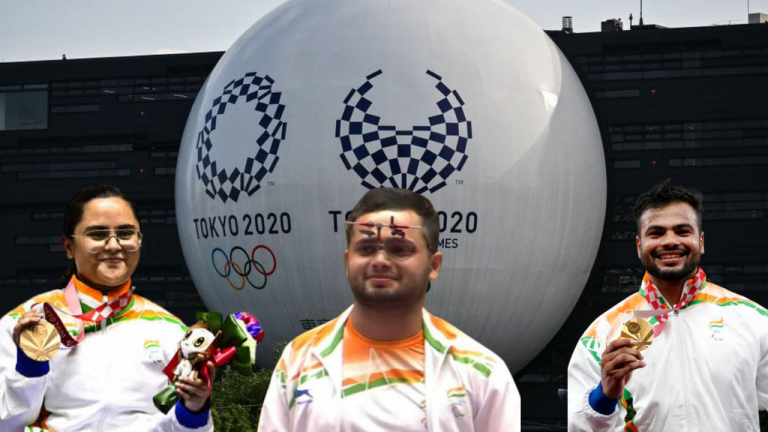
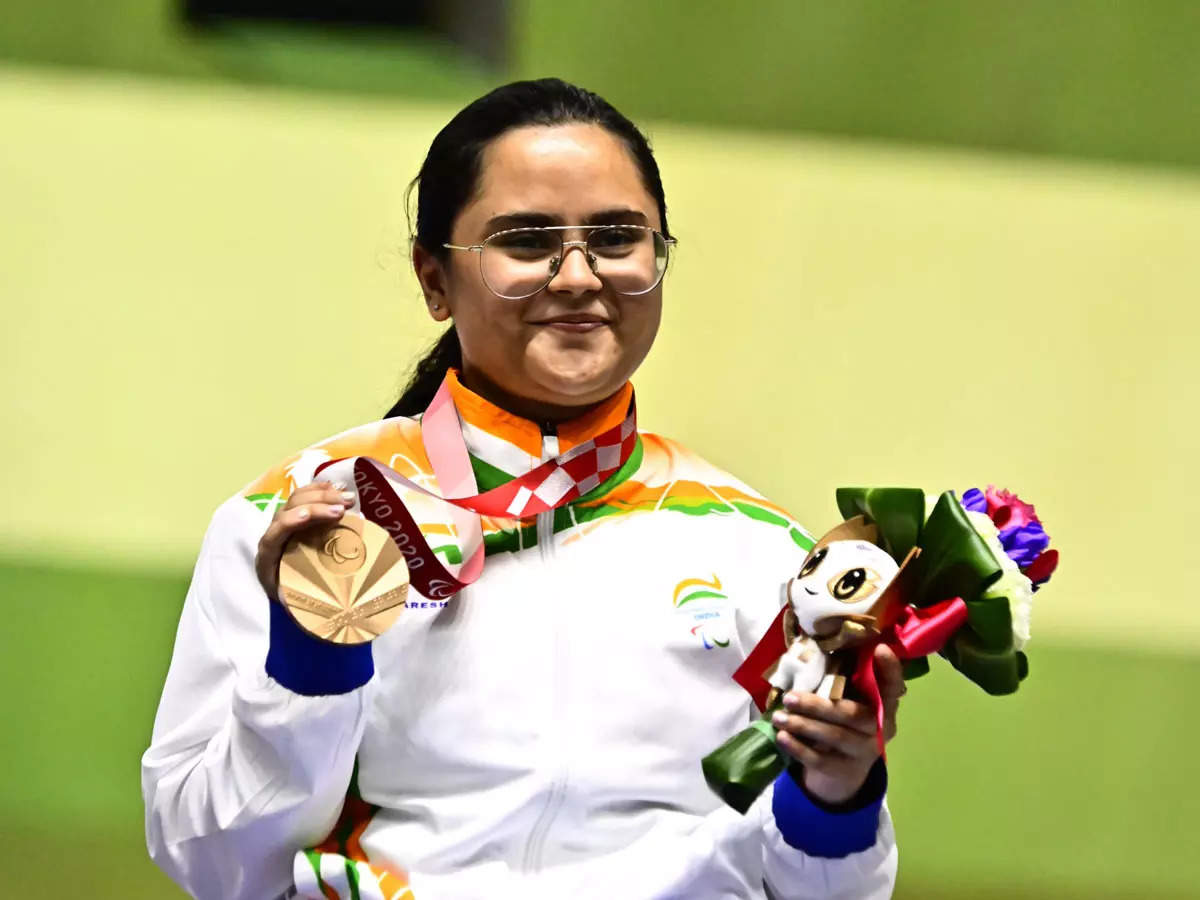
1. Avani Lekhara – Gold Medal – Women’s 10m Air Rifle Shooting standing SH1
Shooter Avani Lekhara scripted history as she became the first Indian woman to win a gold medal at the Paralympics after winning the R-2 women’s 10m Air Rifle standing SH1 event.
The 19-year-old from Jaipur, who sustained spinal cord injuries in a car accident in 2012, finished with a world record-equalling total of 249.6, which is also a new Paralympic record.
SH1 category is designated to athletes with lower limb impairment for competition in Rifle events.
Avani Lekhara – Gold Medal in Shooting/ Image Source: Times of India
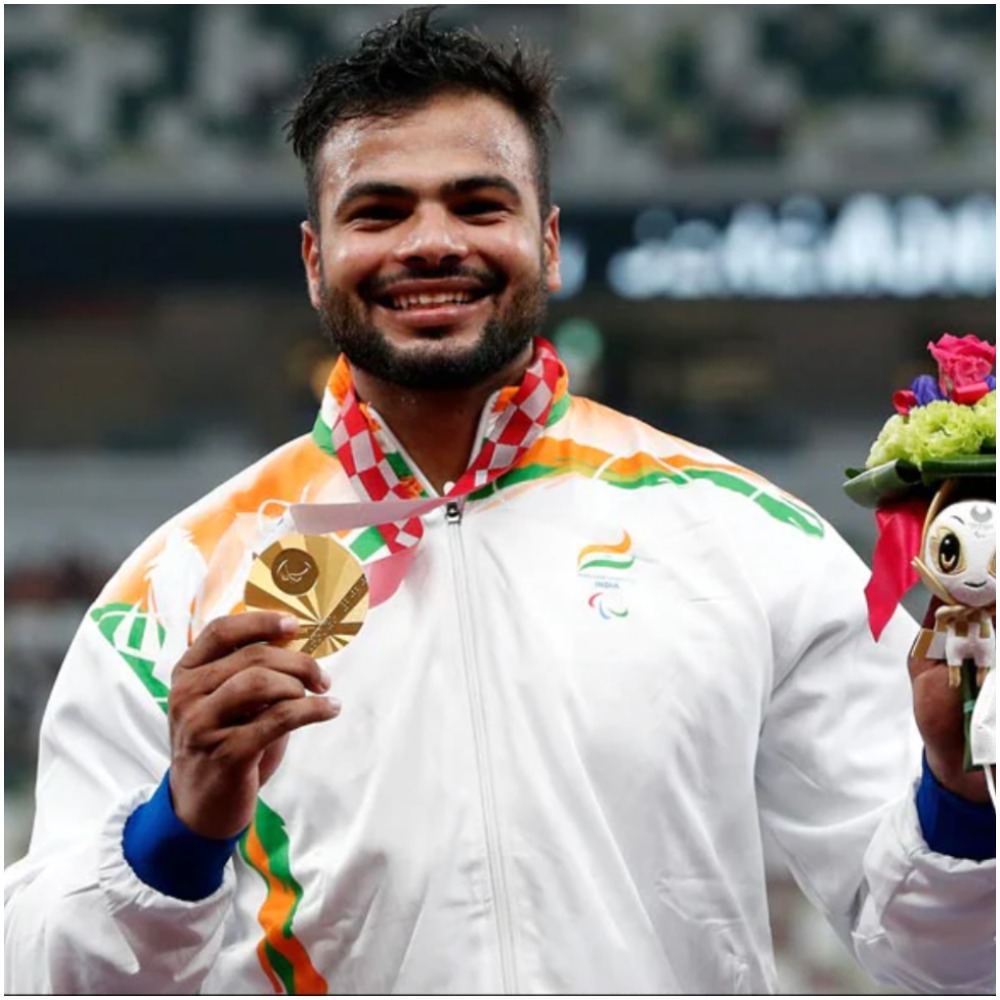
Sumit Antil won the second gold medal for India in the men’s javelin throw F64 event. Antil broke his own world record in the men’s javelin F64 category with a throw of 68.55m to hand India the second gold medal at the Paralympic Games 2020.
In 2019, Sumit had secured a silver in the World Para Athletics Championships. Ahead of the Paralympic Games, Sumit had held the world record with a throw of 62.88m. He recorded 66.95m in his very first throw, and in his second attempt, he threw 68.08m. In his fifth, he threw 68.55m, which eventually secured a gold medal for Sumit.
In the F64 category, athletes are classified based on primary impairments in the lower limbs, including only limb deficiency and leg length discrepancy. All athletes in these classes compete standing without support.
Sumit Antil – Gold Medal in Javelin/ Image Source: Twitter
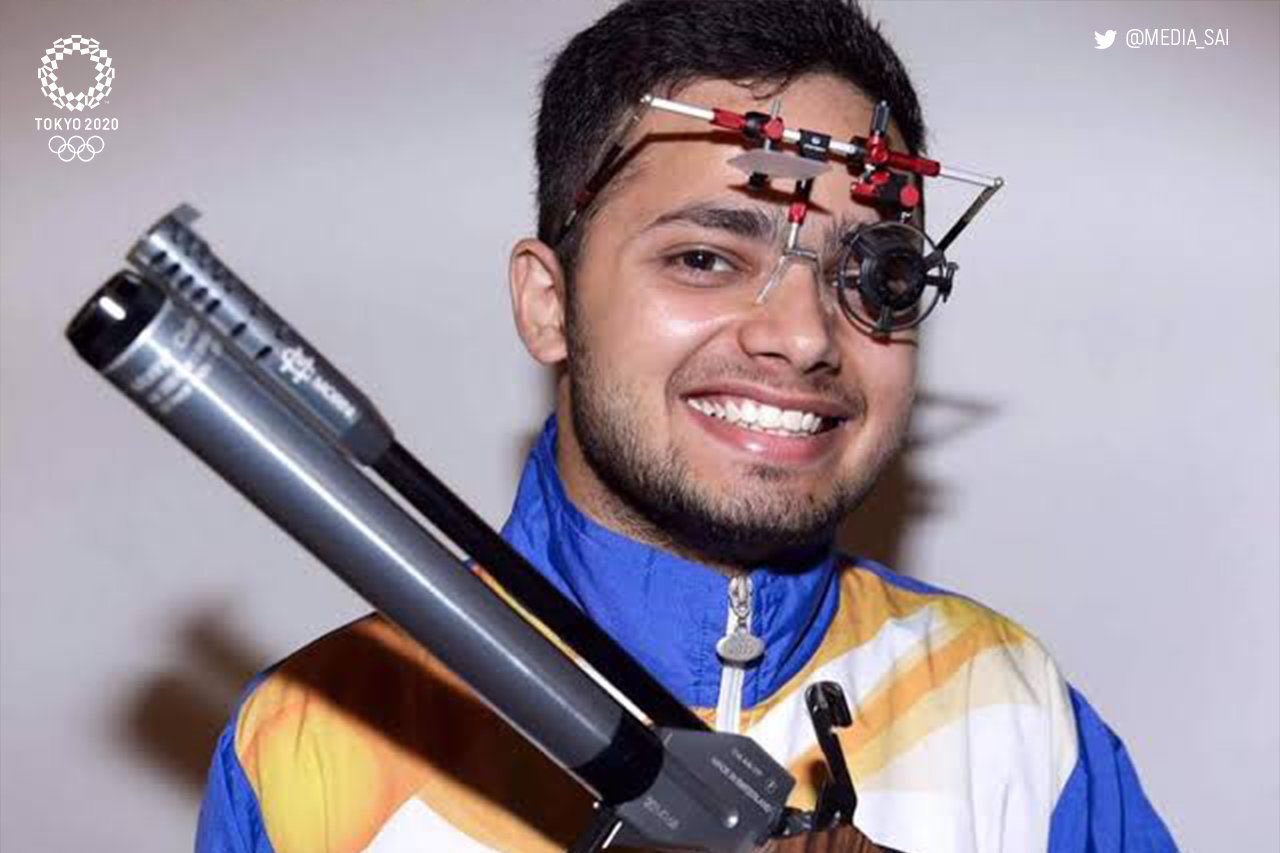
Shooter Manish Narwal clinched India’s third gold at the ongoing Paralympics in the Mixed 50m Pistol SH1 Shooting final. The 19-year-old Manish Narwal won gold in the Mixed 50m Pistol SH1 Shooting final with a new Paralympics record of 218.2.
SH1 category is designated to athletes with upper or lower limb impairment for competition in the pistol events.
Manish Narwal – Gold Medal in Shooting/ Image Source: Twitter
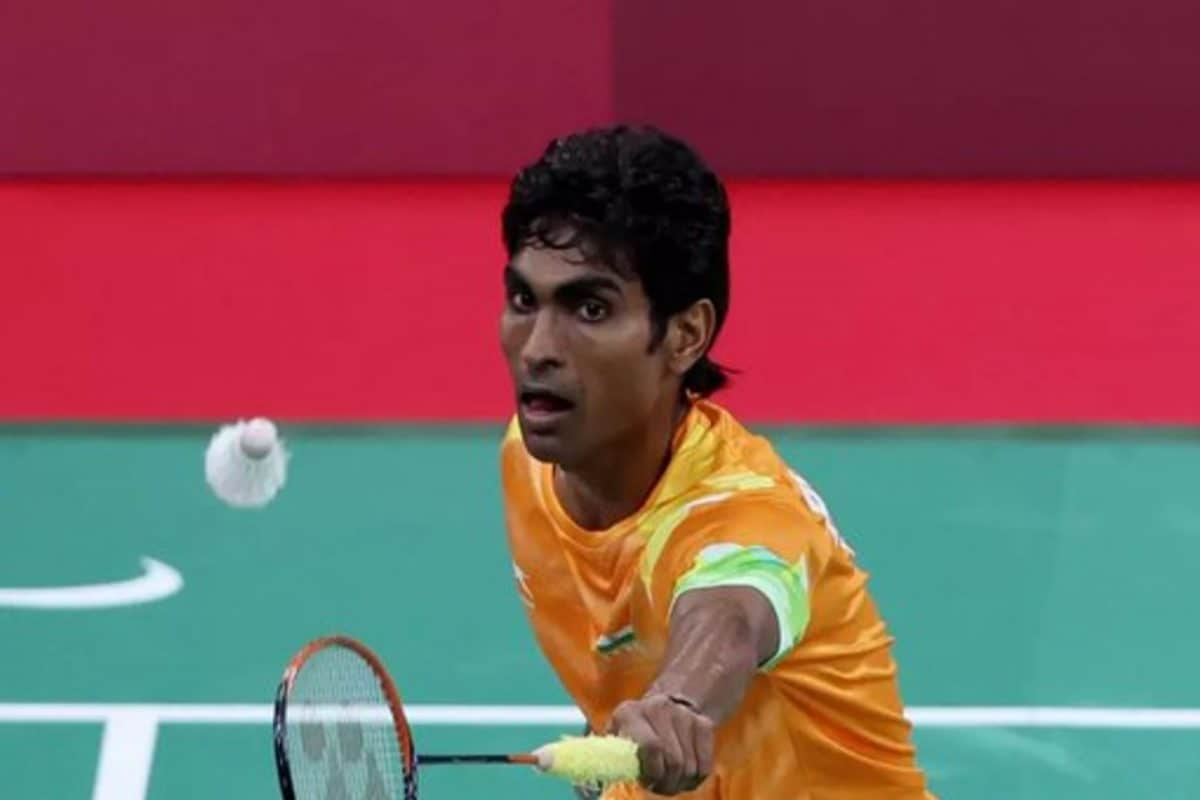
4. Pramod Bhagat – Gold Medal – Badminton
Pramod Bhagat won the Men’s Singles SL3 event badminton gold medal match against Great Britain’s Daniell Bethell at the Tokyo Paralympics on Saturday.
33-year-old Bhagat from Bhubaneswar, Odissa, had contracted polio when he was 4 years old, and had picked up the sports after watching his neighbours play.
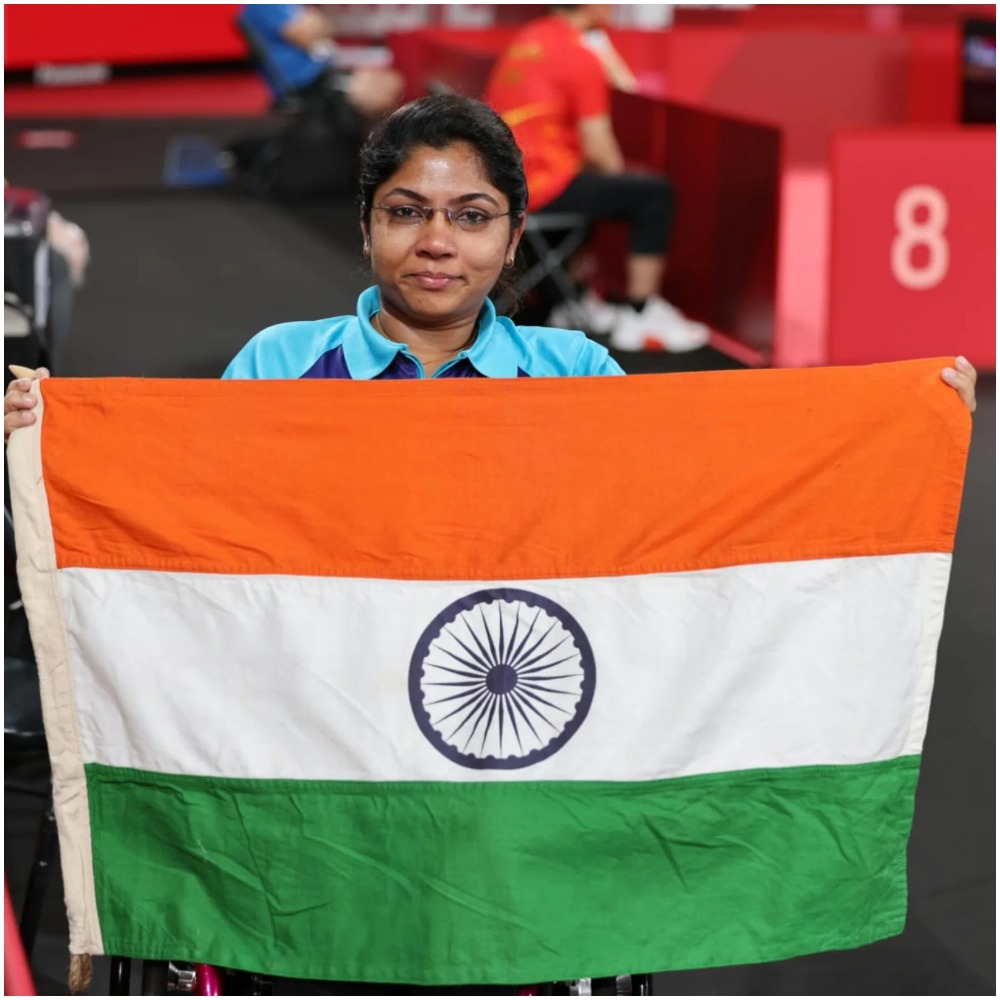
Bhavina Patel won a historic silver medal in the Table Tennis event in the Paralympic Games. She had reached the finals of the Women’s Singles Class 4 Category in the Tokyo Paralympics, however, she lost to Chinese paddler Ying Zhou.
The 34-year-old Patel, diagnosed with polio when she was 12 months old, had defeated world number 3 Miao Zhang of China in the semifinal showdown. C4 category includes people with lower-limb impairments or issues with lower-limb functionality.
Bhavina Patel – Silver medal -Table Tennis/ Image Source: News18
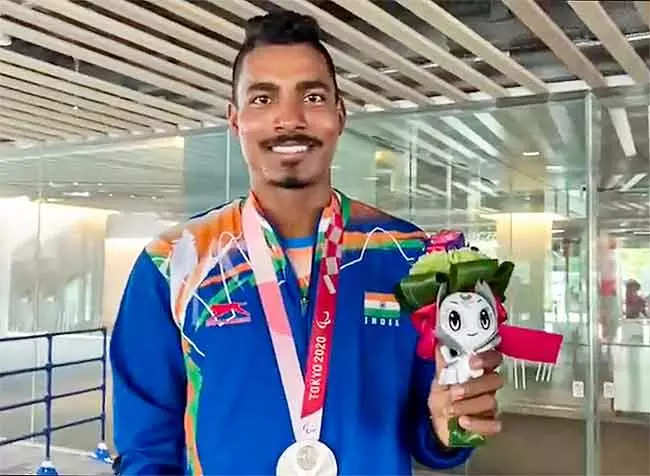
2. Nishad Kumar – Silver medal – Men’s High Jump T47
Nishad Kumar clinched a silver medal in the men’s high jump T47 event in the Paralympics with an Asian record effort. The 21-year-old Kumar jumped 2.06m to win the silver and set an Asian record.
T47 class is meant for athletes with a unilateral upper limb impairment resulting in some loss of function at the shoulder, elbow and wrist. Hailing from Una in Himachal Pradesh, Kumar had met with an accident at the age of eight that resulted in the loss of his right hand. He was also infected by Covid-19 earlier this year while training at the SAI Centre in Bengaluru.
Nishad Kumar – Silver medal – Men’s High Jump/ Image Source: TOI
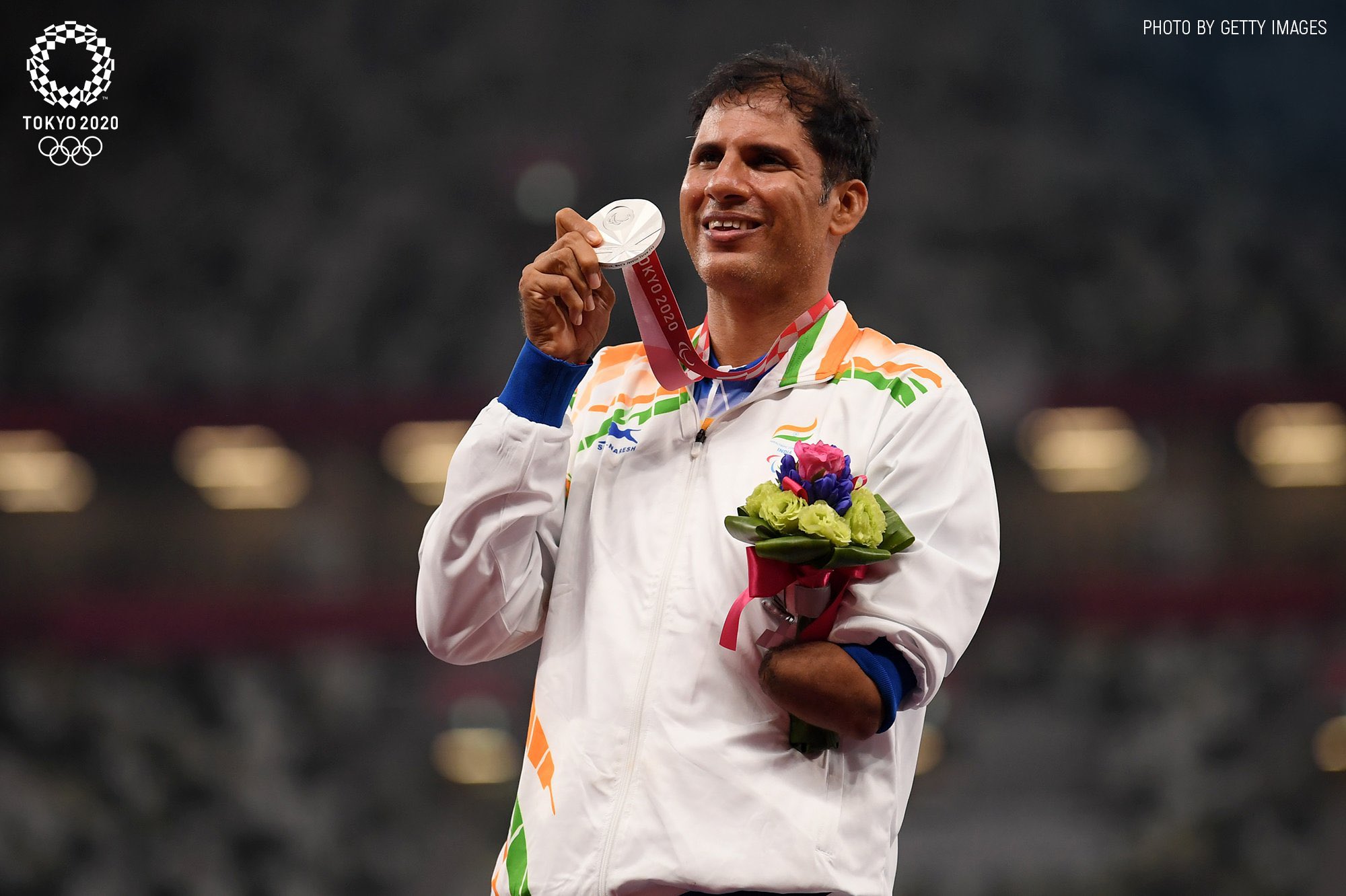
Devendra Jhajharia is one of India’s sporting legends. Two-time Paralympic gold-winning javelin thrower Devendra Jhajharia settled for silver in his to win an extraordinary third Paralympic medal. With the silver medal this time, Devendra Jhajharia has become the first Indian to win three medals in the Paralympics.
The 40-year-old Jhajahria had won gold medals in the 2004 and 2016 Games, pulled off a new personal best throw of 64.35m for the silver.
The F46 classification is for athletes with arm deficiency, impaired muscle power or impaired passive range of movement in arms, with athletes competing in a standing position. Jhajahria had lost his left hand after accidentally touching an electric wire while climbing a tree at the age of eight.
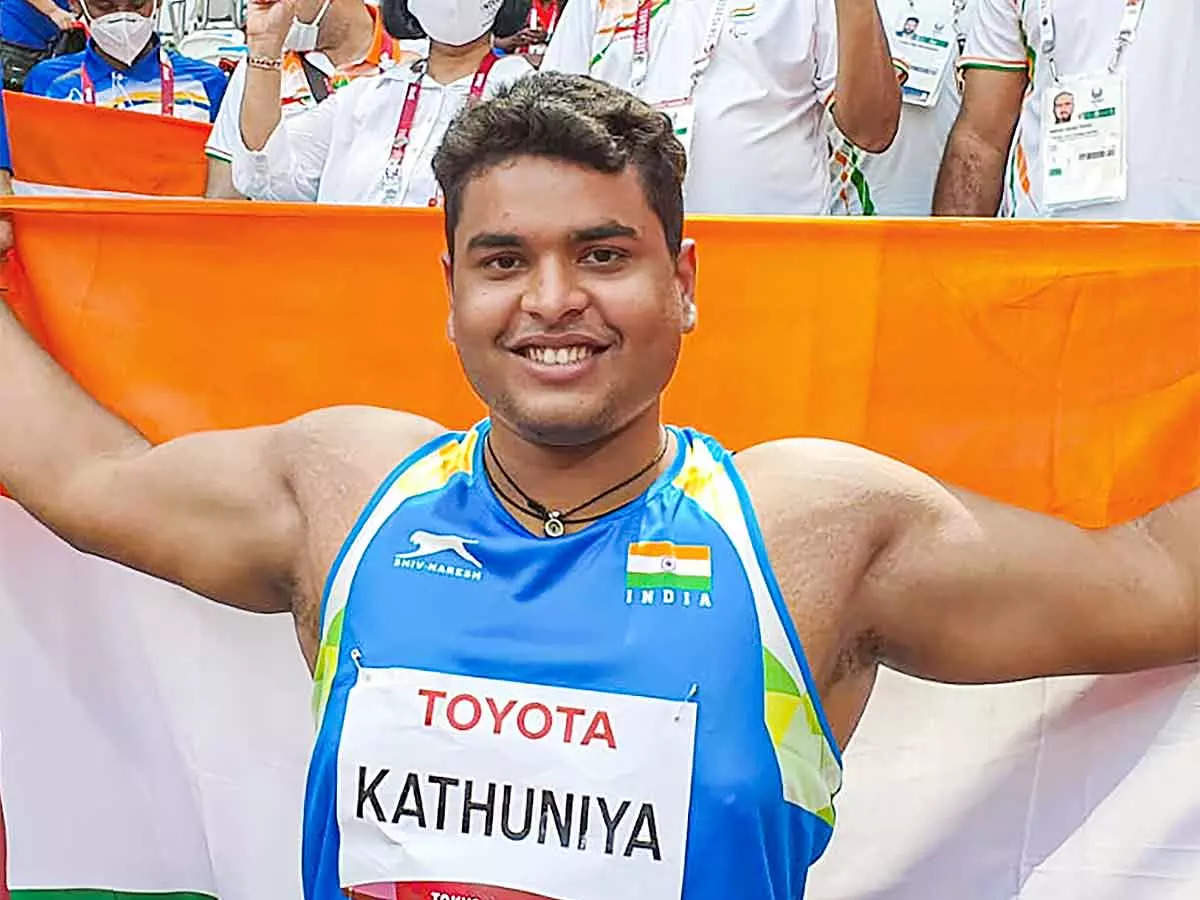
Yogesh Kathuniya secured a silver medal in the men’s discus throw F56. The 24-year-old, a B.Com graduate from New Delhi’s Kirorimal College, threw the discus throw at a distance of 44.38m in his sixth and last attempt to clinch the silver.
Kathuniya suffered a paralytic attack at the age of eight, which left him with coordination impairments in his limbs. He had won a bronze medal in the 2019 World Para Athletics Championships in Dubai with the best throw of 42.51m to secure a Tokyo berth.
The F56 classification is for athletes who have full arm and trunk muscle power. Pelvic stability is provided by some to full ability to press the knees together.
Yogesh Kathuniya – Silver Medal – Men’s Discus throw/ Image Source: TOI
5. Mariyappan Thangavelu – Silver Medal – Men’s High Jump T42
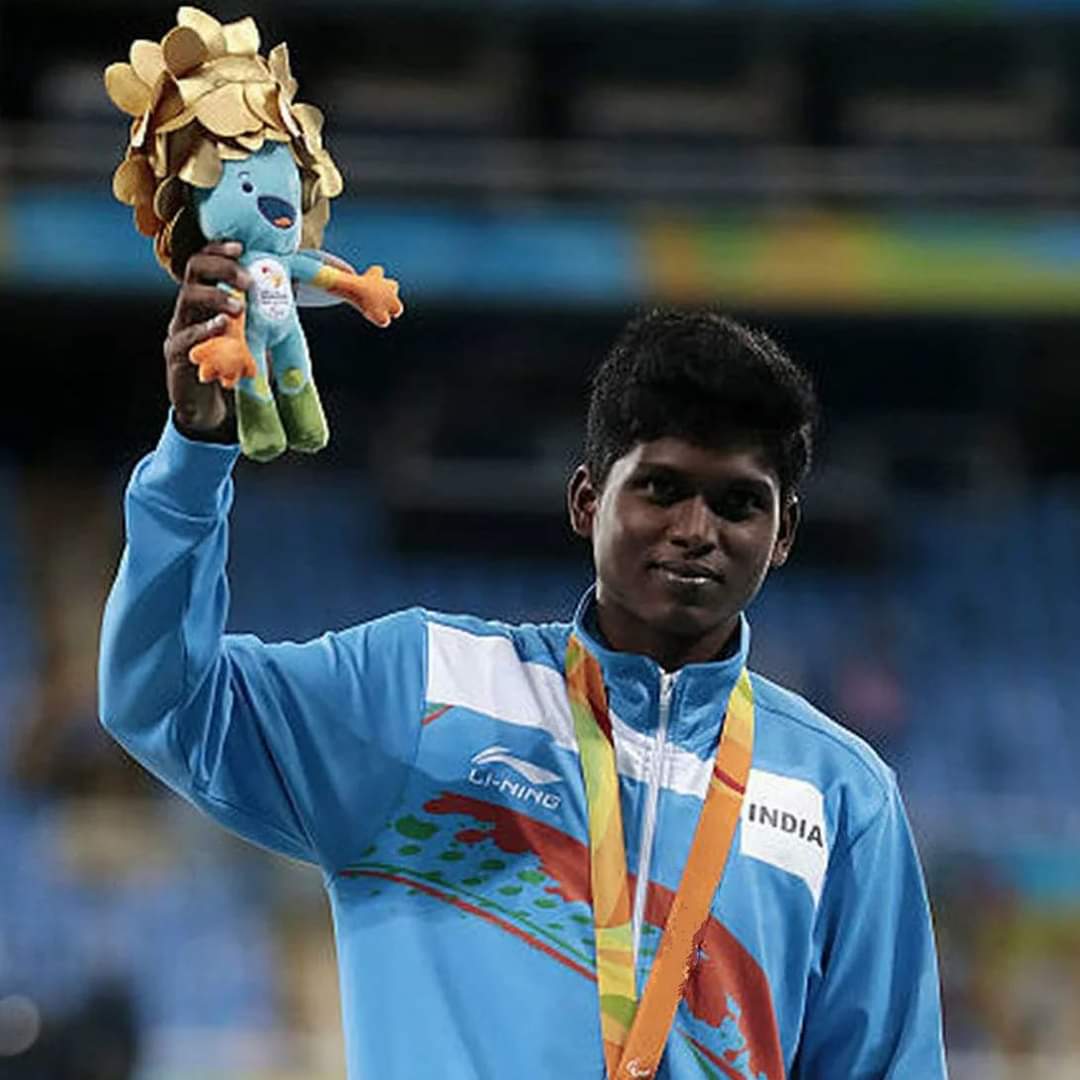
Mariyappan Thangavelu, who had won a gold medal in the Rio Paralympics High Jump event, won yet another medal for India in the Tokyo Paralympic games 2020. He won a silver in the men’s high jump T42 event. Mariyappan cleared 1.86m while American gold winner Sam Grewe succeeded in soaring above 1.88m in his third attempt.
The T42 classification is for athletes with a leg deficiency, leg length difference, impaired muscle power or impaired passive range of movement in the legs. The athletes compete in a standing position. Mariyappan Thangavelu, who hails from Tamil Nadu, had suffered permanent disability in his right leg after being crushed under a bus when he was only 5.
Mariyappan Thangavelu – Silver Medal – Men’s High Jump/ Image Source: Twitter
6. Praveen Kumar – Silver Medal – Men’s High Jump T64
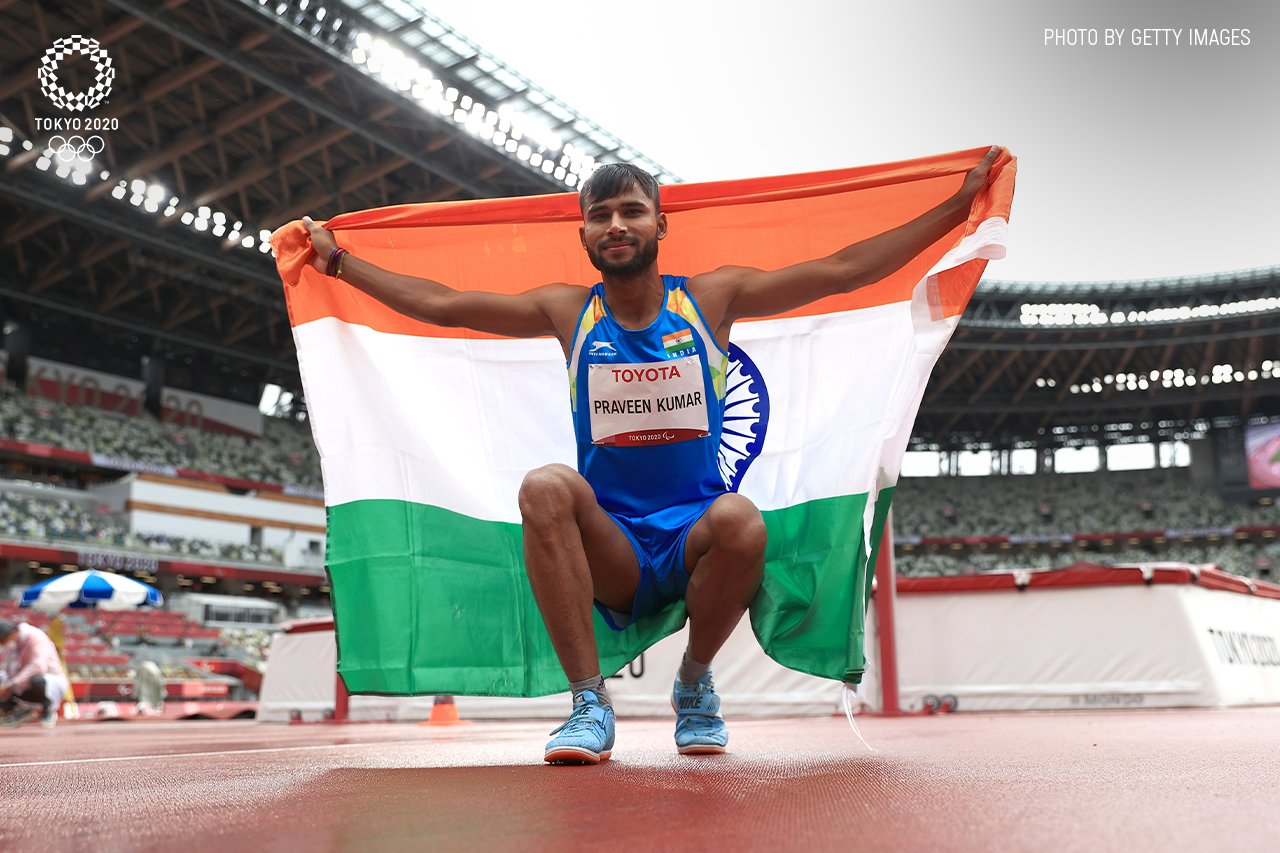
Praveen Kumar won silver in the Men’s High Jump T64 classification with the best jump of 2.07m.
The 18-year-old Praveen Kumar, competing in his debut Paralympics, set a new Asian record with a 2.07m jump. Praveen Kumar, competing in his debut Paralympics, set a new Asian record with a 2.07m jump. This was also Kumar’s personal best performance, and he is also the youngest medal winner in the Indian contingent.
In the T64 category, the athletes are classified based on primary impairments in the lower limbs and include only limb deficiency and leg length discrepancy. All athletes in these classes compete standing without support.
Praveen Kumar – Silver Medal – Men’s High Jump T64/ Image Source: Twitter
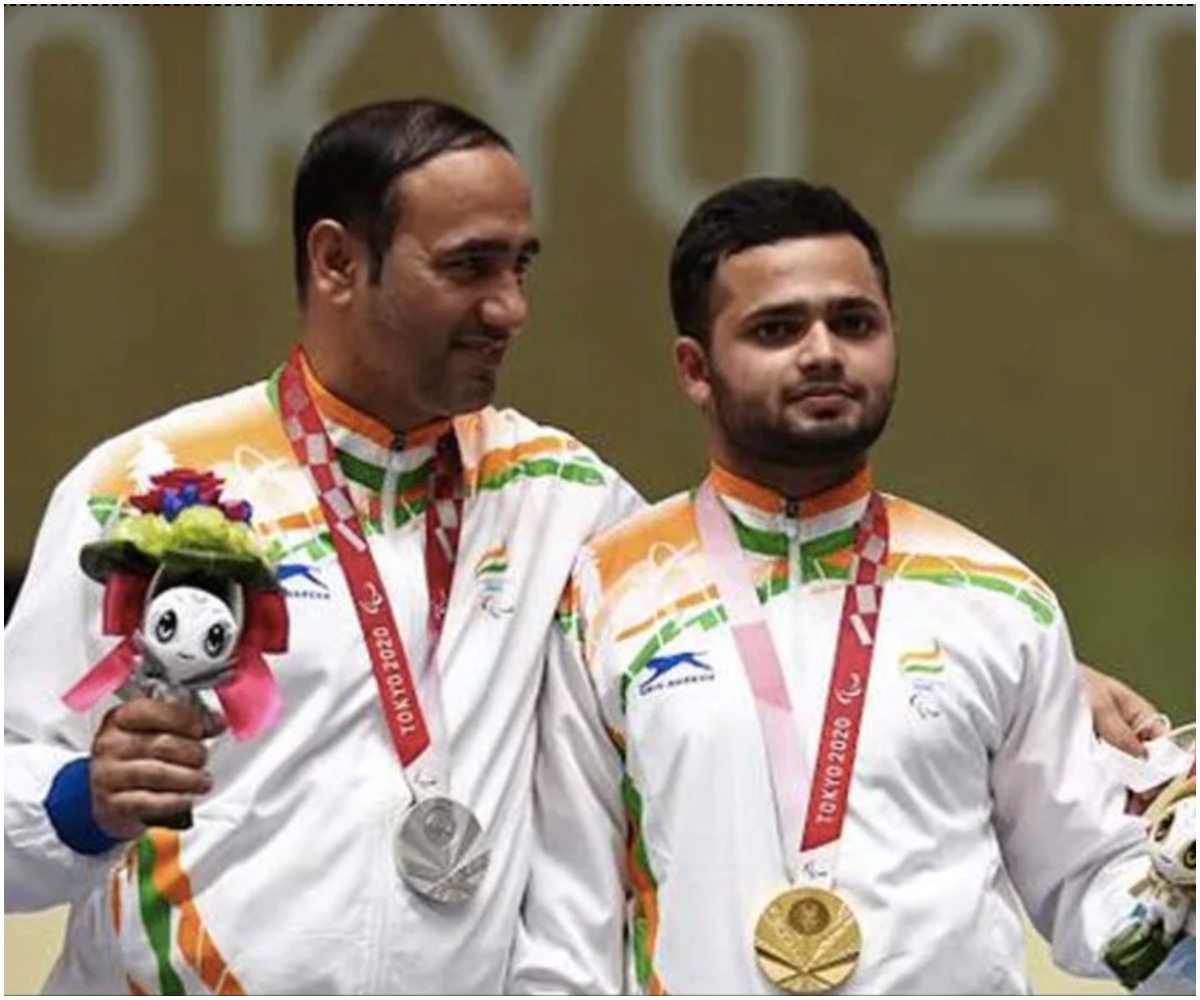
Singhraj Adhana secured a silver medal in the Mixed 50m Pistor SH1 shooting event. He stood second with a score of 216.7, while fellow Indian Manish Narwal won the historic gold medal, securing two medals for the country in the same event.
SH1 category is designated to athletes with upper or lower limb impairment for competition in the pistol events.
Singhraj Adhana (L) – Silver Medal – Mixed 50m Pistol SH1 shooting with Manish Narwal (R)- Gold Medal – Mixed 50m Pistol SH1 shooting/ Image Source: Twitter
Bronze Medal:
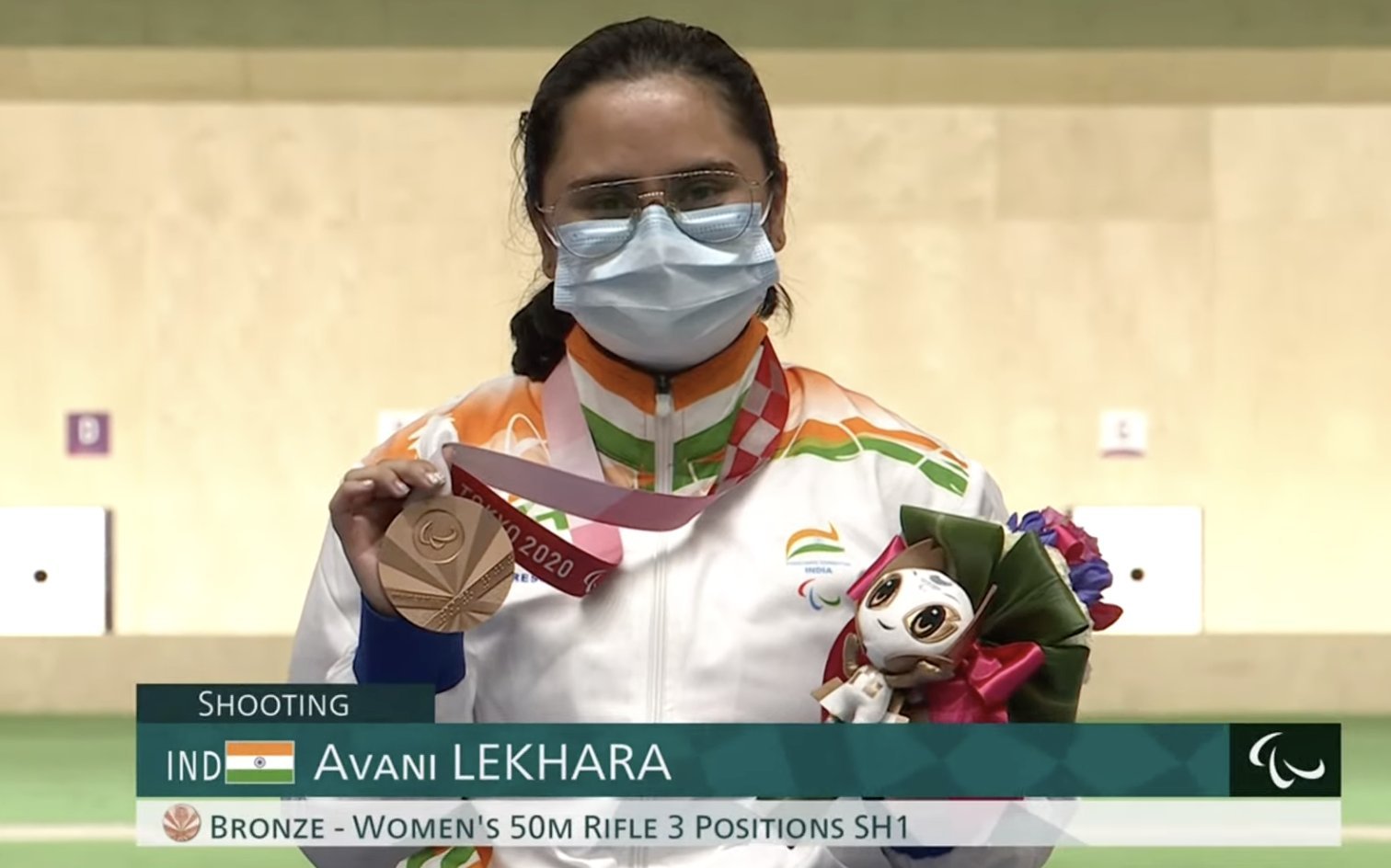
1. Avani Lekhara – Bronze Medal – Women’s 50m Rifle three positions SH1
Avani Lekhara won her second medal at the Tokyo Paralympics after she clinched her second medal with a bronze in women’s 50m rifle three positions SH1 classification.
Lekhara finished with 445.9 points while China’s Zhang Cuiping won her third consecutive Paralympics gold medal at this event with a personal best of 457.9.
SH1 category is designated to athletes with lower limb impairment for competition in Rifle events.
Avani Lekhara – Bronze Medal – Women’s 50m Rifle three positions SH1/ Image Source: Twitter
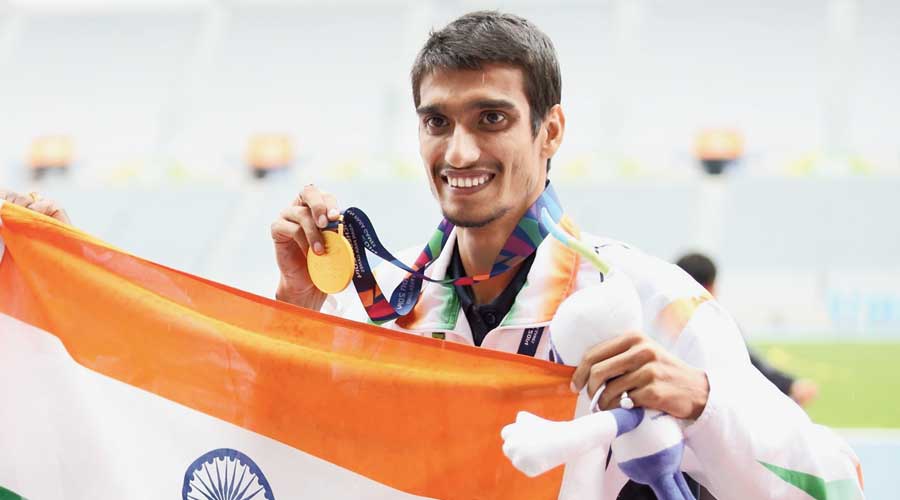
2. Sharad Kumar – Bronze Medal – Men’s High Jump T42
Sharad Kumar won the bronze in the men’s high jump T42 event by clearing 1.83m. Kumar is a two-time Asian Para Games gold-medallist.
Kumar, who hails from Patna, Bihar, suffered paralysis in his left leg as a two-year-old after being administered a spurious polio vaccine. Kumar trained in Ukraine for over two years before the Paralympics under foreign coach Nikitin Yevhen after the Modi government stepped in. The government also assisted him in getting back to India from Ukraine during the Covid-19 restrictions.
The T42 classification is for athletes with a leg deficiency, leg length difference, impaired muscle power or impaired passive range of movement in the legs.
Sharad Kumar – Bronze Medal – Men’s High Jump/ Image Source: Twitter
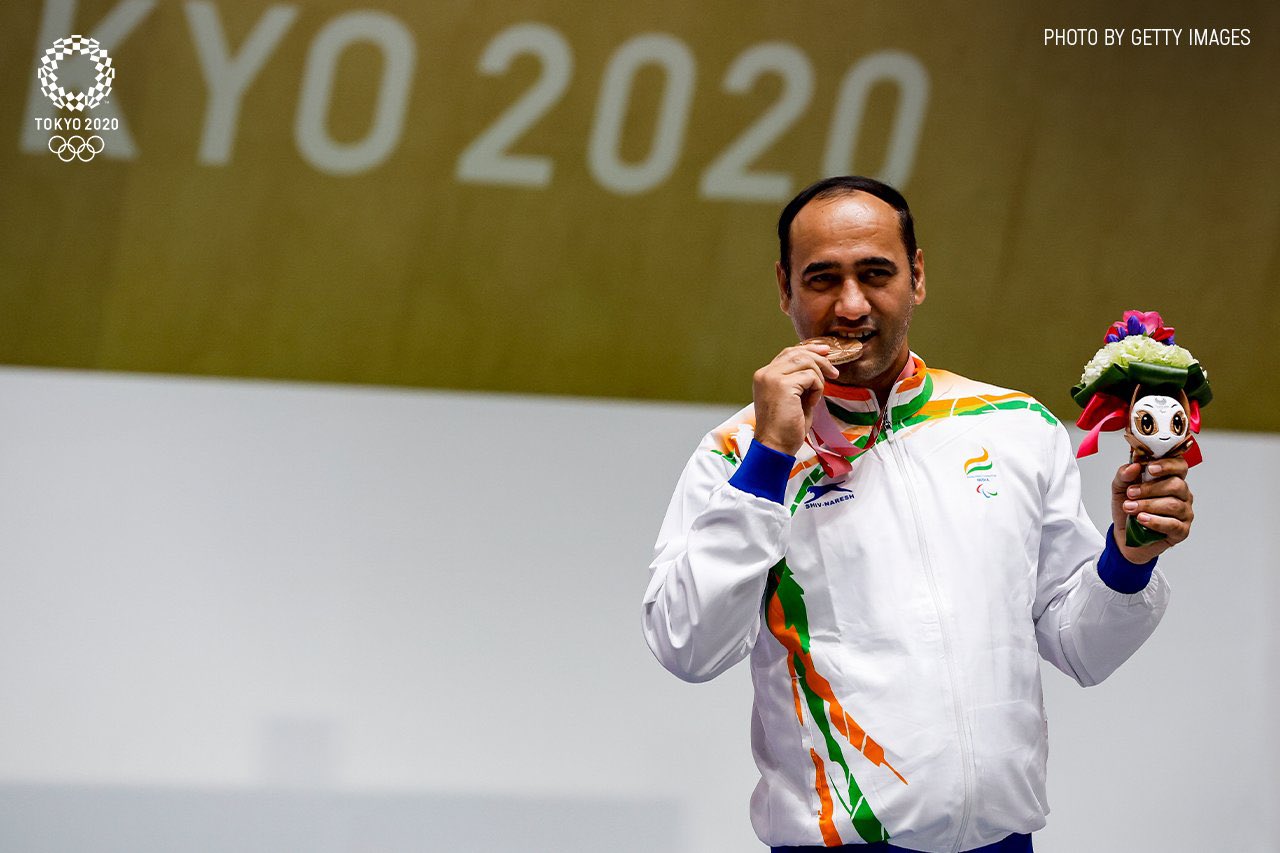
3. Singhraj Adhana – Bronze Medal – Men’s 10m Air Pistol shooting SH1
Singhraj Adana won his first Paralympic medal after finishing third in the Men’s 10m Air pistol shooting SH1 event. He also won the Paralympics silver medal in the Mixed 50m Pistor SH1 shooting event.
The 39-year-old, who is affected by polio, made his Paralympics debut in Tokyo. He shot a total of 216.8 to finish the event in third place after qualifying for the eight-man final as the sixth-best shooter. The shooter from Haryana’s Bahadurgarh took to the sport only four years ago. Earlier, he had served as the chairman of the Sainik School in Faridabad.
Singhraj Adhana – Bronze Medal – Men’s 10m Air Pistol shooting/ Image Source: Twitter
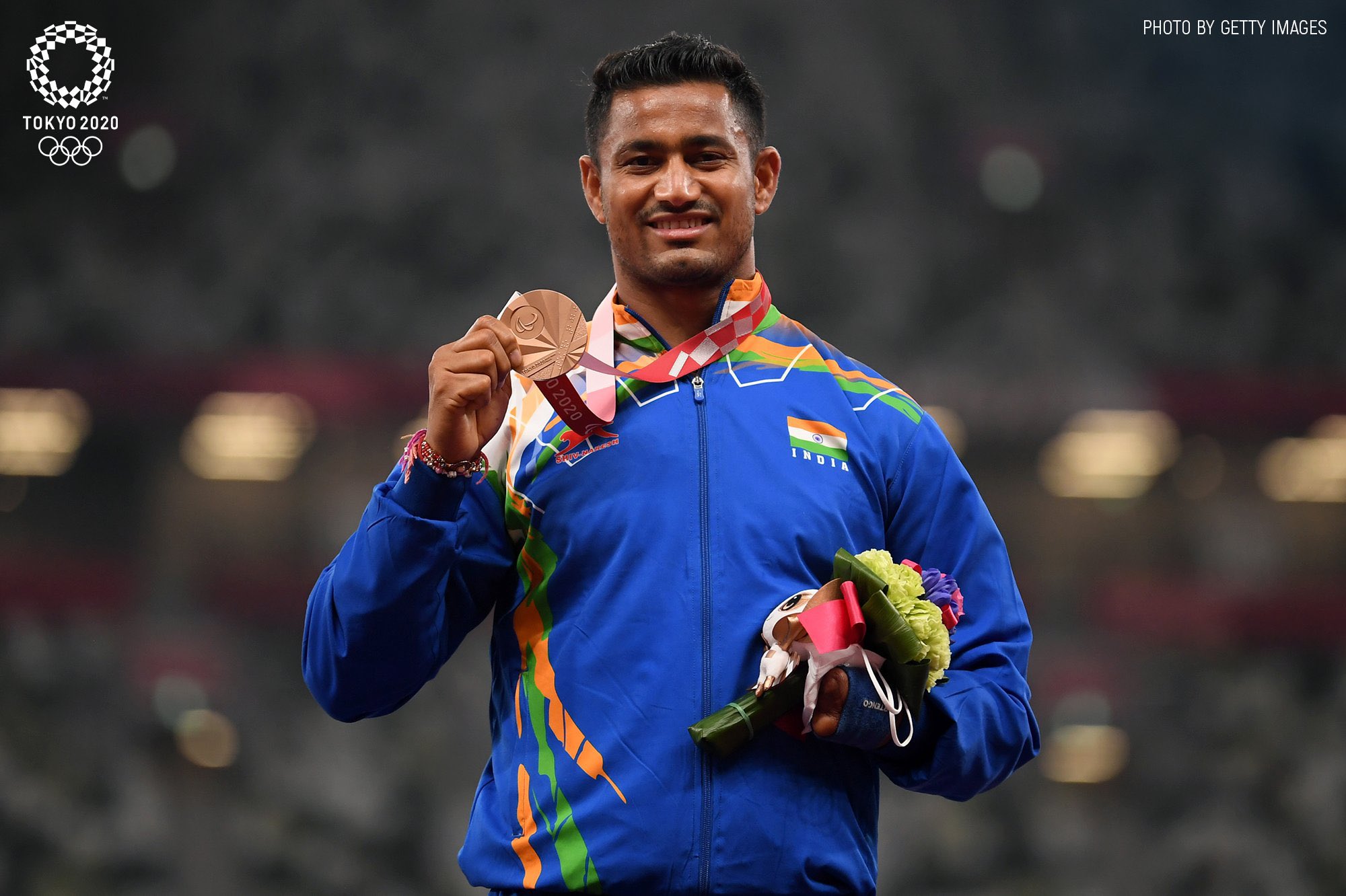
The 25-year-old Sundar Singh Gurjar finished third with a best effort of 64.01m in men’s javelin throw F46 to win a Bronze medal.
Gurjar, who lost his left hand in 2015 after a metal sheet fell on him at his friend’s house, was third with a best effort of 64.01m in men’s javelin throw F46. The Jaipur-based Gurjar had won gold in the 2017 and 2019 World Para Athletics Championships.
The F46 classification is for athletes with arm deficiency, impaired muscle power or impaired passive range of movement in arms, with athletes competing in a standing position.
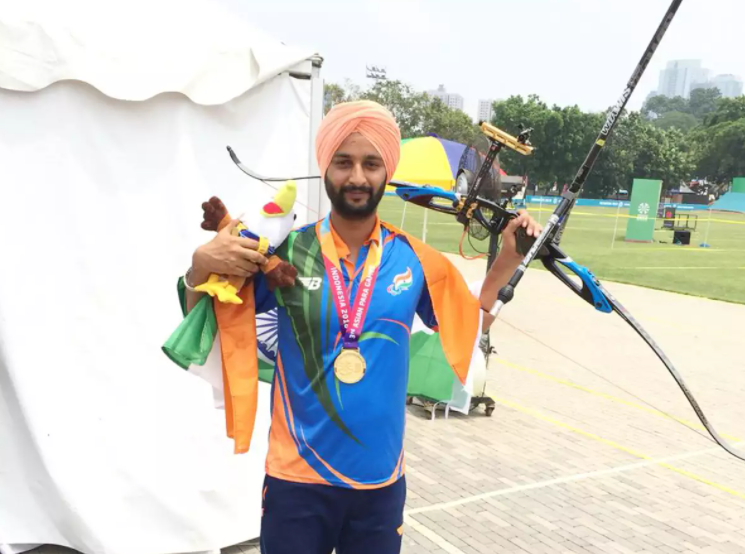
Harvinder Singh won India’s first-ever archery medal in the Paralympics after beating Kim Min Su of Korea for the men’s individual recurve bronze in the Tokyo Paralympics 2020.
Singh, who is ranked world number 23, won a tight contest against South Korean archer Kim Min Su in a thrilling shoot-off for the individual bronze in the recurve men’s open section.
Harvinder Singh – Bronze Medal – Archery/ Image Source: Twitter
India’s performance at the Tokyo Paralympics surpassed the previous records achieved at the Rio Paralympic games, in which India had won 4 medals – 2 Gold, 1 Silver and 1 Bronze.
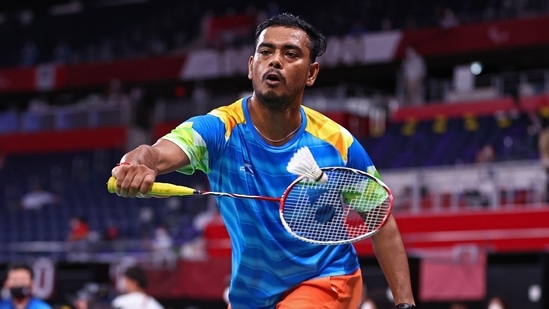
6. Manoj Kumar – Bronze Medal – Badminton
One the day Pramod Bhagat won the gold medal at the singles Badminton event, another Indian Manoj Kumar won the bronze medal in the same event. He defeated Japan’s Daisuke Fujihara to clinch bronze in straight sets 22-20 21-13 on September 4. He had lost the semi-final to Great Britain’s Daniel Bethell in the badminton SL3 category, but bounced back to win third place. Manoj was struck by polio during his teenage years and had begun to play badminton at the age of five.
He had started to compete in para-badminton events in 2011, and had won gold medal in the SL3 singles at the 2016 Asian Championships in Beijing. He was awarded the Arjuna Award in 2018, and was named Para Sportsman of the Year at the Sportstar Aces Awards in 2019.
Note: The Tokyo Paralympics are not yet over and the report will be updated with more medal winners when the events are completed.
There was a time when Jesuit priest Robert Solomon, with rice-bag on his back, was prowling and peeping in the hut of a poor to convert them to Christianity. He was trained in the art of cheating people with fake fables.
But in 1986, he relinquished the very religion (Christianity) which he was coaxing others to embrace. From Solomon, he became Dr. Suman Kumar with no more rice bags and no more fake fables which are chief tools of conversion to Christianity. In the same year, he joined the RSS.
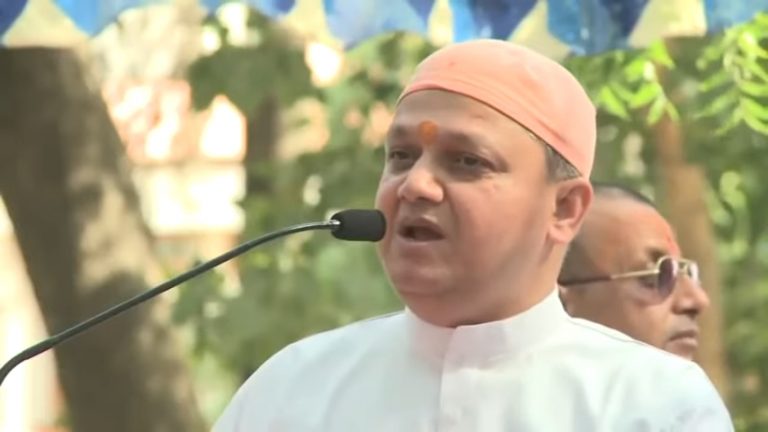
Dr Suman, currently the organizational secretary of Hindu Jagaran Manch (Bihar-Jharkhand), is a quite interesting story about how an agent of conversion returned to Sanatan dharma.
Earlier based in Indonesia he was pursuing higher studies at Oxford University when he joined the church as pastor. It was around 1982 when Robert Solomon was regularly sent to Chennai in Tamil Nadu and other parts of the country for a mission to ‘covert India to Christianity.’
Church falsely told him that RSS people burn the Holy Book, vandalize church and torture missionary people. He was also asked to study the pattern of working of the RSS.
“In fact, he was told to spy on RSS and its activities. He had come to India to report back the church about RSS. But when he closely watched the RSS it opened his mind and perception. He was quite inspired by the RSS and converted to Sanatan dharma. Initially we were very curious about him,’’ said Rajkumar, an old-time RSS worker.
In 1986 Robert Solomon came in touch with Ashok Varshney; the senior RSS functionary and the then national organizational secretary of Arogya Bharti, Thakur Ram Govind Singh of Hindu Jagaran Manch and Swant Ranjan.
He started visiting the shakha of RSS at Orai in Uttar Pradesh and he soon became a regular visitor. He was quick to grab the eyeball of senior functionaries of RSS. During a conclave of the RSS held in Gorakhpur, he was officially given responsibility in the RSS. He was asked to work for the Hindu Jagaran Manch.
In 2004 Suman was sent to Jharkhand where his real fight with the church actually started. The whole of Jharkhand especially the Chotanagpur division was affected by the mass conversion of tribals in Christianity. The church had created such a network and penetrated deep into the tribal society that at once it looked impossible to smash the century-old conversion conspiracy.
He picked Gumla, Khunti (then a part of Ranchi district) and Simdega to start the homecoming of tribals back to their religion. Once in Jharkhand, he had invited all senior functionaries of the church to discuss and explain the position of the church on conversion. As usual, the church ran away from the debate.
A man who was once a missionary blue-eyed boy became their worst enemy. However, the missionary tried their best to instigate local people to boycott him as an outsider.
He convinced tribals that their conversion is a diabolic design of missionaries and they should not quit their religion. The strategy of the unification of Sanatan and Sarana was successful to a great extent since 8000 tribals who had converted in the past returned to their religion.
The Ministry of Home Affairs (MHA) has suspended the foreign funding licence of a prominent Kerala-based NGO linked to Sheikh Abubakr Ahmed, a prominent Sunni leader, over violations of provisions of the Foreign Contribution Regulation Act (FCRA), 2010, an exclusive report published in the Times of India said.
EXCLUSIVE: MHA suspends foreign funding licence of Kerala NGO Markazul Ighasathil Kairiyathil Hindiyya, linked to prominent Sunni leader Sheikh Aboobacker Ahmed, over FCRA violations like misutilisation/diversion of funds & non-filing of returns; NGO recd Rs 146 cr in last 3 yrs pic.twitter.com/gxSXPkXPBD
The NGO—Markazul Ighasathil Kairiyathil Hindiyya—a top foreign funded organisation based out of Kozhikode, has received over Rs 146 crores in donations from abroad in the last three years. However, the home ministry found the NGO violating FCRA norms and barred it from receiving funding from any international donors without prior permission or till revocation of the suspension order.
In its suspension order dated August 27, 2021, the FCRA violations cited by the MHA comprised of inappropriate utilisation and diversion of foreign contributions by Markazul, misrepresentation of facts and its failure to submit annual FCRA returns for the year 2019-20.
A senior office-bearer of the NGO tried to underplay the suspension order it received from the MHA. The functionary said some clerical errors resulted in the suspension. He told the TOI that the group will be issuing a clarification after perusing the order.
However, a government official to whom TOI spoke said the decision to suspend Markazul’s FCRA licence was taken after following a due inquiry process, with a questionnaire sent to the NGO on 05.04.2018. The official said the reply to the questionnaire confirmed that the association had violated Section 12(4)(a)(vi), Section 18 and Section 19 of the FCRA.
Markazul, which also operates under the brand ‘Relief and Charitable Foundation of India (RCFI)’ and receives funds mostly by gulf-based charities, can challenge the suspension order, after which the Home Ministry could review the suspension or persist with permanent cancellation of its FCRA registration after a period of 180 days, which could be extended for another 180 days.
As per the report, the association received a foreign funding of Rs 50 lakhs for the purchase of a piece of land. However, on 13.01.2015, the NGO received back the amount upon cancellation of the land deal. This amount was not allocated to the foreign contribution-designated bank account, but was retained in cash in the NGO’s office. Markazul said the cash was distributed for its orphan care programme. However, enquiry and NGO records showed that they were transferred between July 2014 to December 2014, six months before receiving the amount on January 13, 2015.
“Hence the amount of Rs 50 lakh received on account of cancelled land deed is not accounted for and appears to have been diverted/misutilized,” said the MHA order, adding it was a violation of Section 12(4)(a)(vi), 18 and 19 of the FCRA, 2010.
The association is also accused of using funds procured by the group for personal requirements. It highlighted to the purchase of a vehicle in the name of an individual and not the association, stating it to be another violation of Section 12(4)(a)(vi) of FCRA. The order also said that the NGO had utilised funds received from abroad for the construction of a building on land taken on lease by the Islamic Education Board of India from the Waqf Board of India. The MHA said utilisation of foreign contribution for the creation of assets on land on which the association has no claim, as a “violation of Section 12(4)(a)(vi) of the Act”.
Besides, Markazul also did not file its annual returns for the year 2019-20, a violation of Section 18 of FCRA. According to a Markazul official, they failed to file the returns because the “online window” to file returns was closed just before they could upload the returns.
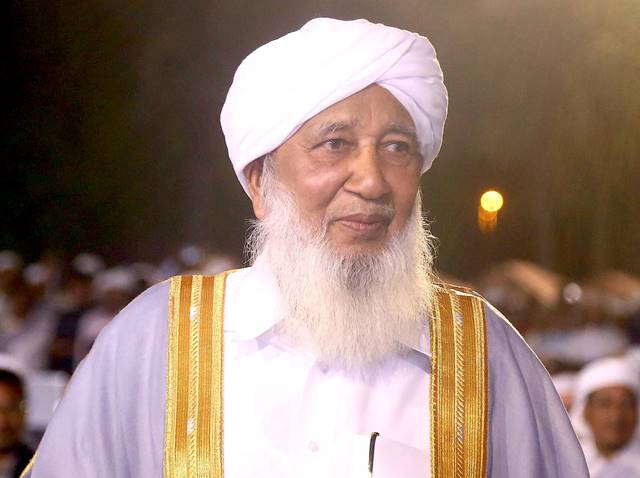
Sheikh Abubakr Ahmed alias Kanthapuram A P Aboobacker Musliyar is a prominent figure among politicians in Kerala and is referred to as ‘Grand Mufti of India’ by his followers. He is credited for establishing Markazul in 2000 and is involved in works related to fields like education, cultural restoration, disaster management, health and sanitation, etc. He is also the Chancellor of the Jamia Markaz, Chairman of the Siraj Daily and General Secretary of the All India Sunni Jamiyyathul Ulama. Markazul, which has Abubakr’s son as its general secretary, claims it has presence in 24 states and operates 233 schools.
What we found about the Kerala-based NGO whose FCRA license MHA has suspended
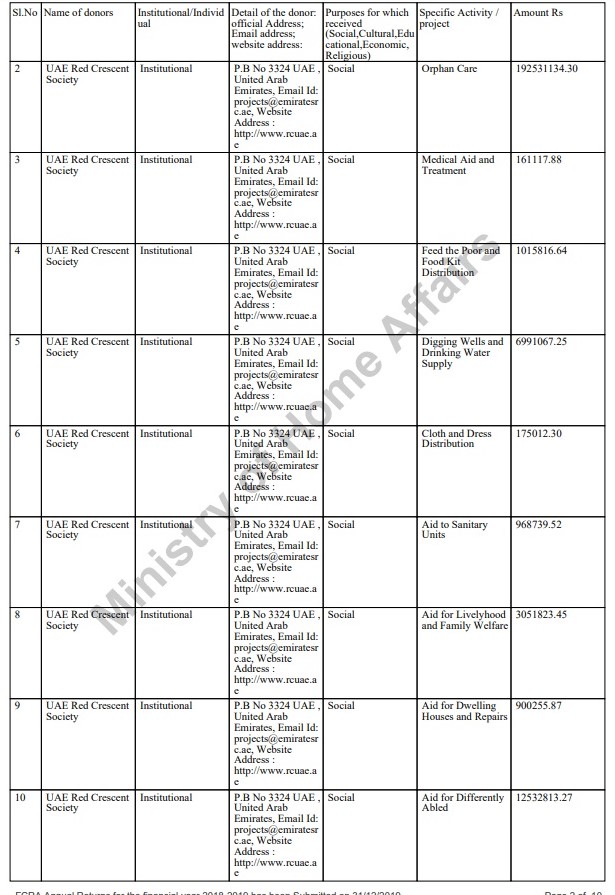
We accessed the FC-4 form submitted by the Markazul Ighasathil Kairiyathil Hindiyya for the fiscal year 2018-19 from the FCRA online website. We learned that the organisation received Rs 70,15,29,185.06 directly from a foreign source during the financial year.
Of the 35 listed foreign contributions, as many as 28 were from the UAE. The others were from Oman, Turkey and the United Kingdom. The UAE Red Crescent Society and the Dubai Charity Association has donated large sums of money to the group.
Source: The NGO’s FC-4 form
The previous financial year, 2017-18, the group received Rs. 33,61,18,095.60 as foreign contribution. UAE again featured prominently in the same.