Home Blog Page 4107

How limestone became marble and Congress ruled Rajasthan govt lost Rs 1,000 crore: Read details

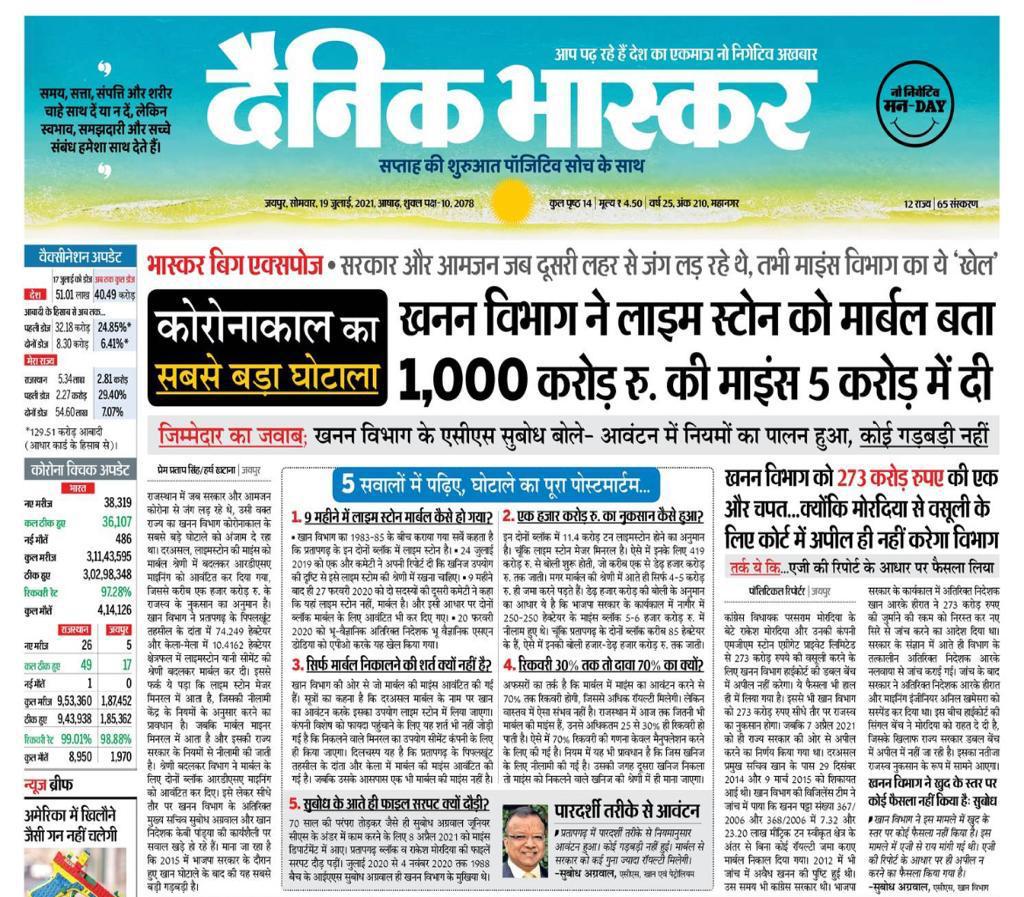
As the country limps back to normalcy after the devastating second wave of Chinese coronavirus pandemic, reports of a mining scam being unearthed have emerged in Rajasthan. According to a report by Dainik Bhaskar, the Mines Department in Congress ruled Rajasthan government has allegedly converted limestone mines to marble grade and cost the exchequer a loss of Rs 1,000 crore.

The Mines Department reportedly tweaked the category of ‘limestone (cement)’ to marble and allowed RDSA Mining company to continue operations in Danta (74.249 hectares of land) and Kela- Mela (10.4162 hectares of land) blocks in Pratapgarh in Rajasthan. It must be mentioned that that limestone falls under the category of ‘major mineral’ and is auctioned as per the rules of the Central government. On the other hand, marble comes under the category of ‘minor mineral’ and is auctioned under the rules of the State government.

A survey conducted by the Mines Department between 1983-1985 found that the two blocks in Pratapgarh have limestone. Similarly, in July 2019, another committee stated that the mineral category in Danta and Kela-Mela must be labelled as limestone. However just 9 months later, a committee recommended that the mineral category was marble and not limestone. Thus, the categorisation of the mine blocks was changed.
Screengrab of the Dainik Bhaskar e-paper

The deliberate change in categorisation of limestone, under the supervision of Additional Chief Secretary Subodh Agarwal and Director KB Pandya, allegedly resulted in an estimated ₹1000 crore loss to the government. It is estimated that Danta and Kela-Mela mine blocks contain 11.4 crore tonnes of limestone. Given that it has been characterised as a major mineral, the auction price begins from ₹419 crores and can reach up to ₹1000-₹1500 crores.

However, the deposit amount for the auction of marble is around ₹4-5 crore. The figure of ₹1000-₹1500 crores is drawn from the fact that limestone mines of approximately 250 hectares in Nagaur were earlier auctioned for ₹5000-6000 crores. Since Danta and Kela-Mela mine blocks are of 85 hectares, the auction amount would have been around the 1000-1500 crore mark. Citing sources, Dainik Bhaskar reported that the change in categorisation was done to benefit RDSA Mining company, which has been tasked to extract marbles from the mine.

The report states that in order to further benefit the company, no condition was imposed for the use of extracted mineral (limestone) in the cement industry. The Department of Mines and Geology has claimed that the change in categorisation would increase recovery and royalty by 70%. This is despite the fact that the usual recovery rate in Rajasthan is about 20-25%. While speaking to Dainik Bhaskar, Additional Chief Secretary Subodh Agarwal claimed, “In Pratapgarh, the allotment was done in a transparent manner. There was no scope for any mistake. The government will get higher royalty from marble.”

Rules state that if the mineral that has been recovered is different from the mineral that was auctioned, the mineral extracted will be categorised in the group it belongs to. Officers, however, refute the allegations of scam and claim that the entire process was done transparently.

NSO Group behind Israeli spyware Pegasus considering defamation suit against The Wire over ‘outrageous allegations’: Details of their letter

NSO, a Tel-Aviv based firm that owns the spyware Pegasus on Sunday slammed leftist propaganda website The Wire, and threatened to file defamation suit against it for publishing a report that claimed phones of journalists, Indian ministers, Supreme Court judges, opposition leaders and other notable personalities were targeted for surveillance. 

The Israeli firm, through its defamation counsel, Clare Locke, sent a letter to The Wire threatening defamation suit against them for making unsubstantiated claims through their reports about the surveillance of eminent individuals in India. 

“…we are writing to put The Wire on written notice of NSO Group’s substantial concerns regarding the false and damaging nature of the proposed articles—and the risks that The Wire faces should it decide to publish the proposed articles (or excerpts of the proposed articles,” the statement read. 

“The report by Forbidden Stories is full of wrong assumptions and uncorroborated theories that raise serious doubts about the reliability and interests of the sources. It seems like the ‘unidentified sources’ have supplied information that has no factual basis and is far from reality,” the company said in the statement.

“In fact, these allegations are so outrageous and far from reality that NSO is considering a defamation lawsuit,” the statement said. The company lambasted The Wire for not doing due diligence and publishing report without verifying the facts of the matter. 

Coming down heavily against The Wire, the statement said: “Needless to say, one would expect that, before such serious and damaging allegations would be published, any responsible news outlet would require multiple on-the-record sources, a fulsome understanding and transparent analysis of relevant data, documentation corroborating the core allegations, and corroboration by credible sources who have been independently vetted by senior editors and in-house attorneys to have been in a position to observe or corroborate the key facts.”

The group also said that it is considering a defamation suit against the writers of the Pegasus story as it is not based on facts and there are no supporting documents to corroborate the allegations.

The statement further added that the claims made by sources to Forbidden Stories are based on an incorrect interpretation of data from accessible and overt basic information, such as HLR Lookup services, which have no bearing on the list of the customers’ targets of Pegasus or any other NSO products.

The NSO said the claim that data was leaked from their server is an arrant lie and preposterous because they don’t store data on any of their servers. 

Refuting the allegations related to the assassination of The Post journalist Jamal Khashoggi, who was killed in October 2018 in a Saudi consulate in Istanbul, NSO said that its technology was never used to spy on him. 

Pegasus technology sold only to trusted law enforcement and intelligence agencies of vetted governments

The organisation reiterated that it provides technology to “law enforcement and intelligence agencies of vetted governments for the sole purpose of saving lives through preventing crime and terror acts”. It further added that it had no access to system operations and visible data. 

“We would like to emphasize that NSO sells its technologies solely to law enforcement and intelligence agencies of vetted governments for the sole purpose of saving lives through preventing crime and terror acts. NSO does not operate the system and has no visibility to the data,” it stated.

‘Take the vaccine, become Baahubali’: PM Modi addresses media ahead of Monsoon Session, encourages people to take Covid jabs

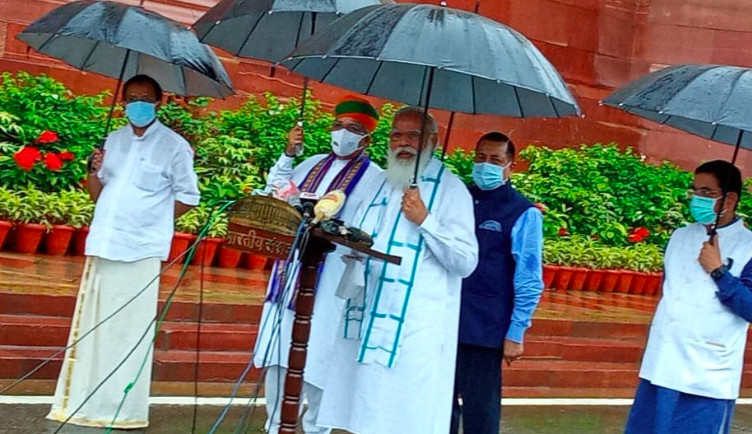
Speaking to the media ahead of the Monsoon Session of Parliament PM Narendra Modi urged all the people of the country, including media personnel to get vaccinated against Covid-19. Emphasising the efforts undertaken by the Indian Government to boost vaccination efforts in the country and encouraging people to get inoculated against the deadly pathogen, PM Modi said in his unique style: “Vaccine is given in ‘baahu’ (arms), those who take it become ‘Baahubali’. Over 40 cr people have become ‘Baahubali’ in the fight against COVID.”

PM Modi furthered that he hopes the opposition parties will hold meaningful discussions in a healthy manner in the Parliament. He said that he wanted the pandemic to be discussed on priority and he expected constructive suggestions from all MPs so that there comes a fresh approach in the fight against COVID.

PM Modi added that it is important that the shortcomings be corrected so that everyone moves forward together in the fight against the pathogen that has gripped the entire world. “So we want meaningful discussions in the Parliament over it”, said the Prime Minister.

Prime Minister Narendra Modi on Monday urged political parties to ask the sharpest and toughest of questions to the govt in the Monsoon session of Parliament, however, asserted that the “government should also be allowed to respond in a cordial environment as democracy is strengthened by conveying the truth to the people”.

The PM said that he has urged all floor leaders to take some time out on Tuesday evening when he would like to give them detailed information on the pandemic.

“We want discussion inside Parliament as well as outside it with floor leaders on Covid-19 pandemic,” he said, adding that his government is ready to answers all questions or queries of the people of the country.

The Monsoon session of the Parliament will start today and conclude on August 13. As per reports, there are 17 bills to be introduced by the government, 3 of them to replace ordinances passed recently. The government has to pass a bill in the parliament within 6 weeks or 42 days once a parliament session starts, or the ordinances lapse.

It is pertinent to note here that the central government is doing all it takes to boost the Covid-19 vaccination efforts in India. On Friday (July 16), the Indian government placed an order for 660 million (66 crores) Covid-19 vaccines worth Rs 14,505 crore to be used between August-December this year. It is the single largest vaccine procurement by the government so far.

According to reports, the Modi government has kept an ambitious target to inoculate 94.4 crore individuals with both doses of Covid-19 vaccines. Amidst concerns of vaccination centres being shut and long queues to receive their jabs, the government has placed orders for additional 37.5 crore doses of Covishield (manufactured by Oxford-AstraZeneca) and 28.5 crore doses of Covaxin (developed and manufactured by Bharat Biotech).

Meanwhile, the vaccine manufacturers have also increased their monthly production. Reportedly, the Serum Institute of India (SII) is now producing 100 million Covishield doses (10 crores) each month. At the same time, Bharat Biotech has increased production from 1 crore Covaxin doses/ month in April to 7 crore doses in July/August.

Textile ministry adopts drone technology to tackle land encroachment, stunning visuals show how survey is carried out

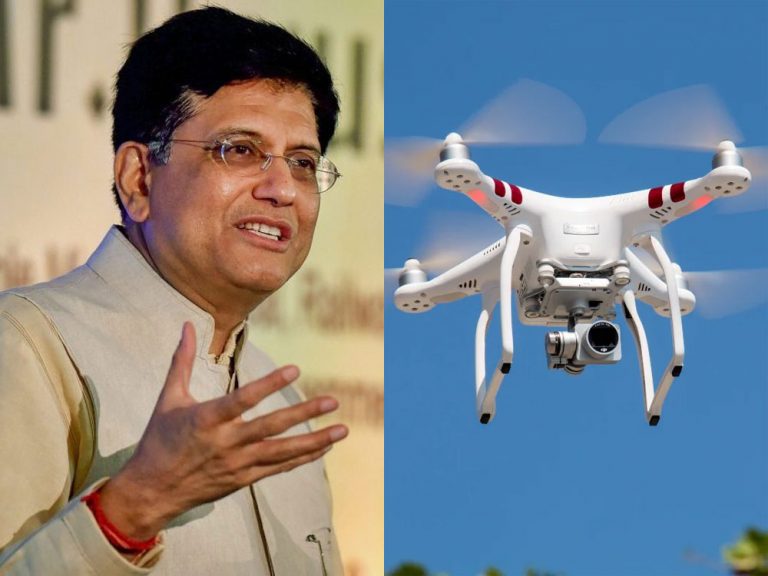
On July 8, Piyush Goyal took charge of the Ministry of Textiles and started reviewing the functioning and performance of the textile sector. During the review meetings of National Textile Corporation Ltd., the largest CPSU under the Ministry of Textiles, the minister suggested that NTC should adopt the latest methods and technology to ensure the safety of its land against encroachments.

Goyal suggested using drones to survey NTC mills to protect and monitor the land of the CPSU periodically. Such surveillance would enable NTC to take swift action against the encroachments at the initial stages, making it easier to remove them from the properties owned by the government-owned company.

There is always a risk involved in traditional ways of conducting surveys on the properties via CCTVs and manual intervention. CCTVs are prone to theft and breakage, while manual intervention can attract unwanted confrontation with the encroachers without sufficient protection from the police. On the other hand, drone surveying is an easier, economical and more efficient way of surveying and mapping a piece of land.

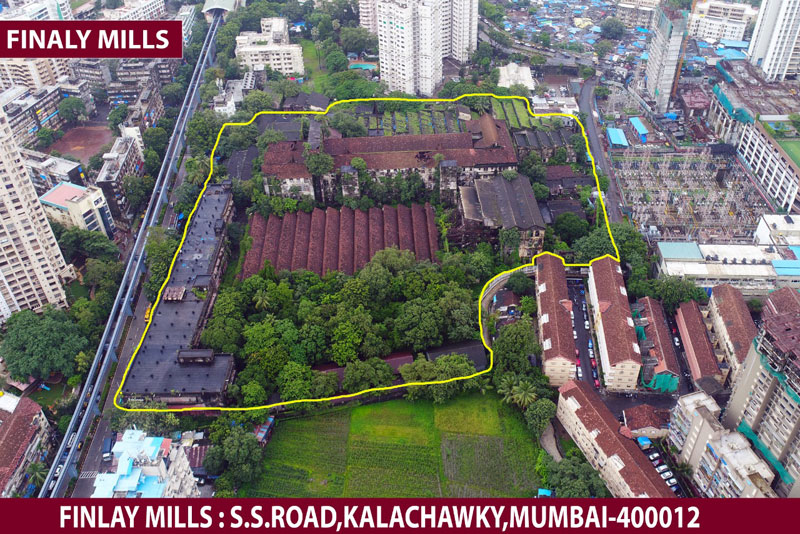
Image captured during drone survey. Image: Ministry of Textile

In such surveillance, there is no need for manual intervention as drones can be operated from a distance. Additionally, the feed can be directed to software for quick analysis of the land. Surveying land from different heights and various camera angles give a better perspective of the situation based on the layout of the land. Compared to other methods to survey the land from the sky, including satellites and helicopters, drones have the capacity to fly at lower altitudes and capture high-resolution images at an economical price.

Also, the time consumed in the conventional method of land surveying is much more compared to drone-based surveying. In conventional methods carrying equipment from one location to another require manpower, but in drone surveying, only one or two operation in-charge can handle a complete budget-friendly survey of the location with high accuracy.

Pilot drone survey

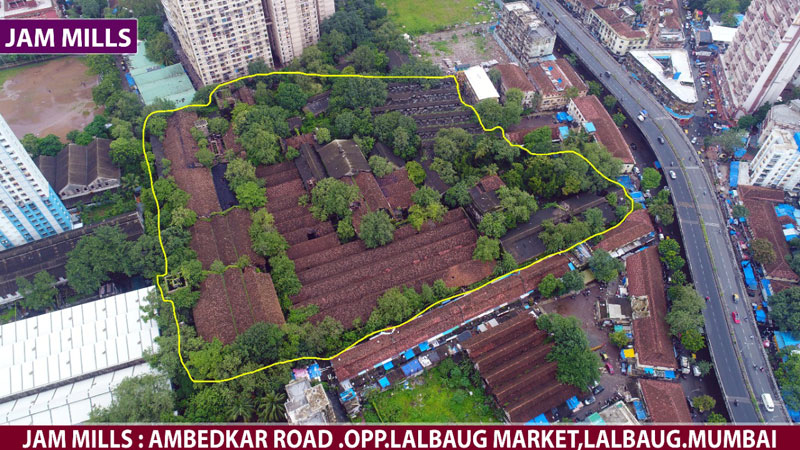
Based on the directions provided by Minister Piyush Goyal, NTC conducted a pilot drone survey and extracted land mapping of five mills at various locations, including Somasundaram Mills and Kaleeswara Mills situated in the Southern Region and JAM Mills, Finlay Mills and Digvijay Mills in the Western Region. The previous maps and images available in NTC records were used to compare the new maps to assess any encroachments or undesired changes.

Image captured during drone survey. Image: Ministry of Textile

The officials at NTC found that drone survey mapping its land assets very efficient and effective, and they would continue to monitor the land assets across India using drone surveys to protect their land from any kind of encroachments in the future.

Afghanistan recalls all diplomats from Pakistan in response to abduction and torture of their ambassador’s daughter

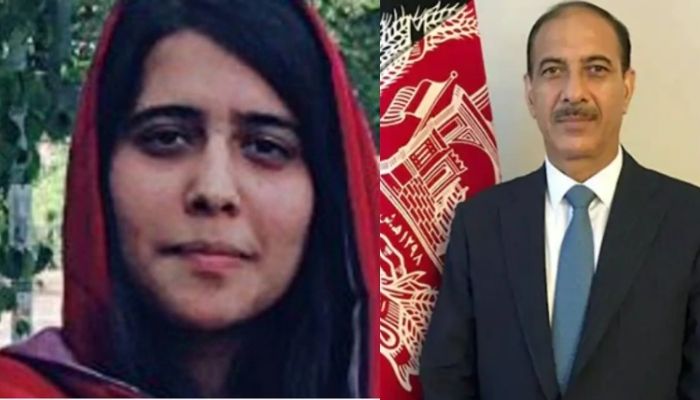
On Sunday (July 18), Afghanistan recalled its ambassador and all diplomats from the Islamic Republic of Pakistan in response to the kidnapping and torture of Silsila Alikhil. Silsila is the daughter of Afghan ambassador Najibullah Alikhil who was kidnapped and left on a roadside in Pakistan after hours of torture.

In a statement released by the Afghan Ministry of Foreign Affairs, the Afghan government has stated, “Following the abduction of the Afghan ambassador’s daughter in Pakistan, the leadership of the Islamic Republic of Afghanistan called back Afghanistan’s ambassador and senior diplomats from Pakistan until all security threats are addressed including the arrest and trial of the perpetrators of abduction.”

It further informed, “An Afghan delegation will visit Pakistan soon to assess and follow up on the case and all related issues; subsequent actions will follow based on the findings.” While confirming the development, Afghan Vice-President Amrullah Saleh conceded that the abduction case had wounded and tortured the conscience of the nation.

He tweeted, “President Ashraf Ghani instructed Ministry of Foreign Affairs to call back our ambassador from Islamabad along with all senior diplomats. The abduction of Afghan ambassador’s daughter & her subsequent torture has wounded the psyche of our nation. Our national psyche has been tortured.”

The Background of the case

Silsila Alikhil, the daughter of the Afghan ambassador in Pakistan Najibullah Alikhil, was abducted on 16th July in Islamabad and was found after several hours. In a statement issued by the Ministry of Foreign Affairs of Afghanistan, it said that Silsila Alikhil was tortured while in captivity. She was abducted by several unknown individuals from Jinnah Super in Islamabad on Friday. After being tortured at some unknown location, she was released near Tehzeeb Bakery in the Blue Area of Islamabad.

According to the medical examination report, Silsila Alikhil had pain and swelling at wrist joints and hands. There were rope marks on the wrist joints as well. She also had similar pain and rope marks on her legs and ankle joints. The woman also had swelling around her eyes, and she was found vomiting and bleeding from the ENT region. On Sunday (July 18), a case of kidnapping was lodged at the Koshar police station in Islamabad. Charges were filed under Pakistan Penal Code (PPC) Sections 34 (common intent), 365 (kidnapping), 354 (assault with intent to outrage her modesty) and 506 (criminal intimidation).

Meanwhile, Pakistani Prime Minister Imran Khan had directed the law enforcement agencies, Islamabad police and Interior Minister Sheikh Rasheed to investigate the abduction case within 48 hours. He also pleaded with all the agencies to work in tandem with the federal police in catching the accused. On Sunday, a large group of Afghans protested outside the Pakistan embassy in Kabul. The demonstrators raised slogans against the Pakistani military-backed establishment for failing to protect Silsila Alikhil.

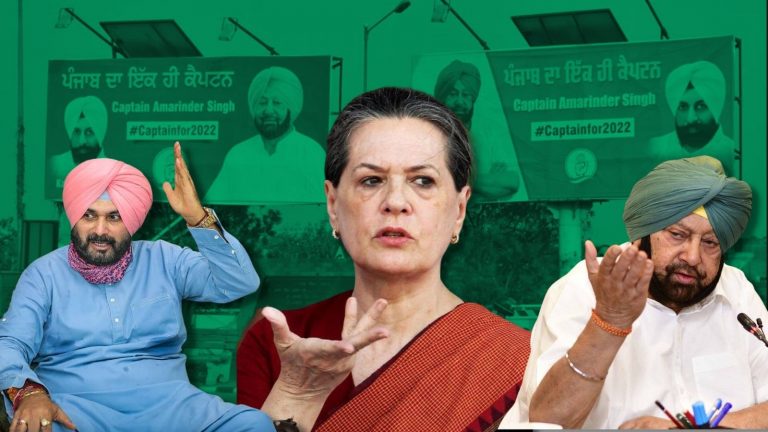
Punjab crisis: Congress ignores Amarinder Singh’s objections, makes Navjot Singh Sidhu the new ‘captain’ in state

Months of bickering and speculations by the Punjab Congress leaders came to an end last evening with Congress supremo Sonia Gandhi overthrowing Sunil Jakhar to make Navjot Singh Sidhu the new Punjab Congress Chief. 

The election of Sidhu as the new Chief is being looked at as a plaster solution to fix the recently developed cracks in the state’s leadership just ahead of the assembly elections. However, this stopgap solution has further widened the rift between the two factions in Punjab Congress.  

The decision garnered a wide range of responses with some snubbing Captain Amarinder Singh while others attacking Sidhu for his vendetta politics. 

What transpired in the Punjab Congress Committee?

Navjot Singh Sidhu in an attempt to gain relevancy in Punjab politics before the state assembly elections came out with guns blazing at the current Punjab Chief Minister with his pack of leaders. From accusing Singh of corruption, failure to rake up the sacrilege case to forgotten promises, Sidhu managed to form an anti-Captain camp within the Punjab Congress.

Not that Captain Amarinder Singh was far behind. Multiple investigations in alleged real estate scams were initiated against Sidhu and company after their blatant attack on Singh.

The unforeseen crisis led to the involvement of National Congress leaders who constituted a committee to issue a resolution. During this period, reports of Sidhu chasing the Gandhi family and standalone meetings between Captain Amarinder Singh and Congress President Sonia Gandhi made headlines. 

What seemed unsolvable was brought to a quick-fix by the constituted committee to not lose hold in the state’s political game. 

Amarinder Singh demands apology

After several rounds of meetings, Captain Amarinder Singh announced that he would happily accept the committee’s recommendations but refused to meet the dissident Congress leader unless he issued an apology.

Captain Amarinder Singh has demanded a public apology from Navjor Singh Sidhu for his offensive comments and Tweets, and has refused to meet him until he receives the apology.

10 MLAs issue statement in support of Amarinder Singh

As Sidhu has been marathoning to seek ‘blessings’ of Punjab MLAs, at least ten MLAs have issued a joint statement in support of CM Capt Amarinder Singh.

After switching over from AAP, MLA Sukhpal Khaira said that after talking to his colleagues Harminder Gill, Fateh Bajwa, Gurpreet GP, Kuldeep Vaid, Balwinder Laddoo, Santok Singh Bhalaipur, Joginder Bhoa, Jagdev Kamalu, Primal Khalsa, a joint statement supporting Capt Amarinder had been issued by the group. 

The statement praising Captain Amarinder Singh for his relentless work claimed that the party stands well entrenched in Punjab.

“There is no doubt that the appointment of state PPCC chief was the prerogative of the party high command, but at the same time, washing dirty linen in public has only decreased the party graph during the last couple of months”, read the statement.

Former Punjab Chief calls for a meeting

Meanwhile, the former Punjab Congress Chief Sunil Jakhar has called for a party meeting on Monday after he was ousted from his position to pacify Navjot Singh Sidhu. 

As many as 80 MLAs and 23 district presidents are expected to arrive at the Congress Bhavan at 3 pm on Monday for the meeting. As per reports, the meeting’s agenda was to urge the party members to accept the decision of the party high command. 

In a statement issued on Sunday Jakhar informed that in the meeting, all the MLAs and district presidents would pass a resolution stating that whatever decision the party high command takes regarding Punjab, would be acceptable to the entire state unit.

As the announcement was made prior to Sidhu’s election, Congress MLA Sukhpal Khaira in a tweet had said, “I urge Sunil Jakhar not to indulge in show of strength and wait for the announcement of Congress President. Even otherwise the PPCC stands dissolved so the meeting would have no locus standi and would be invalid. It’s time to unite and not divide!”  

Sidhu named Punjab Congress Chief

In a late evening announcement, Congress president Sonia Gandhi on Sunday appointed Navjot Singh Sidhu as the new Punjab Congress chief. The AICC also appointed four working presidents of Punjab Pradesh Congress Committee: Sangat Singh Gilzian, Sukhwinder Singh Danny, Pawan Goel and Kuljit Singh Nagra.   

Amarinder Singh had been apprehensive about Sonia Gandhi’s ‘interference’ in Punjab politics. He had reportedly written a strong-worded letter saying that the party high command doesn’t understand the nuances of Punjab politics and appointing Sidhu may hamper the party’s prospects in the state.

Because of Singh’s opposition to Sidhu’s candidature as the chief, the party’s state in-charge, Harish Rawat had to fly to Chandigarh to pacify the sulking CM, suggested reports. 

Congress leaders react

Senior Congress leader and former law minister Ashwani Kumar on Sunday in a Tweet urged the party members to accept the decision. “The decision of the #Congress High Command to appoint @sherryontopp as the new Party chief in #Punjab should now be gracefully accepted by all in the interest of Party unity. This is a time to be united. There are no victors or losers. Reconciliation is the way forward” said Kumar in a thread worried about the present tug-of-war situation in the party. 

Congress ‘youth’ leader Srinivas BV congratulated the ‘Voice of Punjab’ for his new role. Srinivas’s Tweet read, “Warm congratulations to the Voice of Punjab, Shri Navjot Singh Sidhu on being appointed the president of Punjab Congress Committee. Your leadership will continue to spearhead the state and nation to achieve greater heights.”

Congress MP Shashi Tharoor in an understandable language labeled Sidhu as a ‘dynamic leader.’ “Congratulations to Navjot Singh Sidhu ⁦@sherryontopp⁩ on his appointment as President of the Punjab Pradesh Congress Committee. An important state party organisation must move forward under a dynamic leader, in the service of inclusive and progressive values,” read his Tweet. 

While the Congress leadership has been forced to cheer the new appointment, the citizens have cast aspersions on the future of the party under Sidhu who is fairly new to Congress. 

Punjab CM Amarinder Singh has not reacted to the development as of yet. 

India Today Group employee fired over disciplinary grounds, claims martyrdom by dragging in PM Modi

India Today employee, one Shyam Meera Singh on Monday took to Twitter to claim he was fired from his job over his tweets on PM Modi after the media house terminated his contract over violations of company’s guidelines on social media use.

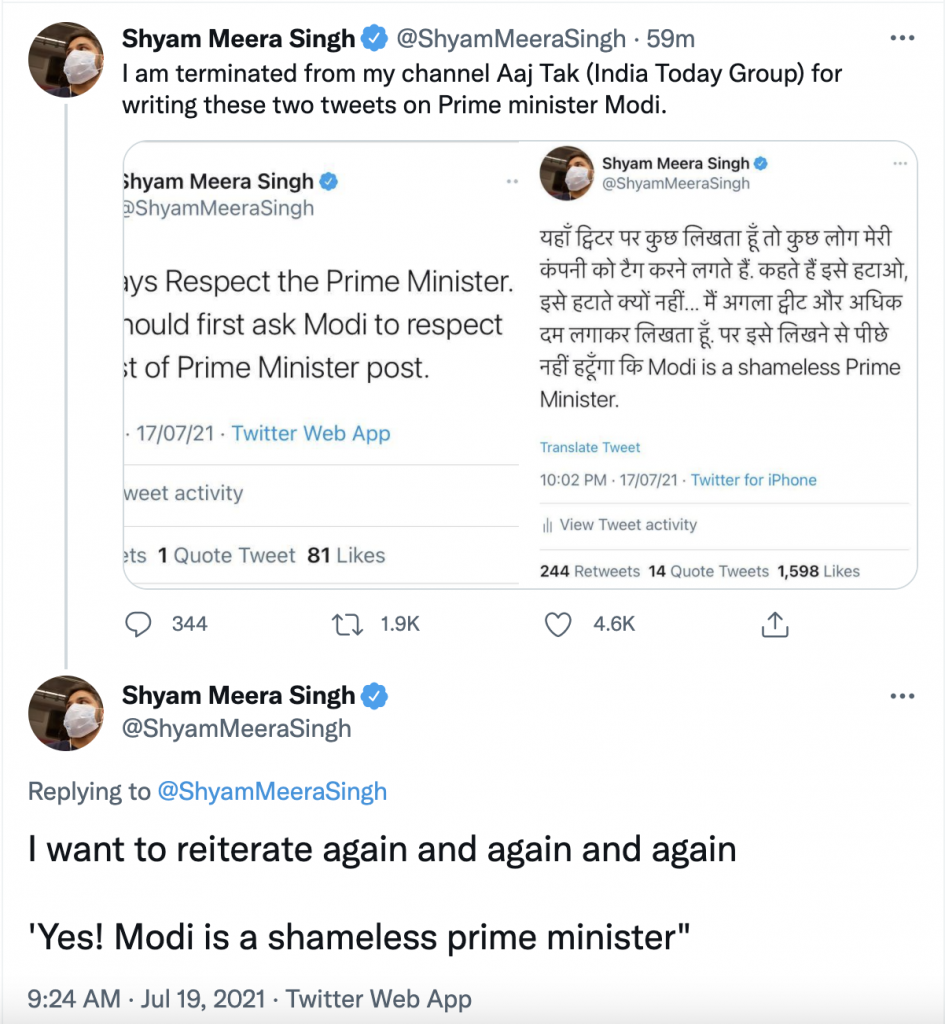
Shyam Meera Singh’s tweets on termination of contract

He shared two of his tweets’ screenshots where he tweeted about not respecting the Prime Minister and calling him shameless.

In his subsequent tweet, he shared the letter his company sent him informing him about terminating his services.

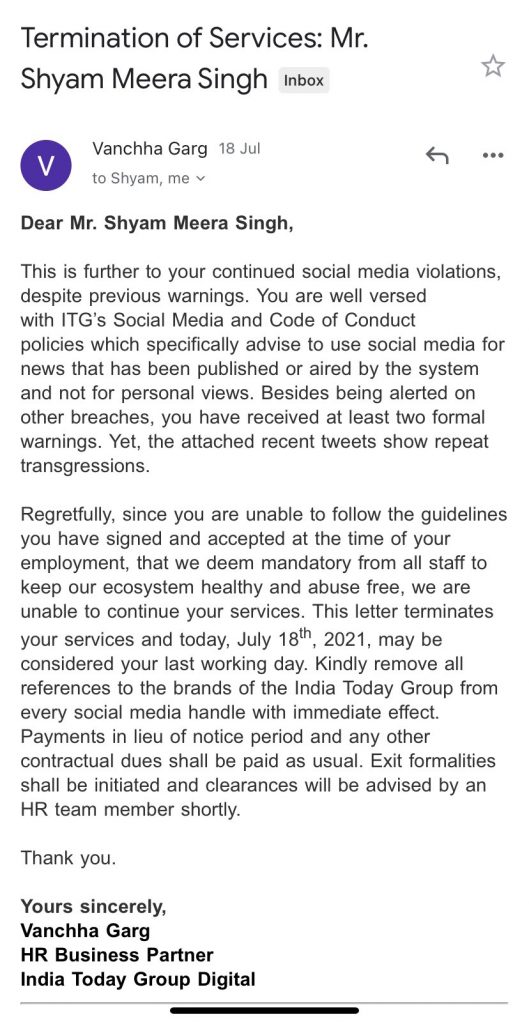
Shyam Meera Singh’s termination letter (image courtesy @shyammeerasingh on Twitter)

In the termination letter, the media house had said that despite previous warnings including two formal warnings, Singh continued to air his views on social media platform which is against their social media policy. India Today Group’s social media policy prohibits employees associated with the media house from airing personal opinions. The policy specifically advices all employees to use social media only for news that has been published or aired by system and not for personal views.

In October 2020, India Today Group issued a gag order on its employees prohibiting them from airing personal political views on the social media platform. The advisory said that those having any contracts with the India Today Group can use their personal handles only for posting the content or promotion belonging to the Group that has been used in print, digital or on air. It further said that such persons cannot even reply or retweet to any post even if they have been tagged in it. They can respond to the post only with the content of the ITG.

Ever since these guidelines came into effect, many top employees of the media house with various shades of political ideology like Rajdeep Sardesai, Gaurav Sawant, Rahul Kanwal, Panini Anand etc have also become kind of subdued in airing their personal political opinions on social media platform. So Singh could not quite have been an exception to the company’s policy.

After his tweet got viral, many netizens took a dig at Singh and questioned his competence since other Modi haters continue to thrive in India Today group even now.

Many also suggested how he could have learnt from his seniors on how to hide his hatred and use his ‘objective’ journalism to speak ‘truth to power’ and malign Modi and his government policies on a bigger platform as they do.

Some also were being polite and inform him about company policies and how things work in corporates.

Since the media house has not yet fired very vocal anti-Modi employees such as Rajdeep Sardesai or Panini Anand who harassed his colleagues for not writing anti-Modi articles, Singh’s allegations that it was just his ‘anti-Modi tweet’ that got him fired, do not add up.

Grooming Jihad: Minor Dalit girl gang-raped, forcibly fed beef, converted to Islam in Baghpat

On Sunday (18), the police arrested 6 people in connection to the rape, torture and forced conversion of a 15-year-old Dalit girl in the Baghpat district of Uttar Pradesh.

In a complaint filed with the police, the victim’s father had alleged that a man named Shahzad had committed grooming jihad against his daughter. He accused Shahzad of entrapping his minor daughter 3.5 years ago. Although the accused was married and had a daughter, he sexually exploited the victim under the pretext of marriage. According to the girl’s father, the victim was also raped by two others namely Sameer and Jannat. When the minor girl became pregnant, Shahzad had allegedly refused responsibility.

As per the complaint by the victim’s father, on July 6, the accused called the girl home under the pretext of marriage and took her hostage. Two days later, the minor girl was raped again by Shahzad’s brothers Bilal and Farman. The victim was also threatened and intimidated with a gun by the accused. It was only on July 10 that the girl managed to reach her father’s house. When the health condition of the victim deteriorated, she was rushed to the hospital where she divulged all details. As per the police complaint, Shahzad would often spike the girl’s food with sleeping pills. He, along with his father Harun and mother Gulfsa, also force-fed beef to the victim.

Cops arrest accused under POCSO, SC/ST Act, anti-conversion law

The police have also collected the DNA sample from Shahzad and have sent it to a laboratory for further testing. On Sunday, the cops arrested Shahzad, his parents Harun and Gulfsa, brothers Bilal and Farman, and friend Sameer. They were produced before the Court and sent to judicial custody. Reportedly, the cops were initially hesitant to register a First Information Report (FIR) but acted upon the victim’s complaint only after the intervention by Hindu rights organisations.

In a statement released by the Baghpat police, it informed that a case was registered under Indian Penal Code (IPC) Sections 376DA (gang rape), 328 (causing hurt by posion etc), 342 (wrongful confinement), 120B (criminal conspiracy), 506 (criminal intimidation). The accused were also booked under 5G/6 of the Prevention of Child Sexual Offences (POCSO) Act, relevant provisions of the SC/ST Act and Uttar Pradesh Prohibition of Unlawful Religious Conversion Act. Investigating officer Anuj Mishra informed that a probe has been initiated in the case and action will be taken accordingly.

Over 1 crore households in 61 encephalitis-prone districts now have access to clean tap water under Jal Jeevan Mission: Report

There are 61 districts across five states that are known for being hotspots for the Acute Encephalitis Syndrome, including Japanese encephalitis, a brain fever in children that require a multi-dimension approach for the treatment.

These 61 districts span across five states. That are Uttar Pradesh, Bihar, Assam, Tamil Nadu and West Bengal.

In his Independence Day speech in 2019, PM Narendra Modi had announced that by the completion of his second term in 2024, his government will provide clean tap water to every household in rural India.

As per the data provided by the government under Jal Jeevan Mission, so far, over one crore households have been provided with clean tapped water in these districts. Notably, experts emphasise better sanitation and clean drinking water as an essential part of the drive to eradicate the disease.

These 61 districts face the wrath of various forms of encephalitis. Repeated outbreaks have contributed to the poor health of the children, especially in the states of Bihar and Uttar Pradesh. Hindustan Times quoted a Jal Shakti Ministry official who said, “This represents a 32% increase in household tap water connections in the 61 priority districts, about 12% higher than the national average increase of 23.43% in providing tap water connections in the country during the past 22 months.” The government has set a target to provide tap water to every household by 2024.

CM Yogi Adityanath’s efforts to eradicate the disease from UP

Acute encephalitis syndrome can be caused by different types of bacteria, parasites, viruses, spirochetes and fungi. A vaccine is available to prevent JE, but for the other strains, a lot is required to be done. When Yogi Adityanath became Chief Minister of Uttar Pradesh, one of the first projects he initiated was vaccinating children against the deadly disease in the hotspots in Uttar Pradesh.

As a result, there has been a steep drop in the death rate among children due to deadly encephalitis. Providing clean water to households in these districts will help in further curbing the disease. The UNICEF has praised the state govt’s efforts to curb the disease.

The problem of encephalitis is decades old

Lokesh Nath, former in-charge, National Vector Borne Disease Control Programme, Bareilly, Uttar Pradesh, told HT, “The absence of clean drinking water aggravates encephalitis syndrome because unsafe water is a cause of malnutrition. When malnourished children are afflicted, they either take longer to recover or have poorer chances of survival.”

KN Bhilegaonkar, ICAR-Indian Veterinary Research Institute, Pune, called Encephalitis syndrome a serious public health problem in India. He is the author of a study of the disease’s prevalence in the Bareilly district.

National Vector Borne Disease Control Programme’s data show that between 2007 and 2016, over 70,000 cases of Encephalitis syndrome were reported in the endemic districts. In the last 30 years, 30,000 children have lost their lives to the deadly disease. According to a 2010 report by Planning Commission, vaccination, vector control, sanitation facilities, safe drinking water, and adequate nutrition are the five broad measures to curb the disease.

Vulnerable states and Jal Jeevan coverage

The most vulnerable states to the Encephalitis syndrome are Uttar Pradesh, Bihar, Assam, Tamil Nadu and West Bengal. As per the data, when the Jal Jeevan Mission had started in 2019, only 2.67% (around 8,00,000) households in the most vulnerable 61 districts had access to clean tap water. By the end of the month of June, the coverage has now reached 35% that make over one crore households.

State-wise coverage, however, is not equally distributed. While Bihar has covered 85.53% of the households, Assam stands at 14.12%, Uttar Pradesh at 11.91%, West Bengal at 10.98% and Tamil Nadu 33.07%. Poll bound Uttar Pradesh has covered 31,37,390 households by July 18 out of 2,63,38,766, the HT report stated.

Aditya Birla Group to invest Rs 700 crore in UP’s Gorakhpur, to set up paint manufacturing units

As Uttar Pradesh Chief Minister Yogi Adityanath is rallying to make the state investment and business-friendly, the Aditya Birla Group is now set to pump in another Rs 700 crore.

Chief Minister Adityanath took to Twitter on Monday to make the announcement. As per the news report, the Aditya Birla group will be setting up industrial units to manufacture paint in Uttar Pradesh. 

Reportedly, the company had expressed a keen interest in investing in the state eight months ago. A proposal was made to sanction land in Gorakhpur’s Bhiti Rawat post which the representatives of the company met Gorakhpur District Magistrate K Vijayendra Pandian. 

The project which will span across 70 acres in Bhiti Rawat has been given a green signal by the Gorakhpur Industrial Development Authority (GIDA). The manufacturing unit will also provide employment to more than two thousand people. 

Additional support by the administration

The development fee has been waived off allowing the company to develop the land as per its requirements. The government has also assured support to ensure uninterrupted water and power supply.   

The administration is hopeful that the entire region will be uplifted with the arrival of the Aditya Birla group. Commenting on the development, District Magistrate K Vijayendra Pandian said, “A major investment of about Rs 700 crore will be made by the Aditya Birla Group in the Gida area. For this, the land will be made available by GIDA. We have spoken to the company representatives. All kinds of assistance will be provided to them. This investment will provide employment to many people directly and indirectly.”

From Uttar Pradesh to Uttam Pradesh

The development projects in Uttar Pradesh are progressing leaps and bounds under the Yogi Adityanath government. 

In what can be seen as a major accomplishment, the Aligarh district in Uttar Pradesh has taken a steady lead, going on to become the first out of the 6 nodes or centres to get its first lease deed done in the Uttar Pradesh Defence Industrial Corridor project.

The implementation of 21 investment-friendly schemes in Uttar Pradesh has now taken the state to the 2nd position in ‘Ease of Doing Business. Additionally, around 4 lakh youth were provided jobs by the government in the last 4 years. The state is also leading in sugarcane production, toilet construction (2.61 crores), Coronavirus testing and vaccination, the establishment of MSMEs, construction of expressways, new medical colleges and ‘one district one, product’ scheme.