Home Blog Page 4115

There are no rules anymore: How journalists have only themselves to blame for the viral photo of Danish Siddiqui’s corpse

Laws are important for any society to prosper and function adequately. But even more so are those unspoken norms that are based not on the legal system of a country but on ethics and personal morality. The punishment for violating such rules is not imprisonment or fines but losing the goodwill of those they share their homeland with.

‘Rationalists’ might even argue that such norms are not based on sound logic and violating them does not constitute a grave moral crime. Such people inadvertently end up encouraging the violation of such norms. Take the norm of respecting elders, for instance.

Yes, elders can be stupid, some can be downright criminals and perverts but in general to teach children to respect their elders is still a good idea. Some ‘rationalists’ would question, “Why should we respect someone just because of their age? Respect is earned, not given!”

On the face of it, there might be some logic behind such arguments but across all cultures everywhere, elders are widely given respect and it is a universal norm that children are taught to respect their elders. The simplest rebuttal to arguments against it is that if a norm has such universality and has survived through hundreds of years to this day, then it ostensibly does provide some benefits to human societies and the benefits outweigh the costs.

After all, the greatest confirmation of a hypothesis is its validity in the world we live, not in theories. Theories must be tailored to explain reality adequately, not the other way around. One such norm that has evolved over centuries and is the norm in most cultures is that death is a private affair and the dead body of the deceased is reserved for the eyes of the family. In the 21st century, even pedophiles and murderers sentenced to die in civilised societies are awarded the privilege of privacy.

It is considered obscene to parade the dead body of the deceased for the eyes of the world at large. Even Kasab and Yakub Memon, responsible for the deaths of hundreds and hundreds of people, were awarded the same privilege. Privacy in death is the one sacred norm that is violated with extreme caution, if it is ever violated at all. Indeed, parading dead bodies in public is a sign of barbarism and savagery, something Islamic terrorists are greatly fond of with their public executions.

Second Wave of Covid-19 pandemic

Something changed during the second wave of the Covid-19 pandemic. It was one of the darkest phases in the history of independent India. Thousands of people lost their lives and at one point, the healthcare system of the country was in the brink of collapse.

Demand for medical oxygen skyrocketed sharply and the Government had very little time to augment the supply of medical oxygen, which they did eventually. But by the time they could secure an adequate supply, thousands had already lost their lives.

People were struggling to secure a bed in hospitals as most were overburdened. Thus, when spirits were low and the future looked bleak, journalism in the country sank to even lower depths. Truth be told, the media conducted itself shamefully during the whole pandemic.

From the CNN admitting to an undercover journalist that they were highlighting the Covid-19 death tally in the United States for ratings to the entire media branding the Covid-19 lab leak hypothesis as a ‘conspiracy theory’ without a shred of evidence, the media went from one blunder to the next without feeling any sense of shame.

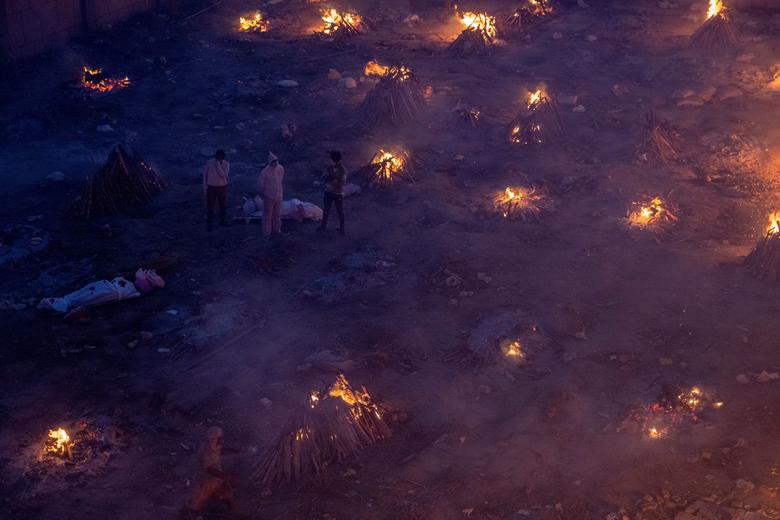
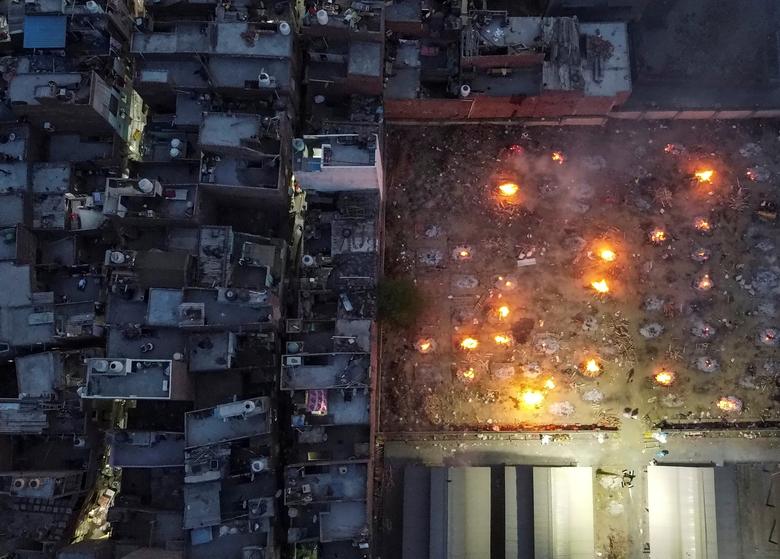
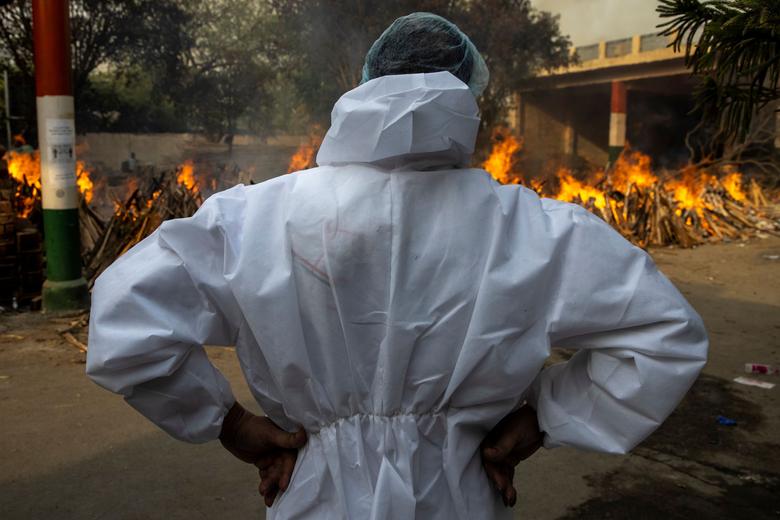
But undoubtedly, the lowest they stooped to was in India, where journalists across the board ran helter-skelter to capture photographs of funeral pyres. Reuters, BBC, New York Times, nearly every international media outlet published images of funeral pyres on their front pages.

Barkha Dutt was one of them, Danish Siddiqui was another. And thus was a sacred norm violated, one of the most sacred norms in civilised society.

Danish Siddiqui killed by Taliban in Afghanistan

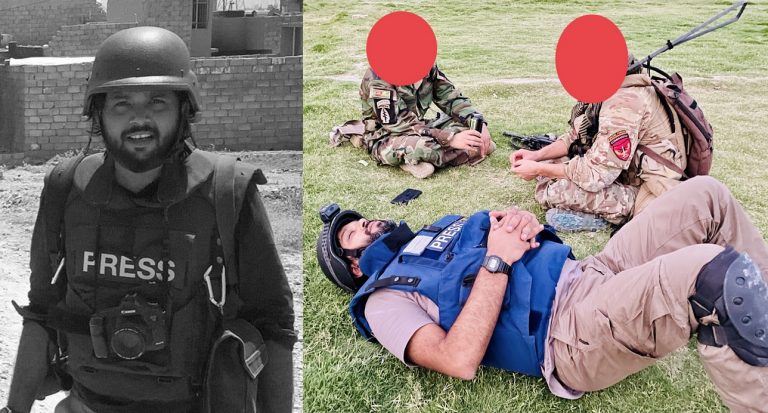
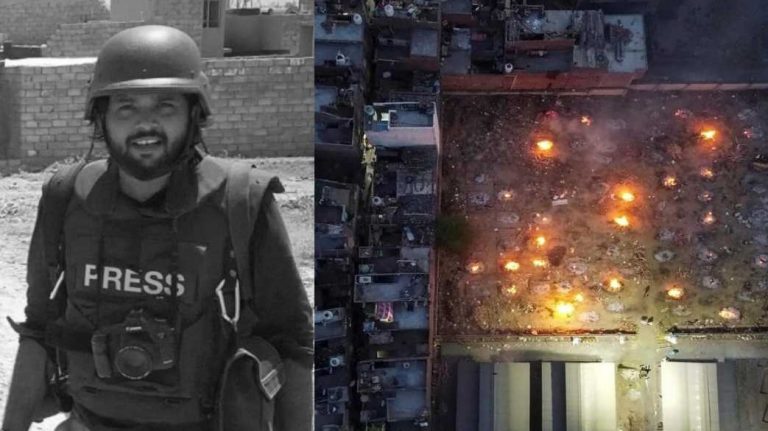
On Friday, the 16th of July, it was reported that Reuters photojournalist Danish Siddiqui was killed during clashes with the Taliban. He was traveling with Afghan forces when they were attacked by the Taliban.

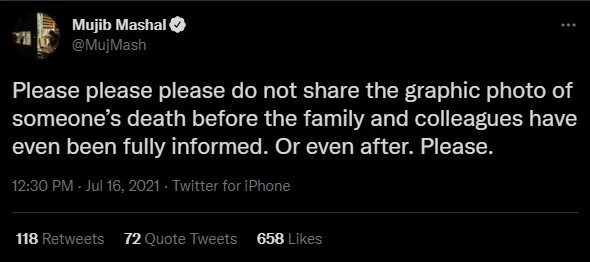
Soon after, a photograph of his dead body surfaced on social media. And journalists, as if on cue, began pleading with others to not circulate the photograph as it was disrespectful to the dead. It was a remarkable demonstration of hypocrisy, really.
Danish Siddiqui killed by Taliban, dead body photograph
The appeal by one journalist

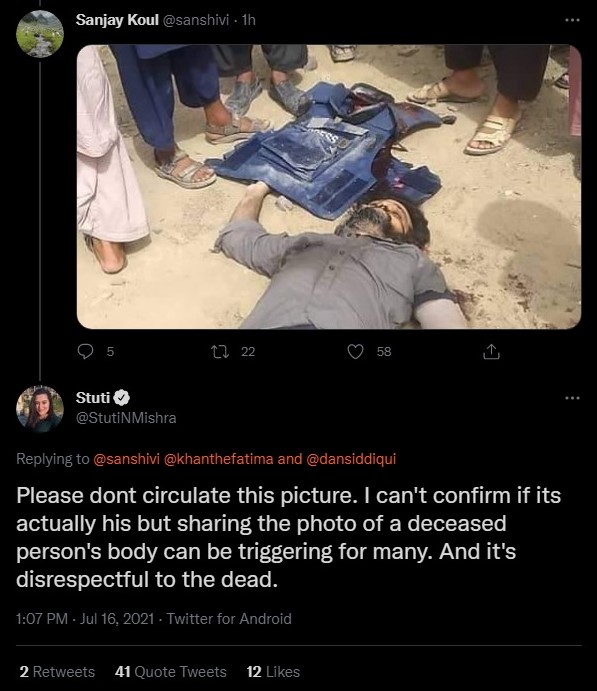
The very people who captured photographs of funeral pyres, violated the right to privacy of the deceased’s family, suddenly realised that sharing the image of a corpse is disrespectful to the dead. One of the most ironic comments came from Stuti Mishra, a reporter with The Independent, who appealed to people to not circulate the image right after sharing photographs of funeral pyres captured by Danish Siddiqui himself.

Until now, journalists were defending the funeral pyre photographs saying it was important to highlight the extent of the crisis in India. But that could have been highlighted in a million different ways. It is only when people are circulating the photograph of Siddiqui’s corpse that the realization has dawned on them that it is disrespectful to the deceased.
Danish Siddiqui killed by Taliban, dead body photograph
The appeal by Stuti Mishra

As the old saying goes, you do not realise the effect your actions have on others until you step in their shoes. And this did really hit close to home. Journalists suddenly realise that photographs of their dead bodies may be circulated in the future as well, just as the treatment that is now being meted out to Danish Siddiqui.

But they have to remember here that things have escalated to this point because it is they who violated the sacred norm of respecting the privacy of the deceased’s family. It is they who trampled on the rule, then danced on top of it in the fancy clothes that were bought with the money that was earned. And now, they are receiving payback for their transgressions.

Danish Siddiqui incident shows there are no rules anymore

The series of events highlights perfectly why rules are important. As I remarked elsewhere, “Such rules do not exist to protect others from your frivolity, they exist to protect you from the savagery of the hordes.”

The ‘intellectual class’ is free to violate them, of course, for they are safer than anyone else from any adverse consequences but they do so at their own peril. Danish Siddiqui was an active participant in the desecration of the sacred norm, the rules were defiled and shat upon and it shall not be forgotten that the degeneration was initiated by the ‘intellectual’ class.

They have violated the very laws that protected them from savagery, much the same way as an idiot cuts off the very branch of the tree he is sitting on. And the consequences are terrible.

Why rules are important

Such rules are important because they represent the essence of co-existence, they are the unspoken agreement that people in a society agree to so that they may continue to exist together in harmony. When such norms are defiled, even without breaking any laws, it leads to a breach of trust that is essential for members of a society to work together.

For instance, the ‘intellectual class’ highlights human rights abuses based on the identity of the perpetrator committing them. What it has led to is a situation where human rights abuses are not considered grave enough by anyone involved.

The same ‘intellectual class’ picks and chooses cases of violations of women’s rights and what it has resulted in is that feminism as an ideology has been discredited entirely. Such norms are not important only for individual countries alone but also international relations between countries.

The United States of America, for example, harps on about “rules based international order” while engaging in regime change wars abroad and working to destabilize entire countries. It accuses China of human rights violations while it continues to wage illegal wars in the Middle East which have cost the lives of hundreds and thousands of people and destroyed the lives of millions others.

The inevitable consequence of such duplicity is that rules do not exist anymore. All that exists is power and forces in pursuit of it, without anyone caring enough about the moral consequences of it.
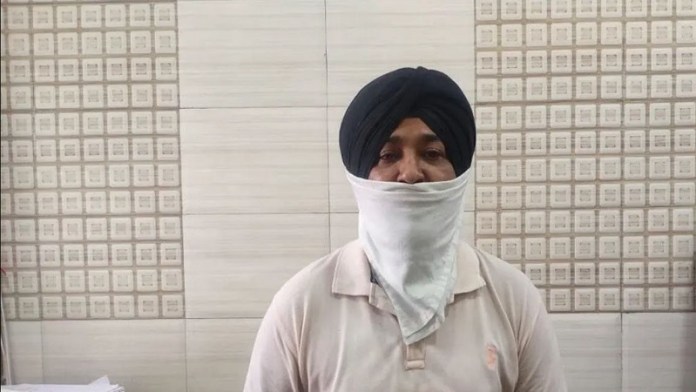
Exclusive: “Please let me meet my son”, cries Tarlochan Sandhu who filed case against wife, in-laws for trying to convert him and his child to Islam

We had reported yesterday how a 36-year-old Sikh man from Chandigarh had to move court and file a civil suit in the district court seeking directions to restrain his Muslim wife and her family from forcibly convert him and his minor son to Islam.

The plaintiff who is Sikh by religion and by birth has stated that his Muslim wife had promised him that religion will never become an issue after marriage. However, the promise was short-lived with his wife Nageena and her family forcing Sandhu to convert to Islam from day one of their marriage.

“My son is small. He is scared” cried Sandhu while speaking to OpIndia

Tarlochan Singh Sandhu in an exclusive interview with OpIndia narrated his ordeal. Sandhu shared that he met Nageena in 2007 and got married in 2008. Initially, he had declined the proposal by Nageena as the two belonged to different religions.

However, Nageena began to emotionally blackmail him and started to pressurize him for marriage. Sandhu eventually agreed when Nageena promised that religion will not be an issue after marriage.

The promise, however, was short-lived and Nageena and her family began to pressurize Sandhu to convert to Islam soon after marriage. To escape the pressure, Sandhu who is originally from Amritsar shifted to Delhi for a while. 

Sandhu shared that from the past two years his wife along with her parents began to pressurize him to convert. He also said that in his 13 years of marriage with Nageena not once did he ask her to give up Islam to accept Sikhism.

Wife forced to shift to Chandigarh

Nageena who is from Chandigarh began to force Sandhu to shift to the city, however, Sandhu refused to do so. He feared that his in-laws would once again influence him. Nageena yet again took him into confidence and promised that her family would not interfere in their marriage. Sandhu then with his wife and child shifted to Chandigarh six years ago but his happiness was short-lived. Sandhu has been facing the brunt of shifting close to his in-laws since then. 

In-laws shifted in his rented house to track his movements

As if harassing Sandhu over calls and meetings was not enough, his in-laws shifted to his rented house to track his movements and persuade him to leave Sikhism. They restricted him from offering prayers or wear kada and even forced him to cut his hair. 

When Sandhu protested, they flung his turban on the ground and forced him to read Namaaz. On May 30, when Sandhu resisted the harassment, Nageena’s family members ganged up to beat him up.

No help from police

After being attacked, Sandhu immediately called 112 and informed the police that his life is under threat. As the statements were being recorded in the police station, Nageena’s brother Nawabuddin started to hurl abuses. After that Nageena’s family once again attacked Sandhu with rods and sticks outside the police station.

When he approached the police once again they advised him to either go home or spend the night at some park. Sandhu then spent two nights at Shivalik Park after which he booked a hotel room.

However, he was still receiving threats from his brother-in-law who claimed that he would gather 150 people on one call to attack him. Sandhu frequented the police station to get the police to take some action but to no avail. 

“They want to change my name to Tahir”

Sandhu had shifted to Dubai for a while for his professional work. Sharing an anecdote Sandhu said that when he was in Dubai, he received pictures of his son dressed as a Muslim. When he questioned his wife she said that it was only for Eid.

Nageena’s family wanted Tarlochan to change his name to Tahir. They subsequently began harassing his son. On multiple occasions, they threw away his son’s kada. When asked, they used to say that it got lost. 

Upon asking his son he got to know that Nageena’s brother stopped him from wearing it. Sandhu also informed that Nageena’s family has taken away his son and does not let him meet or even talk to his son over the phone.

“The last time I spoke to him, my son said that he does not like to stay with that family, is scared and wanted me to take him,” said Sandhu. On complaining to police the SHO said that they would make arrangements to make him meet his son. Sandhu was then taken to meet his son for a few minutes but said his brother-in-law had caught his son’s hand and his son looked dreaded, refusing to speak

False case against Sandhu

In 2019 when Sandhu, tired of the harassment took his son to Amritsar, his wife lodged a false harassment case against him due to which he had to come back. Nageena alleged that Sandhu used to physically abuse her. After this, the Women’s Cell began to trouble Sandhu and even snatched his son from him. 

Sandhu also informed that Nageena’s sister married a Hindu boy a couple of years ago and got him converted to Islam too. 

My parents saved her life

Sandhu alleged that as per a ritual, Nageena was sent to her mother’s home for their child’s delivery. However, Nageena’s family switched off their phones and broke all ties as soon as his son was born.

However, Nageena’s health deteriorated after delivery. It is then when they were compelled to inform Sandhu. 

Sandhu rushed to Chandigarh and said that his parents took care of Nageena and all the expenses. He also informed that his parents had been unhappy with him for marrying Nageena.

Sandhu claimed that Nageena had always been disrespectful towards his parents, used to abuse them and provoke him to assault them. “Yet they saved her life,” he said.

Sandhu filed a police complaint

Worried for his son, Sandhu finally lodged yet another complaint against Nageena and 10 members of her family in Chandigarh’s Sector 09. The matter has been listed for July 20.

Sandhu also said that a BJP youth leader has been helping him in this matter. 

Ram Mandir to open for devotees by the end of 2023, says Shri Ram Janmabhoomi Teerth Kshetra Trust

The much-awaited Shri Ram Mandir in Ayodhya will open to devotees for worship by the end of 2023. According to the reports, Champat Rai, general secretary of the Shri Ram Janmabhoomi Teerth Kshetra Trust, said that the sanctum sanctorum of the Ram temple would be opened for devotees to offer prayers to Ram Lalla by the end of 2023.

The announcement came after a two-day meeting of the 15-member Shri Ram Janmabhoomi Teerth Kshetra Trust with engineers and architects. The meeting was chaired by Shri Ram Janmabhoomi Teerth Kshetra Trust chief Nripendra Misra.

The office-bearers of the trust, who are overseeing the construction of the Ram Mandir, said that the complete construction of the entire 70-acre campus would be finished by the end of 2025.

On August 5, 2020, Prime Minister Narendra Modi had laid the foundation of the temple in a historic ceremony. The 500 years wait of the Hindu devotees worldwide came to an end when Prime Minister Narendra Modi performed the Ram Mandir’s Bhoomi Pujan.

However, the work was temporarily halted in January this year after engineers had found water under the proposed temple site. Currently, engineers are working on the foundation of the temple, and it is likely to be completed by September 15.

Reportedly, the engineers are using Sandstone from UP’s Mirzapur and Rajasthan’s Jodhpur, and marble from Rajasthan’s Makrana and pink stone from Rajasthan’s Bansi Paharpur for the temple construction. The second phase of the work is likely to start in November this year after Diwali.

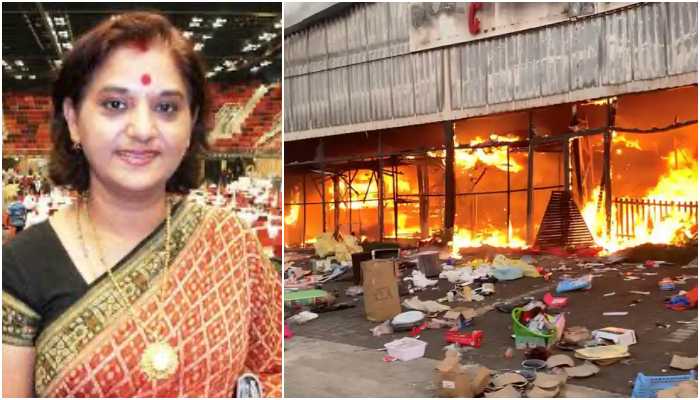
South African MP Shameen Thakur-Rajbansi talks to OpIndia: Racist attacks against Indians, the Indian govt’s help, a ‘toolkit’ and a people in distress

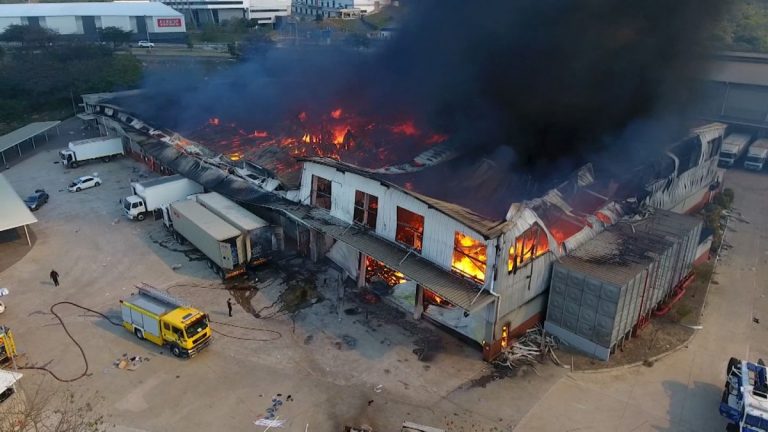
South Africa has been thrown into unrest and a civil war-like situation was seen developing after the arrest of former President Jacob Zuma. On the 7th of July, Jacob Zuma was arrested after he failed to appear for his corruption hearing and was sent to jail for 15 months over contempt charges. In the ensuing violence, reportedly, 72 people have died and over 1,200 people have been arrested. However, as the protests escalated, the violence turned racial and the Indian community in South Africa was targeted.

According to eThekwini Mayor Mxolisi Kaunda, around 45,000 businesses have been deemed out of commission, and it is estimated that properties worth R16 billion (around 8225 crores) have been looted or destroyed during the riots that include damage to infrastructure and equipment.

Kaunda said, “Preliminary estimate of the economic impact revealed that the unrest had cost R1 billion in terms of loss of stock and around R15 billion in terms of damage to property and equipment.” He further added that around 45,000 businesses that include 5,000 informal traders have been severely affected by the riots. “Small businesses may never recover from this upheaval,” he said. 

According to some estimates, over 1,29,000 jobs are at risk in Durban as malls, factories, and certain industries have been burnt down to ashes. A large portion of workers were dependent on these establishments, and it will now add to the already skyrocketing unemployment figures in the country.

Several South Africans took to Twitter to call for violence against the Indian community, some, saying that the violence was retribution for the crimes of the Gupta brothers. However, the violence had severe racial undertones with the Indian community being specifically targeted and Gupta Brothers were being used as an excuse to justify the racial violence

OpIndia, which has followed the developments closely since the beginning of the violence, conducted an interview with the South African Member of Parliament, Ms Shameen Thakur-Rajbansi from the KwaZulu-Natal Provincial Legislature. She belongs to the Minority Front (MF).

Speaking to OpIndia, Shameen Rajbansi revealed how there was a ‘toolkit’ to target Indians in Kwazulu-Natal province and how the charge that the violence was unleashed as retribution for the crimes of the Gupta brothers was completely unfounded. She further spoke about how the Indian government was corresponding with the South African government to ensure the safety of the Indian community and explained the roots of the racist violence in the country.

Following are excerpts from the interview. The questions are indicated in bold, followed by the answers given Shameena Rajbansi.

Do you think the violence that South Africa is seeing today is just protests turned ugly or does it have racial undertones

It was purely a political protest when it started out. During a protest, there are always various agendas at play and then, there are certain people who come out and become violent. On many occasions, the violent takes a racial turn and that is what happened here.

Is there a reason, you think, why there is a racial undertone to the violence specifically against Indians? Because we have seen several examples of racist violence against Indians in African nations. One recalls what happened in Uganda during the time of Idi Amin in 1972. In South Africa specifically, can you explain why there are these racial undertones.

You just quoted Uganda and South Africa is no different since we have a long history of racial undertones against the Indian community and for no fault of ours. It started with the displacement of the Indians from the 1860s from the time Indians were brought in as labourers and shunted off to different parts of the world by the Britishers. Our ancestors went through this. Having come here, being enslaved, then being resilient and working their way up, always being in survival mode and eventually naturalisation, getting citizenship status and getting their rights back – all this has been a long process, but a very painful one.

As far back as 1949, riots against Indians at Durban Central, going on to the 1985 riots to what we are currently experiencing, you have had different political shifts at different time and many riots have broken out against the Indian community. But the root cause has always been that of political power. Whenever there was a crisis in power in South Africa, one of the communities that has always got the brunt of violence has been the Indian community. Because we have been soft targets believing in non-violence. Therefore, we have become vulnerable targets to perpetrators.

Several South Africans too took to Twitter to call for violence against the Indian community. One of the common themes that emerged was that they said it was a backlash because of the Gupta Brothers. Do you think the corruption charges against them along with President Zuma contributed to the violence against the Indian community?

There are many foreign businesses in South Africa. From the inception of our democracy, many people have come to SA looking for business opportunities. They have courted different presidents, leaders, influential people and they have integrated with the business community. They have been a part of powerful structures. Using the Gupta Brothers as an excuse to unleash violence on the Indian community is something I completely denounce. There comes a time as an Indian community we need to stand up. In South Africa, we have had large scale corruption by several other foreign business leaders but it has never taken racial undertones and it has never resulted in violence against their community. This is a political battle and the Indian community is being made a scapegoat.

You said that this is a political battle. How does it help the political cause if the Indian community is targeted

In our democracy, the Indian community has always held a sway vote that every party has been clamouring for. They know that the Indian community has that power, any which way, and they can become powerful if they get the Indian vote bank. In many ways, they also determine who becomes the President of the country. This is the reason the Indian community becomes a target on several occasions.

Are you indicating that the supporters of former President Zuma are targeting the Indian community because they support the current President

That is a blurred area. The Indian community has lived with a philosophy where we believe in ethics. We don’t support a particular leader as such. Indian people vote for who will give them security and who will be a good leader in the country and when they vote, they vote for a party. Indians voted for the majority party which is the party both the leaders belong to and they have been consistent in the voting party. There is no way that our community can be blamed for favouritism. We supported the leader that the party put up. There are even several Indian members in the ANC as well and they vote too for who leads the ANC party. The person who leads the ANC party then goes on to become the President. So the Indian community cannot be blamed for supporting a leader selectively.

Could you give us a sense of the scale of violence that the Indian community has seen in the past 72 hours. There have been reports of Indian women being raped, farm lands being burnt and Indians coming out on the streets to defend themselves.

The rape charges are false, I think. In our legislature we debated the violence as well and nowhere did the government mentioned that women were raped. But yes, 2 lives were lost. But a lot of property was looted, shops and businesses were raised to the ground and even business and shops of expats were burnt down. Perpatrators came into areas where Indians lived and violence was committed rampantly. Indians had to scramble to try to protect whatever they had. People had to use cricket bats etc because we have strong laws against owning firearms. So a majority of the Indian community was fighting with other means, like using bats and setting up barricades. The police was ineffective and could not help the people due to lack of resources. In fact, it was the community that was helping the law enforcement and when that was failing, we called in the army to come.

2,500 army personnel have now been deployed in the riot infested areas where majority of Indian people live. We have promised that the full force of the army will be in the Khwazulu-Natal and that the people will be protected.

There was news of ANC as well issuing a statement and blaming the Indian community for the violence, while they were only defending themselves. What do you make of that?

In order to be a responsible leader, we have to understand all of this in context. Politically, today, in our legislature, I apologised if any action of any Indian person was looked at as racism or discriminatory. But I also said that the Indian community was taken by surprise. And when that happens, it is human instinct to do whatever one can to protect their community. ANC has come out and made that statement, but it was an insidious attack and people were just protecting themselves. Indians were not the ones to start the violence. This was a very well-orchestrated, well-coordinated anarchy that was unleashed on this entire province. We were the community that got the brunt and historically this has been happening. This is an undeniable fact and since this has a political root cause, the political leaders need to find a solution to this.

I have been in touch with several members of the Indian community in South Africa, and they have now created Whatsapp groups just to try and coordinate the resources that are now running out. They have said they are out of water, food, essential items etc and they are helping each other out through specific WhatsApp groups. Now that the Army has been brought in, could you tell us what is the status of the violence now and whether resources have reached community members.

The Indian community is extremely resilient. I am proud of all the heroes. The business sector and the NGO sector has come out very strongly to support everyone in the South African community, not just Indians. They have sprung into survival mode and set up all sorts of Whatsapp groups. I drove around in the area after the Parliamentary debate to assess the situation myself. From Monday, other members are also going to go to areas where they have been deployed. The shops are now slowly opening up but there are unending queues to buy what is necessary. The NGO sector is beginning to pack different commodities like food, water etc. If there is a need, people are getting it to people. This is the magnanimity of the Indian community. They are not discriminating. Anybody who needs help, Indians are helping them.

Interestingly, you said that you apologised if any statement or action of the Indian community hurt the sentiments of the people. Historically, we have seen that Indians are blamed even when they defend themselves after the violence has been unleashed against them. They are blamed for unleashing the violence instead of defending themselves. I know this is a sensitive question, madam, but do you see this as a spark that might escalate further, leading to a situation like Uganda.

What is happening today is a reminder of what happened in 1949 when we had over 1,500 dead, 40,000 Indian refugees were left stranded and were looking for help. At that time, the Indian government did come in and promised to help them. In this case, we are monitoring the situation. The Honourable Minister of External Affairs Mr Jaishankar has spoken to our minister Grace Naledi Mandisa Pandor and they are communicating to assess the situation. The Indian government has to be thanked for having their finger on the pulse and have extended support to us. They have also opened many channels of communication to us to understand what our situation is. Now we just have to monitor and on a daily basis, assess the situation and even our government’s political commitment to bring us back to normalcy. With the army coming in, we have to see and then make a decision on what to do. I have not asked the Indian government to come in and help us because we don’t want to be alarmist. Sometimes, being alarmist ends up claiming more lives and making the situation worse. We don’t want chaos. We want to do this in a responsible manner and follow protocols.

So the Indian government has reached out to the South African government and demanded that the Indian community be protected. Is there something else you think the govt should do? Because clearly, there is not a lot of awareness about the plight of the Indian community in South Africa.

The Indian government has a very long and good standing relationship with South Africa. From the time of Mahatma Gandhi to BRICS now. They have many channels through which they can help. Through BRICS, they could perhaps do something for businesses that are not going to be fully compensated and they can be helped to build their lives again. I even know of many expats whose businesses have been razed to the ground. They are really in a dire plight and they have no hope because they are only 13 years old in our country.

The other thing that can be done with the Embassies. If we are running out of our own resources, like basic commodities, maybe the embassies can start a program to help the community that does not have basic necessities.

You said the Indian businesses are not going to be fully compensated. Is that a problem of governance or is there an underlying racial tone to that as well.

When it comes to compensation, there are two parts to it. Those businesses which are insured, won’t be discriminated against. Built into our insurance, there is a problem of ‘quota’. Out of the R16 billion damages, we have been told only R4 billion will be repaid. But the other compensation would be discriminatory. It would be left to the discretion of the government and the department of economic development will decide how the victims will be compensated. I called in the parliament for a full investigation into a “toolkit” that we have discovered. There was a “toolkit” about the violence being unleashed and who were to be targeted. There were specific instructions about which businesses should not be targeted and which should be targeted. Once the government gives us more information, we will be able to understand whether they will discriminate against businesses that were looted and attacked on a racial basis – whether whites or Indians.

In this ‘toolkit’ that you talk about, was it specifically mentioned that Indian communities and perhaps also white communities should be targeted?

Yes. That is true. Also, this loss is what is being assessed. By the time the investigation is completed, one never knows what the numbers would be. On messages going on in Whatsapp, we have heard voice messages of instructions being given about certain people that need to be attacked. Currently, our intelligence has told us that there were 12 masterminds to this violence. As this unfolds, we will then see what is the treatment they will be given by the government. We will then see how they will compensate victims as well and hopefully, Indian communities will not be discriminated attack since this is an orchestrated attack against us.

R16 billion loss, 2 Indian lives loss, 12 men accused of the conspiracy to target Indian communities and a toolkit – this has the making of a larger conspiracy. Why do you think the international media is quiet?

Well, you know, that is not surprising. As I stated, the violence against the Indian community is a distraction. It is quite clear there is a bigger agenda at play and the Indian community is being used as a scapegoat. The International media, the different institutions are keeping quiet because only as we know the larger, real agenda, will we all be able to, in hindsight, understand why in this period why the violence took place and why the media was silent.

Are you hinting at a regime change operation?

Well, we all know the steps that are taken before a regime change operation is put in motion. We have seen such regime change operations across the world. When you look at other BRICS nations, like India, you will see the same thing. The hidden hand, the role of the media etc, and South Africa is not different. We have only asked for transparency from the government’s side. We are so much to be proud of and as a South African Indian, I would never want to see our country to be taken over by anybody. We can’t let our country collapse because someone else wants to loot our country. With the army coming in, I am hopeful. We have not declared a state or Emergency yet because we are also dealing with COVID-19. The vaccination program has also been affected by the violence. I am just hoping that the political impasse can be resolved and we can return to normalcy.

‘Women who go out after 9 pm are prostitutes, they deserve to be raped’: Kerala’s Islamic cleric Swalih Bathery

A video of a controversial Islamic cleric from Kerala has gone viral in which he was seen making derogatory comments against women, reports Communemag.

In a video that has gone viral now, Maulana Swalih Bathery, a famous cleric in Kerala, was heard saying that those women going out at night after 9 PM are nothing but prostitutes, and they should be killed.

In the controversial video, Salih reportedly justified rapist Govindachamy who had raped and killed a girl named Soumya in 2011. The cleric criticised the judgement and the judge who heard the Soumya case. According to Swalih, Govindachamy had said that he raped Soumya because she was travelling at night, and according to him, every girl travelling at night was a prostitute.

Soumya, who worked at a mall in Ernakulam, was attacked and robbed when she was returning home by train by serial offender Govindachamy. Govindachamy jumped off the train after her, hit her with a stone and raped her. The victim had died five days later.

In 2016, the SC had set aside the death sentence granted to the accused and reduced it to only a 7-year prison sentence for rape. The investigation had failed to establish a water-tight case of murder against the accused.

The 27-year-old cleric Swalih Bathery, who suffers from a medical condition called Hutchinson-Gilford progeria syndrome (HGPS) or the “Benjamin Button” disease, looks like a child. However, Swalih Bathery is known for making many such controversial statements.

Journalist asks people to not circulate photo of dead reporter, after sharing photos of funeral pyres he clicked, netizens call her hypocrite

Reuters photojournalist Danish Siddiqui was killed by the Taliban during clashes at Spin Boldak district in Kandahar, Afghanistan. Danish Siddiqui was a journalist of international acclaim, and was part of the Reuters team that won the Pulitzer in 2018.

After the news of his death broke out, a photo started doing the rounds of social media, which was said to be the dead body of Siddiqui. And appeals were made that the photograph ought not to be circulated on social media.

In one such case, Stuti Mishra of The Independent shared some of the photographs Danish Siddiqui had captured in order to mourn his demise. Someone replied in the comments with the photograph of Siddiqui’s dead body. To which Mishra responded, “Please dont circulate this picture. I can’t confirm if its actually his but sharing the photo of a deceased person’s body can be triggering for many. And it’s disrespectful to the dead.”

Source: Twitter

Mujib Mashal of the New York Times, too, pleaded with people to not circulate the image.

Source: Twitter

Netizens, however, consider such appeals to be a demonstration of unparalleled hypocrisy.

What netizens are saying

People say that Danish Siddiqui sold numerous photographs of funeral pyres of people who had succumbed to Covid-19. Therefore, they argue it is hypocritical for the journalists who were applauding Siddiqui for the same to complain about the picture of his dead body being circulated.

People argued that Danish Siddiqui himself had shared photographs of funeral pyres without the consent of the family of the deceased.

One user demonstrated the hypocrisy that was alleged perfectly. Stuti Mishra, who had urged people to not circulate the photograph of the deceased as it would be disrespectful to the dead, had in the first tweet of the thread shared photographs of funeral pyres captured by Danish Siddiqui.

Journalist defends herself

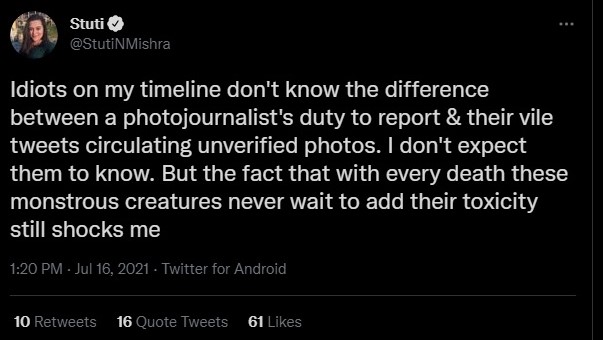
Stuti Mishra, instead of acknowledging that she might have been hypocritical, chose to defend herself accusing others of being “monstrous creatures” and idiots. She said, “Idiots on my timeline don’t know the difference between a photojournalist’s duty to report & their vile tweets circulating unverified photos. I don’t expect them to know. But the fact that with every death these monstrous creatures never wait to add their toxicity still shocks me”.

Source: Twitter

But people on the internet are not buying her argument. They insist that Danish Siddiqui himself opportunistically minted the misery of people for his own benefit and therefore, there is nothing wrong with sharing the image of his corpse.

‘Is it in public interest’: Supreme Court asks Kerala why it withdrew cases against Left MLAs who vandalized assembly

Two weeks after the Pinarayi Vijayan government in Kerala had moved the apex court seeking permission to withdraw cases against prominent CPM leaders for vandalism of state assembly in 2015, the Supreme Court sought to know what kind of ‘public interest’ is behind such a move. The Kerala govt had said that they are withdrawing the cases in the public interest.

The case was heard by a 2-Judge Division Bench of Justices D Y Chandrachud and M R Shah. While referring to a landmark 2016 case (Sheo Nandan Paswan vs State of Bihar and others), the apex court inquired, “Is it (move to withdraw prosecution against the Left MLAs) for public interest…where members have thrown things, broken things?” The Supreme Court had ruled in the 2016 case that withdrawals must be in the interest of the general public.

Justice DY Chandrachud further noted, “Is it in the interest of justice to throw things and damage material at the sanctum sanctorum of democracy?… The fact of the matter is that it is public property and the government is the custodian of the public property”. Citing the example of Judiciary, he said that ‘vituperative’ arguments’ also take place in courtrooms but that would not justify the destruction of property. He added, “There is freedom of speech in the House. No doubt about it. Suppose an MLA empties a revolver in the Assembly, can we say that the House is supreme on this?” While discussing the matter, Justice MR Shah asked the LDF government whether withdrawing such cases against the Communist leaders is in the larger public interest.

Advocate Ranjith Kumar, who represented the Kerala government in the apex Court, claimed that the act of violence and vandalism by the LDF MLAs was a ‘protest’ against the then Finance Minister. He alleged, “A protest is also a speech. It is a manner of freedom of speech. The breach of code of conduct of the House provides for that. Maybe there was breaking of furniture. But it was still a form of speech and a form of protest.”On hearing the bizarre justification, Justice Chandrachud was quick to point out that the property destroyed by the LDF MLAs wasn’t private but public property.

Vandalism in Kerala state legislative assembly in 2015

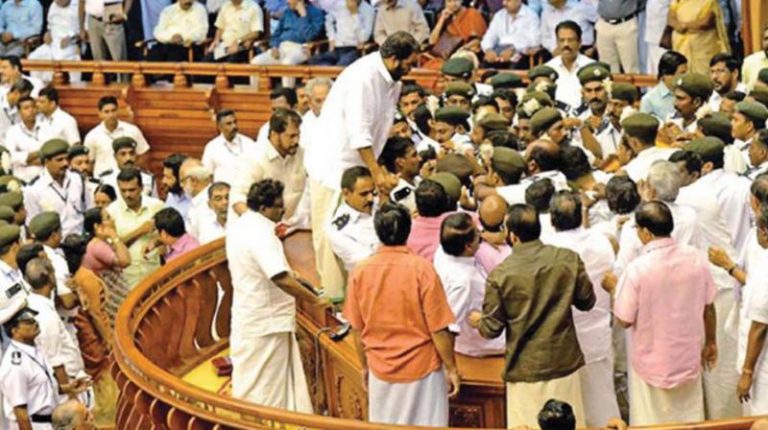
On March 13, 2015, the legislative assembly Kerala witnessed unprecedented vandalism as members of the opposition, in their attempt to prevent scam-tainted Finance Minister K M Mani from presenting the Budget, trashed the Speaker’s dais and even flung out his official chair. However, despite the imbroglio, Mani managed to wrap up the presentation of his 13th Budget in six minutes after the Speaker permitted him to do so. The Opposition alleged that the Budget presentation was invalid as House procedures were not followed. The Opposition MLAs also blocked the path of Speaker N Sakthan to prevent his entry into the dais. Around 20 Opposition MLAs, including senior leaders Thomas Isaac and C Divakaran, and 12 watch-and-ward staff were injured in the scuffle.

The protest demonstrations and the Secretariat blockade by the LDF took a violent turn when the protesters took to the streets and torched two government vehicles, including a police bus. One LDF supporter had died. Police had to resort to firing teargas shells to control the LDF and Yuva Morcha activists. The Opposition had blocked all entry points to the House in the morning itself. Opposition leader V S Achuthanandan and his LDF colleagues were present well before the start of the session at 9 am.

‘Zulus will deal with your curry relatives’: What I learned from speaking out against racist attacks on Indians in South Africa

As a kid, I remember being so excited when Nelson Mandela visited India. This was the first time I had heard the expression “world leader.” In my innocence, I thought Nelson Mandela was literally the president of the world.

As most Indians do, I always felt a connection to the people of South Africa while growing up. We learned that the Mahatma had spent his formative years over there. Our history books mentioned places like Durban, Natal and Pretoria. In essays in school, we wrote about the experience of Gandhi being thrown out of a first-class railway carriage in Pietermaritzburg. We learned about apartheid and India’s role in ending it. I used to think it was all warm and fuzzy between us; Indians and the people of South Africa.

Until now. Yesterday, I chose to tweet about disturbing stories of Indians and their businesses being targeted in South Africa. I demanded to know why the world was being so silent about it. Where is the global elite of CNN, the New York Times, the Washington Post and BBC? Where is the conscience of Justin Trudeau? And where is the army of woke activists, from Trevor Noah to “first niece” Meena Harris and John Oliver? They were all so quick to seize upon the use of water cannon during “farmer” protests in India. Dear Rihanna, why aren’t we talking about the hatred that Indians are facing in South Africa?

Then, the attacks began. As South African Twitter discovered my tweet, my timeline was flooded with racist poison. Many said the Indians should go “home” so Africa could belong to Africans. I was told to go eat curry or smoke spices. I was hit with every possible racist stereotype and many users insisted on calling me “Rajesh.” This surprised me initially until I realized it was a reference to the character of Rajesh Koothrapalli on The Big Bang Theory. And yes, I was asked if I drink cow piss for fun. And then there was the one who told me that Zulus would deal with my “curry relatives.”

Unlike global opinion writers at the Washington Post, I don’t make a living bashing anonymous handles on Twitter. I want to ask deeper questions. I want to know where this anti-Indian hatred comes from. This may seem like a localized incident in South Africa, but anti-Indian hatred has been rising worldwide. The other day, I watched in horror as this Vice News video explained that Indians in London were “incubating the virus.” I watched a video of British police torment a homeless Indian man, find a screw on the ground beside him and accuse him of keeping it as a weapon. All this, under the approving eye of Vice News, covering “crime and covid in London’s Little India.” This is cutting edge liberalism in times of great upheaval against police overreach in the West.

It appears as if they apply the rules of humanity to everyone except Indians. In 2020, Tulsi Gabbard made history as the only Democratic Presidential candidate ever not to be invited to her party convention despite winning delegates. In a year when racial and gender justice was the number one plank of the Democrats, they consciously decided to exclude a woman of colour. She was a Hindu after all.

How was this hate atmosphere against Indians created?

Over the last three years, India’s reputation has been stormed like never before, on the front pages of global publications such as the New York Times and the Washington Post. They were joined by allies such as Al Jazeera and the newly formed TRT world (funded by Turkey). Our internal matters were projected onto the world stage with the harshest possible anti-Hindu commentary. Even channels in faraway South America began using the F-word for Sardar Patel, describing him as a Hindu fundamentalist who took over Muslim kingdoms.

Old smears were dug up, connecting Hindus to Nazism. This was mixed in with racist colonial stereotypes and “cow piss drinker” became a global rallying cry of the Hinduphobes, from Pulwama’s suicide bomber to alleged journalists, academics and thinkers. Every possible thing about India, from sarees to rasam to earthen lamps and even the word “Bharat” was stuck with labels such as supremacist and Nazi.

In the US, it was all hands on deck. While think tanks rallied the intellectual class against us, late-night comedians were firing up American audiences against the evil of Indians. On US campuses, where liberals run everything, they began protest marches, taught seminars and research courses on how bad Indian society is. US Consulates in India now speak of “Bengali Americans.” Or they take a wider view and speak of the “South Asian” community. In polite company, it is now considered unacceptable to utter the word “India.”

In fact, in recent times, the only thing that was described as “Indian” was the so-called “Indian variant” of the Coronavirus. The colonial BBC came up with an absolute gem of a headline on this: “The Indian variant explained in five South Asian languages.” The languages are South Asian. The virus is Indian.

But why? Why do they hate India?

Indeed, what did we ever do to them? The answer is distressingly simple. Anti-India hatred is part of the age-old prejudice against pagan cultures. Across the world, there are three hegemonic forces. One is Christianity, another is Communism and the third one is so peaceful that it is too risky to name them directly. These three forces appear to be at odds with each other, but they are really not. The elephants are fighting. We, pagans, are the grass. We are the ones who really suffer.

But why now? First, because India got big enough to the point that we began demanding an actual place at the global power table. Nobody likes that, even those who share the same culture and values. Even the British were outraged when Americans began to claim their rightful place in the world towards the beginning of the last century. So you can imagine the heartburn when India became the fifth largest economy in the world in 2019. As long as India was playing in the little leagues, it was kind of cute. We heard some nice things about being a democracy and all that. But then, India became the world’s fifth-largest economy. That’s when George Soros declared a $1 billion initiative to destabilize India. The big guys are coming for us. Don’t worry, the big guys just want the best for us…

Second, while India got big, China got bigger and much faster. It was only in 2010 that China became the second-largest economy in the world. A decade since then, China has learned to truly leverage its diplomatic and economic power. That is why a day after the Galwan clash in Jun 2020, “experts” told the New York Times that the reason for the clash was Amit Shah’s aggressive posturing during his speech on Article 370 in Parliament in Aug 2019. In fact, there was a year-long campaign in Western media to portray India as a dictatorship and an occupier in Jammu & Kashmir. After bashing up India’s democratic image, the Chinese came knocking.

Why is India such a convenient enemy for the global elite?

Every movement needs an enemy. For the global elite to truly control the world, they have to give the masses an enemy. And there are several reasons Indians are uniquely suited to be that enemy.

First, India is a country that everyone has heard of, but hardly anyone knows about. You can’t make an enemy out of say Germany or Brazil. Everyone has heard of them and everyone knows about them. Their culture is far too similar to the dominant culture in Europe and America. On the other hand, you cannot make an enemy out of say Swaziland or Mozambique. A lot of people haven’t even heard of them.

We Indians are unique. Everyone has heard of us, but our culture is strange and different. Our reverence for cows, for instance, can easily be mocked. We have our elephant gods and monkey gods and so on. Now, you could say, all religious beliefs and symbols could be mocked. Sure, but their beliefs are the “norm.” That’s why cat and dog meat is banned by federal law in the United States, but beef bans in India are undemocratic. That’s why the British Embassy can pressure the government of South Korea to ban dog meat. Would you confront the British with dog piss jokes? Of course not, because whatever the Christian West believes is the “norm” and must always be the norm.

Second, in order to incite mass hysteria, you need an enemy with a large and distinctive cultural footprint. Like the Jews in Europe in the 1930s, Indians are everywhere. And what is more, Indians are disproportionately well off in all the countries where they live. The conditions are ideal to smear Indians the way the Nazis smeared the Jews. Not just today, India and its cultural footprint have always been there. India is older than history itself. Like the Nazis, the global elite is tapping into the prejudice that is thousands of years old.

Finally, the designated enemy needs to be just strong enough to be hated, but just weak enough that it cannot hit back with sufficient force. India is a big power, but it’s not a superpower. People don’t want to feel like bullies, hating on some country far too weak, like say Colombia or Indonesia. Conversely, they don’t want to hate on someone too strong, such as China, or there might be severe consequences.

The masses are intellectually lazy. The global elite is giving them an enemy that they can hate at the end of a long hard day, with a beer and their feet up. Ultimately, hatred is a drug, that the global elite serves for entertainment. Which American would want to hear that China has captured the American elite? That’s why late-night comedians in America go after India. Yes, the Indians are evil, but America could crush them if they really wanted. The average American can go to sleep after hearing this.

What role have Indian liberals played in creating the current situation?

Even at its peak, the British Empire never had more than 30,000 officers in India. Usually, it was more like ten thousand British officers “against” thirty crore Indians. And the former remained in charge for 200 years. Let that sink in.

The other day I watched BBC toss a (rhetorical?) question to a journalist based in India. Do you think the Western media is biased against India, they asked. The journalist dismissed the possibility outright. Of course, the Western media isn’t biased, she said. The BBC used her as a prop to deny white privilege. Whatever the BBC paid her, if any, I am sure they got their money’s worth.

In the last few years, there has been a great convergence of interests between the global liberal looking to buy and the Indian liberal looking to sell. Something fundamental has changed among the Indian masses. With the political establishment changed, the Indian liberal is forced to sell overseas as the domestic market dries up. You can reel off the names easily. Journalists, academics, think tanks and the like. Everyone seems to be in the market for some international prize or honour.

The second wave of Covid was a stark example of this phenomenon. Remember how they flew drones over crematoriums? The Hindu practice of burning the dead is an international curiosity. Always a hit.

What do Indians need to realize here?

That we have no real friends. We have to understand that the liberal world has no place for us. And being an Indian
“liberal” will not offer you any protection nor advantages. If you are among the handful of Indian liberals actually getting paychecks from global publications, that’s different. But if you are among common people in the audience who sustain and sympathize with the Indian liberal ecosystem, they are taking you for a ride.

In the eyes of the global elite, you are just an Indian and they hate you for it. Whether you make cow urine jokes or say “Hindutva ki kabr khudegi” matters little. Did you see how the Indian liberals were so animated about Gaza a few days back? Did you see any of these people worry about the fate of Indians in Durban? What’s the general political affiliation of Indians in Durban? Does anyone know? Does anyone care?

So better join up with the only group that will have you. There is security in numbers. You may not like everyone on this side. You may loathe most of them. Suck it up, because life isn’t easy, fair nor perfect. The struggle for survival isn’t over. Just ask yourself why the liberals care more about Gaza than they do about Durban.

Liberal values are for the liberal elite. They make these values sound universal, but they are not. If these values were universal, they wouldn’t accuse a homeless Indian man in London of “incubating the virus,” would they?

Jammu and Kashmir administration bans illegal slaughtering of cows, camels on Eid-ul-Adha

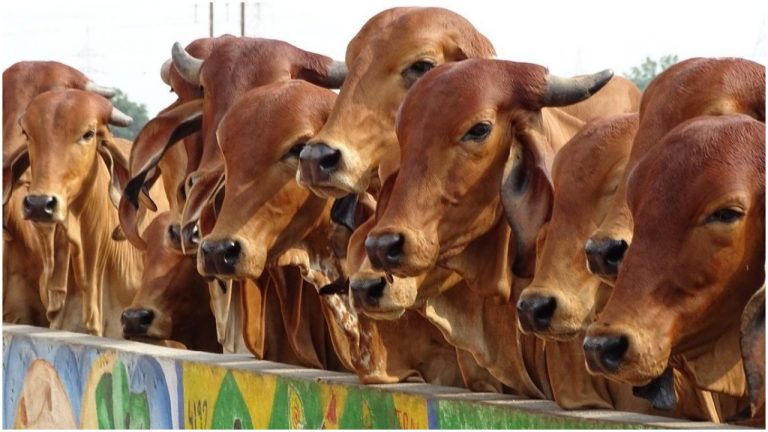
The Government of Union Territory of Jammu and Kashmir has enforced a ban on the illegal slaughter of cows, calves and camels ahead of the Eid-ul-Adha festival in Jammu and Kashmir.

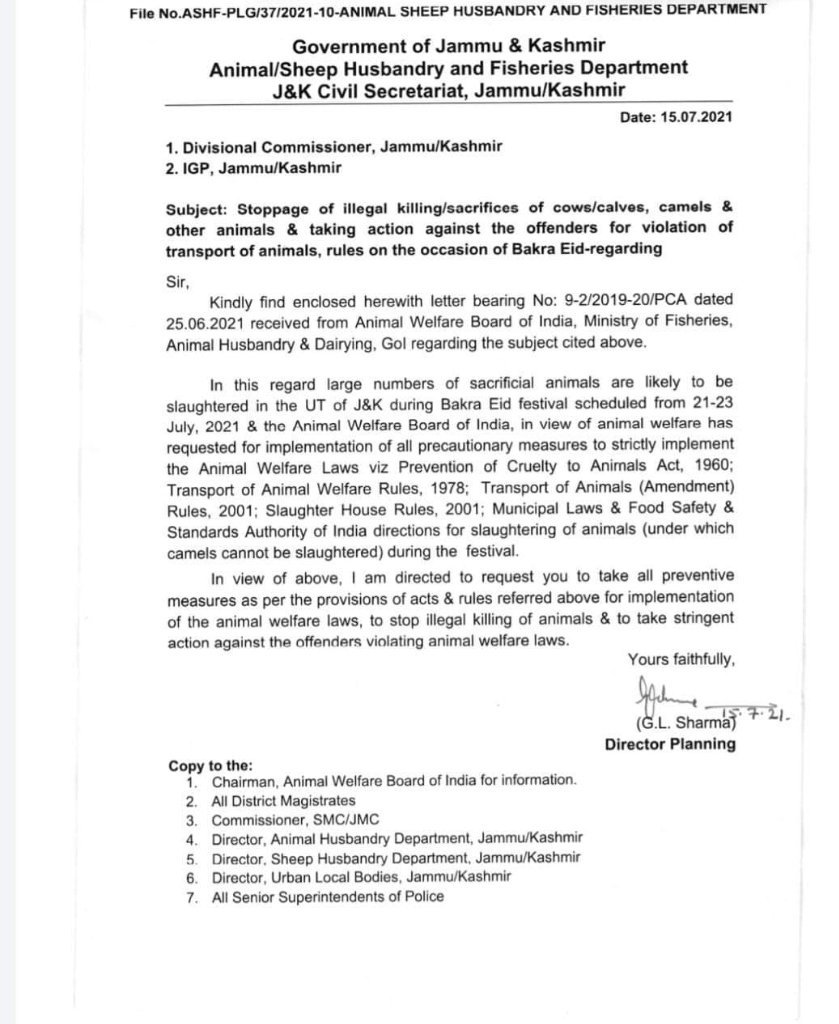
The ban on the slaughters of cows, calves and camels has been communicated by the director of Planning, J&K Animal, Sheep Husbandry and Fisheries Department, to Divisional Commissioner, Jammu and Kashmir, and IGP, Jammu and Kashmir.

In a directive, the Director of Jammu and Kashmir Animal, Sheep Husbandry and Fisheries Department has asked the officials to stop the illegal killing of cows, camels and other animals on the occasion of Bakra-Eid and asked them to take strict action against offenders who violate the order.

The communique reads, “In this regard, large numbers of sacrificial animals are likely to be slaughtered in the UT of J&K during Bakra Eid festival scheduled from 21-23 July 2021 & the Animal Welfare Board of India, in view of animal welfare, has requested for implementation of all precautionary measures to strictly implement the Animal Welfare Laws viz. Prevention of Cruelty to Animals Act, 1960; Transport of Animal Welfare Rules, 1978; Transport of Animals (Amendment) Rules, 2001; Slaughter House Rules, 2001; Municipal Laws & Food Safety & Standards Authority of India directions for slaughtering of animals (under which camels cannot be slaughtered) during the festival.”

Image Source: Samrasta

Further, the J&K government has also directed the police officials to take all preventive measures as per the provisions of acts and rules to effectively implement the animal welfare laws and stop the illegal killing of animals.

Eid-ul-Adha will be celebrated across the country on July 21. Sacrificing sheep, goats and camels are considered an important ritual for Muslims on Eid-ul-Adha. In Jammu and Kashmiri, Muslims largely sacrifice sheep on the occasion of Eid-ul-Adha. However, cows, calves and camels are also slaughtered sometimes.

Reuters photojournalist Danish Siddiqui, who received international praise for Covid funeral pyre pics, killed by Taliban in Afghanistan

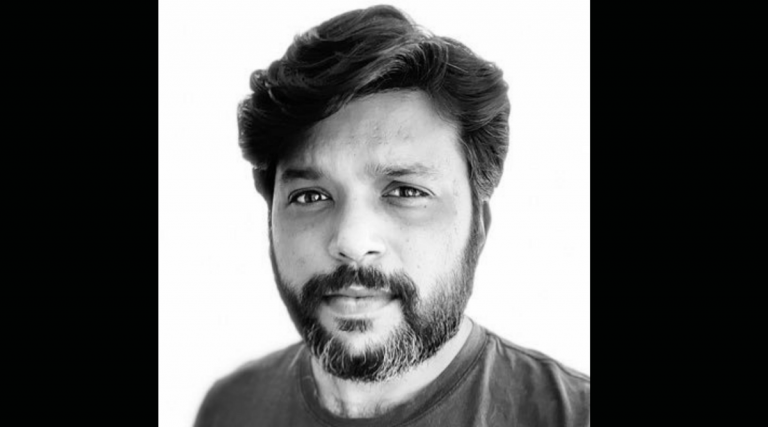
Indian journalist Danish Siddiqui, who has been reporting from Afghanistan the past few days, was killed in Spin Boldak district, Kandahar, reports say. Danish Siddiqui was working with Reuters as a photo journalist.

Only on the 13th of July, Siddiqui had tweeted how he had narrowly escaped disaster after the Humvee he was traveling in was attacked by Taliban forces. He was traveling with Afghan forces, with whom he was attached to the past few days.

Siddiqui was at the centre of the controversy during the peak of the second wave of Covid-19 in India when insensitive photographs of funeral pyres were splashed across the media.

Photograph captured by Danish Siddiqui for Reuters on April 23

The photographs were widely criticized for being insensitive.

Photograph captured by Danish Siddiqui for Reuters on April 22

However, he had also received international praise for the photographs.

Photograph captured by Danish Siddiqui for Reuters on April 28

Siddiqui was also awarded the Pulitzer as part of the Reuters team for the coverage of the Rohingya crisis. The Vice-President of Afghanistan, Amrullah Saleh, had stated on Thursday that they had been warned by Pakistan that any attempt to repel Taliban from the Spin Boldak area, where Siddiqui was killed, would incur action by the Pakistani Air Force.

With US withdrawal from the country, the Taliban has been capturing more and more area and is on the verge of taking complete control of Afghanistan.