Home Blog Page 4327

The orphans of Covid-19: Everything you need to know about legal adoption and govt rules

The covid-19 pandemic has brought the worst out in the world. However, what we are seeing and experiencing is only the tip of the iceberg. There are countless underlying problems that society is either facing or will soon face in the coming days. From hunger to lack of jobs and from loss of lives to children becoming orphans due to Covid-19, there are issues that need to be addressed with sensitivity and empathy.

Recently, a post went viral on all social media platforms about two orphan girls. The message urged people to adopt those girls as their parents died due to Covid. The message read, “Adoption!! If you or your parents wish to adopt a daughter. Please contact [phone number]. One is 3 months old, and the other one is 6 months old. They lost their parents due to Covid.” In one such message, it was added, “I’m posting this because I arranged a bed for their father, and now they both are homeless. Arranging resources are good but providing them shelter is the needs of the hour.”
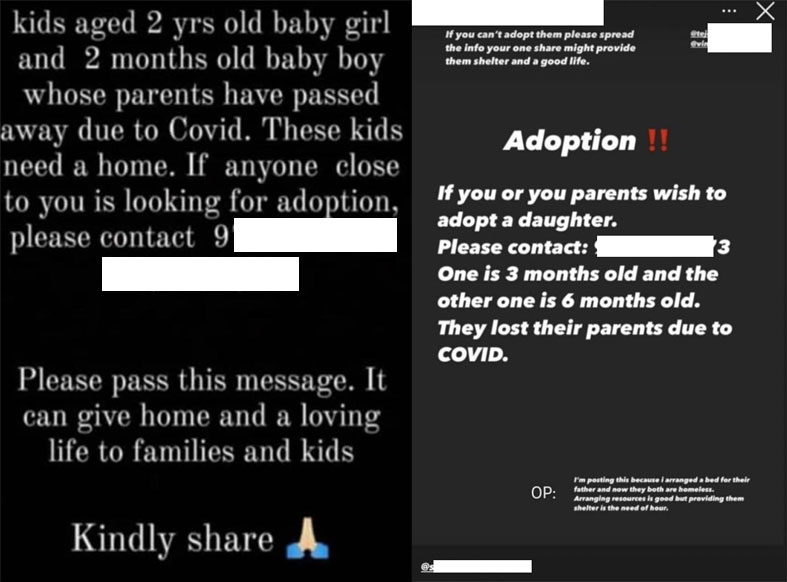
Viral message about adopting girl child

At first, one may think of forwarding the message without a second thought. However, in such times, it is necessary that you read the message carefully. Here the message was for two girls that apparently had the same parents. Their parents died due to Covid, and now they are orphans. Till now, everything looks fine. However, when you look at their age, things will start to raise red flags. One girl was 3 months old, and the other was six months old. Biologically it is not possible for any parent to have two girls with an age difference of three months.

Similar messages with different ages of the said girls with the same mobile numbers were floating on all social media platforms. Unfortunately, even after Union Minister Smriti Irani and PIB Fact Check debunked the claims and warned netizens to be careful, such messages are still circulating on social media platforms. The same message is available in different languages, which has increased the reach further.
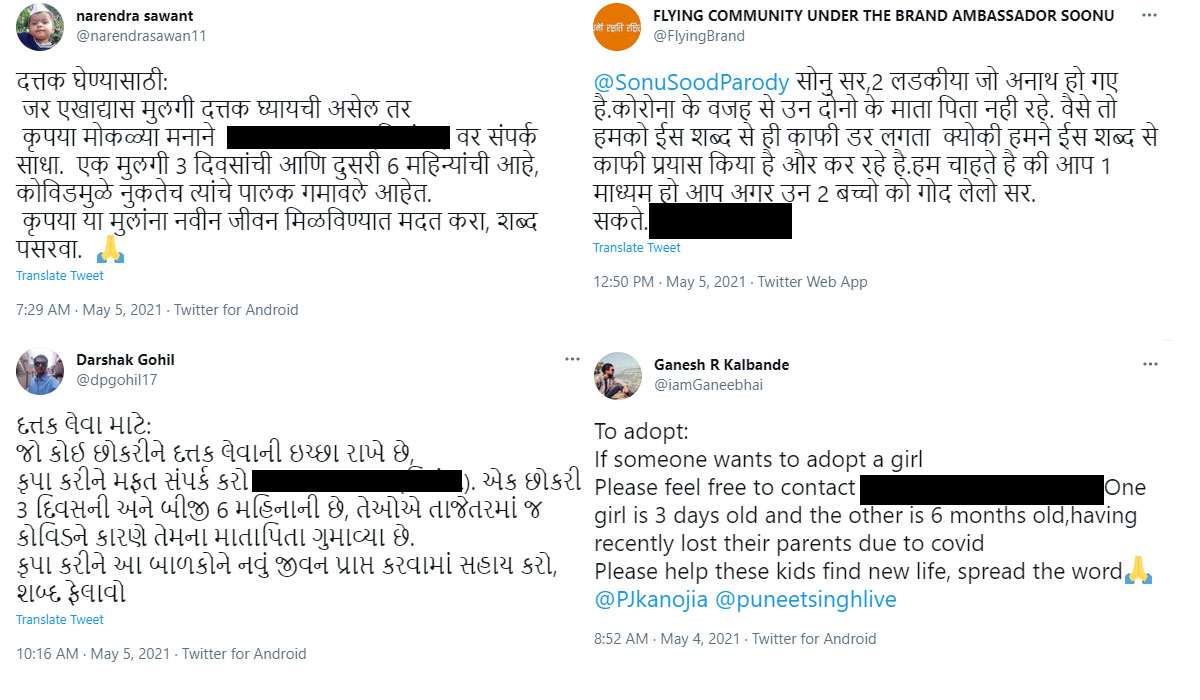
Similar message in different languages

PIB debunked the claim

The Press Information Bureau’s Fact Check department debunked the claims. In a post, they said, “A post is being shared with a claim that two girls who have recently lost their parents can be adopted by calling a number. This claim is #Fake. A process has to be followed to adopt a child. It is illegal to adopt a child if proper guidelines are not followed.”

Smriti Irani urged everyone to understand the law

Smriti Itani, Union Minister for Women and Child Development, penned down a thread on such social media forwards about adoption. In the thread, she wrote that if someone comes to know about such children, who have lost their parents to Covid, they must inform the Police or Child Welfare Committee of the district. Alternatively, they can call on 1098. She added that it is everyone’s legal responsibility to inform the authorities about such children.

Irani further added that it is illegal to adopt such children or give them away for adoption. “Such children should be taken to Child welfare committee, which will take necessary action in the best interest of the child,” she added.

Irani said that if someone comes across posts or contacts regarding orphan children available for direct adoption, it could be a trap, and it is essential to inform the authorities immediately. She added, “We all must ensure legal adoption, otherwise children can be trafficked in the name of adoption. Save them. Inform Police or Child Welfare Committee or Childline 1098 if you come to know of any such child.”

She further urged people not to share pictures and contact details of vulnerable children in distress situation on social media platforms. “Their identity is to be protected as per law. Instead, inform the police, Child welfare committee or Childline 1098,” she said.

The National Commission of Women quoted PIB’s post and said, “Due procedures are to be followed for adoption. Posts claiming otherwise are misleading. Please refrain from sharing such posts and immediately contact National Commission for Protection Of Child Rights and Child helpline 1098  if you come across any illegal adoption practices.”

Possibilities of child trafficking and child labor

One of the major issue with such posts is that they may lead to child trafficking and child labour. While talking to Hindustan Times, Sonal Kapoor Singh, founder of an NGO working for children at risk or having experienced traumatic events said, “We have been working to help children in 40 slums for 10 years to help them recuperate from various traumas. The last few months have been very disturbing. Excluding children, who have lost both parents to Covid, there are cases where the condition of children is worse than those orphaned by the pandemic.” She added that in many cases, young girls were forced to do hard labour for lesser wages as both their parents have died of Covid.

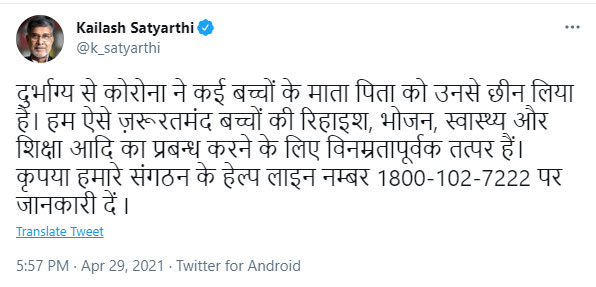
Nobel laureate Kailash Satyarthi recently posted on Twitter that his organisation is ready to help such children. He wrote, “We are ready to provide food, shelter and education to such children whose parents have died of Covid.” He urged people to inform his organisation about such children. But there is a catch.
Though the sentiments might be right, as per law individuals and organizations are not authorized to take in orphan children without permission of the authorities.

Someone questioned Smriti Irani about such individuals or organizations extending support for such children on Twitter. Irani straight away replied that only Childline, CWC, police, and district authorities, along with State governments, are legally mandated to take care of such children. Individuals and organizations are NOT authorized to take such children in. She said, “No individual organization or individual is legally mandated to keep such kids unless authorized by Government. Only Childline / CWC / police & district authorities along with State governments are legally mandated.”

The legal process of adopting a child in India

Many of us are not aware that India has well-established rules for legally adopting children. Central Adoption Resource Authority or CARA comes under the Ministry of Women and Child Development, Government of India.

The adoptions are divided into several categories such as Resident Indian Parents, OCI/Foreigner Living in India, NRI/OCI/Foreigner Living Abroad/Relative Adoption and Adoption by Step Parent. There are terms and conditions for every category.

For Indian resident parents, in order to adopt a child, a couple or individual must register with the said authority as adoptive parents. There is a long list of eligibility criteria for registering as a parent. If a couple wants to adopt a child, they must have at least two years of stable marriage. They must be financially and physically capable of taking care of the child. A single female can adopt a child of any gender, but a single male cannot adopt a girl child. There are several other conditions that the couples or individuals must follow before registering as adoptive parents. They can be checked here.

For in-country relative adoption, the prospective parents shall register in Child Adoption Resource Information and Guidance System and follow due to legal proceedings. Consent of biological parents or permission of the Child Welfare Committee shall be required as per law. If the child is above five years of age, his or her consent would be required. More details can be found here.

For inter-country relative adoption, a Non-Resident Indian or an Overseas Citizen of India interested in adopting a relative’s child may approach concerned authorities as per the law. Once the authorities receive an application, they will conduct a background check of the family before proceeding further. In case of countries that are not signatories to the Hague Adoption Convention, in respect of Indian citizens, family background report of the relative’s child and prior approval letter from the authority shall be forwarded to the Indian Mission of that country, which will issue a recommendation letter to the authority. Once approval is received by the authorities, the couple can follow the guidelines provided. More information can be found here.

Detailed steps and procedures for adopting a child can be found here. Please note that from time to time, these guidelines may change based on the new laws introduced by the parliament or judgements passed by the Indian courts. The couples who are interested in adopting a child must check the latest guidelines and prepare their case accordingly.

For the general public, it is illegal to post any sensitive information about a child in distress. You may get trapped in legal trouble if you post photographs, or identity, location details of a child in distress. As per law, you must contact the authorities and inform them about the child. Make sure you provide complete details so that the authorities can provide the required support.

OpIndia asserts again that individuals, NGOs, or any other organization are not authorized to take in any child in distress without permission from the government authorities. If anyone approaches you for the adoption of a child in distress, it is your duty to inform the authorities immediately so that the child can be rescued. In these times, there is always a possibility of child exploitation, sexual exploitation, and child trafficking. As a citizen of India, it is your duty to help the authorities in saving the child from the hands of criminals. Please contact the authorities immediately if you come across any such posts.
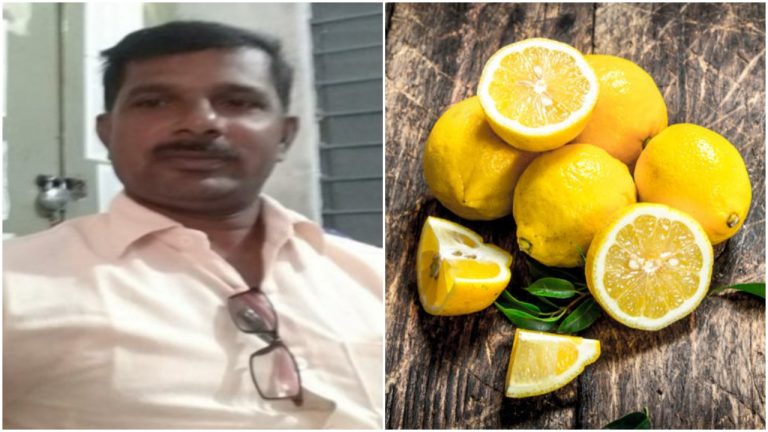
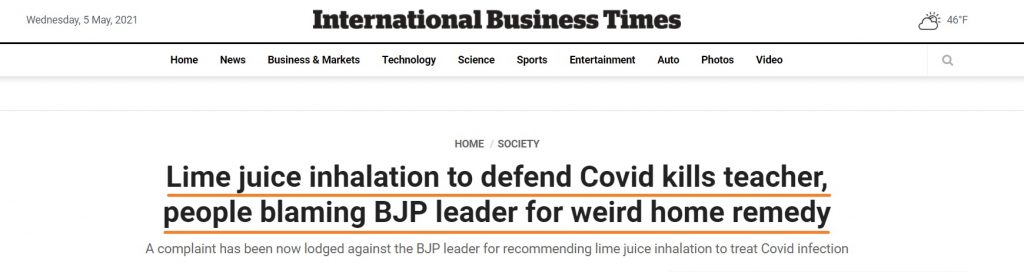
Media says Karnataka teacher died after following COVID-19 advice of BJP leader: Here is what his family says

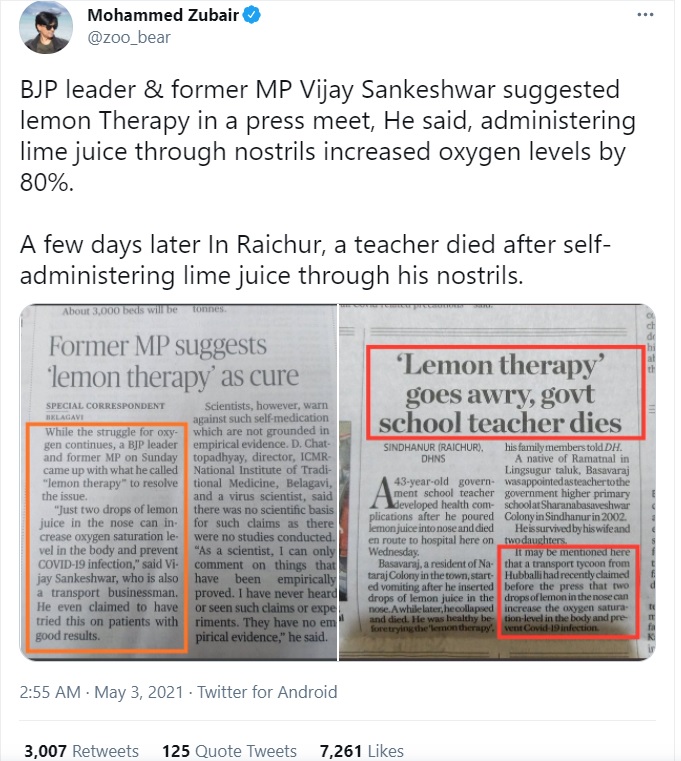
A news report has gone viral on social media platforms since last week claiming that a 45-year-old teacher from Sindhnur taluk of Raichur district in Karnataka had lost his life after self-administering lime juice through his nostrils as a cure to the Covid-19.

Several media outlets had claimed that a 45-year-old teacher Basavaraj had allegedly died after he had tried out the ‘Lemon Therapy’ purportedly suggested by noted industrialist and BJP leader Vijay Sankeshwar.

It is important to note that a few days before the teacher’s death, noted philanthropist Vijay Sankeshwar had addressed a press conference sharing some information regarding certain home remedies that one could follow to stay protected from the Covid-19 pandemic.

What did Vijay Sankeshwar actually say?

Sharing a few preventive therapies suggested by renowned cardiologist Dr BM Hegde and Yusuf Hamied, who is the chairman of pharmaceutical company Cipla, Vijay Sankeshwar had suggested that one could try self-administering lime juice through nostrils, which may help in increasing oxygen levels of Covid-19 affected patients.

In the press conference, Sankeshwar had categorically stated that he was not a medical expert, however, the ‘Lemon Therapy’ he had suggested was based on his own experience and several others, who had successfully regained their Oxygen levels after self-administering the lemon into their nostrils.

In addition to the ‘Lemon Therapy’, Sankeshwar also suggested that the usage of coconut oil and repeated inhalation of steam, along with taking Unani medicine, may help a person to tackle the Chinese pandemic that is raging across the country.

Incidentally, a few days later, several media reports emerged claiming that the 45-year-old teacher Basavaraj had lost his life after self-administering lime juice through his nostrils.

Here are some of the media reports that pushed these claims:

In its report, the International Business Times report claimed that Basavraj, who worked as a teacher in Sindhanur taluk recently tried lime juice inhalation after hearing the recommendation made by Vijay Sankeshwar. The report further said that teacher bought a lemon from a nearby shop and poured the juice into his nasal holes.

Soon, Basavaraj started vomiting and developed shortness of breath, read the report claiming that the self-administering of lemon juice through nostrils had resulted in some complications leading to his death. However, IBT did not provide any medical reports or details to prove their claim that Basavaraj had died due to the ‘Lemon Therapy’.

IBT report claiming that Basavaraj died after hearing the Lemon Therapy recommendation made by Vijay Sankeshwar. 

Not just IBT, several other media groups, including News18, also put out the same misleading claims holding Vijay Sankeshwar responsible for the teacher’s death claiming that he had died after trying out the ‘Lemon Therapy’ suggested by the philanthropist.

Soon, the claim was used by the alleged fact-checkers to spread unverified information on social media platforms. Notorious fake news peddler and an accused in child harassment case – Mohammad Zubair of the Alt News jumped on to the scene to peddle misinformation against Vijay Sankeshwar by claiming that a teacher had died after self-administering lime juice through his nostrils a few days after the BJP leader had suggested the same.

Attaching a few media reports, Zubair claimed that Basavaraj had died after following Sankeshwar’s advice on the ‘Lemon Therapy’. However, he failed to submit any evidence or medical records to substantiate the claim. Further, Zubair also falsely claimed that Sankeshwar had said that administering lime juice would increase oxygen levels by 80 per cent. However, at no point in the press conference, Sankeshwar put such statistics to prove the efficacy of the therapy.

However, in reality, the family of the late teacher has denied the claims, asserting that ‘lemon therapy’ had nothing to do with the 45-year-old teacher’s death.

Did the teacher die due to Sankeshwar’s ‘Lemon Therapy’ advice? Family refutes the lies:

Following the unfortunate death of Basavaraj and the subsequent misinformation peddled by media groups targeting the BJP leader and businessman Vijay Sankeshwar, the family members of the deceased teacher have come out in public to quell the misinformation about his death.

Speaking to Vijayavani, a Kannada daily, the brother of the deceased – Mahantesh has categorically refuted the claims made by media and alleged fact-checkers, stating that his brother Basavaraj had died to low blood pressure that resulted in a heart attack.

Rejecting the news reports, Mahantesh said that the claims regarding his brother’s deaths were untrue as he died due to a heart attack and not because of self-administering lemon juice into nostrils. Expressing his anguish over fake news regarding his brother’s death, he said his family has been in deep pain after media reports peddled misinformation about Basavaraj’s death.

Mahantesh also said that his brother was mentally upset since last few days after the demise of his father due to Covid-19. He added that his brother had died even before he was admitted to the hospital.

Most importantly, the doctor of the hospital also stressed that Basavaraj had died even before reaching the hospital and contended that one could not conclude that Basavaraj died due to ‘Lemon Therapy’ as suggested by Vijay Sankeshwar. “Only a post mortem can find it,” Dr. Suresh said.

[OpIndia does not endorse Vijay Sankeshwar’s ‘Lemon Therapy’. The above report is to put out facts about the incident that has gone viral on the social media platforms since last week]

Bengal post-poll violence: Over a lakh people have fled from Bengal, says BJP’s Suvendu Adhikari

Nandigram MLA and BJP leader Suvendu Adhikari has said that over a lakh people have already fled Bengal since the post-poll violence erupted in West Bengal from May 2, 2021.

News18 journalist Payal Mehta shared the same on Twitter. Recounting the political violence history in Bengal, Adhikari reportedly said that such an atmosphere (of violence) was made in 2001 when CPI(M) was making an exit in the state and when TMC under Mamata Banerjee got 60 seats.

In recently concluded polls, TMC won 213 out of 292 seats while BJP won 77 seats. Suvendu Adhikari defeated West Bengal Chief Minister Mamata Banerjee in Nandigram.

He added that back then, the political violence was in some areas but this time it has spread across the state. “People of a particular community are being attacked. As Nadda ji said, the situation is similar to what happened at the time of partition,” Adhikari said.

It was reported on Tuesday that many people from Bengal have fled and reached Assam where they are being put up in shelters by state government.

Taking to Twitter, Assam’s Himanta Biswa Sarma informed that the Bengalis who have fled from Bengal and reached Assam are getting relief.

Assam BJP disbands its minority cell after failing to make inroads in the Muslim-dominated areas in assembly elections

The Bharatiya Janata Party (BJP) has decided to dissolve all committees of its minority cell in Assam following a poor performance in the recently held assembly elections.

The decision to dissolve all the committees of the minority cell by the BJP comes after the saffron party failed to make any inroads in the minority-dominated areas in the North-eastern state. Even though the BJP registered a victory in the recently concluded Assam assembly elections by winning 60 seats, it performed badly in the minority-dominated seats in the state.

Following the poor performance, the state BJP chief Ranjit Kumar Das has dissolved the committees of the minority cells at all levels in the state.

In a statement, the state BJP President Ranjit Kumar Das said that the party performed badly in minority-dominated areas in the recently concluded Assam assembly elections.

It has been observed that the party has won fewer votes than the 20-member booth committees present in those areas. Hence, the state committee, district committee and block committees of the minority cells of BJP will be dissolved with immediate effect till further notice, the statement said.

The Bharatiya Janata Party (BJP)-led National Democratic Alliance coalition won the 2021 Assam Assembly elections with an overwhelming majority and is all set to form the government for the second consecutive time. The ruling alliance won 75 seats in the 126-member Assembly. The Congress-led “Mahajot” secured the win in only 50 seats, most of which are from minority-dominated areas. BJP lost some minority-dominated where it has won in 2016 elections, and where the incumbent MLAs were praised for the work they had done for the constituencies. But still, they lost only due to the demographics of their constituencies.

Exodus of BJP workers with families from Bengal to Assam continues due to violence by TMC, state govt and BJP provide shelter, food, essentials

The exodus of BJP workers along with their families from West Bengal to Assam continues after the post-election violence wreaked by TMC goons. Yesterday, Assam minister Himanta Biswa Sarma had informed that around 300-400 people had entered the Dhubri district in Assam from north Bengal by crossing the border.

Today Assam BJP president Ranjit Kumar Dass and MP Rajdeep Roy visited the camps where the refugees have been kept and distributed relief items. Rajdeep Roy informed that around 600 people from Bengal have been given shelter at a camp at Agamoni in Dhubri by the Assam BJP. He said that most of the people in the camp are children and women, and the state BJP unit is supplying them with food and essentials. He said that more such camps have been set up at other places in the district.

Rajdeep Roy also said that all the people who have entered Assam are from Cooch Behar district in West Bengal, where BJP won 7 out of 9 assembly seats. “Can only imagine the condition of the districts where TMC has majority seats. This is what Mamata has reduced Bengal to. Deplorable!” he added.

BJP leader and Cabinet Minister Himanta Biswa Sarma also informed that BJP workers continue to flee West Bengal and cross over to Dhubri due to the violence by TMC workers.

Calling the event a ‘tragic exodus’, Sarma in his Tweet said, “Tragic exodus of people from Bengal continues! Over 450 people, who crossed over fearing ruthless oppression in Bengal, are put up in 2 shelters in Dhubri. They’re are getting relief, & also being tested for #COVID19. @MamataOfficial Didi is fueling miseries of people. Shameful!”

The Assam government has provided temporary aid to the party workers and villagers in Dhubri. The government has also set up a centre for Covid-19 testing as the unfortunate exodus is taking place amidst the second wave of the coronavirus pandemic.

Assam BJP president Ranjit Kumar Dass also tweeted that “hundreds of BJP Karyakartas from Bengal have moved to Dhubri, Assam in fear of their lives.” He added in another tweet, “I strongly condemn this cowardly attack. Mamata Banerjee should take quick action to stop such uncivilized activities.” He said that they can live in Assam as long as they don’t feel safe in returning to West Bengal.

One of the persons who fled to Assam told reporters that they were forced to flee after they were attacked by TMC workers. He said that they were beaten by the TMC goons, their women molested, the houses demolished, and their properties and livestock were looted. He said that they had to flee to protect their lives and the honours of their mothers and sisters.

Dhubri district administration officials have said that they have informed the Cooch Behar district administration about the development. They have said that when someone fears for their lives, they will flee to a place where they feel safe, and therefore the district admin is providing them shelter to stay in Assam for the time being.

Soon after the Trinamool Congress (TMC) surpassed the BJP in Vidhan Sabha elections, the goons of the ruling dispensation unleashed violence against their political opponents. One worker, Avijit Sarkar, was murdered soon after he posted a video on Facebook speaking about the attack at his home.

Multiple videos have also come forward that shows that a spate of looting, arson, and violence has erupted in the state. The MHA has also asked the state government to submit a report on the post-poll violence targeting political opponents.

The violence doesn’t come as a shock as Mamata Banerjee’s speeches were laced with hints of violence and provocation. From labeling the central forces as a BJP unit to ordering the supporters to ‘gherao CRPF’, Banerjee did not shy away from promoting violence. 

The pre-poll phase too was marked by targeted and repeated violence with the state witnessing the silent killing of dozens of BJP karyakartas allegedly by the TMC goons. 

The BJP to protest against the killings in West Bengal, organized a silent dharna all over India as Mamata Banerjee took oath for the third time as West Bengal Chief Minister.

How the ‘Liberal’ press is whitewashing Bengal’s post-election violence

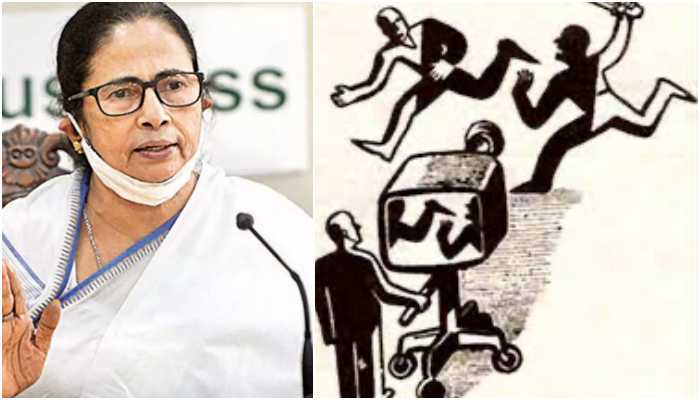
In the violent aftermath of the 2021 Bengal elections, liberal publications have gone on the offensive in an effort to whitewash, and somehow even justify, the post-election violence that is taking place. Right on cue, two different write-ups have appeared in Scroll.in and The Wire. Both of these articles are similar in nature, as they both attempt to downplay the heinous violence in Bengal, labeling it as merely “party politics”.

Article in Scroll

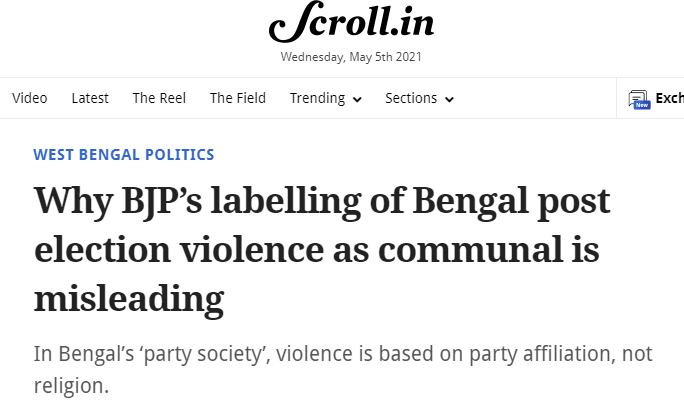
The Scroll.in piece is titled, “Why BJP’s labelling of Bengal post-election violence as communal is misleading”, and this headline in itself reveals the issue. It plays into a narrative that perceives “communal” violence to be worse than any other sort of violence. This mentality is inherently flawed, and has no basis in morality, but is somehow ubiquitous in the un-elected ‘intellectual’ class of this country.

The article does not dispute the violence that took place, it only takes issue with the BJP allegedly characterizing the violence as “communal”. Think about that for a second. The article reads, “This is why the BJP’s labelling of the violence as communal is incorrect. People across communities have got attacked – not only Hindus, as the BJP claims. The only pattern is that by and large, the people getting attacked are from the opposition and the attackers from the Trinamool. The violence is political, not communal.“

So the article admits that the post-election violence in Bengal is by and large being perpetrated by attackers from Trinamool Congress. However, that is not the primary thrust of the article, nor is it even emphasized upon. The article’s primary objective is to disprove the notion that post-election violence is “communal”. What exactly does this serve to achieve? Should we not be concerned about the lawlessness and violence plaguing Bengal because it is not “communal”? Should the families of BJP, CPI(M), and Congress workers who were either injured or killed during this violence feel better that at least they weren’t victims of “communal” violence? This is an absurdist idea of morality, which has nothing to do with religious principles or natural law.

Not just morally, this view of violence is also totally incompatible with the law. If according to these liberal intellectuals, “communal” violence is objectively worse than other kinds of violence, and if they push these views through the help of the mainstream press, then they are creating a parallel morality which might even justify violence in some cases. This is exactly how Left-wing Anarchists like Antifa have cropped up in the U.S. They believe themselves to be vigilantes, using appropriate force or violence in order to create destruction, which they believe helps them achieve their goals. Just a few days ago, a Left-wing Antifa radical was convicted to four years in jail for burning a U.S. police station. This type of Antifa vigilantism is not only totally amoral but also contrary to the law.

The Scroll.in piece is also hilarious in some other ways. It places huge importance on the role of party affiliation in Bengali society, but almost flippantly dismisses caste and religion as having any effect. The article unironically argues that party politics and political identity, which permeated through Bengali society in 1977, is more important to the Bengali people than their religion and caste which has been interwoven into their identity for over 1000 years. However, that is an analysis for another day.

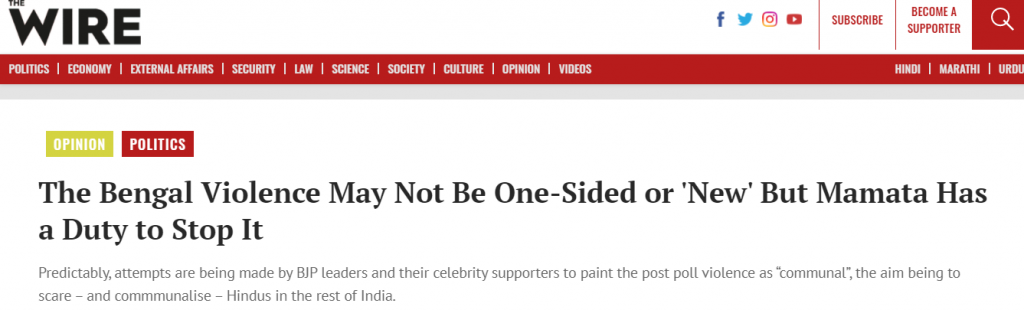
The Wire piece, on the other hand, does meet the lowest possible expectation of at least nominally criticizing Mamata Banerjee, placing the blame for the violence and lawlessness at her feet. However, this op-ed does so whilst giving overt praise to the three-time CM, calling her a “formidable fighter”, who has just “defeated the politics of hate”, at the same time when TMC cadres are attacking and murdering BJP, CPI(M), and Congress workers.

This white-washing of political violence in Bengal by the liberal press doesn’t stop here. On Tuesday, the much-championed liberal network NDTV platformed Professor Ananya Chakraborty, as a “Political Analyst”, presumably someone who is supposed to be objective and non-biased. That was unfortunately not the case, as the Professor bizarrely claimed that political violence in Bengal has “never happened before”, a claim which is obviously untrue.

The truth is, neither the mainstream media nor the intellectual class care for the Bengali people. The mainstream press and the intellectual class are ideological brethren who care more about certain types of violence than others. To these ideological drones, the life of a Dalit man attacked by a Muslim mob will have far less value than a Dalit person attacked by an upper-caste Hindu mob.

Is it a surprise that whilst the Indian media, especially the Liberal media, has a large section of Bengali representation, the largest anti-Dalit pogrom in the history of India, conducted by the Communist government of Jyoti Basu, has largely been forgotten? These crusaders for Dalits and other marginalized groups can’t even recall the Marichjhapi massacre because it was committed by a godless, secular, communist regime, not by the “forces of Hindutva”. Was the Marichjhapi massacre somehow better, because it was not “communal” violence, just “communist” violence? Maybe we need another Scroll article to clear this up.

While Delhi govt demands more oxygen, numbers show its demand is four times the consumption by Mumbai for similar Covid-19 cases

Even since the second wave of Covid-19 in the country, several states have faced shortages of oxygen, ICU and other beds, and medications like Remdesivir etc. But, while most of the states seemed to have stabilised the supply of these essentials against their demand, Delhi is still facing a serious shortage of oxygen. For over two weeks now the Delhi High Court is monitoring the oxygen supply situation in the national capital, the centre is increasing the oxygen allocation for Delhi, but still, daily Delhi hospitals send SOS saying they only have few hours of oxygen left.

Hearing centre’s plea against Delhi High Court threatening to file contempt of court against the central govt over oxygen supply in Delhi, the Supreme Court today suggested that the Mumbai model of oxygen management should be studied to find out if it can be implemented in Delhi. The apex court said that the Mumbai municipal corporation did well to manage the oxygen situation.

The observation by the Supreme Court is valid, as it has been observed that the consumption of oxygen is unusually high in Delhi compared to other places with comparative Covid-19 numbers. For example, if one compares Delhi’s oxygen consumption with Mumbai, it appears Delhi’s consumption is double the consumption in Mumbai despite having similar active cases.

For example, on 20th April, Mumbai had an active caseload of 84,743, the highest in the last 15 days, and the oxygen consumption in the city was 245 MT. On 3rd May, Delhi had 89,592 active cases at 89,592, but its oxygen demand on that day was 976 MT, four times Mumbai’s use, while the city received 433 MT of oxygen on that day, double of Mumbai’s consumption.

According to data provided by Municipal Corporation of Greater Mumbai, O₂ consumption in the city is hovering between 220 MT to 245 MT from 20th April to 1st May, with the requirement coming down gradually. During this period, Delhi’s active case numbers around 1.5 times of Mumbai’s, but the oxygen demand in the city is much more.

According to AAP leaders, Delhi has been demanding 700 MT of oxygen per day during the last fortnight of April, and its demand went up to 976 MT per day from 29th April. On that day, Delhi Deputy CM wrote to the union govt demanding 976 MT oxygen per day. On that day, it had active case load of 97,977. On the same day, Mumbai consumed 225 MT oxygen for 61,433 active cases. If we go by Mumbai’s average O₂ for that day, Delhi should need around 360 MT. According to the Delhi govt, they received 400 MT of oxygen on that day, which means they received more oxygen than the consumption by Mumbai.

DateMumbai Active casesMumbai ConsumptionMumbai Average useDelhi Active casesDelhi DemandDelhi ReceivedDelhi Average DemandDelhi Average Received
20-04-2021847432452.8985575700300*8.183.51
21-04-2021839532302.7485364700300*8.203.51
22-04-2021815382432.9891618700300*7.643.27
23-04-2021787752332.96920297002977.613.23
24-04-2021757402393.1693080700300*7.523.22
25-04-2021703732373.37945927003057.403.22
26-04-2021660452323.51923587004087.584.42
27-04-2021655892293.49982647003987.124.05
28-04-2021640182293.58997527004317.024.32
29-04-2021614332253.66979779764099.964.17
30-04-2021593182223.74993619763129.823.14
01-05-2021573422203.849674797643310.094.48
Oxygen use comparison between Mumbai and Delhi
O₂ quantity in MT. Average is O₂ in MT per 1000 active cases. *-Estimated amount

While the Delhi govt is claiming that it is receiving less than half of what it needs, the fact is that the quantity received by Delhi is more than what Mumbai consumed at a similar number of active Covid-19 cases.

This shows that while Delhi is not getting what it is demanding, mostly due to the lack of oxygen availability in nearby states, and lack of adequate number of tankers, it is still getting more than the quantity that Mumbai is using at a similar level of active cases.

This points towards two possibilities, either the number of covid-19 patients requiring oxygen is disproportionately high in Delhi, or there are issues with the management of the gas in the capital city, with perhaps leakage.

In fact, the union govt has also noticed this mismatch in oxygen demand by Mumbai and Delhi, and looking at Mumbai’s oxygen supply management to know how they are managing the oxygen supply so better than Delhi.

While the Delhi govt is demanding more oxygen, it also has been alleging that the centre is giving other states more oxygens compared to demand. But they are missing one important detail, which is the demand by other states is much less in relation to the number of active cases. While most states demanding around 2-3 MT of oxygen per 1000 active cases, Delhi’s demand is more than 7 MT per 1000 active cases.

Therefore, Delhi is demanding more oxygen not only compared to Mumbai, but almost all other states.

‘Over 9000 tonnes of medical oxygen being produced per day, capacity increased 300%’: INOX chief

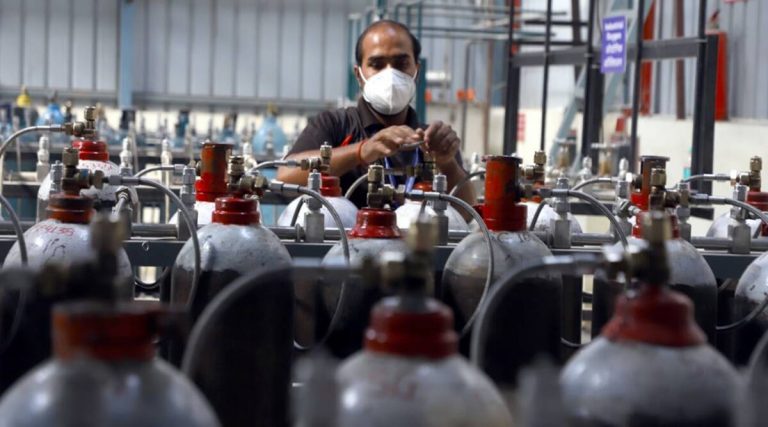
With the advent of the second wave of the coronavirus pandemic, the demand for medical oxygen increased 7 times from 700 tonnes per day to 5000 tonnes per day in April. To bridge the demand and supply gap, the Centre sanctioned the installation of PSA’s in many states at the earliest and urged the relevant industries to initiate the production of medical oxygen.

With this, the medical oxygen availability has increased to 9,200 tonnes a day within a month, as per a report in Business Today. Siddharth Jain, Director, Inox Air Products, the largest manufacturer of industrial and medical gases in India said that the issue of oxygen shortage in the country will be mitigated within a few days. 

The excess demand for medical oxygen was unprecedented as even during the peak of the first COVID-19 wave in India, maximum demand was not more than 3,000 tonnes a day.

Role of Inox in bridging the demand-supply gap

The company is currently responsible for creating over 75 per cent of the existing medical oxygen infrastructure in India.

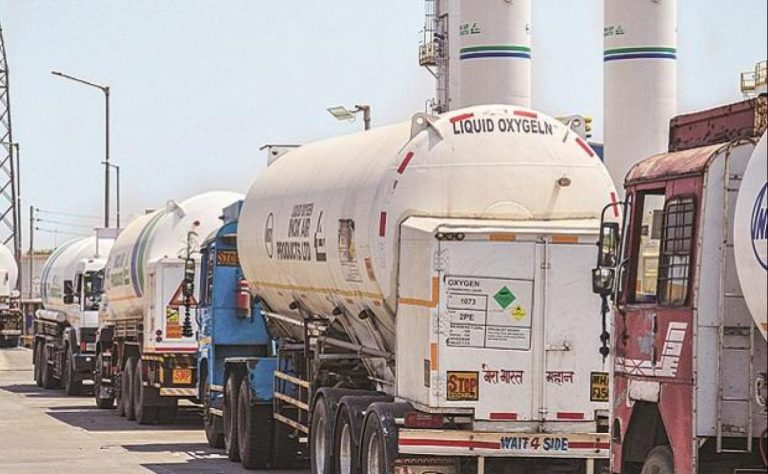
Talking about the obstacles to supply medical oxygen across the nation and the solution for the same, Jain in a virtual press conference informed, “The main issue was in supply chain as liquid medical oxygen has to be transported in cryogenic tankers, which normally cater to a 200 kilometre radius. With the increased demand even in remote areas, now tankers have to cater to over 1,000 kilometres radius. India had only 1,200 such tankers before the current crisis and permission was given recently to convert another 1,200 nitrogen and argon carrying tankers to transport medical oxygen. Besides, some 40 plus such tankers have been imported.”

“With the point-to-point green corridor ‘Oxygen Express’ trains shuttling between most affected areas, and with Airforce, Navy helping with the transport, the logistics issues are more or less resolved. Now, we can cater to even remotest areas even if the wave spreads to non-affected states,” he added.

Inox Air Products produces about 2,600 tonnes oxygen a day catering the demand of over 26 states. According to Jain, the capacity has been increased to around 40 percent in the past three years and has announced an investment of Rs 2,000 crore to increase capacity in the next few years. 

It takes about two years to set up a new oxygen plant, Jain informed.

Oxygen manufacturing in the country

Most of the oxygen manufacturing units in the country are concentrated in the North and East; close to steel plants which are the main consumers of oxygen, as per INOX in the Business Today report.

Maharashtra, which has the highest demand mainly in Mumbai and Pune, produces around 1,500 tonnes of medical oxygen. Gujarat and Uttar Pradesh follow. About 25% of all production is consumed by Maharashtra and Gujarat alone. 

Talking about fulfilling the demand of the capital city and allotment process, Jain said, “Delhi does not have a manufacturing unit and currently, supplies are 140 tonnes a day, including 450 tonnes supplied in the last three days. Earlier, companies were supplying medical oxygen directly to hospitals. Now, the Centre monitors production and allocates oxygen to states depending on the number of cases and situation.”

Maharashtra: State Health Minister’s home district got huge surplus of vaccine doses while other areas suffered from scarcity

The state of Maharashtra ran out of vaccines from April 7 to 9 forcing the vaccination centres to shut despite the Centre claiming that the state should have stocks available for a few more days.

While most vaccination centres were locked due to an acute shortage, the city of Jalna was sitting on a surplus that would last at least 10 more days, as per a report in Indian Express.

This is because NCP leader and Maharashtra’s Home Minister Rajesh Tope, whose hometown happens to be Jalna, was allotted an excess of 60,000 vaccine doses while the quota was just 17,000 doses.

The extra doses were sent from the fresh supplies of 26.77 lakh doses received by the state from the Centre on March 31 to be distributed to all districts.

The Indian Express report said that Tope had called the Health Department officials and ordered them to increase the allocation to his district to 77,000 doses. Tope, however, denying the claims said, “no particular district was preferred” and insisted that if Jalna received more stocks, it was only “to encourage more vaccination”. 

Discrimination in supplies

It is imperative to note that on March 31, Jalna had only 773 active cases which was lower than at least 30 districts. In terms of daily vaccinations, its figure of 600-1,000 till March end put it among the 10 lowest-performing districts.

So while the other districts recorded more numbers of new coronavirus cases and a better vaccination administration percentage, the Health Minister’s district was given a priority.

Aurangabad, which is one of the six divisional storage centres for vaccines in the state, had diverted 60,000 doses from Aurangabad to Jalna on April 1 on the orders of State immunisation officer Dr DN Patil. Aurangabad had received 1.95 lakh doses, based on its 7,000-8,000 daily vaccinations.

At that point Jalna was conducting just 600-1000 vaccinations a day which means the district had enough vaccine doses for 15-18 days when stocks in other districts had depleted to suffice for only for five to ten days. Only after receiving the extra doses, did Jalna increase daily vaccinations to 3,000-5,000 in the first week of April.

This was also the period when the state of Maharashtra had made frantic calls to the Centre for more supplies.

The district of Beed which was clocking more cases of Covid-19 and better performance in vaccination drive received lesser doses. Only nine districts with vaccination numbers higher than that of Jalna received more stocks than the district on April 1 as per the report.

Jalna made to transfer excess stock

Sources informed that Tope “insisted” on allotting Jalna more stock from the huge supply received from Centre. 

District health officials informed that they requested the state government, including Tope, to urgently send more stocks. “We reasoned with the minister that stocks in Jalna would sit for days as other districts suffered. He eventually agreed to divert stocks from Jalna,” an official said.

With Jalna sitting on around 50,000 doses around April 07, 25 vaccination centres in Mumbai were shut due to shortage.

Finally, on April 08, Jalna was made to transfer 15,000 doses, to Washim, Yavatmal and Parbhani. However, “A few centres could not function for a day-and-a-half,” said Dr Avinash Aaher, Washim’s district health officer.

Devendra Fadnavis hits back at Maharashtra government

Leader of opposition Devendra Fadnavis had lashed out on the MVA government on April 08 when demands were made to the Centre to increase vaccine supplies.

He said that vaccine supply is not based on population but vaccination performance. Posting a screenshot of a tweet from Maharashtra DGIPR, Fadnavis claimed, “Maharashtra received 1.06 crore vaccines. The tweet was made by DGIPR on April 6. 91 lakh vaccines were used. That means there are 1.5 million vaccines left. So, what is the reason for deliberately closing the Centre today and spreading false news about vaccines?.”

New cases in Maharashtra

As per PIB data, the state of Maharashtra has begun to register more recoveries than new cases. In the past 24 hours, the state recorded 51,880 new Covid-19 cases, 65,934 recoveries and 891 deaths. 

The Covid fatality rate in Maharashtra stands at 1.49%.

Karnataka: Bribe for Bed scam unearthed, BJP’s Tejasvi Surya accuses BBMP officials of allotment of beds against money, says many lives lost

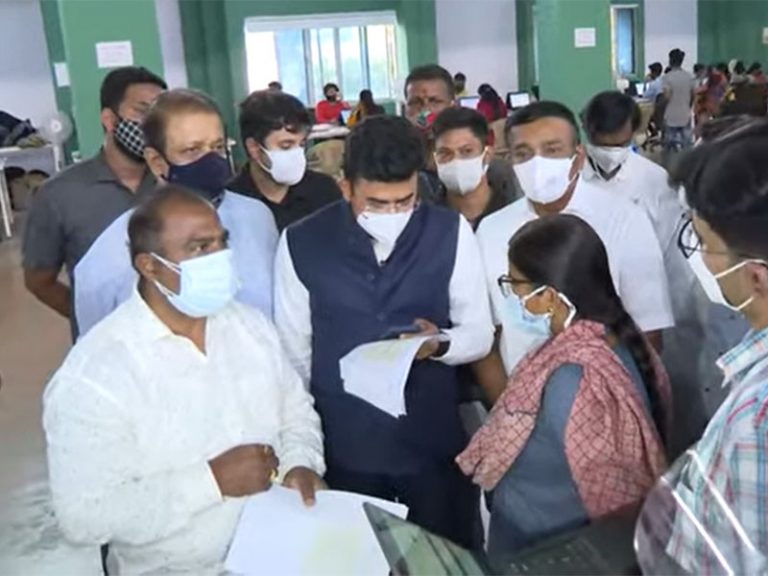
Bengaluru Urban and Rural have collectively reported 21,866 cases on May 4. There has been a steady increase in the demand for hospital beds across the city due to the surge in Covid cases. Amidst the health crisis Bengaluru is facing, BJP MP Tejasvi Surya has alleged that a ‘Bribe for Bed’ scam is going at at BBMP (Bruhat Bengaluru Mahanagara Palike). Surya alleged that the war room officials at BBMP were falsely booking beds meant for the Covid-19 positive patients in exchange for money.

According to BJP MP, 4065 beds in Bengaluru were found to have been booked illegally. He added that BBMP officials were allegedly attempting to sell the beds in exchange for money. Surya, along with MLAs Uday Garudachar and Sathish Reddy, went to the BBMP war room and confronted the officials regarding the alleged bed allotment scam. The case has been handed over to Central Crime Branch for further investigation.

Tejasvi alleged that the BBMP officials were allotting the beds meant for Covid-19 patients to asymptomatic patients. They were then charging as much as Rs 50,000 for blocking a bed. During the confrontation, Surya questioned the civic body officials how they managed to admit a new patient within thirty seconds of the previous patient who was discharged.

Further, Surya questioned how the war-room personnel who were related to each other were appointed. He also questioned the hiring process of 17 individuals and asked about the agency that they belonged to.

Some of the names he enquired about while confronting BBMP officials are Mansoor Ali, Tahir Ali Khan, Sadiq Pasha, Md Zayed, Alsai Saheer, Umer Khan, Salman Urif, Zameer Pasha, Zabiullah Khan, Sayed Hasnain, Sayed Shahid, Sayeed Shahbaz, Md Yunus, Syed Mohin and Syed Mukesh.

BBMP officials, Aarogya Mitra Hospitals and private agents were involved, alleges Tejasvi

During the press conference, Surya said that there are enough beds in Bengaluru city. However, the war room personnel had been running a racket of false blocking the beds. They were then allotting those beds to the people in exchange for money. He added that there was a nexus between BBMP officials, Aarogya Mitra hospitals and private agents who were indulging in the said crime.

He said, “People of Bengaluru have been trying to get a single bed to save their near and dear ones. However, each day the BBMP bed booking system showed all beds across the cities are blocked. Every day many patients were getting discharged. Many unfortunately died and discharged. So there must be beds available, but the system showed there were no beds available.”

He added that there were certain BBMP officials, certain Aarogya Mitra Hospitals and certain private agents outside hospitals who made the ‘Bribe for Beds’ scam. “People were at home isolated and not even aware that beds were being booked in their name. Thereafter, the agents outside would talk to the in charge inside the hospital and re-allot the bed to patients after they made certain payment,” he added.

Explaining the scam, Surya added, “After a bed is booked, after a bed is booked for a patient and he does not get admitted, after 12 hours the bed gets unbooked. In those 12 hour window, agents contact patients looking for admission and divert beds to them.” He said that they contacted multiple people under whose names the beds were booked but found that they had recovered long back. He also added that ICU and ventilators were also assigned to those who could pay the bribe.

He also alleged that some set of people were reserving beds for influential people such as ministers, MLAs and MPs.

CM Yediyurappa promises ‘severe action’

Karnataka Chief Minister BS Yediyurappa promised swift action against those who were involved in the scam. Later in the evening, Kamal Pant, Police Commissioner, Bengaluru City, said that two of the accused who were arrested had been handed over CCB for further investigation. Two agents identified as Rohit and Netra have been booked under Sections 420 and 384 of the IPC. Police said that they were selling ICU beds to the patients in exchange for Rs 50,000 per bed. Police recovered Rs 1,05,000 from their bank accounts.