Home Blog Page 448

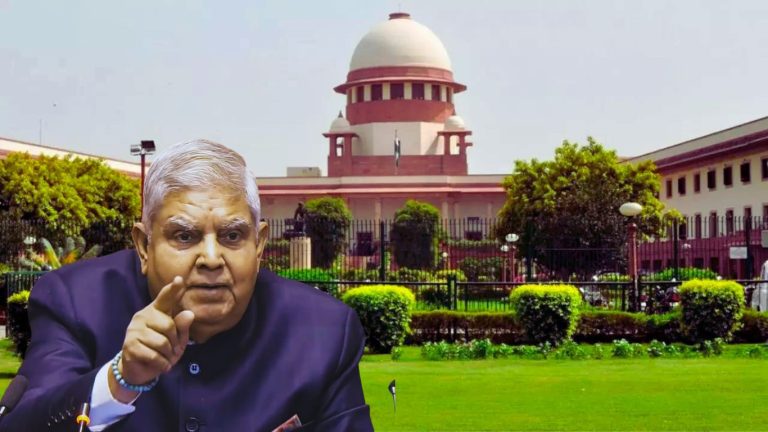
What is Article 142, which VP Dhankhar called a ‘nuclear missile’, that the judiciary is using against the legislature, trying to remote control an elected government?

0

Vice President Jagdeep Dhankhar yesterday (17th April) took a dig at the Supreme Court, accusing it of overstepping its constitutional powers. Dhankhar’s remarks came in the context of the controversial verdict delivered by the Supreme Court in The State of Tamil Nadu v The Governor of Tamil Nadu and Anr. In the case, a division bench of the Supreme Court, comprising Justices B Pardiwala and R Mahadevan, prescribed time limits to be followed by the President and the Governor while considering Bills in exercise of their powers under Articles 200 and 201 of the Constitution. Besides, the court made the President and the Governor answerable to it for failing to comply with the prescribed time limits, and allowed the state government to approach it to seek the issuance of the writ of mandamus against the President and the Governor.

The verdict is being widely criticised as an act of judicial overreach and an attempt by the judiciary to interfere with constitution-backed powers of the legislature and the executive, and thus a violation of the principle of separation of powers envisaged under Article 50 of the Constitution. Commenting on the verdict, VP Dhankhar questioned how a small bench of two judges could pass a judgment that effectively modified the constitutional provisions. Referring to Article 145(3), which mandates that the minimum number of judges for deciding on a substantial question of law should be five, Dhankhar said that the provision requires revision because at the time enactment of the Constitution, the Supreme Court had a total of 7 judges and 5 judges would have constituted majority. But now the number of judges in the Supreme Court has increased, and therefore the minimum number of judges required to decide on an important question of law should also increase proportionately.

Using strong words, VP Dhankhar said that Article 142 was being misused by the Supreme Court like a “nuclear missile” to override a democratic process. “Article 142 has become a nuclear missile against Democratic forces, available to the judiciary 24 x 7,” Dhankhar said.

What does Article 142 say?

Article 142 is a one of its kind provision in the Indian Constitution which confers vast discretionary powers on the Supreme Court. The contours of the Supreme Court’s power under this provision transcend the boundaries of procedural and substantive law. The provision empowers the Court to fill any gaps in the existing statutory provisions and pass any decree or order which it deems “necessary for doing complete justice” in any case pending before it. In addition to that, the provision also says that the Supreme Court has the power to punish for its contempt.

The extraordinary provision is intended to enable the Supreme Court to do justice in any matter that comes up before it when the existing legal framework appears inadequate. It empowers the Apex Court to assume quasi-legislative and quasi-executive roles in certain contexts if it finds it necessary for safeguarding the fundamental rights and upholding the constitutional values. Article 142, which was Article 118 in the draft Constitution, was inserted in the Constitution by the Constituent Assembly without holding a discussion and its interpretation was left to he discretion of the Supreme Court.

Instances when the Supreme Court invoked Article 142

The Supreme Court, on numerous occasions, has made use of its wide discretionary powers under Article 142 to quash proceedings, grant divorce, issue directions, and even approve settlements. Explaining the scope of the Apex Court’s power under Article 142, the Supreme Court in the Delhi Judicial Service Association case (1991) said that prohibitions or limitations contained in ordinary laws cannot restrict its constitutional power under Article 142. The Supreme Court reiterated in the Vinay Chandra Mishra case (1995) that its power under Article 142 was not limited by any statutory provision.

The Court recently invoked the provision in the Shilpa Sailesh case (2023), where, describing the ambit of its constitutional power under Article 142, it said that it could grant unilateral divorce in appropriate cases, and it can do so without being bound by personal laws and statutory requirements. In 2017, the Supreme Court banned the sale of liquor within 500 metres of a national highway using its discretionary power under Article 142. Similarly, in 2024, the Supreme Court invoked the same powers to set aside the 2024 Chandigarh Mayoral elections. The discretionary power was also used by the Supreme Court in the Union Carbide case (Bhopal Gas Tragedy case), where it ordered Union Carbide to pay $470 million as compensation to victims.

Power under Article 142 is not absolute

Even though the Supreme Court enjoys extraordinary powers under Article 142, they are not absolute. The powers are subject to constitutional limitations. In the Supreme Court Bar Association Case (1998), a Constitution bench of the Supreme Court outlined the scope of its discretionary power under Article 142 by noting that the provision could not supplant the existing substantive law applicable in the case. Similarly, in State of Karnataka v Umadevi (2006), the Supreme Court observed that it cannot grant any relief under Article 142, which would amount to perpetuating an illegality.

Last year, the Supreme Court laid down certain parameters for the exercise of power under Article 142 in High Court Bar Association, Allahabad v. the State of U.P. & Ors. (2024). The Court said that the powers under Article 142 can be exercised to do complete justice, but the Court shall not nullify any judicial orders passed in favour of other litigants in other jurisdictions. And, the Court shall respect a litigant’s substantive rights within its jurisdiction and preserve legal integrity. And most importantly, the Court shall not undermine the principles of natural justice.

The Supreme Court is bound by the Constitution and the principles of natural justice in exercising this discretionary power. The words “necessary for doing complete justice” themselves bear a torch for the court in this regard. The Court should be guided by the principles of reasonableness and necessity in invoking the said provision for doing “complete justice”. In exercising its unique discretionary powers under Article 142, the Court cannot act unjustly and arbitrarily. The extraordinary power has to be invoked sparingly and only in necessary cases. Adopting a balanced approach in exercising its powers under Article 142, the Court should ensure that the fundamental principles of justice and fairness are not transgressed. The use of this provision by the Supreme Court should not go against the spirit of the Constitution, which envisages a balance between the three organs of the state- the Executive, the legislature, and the judiciary.

Bangladesh economic crisis: IMF withholds $1.3 billion in 4th and 5th instalments of funding for not fulfilling conditions, delegation leaves country without confirming release

Bangladesh is lagging behind in fulfilling four essential requirements needed to obtain $1.3B of the fourth and fifth instalments of an International Monetary Fund (IMF) loan worth USD 4.7 billion. Weak revenue growth, a non-market exchange rate, inadequate subsidy reduction and a lack of anticipated advancements in the banking industry are among the areas of concern. After a two-week evaluation mission, the visiting IMF delegation summarised these issues in a briefing on 17th April.

The IMF stated that talks are still continuing, but did not render a final decision about the disbursement of the next tranches. The money could be released by the end of June if the progress is adequate. Chris Papageorgiou, Head of the Development Macroeconomics Section at the IMF’s Research Department, and nine other delegation members attended the briefing, which was hosted at the Bangladesh Bank. The IMF mission met with several government agencies, including Finance Adviser Salehuddin Ahmed, from 6th to 17th April prior to the briefing.

The package includes the Extended Credit Facility (ECF), Extended Fund Facility (EFF), and Resilience and Sustainability Facility (RSF). According to Papageorgiou, officials want to get a staff-level agreement, maybe at the IMF-World Bank Spring Meetings in Washington in scheduled from 21st-26th April.

Papageorgiou noted that the uncertainty in the world is posing a number of problems for Bangladesh’s economy. Growth in the gross domestic product (GDP) fell to 3.3% in the first half of the current fiscal year from 5.1% at a similar time last year. He blamed tight monetary policy, investment ambiguity and political upheaval for the recession. Inflation has decreased from a ten-year high of 11.7% to 9.4%, however, it is still far higher than the Bangladesh Bank’s desired range of 5.3-6%.

The nation’s foreign currency market has been volatile for over three years. Nonetheless, there have been indications of stability in recent months, primarily as a result of a rise in US dollar inflows that have narrowed the difference between official and black market rates. The exchange rate system is still only partially regulated in spite of this progress.

$476.2 million was paid out in February 2023, $681 million in December 2023, and $1.15 billion in June 2024 as the third tranche to Bangladesh. This indicates that the IMF has loaned Bangladesh a total of USD 2.31 billion. The IMF loan is regarded by economists as crucial to the nation’s economic stability. They claim that if the IMF does not make the loan available, other people will be deterred as well, and international financial institutions may lower Bangladesh’s credit rating.

It is important to note that Bangladesh and Pakistan, which were once part of India, have increasingly relied on financial assistance from other nations and international monetary organizations such as the IMF for their survival. The decline of these countries has been closely linked to their anti-India diplomatic stance, extreme ideologies and a greater emphasis on radical propaganda rather than fostering a developmental and progressive environment within their borders.

The stampedes in Pakistan over flour, combined with gas shortages and electricity outages, alongside rising inflation and dwindling reserves, have presented a concerning picture for the global community. The severity of the situation forced the government to implement spending cuts. Similarly, Bangladesh is becoming more radical under the leadership of Muhammad Yunus, while also experiencing a significant financial decline and inflation.

Currently, the two nations notorious for extremism, terrorism, jihad and the oppression of their minorities, particularly Hindus, have no choice but to turn to the IMF as their source of financial support for survival. Pakistan was placed on the grey list until 2022 due to its insufficient progress in adhering to United Nations Security Council Resolutions. In summary, the nation has become a center for terrorism and money laundering.

Now, Bangladesh appears to be following a similar trajectory. The prevalence of anti-Hindu hatred and jihadi propaganda takes precedence over any initiatives intended to improve the lives of their people. As a result, they are left with no choice but to solicit funds from the IMF. However, it seems that the nations are not gaining any insights, as reflected in the actions of their leaders like Army Chief Asim Munir and Muhammad Yunus.

Adani Realty honoured with prestigious Grohe Hurun India Visionary Real Estate Brand of the Year Award at the Real Estate Leaders’ Conclave in Delhi

0

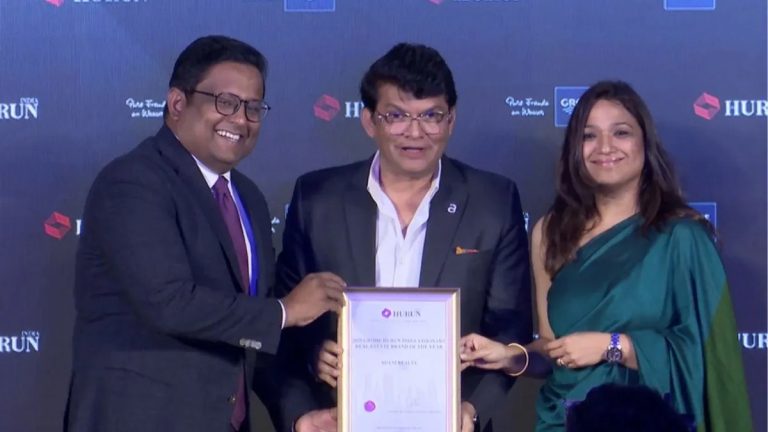
Adani Realty, the real estate arm of the diversified Adani Group, has been honoured with the prestigious Grohe Hurun India Visionary Real Estate Brand of the Year Award at the Real Estate Leaders’ Conclave 2025, held here in the national capital, a company statement said Friday.

The award recognises Adani Realty’s exceptional growth, forward-thinking approach, and commitment to shaping the future of Indian real estate through innovation, sustainability, quality, and customer-centric development.

“This recognition is a reflection of our unwavering focus on building world-class developments and our belief in transformative growth led by purpose and precision,” said a spokesperson from Adani Realty.

Adani Realty’s journey began in 2010 with the launch of Shantigram — a 600-acre integrated township in Ahmedabad.

Since then, the company has steadily expanded across asset classes including residential, commercial, and social infrastructure, with a presence in high-growth urban centres such as Mumbai, Pune, Gurugram, and Ahmedabad.

Today, the company boasts 24 million square feet of completed development, with over 7,000 families residing across projects delivered by Adani Realty.

In 2024, it was valued at Rs 56,500 crore, topping the Grohe-Hurun India Real Estate 100 list as the highest-valued unlisted real estate firm in the country.

“The award underscores Adani Realty’s continued evolution as a brand that balances visionary ambition with grounded execution, earning the trust of customers and industry peers alike,” Adani Realty said in the statement.

Hurun Report, founded in London in 1999 and launched in India in 2012, is renowned for its authoritative lists that track wealth creation, innovation, and philanthropy, including the India Rich List and Hurun India 500.


(This news report is published from a syndicated feed. Except for the headline, the content has not been written or edited by OpIndia staff)

Supreme Court stays demolition of illegal dargah in Nashik, seeks report from Bombay HC for not listing plea challenging demolition notice

0

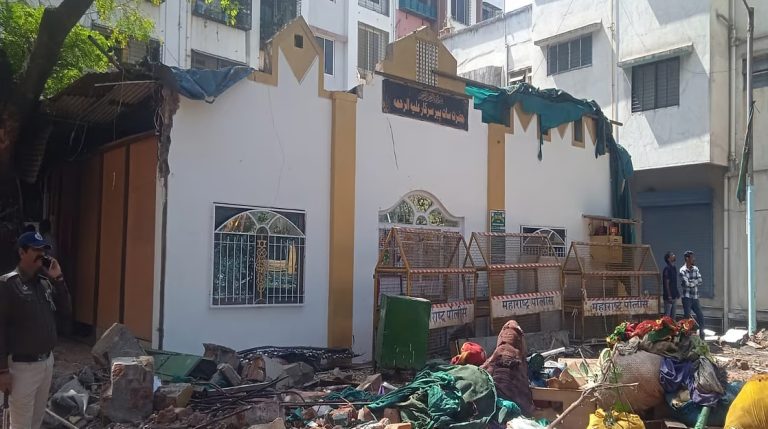
The Supreme Court has put an interim stay on the Nashik Municipal Corporation’s April 1 demolition notice to the Hazrat Saatpeer Sayed Baba dargah in the city, and sought an explanation from the Bombay High Court Registrar General as to why a plea challenging a demolition notice was not listed for hearing urgently.

A bench of Justices PS Narasimha and Joymalya Bagchi noted that there was urgency in the matter as the religious structure could be demolished.

The apex court, in its April 16 order, noted that, according to the senior lawyer representing the Dargah, the plea was filed before the High Court on April 7 and had been sought for listing since April 8.

“We are unable to understand what transpired from April 9 till today (April 16). Counsel submits that they have been attempting to list the matter every day.

As per the reports, the structure was razed by a civic squad hours before the apex court hearing amid violence.

The bench stated that it has taken “extraordinary measures” in light of the specific statement made by senior advocate Navin Pahwa, who was representing the Dargah management, that efforts were made every day to get the matter listed in the High Court.

Thus, it directed the Registrar General of the High Court to send a report about the listing of the petition and posted the matter for hearing before it on April 21.

“We are unsure of the statement made and that the High Court would not have listed the case despite repeated requests. This is a serious statement and the counsel shall take and feel responsibility for the consequences of such a statement,” the bench stated in its order.

While staying the demolition of the Dargah, the bench said, “In the meanwhile, there shall be a stay of notice dated April 1, 2025, issued by the respondent number 1 – Nashik Municipal Corporation as prayed for.”

It also sought a response from the Nashik Municipal Corporation on the issue.


(This news report is published from a syndicated feed. Except for the headline, the content has not been written or edited by OpIndia staff)

How the Indian government is giving more benefits to the poor, without increased spending of tax payer’s money

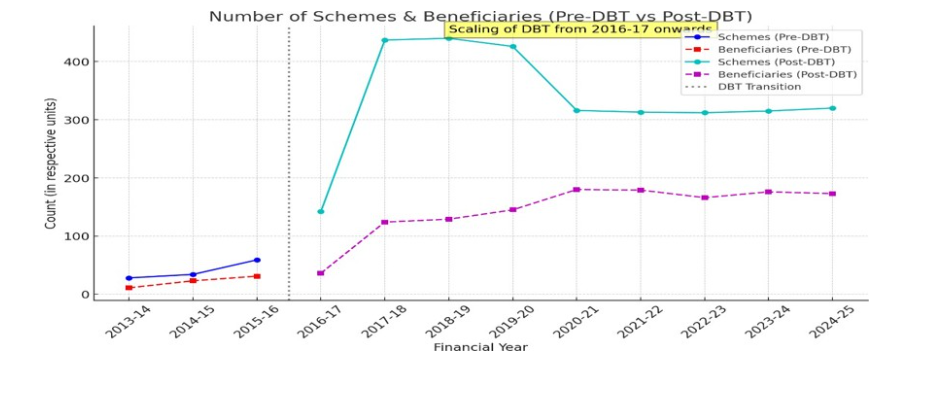
India’s Direct Benefit Transfer (DBT) initiative, which was launched in 2013, has transformed the nation’s welfare distribution system, creating a global model for effective and inclusive assistance. The transformative system has generated cumulative savings amounting to ₹3.48 lakh crore and has halved the subsidy allocations from 16% to 9% since it was introduced, owing to its high efficiency. Furthermore, it has fostered improved transparency, mitigated leakages and facilitated the accurate distribution of funds.

The program has successfully expanded its reach sixteen times during this period, from 11 crore beneficiaries to 176 crore, while ensuring both fiscal and social benefits. The newly created Welfare Efficiency Index (WEI), which quantifies fiscal and social gains, saw an increase from 0.32 in 2014 to 0.91 in 2023, reflecting substantial improvements within the system.

Dr. Shakil Bhat, a researcher, conducted an evaluation of ten years of data (2009–2024) to analyse the effects of DBT on budget efficiency, subsidy rationalisation, and social outcomes for the BlueKraft Digital Foundation.

According to the policy paper, which was published on 16th April, the DBT system was aggressively rolled out following governmental transition in 2014 when Bharatiya Janata Party (BJP)-led National Democratic Alliance (NDA) stormed to power at the centre. The new administration prioritised transparency and digitalisation through the JAM Trinity (Jan Dhan accounts, Aadhaar authentication and Mobile connectivity), which became integral to its success.

DBT revolutionised a rotten system

Long-standing systemic inefficiencies in India’s welfare ecosystem, such as leaks, phantom beneficiaries and misallocated resources, weakened the effectiveness of public spending. According to the Economic Survey (2017-18), until 2013 about 85% of welfare monies did not reach their intended users. Likewise, subsidies accounted for 16% of the national budget with negligible social returns. The financial burden highlighted the pressing necessity for structural reforms to synchronise welfare provision with the ideals of equity, transparency and efficiency.

The launch of the DBT system in 2013 represented a key transformation as it revolutionised the distribution of welfare by substituting unclear subsidy channels with direct and targeted financial transfers via the JAM Trinity. There has been a notable rise in welfare budgets, escalating from ₹2.1 lakh crore in 2009-10 to ₹8.5 lakh crore in 2023-24.

However, the proportion of subsidy allocations has fallen, highlighting the efficiency resulting from Direct Benefit Transfers (DBT). The removal of ghost beneficiaries confirmed that subsidies are delivered to those who truly need assistance. This advancement has not only reduced leakages but also reshaped the connection between fiscal accountability and social inclusion, in the following ten years.

This policy document integrates empirical data sourced from Union Budgets, reports from the Ministry of Finance and the DBT portal. It utilised sophisticated analytical methods such as correlation analysis, Granger causality tests and the exclusive Welfare Efficiency Index (WEI). It is a composite index that assigns weights of 50% to DBT savings, 30% to subsidy reductions and 20% to beneficiary growth. The results emphasised DBT’s promise as a framework for welfare systems that are equipped for the future, striking a balance between fiscal responsibility and inclusive growth.

Image via BlueKraft Digital Foundation

The research presented a thorough evidence base for policymakers and uses a robust mixed-methods approach to analyse the influence of India’s Direct Benefit Transfer (DBT) system. It integrated quantitative data analysis, econometric modelling and a unique composite index to offer a detailed assessment of DBT’s effectiveness over a 15-year timeframe (2009-2024).

The primary data sources for the quantitative assessment are Union Budgets from 2009 to 2024, records from the DBT Portal and reports from the Ministry of Finance, among others. The secondary data was derived from the Economic Survey of India (2017-18), studies conducted by the National Institute of Public Finance and Policy (NIPFP) and various academic literature.

Crucial findings

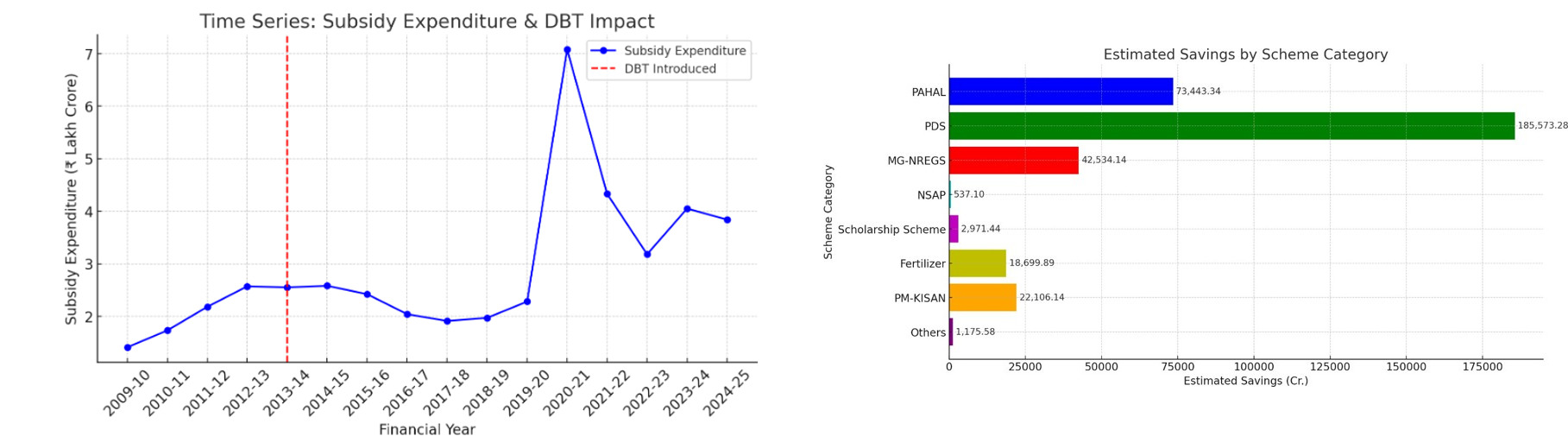
Subsidy Allocation: On average, subsidies constituted 16% of total spending (₹2.1 lakh crore per year) from 2009 to 2013, with notable leakages. However, this percentage fell to 9% by the fiscal year 2023-24, despite a substantial rise in the number of beneficiaries from 11 crore to 176 crore. Emergency fiscal measures during the pandemic caused a brief increase in subsidies (2020–21), but efficiency recovered after the outbreak. This reduction in the subsidy burden, despite broader coverage, underscores the critical role of Direct Benefit Transfers (DBT) in optimising fiscal management.

Sectoral Impact: The implementation of Aadhaar-linked ration card verification in food subsidies has resulted in savings of ₹1.85 lakh crore, which accounts for 53% of the total savings. Moreover, the Direct Benefit Transfer (DBT) system ensured that 98% of wage payments are made promptly. It resulted in the savings of ₹42,534 crore under the MGNREGA (Mahatma Gandhi National Rural Employment Guarantee Act) program. Moreover, the removal of 2.1 crore ineligible beneficiaries from the PM-KISAN (Pradhan Mantri Kisan Samman Nidhi) initiative has saved ₹22,106 crore. Targeted distribution has also decreased fertiliser subsidy sales by 158 lakh metric tons, resulting in an additional saving of ₹18,699.8 crore.

Image via BlueKraft Digital Foundation

Aadhaar-linked authentication has effectively eliminated the presence of ghost beneficiaries, which allowed for the expansion of coverage without a proportional impact on fiscal spending. Savings that are specific to certain sectors underscore the significant effect of Direct Benefit Transfers (DBT) on programs with high leakage rates. Food subsidies, which have a long history of being misappropriated, experienced the greatest advantages from biometric authentication, whereas wage initiatives, including MGNREGA, improved their efficiency through direct transfers.

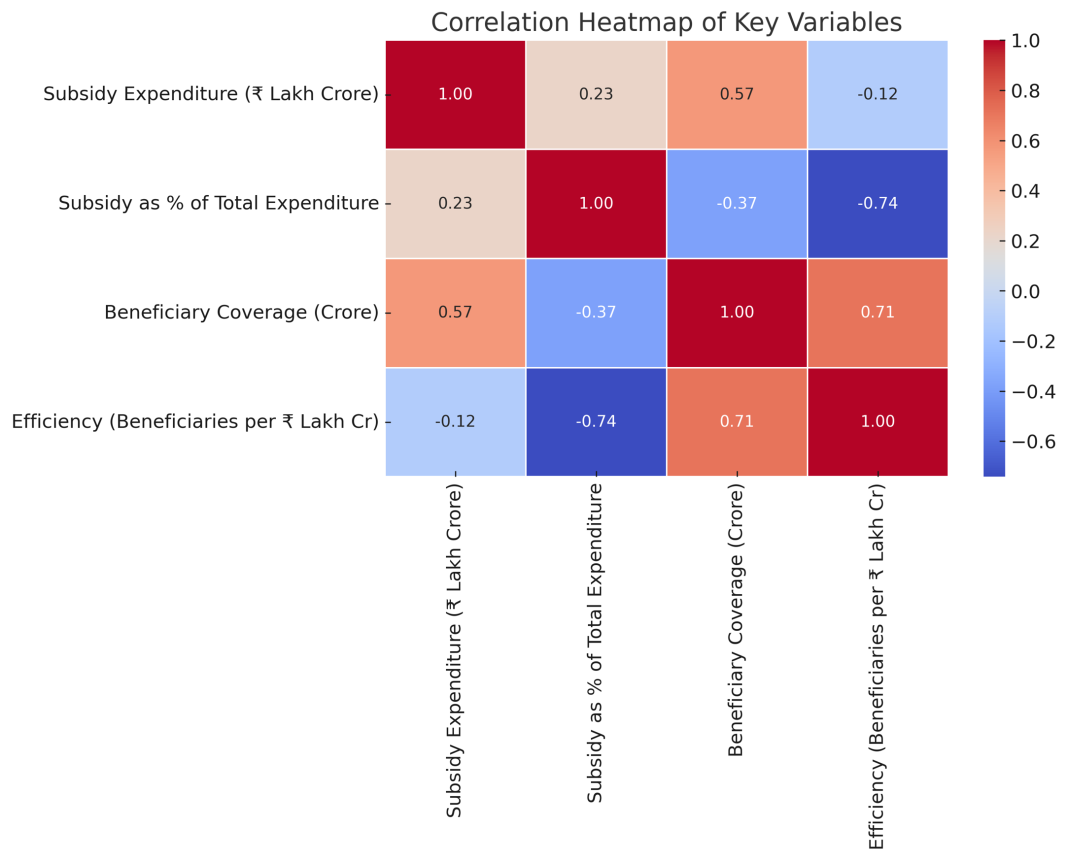
There is a significant positive correlation of 0.71 between beneficiary coverage, contrasted with a negative correlation of -0.74 between the subsidy percentage of total expenditure and efficiency. This implied that Direct Benefit Transfers (DBT) have played a crucial role in decreasing waste and leakages while simultaneously increasing coverage. The correlation heat map below measures the relationship among budget allocations, DBT savings and the efficiency of welfare programs.

Image via BlueKraft Digital Foundation

As savings from Direct Benefit Transfers (DBT) rose, there was a corresponding decrease in subsidy allocations, indicating that DBT has successfully reduced leakages and improved targeting. The increased savings from DBT allowed the government to enhance welfare programs, effectively reaching a greater number of beneficiaries. Even in the face of stable or reduced budgets, beneficiary coverage grew due to improved fund utilisation through DBT.

The negative correlation between subsidy expenditure and efficiency contradicts the critiques regarding “declining welfare spending.” DBT’s relevance, instead, as a fiscal optimisation tool has been validated by its ability to provide wider coverage with lower fiscal outlays due to its precise targeting.

The spike in the WEI measured systemic changes and demonstrated that efficiency gains have been caused by a variety of variables, not only budget reduction. This index gave international policymakers a reproducible structure for assessing welfare changes. The WEI underwent a vital increase from 0.32 in 2013 to 0.91 in 2023, primarily influenced by DBT Savings, which accounted for 50% of the weight, resulting in a cumulative reduction of ₹3.48 lakh crore in leakage.

Image via BlueKraft Digital Foundation

Additionally, Subsidy Reduction, representing 30% of the weight, witnessed a fall in expenditure from 16% to 9%. Furthermore, Beneficiary Growth, which contributed 20% to the overall weight, conveyed a remarkable 16-fold increase in coverage.

Challenges and recommendations

The paper also pointed out certain limitations and contextual challenges, noting that data on beneficiaries for scholarships and pensions prior to 2013 were limited, which hindered longitudinal analyses. Additionally, the COVID-19 pandemic (2020–21) caused temporary disruptions in subsidy trends, requiring adjustments for outliers. Furthermore, ongoing gaps in digital infrastructure in rural areas continue to impact the consistent implementation of Direct Benefit Transfers (DBT).

DBT has maximised resource usage, allowing for a wider beneficiary reach with lower fiscal outlays, in contrast to criticisms of reduced welfare spending. Measurable improvements in welfare efficiency have been made in India by substituting targeted payments for ineffective subsidies. Future initiatives should prioritise expanding the reach of DBT, leveraging technology, and promoting inclusive growth to guarantee fair welfare governance.

The analysis proposed to broaden the coverage of Direct Benefit Transfers (DBT) by transitioning the remaining subsidy-based schemes into direct transfers, to focus on strengthening digital infrastructure and ensure that banking access is prioritised in rural and semi-urban regions, thereby closing inclusion gaps. Additionally, it suggested incorporating AI-driven fraud detection, further reducing financial leakages. Furthermore, it emphasised the need to improve grievance redressal by establishing strong mechanisms and tackling issues of exclusion.

Conclusion

India’s Direct Benefit Transfer (DBT) system, which was established in 2013 and significantly expanded following 2014, has fundamentally changed the landscape of welfare governance by merging fiscal discipline with social equity. This initiative has revamped the country’s welfare system from one plagued by leaks and heavy subsidies to a more precise and efficient model. The pivotal shift in government in 2014 was instrumental, as it placed a strong emphasis on transparency and digital initiatives through the JAM Trinity, which served as the foundation for the success of DBT.

As we look to the future, the success of Direct Benefit Transfer (DBT) positions India to realise its vision of Viksit Bharat 2047, aiming for a developed and inclusive nation. DBT links welfare delivery with sustainable development goals by rerouting savings into rural employment (MGNREGS), agriculture (PM-KISAN), and healthcare (Ayushman Bharat). The analysis provided an insight into practical ideas to improve targeting, fortify digital infrastructure and leverage emerging technologies for transformative governance as India moves closer to the “Viksit Bharat” goal.

On the other hand, problems including the rural digital divide, exclusion errors, and the development of sophisticated fraud tactics require persistent innovation. Future actions must emphasise AI-powered fraud detection, improving last-mile banking systems, and implementing strong grievance redressal processes to ensure that no beneficiary is overlooked.

More importantly, DBT illustrates the unification of technology and governance in establishing a welfare model that is both financially prudent and socially equitable. This program serves as a pillar of India’s growth targets as it advances toward 2047, demonstrating that effectiveness, openness and inclusivity are not mutually incompatible but rather necessary components of a Viksit Bharat.

As Graham Staines murder convict Mahendra Hembram is released after 25 years in jail, read how a witness had accused the Australian missionary of sexual harassment

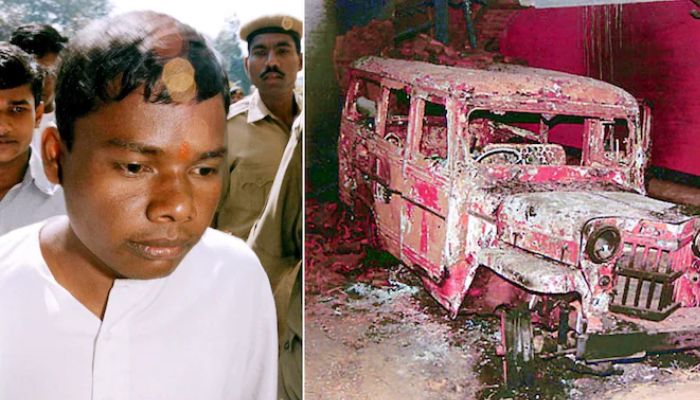
On Wednesday (16th April), Mahendra Hembram, one of the convicts in the killings of Australian Christian missionary Graham Staines and his two minor sons, was released from jail. Hembram walked out of Keonjhar Jail in Odisha after 25 years.

Alongside Dara Singh, Hembram was accused of involvement in the burning alive of the Christian missionary and his two sons (Timothy and Philip) while they were asleep in a station wagon in Manoharpur. After his release from prison, Mahendra Hembram received a rousing welcome and was garlanded.

According to Jailer Manaswini Naik, the State Sentence Review Board ordered Hembram’s release because of good behaviour as per the rules. “The decision to release Hembram is part of our policy of releasing convicts who have spent 14 years behind bars,” the authorities said.

While the Vishwa Hindu Parishad welcomed Hembram’s release from jail, the Congress party expressed its discontent.

Taking to X, Congress leader Manickam Tagore said, “A hate-fuelled murderer who burned alive Graham Staines and his two little sons is now walking free. Mahendra Hembram’s release is a celebration for Sanghis, but a dark stain on Indian justice. What message does this send?”

Notably, Dara Singh, an activist linked to Bajrang Dal and 12 others, were convicted in 2003 for the murders. On the intervening night of 22nd and 23rd January 1999, Graham Stewart Staines, an Australian missionary and his two sons were all burnt to death while they were sleeping inside a station wagon in a remote village, Manoharpur, in District Keonjhar of Odisha. In this case, Rabindra Kumar Pal alias Dara Singh, an activist linked with Bajrang Dal alongside 12 others, was convicted in 2003.

When Graham Staines admitted to having been carrying out religious conversions in Odisha

Just a year before his murder, Graham Staines noted in his journal that some people on motorcycles hampered his missionary work. The police had even asked Staines to leave the area and informed him that they could not provide him with security due to the elections.

Admitting to his conversion activities, Staines had said, “The first jungle camp in Ranchandrapur was a fruitful one and the Spirit of God worked among the people. About 100 attended, some were baptised at the camp. At present, Misayel and some of the church leaders are touring a number of places where people are asking for baptism. Five were baptised at Bigonbadi.”

Even the Wadhwa Commission report mentions how communal tensions were at their peak in Keonjhar district due to missionary activities and that the Bajrang Dal was not involved in the gruesome murder.

When a witness had said that Graham Staines sexually harassed women

Back in 2003, during a hearing in the Graham Staines murder case, a woman witness, Hemlata Karua, told a trial court that she had converted to Christianity under Staines’s influence and that he had tried to outrage her modesty. She told the judge that she and her husband had been to a church in their village where they met Graham Staines and his wife in October 1998.

Karua alleged that Staines had asked them to convert to Christianity, saying there would not be any financial difficulty for them if they left Hinduism and embraced Christianity. Staines also allegedly invited them to a jungle camp to be held at Manoharpur after Makar Sankranti.

She further claimed that she and her husband were converted to Christianity at the jungle camp on 21st January 1999, and were given new clothes. They also attended a prayer meeting and a film on Christian faith in the evening that day.

Hemlata Karua had also alleged that they were served beef at dinner, which she refused to eat. She added that she stayed in a hut behind the local church alone while alleging Graham Staines came to the hut that night and attempted to outrage her modesty. She told her husband the next morning, and then they left for their village.

Karua also stated that two days later, she learnt that Staines had been killed and did not report the matter to the police. After 20 days of the incident, she claimed, Staines’s wife visited her to express regret over the incident, TOI reported back in 2003.

However, CBI counsel K Sudhakar claimed Karua had neither visited Manoharpur nor had Staines misbehaved with her.


‘Brahmins pe main mootunga…koi problem?’ Anurag Kashyap abuses Brahmins after ranting over Phule controversy

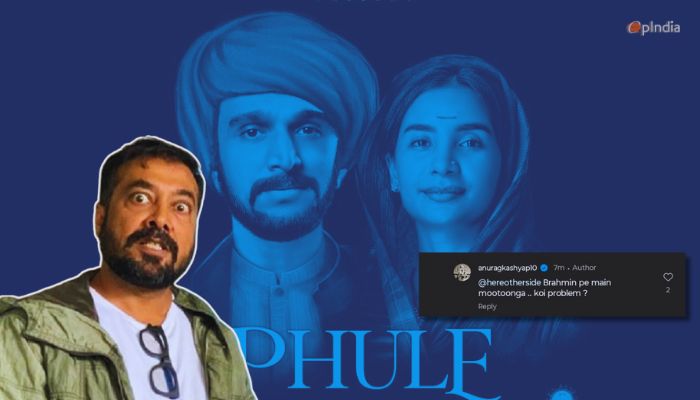
It is said that the loudest bigot cries the shrillest when the world returns their scorn. This is exactly what is happening with filmmaker-actor Anurag Kashyap, who recently went on a hate tirade against the Brahmin Hindus amidst the Brahmin community’s strong objections against the upcoming controversial film Phule. Responding to a comment under his Instagram post, Anurag Kashyap allegedly said that he would piss on Brahmins.

On 17th April 2025,  the controversial filmmaker published a post on his Instagram page wherein in expressed his frustration over the outrage by Maharashtrian Brahmin groups and delays in the release of Ananth Mahadevan directorial ‘Phule’, starring actors Prateek Gandhi and Patralekha as Dalit activists and ‘social reformers’ Jyotiba Phule and Savitribai Phule.

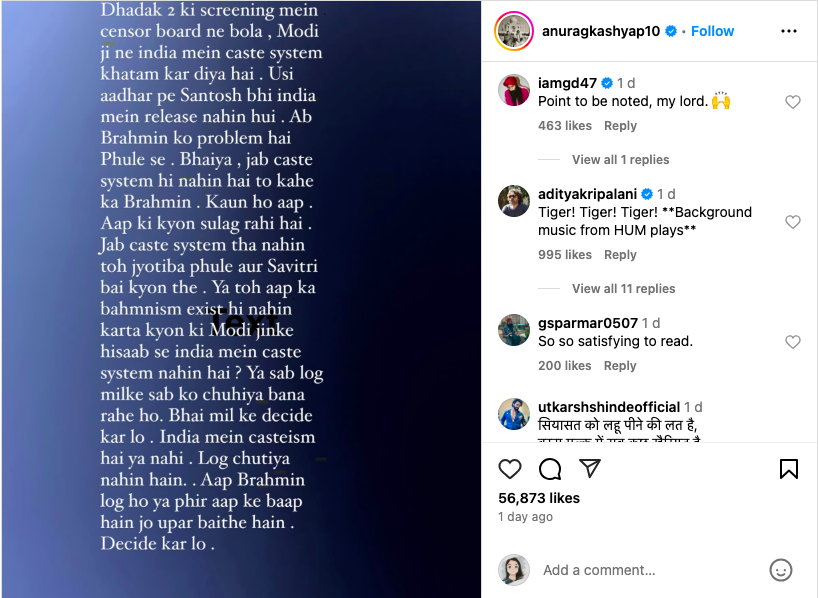
In his Instagram story, Kashyap wrote, “Meri zindagi ka pehla natak Jyotiba aur Savitribai Phule pe tha. Bhai agar casteism nahin hota is desh mein toh unko kya zaroorat thi ladne ki. Ab ye Brahmin log ko sharam aa rahi hai ya wo sharam mein mare ja rahe hain ya phir ek alag Brahmin Bharat mein jee rahe hain jo hum dekh nahin paa rahe hain, ch****a kaun hai koi to samjhave. (The first play I ever did in my life was on Jyotiba and Savitribai Phule. If casteism didn’t exist in this country, why would they have needed to fight against it? Now these Brahmin groups either feel ashamed, are dying of shame, or perhaps they’re living in some alternate Brahmin-only India that we’re unable to see. Someone please explain—who’s the real fool here?”

“My question is, when the film goes for censoring, there are four members in the board. How the f*** the groups and the wings get access to films until and unless they are given access to it? The whole f******g system is rigged,” Kashyap continued.

He also lamented how several films including Punjab 95, Tees, Dhadak 2, telling the supposed ‘uncomfortable truths’ of society face censorship and remain unreleased. “I don’t know how many other films are blocked that exposes the agenda of this casteist, regionalist, racist government… so ashamed to see their own face in the mirror. So ashamed that they can’t even openly talk about what it is about the film that bothers them. F*****g cowards.”

The controversial filmmaker shared an excerpt of his long rant in a post wherein he asked Brahmins to decide whether there is casteism in India or not. “During the screening of Dhadak 2, censor board told us that Modiji has eradicated the caste system in India. On the same grounds, Santosh couldn’t be released in India either. Now, Brahmins are objecting to Phule. Brother, if there’s no caste system, how can you be a Brahmin? Who are you? Why are you getting worked up?” he questioned.

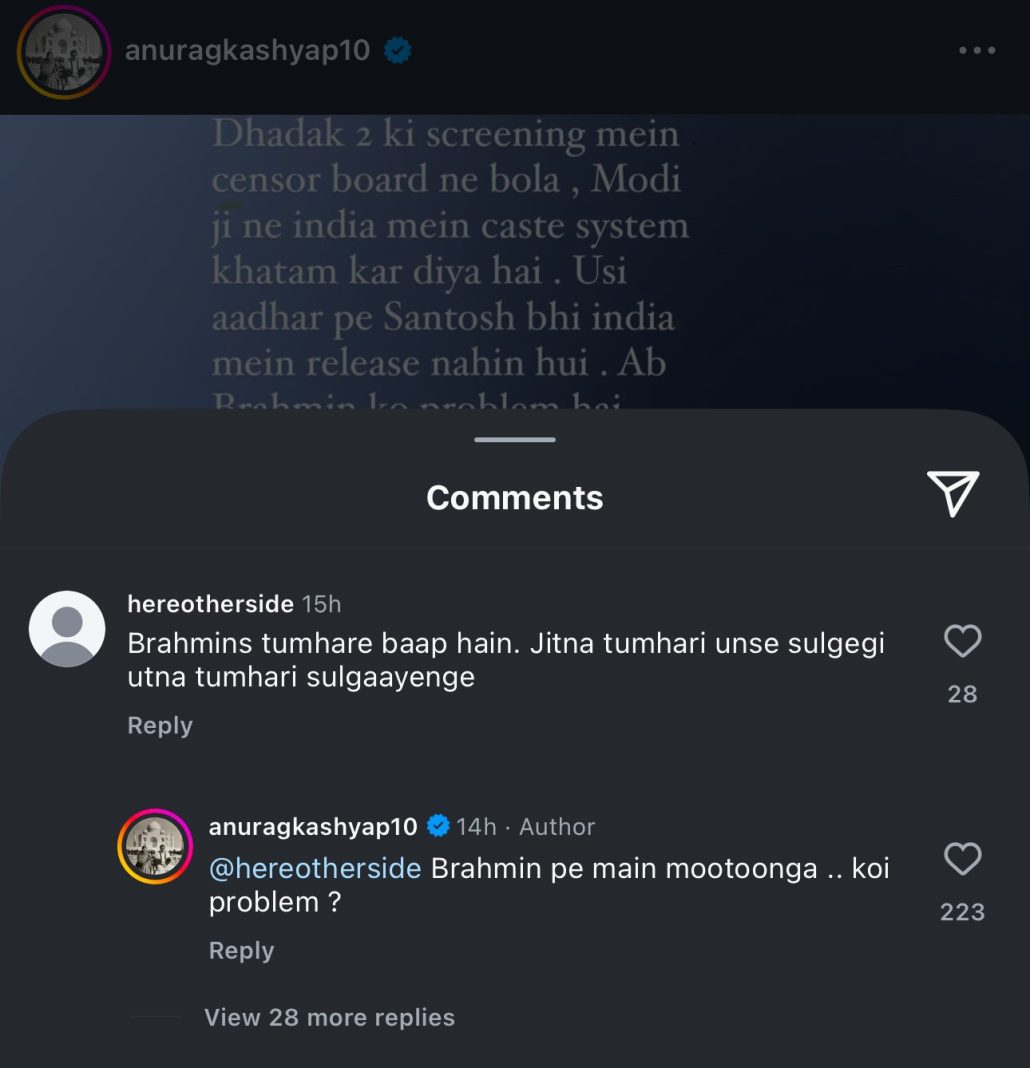
Commenting on this post, an Instagram user mocked Kashyap saying that Brahmins are the latter’s father, however, in reply, Anurag Kashyap said that he would urinate on Brahmins.

“Brahmin pe main mootunga…koi problem?” Kashyap allegedly wrote.

OpIndia checked Kashyap’s post. It is buried deep inside his comments section, where an avalanche of comments has been posted following his bitter ranting against the Brahmins. Considering the Gangs of Wasseypur director has a history of using abusive and provocative language to hit back at critics, it is not entirely surprising that he used dehumanising remarks to insult a section of society while routinely harping about the need to end discrimination on the grounds of caste.

The vile comment allegedly made by Anurag Kashyap is blatant anti-Brahmin hate speech. His disdain for the Brahmin community, so much so that he calls them cowards, dehumanises them by saying he would piss on them, makes one wonder if the intent behind supporting movies like Phule or any such piece of cinema which essentially villainises Brahmins especially at a time when the community already receives hatred in all forms for simply existing, is more about exacting revenge from Brahmins for the alleged caste discrimination in the past, to humiliate them or to tarnish their identity.

Even if one were to discount this brazen anti-Brahmin comment, Anurag Kashyap’s rant against Brahmins over Phule’s delayed release and CBFC’s mandated edits, including the removal of caste-related references like Peshwai, Mahar, Mang and replacement of the phrase ‘3000 saal purani gulami’ to ‘kai saal ki gulami’, reflects his deep-seated contempt for Brahmins, which effortlessly surfaces in the form of ‘heat of the moment’ exchange on social media.

Kashyap called the BJP government regionalist, casteist, racist, who are “ashamed to see their own face in the mirror”, as if the Bhartiya Janata Party existed in the times of Jyotiba Phule, had only Brahmin members and discriminated against Dalits. 

Anurag Kashyap questioned that if casteism didn’t exist in this country, why would Jyotiba Phule and Savitribai Phule have needed to fight against it, and if these Brahmin groups either feel ashamed, are dying of shame, or perhaps they’re living in some alternate Brahmin-only India. He asked: “Who is the real ‘Ch*&t^ya’ here?” The answer is: Anurag Kashyap. No one denies that caste-based discrimination was an inglorious reality of the past, however, the film’s trailer suggests that it will offer a one-sided depiction, painting Brahmins as monolithic oppressors, completely ignoring their great contributions towards society and our country. Jyotiba Phule, while a great social reformer, had in his book, Gulamgiri, used derogatory language for Hindu deities. It is interesting how liberals and self-declared ‘social justice’ crusaders carefully pick their icons, the more opposed to Hinduism and Brahmins, the better. This tendency is shared by the Islamists as well, who pick their historical heroes based on their anti-Hindu credentials, for example, Aurangzeb.

Anurag Kashyap’s rhetoric is laden with expletives and mockery of Brahmins, and contributes nothing to constructive dialogue or raises awareness about caste discrimination, rather, it only fuels hatred against Brahmins, who are a minority group in Maharashtra. It is also amusing that liberals and leftists who see ‘protests’ as the solution for almost all socio-political problems are the first to get infuriated when people from the other side of the ideological spectrum exercise their right to protest. Kashyap is rattled with Hindu groups like the Hindu Mahasangh opposing the release of the film Phule and calling them outright ‘cowards’ and those ‘ashamed’ of themselves; however, he had no such opinion about himself and his ilk when they joined the anti-CAA protests in 2020.

While it is a trend prevalent nationwide, Brahmin-bashing is especially considered ‘cool’ in Maharashtra, even at the risk of putting the entire community in danger. Since Brahmins are the custodians of Hindu traditions and wisdom, they are targeted the most even in modern times despite the community complying with the moral compass set by the progressive movement. What started in 1948 with the genocide of Chitpavan Brahmins after Nathuram Godse, a Chitpavan Brahmin and their socio-political sidelining, continued with leftists ‘historians’ wiping out the contributions of Brahmin social reformers and thinkers from Marathi social discourse. The situation has worsened to a point where Brahmins often face reverse casteism in the state’s socio-political landscape. Now, when movies backed by the likes of Kashyap come up, it further stokes apprehension that the Brahmin community, especially in Maharashtra, might face a fresh wave of hatred for discrimination that happened in the past,  and they have hardly anything to do with in contemporary times.

This anti-Brahmin campaign is not confined to Maharashtra; rather, in the mid-20th century, Brahmins in Tamil Nadu were subjected to violence and their Poonool (Janeu, sacred thread) was cut by Dravidianists to mock them. Even to this day, although the scale has reduced, incidents of Poonool cutting make headlines. In fact, Tamil Nadu’s ruling party, DMK, openly calls for the eradication of Sanatan Dharma, deeming it ‘Brahminism’.

Over the years, Brahmin bashing has disturbingly been normalised with various platforms including cinema, social media and politics serving as the loudest amplifiers. Not a day goes by without the so-called champions of social justice publishing posts slandering Brahmins and discrediting their contributions to the progress of India. From their dressing, mannerisms, Janeu (sacred thread), to even pure vegetarian food preferences, Brahmins are subject to perpetual scrutiny by those who draw a weird sense of joy in putting Brahmins through the same mockery and hatred they claim to oppose against Dalits.

Coming back to Anurag Kashyap, the controversial filmmaker going unhinged against Brahmins is not shocking, given he has a history of making anti-Hindu comments. Back in 2017, when Karni Sena activists allegedly assaulted filmmaker Sanjay Leela Bhansali on the sets of ‘Padmavat’, Kashyap labelled those attackers as ‘Hindu terrorists’, however, he fails to find the religion of terrorists who literally cry Allahu Akbar and blow themselves up to kill Kafirs. Anurag Kashyap’s latest tirade against Brahmins suggests that ‘liberals’ in the Indian film industry, social justice is just a way of normalising hate against a community already burdened by historical and prevalent prejudice by projecting Brahmins as reckless oppressors.  It is evident that whether through films laden with anti-Brahmin narratives, through social media mockery or ‘progressive’ politics, Brahmins face hatred for simply existing. Kashyap’s rant against Brahmins, especially his alleged ‘will piss on Brahmins’ comment shows that for him, anything themed on ‘social justice’ like the film Phule, is a means to further anti-Brahmin narrative than actually advocate eradication of caste discrimination.

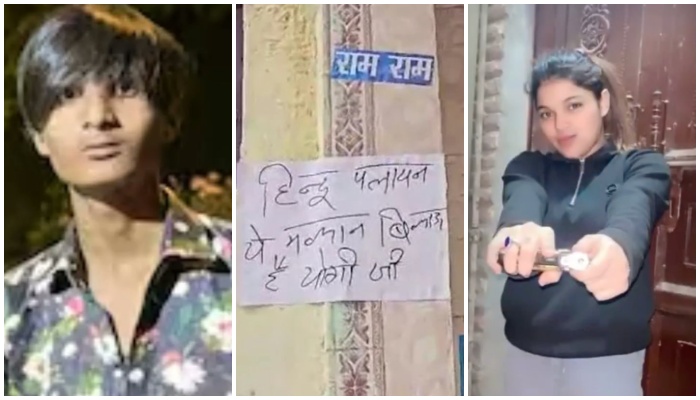
Seelampur, Delhi: 17-year-old Hindu boy stabbed to death by Sahil and his gang, locals name ‘lady don Ziqra,’ CM Gupta assures justice

Delhi Chief Minister Rekha Gupta on Friday said that justice will be served for the 17-year-old boy, who was attacked by knives and was pronounced dead on arrival at the Lok Nayak Jai Prakash Narayan (LNJP) Hospital.

The teenager, who was killed in the J block of Seelampur, has been identified as Kunal, the Chief Minister said.

“I have spoken to the Police commissioner on the murder of a 17-year-old boy, Kunal. He was attacked by knives and was rushed to the Jai Prakash hospital, where he was pronounced dead on arrival,” Gupta told reporters.

She informed that the police had registered an FIR in the murder case while assuring that the police would arrest the accused soon.

“The police are after the accused, and they will be caught soon. FIR has been registered, and the police are on the job. Justice will be served,” Gupta said.

Delhi BJP President Virendraa Sachdeva appealed to the people to maintain peace in the area.

“Police have arrested all the criminals in such cases that have happened in the last few days. In this case, too, both of them are declared criminals. They are identified and will be arrested soon. Police are doing their work. We need to maintain peace right now,” he said.

Joint Commissioner of Police (CP) East, Pushpendra Kumar, said that the boy was killed in Seelampur’s J block on Thursday, and the accused are from the same area. He added that the police were on the lookout for two people who remain suspects in the murder case.

“A 17-year-old boy was stabbed to death in Seelampur’s J block yesterday. Few people from the same area are accused in the case. The accused have been identified, and our teams are working to nab them soon. The two individuals whose names have come to light are being pursued by the police. If any other person’s involvement is found, they will be arrested,” Joint CP Kumar told ANI.

Family alleges police negligence, local Hindus protest against constant harassment by Muslim gangs

The mother of a 17-year-old boy who was stabbed to death in the Seelampur area of the national capital said on Friday that she had not been given any updates from the police, alleging complicity by the authorities in catching the culprits and allowing the perpetrators to flee the area.

“My son had a fight a few days ago. There was some incident, and my son was just standing there and watching as he got beaten up; they gave him threats. We had taken him to the hospital; we had not eaten anything for two days. When my kid came back, he had asked for a samosa and milk and had gone out to get the food. He went out around 7 o’clock, and by 7:15, we got the news that our son had been stabbed,” the mother told ANI.

She further said that the doctor who had treated the child was also beaten up by some people.

Locals in the Seelampur area continued their protest from last night against the stabbing of the 17-year-old boy in the area, blocking roads and holding signs demanding justice for the boy.

Visuals from the area showed hundreds of locals blocking the roads late at night on April 17, and on the morning of Friday, they continued the protest. The locals were seen shouting slogans demanding justice and holding cards written with ‘Modi ji madad karo, Yogi model chahiye’ (PM Modi, help us, we need the Yogi model).

‘House for sale’ posters, lady don Ziqra and more

The Hindu families have reported that they have been living in fear due to the constant harassment and threats from Muslim gangs. Some families have put up posters for selling their houses and are pleading with authorities for help. BJP MLA Ravi Negi has reached the area to speak with the locals and address their problems.

Locals of the area have told media that they are continuously harassed by Muslim gangs and face threats and violence from the Muslims. “There have been six murders of Hindus in the last few years. The accused are powerful. They run crime gangs and have political connections too. The councillor, MLA are all in their hands. Police know all this but they do not take any action”, a local man was quoted by Aaj Tak.

The locals, and the victim Kunal’s family have also named a local woman named Ziqra, Sahil’s sister, who runs a gang of Muslim goons. Locals have stated that Ziqra’s gang had a fight with some boys few months ago, where one of their gang members was injured. Kunal’s family members have stated that though Kunal knew the boys who were involved in the fight, the boy wasn’t involved in the fight, neither was he a member of any gang.

Ziqra reportedly roams around with guns in hand and threatens people in the area. She was also arrested under arms act for possession of illegal weapons, but she came out on bail.

Additional Deputy Commissioner of Police of the northeast area, Sandeep Lamba, assured that the accused will be caught soon as authorities conduct raids in the area.

“We are conducting raids. The accused will be caught soon. Investigation is underway,” he said.

According to the Delhi police, the 17-year-old victim was rushed to a hospital but succumbed to his injuries during treatment.

As of latest updates, the police have detained some persons for interrogation, but nobody has been arrested so far.

This is a developing story.

(With inputs from ANI)

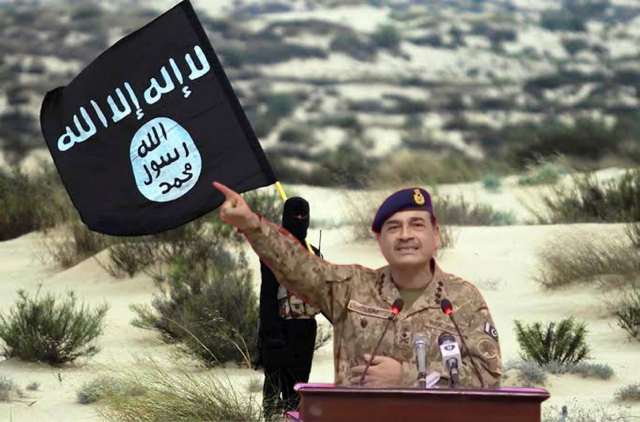
We are the ISIS which came before ISIS: What Pakistan’s Chief of Army Staff, Asim Munir, essentially said and what it means for India

On April 16, 2025, journalist Taha Siddiqui posted a video of Asim Munir, Pakistan’s 11th Chief of Army Staff, speaking to a gathering of Pakistanis based abroad. With his chest puffed out, a proud smirk on his face and his head held high, arguably one of the most powerful men in Pakistan gloated about the core aspiration that every Pakistani Muslim should have – essentially, to believe that Pakistan is the ISIS which came before ISIS.

Speaking to the Pakistani diaspora, General Munir said they were the country’s ambassadors and must not forget that they belong to a “superior ideology and culture”. “You should definitely tell Pakistan’s story to your children. Our forefathers thought that we were different from the Hindus in every aspect of life. Our religions, our customs, traditions, thoughts and ambitions are different. That was the foundation of the two-nation theory that was laid.”

He further said, “We are not one nation. That is why our forefathers struggled to create this country. Our forefathers and we have sacrificed a lot for the creation of this country. We know how to defend it. My dear brothers, sisters, daughters and sons, please don’t forget this story of Pakistan. Don’t forget to narrate this story to your next generation so that their bond with Pakistan never weakens.”

Pertinently, he said that to date, there have been only two ‘states’ which were established on the basis of the Kalma. The first, he said, was Riyasat-e-Tayyaba and the second, he said, was also established by Allah after 1300 years – Pakistan.

To understand the significance of what Munir said and how, it essentially means that the eternal Pakistani aspiration is to be the ‘real’ ISIS, we need to understand what Riyasat-e-Tayyaba was. Riyasat-e-Tayyaba was basically the establishment of the concept of Ummah after it is claimed that Mohammad constituted the Charter of Medina. The charter basically formed the first Islamic nation – a collection of Muslim tribes which followed Mohammad.

The most significant part of the charter is the first two points, as translated by Michael Lecker in 2004.

  1. This is a prescript of Muhammad, the Prophet and Messenger of God (to operate) between the faithful and the followers of Islam (“Muslims”) from among the Quraish and the people of Madina and those who may be under them, may join them and take part in wars in their company.
  2. They shall constitute a separate political unit (Ummat) as distinguished from all the people (of the world.

While it is claimed that the charter also included Jews and established peaceful relations with their tribes, it is also theorised that the charter gave Mohammad the justification to later attack the jews, citing their opposition to his supremacy.

Be that as it may, what becomes clear is that Asim Munir was talking about Pakistan being only the second state, in the history of Islam, to have been established on the basis of puritan Islamic principles, just like Medina in 622 CE. From a cursory reading of the Ummah Document, it becomes evident that the principles which Pakistan wants to base its existence on are the following:

  1. All Muslims are one nation, governed by Sharia and ruled by a Caliph, and this would automatically exclude non-Muslims
  2. The strict adherence to and the spread of Islam
  3. A theological state to which all Muslims must bear allegiance, according to Islamic jurisprudence, since it has been established as Riyasat-e-Tayyaba
  4. As an extension, Pakistan would therefore have divine sanction to lead the Muslim world into war and/or peace for the ultimate protection and expansion of Islam.

Based on these principles, which Munir says (rightly so) that Pakistan was established on the basis of, it would not be far-fetched to conclude that Pakistan is ISIS 1.0 – that one true ISIS which came before ISIS.

ISIS espouses similar principles, harbours similar delusions and follows the exact same doctrine that Munir says Pakistan has followed and should continue to follow. ISIS claimed that it had the divine sanction to create a theological state based on Islamic jurisprudence, ruled by Sharia, which all Muslims should declare allegiance to. It further claimed that its explicit goal was the spread of Islam to the entire world, the supremacy of the Ummah and becoming the ideal state based on puritan Islamic values, just like the one ordained by Mohammad. It claimed that its Caliph was the descendant of Mohammad and therefore had the divine right to rule and lead the Muslims of the world.

The two-nation theory, embedded in Islam, is the foundation of Pakistan, and Munir was certainly not off the mark when he claimed that Muslims like himself (and an overwhelming majority) believe that Hindus and Muslims cannot coexist, given that Muslims are a nation unto themselves, given their unique theological moorings. That Pakistan was created basis of this foundational belief is not in dispute at all. At the same time, that ISIS (the cheap version of Pakistan) was also formed on the basis of this very ideology is also not in dispute. The fact that Pakistan, based on the very foundational principles of ISIS, came decades before what we know as the Islamic State of Iraq and Ash-Sham, beyond reasonable doubt, establishes Pakistan as the real ISIS – brute, based on puritan Islamic theology, proud of their barbaric ways, predisposed to persecuting non-believers, harbouring wet dreams of world domination and fancying themselves as the chosen ones who would convert Dar-ul-Harb into Dar-ul-Islam.

In fact, this is not an original idea at all. This is something late Tarek Fatah said often – “Pakistan is the original ‘Islamic State,’ much before ISIS”

With Pakistan being the original ISIS (and proud of it), one is forced to ask if it deserves to be a part of the free world. Post the French Revolution and the Industrial Revolution, the civilised world broadly came to a consensus that modern nation states would not be purely driven by religious expansionism and theology; rather, the Westphalian system of national sovereignty, where legitimate states were assumed to correspond to nations, defined as groups of people united by culture, geography, history and more.

These driving principles, broadly agreed upon by the free world, enabled modern nation states to interact with each other in an increasingly globalised world without harbouring (most of the time) dreams of theological and geographical expansionism, approaching global relationships with mutual respect for each nation’s independence and integrity.

Pakistan, however, has been a glowing exception to the civilised world agreeing on these basic principles. Asim Munir, in his speech, not only spoke of being the chosen people of Allah and proved how it was, indeed, the original ISIS, but he also substantiated Pakistan being an exception to the free world. In his speech, Munir spoke about Kashmir being the jugular vein of Pakistan, right after he spoke of how Pakistan (Muslims, basically) belong to “superior ideology and culture”. He also spoke of how Balochistan is Pakistan’s pride and that the “terrorists” who were trying to gain independence would be defeated”, Inshallah”.

Pakistan’s unhealthy obsession with Kashmir and its illegal occupation of parts of the state is steeped in religious expansionism and conquest, believing that since the state has a substantial Muslim population, Pakistan, the supposed Riyasat-e-Tayyaba, has a divine right to conquer it owing to their “superior culture and ideology” – the Ummah.

That Islam forms the foundation of Pakistan’s obsession with Kashmir is evidenced by how ISIS 1.0 has consistently used the Organisation of Islamic Cooperation (OIC) in an attempt to strongarm India on the matter of Kashmir, and it has done so by invoking shared Islamic roots and theological brotherhood while doing so. In fact, the events of the October 1947 invasion itself evidence the strong Islamic foundation of Pakistan’s obsession with Kashmir.

The first clashes were reported on the 3rd and 4th of October 1947. On the 22nd of October, after Pakistani Pashtun tribals infiltrated into J&K and attacked Muzaffarabad, the region fell quickly without much resistance. Many Muslim state forces mutinied and joined the invading Pakistani tribesmen. The path to Srinagar was clear, but instead of advancing towards the capital, the tribal forces resorted to loot and plunder. Apart from plundering the state armoury, they are also said to have resorted to arson and set markets on fire.

“They plundered the state armoury, set entire markets on fire and looted their goods,” Gohar Rahman, who was one of the Pakistanis that crossed over into J&K, told the BBC. “They shot everyone who couldn’t recite the kalma – the Arabic-language Muslim declaration of faith. Many non-Muslim women were enslaved, while many others jumped in the river to escape capture.” He further said, “Muslim women would sometimes offer us food, but the Pathans were reluctant to accept, thinking it may be poisoned. They would instead capture those people’s goats and sheep, slaughter them and roast the meat over fire.”

While the events of October led to the first Indo-Pakistan war and the accession of Kashmir to India, the horrific stories of rape, plunder and murder of those who could not recite the Kalma haunt Hindus to this date.

Pakistan is, therefore, one of the few theocratic states in the world which outright rejects modern principles and bases its state policy on ancient and barbaric religious supremacist and expansionist principles. While fancying itself as more Arab than the Arabs, it is so subsumed by its fantasies of Ummah and leading the world domination of Islam, that it even, on occasion, rejects the recent strides Saudi Arabia has made in modernising itself and shedding the archaic religious dogmas that potentially hold its society back.

While the converted Muslims of Pakistan may sound and appear comical, rejecting Saudi advancement as a betrayal of Islam, for India, the truth of its neighbourhood is a grim reminder of the dangers of being forced to coexist with barbarians and the horror that would befall the nation if it chooses to not acknowledge that the two-nation theory wasn’t a mere political slogan but the very basis of existence for Islamic nations like Pakistan and Bangladesh. It is not irrelevant. It is not an aberration of the past but a reality that we must come to terms with.

In 1876, Syed Ahmad Khan, the founder of Aligarh Muslim University, said that Hindus and Muslims could never become one nation as their religion and way of life were quite distinct. Twelve years later, he said, “Now, suppose that the English community and the army were to leave India, taking with them all their cannons and their splendid weapons and all else, who then would be the rulers of India?… Is it possible that under these circumstances two nations—the Mohammedans and the Hindus—could sit on the same throne and remain equal in power? Most certainly not. It is necessary that one of them should conquer the other. To hope that both could remain equal is to desire the impossible and the inconceivable. But until one nation has conquered the other and made it obedient, peace cannot reign in the land.”

While Khan spoke in the context of India specifically, the nature of Muslim separatism was not new and was certainly not an alien concept that anyone who was willing, to be honest, could not see for themselves. Karl Marx, the Father of Communism, stated in 1854, “The Koran and the Mussulman legislation emanating from it reduce the geography and ethnography of the various people to the simple and convenient distinction of two nations and of two countries; those of the Faithful and of the Infidels. The Infidel is “Harby,” i.e. the enemy. Islamism proscribes the nation of the Infidels, constituting a state of permanent hostility between the Mussulman and the unbeliever.”

It was only in 1940 that Jinnah formally announced the demand for a separate Muslim nation. At the 1940 Muslim League conference in Lahore, Jinnah said: “Hindus and the Muslims belong to two different religions, philosophies, social customs and literature… It is quite clear that Hindus and Muslims derive their inspiration from different sources of history. They have different epics, different heroes and different episodes… To yoke together two such nations under a single state, one as a numerical minority and the other as a majority must lead to growing discontent and final destruction of any fabric that may be so built up for the government of such a state.”

Essentially, while Jinnah only made the formal demand in 1940, the verbalisation of Muslim separatism had taken place much before that, almost 70 years ago, by the founder of AMU.

Unless the reality of the two-nation theory is not acknowledged and accepted, Bharat as a modern nation-state would always be caught off-guard, like it was in 1946, into carving out pieces of itself to satiate the insatiable appetite of the believers to cast Kafirs into hell-fire and turn Bharat into a Muslim nation.

While Pakistan and Bangladesh view India as a Hindu collectivity and repeatedly persecute Hindus on the basis of the two-nation theory and the Ummah, often branding them as ‘agents’ of the Hindu collectivity, there are those from within India as well who in letter and spirit, believe in the ideals espoused by Pakistan and Bangladesh.

This theory is proved by the fact that over 70 years after the partition of India, while our lawmakers believe that we have managed to achieve a nation where general brotherhood between Hindus and Muslims exists as a norm, we saw the rise of organisations like the Popular Front of India (PFI) which vowed to turn India into an Islamic state, convert Hindus and even commit genocide of the Kafirs in their holy war. One must ask the question that if the partition of India on the basis of religion was time and geography-specific, why does India, with one of the largest Muslim populations in the world, see the rise of Muslim separatism repeatedly and why does, to this day, Pakistan and Bangladesh who got their theological states, ‘untainted’ by Hindus, over 70 years ago, still harbour dreams of turning Dar-ul-Harb into Dar-ul-Islam – something that Asim Munir articulated so honestly, so eloquently and so vehemently.


Government considering 18% GST on UPI payments over ₹2000? Here is the fact behind the baseless claim

A claim is made by some media houses and social media users that the Union government has proposed imposing GST on UPI transactions. As per the claims, there will be 18% GST on UPI transaction values above ₹2000. ET Now published a report titled “GST on UPI payments or transactions above Rs 2000? What experts argue” on 18 April, fuelling the rumours.

Subsequently, several anti-BJP social media users circulated the claim on social media, attacking the government for imposing yet another burden on taxpayers.

A post by user @IndianGems_ claiming the same was widely shared by several users on ?, including pro-AAP handle Kapil (@kapsology). Sharing the now-deleted tweet, Kapil wrote, “Only people with white money use UPI for payments. That money has already been taxed by the government before they can spend it. They also pay GST on the product/Service they’re purchasing via UPI Now, the government wants to charge GST on the UPI transaction itself as well.”

‘Crypto Educator’ Sumit Kapoor shared the ET Now report, adding that “The change will drastically impact daily spending, especially for small businesses, freelancers, and middle-class families.”

While social media users have started outrage over the so-called GST proposal, the fact is the ET Now report is nothing but speculation, and the report does not quote any govt source over the ‘proposal’, and calls it a ‘hypothetical situation’. The report itself states in the first paragraph, “But what will you do if a GST of 18 per cent is charged on transactions, will you continue using UPI for daily payments or return to cash? Well, that seems to be a hypothetical situation as of now, considering that way government is promoting digital economy and the scale of UPI in our country.”

It then states, “GST on UPI is the talk of the town after multiple reports started are doing the rounds that GST will be imposed on UPI payments or transactions above Rs 2,000.”

But the fact is, this is complete misreporting by the so-called business and finance portal, as there was never any talk of imposing GST on UPI transactions above ₹2000. Even if any GST is charged, it will be charged on the service charge on UPI payments, not on the transactions themselves.

Notably, payment aggregators charge a fee ranging from 0.5% to 2% on cashless transactions like credit card payments, which is called the Merchant Discount Rate. But it is not applicable to UPI payments yet. Rupay credit cards are also exempt from this fee now. While there is a proposal to bring MDR on UPI payments too, so that the UPI service providers can recover their cost, this has not been implemented yet.

Notably, there is a 1.1% service charge on certain specific UPI transactions above ₹2,000, not all. The fee is applied for payments made through prepaid payment instruments (PPIs) like wallets or credit cards linked to UPI. This fee is payable by the merchant, not by the consumer.

Therefore, when a customer makes a payment above ₹2000 using wallets or credit cards through UPI apps, the payment aggregators charge a 1.1% fee from the merchant, the same as the fee charged for credit card payments. As this is a service charge, 18% GST on it becomes applicable, the rate for services under the GST regime.

At present, there is no service charge on other UPI payments, and therefore, there is no question of GST on them. Notably, as per the govt, less than 1% of UPI payments are made using wallets or credit cards; therefore majority of payments, over 99.9%, are exempt from any service charge.

The rules make it clear that customers don’t have to pay any charge for both Peer to Peer (P2P) and Peer to Merchant (P2M) transactions. P2P transaction means money transfer between two individuals using UPI, not involving any business transaction.

At present, there is an exemption from paying GST for digital payments below ₹2000. However, the GST council last year proposed to impose 18% GST on MDR of transactions below ₹2000 made using Debit and Credit card. But the proposal has not been implemented yet. There is no proposal for imposing MDR on UPI payments, and therefore, there is no proposal for GST on them.