Home Blog Page 4943

Admin expenses, dependency on local transfer and word clouds: An analysis of Foreign Funding to Indian NGOs with graphs and charts

0

In this short article, we will provide a series of data points that will help break down the nature of foreign funded non-profits in India. This is intended to serve as a reference for all discussions on the subject.

Basic Facts

  1. A total of 21918 entities filed FC4 returns for the financial year 2018-2019
  2. 10336 reported having received no funds from abroad at all
  3. 16557 reported having received no funds from other FCRA NGOs within India.
  4. 5361 NGOs received some funds from other FCRA NGOs within India.
  5. 5033 relied on transfers from other FCRA NGOs within India for more than 30% of their foreign fund inflow.
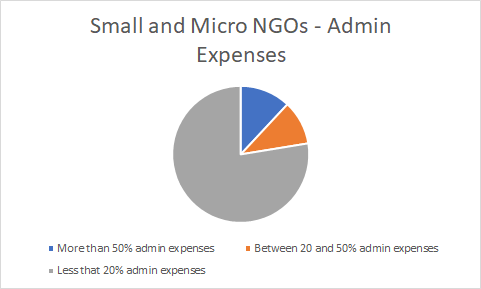
  6. 3341 reported having spent more than 20% of their total inflow on administrative expenses.

NGO distribution by size

We have categorized NGOs in these four categories

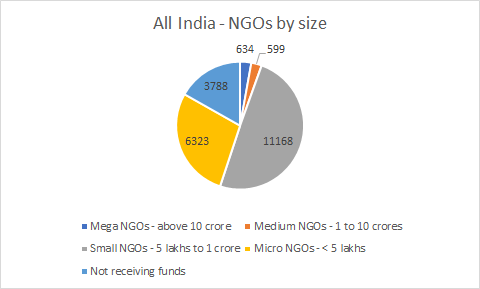
  1. 634 Mega NGOs – Total foreign income (including interest income and intra-India transfers) above 10 crore
  2. 599 Medium NGOs – Total foreign income of 1 to 10 crores
  3. 11168 Small NGOs – Total foreign income of 5 lakhs to 1 crore
  4. 6323 Micro NGOs – Total foreign income of < 5 lakhs
  5. 3788 Not receiving funds – No foreign income at all
Graphical representation of the proportion of each category of NGOs

Admin Expenses and Size

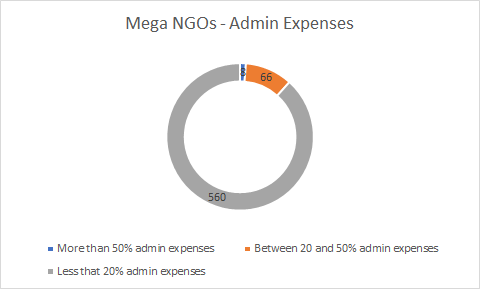
Graphical representation of the admin expenses of Mega NGOs
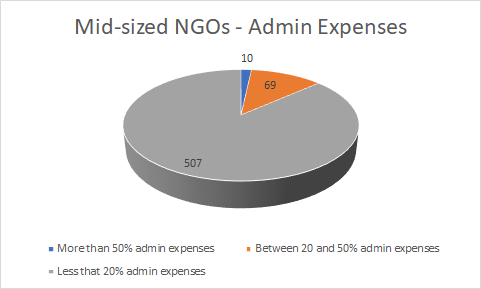
Graphical representation of the admin expenses of mid-sized NGOs
Graphical representation of the admin expenses of small and micro NGOs

Dependency on Local Transfer

A total of 2879 NGOs depend upon transfers from other FCRA NGOs in India for more than 20% of their total income. Of these

  • 69 are Mega NGOs
  • 66 are medium sized NGOs
  • 2744 are Small and Micro NGOs

FDs and Cash in the hands of NGOs

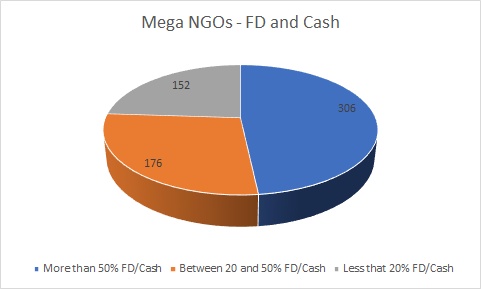
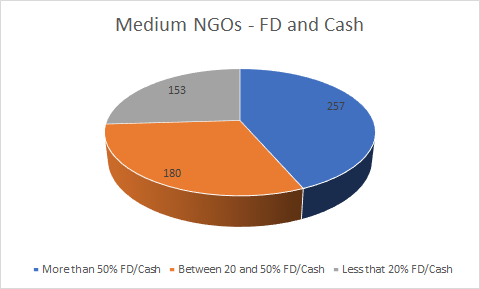
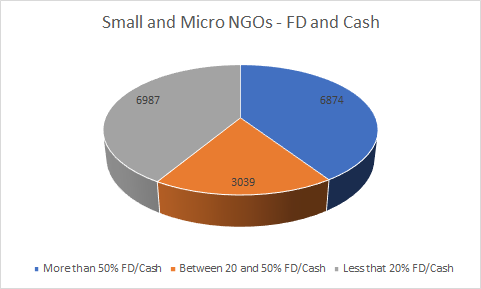
We categorize the ratio of FD and cash in hand to the total inflow of foreign funds for the year in this segment. As can be seen, the large hoard of cash above Rs 13000 crores is concentrated in the mega NGOs

  1. 634 large NGOs hold Rs 9576 crores in FD and cash – an average of Rs 15.1 crores
  2. 599 Medium NGOs hold Rs 1349 crores in FD and cash – an average of Rs 2.25  crores
  3. 17491 Small and Micro NGOs hold Rs 2189 crores in FD and cash – an average of Rs 12.5 lakhs
Graphical representation of the admin expenses of the FD/Cash ratio of Mega NGOs
Graphical representation of the admin expenses of the FD/Cash ratio of Medium NGOs
Graphical representation of the admin expenses of the FD/Cash ratio of

State Wise distribution

All NGOs

Mega NGOs

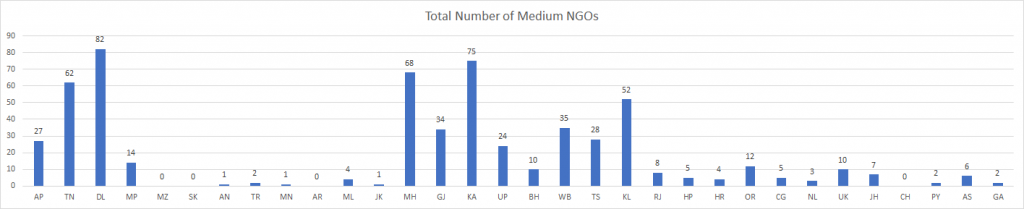
Medium NGOs

Small and Micro NGOs

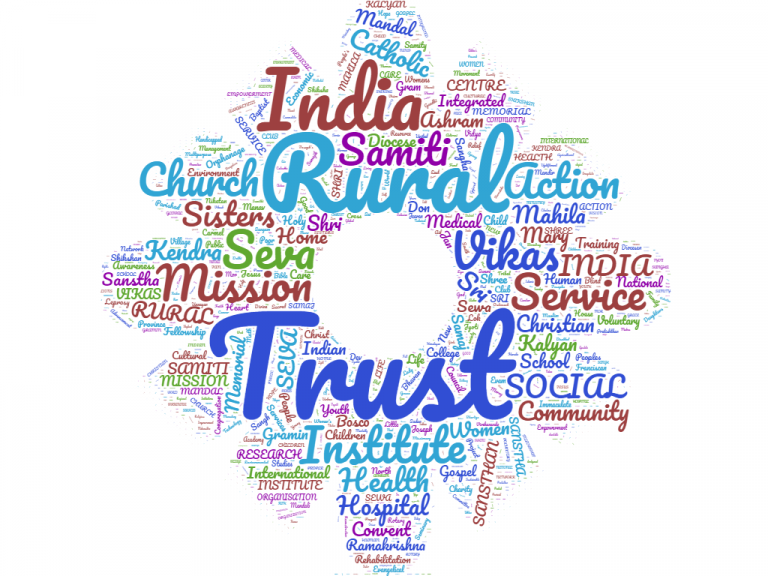
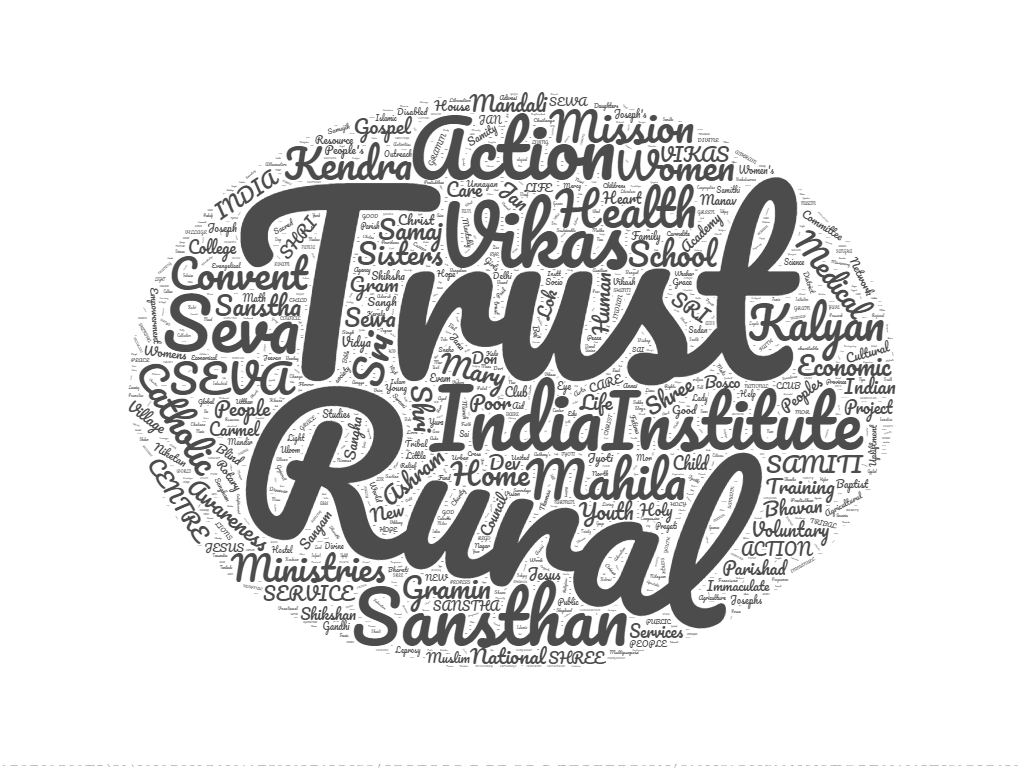
Names of NGOs – word clouds

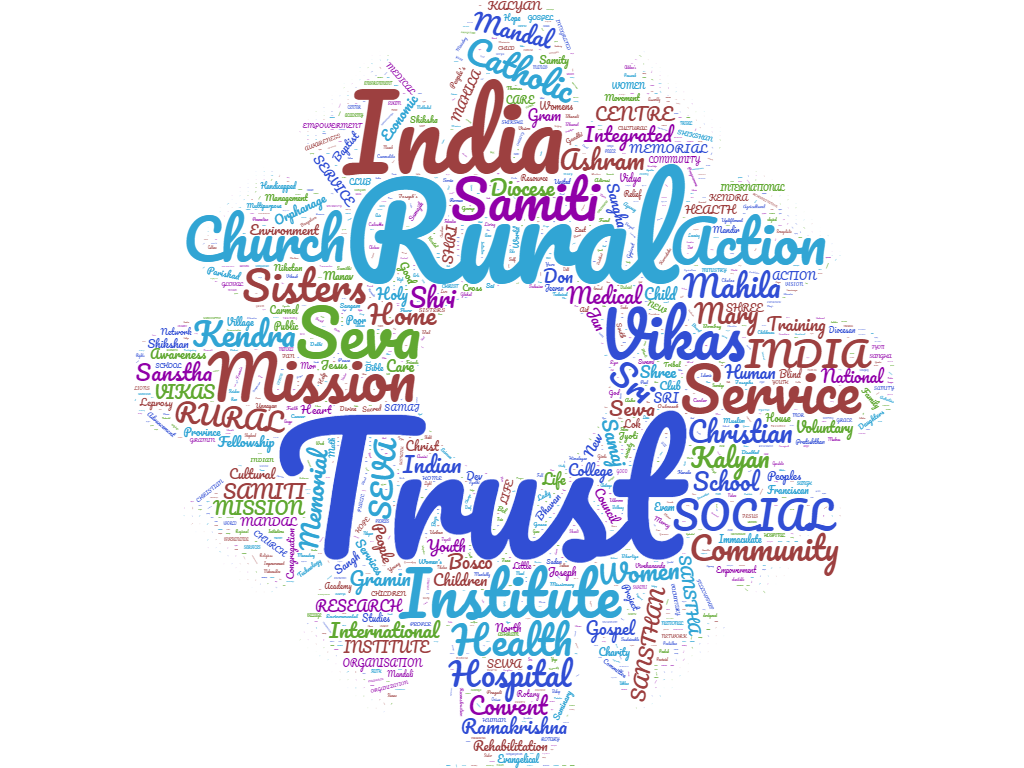
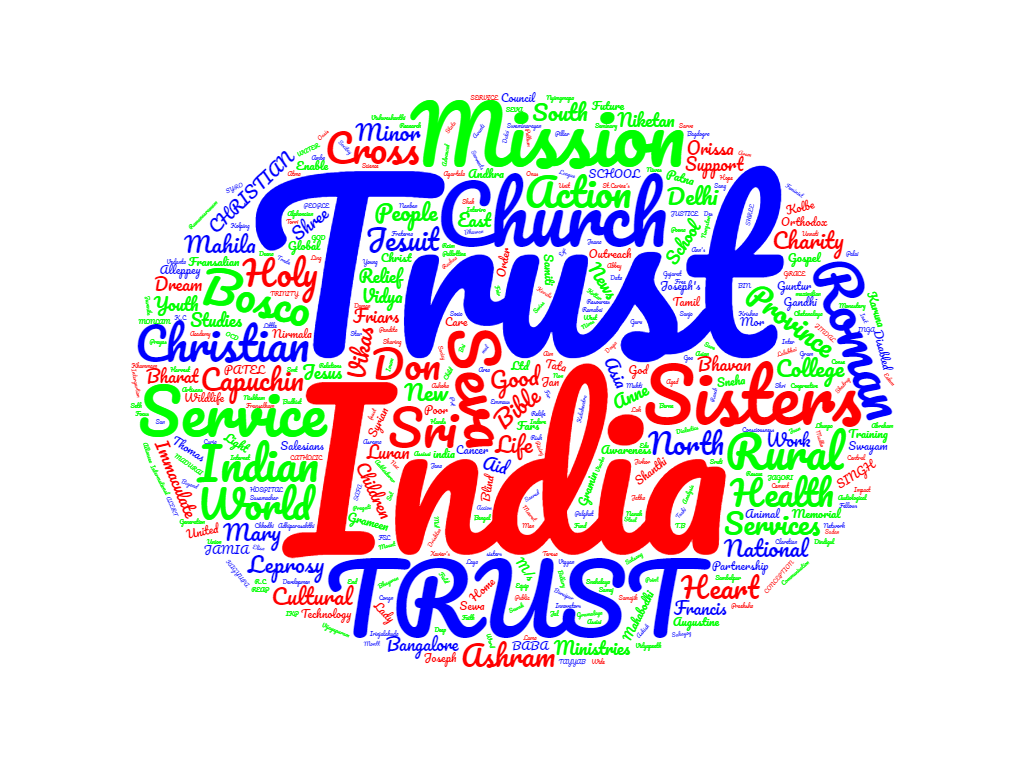
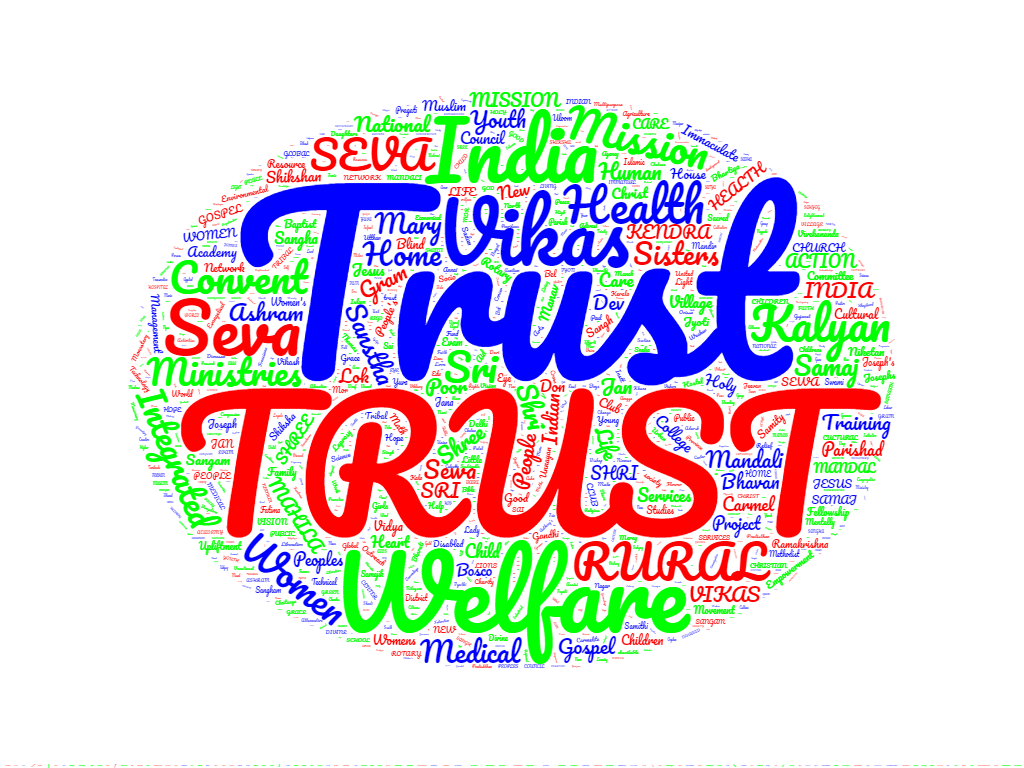
Wordclouds indicate the frequency at which a particular word appears in a list of names.

This has the names of NGOs with common words like A, An, The, Of, For removed:

All NGOs

Mega NGOs – Total foreign income above 10 crore

Medium NGOs – Total foreign income of 1 to 10 crores

Small NGOs – Total foreign income of 5 lakhs to 1 crore

Micro NGOs – Total foreign income of < 5 lakhs

Conclusion

The above mentioned charts demonstrate that a significant portion of NGOs will be affected by the FCRA Amendment passed recently by the Indian Parliament. Two provisions that will have the greatest impact are the amendment that restricts administrative expenses to 20% of fund inflow and another that requires all NGOs to utilise the funds themselves and not transfer them to other NGOs.

CBI recovers clothes with blood-like stains from the house of Hathras rape accused, his family claims the stains to be of red paint

0

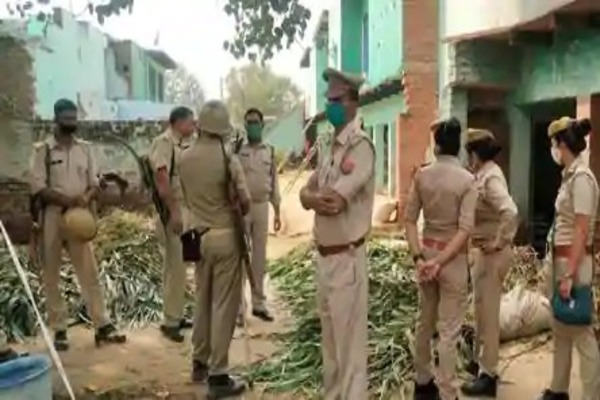
A team of the Central Bureau of Investigation (CBI) that has been investigating the Hathras case has reportedly recovered clothes having stains of blood-like colour from the house of one of the accused in the case named Luv Kush Sikarwar. Sikarwar is one of the four accused in the Hathras case. The CBI team is staying in the village since the past few days probing the case. The team found the clothes while conducting search at the house of the accused. It is suspected by the CBI team that the colour stains on the clothes are that of blood. The family of Sikarwar has, however, refuted the claims of the CBI.

According to reports, the family on the accused has claimed that the colour on the clothes was not blood but paint. They said that the elder brother of the accused named Ravi Sikarwar works as a painter in a factory and therefore the clothes had the stains of paint. Lalit Sikarwar, the younger brother of the accused said that CBI searched their house for around a couple of hours and took along the clothes stained with red paint. “CBI stayed for two and half hours and kept on searching material in our house. They found clothes with red colour on it and took that along”, he said. Lalit reportedly claimed in a video message that the clothes belonged to his elder brother who worked in a paint factory and that the stains on the clothes were that of paint and not blood.

CBI had re-summoned victim’s brothers

The CBI team had re-summoned the Hathras victim’s brothers two days ago for questioning. One of the brothers of the victim was interrogated by the CBI team a day earlier after inconsistencies were found in his statement. He was also taken to the crime scene by the team and was asked to recreate the scene. The family of the victim has sought CRPF protection and the transfer of the case outside Uttar Pradesh. The Supreme Court reserved the decision regarding their demands yesterday.

Hindu group sends legal notice against Bangladeshi teledrama alleging promotion of love jihad and adultery, promos of the show suspended

After India, now allegations of promoting love jihad has emerged in Bangladesh also. Minority Hindus in the country has sent a legal notice to the producer, director and actors of an upcoming teledrama named Bijoya, which was scheduled to release on the occasion of Durga puja. Lawyer and Bangladeshi Hindu activist Suman Kumar Rai sent the legal notice on the behalf of one Litan Krishna Das alleging that the show promotes communal disharmony and religious conversion.

The notice has been sent to actress Nusrat Imroz Tisha, actor Irfan Sajjad, writer Salah Uddin Shoaib Choudhury and director Abu Hayat Mahmud Bhuiyan on Monday. Suman Rai said that if the makers of the drama do not announce the withdrawal of the same withing seven days, they will take strong legal action against them.

Talking to media, Suman Rai said that from the trailer of the drama released on social media, it is evident the show hurts the sentiments of Hindus. He said that the show does character assassination of Hindu women depicting them as immoral, and the Hindu men are presented as alcoholic, cruel, worthless and heartless people. It has been alleged that the show encourages adultery and religious conversion of Hindu women.

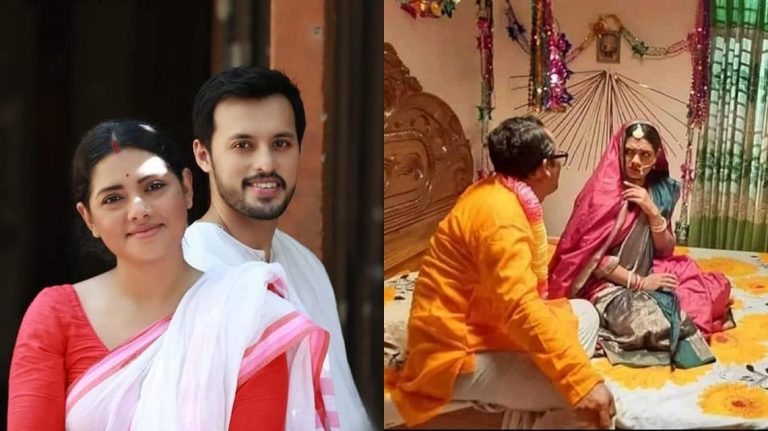
As per trailers of the drama produced by Crown Entertainment, Tisha is seen enacting the role of a Hindu woman married to a Hindu man at least 20 years elder than her. Her husband Haridas is a cruel alcoholic man, and this pushes Tisha’s character to an extra-marital affair with a Muslim man in whom she finds love and protection.

After the trailer was released, it attracted strong criticism from Hindus in Bangladesh on social media. Many social media users targeted the actors and makers of the show on social media, with reportedly some of them even issuing threats. Following the backlash, the promo of the puja special show has been suspended, which is to be aired on BanglaVision.

Read- Assamese TV serial ‘Begum Jaan’ banned temporarily for 2 months after Hindu groups accuse it of promoting ‘Love Jihad’

Director Abu Hayat Mahmud Bhuiyan wrote on Facebook informing that they have suspended the publicity of the drama due to protests by Hindus and legal notice sent to them. “We have taken a decision by talking to the production organization a little early, as the Sanatan Hindu religious brothers and sisters have not seen the drama, we have suspended the publicity of the drama to color the festival of Durga Puja and so that you do not have any pain in your mind for any reason,” he said.

Bhuiyan also announced that he has also decided not to create any television drama in the future on the occasion of Puja

The makers of the show have rejected the allegations that it promotes adultery and love jihad. They have said that some people are spreading misinformation about the show even before its release.

Coronavirus: Here are the 5 states that would be monitored by high-level central teams

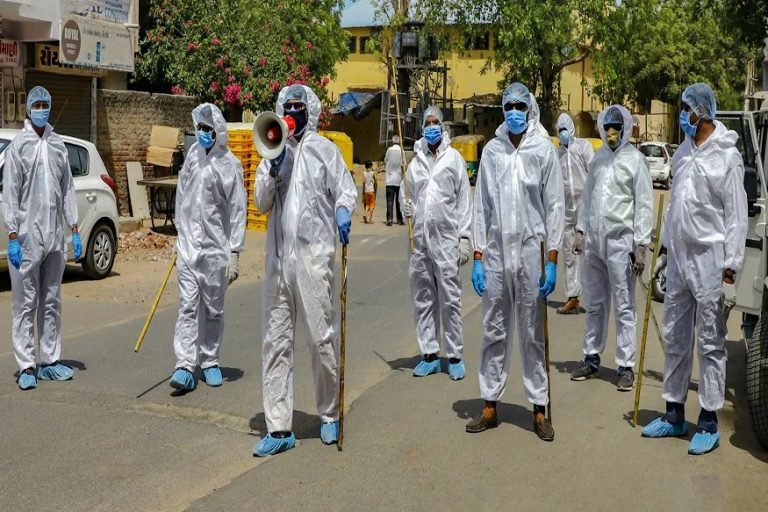
The central government today constituted high-level teams which will be assisting the five worst-affected states in the country by the Chinese virus. The five states are Karnataka, Kerala, Chhattisgarh, Rajasthan and West Bengal. As per the Ministry of Health and Family Welfare, these states reported an upsurge in the number of new Covid-19 cases.

Each team will consist of three members including a Joint Secretary, who will be the nodal officer for the respective state, one public health expert for the purpose of looking after the public health aspects, one clinician to look after infection prevention practices and clinical management protocol being followed by the State.

The teams will be expected to support the efforts their respective states towards strengthening containment of the virus, surveillance, testing, prevention of the infection, control measures and efficient clinical management of positive cases. The teams will guide the state in effectively managing the challenges related to timely diagnosis and follow up.

COVID-19 situation in the five states

Karnataka is leading among the five states in terms of active cases of Covid-19. The states, as on today, has 1,13,538 active cases and 10,283 deaths so far. Karnataka is followed by Kerala which has 94,609 active cases of Covid-19 and 1,090 deaths. Next is West Bengal which has 31,984 active cases and 5,870 deaths. 28,187 cases of Covid-19 are currently active in Chhattisgarh with 1,385 deaths. Rajasthan has 21,587 active cases and has recorded 1,708 deaths.

Republic TV’s Pradeep Bhandari summoned to the court by Mumbai Police, threatened with arrest: Details

0

Mumbai Police and the Maharashtra Government’s witch-hunt Republic TV seems to be just getting filthier. A day after the channels consulting editor Pradeep Bhandari was granted an anticipatory bail against a non-bailable complaint, he has been once again summoned by the Mumbai police to appear before the court on October 22. The Republic TV senior journalist wrote on Twitter that he who is currently in Bihar, analysing the upcoming Assembly elections, would be leaving for Mumbai today and will be reaching Khar police station tomorrow.

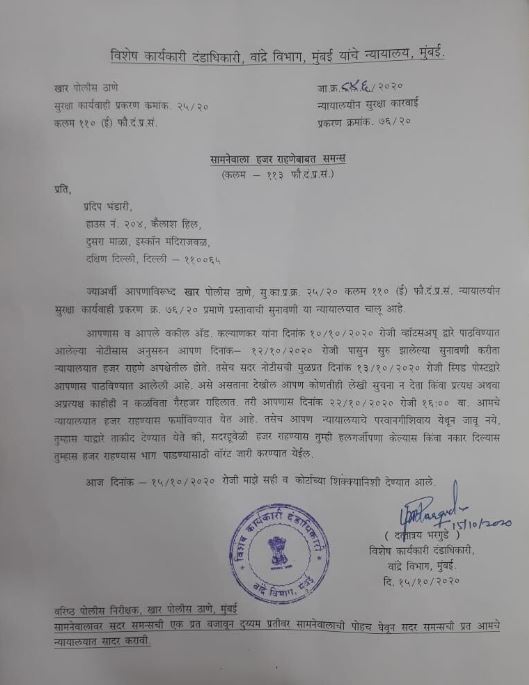
In the summon issued to Bhandari, the Mumbai police ordered him to be present on October 22, 2020, at 4 pm in the court. It also said that Bhandari could move anywhere without informing the court. The police reminded him that a notice had been sent to his and his lawyer on October 10, 2020, to be present in the court on October 12, 2020, for the hearing in a case that was registered against him at the Khar police station.

The notice read that though the original copy of the notice was also sent to him on October 13, 2020, he had given no written or verbal information and remained absent for the same. Saying so, the Mumbai police wrote that this summon should be considered a strict warning. It said that if Bhandari remained absent, negligent or refused to be present then a warrant will be issued against him.

Summon issued to Pradeep Bhandari by the Mumbai police

This notice also alleges that Pradeep Bhandari was informed on Whatsapp as well as a notice was sent through speed post to him for attending the court proceedings but he remained absent without informing the court about his unavailability.

Anticipatory bail granted to Pradeep Bhandari after being opposed for 2 hours

Pertinently, only yesterday Pradeep Bhandari had taken to Twitter to reveal that though his anticipatory bail was opposed for two hours in court, finally, it was granted after the legal team of Arnab Goswami put up a commendable fight.

The Maharashtra government has been misusing the state machinery, including the Mumbai police, hounding the Republic TV chief and other employees, ever since Mumbai police commissioner Param Bir Singh’s chicanery over the fake ‘TRP scam’ case was brought out in the open. Pradip Bhandari had also slammed Mumbai PC Singh for partiality, working on the behest of his political masters and not respecting the police uniform. Following the embarrassment, the Mumbai police had upped its ante against the independent media network and summoned its consulting editor and journalist Pradeep Bhandari for questioning.

Pertinently, Pradeep Bhandari has been leading the reportage in demand for justice in Sushant Singh Rajput death case. Subsequently, Arnab Goswami had accused Param Bir Singh of targeting his channel for relentlessly pursuing the actor’s death case, the Palghar lynching case etc. He had said that the Mumbai PC is scared about facts coming out in the Sushant Singh Rajput death case.

A complaint against Bhandari was registered at the Khar police station under Articles 188 (Disobedience to order duly promulgated by public servant), 353 (Assault or criminal force to deter public servant from discharge of his duty) of IPC and 37(1), 135 of the Bombay Police Act, and he has been asked to appear for the investigation of the said crime.

4th notice served to Arnab Goswami by Maharashtra Assembly, asks him to appear within 10 minutes: Read details

The coalition government in Maharashtra headed by Shiv Sena and their chief minister Uddhav Thackeray has been dogged in its hounding of Republic TV editor-in-chief Arnab Goswami. After serving 3 prior notices, now, the Maharashtra Legislative Assembly has now served the fourth notice to Goswami and asked him to reach the assembly within 10 minutes.

Republic TV broke the news that at 2:50 PM today, Arnab Goswami got a notice from the Maharashtra Legislative Assembly asking him to appear, in person, at 3:00 PM. Essentially, the state government gave Arnab Goswami merely 10 minutes to make a personal appearance in the Assembly, saying that if he does not, action could be initiated against him.

Taking to Republic TV, Arnab Goswami said that this was a complete break-down of the democratic process in the state. He said that every prior notice served by the Assembly has been responded but the Assembly seems to have refused to accept their responses. This, Arnab Goswami said, is illegal and the Assembly was duty-bound to accept the response.

3 other notices served to Arnab Goswami by Maharashtra Assembly earlier

The firs notice by the Maharashtra Assembly was served to Goswami on the 16th of September over breach of privilege.

The Maharashtra legislature secretariat had earlier sought clarification from Arnab Goswami on September 16 over a breach of privilege motion against him during a two-day monsoon session of the state legislature for the alleged derogatory comments against Uddhav Thackeray and Sharad Pawar.

The motion had been tabled by Shiv Sena MLA Pratap Sarnaik, taking offence to the way Republic TV chief referred to Chief Minister Uddhav Thackeray and other ministers during his coverage of Sushant Singh Rajput death case.

After the Assembly alleged that no response was received, a second notice was served to Arnab Goswami and a response was sought by the 20th of October.

A third notice was served to Goswami where Maharashtra Legislature Secretariat issued a notice to Arnab Goswami, chief of Republic TV, for breach of privilege for submitting a copy of the proceedings of the Assembly in the Supreme Court without the Speaker’s permission. The notice was served on October 13 and a written clarification has been sought from Goswami by October 15, the secretariat said in a statement on Wednesday.

Bihar Election 2020: How LJP’s ‘bungalow’ and BJP rebels are complicating the political equations in Jamui district

With the 243-member Bihar assembly election just two weeks away, the political drama in the state is in full swing. In what is being seen as one of the biggest elections globally during the Covid-19 pandemic, the voting for Bihar elections will be held in three phases on October 28 (71 seats), November 3 (94 seats) and November 7 (78 seats), followed by counting of votes on November 10.

Political battle in 4 seats of Jamui district in Bihar

Among the 71 Assembly seats spread across 14 districts going into polls in the first phase, the Jamui district has 4 seats, namely Jamui, Sikandra, Jhajha and Chakai. During the 2015 Assembly elections, BJP won only one of these seats- Jhajha. Two seats (Jamui and Chakai) was bagged by the then Mahagathbandhan partner RJD and one seat (Sikandra) went to the Congress.

However, this time the political scenerio in the Jamui Lok Sabha constituency seems to be different and there are three main reasons for this. The first and primary reason being that Nitish Kumar’s Janata Dal (United) JDU, which contested the 2015 election in alliance with the RJD and Congress, is with the NDA alliance this time.

Secondly, Ram Vilas Paswan’s Lok Janshaki Party (LJP), which was with the BJP in the last election, is contesting the Bihar polls out of the fold of the NDA. It is pertinent to note here that Jamui district is largely influenced by the Lok Janshaki Party. Riding the Narendra Modi wave, young Lok Janshakti Party leader Chirag Paswan had made a successful debut five years back from the Jamui district, defeating the Mahagathbandhan candidate by a margin of around 2.41 lakh votes.

Whether LJP wins more seats or loses this time, it might play a spoilsport for Nitish Kumar’s government. Thirdly, the sons of the former state minister Narendra Singh- Ajay Pratap Singh and Sumit Kumar Singh are also popular in Jamui district.

Jamui assembly seat:

Keeping in mind how crucial this district is in the Bihar electoral arena, BJP has this year fielded shooter Shreyasi Singh from the Jamui seat. By feilding the daughter of former Union minister late Digvijay Singh, BJP has converted Jamui into the most popular seat of this phase. Though this election will be Singh’s debut in politics, Shreyasi who recently joined BJP, has a strong political background and is quite popular amongst the young voters.

During the 2015 Assembly elections, except Chakai, there was a direct fight seen between the NDA and the Grand Alliance candidate in the remaining three seats of Jamui. But this time, things are different. This elections, NDA and the RJD candidates will be facing resistance from the family of former minister Narendra Singh, whose son Ajay Pratap Singh was an MLA from 2010 to 2015. BJP rebel Ajay Pratap is likely to contest as the Rashtriya Lok Samata Party (RLSP) nominee. This third party which has been added in the political fray in Jamui this time is being considered to be the deciding factor.

Meanwhile, RJD has fielded MLA Vijay Prakash. Vijay has fought from this seat many times. He first won from Jamui in February 2005. After that, he lost twice by big margins. Again in 2015, he got the benefits of being associated with JDU and won this seat with a margin of around eight thousand votes. He was also a minister in the Grand Alliance government. His wife Vinita Prakash is the chairman of Jamui Zilla Parishad, while elder brother Jai Prakash Narayan Yadav has been a Member of Parliament from the Banka seat and a former minister at the Center.

Though RJD’s MLA Vijay Prakash and RLSP candidate Ajay Pratap are banking on their past victories and their long-serving political careers, BJP’s Shreyasi Singh is being touted as the most popular candidate from the seat. In fact, after BJP has announced the name of the Commonwealth Games gold medallist’s name, most political discussion in context to the Bihar elections have just been revolving around the ace shooter. Moreover, no LJP candidate is contesting from Jamui, a fact that is bound to help Shreyasi. She had admitted it too while speaking to OpIndia.

Jhajha in Jamui, Bihar

On the contrary, the presence of LJP candidate in Jhajha’s seat is increasing the problem of the NDA alliance. During the 2015 Assembly elections, the Jhajha seat was bagged by BJP’s Ravindra Yadav after securing 65,537 votes. JD(U)’s Damodar Rawat was second with 43,451 votes. This time this seat has gone into JD(U)’s account and Damodar Rawat is NDA candidate. After being expelled from BJP,  the sitting MLA from Jhajha-Ravindra Yadav will now enter the fray representing Chirag Paswan-led LJP’s ‘Bungalow’ symbol. Jhajha is one of the seats where LJP is believed have a strong hold.

However, during our visit in the remote rural areas of the region, about two weeks before the polling, we found that a section of voters are confused about Ravindra Yadav’s party and election symbol. Though Rajendra Prasad has been fielded by RJD, the key factor between its victory and defeat is Ravindra Yadav.

Chakai seat in Jamui, Bihar

Meanwhile, the deciding factor in Chakai’s seat this time is an independent candidate. His name is Sumit Singh. He is also the son of Narendra Singh. Last time, as an independent, he was second with nearly 35,000 votes. Savitri Devi of RJD won by bagging around 47,000 votes. This time too, the RJD has given her a chance. To give her a tough fight, JD(U) has fielded Sanjay Prasad from the Chakai seat which has gone into the kitty of ruling JD(U) as a result of the seat sharing between the two NDA allies. Last year, LJP’s Vijay Kumar Singh was third aftet securing 28,535 votes. This time LJP has fielded Sanjay Mandal. Though LJP has a significant influence on the Chakai seat too, but this election season, the most discussed name in Chakai is that of Sumit Singh.

Speaking to OpIndia, locals said that despite losing the election, Sumit Singh remained continuously active in the area for the last 5 years. Apart from his father’s name, this seems to be going in his favour. Although it is difficult to say who will win in the triangular contest, Chakai will definitely be one of the seats in Bihar where the competition is going to be really tough.

Sikandra seat in Jamui

Congress’ Sudheer Kumar alias Bunty Chaudhary still appears to be a strong candidate in Sikandra. Last elections, he had received around 59,000 votes. LJP’s Subhash Paswan was at the second spot with around 51,000 votes. Pertinently, in the past five years, Bunty Chaudhary has been in discussion for various other reasons apart from work. Meanwhile, another BJP turncoat Ravi Shankar Paswan has been fielded by LJP from the Sikandra seat. Jitan Ram Manjhi’s ‘Hum’, which bagged the seat during seat sharing between NDA allies, has fielded Praful Manjhi from Sikandra.

Subhash Paswan, who had represented LJP in the last election has turned rebel this time. It is pertinent to note that initially, there was talk that LJP chief Chirag Paswan, who has decided to go solo contesting 143 of the 243 seats, would himself contest the assembly elections from this reserved seat. Here LJP is considered to have a strong hold and moreover, after the death of Ram Vilas Paswan, the sympathy wave might impact the outcome of the elections.

Interestingly, the voters on the ground are complaining about not getting the benefit of government schemes and corruption. They are also seen cribbing about the impact of the lockdown. But in the end, every discussion is ending at the candidate’s name.

As local journalist Murali Dixit says, “The equation on paper and the ground reality is different.” The biggest reason for this may be JDU’s separation from the Mahagatbandhan this time and LJP’s separation from the NDA alliance. With the JDU joining NDA alliance, it is certain that it will lose the votes that RJD and Congress had contributed to it last year. Similarly, the seats where LJP is fighting are also going to have an impact. Also, the claims of Sumit Singh and Ajay Pratap cannot be easily dismissed”, opined Dixit.

Amidst all the political drama, the one thing which is interesting in Jamui is that in this backward district, situated adjacent to Jharkhand, the one name which is being discussed in every nook and cranny, by almost every individual, is that of Prime Minister Narendra Modi. Surprisingly, the ignorant voters who do not even know that RJD and JD(U) are no longer together, recognise Narendra Modi and the ‘lotus’, the election symbol of BJP.


#IndiaKeLiye: Micromax shows the way, launches ad that tugs on the heartstrings of the nation after aggression by China

Amidst the rising belligerence from China and the continuing stand-off between the Indian and Chinese forces along the Line of Actual Control, the Indian mobile phone manufacture Micromax on Friday announced its comeback in the Indian market currently flooded by Chinese manufacturers.

The announcement of Micromax’s return to the Indian market was made through a heartwarming video shared by the company’s official Twitter account that featured co-founder Rahul Sharma, who in the video announced the Gurugram based organisation’s re-entry into the Indian mobile phone market with a new range of locally manufactured ‘IN mobile phone range’ against the Chinese counterparts.

“We’re #INForIndia with #INMobiles! What about you? #IndiaKeLiye #BigAnnouncement #MicromaxIsBack #AatmanirbharBharat,” the tweet by Micromax read.

In the approximately 2-minute long video, Sharma shared the company’s journey and how it was among the top 10 mobile manufacturers in the world before losing its market share to the Chinese mobile manufacturing companies. Sharma candidly and honestly admitted to the mistakes made by the company during its first innings that propelled its downfall and ensured that the organisation has learned from its past mistakes and will launch competitive products to take on the Chinese mobile companies currently dominating the Indian smartphone market.

Talking about the recent conflict between Indiana and Chinese forces at the LAC, Rahul Sharma said that what happened at the border was not good, and after the incident, people in the country appealed the company to make a comeback to counter the Chinese phone makers amid the calls of boycotting Chinese products.

Sharma also mentioned in the video that when PM Modi called for a push towards self-reliance (Atma Nirbhar), Micromax found a new purpose to revitalise its fight against the Chinese mobile phone companies. Towards the end of the video, Sharma flashes a sky-blue box of a mobile phone with ‘IN’ written on it, which is believed to be the company’s new range of smartphones with which it will re-enter the Indian mobile phone market.

Besides, Micromax has also pledged an investment of Rs 500 crores for expanding its local manufacturing capabilities and research and development operations as it gears up for its comeback in the Indian mobile phone market.

Indian government launched the PLI scheme to boost local manufacturing of electronics goods

To grab the market share of the mobile phones currently dominated by the Chinese and American companies, Micromax is seeking to avail benefits that the Indian government has announced with the schemes like PLI. The Production Linked Incentive (PLI) was introduced by the Modi government in the electronics manufacturing segment in April this year under the National Policy on Electronics (NPE) 2019 that aims to incentivise companies that manufacture their products locally and which will ultimately position India as a global hub for Electronics System Design and Manufacturing (ESDM).

Proposals by 16 phone makers under the Production Linked Incentive Scheme (PLI) for Large Scale Electronics Manufacturing was approved by the Ministry of Electronics and Information and Technology earlier this month, including Bhagwati Products Ltd, the maker of Micromax phones and other consumer electronic products.

Speaking about the PLI scheme, Micromax co-founder Rahul Sharma said, “The new PLI scheme balances out foreign and Indian players. The support of 6 per cent is big and with the government support, we will be able to fight Chinese brands fiercely on the pricing front.”

In addition to encouraging companies to manufacture locally, the government has also hiked up import duties on smartphone components like displays, thereby raising difficulties for the foreign manufacturers to keep their prices competitive and providing another incentive to manufacture locally.

Chinese mobile phone companies shunted out Micromax from the Indian mobile phone market

True to its tagline “nothing like anything”, Micromax disrupted the Indian mobile phone market a decade ago with its unique value-for-money products. The company quickly captured the market share from the then market leader Samsung by offering the same features as the Korean brand gave but at half the cost. However, this dominance of the smartphone market was short-lived as Micromax was strangled out of the Indian mobile phone market following the advent of the Chinese mobile phone companies.

The company which once commanded an impressive 22 per cent of the mobile phone market share in India in 2015 was reduced to an inconsequential player by 2018 as more and more number of Indians embraced Chinese mobile phones made by companies such as Oppo, Vivo, Xiaomi, One Plus and several others. Chinese mobile companies flooded the Indian market with glitzy new products packed with a ton of features at affordable prices which played an instrumental role in Micromax’s undoing.

As India now moves towards a more self-reliant economy with PM Modi’s clarion call to be “vocal for local”, the Indian mobile phone manufacturer is poised to take the heat on its Chinese counterparts.

‘Ruling communists treacherously ignoring China capturing our land’: Indian Army Chief to visit Nepal amidst opposition parties targeting Oli

0

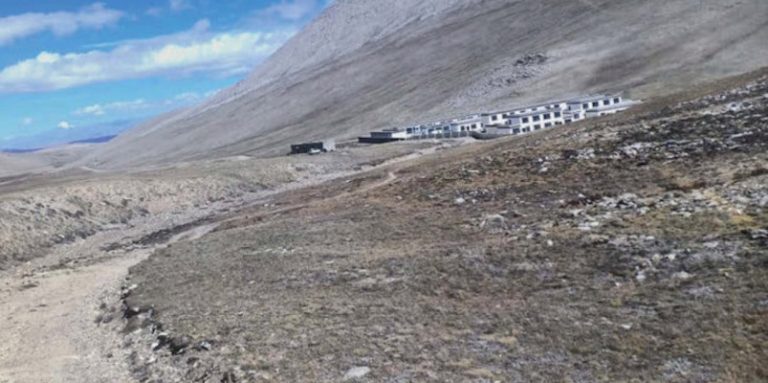
The Nepali Congress (NC) has reiterated that China has encroached upon Nepalese territory and said that the central government’s silence on the matter is shameful and condemnable. The main opposition party also described the silence of the Nepal Communist Party (NCP) as treasonous. The encroachment reportedly occurred at Limi of Namkha Rural Municipality in Humla district.

The NC also accused the government of cover-up for issuing a ‘hasty denial’ even when the CDO-led inspection team was inspecting the border areas. The party called the actions of the government ‘anti-national’. They demanded that the government send a protest note to China over illegal encroachment of their territory and seek a resolution through dialogue and diplomacy.

Nepalese lawmaker Jeevan Bahadur Shahi said, “A team of experts should visit the Nepal-China border in Humla district to make a scientific assessment of what China has done. Our findings have clearly shown that China has entered into one and half kilometers inside our territory after replacing the boundary pillar.” Earlier, reports had emerged in the media that asserted the same.

Meanwhile, Indian Army Chief General Navrane will be visiting Nepal in the month of November. The timing of the visit is significant given reports of Chines encroachment at the China-Nepal border. “The visit was approved by the government of Nepal on 3rd February 2020 but was postponed due to lockdown in both the countries,” the Defence Ministry of Nepal said in a statement. The objective of the visit is to “confer the honorary rank of general of the Nepali Army to General Naravane in an investiture ceremony during this visit”. The ceremony is a 70-year old tradition, an arrangement between the armies of the two countries since 1950.

Geja Sharma Wagle, an expert on strategic affairs and foreign policy, said that the visit “is an olive branch from India to normalise ruptured relations due to the longstanding territorial dispute. I think this visit will positively contribute towards reviving much-needed dialogue between the two countries.” “The visit is meaningful as it comes amid a diplomatic standoff between the two countries,” he added.

Tensions had erupted between India and Nepal recently with the Himalayan country releasing a new map claiming Indian territory. Its Prime Minister K.P. Oli also made bizarre comments going so far as to claim that Shri Ram was born in Nepal in a bid to antagonise India.

Chinese President Xi Jinping keeps coughing violently during speech, fuels speculations about coronavirus infection

0

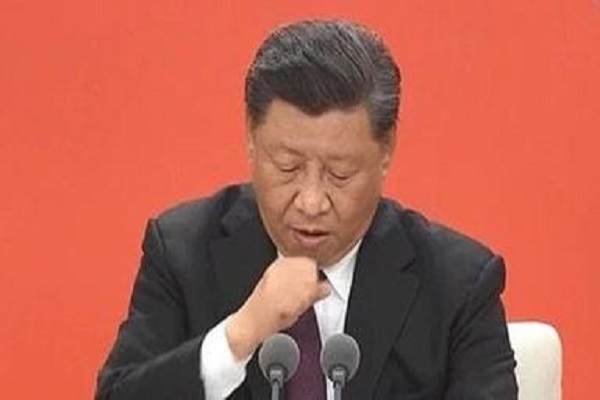
Speculations over Chinese Premier Xi Jinping’s health condition have been rife over several media reports after it was reported that Jinping kept coughing violently throughout his address at a Chinese Communist Party event held in Shenzhen in Guangdong province on October 14. As per a report in WION, this episode has prompted discussions regarding whether the Chinese President has contracted coronavirus.

Jinping was delivering a speech. According to reports, Jinping could hardly speak because he was interrupted by constant coughing. He kept sipping water to relieve his cough but it did not seem to help. The state TV camera covering the event moved away from the Chinese president and focused on the audience whenever he suffered from bouts of cough but the noise of him coughing could be heard clearly.

According to Hong Kong Apple Daily, the Chinese President was speaking at an event marking the 40th anniversary of the establishment of the Shenzhen Economic Zone. While the people seated in the audience were wearing masks, Jinping was there without a mask. Other guests seated with him on the stage including the Chief Executive of Hong Kong Carrie Lam, were also not wearing masks. The President spoke for 50 minutes and coughed repeatedly. The reports also said that the Chinese President had visited Chaozhou and Shantou earlier this week as part of his southbound tour but, contrary to the tradition, he did not interact closely with people on the streets.

Speculations about Jinping’s Health

The incident has given rise to speculations regarding Jinping’s health as the risk of the Chinese virus still looms around. However, it is too rich to expect transparency from China regardless of whether Jinping is positive for the virus or not. Jinping had reportedly disappeared from the public view on two occasions during the outset of the Wuhan virus outbreak.

Many world leaders have been found positive for the Wuhan virus so far including the UK Prime Minister Boris Johnson, the US President Donald Trump, Iranian Vice President Masoumeh Ebtekar and the Brazilian President Jair Bolsonaro.