On Friday, the Mumbai Police nabbed six Shiv Sena goons including a shakha pramukh for brutally attacking a 65-year-old former Navy officer for sharing a cartoon on WhatsApp that had allegedly mocked Shiv Sena chief Uddhav Thackeray.
According to reports, hours after Shiv Sena goons thrashed the elderly man, the Mumbai Police arrested six accused including Shiv Sena’s shakha pramukh Kamlesh Kadam and another party worker Sanjay Manjre.
The FIR filed by the retired naval officer stated that he was attacked by Shiv Sena workers earlier in the day for sharing a cartoon that had taken a dig at Maharashtra Chief Minister and Sena chief Uddhav Thackeray. The FIR was filed at the Samta Nagar police station.
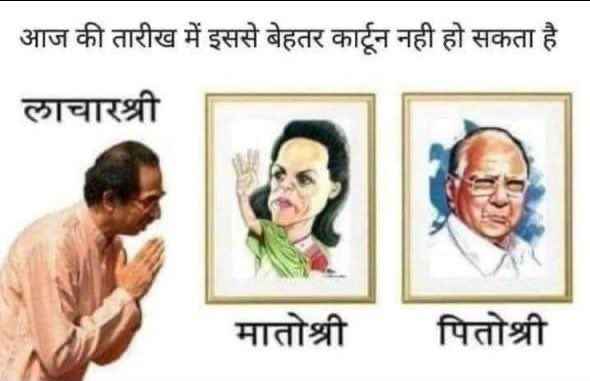
The cartoon of Uddhav Thackeray that was allegedly shared by the Navy veteran over WhatsApp and has now gone viral
Additional Commissioner North Region Dilip Sawant had assured of action against the culprits who had attacked the navy veteran Madan Sharma. Madan Kashinath Sharma, who retired from Navy in 1990, is a resident of Thakur Complex in Kandivli (East).
“A case of assault and rioting under various sections of Indian Penal Code was registered against Kadam, who is Sena’s local shakha pramukh, and others. Kadam and five others were arrested on Friday night,” said Raju Kasbe, senior inspector of Samta Nagar police station.
Navy veteran brutally attacked by Shiv Sena goons for sharing Uddhav Thackeray cartoon
On Friday, a veteran of the Indian Navy – Madan Sharma was attacked by Shiv Sena goons in Maharashtra on Friday for sharing a cartoon on WhatsApp.
The WhatsApp forward was allegedly a satirical cartoon featuring Uddhav Thackeray and his allies Sharad Pawar and Sonia Gandhi.
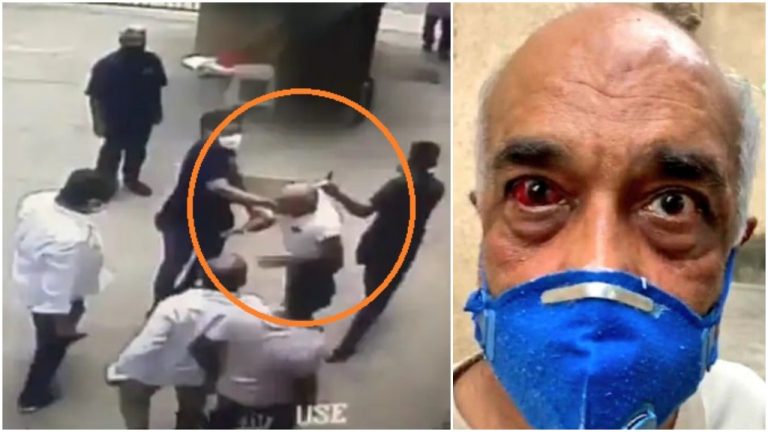
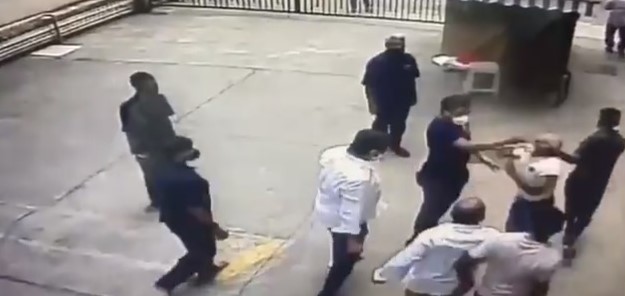
In the CCTV footage of the incident that has gone viral on social media, one can see how the veteran was brutally attacked by a bunch of goons.
अभिनेत्री कंगना राणावत के कार्यालय की तोड़फोड़ करके अपनी मर्दानगी दिखाने वाले सत्ताधारी शिवसेना ने अब सत्ता के मद में एक बुजुर्ग भूतपूर्व नौसेना अधिकारी मदन शर्मा को मारपीट करते हुए उनकी आंख को जबरदस्त चोट पहुंचाई है। मुख्यमंत्री घरबैठे तानाशाही चला रहे है। pic.twitter.com/qF2NVcIN55
Speaking to the media after the incident, Madan Sharma had said that he had received a phone call from an unknown person earlier in the day. A person, who identified himself as Kamlesh Kadam, had asked him to come down at his society’s gate.
As Sharma reached the gate, Kadam and other Shiv Sena goons attacked him brutally and injured him. They assaulted me, punched me and kicked me. My right eye sustained injuries, Sharma had said.
Shockingly, a complaint filed was also filed against elderly person Sharma for sharing the cartoon which had mocked Shiv Sena chief Uddhav Thackeray.
Hours after Shiv Sena goons brutally attacked a veteran of the Indian Navy for sharing an Uddhav Thackeray cartoon on WhatsApp, a massive outrage had erupted across the country against Uddhav Thackeray-led Shiv Sena for brutalising and thrashing an elderly person.
Several concerned citizens expressed their anguish over the incident and took to social media to share the ‘offensive cartoon’ that infuriated the Shin Sena goons in the first place that led them to beat up the Navy officer.
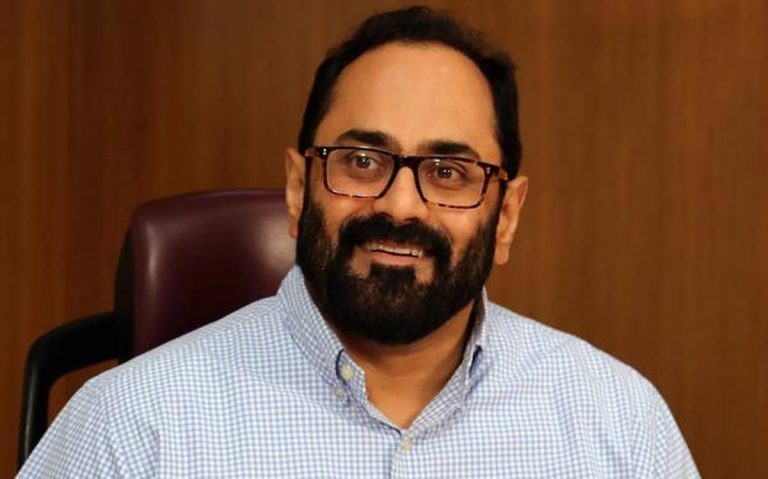
Joining netizens, BJP Rajya Sabha MP Rajeev Chandrasekhar too posted the purported cartoon that had angered the Shiv Sena goons earlier.
Sharing the ‘offensive’ cartoon, the BJP MP said he enjoyed the cartoon of a “woman-bullying, veteran-beating shameless opportunist-in-chief” Uddhav Thackeray.
I enjoyed this cartoon of a woman-bullying, veteran-beating shameless opportunist-in-chief “CM” @OfficeofUT !
The Shiv Sena goons, who had thrashed the elderly man over a trivial cartoon has now become viral on the internet and is being shared across the social media platforms.
In the hilarious cartoon, that had infuriated the Shiv Sena goons, the Maharashtra Chief Minister and Shiv Sena chief Uddhav Thackeray was seen bowing in front of Congress interim chief Sonia Gandhi and NCP Supremo Sharad Pawar. Uddhav Thackeray’s Sena is in alliance with NCP and Congress in Maharashtra.
The Maharashtra Chief Minister Uddhav Thackeray is often mocked by his critics and opposition parties members for allegedly being subservient to his alliance partners Congress and NCP. Many of his critics now refer to ‘Shiv Sena’ as ‘Sonia Sena’ over Congress party’s extreme control over Shiv Sena-led Maharashtra government.
Navy veteran brutally attacked by Shiv Sena goons
On Friday, a veteran of the Indian Navy – Madan Sharma was attacked by Shiv Sena goons in Maharashtra on Friday for sharing a cartoon on WhatsApp.
The WhatsApp forward was allegedly a satirical cartoon featuring Uddhav Thackeray and his allies Sharad Pawar and Sonia Gandhi.
In the CCTV footage of the incident that has gone viral on social media, one can see how the veteran was brutally attacked by a bunch of goons.
अभिनेत्री कंगना राणावत के कार्यालय की तोड़फोड़ करके अपनी मर्दानगी दिखाने वाले सत्ताधारी शिवसेना ने अब सत्ता के मद में एक बुजुर्ग भूतपूर्व नौसेना अधिकारी मदन शर्मा को मारपीट करते हुए उनकी आंख को जबरदस्त चोट पहुंचाई है। मुख्यमंत्री घरबैठे तानाशाही चला रहे है। pic.twitter.com/qF2NVcIN55
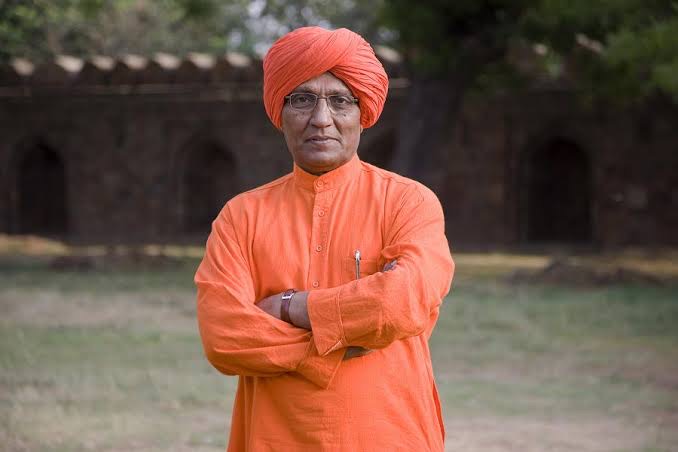
Expelled Arya Samaj leader and Former Haryana MLA, Swami Agnivesh, breathed his last on Friday at the Institute of Liver and Biliary Sciences in New Delhi. The 80 years old activist was ailing from liver cirrhosis and was critically ill.
He was hospitalised and kept on ventilator since Tuesday due to multi-organ failure.
A statement issued by the hospital authorities said that Swami Agnivesh died of cardiac arrest at around 6 PM in the evening. “On September 11, his condition deteriorated and he went into cardiac arrest at 6 pm. Resuscitation was attempted but then he passed away at 6:30 pm. ILBS joins the country in mourning the loss of this beloved leader,” the hospital said in a statement.
The 80-year-old political activist was a former MLA from Haryana and had founded a political party, Arya Sabha in 1970. He was also associated with various social campaigns. He rallied against female foeticide and fought for the emancipation of women. He had also been associated with Anna Hazare’s India Against Corruption campaign in 2011 which centred around the demand for the implementation of the Jan Lokpal Bill.
However, he was once seen calling for a disruption of the Anna Hazare movement in a video where he was discussing a plan to end the movement with Kapil Sibal, who was the UPA minister back in 2011.
The former Arya Samaj leader had also once referred to Hindu pilgrimage sites as “blind faith” and “useless” while maintaining a sarcastic tone when referring to their Gods.
Swami Agnivesh was also quite legitimately termed a vocal campaigner for Naxal peace-talks and Kashmiri secessionism. He had not only demanded “peace talks” as the way forward with Maoists when addressing Manmohan Singh, but he was also seen leading a march in protest, with Yasin Malik in Jammu & Kashmir.
In addition to this, Swami Agnivesh also supported a 30-hour hunger strike, battling against the resettlement of the Kashmiri Pandits who were forcefully sent out of their own homes by radical Jihadists in Kashmir.
The Election Commission has issued a new set of guidelines for declaring criminal history by nominees and political parties regarding the candidates nominated by them for elections.
The modified instructions mandate the candidates and the political parties nominating the candidates with criminal background to publish the details of the criminal antecedents, if any, in newspapers and television.
Election Commission of India issues revised guidelines for publishing details of criminal antecedents by candidates &, the political parties regarding candidates nominated by them. pic.twitter.com/kLWbsI1V3E
Contesting and uncontested candidates to publicise their criminal antecedents
The Commission has provided a revised timeline for publicity, asking the candidates and political parties to publish first publicity of the details of the criminal antecedents within first 4 dates of the last date of withdrawal. The second publicity should be done within 5th to 8th day of the last date of withdrawal and the third publicity to be done from the 9th day till the last day of the campaign, i.e two days prior to the date of poll.
The Election Commission stated that the revised timeline for publicity will help voters to exercise their choice in a more informed manner.
The Poll committee has also asked the uncontested winning candidates as well as political parties nominating them to publicise the criminal antecedents, if any, in a similar manner as prescribed for other contesting candidates and political parties.
These modified instructions will be applied with immediate effect, a press release statement signed by Under Secretary Pawan Diwan noted.
Actor Kangana Ranaut has recently been at the receiving end facing constant threats, derogatory attacks and harassment from the Uddhav Thackeray-led Maharashtra government. On September 9, the Shiv Sena led BMC demolished her property in Bandra worth crores, within just 24 hours of a ‘stop work’ notice and at a time when such demolition activities have been prohibited by a High Court order. While the civic body’s action drew a lot of flak from various quarters, immense support has been pouring in for the actor.
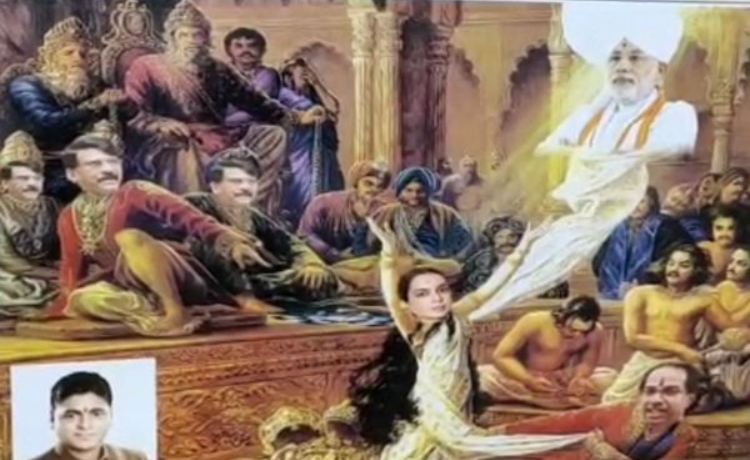
Now, one of her supporters’ Sripati Mishra, a local lawyer in Varanasi has come up with posters in which he uses the Mahabharata’s iconic Draupadi ‘Cheer Haran’ scene to manifest the entire Kangana-Shiv Sena fiasco. The posters which were seen in various places in Uttar Pradesh’s Varanasi depicts actor Kangana Ranaut as Draupadi, Maharashtra CM Uddhav Thackray and Shiv Sena motormouth leader Sanjay Raut as Dushasana and others Kauravas, and PM Modi as Lord Krishna.
Justifying the posters, Mishra said that in the case of Kangana’s tussle with the Shiv Sena, the Maharashtra government has been acting like the ‘Kaurav Sena’. He furthered that only PM Modi can protect the dignity of women in this country. Mishra also hit out at Congress president Sonia Gandhi for remaining silent over the entire issue.
Kangana Ranaut questions Sonia Gandhi’s silence
Questioning her silence, Kangana Ranaut had also hit out at the Congress president Sonia Gandhi today asking whether she is not anguished by how the government where Congress is a part of is treating a woman in Maharashtra. “History will judge your silence and indifference when your own government is harassing women and ensuring a total mockery of law and order,” Kangana wrote.
Ranaut then added that she hopes Sonia Gandhi will intervene on the issue and address how a government the Congress is a part of is behaving in Maharashtra.
Kangana’s family has been in Congress
Yesterday, Kangana Ranaut’s mother had thanked home minister Amit Shah to take cognisance of the threats to Kangana’s safety and provide Y-category security for her. She had stated that her family has been in Congress for generations, yet the BJP government ensured the safety of Kangana.
A veteran of the Indian Navy was attacked by Shiv Sena goons in Maharashtra on Friday for sharing a cartoon on WhatsApp. A complaint filed has been filed and an FIR has been registered regarding the matter, Times Now has reported. The veteran confirmed that he was brutalised for sharing the WhatsApp forward. He also said that the Police has first come to arrest him.
#Exclusive | Attacked veteran speaks to TIMES NOW and confirms the ‘assault’ by @ShivSena workers.
The veteran also said that he had never expected such a thing to happen to him in his own country. He said that he was helped by the local MLA who is from the Bharatiya Janata Party. Former Chief Minister Devendra Fadnavis urged Chief Minister Uddhav Thackeray to put an end to the ‘Gundaraj’ and demanded strong punishment for the guilty.
Extremely sad & shocking incident. Retired Naval Officer got beaten up by goons because of just a whatsapp forward. Pls stop this GundaRaj Hon Uddhav Thackeray ji. We demand strong action and punishment to these goons. https://t.co/g4fQ5xfPYzpic.twitter.com/p1vdP2P0m8
CCTV footage of the incident are also doing the rounds on social media where the veteran can allegedly been seen being attacked by a bunch of goons. The victim has been identified as Madan Sharma. The WhatsApp forward was allegedly a satirical cartoon featuring Uddhav Thackeray and his allies Sharad Pawar and Sonia Gandhi. Sharma is currently receiving treatment at the Shatabdi Hospital in Kandivali.
अभिनेत्री कंगना राणावत के कार्यालय की तोड़फोड़ करके अपनी मर्दानगी दिखाने वाले सत्ताधारी शिवसेना ने अब सत्ता के मद में एक बुजुर्ग भूतपूर्व नौसेना अधिकारी मदन शर्मा को मारपीट करते हुए उनकी आंख को जबरदस्त चोट पहुंचाई है। मुख्यमंत्री घरबैठे तानाशाही चला रहे है। pic.twitter.com/qF2NVcIN55
The Shiv Sena has been acting in increasingly tyrannical fashion of late. Recently, the Shiv Sena-controlled BMC had ordered the demolition of Kangana Ranaut’s office in Mumbai after her recent spat with the government in the state. The Mumbai Police has also imprisoned two journalists associated with Republic TV and they are currently languishing in jail for three days without access to their legal counsel.
At a defence panel meet today, senior Congress leader Rahul Gandhi questioned the supply of rations to the Indian Army. In the Parliamentary Standing Committee on Defence which was chaired by BJP leader Jual Oram, the Congress MP from Wayanad asked why there is a difference in food for jawans and officers stationed at the borders.
News18 journalist working on Congress beat Pallavi Ghosh had also taken to the micro-blogging site to announce that Rahul Gandhi would be raising the agenda on the difference in the diet of jawans and officers in the Parliamentary meeting today.
Rahul gandhi asks. Why difference in diet of jawans and officers .. this is the agenda of today’s meeting of parl committee on defence pic.twitter.com/fOTpHwZVqJ
It may be noted that although Rahul Gandhi is a member of the Parliamentary Standing Committee on Defence in the current Lok Sabha, today was the first time that he attended the meeting. He had skipped all the previous 11 meetings of the committee, even though he has been attacking the Modi government on various defense related matters, from Rafale jets to LAC conflict.
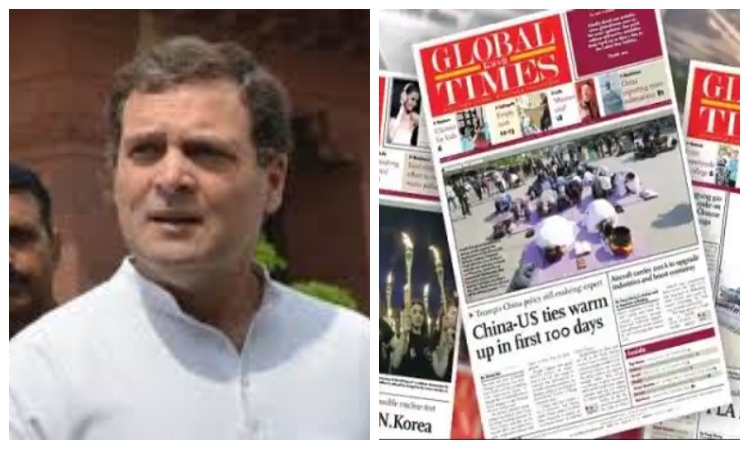
Rahul Gandhi questions just when Global Times’s editor-in-chief taunts Indian Army over food
It’s uncanny how Rahul Gandhi’s ‘concern’ for the Indian jawans came just when the Chinese government mouthpiece Global Times’s editor-in-chief took to Twitter to peddle the same agenda to belittle India. The Global Times’s editor-in-chief taunted India over the “cold canned food” they are given to consume in comparison to the “hot meals” the PLA’s frontline soldiers enjoy.
Sharing a video of the food the Chinese Army officials get to eat, Hu Xijin, the editor-in-chief of the Chinese propaganda arm wrote: “With these drones, the PLA’s frontline soldiers can enjoy hot meals once winter reaches the plateau. Some sympathize with the nearby Indian soldiers who can only eat cold canned food and have to endure the severe cold and potential spread of COVID-19”.
With these drones, the PLA’s frontline soldiers can enjoy hot meals once winter reaches the plateau. Some sympathize with the nearby Indian soldiers who can only eat cold canned food and have to endure the severe cold and potential spread of COVID-19. pic.twitter.com/Rci5H8Wbmy
Chinese govt mouthpiece Global Times used Congress rants to target India’s moves in Ladakh
Just like the Communist Party in China, it’s propaganda machinery Global Times also seems to be sharing an unfaltering understanding with the Congress party. Today, Rahul Gandhi was seen peddling the same agenda which the Global Times editor-in-chief used to deride India. Recently, to target India’s move in Ladakh, the Chinese propaganda arm, Global Times, had leaned on Congress propaganda against the Modi government to mount pressure on India.
In an article published by Global Times on September 5, allegations made by the Congress party against Modi govt has been used by the Chinese govt’s media house.
The reference to the Indian National Congress was made by the Chinese propaganda media outlet to dissuade the Modi government from embroiling itself in a border dispute with Beijing and risk losing the political capital to the principal opposition party. It was a veiled threat issued by the Chinese mouthpiece, alleging that any wrong move by the PM Modi concerning the Ladakh standoff might provide an opening to the Congress party, which is restlessly seeking to depose the BJP government.
Congress party’s close association with the ruling Communist Party in China
It is noteworthy that the Congress party maintains a close association with the ruling Communist Party in China. In in 2008, the Congress party and the Communist Party of China (CPC) had signed a deal in Beijing for exchanging high-level information and co-operation between them. The memorandum of understanding (MoU) also provided the two parties with the “opportunity to consult each other on important bilateral, regional and international developments”.
Interestingly, the MoU was signed by the then Congress general secretary Rahul Gandhi and on the Chinese side, it was signed by none other than Xi Jinping himself, who was then the Chinese vice-president and standing committee member of the CPC’s politburo. The MoU was signed in the presence of his mother and party president Sonia Gandhi.
Moreover, during the Indo-China standoff on the Doklam issue, Rahul Gandhi had met Chinese officials multiple times. His meeting with Chinese officials during his Kailash Mansarovar visit in 2018 was kept secret, but later he had revealed it accidentally during a speech in 2019.
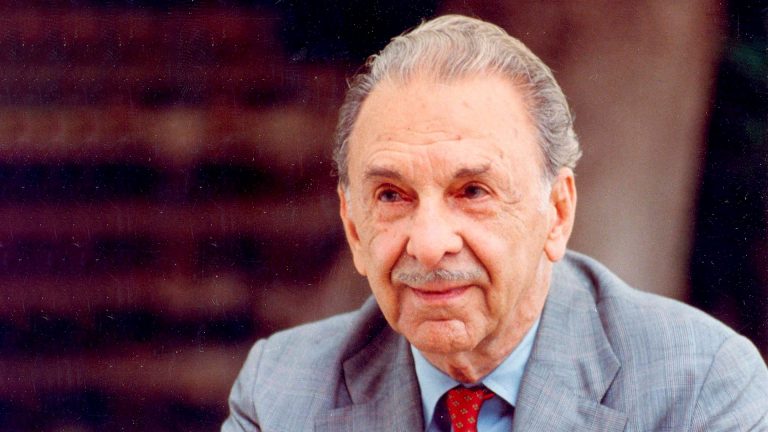
Jehangir Ratanji Dadabhoy Tata commonly known as JRD Tata needs no introduction. Known as the father of aviation, JRD Tata founded India’s first international airline- Air India and went on to become the longest-serving chairman of the Tata group.
In the 90s, the business magnet was interviewed by journalist Rajiv Mehrotra as part of his “In Conversation” series, which aired on Doordarshan. According to the website of Tata, the interview was taken in the spring of 1987, and it is the only known television interview of the legend. In the interview, JRD spoke on diverse issues, ranging from his professional life to India’s political influence, policies and governance. However, he particularly spoke in length about the lack of economic development under the leadership of India first PM Jawaharlal Nehru and the Congress legacy which followed.
JRD Tata’s modesty
In the interview, a part of which has now gone viral on social media, the man under whose chairmanshipthe assets of the Tata Group grew from US$101 million to over US$5 billion, modestly said that except for Air India, he did not create anything from scratch or anything entirely new. “It so happened that I inherited the situation”, said JRD. He said that it was already being led by a good team of people when he got into Tata’s after the demise of his father Ratanji Dadabhoy Tata in 1926, and that his job was to motivate them and “keep things going and going”.
To make light of his achievements at a young age, the philanthropist joked that he was appointed the chairman of the Tata group “prematurely” at the age of 34 and that his appointment was ‘a moment of mental aberration’.
How Morarji Desai unceremoniously terminated JRD Tata from Air India’s chairmanship
During the course of the conversation, JRD’s passion for Air India was evident as he said that Air India was the “only one thing which I may feel that I was wholly responsible for”.
JRD Tata opened up on how he continued as chairman of Air-India till 1978, until he was unceremoniously terminated from his services in February by the then Prime Minister Morarji Desai. “He didn’t inform me for 8 to 10 days, until I received a letter thanking me for my services”, he informed.
JRD recollected that his termination was “not unexpected” considering his “love-hate relationship with the then PM of India”. He said that though they were friends “the man was quite impossible to deal with”. Distressed by the disastrous act of vindictiveness, JRD says that “the way it was done was not pleasent”.
For the uninitiated, In 1978, Prime Minister Morarji Desai-led government unceremoniously dropped JRD from the chairmanship of Air India and the directorship of Indian Airlines. A year earlier, he had already been removed from the board of the Atomic Energy Commission on which he had served since its inception in 1948. JRD, who was in Jamshedpur then learnt about his termination through a radio announcement.
On his return to Bombay House on 9 February, JRD found a letter from the prime minister dated 4 February and dispatched from Delhi on 6 February. The press reports on 11 February finally clarified that he had been removed from the position with retrospective effect from 1 February.
In his reply, a terribly upset JRD who had served Air India for a quarter-century without remuneration of a single rupee stated: “I hope you will not consider it presumptuous of me to have expected that when the government decided to terminate my services and my forty-five years’ association with Indian civil aviation, I would be informed of their decision directly, and if possible, in advance of the public…”
The airline crew and public on a whole were extremely outraged at this sudden development as Air India was, at that time, a matter of deep national pride, and JRD was synonymous with Air India’s success and service. Morarji Desai’s decision had brought him some of the worst publicity since he took office as prime minister.
Stupid enough to think at one stage to join the Congress party: JRD Tata
When asked whether he ever felt the urge to participate in India’s freedom struggle, JRD says: “I was stupid enough to think at one stage to give up the idea of becoming a businessman or an Industrial leader and join the Congress party”. He continued saying that he was highly impressed by Jawaharlal Nehru, but then he realised that all that would mean getting arrested and going to jail, where he couldn’t have done anything significant.
Interestingly, one of the main reasons why Veer Savarkar had also written a mercy petition to the British was that he too thought what bravery it is to be in jail if one can serve in other ways being out of it. The Congress, especially the party’s senior leader Rahul Gandhi probably needs to understand this before taking cheap digs at the freedom fighter.
Jawaharlal Nehru made grave mistakes in policy decissions
Calling himself apolitical, JRD opined that he found himself opposed to the Congress government’s policies. Though he was an admirer and a friend to Jay Prakash Narayan and Jawaharlal Nehru, both of them, particularly Jawaharlal Nehru made grave mistakes in handling the political processes of India, said JRD.
“Nehru’s socialism is what I consider to be the wrong type of socialism, bureaucratism etc”. JRD said that he had never done any lobbying, rather he had been very vocal rather a critic, of the government policies which should have been implemented but were not by the then Congress government.
He continued that how for instance he was averse to the blind nationalisation of industries, which he thought would mean bureaucracy and lethargy. He said that there were many considerations which made him opposed to nationalisation.
British parliamentary system was not fit for India
The former chairman of the Tata conglomerate opined that the system of democratic governance which Congress adopted from the British was not fit for India. He said: “I was more and more concerned with the adoption of the British parliamentary system in India. I was convinced that it would not work in India”.
“I have often thought that if fate had decreed that Vallabhbhai Patel instead of Jawaharlal, would be the younger of the two, India would have followed a very different path and would be in better economic shape than it is today”, said JRD opining that Jawaharlal Nehru knew very little about economics and socialism and he was simply not even open to ideas. “Socialism could be established without the loss of the economic freedom of the majority of the people, but Jawahar was not even interested in listening”.
Here, JRD paused for a second to say that he needs to be very careful of what he says, probably hinting at the atmosphere of fear and intimidation for industrialists and bureaucrats when Congress government was at the helm of affairs in the country.
“When it came to issues like economics, nationalisation, bureaucracy, he (Jawaharlal Nehru) was not only disinterested he was unwilling to talk, and he developed a trick to avoid the conversation. JRD said that whenever he tried to initiate a conversation with the former PM on these issues he would look out of the window… and “I would get the hint that he is not interested”, recollected JRD.
Indira Gandhi was as disinterested as her father
JRD Tata disclosed that Indira Gandhi was similar, she too would not listen to things against socialism, but, however, her trick to avoid the conversation was slightly different from that of her father. Essentially when someone disagreed or argued against what she was doing, she would start picking up envelopes from the table and pulling out letters, “Practically hinting that look…I have other things to do”.
Basically, what JRD implied that both the father-daughter duo were never interested in the economic development of the country. One needs to pause and think here that if Nehru and Indira could brush-off someone as influential as JRD Tata, how would they have been dealing with dissent otherwise.
JRD Tata predicted political instability in the past
Asked about his political views, as the year when the interview happened was the election year, JRD continued that if Rajiv Gandhi and the Congress party is ousted by the Opposition then the same thing would happen what happened during the short tenure of Janata Party government. Basically the visionary had then warned that Congress’ loss would lead to political instability which is exactly what happened with smaller parties heading the government for short terms after the fall of Rajiv Gandhi govt. Whether it was led by V P Singh or Charan Singh or Chandrashekhar, all have been failures.
Saying so he said that whoever be at the helm of affairs as a citizen of the country he wants that the government works on issues like agriculture, employment, industrialisation and population control…”things on which very little is being done now”, said JRD.
Licence Raj- the bureaucratic muddle for ‘make in India’.
Asked about his opinion on industrial development and modernisation which is a key to economic growth, JRD said that only modern equipment can make manufacturing cheaper and attractive, but labour unions are averse to modernisation and the problem is that labor unions are backed by politicians.
He goes on to speak of how industrialisation was scuttled during those days because of the Licence-permit Raaj. He said that companies need permission for everything, “had this been a government hotel, even to move a chair in this room permission would have been required”, exclaimed JRD. At that time companies could not expand capacity without permission, also new companies were not allowed in many sectors, so existing companies had no incentive to innovate. Basically what JRD Tata implied was that the Licence Raj was the bureaucratic hurdle for ‘make in India’.
On Black money
“When I joined business, there was no black money. There was no corruption, for whom were you to corrupt? When you did not have a system of government control where you had to get a permit for everything. In the early days, taxes were also very low. Black money will always be there as long as taxes and controls are high,” said JRD.
Based on his half a century of experience under different systems of government, the former Tata Group chairman affirmed that black money will always be there till taxes are high and the government controls are high.
Jehangir Ratanji Dadabhoy Tata, who was born on July 29, 1904, is the recipient of two of India’s highest civilian awards — the Padma Vibhushan and the Bharat Ratna. JRD Tata is not only remembered as a great industrialist but also as a keen aviator.
JRD Tata joined the family business as an apprentice and became the chairman of Tata & Sons at the age of 34. He also led the group to diversify and oversaw that Tata Group becomes one of the most trusted brands in India. It was under his leadership that Tata Group diversified into aviation after he formed an aviation department called Tata Airlines which later became Air India. In fact, JRD Tata is widely considered to be the Father of Indian Aviation for his pioneering role in civil aviation.
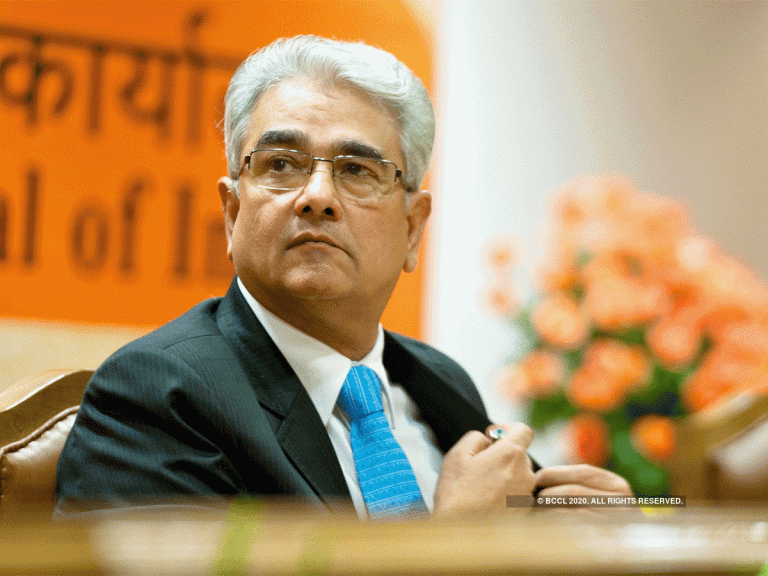
The Central Bureau of Investigation (CBI) has sought prosecution sanction from the Union government against former defence secretary and Comptroller and Auditor General of India Shashikant Sharma, former Air-Vice Marshal Jasbir Singh Panesar, and three other Indian Air Force (IAF) officers in connection with the UPA-era AgustaWestland chopper scam.
According to the reports, the CBI officials have approached the Defence Ministry seeking permission to prosecute Shashikant Sharma, Panesar, three others for their alleged involvement in the multi-crore chopper scam.
According to Section 19 of the Prevention of Corruption Act, it is mandatory for CBI to seek a prosecution sanction from the concerned department before filing a charge sheet against a government official.
Shashikant Sharma was Joint Secretary (Air) in the Ministry of Defence when the contract was under consideration. Sharma had reportedly finalised the operational requirements (OR) for the deal.
Sharma later became India’s defence secretary, between July 2011 and May 2013, and went on to become CAG till 2017. The alleged violations and kickbacks in the UPA era scam was one of the biggest controversies during the Manmohan Singh government.
Reportedly, the CBI has stated that the five officers had taken “key decisions” and were actively involved in the procurement process of VVIP chopper deal which took place during UPA-II.
The words “JS Air” – an alleged reference to the designation Joint Secretary (Air) had appeared in Italian court judgments in connection with AgustaWestland scam, as revealed by British middleman Christian Michel.
A second CBI officer speaking to Hindustan Times said that Panesar and the three IAF officers had played an important role in the purchase and testing of the AW-101 helicopters. The three other officers – Deputy chief test pilot SA Kunte, Wing Commander Thomas Mathew, and Group Captain N Santosh.
The CBI officer also added there have prepared a supplementary charge sheet against Shashikant Sharma, Panesar, Kunte, Mathew and Santosh, which now needs a prior government sanction. The charge sheet will also detail the role of about other officials and individuals that amount to conspiracy and violation under the prevention of corruption act, the officer added.
UPA era AgustaWestland Scam
India had signed a deal in 2010 under the UPA regime to buy 12 AgustaWestland AW101 helicopters for the service of the Prime Minister, the President and other VVIPs. It is alleged that some politicians and public servants had abused their official positions to reduce the service ceiling of the VVIPs helicopter from 6000 metres to 4500 metres to make AgustaWestland eligible for the contract and had awarded the contract for an amount of Euro 556.262 million in 2010. The deal was cancelled in 2013 after the scam was revealed.
Bollywood megastar Amitabh Bachchan causes quite a confusion on Twitter today, when he referred to someone as Ef Coky. As this is not a name of any known person, many people wondered if it was a typo by the meticulous actor. Many people also wondered if it was a “Covfefe” moment for Bachchan, an infamous misspelling in a tweet posted by US President Donald Trump in 2017.
Amitabh Bachchan has used the name while issuing a correction for the numbering for his tweets. The megastar is known for his discipline, he has been praised by his directors, costars and other colleagues for his punctuality. This quality of him can be observed in his Twitter account, where he meticulously numbers his tweets serially, which he had started with his first tweet. His tweet begins with a number with the prefix T, implying Tweet number.
But sometimes he makes a mistake in the serial numbering, where he either repeats or skips a number. But this mistake does not escape his scrutiny, and often he issues a correction tweet, rectifying the numbers. His correction tweets also get their own serial number. Although many people think that Bachchan is too much concerned about a trivial thing like a serial number of his tweets, it shows how he takes everything that he does seriously.
T 3656 – the T numbers have gone wrong .. please read T 3654, T 3655 ; and not as shown in Pic .. thank you Ef Coky pic.twitter.com/MIHZL6wHDH
In such a correction tweet numbered T3656 today, Bachchan pointed out that he had repeated the Tweet number T3654, and asked his followers to read his tweets with the rectified numbers. Along with this, he also thanked the mysterious Ef Coky, possibly a Twitter user who had pointed out his mistake.
Although people wondered if Bachchan made a typo in the name, that is unlikely, as he is meticulous about what he tweets. Moreover, if it was a mistake, he would have promptly issued a correction tweet, like he does for numberings.
We did a search for the mysterious name, and found a Twitter with the username Coky Amitabh EF, who describes herself as “Crazy Egyptian Fan of The Legend @SrBachchan” in the bio of the Twitter account. From the tweets, it is apparent that the user is a big fan of Bachchan. Although there is no tweet visible on the user’s timeline, Bachchan was perhaps informed about the mistake via Direct Message. It is notable that Bachchan follows the user on Twitter.
It is important to note that Amitabh Bachchan refers to his fans as Ef, which is the short form of Extended Family. He himself had explained this years ago. Therefore, the Ef in the username of Coky Ef refers to this extended family of Bachchan.
Last year in March, Amitabh Bachchan had posted a few videos from Vimeo made by this same Coky Ef, referring to the user as “My dedicated Ef”. He had informed that Coky Ef from Egypt had put together the videos celebrating 50 Years of Amitabh Bachchan.
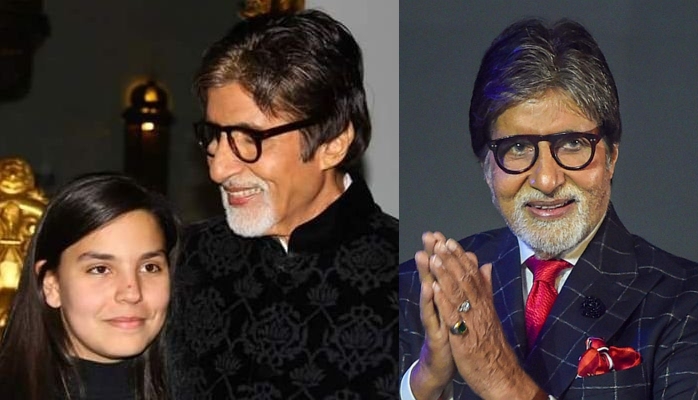
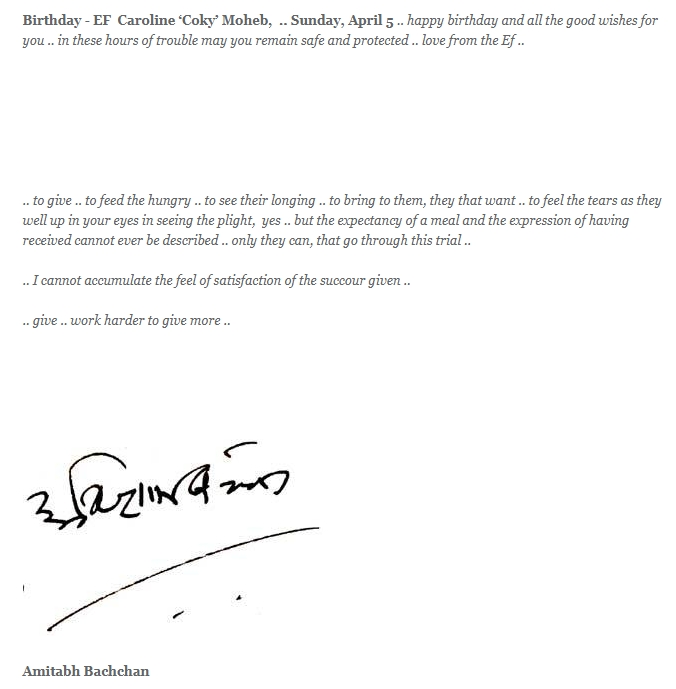
Amitabh Bachchan has also wished the user on her birthday multiple times. In April 2016, he had posted a birthday wish for his Egyptian fan Ef Caroline Moheb, referring to her as Coky on his official blog. This year on 4th April too, Bachchan had posted birthday wish for EF Caroline ‘Coky’ Moheb.
Birthday wish of Bachchan for Ef Coky
Therefore, it can be concluded that Ef Coky was not a Covfefe moment for Amitabh Bachchan. He was actually referring to his dedicated fan from Egypt named Caroline Moheb, who goes by the nickname Ef Coky.