Startling images of ruined expensive leather products have started to appear from Malaysian shopping centre as businesses in Malaysia reopens after over 50 days of lockdown due to the coronavirus pandemic.
Branded leather merchandise have been ruined by moulds after being left untouched in a Malaysian store as Malaysia prepares to enter its third month of coronavirus lockdown.
In the images, which have now gone viral on social media, leather products on display including shoes, bags and belts can be seen covered in mould.
Image courtesy Mothership
At a shopping mall in Penang’s Pulau Tikus, a travel and cold-wear store owner, Chong said it could have happened due to humidity. “As the mall temperature depends on the air conditioning, sometimes it may be humid when the cool temperature suddenly rises. This causes a sudden increase in water vapour in the surrounding air, making it more likely for mould to grow”, said the shop owner.
Malaysia’s movement control order (MCO) started on March 18 and has been extended until June 9.
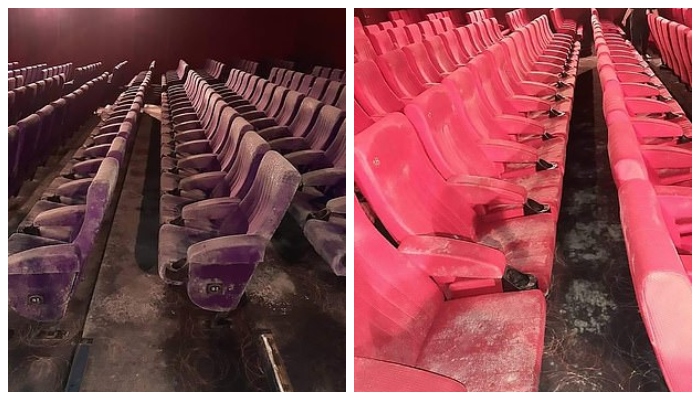
Earlier in the day it was also reported that a Malaysian cinema has been covered in mould after two months of coronavirus lockdown.
Image credit Mail Online
The cinema’s purple and red seats and its carpets had been covered by a thick layer of mould and dust, according to a photographer in the city of Ipoh in western Perak state.
With 6,742 cases and 109 deaths, Malaysia eased movement earlier this month but has kept tight restrictions on several areas where there have been new outbreaks of the coronavirus disease.
Union Finance Minister Nirmala Sitharaman on Wednesday unveiled the details of the Rs 20 lakh crore economic package under ‘Atmanirbhar Bharat Abhiyan’ announced by Prime Minister Narendra Modi in his address to the nation on Tuesday night.
Beginning her speech with a beautiful set of translations in Tamil, Malayalam, Telugu and Kannada for ‘Atmanirbhar Bharat Abhiyan’, Finance Minister Nirmala Sitharaman addressed the press conference to divulged details of the economic stimulus.
Finance Minister Sitharaman said the mission of Atmanirbhar Bharat Abhiyan is not to look inwards but to build a confident India which can rest on its strength and also contribute to global growth. The Finance Minister added that the mission is essentially to spurt growth and to build a very self-reliant India. This is why this whole initiative is called Atmanirbhar Bharat Abhiyan, added Finance Minister Nirmala Sitharaman.
Finance Minister Nirmala Sitharaman said that the Rs 20 lakh crore economic package will focus on land, labour, capital and enterprise. Five pillars of ‘Atmanirbhar Bharat’ are – economy, infrastructure, system, demography and demand” reiterated Sitharaman.
The Finance Minister also said that the mission is to get local brands to a global level. She added, “The Direct Benefit Transfer, Microinsurance schemes, PM Awas Yojana, PM Ujjwala Yojana, Swachh Bharat and Ayushman Bharat were all transformative reforms which have benefited the poor in a big way”.
Modi government is responsive, sensitive: Finance Minister
The Finance Minister said the Modi government has responded countless times to calls. “You are speaking to a responsive, sensitive government. Within hours of the lockdown announced by the PM, the Garib Kalyan Yojana was announced,” she added.
The government has also ensured that Rs 18,000 crore of refunds was given through a special drive to all taxpayers says Finance Minister.
Beginning today, over the next few days we will come before you (media) with team to put forth PM’s vision, said Finance Minister.
Relief to Micro, Small and Medium Enterprises (MSMEs)
In a major initiative, Finance Minister Nirmala Sitharaman announced Rs 3 lakh crores Collateral-free Automatic Loans for Businesses, including Micro, Small and Medium Enterprises (MSMEs). FM Sitharaman announced that collateral-free automatic loan to MSMEs will be given for a four-year tenure with 100% credit guarantee. The collateral-free loan is available till 31st October, said Finance Minister. The scheme will benefit 45 lakh units, allowing them to resume activity and safeguarding jobs, said Sitharaman.
“To provide stressed MSMEs with equity support, Modi government will facilitate the provision of Rs 20,000 crore as subordinate debt. Two lakh MSMEs are likely to benefit,” said Finance Minister.
She added, “All NPAs or stressed MSMEs are eligible for the scheme. The government will provide Rs 4,000 crore to CGTMSE who will provide a partial guarantee to banks who will then give benefit to stressed MSMEs”.
The Finance Minister also said that an additional Rs 50,000 crore equity infusion will be done for MSMEs through Fund of Funds. It will be operated through a Mother Fund and few daughter funds, which will help to expand MSME size as well as capacity, Finance Minister Nirmala Sitharaman.
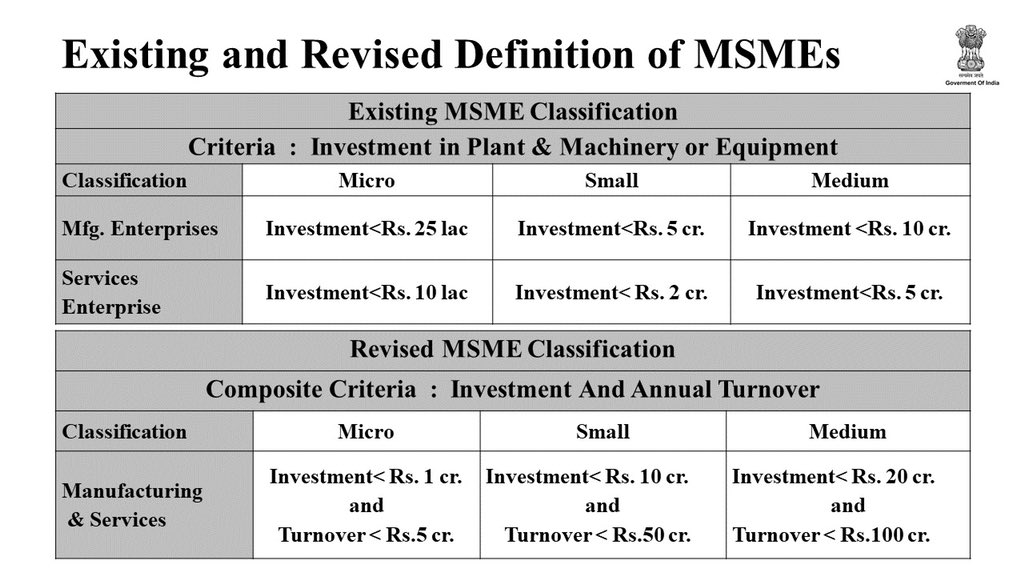
FM Sitharaman also said that the definition of the Micro, Small and Medium Enterprises will be changed to benefit the sector so that they can grow in size and get benefits. The investment limit which defined MSMEs revised upwards and additional criteria being brought in are turnover size – earlier differentiation between manufacturing and service MSMEs will be categorised similarly, said Sitharaman.
Image Source: PIB
In a big boost to MSMes, Finance Minister Nirmala Sitharaman on Wednesday announced that global tenders for government procurement tenders will be disallowed for tenders upto Rs 200 crore to enable self-reliant India.
“This will allow MSMEs a chance to supply for these big projects. Small units can be part of government purchases and now Self-reliant India can Make in India,” said Finance Minister Sitharaman.
Finance Minister said that government of Indian, including CPSEs to clear all dues to MSMEs within next 45 days. She also added that e-market linkage to be enabled for MSMEs due to absence of trade fairs and exhibition amidst coronavirus pandemic.
Measures on Employees Provident Fund
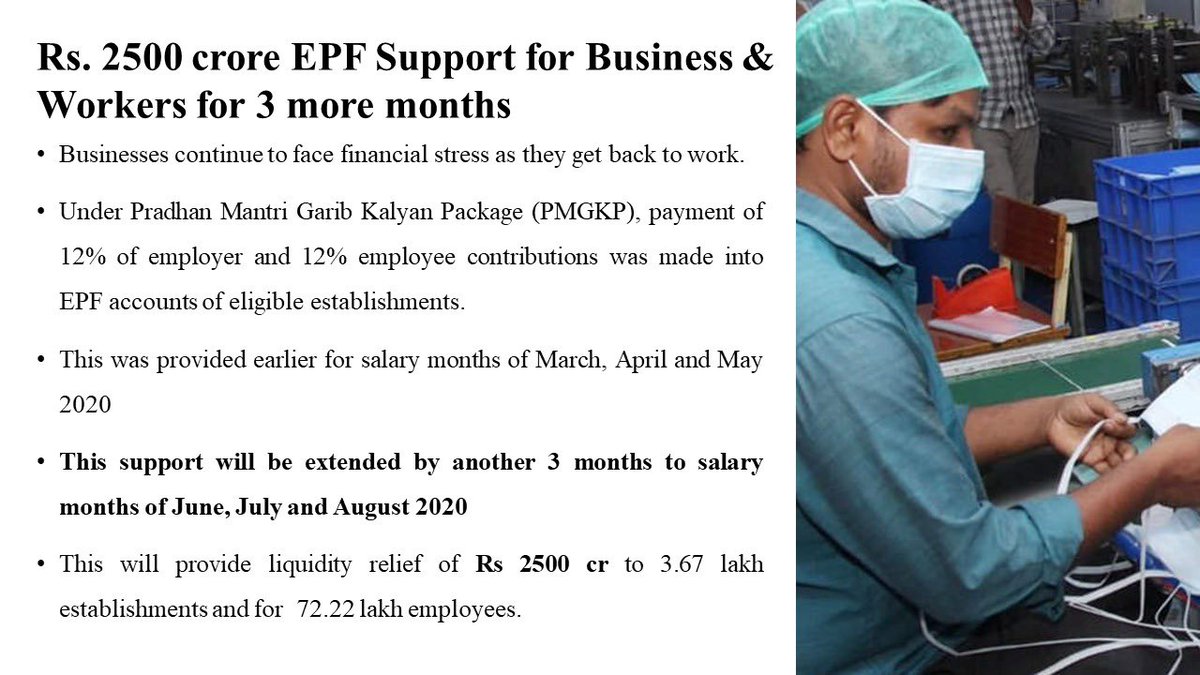
Finance Minister Nirmala Sitharaman also announced that Employees Provident Fund (EPF) relief measures for all establishments with Rs 2,500 crore liquidity support. She added that the Modi government will provide both employer and employee – 12% contributions.
She added that the relief will be extended for another three months from March-May 2020 to June-August 2020 as well which will benefit nearly 3.6 lakh establishments benefit and 72.22 lakh employees.
“In order to provide more take home salary for employees and to give relief to employers in payment of PF, EPF contribution is being reduced for Businesses and Workers for 3 months, amounting to a liquidity support of Rs 6750 crores,” the Finance Minister announced.
Image via PIB
Non-Banking Financial Companies, Housing Finance Companies and Micro Finance Institutions
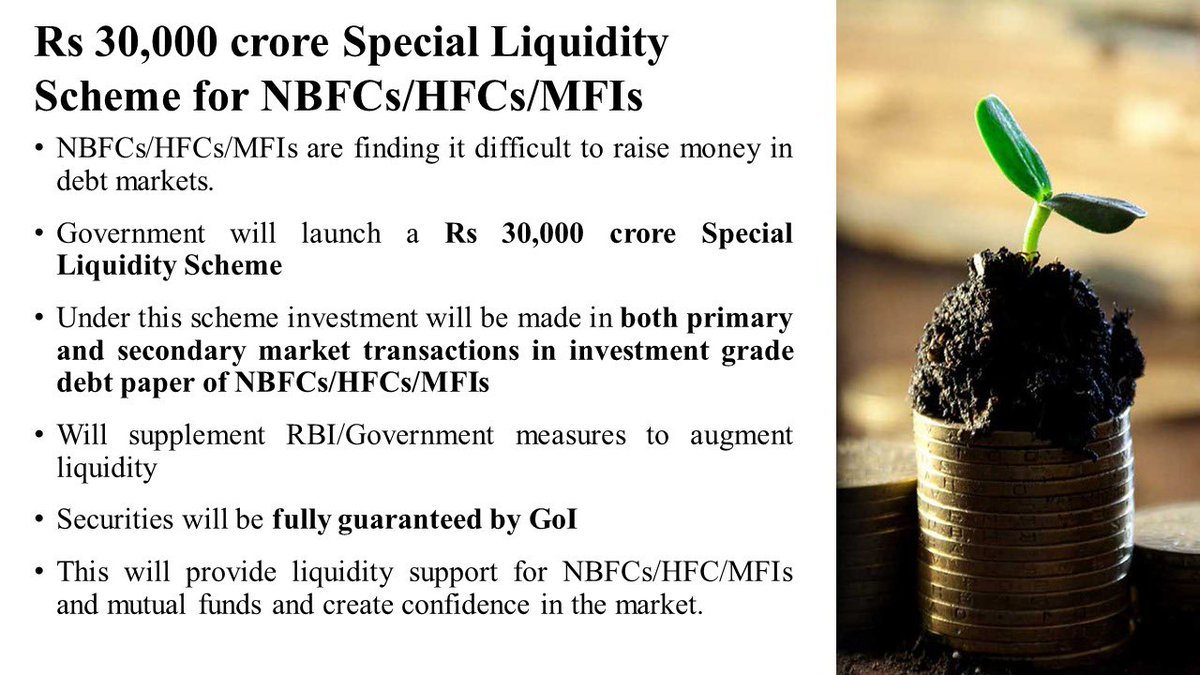
The Modi government has also announced of launching Rs 30,000 crore special liquidity scheme to NBFCs, MFIs and HFCs, where government will buy investment grade debt papers.
Finance Ministry also said that investment under the scheme can be made by both primary and secondary market transactions in investment grade debt paper of NBFC/HFC/MFIs.
“For NBFCs, HFCs and MFIs – Rs 45,000 liquidity infusion through a partial guarantee scheme. Will cover commercial papers and borrowings. First 20 per cent loss will be borne by guarantor – GOI. Double AA-rated paper and unrated papers will all be eligible,” announced Finance Minister Sitharaman.
Image via PIB
Electric Distribution companies (Discoms)
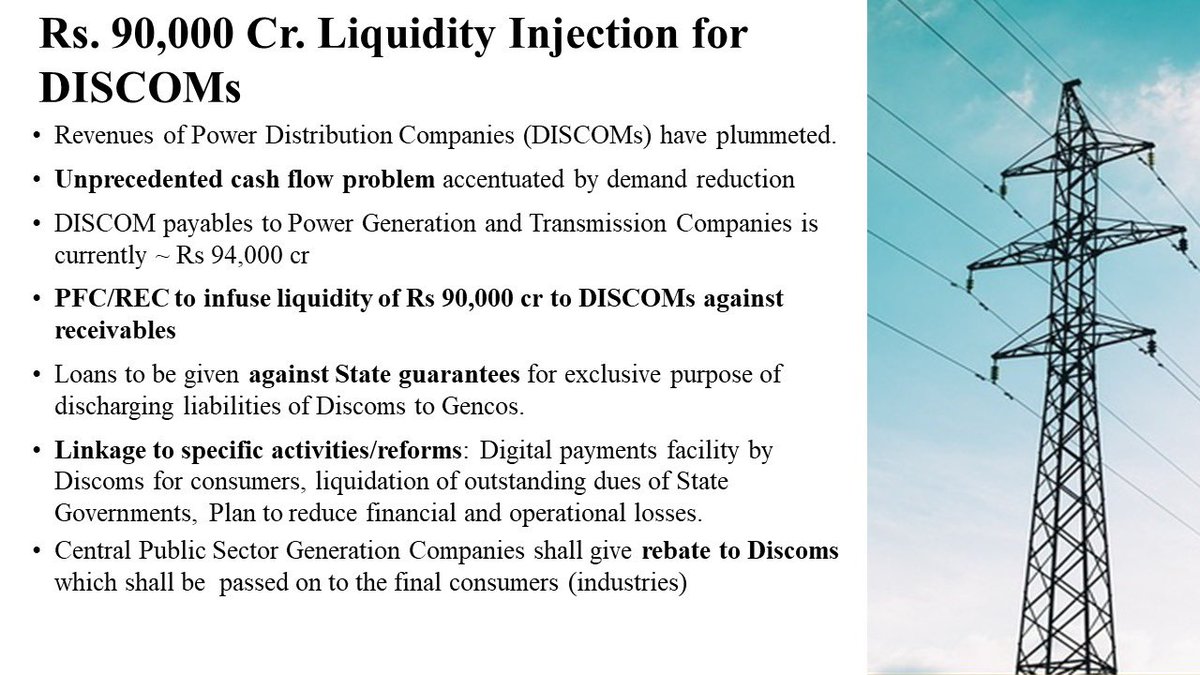
Announcing relief measures to Electric Distribution companies (Discoms), Nirmala Sitharaman said that to help those discoms which are facing unprecedented cash flow problems, unable to pay to the generation companies, a one-time emergency liquidity infusion of Rs 90,000 crore Power Finance Corporation and Rural Electricity Corporation is provided.
This will be a state-issued guarantee and rebate will be provided to those discoms that pass the benefit to end-customer, said Sitharaman.
Relief to Contractors
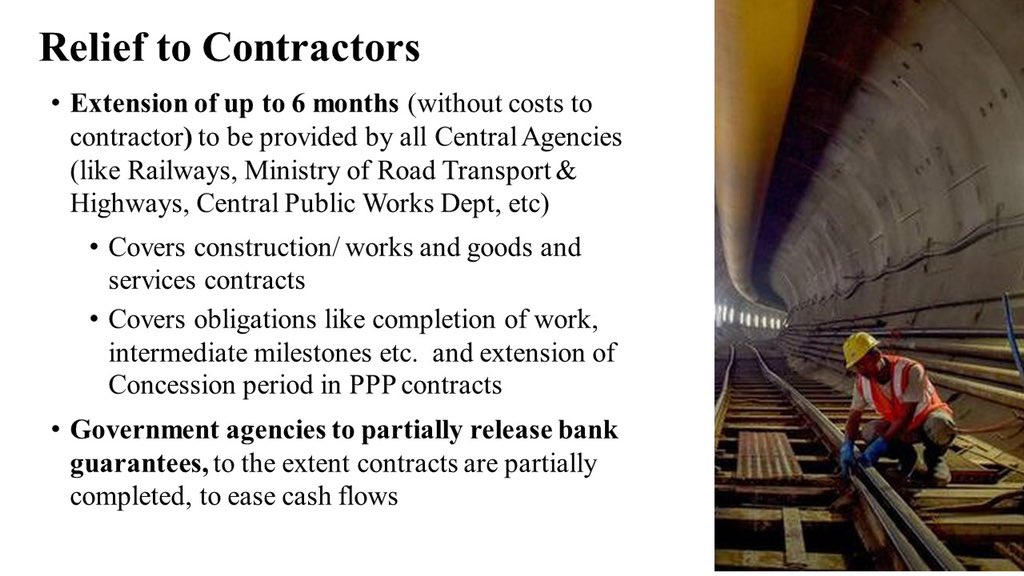
Finance Minister Nirmala Sitharaman announced relief measures for contractors. She said that all Union government agencies, such as Railways, highways or central public works, will give three to six months extension to all contractors without extra costs.
This will cover construction work and goods and services contracts, completion of works and intermediate milestones, and also the concessional period in PPP contracts, Finance Minister announced. The government added that to facilitate greater liquidity, government agencies will partially release bank guarantees to the extent of the completed contract so that cash flow improves.
Real estate sector
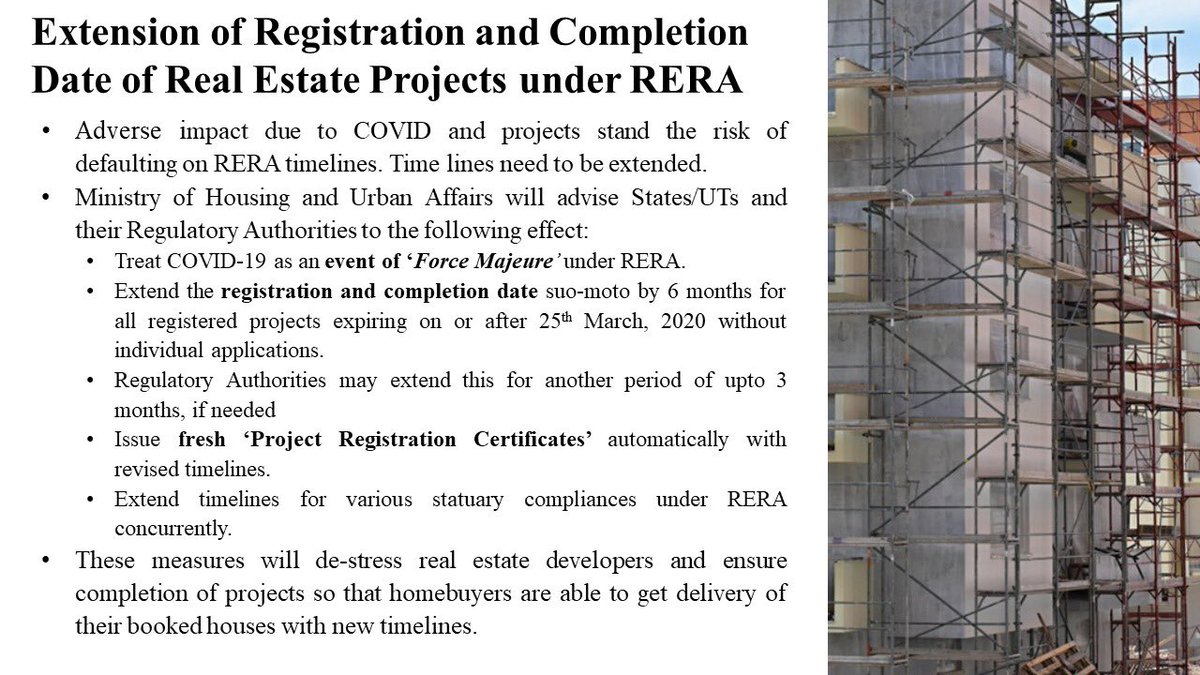
For the real estate sector, the government announced that the Urban Development Ministry shall issue advisories to states and UTs to treat the coronavirus period as an ‘Act of God’ and thus allow ‘force majeure. The government has also extended the registration and completion date suo-moto by 6 months for all registered projects expiring on or after 25th March 2020 without individual applications.
“These measures will de-stress real estate developers and ensure completion of projects so that homebuyers are able to get delivery of their booked houses with new timelines,” said Finance Minister.
Measures on TDS/TCS
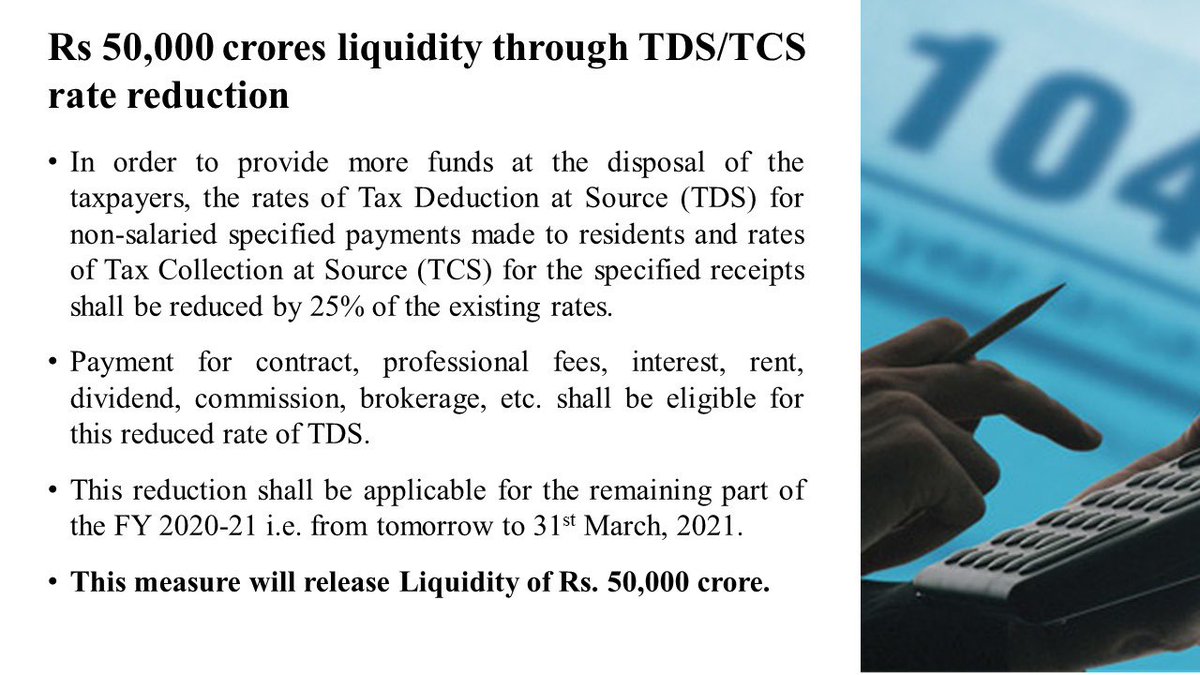
The Modi government also decided to infuse Rs 50,000 crores liquidity by reducing rates of TDS, for non-salaried specified payments made to residents, and rates of Tax Collection at Source for specified receipts, by 25% of the existing rates.
This is applicable on all payments – interest, rent, brokerage, supply, etc, which will be enforced from tomorrow till March 31, 2021. The reduction will release Rs 50,000 crore in the hands of people, added Finance Minister.
Date of filing Income Tax returns for Fiscal Year 19-20 extended
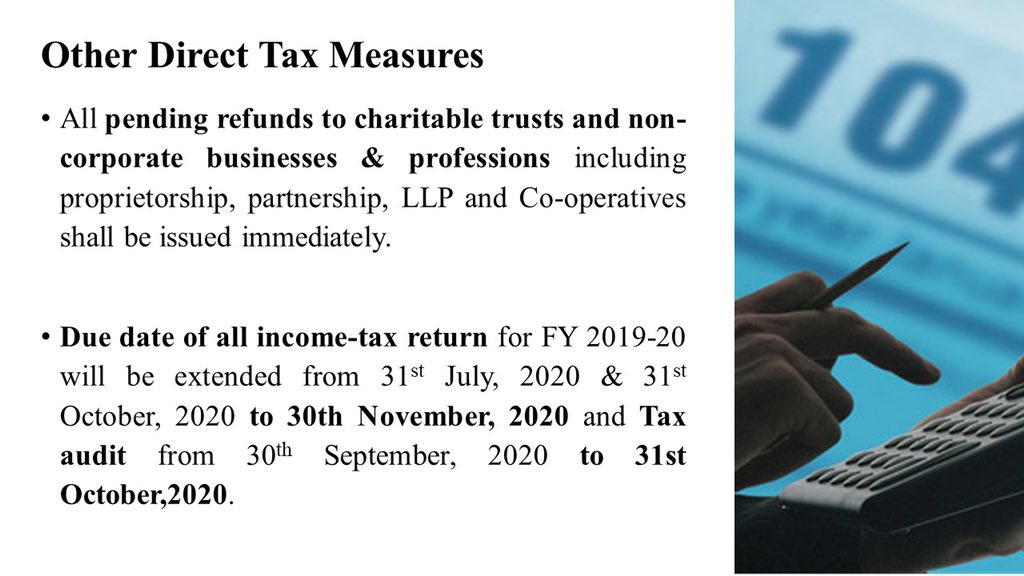
The Modi government announced that all due date of all income-tax return for FY 2019-20 will be extended from 31st July 2020 & 31st October 2020 to 30th November 2020 and Tax audit from 30th September 2020 to 31st October 2020.
“All pending refunds to charitable trusts and noncorporate businesses & professions including proprietorship, partnership, LLP and Co-operatives shall be issued immediately,” she added.
Finance Minister added that the date of assessments getting barred on 30th September 2020 extended to 31st December 2020 and those getting barred on 31st March 2021 will be extended to 30th September 2021. The period of “Vivad se Vishwas Scheme” for making payment without additional amount will be extended to 31st December, Finance Minister added.
‘Atmanirbhar Bharat Abhiyan’ – A mission for self-reliance
In his fifth address to the nation over the Coronavirus pandemic, on Tuesday Prime Minister Narendra Modi announced an economic package under ‘Atmanirbhar Bharat Abhiyan’ amounting Rs 20 lakh crore to revamp the economy which is facing a serious crisis due to the Chinese epidemic. The economic package includes the recent announcements made by the government and the Reserve Bank of India on supporting key sectors of the country.
In his speech, PM Modi said the economic package would be around the 10 per cent of the GDP.
“I announce a special economic package today. This will play an important role in the ‘Atmanirbhar Bharat Abhiyan’. The announcements made by the government on coronavirus, decisions of RBI and today’s package totals to Rs 20 lakh crore. This is 10 per cent of India’s GDP,” PM Narendra Modi said.
The Prime Minister also said the package would help every section of society, including workers, farmers, the middle class, industrial units and the MSME sector.
The stimulus will play an important role in the ‘Atmanirbhar Bharat Abhiyan’ (Self-reliant India Campaign), PM Modi said.
“India’s self-reliance will be based on five pillars — economy, infrastructure, technology-driven system, vibrant demography and demand. When India speaks of self-reliance, it does not advocate for a self-centred system. In India’s self-reliance there is a concern for the whole world’s happiness, cooperation and peace,” PM Modi said in his address.
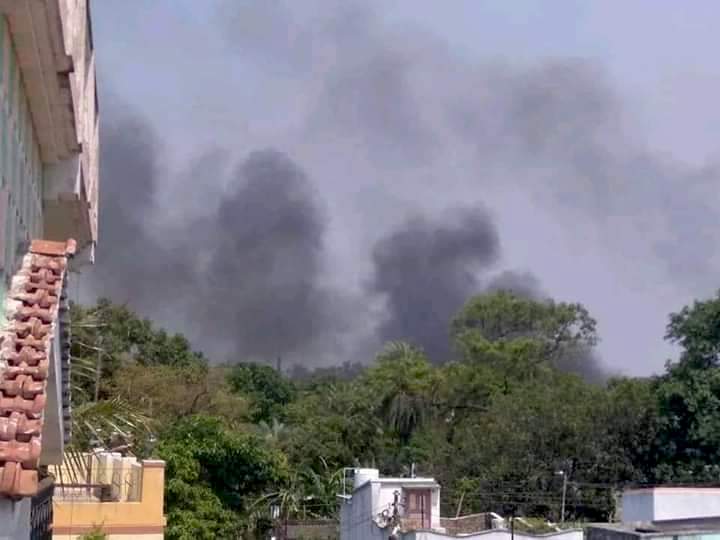
A local man resident of Telinipara of Hooghly district in West Bengal has alleged that Hindus has been tortured and attacked with sharp weapons and their houses were set on fire. The Telinipara area comes in Chander Nagar of Hoogly district. The area is recently in news due to communal violence.
Many BJP leaders made the same allegations. Kailash Vijayvargiya, who is in charge of BJP in West Bengal criticized Mamata Banerjee by sharing one video after another.
On condition of anonymity, a Telinipara resident said that a coronavirus positive case was found in Urdi market where people of both Hindu and Muslim community live. The husband and wife are currently undergoing treatment in Kolkata. The area is located near Victoria Jute mill. Some cases of coronavirus emerged in the Urdi market, which included husband and wife. They are undergoing treatment in Kolkata.
After the detection of these cases, 20 people associated with them were sent to be quarantined. The number of testing increased in the area from the 3-4 kilometers from the area influenced by Muslims.
The local person said that the sweet shopkeeper was also found corona positive following that he was also sent for treatment. The area was declared a containment zone. Then the police barricaded and appealed to other people to follow safety norms. But a local youth informed that the Muslims keep flouting the lockdown continuously during the month of Ramzan.
The area has also been in headlines earlier due to Hindu-Muslim tensions. A factory of illegal arms was also sealed in the area earlier. It is known that Muslims have their influence there and anti-social activities are happening continuously.
Reportedly, the Muslims were enraged when the local Hindus started putting up barricades to stop the movement of the people. Quoting Ramadan, they said that those people will come and go from ‘here’ only. The local man further said this: “Recently, the Muslims were first to protest against barricading police. After this, when Hindus started barricading, taking care of their safety, they were infuriated. It was raining heavily in the area 3 days ago. Amidst the rain, many Muslims came out on the road carrying swords and other weapons. During the rains, the Hindus were chased away, their houses were attacked and vandalized. Commissioner Humayun Kabir refused to listen to the suffering Hindus. Hindu shops were looted. Suraj Sau’s utensil shop was looted.”
In fact, after Suraj Sau’s shop was looted, he asked for permission to vacate his shop as he had no means of earning left and if something happens then how will they compensate for the loss. The police did not allow him to vacate his shop that was later set on fire.
When Opindia contacted him, he confirmed this news. Soon we will be bringing separate detailed report in this regard and will explain what happened to him.
There was also a jewelry shop near the Suraj Sau’s shop that was also burnt down. Seeing this unilateral attack on Hindus, Local BJP MP Loket Chatterjee swung into action and left Kolkata to reach the violence-affected area but police barred her to enter the area.
Locket Chatterjee also put this matter on social media. The local person said that the councilor in Telinipara is a Muslim and is also influential, hence this collusion with the police. It has also been alleged that Hindus get every punishment for the actions of Muslims there.
Suddenly, the police came back in the night, took some Hindus, and took them to jail. The locals said that a friend of him was taken away by police in the same manner. Even Hindus are targeted instead of Muslims who drive out the Muslims. He said that there’s an atmosphere of fear in the environment.
Although this is not a new thing for Bengal that is happening now. Locket Chatterjee kept calling the police but the commissioner did not pick up the call. She said that those who are sitting silently for a long time, the community which is doing nothing wrong- they are under attack. She alleged that these attacks are taking place from one side only. The MP said that due to Chief Minister Mamata Banerjee’s policy of Muslim appeasement incidents like Malda are repeated again and again.
Kailash Vijayvargiya also shared a video claiming that Hindus are being targeted by the people of the same community. Smoke and smoke can be seen all around in the video. People have seen this incident even from far away on the roof.
The local police administration has blocked the internet in the area till 17 May. Opindia has also found that many such videos are being shared on social media, in which it has been said there is atrocity by Muslims there. The same trend was seen in Delhi. The atrocities were committed on Hindus while all the media networks were engaged in proving Muslims innocent. Similarly from youtube to twitter, you’ll find many such videos regarding Bengal in which the local Muslims are playing the victim. This has been done to gain attention from a particular section of media.
The locals also claimed that the local temple in the area named Sheetla Mata temple was also vandalized. Temple was also set on fire whose picture has been taken by Opindia. However, no video related to this incident has been surfacing till now. A Hindu club was also burnt and Hindus buildings were demolished.
Police told local MP Locket Chatterjee that she will not be allowed to meet victims because she will go there to do politics. They told her that the atmosphere there will be deteriorating with her departure. The people there have accused the mainstream media of bias and said that media is not showing any interest in this whole matter.
It is being said that the Muslims there do not believe in social distancing that is why there is a fear of corona within the Hindus. Whenever they take preventive measures, the Muslims oppose it.
West Bengal Chief Minister Mamata Banerjee also said that people should stay in their homes and do not gather in hospitals, which shows that the health system has also collapsed. In this situation, it is obvious to fear the spread of the epidemic. On one hand, it is fear of pandemic while on other it is of spreaders of a pandemic.
Many people recorded the video when the atrocities were going on. One person recorded the video and pleaded for help and told that Muslims were hurling brick, stones, and bombs at him.
One person made a video of arson saying that Hindus there have been absolutely forced and nothing is being done to stop the atrocities by Muslims, Hindus are not even being listened to. Other people also made a video showing that the police are standing and supporting the mob as well. There are also some rumors about the firing.
The helpless people shot the video and informed the public about the situation there and said that if the Hindus will still not leave the place they will be either killed by them or they’ll have to commit suicide. People criticized the Chief Minister Mamata Banerjee and said, “Mamata Banerjee is supporting us a lot! Wow, the government of Bengal.” People clearly said that the police are wearing Bengals and Muslims are firing.
In another video, people are taking an injured Hindu who has been shot. the police are alleged of shooting him. His treatment was also not arranged and he was left on his own, after which the locals are taking care of him. In the videos, people are also seen talking about meeting of police and Muslims.
The hand of a Hindu was cut off, who was suffering from unbearable pain. The Administration did not make any arrangements for his treatment. 3 days after the incident, the eyes of Mamata Banerjee opened and she has spoken of strict action against the culprits.
Till now 56 people have been arrested in the Telinipara violence case and section-144 has been imposed in the area after which the additional soldiers were camping there. At the same time, the Trinamool Supremo did not desist from playing politics and claimed that the Union ministers are causing the problem here and they have conveyed this to the Prime Minister.
Giving details about PM Modi’s announced “Atmanirbhar Bharat Abhiyan” package worth Rs 20 lakh crores to restart the economy following the coronavirus induced lockdown, the Finance Minister Nirmala Sitharaman has announced a slew of measures to be taken by the government to alleviate the financial concerns faced by the MSME sector.
Finance Minister Nirmala Sitharaman announced that MSMEs will get collateral-free loans for MSME up to Rs 3 lakh crores with 4 years tenor. 100 per cent of the credit guarantee will be provided by the government to the banks and NBFCs on principal and interest. The scheme can be availed by the MSMEs till October 31, 2020. She said that this will enable 45 lakh MSME units to resume business and safeguard jobs.
— PIB India #StayHome #StaySafe (@PIB_India) May 13, 2020
Sitharaman further added that for the stressed MSMEs, Rs 20,000 crore liquidity will be earmarked by the government to benefit around 2 lakh MSMEs. Stressed and NPA MSMEs will be eligible for this facility. The government will provide a cover of Rs 4000 crore to CGTMSE which in turn will extend partial credit guarantee support to the banks.
— PIB India #StayHome #StaySafe (@PIB_India) May 13, 2020
Furthermore, the finance minister also declared that the capital of Rs 50,000 crores will be infused in MSMEs for their expansion through Fund of Funds and will be operated through a mother fund and few daughter funds. She added that this move will bolster MSMEs and help them in their size and capacity expansion. This measure will help MSMEs to get listed on the main board of Stock Exchanges, Ms Sitharaman asserted.
— PIB India #StayHome #StaySafe (@PIB_India) May 13, 2020
Besides, MSME gets a revision and the investment limit has been revised upwards and additional criteria of turnover is also being introduced. Manufacturing and Services sectors which were hitherto differentiated have been clubbed as per the revised definition.
— PIB India #StayHome #StaySafe (@PIB_India) May 13, 2020
As per the new definition, MSMEs with the investment and turnover less than Rs 1 crore and Rs 5 crores respectively will be categorised under Micro MSMEs. Small MSMEs will have the investment and turnover threshold of Rs 10 crores and Rs 50 crores respectively and the Medium MSMEs will have investment and turnover limit of Rs 20 crores and Rs 100 crores respectively.
A 78-year old man committed suicide by jumping off from the fourth floor of the Maharaj Tukajirao Holkar hospital in Indore on Wednesday morning. The hospital administration hast stated that the elderly patient was suffering from severe pneumonia in both lungs.
The hospital has clarified that the deceased patient was found coronavirus negative. It is suspected that he went into depression.
A 78-year-old man committed suicide by jumping off the fourth floor of MTH Hospital in Indore, Madhya Pradesh, at around 7:30 AM today. He was suffering from pneumonia & breathing problem: Indore Central Kotwali Police Station in-charge BD Tripathi pic.twitter.com/hiI4shAXll
As per reports, the elderly patient was admitted in the hospital for the last 19 days. The Doctor in-charge of MTH hospital Sumit Shukla said that Satyapal Ahuja (78) was under treatment in the fourth floor of the hospital. He suddenly jumped off the hospital floor. There was a window near his bed from he jumped down. He said that the elderly man was seriously injured in the incident and was put on the life support system. Despite all the efforts of the doctors, his life could not be saved.
The MTH Hospital has a 300 bedded facility for admitting Coronavirus patients. The hospital is categorized as Yellow category by the Health Department and is currently treating coronavirus patients too.
Shukla informed that Ahuja was admitted to the hospital on 24 April on suspicion of Covid-19. However, he was not found infected with the epidemic in the tests. He told that Ahuja was admitted to MTH hospital because he had severe pnuemonia in both of the lungs and due to difficulty in breathing he was being given oxygen from medical devices.
Indore has been the worst coronavirus affected city in Madhya Pradesh. The state has reported over 3600 coronavirus cases and only Indore has over 1800 of the total cases in the state.
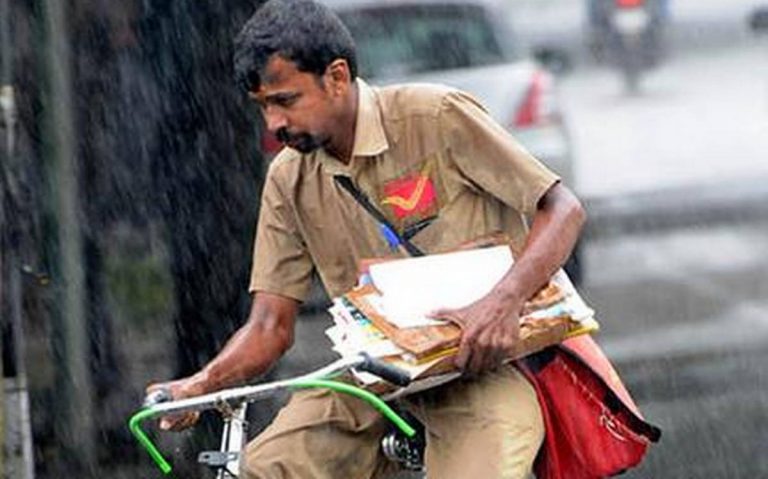
The India Post has achieved a new milestone in the history of Indian banking as postmen across the country have delivered Rs 1,000 crore in cash to various account holders of different banks at their doorstep across the country. In addition to this, the transactions of the post office savings bank amount to another Rs 66,000 crore in nearly four crore transactions during the lockdown period, reports Times of India.
According to the reports, nearly Rs 1,051 crore have been delivered in as many as 59 lakh transactions during the lockdown between March 23 and May 11. With 20 lakh Aadhaar enabled Payment Services (AePS) transactions, Uttar Pradesh alone has contributed one-third of these transactions.
The migrant labourers who have returned back to their respective states are driving these success stories ironically. In Uttar Pradesh and Bihar, the Indian Post has delivered Rs 274 crore and Rs 101 crore respectively, making it top two states in transactions. Gujarat, Telangana and Andhra lower down the order among top five best performers.
Migrants have opened 23 lakh new bank accounts
The migrants have also scripted another success story by opening 23 lakh new bank accounts with India Post Payments Bank (IPPB) during the lockdown period, including in backward and unbanked areas. The opening of such huge number of bank accounts at the India Post comes at a time when many financial institutions are struggling due to coronavirus pandemic, which has led to decrease in business operations.
The IPPB, which began its operation in September last year, has now emerged as the single largest platform for providing “interoperable banking services” to customer of any bank having their account linked to Aadhaar.
Speaking to Times of India, Pradipta Kumar Bisoi, Secretary, Department of Posts, had earlier said that more than two lakh postmen have been providing doorstep banking services to people through a network of 1.36 lakh post offices and 1.86 lakh handheld AePS devices.
Postmen using Aadhar infrastructure to enable easy banking
The postmen across the country are delivering cash by authenticating fingerprints at doorsteps – particularly in containment areas, migrant camps and hotspot zones, serving the sick, elderly and disabled through their Aadhaar enabled Payment Services (AePS), a wi-fi enabled device. Several old age pensioners and poor villagers are getting the benefit of cash deliveries of direct benefit transfer and PM Garib Kalyan Yojana credited to their bank accounts.
The payment bank of the India Post has developed a “PostInfo App”, through which a request for doorstep cash delivery can be made. The customers can also book doorstep service for speed post and collection of post office savings bank instalments through this app.
Madura Vijaya is an epic written in 14th century. Leftist historians would tell you that in medieval India, women had no right to study and in general their condition was pitiful. This particular epic was written by Ganga Devi, who was a witness to the events of this tale, which concerns her warrior husband Kumara Kampana II. We have already seen a glorious chapter of Indian History, how Maharana Pratap defeated Mughals, remains absent from history books. This is one such other chapter.
The rise of Vijayanagara
14th Century India was a time of flux. By 1320, the Khilji Empire had fallen and Tughlaqs had become the overlords of the Sultanate. Under Jauna Khan, laso known as mad King Muhammad Bin Tuglaq, the empire expanded greatly and reached to the farthest regions in the South. Kafur’s expeditions under Khilji had already weakened the Kingdoms of South. Tughlaq’s expeditions effectively terminated many kingdoms which had stood for more than a thousand years. But the conquest was temporary. Within a few years, Vijayanagara Kingdom arose from the ashes of Kakatiya Kingdom and extinguished all traces of Muslim Sovereignty in the South. This is one small portion of that story.
With the breakup of Tughlaq Empire, many Kingdoms arose in the South. The Vijayanagar was one of them but also there was the Madurai Sultanate in the south. Anyway, Vijayanagar was founded by two brothers of noble birth. Both had been captured and taken to Delhi by Tughlaqs. There they were converted to Islam. But at the first opportunity, they escaped to South and took refuge under sage Vidyaranya (later Jagadguru Shankaracharya of Shringeri). Vidyaranya converted them back into Hinduism and gave them a mission of reestablishing Hindu sovereignty in South India.
Harihara was the first King of Vijayanagara (now Hampi). After him Bukka Raya’s reign started. His son Akampana was a great commander and expanded his kingdom over all of South India, parts of Odisha, and parts of Bahmani Empire. Gandadevi was his wife.
Madurai Sultanate
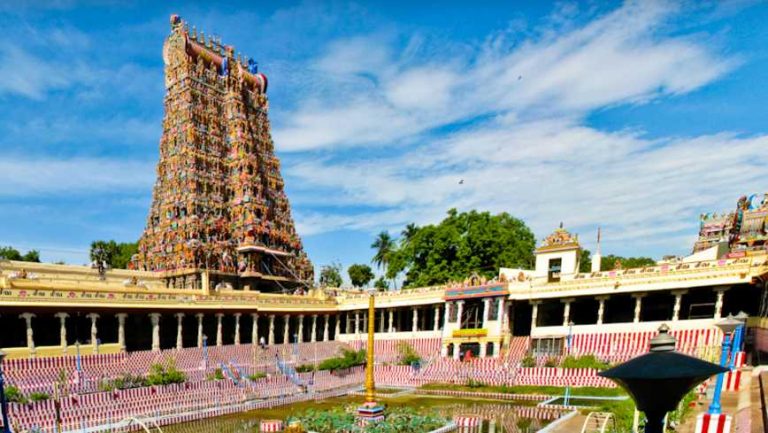
Madurai Sultanate was founded in 1335 with its capital at Madurai. As was the custom of Muslims, prayers in the Madurai temple were stopped. They destroyed many parts of the temple. The idol of Sundereshwar Shiva could be saved by a clever ruse of installing a replacement and walling up the sacred Garbhgriha. In Madura Vijaya, Gangadevi notes the decaying situation of the temple building, the destruction of Brahmanas, the defiling of sacred areas by cow-meat and liquor and general chaos wrought by the Turushkas (Turks). The atrocities against native populace were also recorded by Ibn Batuta, the famous Moroccan traveler, who visited it on his way to China. His book Rihla gives the following account:-
“THE HINDU PRISONERS WERE DIVIDED INTO FOUR SECTIONS AND TAKEN TO EACH OF THE FOUR GATES OF THE GREAT CATCAR. THERE, ON THE STAKES THEY HAD CARRIED, THE PRISONERS WERE IMPALED. AFTERWARDS, THEIR WIVES WERE KILLED AND TIED BY THEIR HAIR TO THESE PALES. LITTLE CHILDREN WERE MASSACRED ON THE BOSOMS OF THEIR MOTHERS AND THEIR CORPSES LEFT THERE. THEN, THE CAMP WAS RAISED, AND THEY STARTED CUTTING DOWN THE TREES OF ANOTHER FOREST. IN THE SAME MANNER, DID THEY TREAT THEIR LATER HINDU PRISONERS. THIS IS SHAMEFUL CONDUCT SUCH AS I HAVE NOT KNOWN ANY OTHER SOVEREIGN GUILTY OF. “
This is not the only, or the most heart wrenching account mentioned by him. Gangadevi also mentions similar conditions. Due to misrule, Madurai was also afflicted by famine and later plague.
Vijayanagara’s victory over Madurai Sultanate
The prince had his task cut out. But before conquering Madurai, it was important to be secure from the areas surrounding it. Accordingly, he first captured and made secure areas around Kanchipuram{near Chennai} which were held by a loyal Hindu vassal of Delhi Sultanate and then marched South. A curious element in the story is the royal sword of the Pandyas. It was presented to Kampana by a messenger. It represents the passage of sovereignty of the South from hands of Pandyas to Vijayanagaram.
Kampana reached the borders of the Sultanate. Madura Vijaya had started. The battle was fierce. In front of the experienced and mighty Vijayanagar army, the Sultanate forces were losing ground. To bolster their morale and to finish the battle, Sultan himself came into the field. India’s history is replete with instances where a battle almost won was lost due to incapacitation of the King or commander. One can remember the battle of Chandawar, in which Jaychand of Kannauj was winning against Delhi Sultan or later in 16th century, the defeat of Hemchandra Vikramaditya in Panipat{1556}. In both these battles, Hindu armies, on the brink of victory, lost as the King was unfortunately killed/incapacitated by a stray arrow. The leaderless armies lost in a rout. However, here fortune was with Kampana. A fierce battle ensued in which valiant Kampana first defeated the Sultan in a longbow duel. The sultan took a sword and attacked Kamapana. Dodging his blow, Kampana lobbed his head clean off his body in a single blow. The head of Muslim tyranny in South India was rolling in the dust. The body stayed on the steed for a little while, still clasping the reigns of the horse and the sword. The mission had been accomplished. This was the year 1378 of Common Era. The temple was reestablished, the damage undone. It would be beautified and enlarged by the vassals of Vijayanagar, Madurai Nayakas for many centuries yet. The temple and Matha at Srirangam was restored to its former glory.
Conclusion
South India would remain a stronghold of Hindus for another 200 years. Even after that, the rump state of Vijayanagaram and vassal states of Vijayanagar, Mysore Wodeyars, Madurai Nayakas etc. protected Dharma and the people from foreign depredations. The Mughals could never reach there. Only after rise of Hyder Ali, another threat appeared. However the Marathas succeeded in countering him and with English, finished his dynasty.
Madura Vijaya is above all the victory of Good over evil. Unfortunately, our textbooks have no place for such glorious episodes of history. Common Hindus are content with reciting stories of their so called 800 years’ slavery under Islamic invaders. This defeatism needs to be dispelled. Such heroic histories are a necessary part of a community’s renaissance and need to be told and retold.
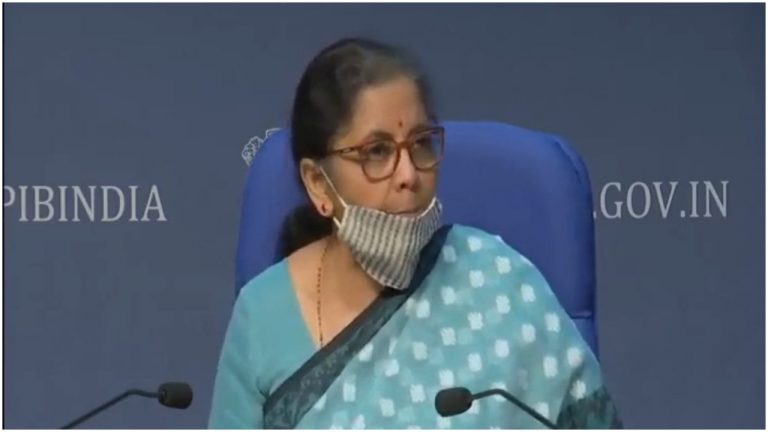
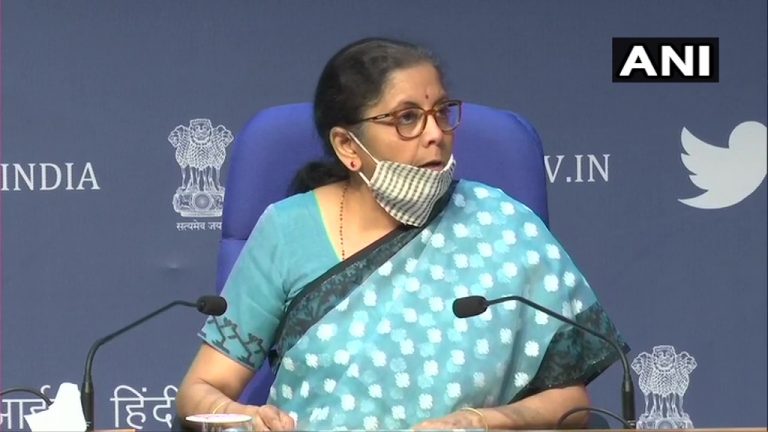
Finance Minister Nirmala Sitharaman addressed media today on the economic package for the Atmanirbhar Bharat Abhiyan.
Boost to MSMEs
Union Finance Minister Nirmala Sitharaman on Wednesday unveiled the details of the Rs 20 lakh crore economic package under ‘Atmanirbhar Bharat Abhiyan’ announced by Prime Minister Narendra Modi in his address to the nation on Tuesday night.
Finance Minister Nirmala Sitharaman said that the Rs 20 lakh crore economic package will focus on land, labour, capital and enterprise. Five pillars of ‘Atmanirbhar Bharat’ are – economy, infrastructure, system, demography and demand” reiterated Sitharaman.
In a major initiative, Finance Minister Nirmala Sitharaman announced Rs 3 lakh crores Collateral-free Automatic Loans for Businesses, including Micro, Small and Medium Enterprises (MSMEs). FM Sitharaman announced that collateral-free automatic loan to MSMEs will be given for a four-year tenure with 100% credit guarantee. The collateral-free loan is available till 31st October, said Finance Minister. The scheme will benefit 45 lakh units, allowing them to resume activity and safeguarding jobs, said Sitharaman.
On 12th May 2020, Prime Minister Modi in his address to nation gave a call for using made in India products and stressed on self-reliant economy. He urged people to consume more and more made in India products so as to achieve this goal.
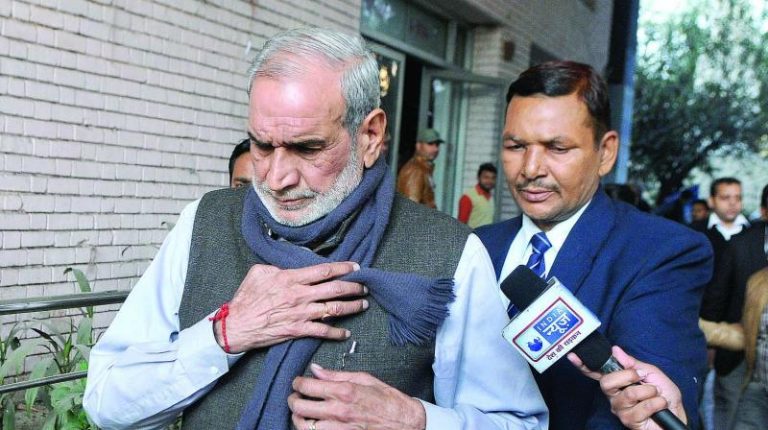
The Supreme Court Wednesday refused to grant any relief to 1984 anti-Sikh genocide convict and Congress leader Sajjan Kumar. The former Congress leader is currently serving life imprisonment for his involvement in the 1984 anti-Sikh genocide. The Supreme Court has said that it will consider the bail plea in July.
“We will consider your bail application in July, not now, sorry”, a three-judge bench headed by CJI Sharad Arvind Bobde said refusing to give immediate relief to Sajjan Kumar in the matter.
Quoting the AIIMS medical report, CJI Bobde said that Sajjan Kumar did not need any medical hospitalisation. “At the moment, we don’t want to decide on his bail application”, CJI added.
The Supreme court had, earlier, ordered AIIMS to conduct a medical examination in the former Congress leader after he had moved the apex court for an immediate bail plea citing that his medical condition had worsened. The bail application contended that the convict has been in jail from December 2018 and has lost 8-10 kilograms since then.
Advocate Vikas Singh, appearing for Sajjan Kumar, has raised the health issue in front of the three-judge bench to contend that his client’s bail plea remains pending.
The last bail plea of Sajjan Kumar was also rejected by SC
Sajjan Kumar’s last interim bail application was also rejected by the Supreme Court on February 14, 2020. The 3-Judge bench comprised of Chief Justice SA Bobde, Justice BR Gavai and Justice Surya Kant had highlighted that it would consider a medical report from the All India Institute of Medical Sciences (AIIMS) regarding Sajjan’s health condition. It reiterated that the plea for his bail would be heard during the summer vacations.
The former Congress leader was convicted in December 2018
Sajjan Kumar was one of the many Congress leaders involved in Anti-Sikh riots, post the assassination of former PM Indira Gandhi in 1984. He was convicted and subsequently sentenced to life imprisonment by the Delhi High Court on December 17, 2018. Kumar was charged under Section 302 IPC (murder), 120 B (criminal conspiracy), Section 153A IPC (communal hatred speech), etc. He was responsible for the murder of 5 Sikhs (Kehar Singh, Gurpreet Singh, Raghuvender Singh, Narender Pal Singh, and Kuldeep Singh in Delhi Cantonment area.
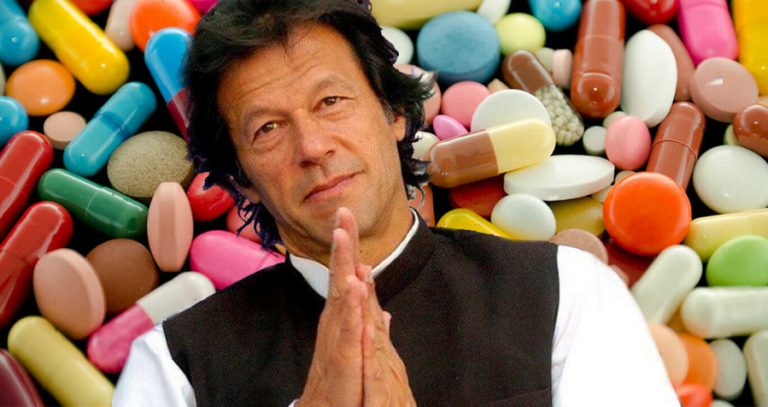
As coronavirus cases continue to rise in Pakistan with more than 33,000 active cases, Pakistan has decided to lift the ban it had imposed on importing Indian medicines and medicinal raw materials to prevent shortages, reports Economic Times.
According to the report, the Imran Khan-led Pakistan government has decided to import much-needed key life-saving drugs and vitamins to the country from India.
The list of drugs imported from India includes those to prevent or treat tuberculosis, polio and tetanus. Moreover, a number of vitamins, including B1, B2, B6, B12, D3 and zinc sulphate monohydrate have also been imported.
Following the decision of the Modi government to revoke the special status of Jammu and Kashmir under Article 370, the Pakistan government had decided to suspend all kinds of trade with India.
However, with the advent of the Chinese pandemic, the pharmaceutical industry in Pakistan had pleaded with the government to allow for a relaxation and sought clearance for goods already imported from India.
Pharma body in Pakistan demands import from India
Pakistan’s pharmaceutical industry had demanded that the ban on Indian medicines and medicinal raw material should be lifted because the country might face a severe shortage of medicines, especially life-saving drugs. The pharmaceutical body had warned the Imran Khan government that any attempt to disrupt the global supply chains related to the country’s pharma industry will hamper the country’s ability to treat coronavirus cases.
Pakistan Pharmaceutical Manufacturers’ Association senior vice chairman Syed Farooq Bukhari had suggested that the Imran Khan government should not take any decision to ban the import of medicine, raw material from India or from any other country at a time when there is an increase in coronavirus patients in the country.
With the grave threat of Chinese pandemic impacting Pakistan, the Imran Khan-led government has now allowed the import of a number of vitamins, drugs and medicinal salts from India.
Pakistan had sought Hydroxychloroquine from India
As the scourge of the Wuhan coronavirus intensifies in Pakistan, the Imran Khan government had earlier sought India’s help in combating the pandemic. Reportedly, Pakistan has formally requested India for the drug Hydroxychloroquine (HCQ), believed to be helpful in treating the coronavirus.
India is the largest producer of the anti-malarian anti-arthritis drug and had put a ban on its exports. However, after US President Donald Trump’s request for the drug and assurance of the manufacturers that India have sufficient stock cater to both domestic and export demand, India partially lifted the restrictions on its export and fulfilled several country’s requests for the HCQ tablets.