Home Blog Page 5392

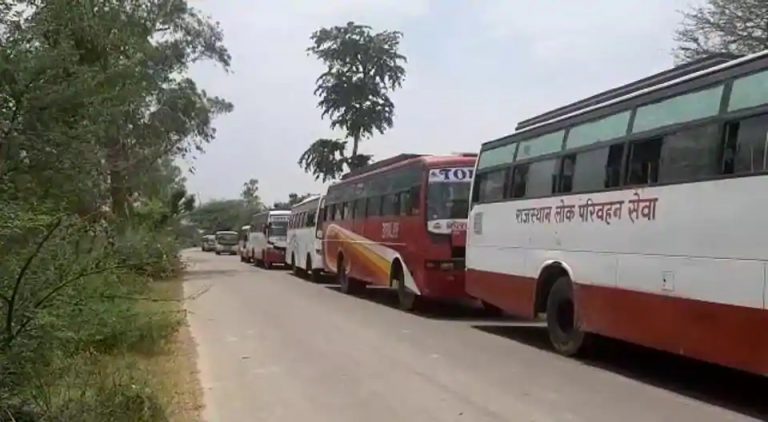
In the list of 1049 buses provided by Congress, 31 are three-wheelers, 69 ambulances/trucks and details of 70 vehicles unknown: UP government

Following the media reports that said that the list of buses provided by Congress to ferry migrant workers in Uttar Pradesh was erroneous and included autos, trucks and two-wheelers, the Uttar Pradesh government has officially acknowledged that the data they received from the Congress party indeed include details of such vehicles. According to a letter written by the Lucknow RTO department to Police Commissionerate Lucknow, a staggering 170 vehicles out of the list of 1049 are not buses as claimed by the Congress party.

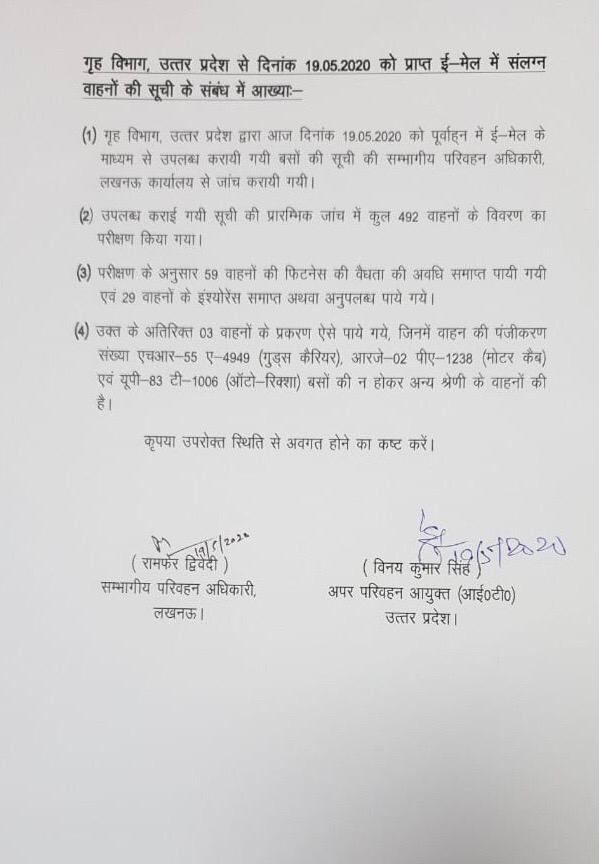
The letter addressed to the Police Commissionerate Lucknow categorises the different types of vehicles based on the list of buses provided by the Congress party. The analysis of the 1049 registration details of the vehicles revealed that 31 of them were registered as autos/three-wheelers, 69 of them as ambulances/school buses/trucks and there were no details available for 70 vehicles. Furthermore, it added that a vehicle with registration number RJ 51 PA 0288 was added in two lists.
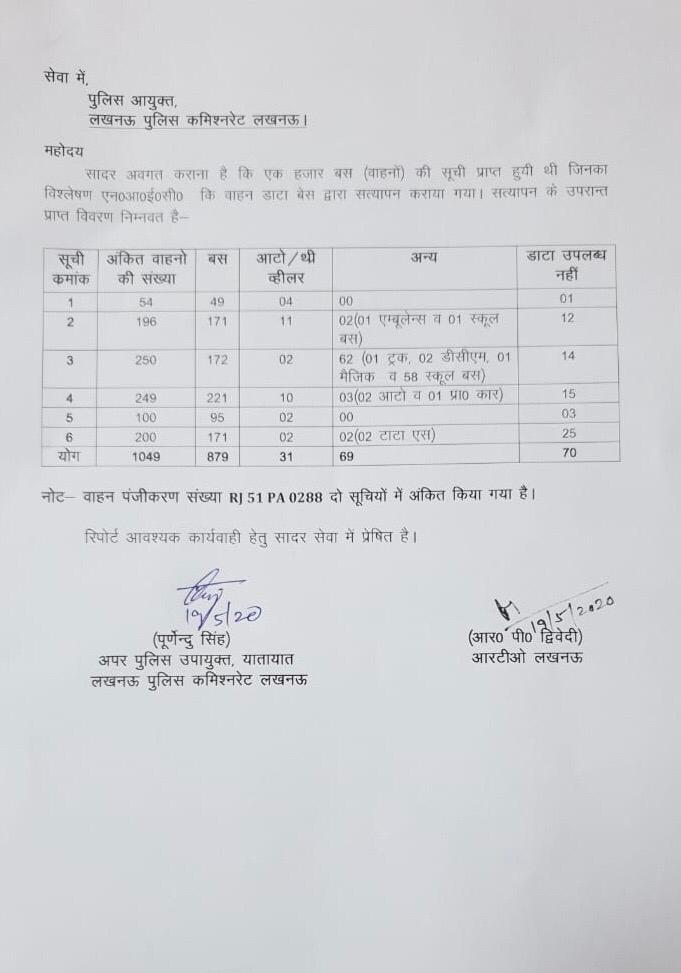
In addition, the preliminary inspection of 492 vehicles provided in the list of buses sent by the Congress party revealed that fitness validity of 59 vehicles has expired, while insurance of 29 vehicles have lapsed. Apart from this, the inspection of the data disclosed that three vehicles with registration numbers- HR 55 A 4949 (Goods carrier), RJ 02 PA 1238 (Motor cab) and UP 83 T 1006 (auto-rickshaw) did not belong the bus category.
Priyanka Gandhi Vadra issues clarification

After the above letters of the UP govt went viral on social media, Priyanka Gandhi Vadra took to Twitter to defend herself. She said that in the inspection by UP govt, it has been found that there are 879 buses in the list of 1049, thereby admitting that the rest 170 are not buses.

The Congress general secretary also alleged that UP govt has kept more than 500 buses blocked for several hours, and now more than 300 buses are arriving on the Delhi border. “At least let these 879 buses run”, she said. Priyanka Gandhi Vadra also assured that her party will provide a new list of 200 buses by tomorrow, and will made the buses available. “Inspect that list also”, she added.

UP government had agreed to Congress offer of buses

On Monday, the Uttar Pradesh government had accepted Congress General Secretary Priyanka Gandhi Vadra’s offer of providing 1,000 buses for migrant workers. The UP administration has written to Priyanka Gandhi Vadra to submit the details of the buses along with drivers and co-drivers so that the process can be started. On 16 May 2020, Priyanka Gandhi Vadra had tweeted a letter wherein she had written to UP government seeking permission to ply 1,000 buses for migrant workers. Accordingly, the Congress party had submitted a list of buses they intend to use with the UP government.

But in a major embarrassment to Congress, the list of ‘buses’ sent by Congress General Secretary Priyanka Gandhi claiming to be that filled with migrant workers stranded at Delhi-UP border contains blacklisted numbers, cars and even three-wheeled auto rickshaws.
Harassment of OpIndia and its Editors: A note from the CEO, Rahul Roushan

In the last few days, you would have noticed that we were the target of a coordinated attack from the usual suspects as well as from some unusual corners.

Attacks don’t bother us, in fact, if they don’t attack us, it seems like we are not doing something right. So first of all, thanks to the haters, keep attacking us. Whenever you’ve done that to people, they’ve grown bigger.

But when all is said and done, thanks a lot – this time in all seriousness and a heartfelt one – to you, our readers, our supporters, our people. To those who spoke up in support of OpIndia and the Editors Nupur Sharma and Ajeet Bharti. Not only did you speak up, so, so many of you actually put your money where your mouth is by extending monetary support.

After things settled a bit, I told both the editors that this was the only pressure they have to be under – the faith shown by people in them. Because it was an unprecedented level of support we had witnessed since the launch of the website. We are truly overwhelmed and humbled.No other means of pressure by haters are going to work.

This incident has only made both the editors come out stronger and more energized. And what was their mistake really? Ajeet’s mistake was that he trusted a grieving father’s words, while Nupur’s mistake was, well, that she lives in a particular eastern part of India. By the way, both were separate cases, related to entirely separate incidents with no connection to each other. Just a strange coincidence that it happened at the same time. Deliberate or design? We don’t know.

And as of now, we have been legally advised not to speculate or debate it in public. So that is for the future. I am not saying that they can’t make mistakes, and when our well-wishers like you would point them out, they will make amends. But this time, their only mistake was that they were standing on the wrong side of the ideological divide. But that stand is non-negotiable. That’s what is the soul, the identity of India. That’s not going to change.

So a heartfelt thanks once again for the support shown to the team. We won’t be anywhere without you. Stay there, and we’ll say here. Firmly. Forever.

Rahul Roushan,
Something at OpIndia.

‘Coronavirus is not a pandemic in the country’: Pakistan’s Supreme Court lifts restrictions, orders all markets to be opened

While hearing a suo moto case, a 5-Judge Bench of the Supreme Court of Pakistan has reportedly directed all markets and shopping malls to open, amidst the Coronavirus outbreak that has claimed 903 lives and has infected 42,125 people in the country.

The Bench comprising of Chief Justice of Pakistan (CJP) Gulzar Ahmed, Justices Umar Ata Bandial, Mazhar Alam Khan Miankhel, Sajjad Ali Shah and Qazi Muhammad Amin Ahmed noted that there was ‘no logic’ behind keeping malls closed.

The apex court of Pakistan has also asked the provincial governments to not create hindrance in opening up markets and malls while ensuring implementation of standard operating procedures (SOPs). The Bench also ruled that keeping markets closed on Saturdays and Sundays was a violation of the Constitution.

Reportedly, the Karachi administration had earlier sealed shops due to overcrowding, after restrictions were eased by the Government. The Supreme Court, however, has now prevented the Karachi Commissioner Iftikhar Shallwani from sealing shops and instead directed him to implement SOPs.

The Bench also rebuked Pakistan’s Disaster Management Authority for spending too much money on the Coronavirus. The Court observed, “There are other serious ailments prevailing in the country, from which people are dying daily and those ailments are not being catered and the coronavirus (Covid-19), which apparently is not a pandemic in Pakistan, is swallowing huge money.”

Coronavirus in Pakistan

On Monday, Pakistan reported 1,974 new cases of Coronavirus. According to the Health Ministry, there are 42,125 active cases in the country. A total of 11,922 patients have been recovered while 903 people have lost their lives. The Sindh province has the highest number of cases (16,377), followed by Punjab (6,061).

According to Planning Minister Asad Umar, Pakistan which is currently conducting 25,000 tests per day has a capacity to increase testing up to 30,000 per day. As of May 18, a total of 387,335 tests have been conducted in the country. Transport facilities have been allowed, domestic flight services have been partly allowed. Railway Minister Sheikh Rashid Ahmed has now demanded the resumption of trains.

Doctors Concerned

Doctors in the country have criticised the move to lift curbs that were imposed initially, in the wake of the Coronavirus outbreak. They fear that it can rapidly transmit the deadly virus and overburden the health sector. “It will definitely lead to an increase in the number of cases, the number of critical cases. “We are concerned about the pressure that will come on the hospitals”, Salman Kazmi, Secretary of Young Doctors’ Association, was quoted as saying.

Pakistan imports medicines from India

Earlier, the Imran Khan-led Pakistan government had decided to import much-needed key life-saving drugs and vitamins to the country from India. The list of drugs imported from India included those to prevent or treat tuberculosis, polio, and tetanus. The Pakistan government had decided to suspend all kinds of trade with India, following the Indian government’s decision to abrogate Article 370 in Jammu and Kashmir.

Following the coronavirus crisis, Pakistan’s pharmaceutical industry had demanded that the ban on Indian medicines and medicinal raw material should be lifted because the country might face a severe shortage of medicines, especially life-saving drugs. The pharmaceutical body had warned the Imran Khan government that any attempt to disrupt the global supply chains related to the country’s pharma industry will hamper the country’s ability to treat coronavirus cases.

Imran Khan hoped for a monetary relief

In March, the Pakistan Prime Minister Imran Khan has urged the international community to consider for a debt waiver for poor and vulnerable countries like his. During the interview with The Associated Press, Khan claimed that the coronavirus will devastate the economies of developing nations, and as a result, richer economies must write off the debts of the world’s poorer countries which includes Pakistan. “My worry is poverty and hunger,” Khan said. “The world community has to think of some sort of a debt write-off for countries like us, which are very vulnerable, at least that will help us in coping with (the coronavirus).”

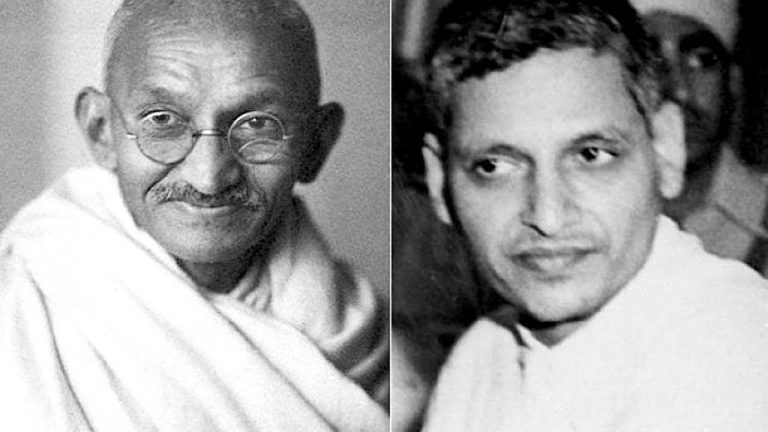
Hindus should never be angry against Muslims: Gandhi’s non-violence, Godse’s speech and Koenraad Elst’s analysis

The 19th of May 2020 is the 110th birth anniversary of Nathuram Godse. Very little is known or spoken about the actual views and opinions of Mohandas Karamchand Gandhi’s assassin and discussion surrounding him relegated to calling him a monster and a bigot or a Hindu terrorist. In this article, we shall discuss non-violence as preached by Gandhi, from the perspective of Koenraad Elst and his analysis of the courtroom speech of Nathuram Godse on the issue of Gandhian nonviolence.

Why Gandhian non-violence was a failure- Godse and Elst

“On the issue of non-violence, not Godse but Gandhi was the fanatic.” says Koenraad Elst in his book ‘Why I killed the Mahatma’. In the book, Elst presents an analysis of Nathuram Godse’s courtroom speech, where Godse presents his plea to the Indian judiciary. One of the issues which Nathuram Godse extensively covers in his speech is the issue of non-violence and Gandhi’s mishandling of the same.

In Godse’s speech, paragraph 56, he says ‘(…) To imagine that the bulk of mankind is or can ever become capable of scrupulous adherence to these lofty principles in its normal life from day to day is a mere dream.’

’56. (…) I could never conceive that an armed resistance to the aggressor is unjust. I will consider it a religious and moral duty to resist and if possible to overpower such an enemy by the use of force.’

’59. (…) Gandhiji himself was guilty of glaring breaches of his much-valued ideals.’  

Here, Godse presents a threefold criticism of Gandhian non-violence. Firstly, as Elst analyses, Gandhi’s absolute non-violence was a lofty and impractical ideal. In fact, “Honour, duty and love of one’s own kith and kin and country might often compel us to disregard non-violence.”, says Godse. Secondly, non-violence is sometimes morally wrong. The fact that Gandhi uses the example of the Gita as a precedent to non-violence is absurd since the Gita was recited by Krishna in order to convince Arjun to fight against unjust aggressors. Thirdly, in many instances, Gandhiji himself broke the principle of non-violence, making the central ideal of the Gandhian independence movement, inconsistent.

The fanaticism of Gandhi

Let us start the criticism of Gandhian non-violence by simply quoting Gandhi in his post-prayer speeches. Godse mentioned these quotes in his plea as well.

‘93(b). (…) Hindus should be never angry against the Muslims even if the latter might take up their minds to undo even their existence.’

After the partition, referring to violence against Hindus in Pakistan, Gandhiji said, ‘I asked them why they all came here (to Delhi). Why they did not die there? (…) Let us die if the people kill us, but we should die bravely with the name of God on our tongue.’ This is quite ironical since Gandhiji’s God himself would ask him to fight whenever there’s a decline in righteousness.

“यदा यदा हि धर्मस्य ग्लानिर्भवति भारत ।
अभ्युत्थानमधर्मस्य तदात्मानं सृजाम्यहम् ॥४-७॥
परित्राणाय साधूनां विनाशाय च दुष्कृताम् ।
धर्मसंस्थापनार्थाय सम्भवामि युगे युगे ॥४-८॥”

He also suggested that in the killing of Hindus in Pakistan, it is the Hindus who had gained something, since ‘the killers were none other than our Muslim brothers.’ He made similar comments to the Hindu refugees from West Punjab, asking them to return home, even if they die in doing so. Hence, not only is Gandhian non-violence misplaced, radical and not in-tune with Hindu teachings, it is also unjustly applicable only when Hindus are subject to communal violence.

Ineffectiveness of non-violence and the Quit India Movement

The first and most obvious instance of the ineffectiveness of non-violence may be the Quit India Movement of 1942. Elst believes that the Quit India movement was the “height of folly given the circumstances”, considering the fact that Britain was at war and had an army at the ready. Hence, the Quit India movement gained Congress nothing but mistrust of the British Government, who sided with the Muslim league more heavily thereafter.

As far as the failure of non-violence in the movement is concerned, Godse says, ’66. In the Province of North Bihar, there was hardly a railway station which was not burnt or destroyed by the Congress non-co-operators; but in spite of all the opposition of the Congress, the Germans were beaten in April, 1945 and the Japanese in August, 1945. (…) The “Quit India” campaign of 1942 had completely failed.’ Not only this, but the suspension of the campaign marked the end of the struggle against Muslim separatism since in return for Office, Congress surrendered to Jinnah and the idea of a separate Muslim state. Gandhi realised his mistake and did penance after the movement, knowing that he could not control the violence ignited by his own campaign.

Inconsistency of Gandhi’s non-violence

Gandhi himself didn’t adhere to his principles of non-violence in many instances. This was shown in both the World Wars. In the first World War, Gandhi led recruitment efforts for the British army, hence implying his support for a violent and bloody war. In World War II as well, he took up a contract for supplying blankets to the Army from the Congress Khadi Bhandar.

According to Godse, Gandhi missed ‘103. (…) a golden opportunity for Gandhiji to show the power of his Satyagraha’ during the Pakistani invasion of 1947. ‘101. (…) It was only on the consent of Gandhiji that Pt. Nehru sent troops for the protection and defence of Kashmir.’ Gandhiji was fasting because ‘104. (…)a few Muslims could not live safely in Delhi. But he was not bold enough to go on fast in front of the raiders of Kashmir. (…) All his fasts were to coerce Hindus.’, says Godse.

Conclusion

Godse said that the ideals of non-violence are ’56. (…) implicit in every constitutional and public movement’, but Gandhiji made his version of non-violence ineffective, absolute and communal and thus, faltered.

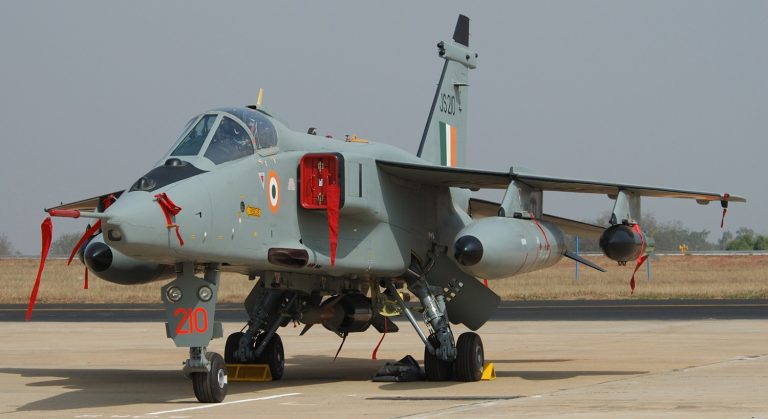
Indian Air Force shelves three acquisition projects worth over Rs 8,000 crore to support Make in India and due to high cost

The Indian Air Force has decided to suspend three major acquisition projects worth a total of 8,000 crore rupees. Air Marshal RRKS Bhadauria has said that there various reasons for each project which will not be carried forward. The projects which have been suspended include the Air force’s plan to buy 38 Swiss Pilatus basic trainer aircraft, 20 additional Hawk planes from Britain, and a plan to upgrade 80 Jaguar fighter planes with engines from America.

While speaking to ANI, Air Marshal RKS Bhadauria said, “We are not going forward with the additional Pilatus basic trainer aircraft that we were intending to buy. Additional Hawks (trainer aircraft) were in the plans but at this moment it is also decided to be shelved. There was a Jaguar re-engineering plan which was totally imported and that project is also shelved.”

“We are going to go in HAL support and some other engine related upgrades that will help see through the fleet”, the IAF Chief further added. He informed that there are various reasons behind suspending the projects, including support for the Make-in-India initiative.

As state-owned Hindustan Aeronautics limited is in advanced stages of development of the HTT-40 trainer planes, the plan of acquiring 38 additional Pilatus Basic Training aircraft worth rupees 1000 crores was decided to be shelved. The Air force chief said the force would be buying 70 of these Made-in-India planes instead.

The 20 additional Hawk plane deal expected to be worth around rupees 2000 crores has been shelved because the project was stuck for over 3-4 years now mainly over the price of the planes.

Another project relating to Jaguar re-engining was also shelved. The plan was to refit Jaguar fighter aircraft with F-125IN engines from US-based company Honeywell corporation. The Jaguar degradation plan was pending for a long time as India believed that the price quoted by Honeywell for the engines was too high.

According to reports, Honeywell was charging $2.4 billion for 180 engines, which include 160 engines for 80 twin-engine Jaguars, and 20 spare engines. That amounts to $13.3 million (Rs 95 crore) per engine. This would have meant that the cost of refitting one Jaguar would be Rs210 crore, including Rs 20 crore to be taken by HAL for the job. Due to the statement over the cost, IAF had put the plan on hold last year, and now the same has been cancelled.

On the other hand, Honeywell was unwilling to reduce the price alleging that IAF is not serious about the deal, due to the long delay the negotiations saw. The company said that they spent $50 million on the project including the purchase of two old Jaguars to integrate the engines, and spent another $50 million in contract-related cost. The company had said that it is unwilling to spend any more money on the project.

Indian Air Force plan to to acquire 450 fighter aircraft 

India plans to acquire 450 fighter aircraft for deployment on the northern and western frontiers of the country in the future.

The list of aircraft planned to be inducted by the Air Force includes 36 Rafales, 114 Multirole Fighter Aircraft, 100 Advanced Medium Combat Aircraft (AMCA) and Over 200 variants of Light Combat Aircraft.

Adding that the induction of these fighters would take place over a period of the next 35 years as the inductions have to be planned to keep in mind future requirements. The IAF chief said, “In the next 15 years, 83 LCAs are our primary focus after that LCA Mark 2 will come in we are looking at close to 100 of those, that makes it near 200 of LCA class.” 

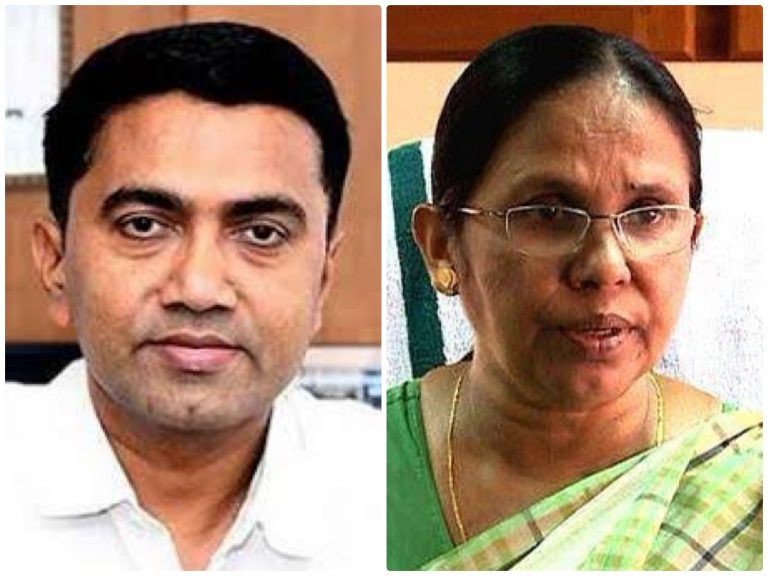
‘Union Territory’ of Goa doesn’t have enough facilities to treat coronavirus, claims Kerala health minister, Goa CM calls out her claims

The chief minister of Goa, Dr Pramod Sawant has objected to the Kerala Health Minister KK Shailaja stating factually incorrect remarks against Goa and casting aspersions on the state’s preparedness to tackle the coronavirus crisis.

Shailaja claimed in an interview that the total deaths in Kerala is 4, one of which had come from the “Union territory of Goa” to Kerala for the treatment of his COVID-19 because of lack of sufficient hospitals to treat coronavirus in Goa.

“Kerala had so far seen only 4 deaths, out of which 1 person had come from the ‘union territory of Goa’ because there were not sufficient hospitals to treat coronavirus cases. The central government is adding that count to our tally but that person came to Kerala for treatment and was already carrying the infection from the union territory of Goa,” Shailaja said in an interview to the BBC.

In a series of tweets posted on Twitter, the Goa chief minister expressed his ire over the erroneous statements made by Ms Shailaja in an interview to the British public service broadcaster BBC.

Goa CM Pramod Sawant claimed that he was greatly horrified to see the Kerala Health Minister utter fallacious assertions in her interview with the international news organisation.

Mr Sawant clarified that the person in question was not from Goa and the same was confirmed by the Kerala IDSP team, nor had he travelled from Goa because of lack of facilities in the state to deal with the coronavirus.

He further added that Goa has a dedicated COVID-19 hospital to cope up with the pandemic and 7 patients who were diagnosed with the deadly contagion have all recovered after receiving treatment from the said hospital, adding that the hospital continues to treat patients from Goa as well as other states.

“Goa has outstanding healthcare facilities with Goa Medical College being one of the oldest and finest medical colleges in Asia. For decades, we have been treating a large number of non-Goan patients, especially from our neighbouring states for different ailments,” Sawant further tweeted.

Lastly, Sawant also reminded the Kerala Health Minister that Goa is a full-fledged state like Kerala and not a Union Territory of India as she was referring to it in her interview with the BBC.

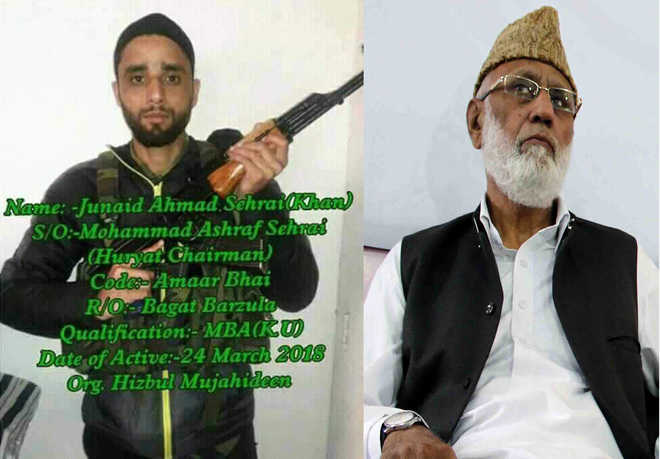
Tehreek-e-Hurriyat Chairman Mohammad Ashraf Sehrai’s son Junaid Sehrai among two terrorists killed in Srinagar encounter

The Indian Armed Forces today neutralised two Hizb-ul-Mujahideen terrorists, including the son of the Kashmiri separatist and Tehreek-e-Hurriyat chairman Mohammad Ashraf Sehrai, in an encounter in Srinagar.

The encounter broke out on the intervening night of May 18-19 in Nawakadal area in Srinagar. A Jammu and Kashmir police constable lost his life in the encounter while a CRPF jawan and two others sustained injuries.

Of the two terrorists killed in the encounter, one of them was identified as Junaid Sehrai, the son of Tehreek-e-Hurriyat chairman Mohammed Ashraf Sehrai. Junaid Sehrai was a divisional commander of Hizb-ul Mujahideen and was also responsible for several terror activities in Central Kashmir. The second terrorist was Tariq Ahmed Sheikh of Pulwama who had joined the Hizb-ul-Mujahideen terror outfit a couple of months ago in March.

Police reportedly received an intelligence tip-off about the presence of the terrorists in Nawakadal area of Srinagar. After receiving the input, the police cordoned off the area and started a combing operation. The encounter began at 2 am in the morning after the security forces zeroed in on the house where the militants were holed up. Mobile Internet and mobile call services, except on BSNL postpaid, were suspended as a part of preventive measures.

Junaid Sehrai joined Hizb-ul-Mujahideen in March 2018

Junaid had reportedly joined the Hizb-ul-Mujahideen terror outfit in March 2018. According to his family, Junaid went to offer Friday namaz in the mosque but never returned to his home at Baghat, Srinagar.

As per the reports, Junaid was a history-sheeter and was involved in a stone-pelting cases before joining the ranks of HM. An FIR was filed against Junaid in a stone-pelting case and he was regularly asked to report to the police station and in some cases for the court hearing.

Jammu and Kashmir: Dalits, children of exiled Kashmiri Pandits can now have domicile certificates and get equal rights at jobs

Giving a ray of hope to the Valmiki community in the Jammu, the government of the Union Territory of Jammu and Kashmir has decided to grant domicile certificates to the Valmiki community that has been living in Jammu and Kashmir for several decades.

Eklavya, a member of the community was quoted by Times Now, “Now we too can lead a dignified life. All these years we had been treated like slaves. We were denied basic constitutional and fundamental rights.” Eklavya, who has completed his Ph.D., was only entitled to the job of a sweeper up to now. But now with a domicile certificate, he can apply for other jobs like fellow citizens.

Valmiki community came to Jammu in 1957

Members of the Valmiki community came to Jammu from Punjab’s Amritsar and Gurdaspur on the invitation from the then the autonomous government headed by its Prime Minister Bakshi Ghulam Mohammad.

The Jammu city fell into a crisis following the strike of local sweeper union against the decision of calling cleaning workers from Punjab. The government then assured the community that the ‘permanent resident clause’ will be relaxed for them. But that promise was never fulfilled for the decades and the community continued to suffer.

The Dalits, girl children, women and many weaker sections of the societies were denied the rights and benefits enjoyed by the citizens of India when Article 370 was in place.

Jammu and Kashmir government issued notification

The decades-long wait came to an end on Monday when Union Territory government issued notification defining the rules while issuing a domicile certificate, as per reports. The ‘Jammu and Kashmir Grant of Domicile Certificate (Procedure) Rules 2020’ was brought in through an amendment to the Jammu And Kashmir Civil Services (Decentralisation And Recruitment) Act, 2010.

As per a March 31 order by the government, a person “who has resided for a period of 15 years in the UT of J&K or has studied for a period of seven years and appeared in class 10th/12th examination in an educational institution located in the UT of J&K”, was designated as a domicile.

As specified by the notification, now he children of exiled Kashmiri Pandits, children of a woman who had married outside the Union Territory, Dalit workers settled in Jammu and Kashmir and the children of families who had come from Pakistan during or after the partition will now be eligible to apply for the certificate.

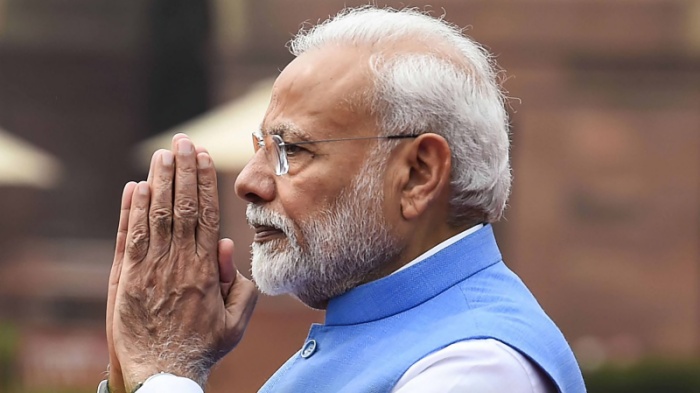
PM Modi’s Leadership: Governing India and leading the World from the front

Desperate times call for desperate measures. And it is amid these desperate times, the best and the worst qualities of a man are tested. As the world continues to fight the pandemic caused due to Coronavirus, the leadership of various countries is put to a difficult test unparallel in history. Their individual successes and failures will define the collective future of their countries. And India is fortunate enough to have Prime Minister Narendra Modi to lead the nation from the front in its struggle against coronavirus.

Managing a country like India with a vast geographical area, limited resources and the second-largest population of the world with a federal polity was never going to be easy. However, this daunting task has been made possible by the pro-active (rather than reactive), timely and inclusive approach and vision of the PM. No wonder, the response of the Government of India has been earning laurels all throughout the world, at a time when even developed nations are facing heat over their lackadaisical response to the unforeseen crisis and their leaders losing the support of the people. 

Not only has the PM reflected the vision of ‘Team India’ and ‘co-operative federalism’ in both letter and spirit by taking the CMs of all states along in this fight but has also gained global recognition for his initiative like Mission Sagar (assisting island nations in Eastern India ocean with food and COVID related medicines), his call for SAARC to create a fund for fighting COVID-19 collectively and providing much-needed medicines to various nations of the world ranging from USA, Brazil and UAE to Afghanistan and Bangladesh etc.

There is scientific evidence that highlight that had India not taken the timely decision to impose the lockdown, the number of cases would have reached nearly eight lakhs by fifteenth April (when the actual number was only around ten thousand). India’s lockdown has gained one of the highest points in the Stringency Index, an index prepared by the University of Oxford to compare the strictness of lockdowns imposed by various countries. 

Realising that lockdown would impact the farmers, labourers and poor section of the society the most, Modi government came up with a series of measures to help the needy in the form of PM Gareeb Kalyan Yojana which provided for financial incentives to the vulnerable section of society, putting money in the PM Jan Dhan Yojana bank accounts of women, providing free gas cylinders under Ujjwala Yojana, early disbursal of scholarships, pensions and more work for MGNREGA job cardholders.

The technology was judiciously used by the government for checking the spread of coronavirus by launching of ‘Aarogy Setu’, a mobile app to help people in getting knowledge about the disease, the nearby victims of this disease etc. The app maintains the health record of an individual, without compromising his/her privacy rights, as is generally made to believe by a certain section media at the behest of the opposition of the country.

PM Modi’s initiative to show our gratitude to the Corona warriors by lighting up diyas/candles and beating up plates resonated with the people of India at large who supported it whole-heartedly by doing these activities wherever they could, from Kashmir to Kanyakumari and from Kutch to Kamrup and Kohima. The RBI, joining hands with the government, came out with a series of measures in the monetary domain to help banks, businesses and industries (especially the MSMEs) from getting adversely impacted from the lockdown. The policies of the RBI are in line with the government’s vision of saving the jobs, employment, businesses and livelihood of the people. 

The recent announcement of economic package worth rupees twenty lakh crore, which is around ten percent of our GDP, highlights the fact that this government has its ears on the ground and listens to grievances of the people. It is due to the optimism created by the policies of the government that global financial institutions like the IMF (International Monetary Fund) have projected India’s growth to be around 1.9 % for the financial year 2021, with India and China as the only two major economies that are likely to grow, while all others getting contracted in this challenging times.

PM also launched PM-CARES fund where people can donate generously to help the government financially in assisting the vulnerable groups. To encourage the corporates to donate more and more, tax exemptions are provided for transactions made to PM-CARES. Special trains have been run by the Railway Ministry for the labourers and migrants to reach their home. Also, the production of medical equipment like masks, testing kits, and ventilators has witnessed unprecedented growth in the last two months under the ‘Make In India’ initiative of the government. 

PM Modi continues to remain popular and loved by the people due to his approachability, commitment to serve the children of Bharat Mata, selfless attitude, devotion and empathy towards the poor of this nation. He believes in putting Nation above petty politics and this the reason why he has taken CMs of all the states on board and allowed them to speak their minds freely despite the fact that those belonging to the opposition may be critical of both him and as well the Union Government which he heads.

States have also been provided full support and assistance without any discrimination by the Centre, be it in the form of manpower or monetary help irrespective of the party in power in that state. Keeping up the democratic traditions of the country, the decisions related to the extension of lockdown has been taken by the PM after taking the opinions, suggestions and considerations of all the states, thereby making it a case of the bottom-up model of governance, instead of the much-criticised top-down one. 

When the lockdown ends, the world would have transformed completely. Our conventional wisdom and way of thinking would not be of much use then. Therefore, it is time to join hands with PM Modi and support him in his fight to protect both the lives and livelihood of the people with his unconventional and out-of-the-box thinking and leadership.

There can be no denial of the fact that the world is looking towards India with great hope and expectations due to PM’s decisive leadership and immense potential in the people of India to turn every challenge into an opportunity. We have shown the world our power by providing affordable and timely medicines like HCQ to even superpower like the US. Therefore, the rise of India is very much beneficial to the world as we had been living with the philosophy of ‘Vaisudeva Kutumbakam’ or the entire world as a family and ‘Sarve Bhavantu Sukhina’(Happiness for all) since ages.

(This article has been written by Radhe Shyam Singh Yadav, who is a BJP Karyakarta/National Co-Treasurer of BJPkm4kisan)

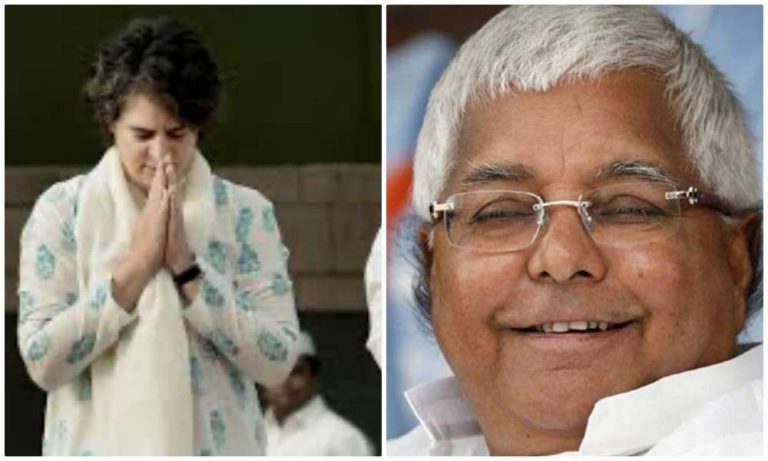
As Priyanka Gandhi sends details of auto rickshaw instead of buses in UP, read how Lalu Prasad Yadav ‘transported’ cattle on two-wheeler in Fodder Scam

Recently, the Congress party faced a major embarrassment after its General Secretary zealously offered the Uttar Pradesh government 1000 buses to ferry migrant workers. The Uttar Pradesh government accepted Ms Vadra’s offer and asked the Congress party to provide the list of buses provided by Priyanka Gandhi to facilitate transportation of migrant workers. However, the registration number of the buses provided by the Congress party revealed that the list of vehicles which the party claimed to be used for carrying migrant workers contained blacklisted numbers, cars and even three-wheeled wonder autorickshaws.

This debacle where the list of buses sent by Congress General Secretary actually included blacklisted numbers, auto-rickshaws and three-wheelers are evocative of the infamous fodder scam presided over by the former Bihar Chief Minister Lalu Prasad Yadav wherein submitted forged bills to extract money from district treasuries revealed that two-wheelers were used to transport the fictitious cattle over several hundred kilometres.

Fodder scam: Scooters and two-wheelers used to transport cattle

In the 1990s while India’s economic upsurge was still in its infantile stage, a nefarious corruption scandal was underway in the state of Bihar where Lalu Prasad Yadav was the chief minister.

The scam was unearthed by then finance commissioner VS Dubey who stumbled upon financial irregularities of massive proportions while reviewing the performance of various departments of the Bihar government. He found out that money was withdrawn in excess of the allocation by some of the departments and the animal husbandry department topped the list of withdrawals.

The auditor general’s report also found prevalence of corruption. The then Bihar CM Lalu Prasad Yadav and his close associates came under the scanner of the investigative agencies as the prime accused in the scam. The CBI investigation into the matter found out that the suppliers colluding with officials enjoyed state patronage and submitted forged documents and fake bills to claim reimbursements from the animal husbandry department.

The CBI investigation showed how suppliers provided registration numbers of two-wheelers in the fake bills alleging that cattle including buffaloes were transported over hundreds of kilometres by scooters and two-wheelers. Bills bearing registration numbers of scooters were submitted for the transportation of 500 kgs of mustard oil worth Rs 15 lakh which is used to polish the horns of buffaloes.

The entire fodder scam was unravelled by Chaibasa case in which the RJD supremo Lalu Prasad Yadav was later convicted for in the case of fraudulent withdrawal of Rs 37.7 crore for procuring fodder for fictitious livestock from Chaibasa treasury by tendering fake bills.

Besides Chaibasa case, Lalu Prasad Yadav is convicted by the Supreme Court in other 3 fodder scam cases and 1 fodder scam of Rs 184 crore swindled from Doranda treasury is still pending in the court. Lalu Prasad Yadav is currently lodged in Birsa Munda Jail in Ranchi and serving a cumulative sentence of close to 27 years.