Home Blog Page 556

Uttar Pradesh: Akeel poses as a Hindu to trap a divorced Hindu woman in Kanpur, rapes her, pressurises her for conversion

On 20th December, a divorced Hindu woman filed a complaint at Naubasta Police Station, Kanpur, Uttar Pradesh, accusing a man named Akeel of raping her and pressurising her to convert to Islam. She also accused him of attempting to extort Rs 5 lakh from her using obscene videos.

Initially, the police facilitated a compromise between the victim and Akeel. However, when the harassment did not stop, the woman approached the Additional Deputy Commissioner of Police (ADCP), who ordered an investigation into the matter.

Background of the case

According to media reports, the incident took place in the Dada Nagar area of Kanpur. The victim in this case is a divorced Hindu woman from Barra who works in a factory where the accused, Akeel, was employed as a contractor. When Akeel approached the victim, he claimed that he was single. However, it was later revealed that he was already married.

Furthermore, Akeel hid his true identity and posed as “Baua” to befriend the victim. He promised to marry her and coerced her into a physical relationship multiple times. The victim said in her complaint that she resisted a physical relationship with Akeel, but he did not pay heed to her.

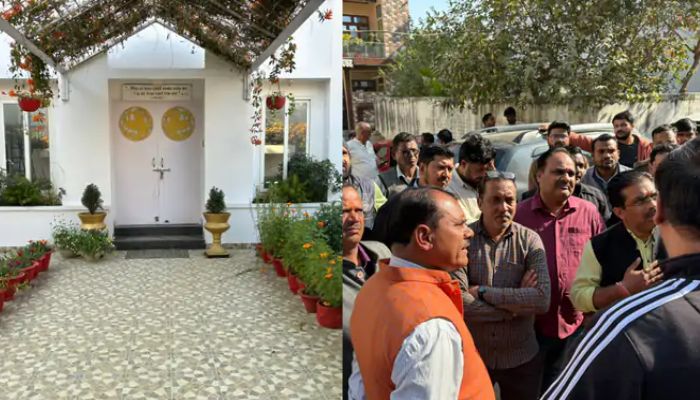
Hindu organisations came in support of the Hindu woman. Image: abplive

The victim told the police that Akeel took her to several hotels and recorded obscene photos and videos of her. During that time, the victim became pregnant. When Akeel came to know about the pregnancy, he forced the victim to undergo an abortion. Eventually, the victim discovered his real identity, that he was a Muslim man, and also came to know that he was already married.

When the victim confronted him, Akeel started pressurising her to convert to Islam. The victim categorically refused to convert, after which Akeel resorted to blackmailing her using the explicit photos and videos. The victim alleged that Akeel attempted to extort Rs 5 lakh from her.

When she was left with no options, the victim approached Akeel’s wife. When she told his wife about her ordeal, instead of helping her, Akeel’s wife and his three brothers-in-law brutally assaulted the victim. Following the incident, the woman approached the police to file a complaint. However, no substantial action was taken by the police at that time. On 5th December, the police facilitated a compromise between the victim and Akeel’s family.

Following the compromise, Akeel did not stop pressurising the victim to give him Rs 5 lakh and convert to Islam. On 20th December, the victim finally decided to approach the ADCP and told him her ordeal. The ADCP took cognisance of the matter and directed the Naubasta police station to investigate the matter. Hindu organisations have come forward in support of the victim. They have expressed concerns over increasing instances of love jihad in Kanpur and demanded strict action against Akeel.

Mohali building collapse: Rescue operations enter second day, FIR registered against owners

0

Rescue operations by the personnel of the Indian Army and NDRF continued on Sunday a day after a multi-storey under-construction building collapsed in Punjab’s Mohali.

Speaking to ANI, DSP Harsimran Singh Bal said, “The clearance operations are ongoing. We have registered the FIR against the owners of the building.”

A victim of the incident, Drishti Verma succumbed to injuries. “She was rescued from the debris by the National Disaster Management Force in critical condition. She was rushed to Sohana Hospital,” said Viraj S Tidke, officiating Deputy Commissioner.

On Saturday, Punjab Chief Minister Bhagwant Mann said that action will be taken against the culprits behind the collapse of the under-construction building.

In a post on X, CM Mann said, “Received sad news of an accident of a multi-storey building near Sohana in Sahibzada Ajit Singh Nagar (Mohali). Full administration and other rescue operations teams are deployed at the spot. I am in constant touch with the administration. We pray that there is no loss of life and property, action will be taken against the culprits. People are requested to cooperate with the administration.”

Indian Army along with NDRF and State rescue teams have been relentlessly working to address the crisis.

In a post on X, the Indian Army said, “Indian Army reacted swiftly for the rescue. In a remarkable display of coordinated efforts, Indian Army Columns along with NDRF and State rescue teams have been relentlessly working to address the crisis. Engineer Task Force with debris clearance machine & JCBs are operational at the site. Top debris removed & efforts being done to reach the basement.” 

(This news report is published from a syndicated feed. Except for the headline, the content has not been written or edited by OpIndia staff)

American woman dies in Assam after speeding truck hits her motorcycle in Lumding

0

A lady rider from the USA died in a road mishap at the Lumding area in Assam’s Hojai district on Saturday, police said.

According to police, the lady identified as Elaine Berry Thompson, a USA national was coming from Silchar towards Dhemaji riding a motorcycle when a speeding truck hit her bike in the Lumding area.

Rupam Bordoloi, Additional Superintendent of Police of Hojai district told ANI that, police have seized the truck.

“At around 12-45 pm, we received information about an accident. When our police team reached the spot they came to know that a USA national was involved in that accident and that lady was identified as Elaine Berry Thompson. She was rushed to the hospital, but doctors declared her brought dead. The victim might be involved in some social work. She was coming from Silchar towards Dhemaji. We have seized the vehicle (truck),” Rupam Bordoloi said. Further investigation is underway.


(This news report is published from a syndicated feed. Except for the headline, the content has not been written or edited by OpIndia staff)

As locals demand reopening of Sterlite Copper plant in Tamil Nadu, here is how the closure is harming Indian economy and posing challenges for future

On 20 December, protests erupted at Thoothukudi in Tamil Nadu, demanding the reopening of the Vedanta’s Sterlite Copper Plant which was closed on the Tamil Nadu government’s order, which was supported by courts. Indian National Trade Union Congress (INTUC) staged the protest demanding to revive the copper plant along with other closed industries and provide relief from the widespread joblessness in the area.

While the closure of the copper plant has resulted in the loss of over 1500 direct jobs and over 40,000 jobs, the impact of the shutdown over alleged pollution is much bigger on the Indian economy. Notably, in just one stroke of a court order, India became a net importer of copper while it was a net exporter of the vital metal before the shutdown of the Sterlite Copper plant in 2018.

The closure of the Sterlite Copper plant had such widespread ramifications on the country’s copper trade that from being one of the top five exporters of copper cathodes in 2017-2018, India became a net importer beginning 2018-2019. Sterlite Copper accounted for roughly 38% of the country’s copper needs as the smelter produced nearly 4 lakh tonnes every year.

One of the most concerning developments as a result of the closure is that China has become a major beneficiary of the decision, as it is a major producer and exporter of copper. This has put a major blow on India’s Atmanirbhar Bharat campaign, as copper is a vital metal used everywhere like automobiles, electricals, and electronics.

The situation is expected to worsen in future, as demand for copper is set to rise due to rapid growth in several industries that use copper. As per estimates, copper demand will rise by over 9.3% annually to reach around 2.5 – 3.5 million metric tons by 2030. This demand is going to be fuelled by several industries, including renewable energy, electric vehicles, power grid expansion, rabid urbanisation etc.

As part of the Modi government’s push for solar energy, India will need around 1.5 million tonnes of copper by 2030 for solar and wind energy. Copper is essential in the production and transmission of electricity as it is used in equipment like alternators and transformers. It is also an essential metal used on solar photovoltaic panels.

There is no doubt that the world is moving towards an era of Electric Vehicles, and India will not be an exception. Electric motors require large quantities of copper, and therefore, the sector will account for huge copper demand. On average, an EV car has 83 kg of copper, while EV buses use, 224 kg of the metal. With the govt’s target of 30% EVs by the year 2030, the copper demand is set to soar.

Additionally, with the rapid urbanisation in the country along with initiatives like the Smart City project, copper demand will increase due to the increased use of electricity and various equipment. India plans to increase its power grid by 20% by 2030, and copper’s role in high-efficiency transmission is crucial. It is estimated that demand for copper in electrical infrastructure to hit 1.8–2 million tonnes by 2030.

As a whole, India’s per capita copper consumption is 1 kg now, which will reach 3.2 kg per capita by 2047. As per estimates, India needs 1 new copper smelter every 4 years, and reviving facilities like the Sterlite plant is important.

The shutdown of the plant created a vacuum in India’s copper production and transformed the nation from a net exporter to a net importer of copper. Before the plant’s closure, India exported around 50% of its copper output. With the Sterlite plant offline, India’s copper exports fell by 70%. For instance, exports dropped by 90% in 2018–2019, from 378,000 tonnes in the previous year to just 48,000 tonnes.

According to a report by CUTS International, the closure of the Sterlite plant cost India ₹14,749 crore, affecting the economy and copper supply.

Copper production is a high-return investment, with almost 400% return on investment. Therefore, domestic copper production can be a massive boost for the economy. On the other hand, importing copper means enriching other countries that export copper to India to fill the gap created by the Vedanta plant shutdown.

India’s loss is a gain for China, Pakistan and others

To meet domestic copper demand, India’s copper import increased by a huge margin, with the majority of imports coming from China. As a result, China’s copper exports to India have doubled, which was worth $340.12 million in 2023. India imported over 300 thousand tonnes of copper in 2023-24, with 363,000 tonnes of refined copper. Imports grew by 13% in just 2 years.

With India out of the picture as a major copper exporter, the global copper supply has become tighter. This allowed Chinese companies, with their robust manufacturing and smelting infrastructure, to secure better prices and terms.

China remains a major consumer of copper due to its dominance in the manufacturing sector, and other countries have benefited by taking India’s place in exports to China. This includes Pakistan, which took India’s place and its copper export to China was valued at approximately $752 million in 2023.

Another major beneficiary is Saudi Arabia, as Vedanta group has signed a MOU to invest $2 billion in major copper projects in the country. The company took the decision after the Supreme Court repeatedly rejected its pleas to reopen the Thoothukudi plant. The company plans to open a 400 KTPA greenfield copper smelter and refinery and a 300 KTPA copper rod project. Vedanta’s investment is expected to contribute $19 billion to Saudi Arabia’s GDP.

This shift of investment from India to Saudi Arabia is a significant setback for Tuticorin and India. Continuing the plant with adequate pollution control measures would have boosted the local economy, creating jobs and driving infrastructure development in Tamil Nadu.

Foreign hand

It has been alleged since the beginning that the anti-plant protest was foreign-funded, which was also alleged by Tamil Nadu Governor R N Ravi last year. Strikingly, it has also been alleged that Chinese companies which had an economic interest in Indian copper import were behind the protests that led to the closure of the plant. Vedanta Limited had told the Madras High Court that the Chinese companies promoted and funded the agitations and protests against Sterlite.

It has been alleged that the NGOs that led the protests against the Sterlite Copper Plant violated the Foreign Contribution Regulation Act (FCRA) by continuing to accept foreign funds even after the cancellation of their FCRA registrations. This includes Church groups Tuticorin Diocesan Association, Tuticorin Multipurpose Social Service Society, and preacher activists Mohan C. Lazarus and Henri Tiphagne.

The FCRA registrations were cancelled in 2015 based on adverse reports received from the intelligence agencies. Their bank accounts were also frozen. However it was alleged that they continued to receive foreign donations, violating the law.

Sterlite Copper Plant closure – Protests erupt in Tamil Nadu as locals regret shutdown’s impact on employment, govt urged to reopen the plant

On 20th December, members of the Indian National Trade Union Congress (INTUC) staged a protest demanding immediate action from the government to revive local industries and provide relief from the widespread joblessness in Thoothukudi, Tamil Nadu. Notably, Thoothukudi was once a thriving industrial hub. However, following the closure of key industries, including the Sterlite Copper Plant, the region has been grappling with a severe unemployment crisis.

When the Sterlite Plant was shut down following environmental concerns and violent protests, more than 1,500 workers were displaced. The closure indirectly impacted the livelihoods of around 40,000 individuals. Following the Sterlite shutdown, several other industries, such as textile mills, thermal power plants, Food Corporation of India warehouses, salt pans, and other small- and large-scale businesses, were shut down in the region. Many families were forced to leave the district in search of better opportunities so that they could have a sustainable livelihood.

Impact on the local economy

Every sector in the region has been affected by the downfall of the industrial hub. Truck owners, who previously relied on transporting materials for Sterlite, were forced to sell their vehicles as they were unable to pay their loans. Around a million daily wage workers have been left unemployed. Many businesses in the region that relied on industrial demand have now been forced to shut their shutters.

General Secretary of INTUC, P. Kathirvel, stated that factors such as the automation of Thoothukudi port, modernisation of the traditional spinning mills, and urban expansion have further deepened the economic challenges in the area.

Calls to reopen Sterlite

Interestingly, INTUC has highlighted that if the Sterlite Copper Plant reopens in the area, it could create jobs for around 3,000 truck operators, 4,000 daily wage workers per shift, and hundreds of port workers. Furthermore, around 400 downstream industries that relied on Sterlite could be restarted. INTUC General Secretary P Kathirvel said that many truck owners were forced to sell their trucks for being unable to repay the loans following the closure of the plant.

The protesters emphasised that the plant played a crucial role in generating around Rs 5,000 crore in annual revenue for the state and union governments. It used to contribute 40% to the nation’s copper production.

Government urged to act

The Sterlite Copper Plant was closed down following sustained opposition citing environmental concerns. However, many locals now believe that the decision was not justifiable, as it was influenced by external pressures. INTUC has accused the government of neglecting its responsibility to revive the local economy. Kathirvel said, “The Sterlite plant’s closure has crippled Thoothukudi’s economy, and the government must prioritise its reopening to restore livelihoods and economic stability.”

With the unemployment crisis worsening in the region, the demand to reconsider industrial shutdowns has resonated strongly among local communities. It has marked a substantial shift in public sentiment towards prioritising economic revival over the ideological resistance that played a vital role during the protests against the Sterlite Copper Plant.

The closure of the plant

The locals and environmental activists had been protesting against the plant for a long. In March 2018 massive protests started against the plant. The Police had opened fire at the protesters outside the plant leading to the death of 13 people. The protesters had claimed the plant was causing pollution in the area. Following the closure, Vedanta moved to National Green Tribunal (NGT) to get permission to reopen the plant. NGT granted permission, but the Tamil Nadu government moved to Supreme Court. The apex court stayed the NGT order and allowed Vedanta to approach High Court for reopening of the plant. The High Court refused to allow Vedanta to reopen the plant, after which the company moved to Supreme Court, where the case is pending.

Notably, in 2021, Vedanta Group got permission to reopen the plant to provide medical oxygen during the Covid pandemic. TN government had appealed to the apex court that the plant should provide oxygen only to the state but the court rejected it. It operated for three months and then the premises were again shut once the second wave was subsidised. In December 2021, there were reports that the locals had claimed they were cheated in the name of the protests and wanted it to reopen.

Indore shocker: Arshad Pathan poses as ‘Harish’, rapes Hindu woman, pressures her to convert to Islam

A harrowing incident of Love Jihad has come to light from Chandan Nagar, Indore, Madhya Pradesh. A man named Arshad Pathan allegedly posed as a Hindu man named Harish and coerced a Hindu woman into a relationship. According to the complaint filed by the 24-year-old woman, Arshad raped her and subjected her to unnatural sexual assault. He also coerced her to convert to Islam.

The victim stated in her complaint that his family was involved in the crime, including his brother Sabir, father Qadir, and three women who intimidated and threatened her. A case has been registered against all six accused. All of them are absconding. Investigation into the matter is underway, and the police are searching for the accused.

Ordeal of the victim – How trust turned into a nightmare

The victim is a resident of Chandan Nagar, Indore. She sells goods with her mother to earn her livelihood. Around six months ago, she met Arshad, who works as an auto driver, during her commute. Arshad introduced himself as Harish. He gained the victim’s trust by pretending to be Hindu. He claimed that he was an orphan and slowly became part of her daily life.

Over time, Arshad developed a relationship with her. The victim and her mother started riding in his auto frequently. He expressed a desire to marry the victim and sought her family’s approval. In August, he visited the victim’s home and formally expressed his intentions to marry her. However, during this visit, he allegedly raped the victim. By this time, the victim was unaware of his real identity and trusted him.

Arshad did everything possible to conceal his religious background. He participated in Hindu religious events such as Ganesh Visarjan and followed Hindu rituals, including temple visits. His actions gave the impression that he belonged to the Hindu community. However, his behaviour changed when the victim started raising the question of marriage repeatedly. He demanded that she convert to Islam, stating it was a requirement for their union.

Initially, the victim thought he was joking. However, she was shocked when he revealed that his real name was Arshad and insisted that she should convert to Islam so they could get married. Despite her refusal, Arshad continued to pressure her and resorted to violence. He allegedly forced unnatural sexual acts on her and claimed such actions were necessary if she wanted to marry him. When she resisted, he physically assaulted her. He stated that she must indulge in these acts as it was part of their future together.

On 9 December, the victim visited Arshad’s house, determined to uncover the truth. She found that he was not an orphan and met his father, Qadir. Later, Arshad and his brother Sabir arrived, and they got into a heated argument. During the argument, Arshad again insisted that she should convert to Islam and comply with his demands to marry him. She received another shock when Sabir suggested that if Arshad was unwilling, she could be with him instead.

The victim added in her complaint that she resisted and pushed Sabir. Irked by her actions, he dragged her into a room and threatened her with a knife. He then raped her and warned her not to disclose the incident. Traumatised by the incident, she returned home and initially did not tell anyone. For days, she avoided leaving the house. Eventually, she confided in members of Hindu organisations, who encouraged her to file a police complaint.

Six accused, including three women, booked

Following her complaint, the Chandan Nagar Police registered a case against Arshad Pathan, alias Harish, his brother Sabir, father Qadir, and three women from their family under charges including rape, unnatural sexual assault, religious conversion coercion, intimidation, and physical assault.

Speaking to the media, the police confirmed that the accused family not only intimidated the victim but also pressured her to convert to Islam as a condition for marriage. All six accused are currently absconding, and a search operation is underway.

Busted Ansarullah Bangla Team module was trying to target Siliguri Corridor to cut off northeast: Reveals probe after 8 terrorists arrested in pan-India ‘Operation Praghat’

Days after Assam police in collaboration with police in West Bengal and Kerala arrested eight jihadi terrorists, their interrogation revealed that they were attempting to cut off northeast India from the rest of the country at the Siliguri corridor. The eight persons associated with Bangladesh-based Jihadi terror group Ansarullah Bangla Team (ABT) were arrested from Assam, West Bengal and Kerala under ‘Operation Praghat’ led by a Special Task Force.

The arrested jihadis included a man from Bangladesh named Sad Radi alias Shab Seikh, arrested from Kerala, who was the mastermind of the ABT sleeper cell targeting the Siliguri corridor or the Chicken’s Neck, the narrow patch of land connecting north east India with the mainland. This was revealed by West Bengal STF on Saturday.

ADG (South Bengal) Supratim Sarkar said, “They were planning terror activities in the Chicken’s Neck, Siliguri corridor. A person called Farhan was the head of the sleeper cell.” He added that the arrested persons were setting up sleeper cells in West Bengal by recruiting locals. They were mainly recruiting from two places – Murshidabad and Alipurduar, he said.

Police recovered a 16 GB pen drive, 4 mobile phones and other suspicious documents from the arrested persons.

As per police, the terror module was also trying to target members of the Rashtriya Swayamsevak Sangh (RSS) and other Hindu organisations. The module was working under the directive of one Md Farhan Israk, a close associate of Jasimuddin Rahmani, Chief of the Ansarullah Bangla Team. Notably, ABT is an affiliate of Al-Qaeda in the Indian subcontinent, and several of their operatives have been arrested in Assam in recent months.

ABT chief Jasimuddin Rahmani was released from prison by the interim govt in Bangladesh after the fall of Sheikh Hasina govt, and after that the activities of the jihadi terror group have accelerated. As per reports, Sad Radi entered India on his instructions to recruit cadres for the operation.

The group was trying to identify youths to recruit using communal fissures and economic disparities. Jasimuddin Rahmani had sent Sad Radi from Rajshahi in Bangladesh drive to India for the recruitment, and Farhan Israk was overseeing the operations from Bangladesh. Reportedly he entered India in November through Murshidabad. Radi visited West Bengal, Assam, and Kerala during his recruitment drive, said police.

Talking about the operation that busted the terror module, Gaurav Sharma, IG STF, West Bengal, said, “There was an input and a well-coordinated joint operation in which Assam police needed our support. ABT were trying to set up sleeper cells in the country. They were recruiting youths in the country.”

While Bangladeshi national Sad Radi was arrested in Kerala, the rest were arrested in Assam and West Bengal. They have been identified as Minarul Sheikh, Md. Abbas Ali, Nur Islam Mandal, Abdul Karim Mandal, Mojibar Rahman, Hamidul Islam, and Enamul Hoque. 

Assam STF chief Dr Partha Sarathi Mahanta said that the investigation is on and the whole network is being dismantled.  “Operation Praghat highlights the effort of STF in the context of cross-border terrorism and maintaining regional stability,” he said.

Notably, a Guwahati court has granted police custody of the 8 arrested persons for 10 days.

Saudi Arabian ‘doctor’ Taleb, who carried out the terror attack in Germany, was interviewed by BBC in 2019

Hours after a Saudi Arabian ‘doctor’ Taleb Al-Abdulmohsen carried out a deadly terror attack in Magdeburg city of Germany, it emerged that the terrorist was interviewed by the British Broadcasting Corporation (BBC) News in 2019.

The UK’s national broadcaster hailed Taleb Al-Abdulmohsen as an activist who “helped hundreds seek asylum” in the European country.

In a news feature titled ‘The website helping ex-Muslims flee the Gulf’, BBC News interviewed the future Magdeburg terrorist.

Screengrab of the 2019 BBC story on Taleb Al-Abdulmohsen

Hi, my name is Taleb. I am from Saudi Arabia. I am an activist. I created a website to help people seeking asylum, especially from Saudi Arabia and the Gulf region. I use basically WhatsApp, Twitter, Telegram,” he was heard saying.

Taleb Al-Abdulmohsen had claimed to spend 10-16 hours each day helping Saudi asylum seekers.

The only Arab country from which I did not have an ex-Muslim seeking help until now from me is Oman. 90% of people who approach me are women between 18 and 30 years old,” he claimed in the BBC News feature.

The UK’s national broadcaster is also accused of downplaying the severity of the terror attack in Magdeburg city of Germany

Taleb Al-Abdulmohsen had openly posted threats of violence before killing 2 people and injuring 60 others.

“I seriously expect to die this year. Reason: I will bring justice at any cost. And German authorities are impeding all peaceful pathways to justice. If you are a concerned German citizen, you should demand justice now. If you are not concerned, then ok but don’t complain later,” he had tweeted.

The German authorities did not act against him despite repeated alerts from the Saudi government.

Shiv Sena (UBT) MP Sanjay Raut claims that Congress members too were involved in Ram Mandir movement

Amid the nationwide call for recovering Hindu temples converted to mosques by Islamic regimes, Shiv Sena (UBT) MP Sanjay Raut said that even the Congress party contributed towards the Ram Mandr movement. Raut said that BJP should not take credit for successful construction of Ram Mandir, because several other parties contributed towards the movement, including the Congress party.

Sanjay Raut said that the Ram Mandir movement was a nationwide movement and that everyone contributed to the movement. He said, “not only BJP and PM Modi contributed to it but RSS, BJP, Shiv Sena, VHP, Bajrang Dal and Congress also contributed to the movement.”

He said that without former PM Narasimha Rao, former president Dr Shankar Dayal Sharma, the temple would not have been possible. The claim that ‘Modi made the Ram Madir’ is unfortunate, he added.

As the demolition of the Babri structure was a key moment in the Ram Mandir movement, from Raut’s comments it ca be concluded that Congress workers were also involved in the demolition.

He also supported the recent comments by RSS chief Mohan Bhagwat that no one can become a leader just by constructing a temple. ‘Nation is a temple, make the nation,’ he added. However, Raut blamed the Sangh for calls to survey various places to recover ancient temples. He said that such calls during elections is very dangerous for the country.

“I agree with what RSS chief said, the entire nation agrees, but you are the one who brought such people to power. So now, you take the responsibility,” Sanjay Raut said.

Earlier on Friday, RSS Chief Mohan Bhagwat talked against the reclamation of Temples. He said that certain people want to become Hindu leaders by raking up new Temple-Mosque disputes after the Ayodhya Ram Temple was built.

“Every day, a new matter (dispute) is being raked up. How can this be allowed? This cannot continue. India needs to show that we can live together,” the RSS chief said, triggering strong reactions.

ISKCON expresses concern over violence against Hindu minorities in Bangladesh

0

Governing Body Commissioner of ISKCON Gauranga Das on Saturday expressed concern over the violence against Hindu minorities in Bangladesh as a fresh case of vandalism of Hindu Temple emerged in the country.

Gauranga Das requested the Bangladesh government to provide security to citizens and protection to Hindu Temples.

“ISKCON is very concerned about this situation in Bangladesh and we are very concerned about the safety of all the Hindu minorities. We request the Bangladesh government and all the officials there to provide complete security to all the citizens, especially the minorities. All our temples there where all the citizens voluntarily pray according to their religion, those temples should be protected, those idols should be protected and those devotees should be protected,” Gauranga Das said.

Gauranga Das also requested the Bangladesh government to give the right to adopt and follow their religious freedom to all minorities.

“We also request the Bangladesh government that all minorities, whether they are Hindus, Buddhists, Christians, should be given the right to adopt and follow their religious freedom and all their places of worship should be protected,” Das said.

Earlier in the day, Police in Bangladesh arrested one person for vandalizing Hindu idols in the Shakuair area on Saturday morning, officials said.

“We have arrested one person early today for vandalising Hindu idols in the Shakuair area,” said Abul Khair, Officer in Charge (OC) of Haluaghat Police Station under northern Mymensigh district.

Meanwhile, MoS External Affairs Kirti Vardhan Singh in a written reply to a question in Lok Sabha, relating to violence in Bangladesh, informed that the 2,200 cases of violence against Hindus and other minorities in Bangladesh till October of this year.

“2,200 cases of violence against Hindus and other minorities in Bangladesh were reported till 8th December 2024 and 112 cases in Pakistan were reported till October 2024,” he replied.

Notably, Bangladesh is currently facing a tumultuous period following a student-led movement that led to the ousting of Former Prime Minister Sheikh Hasina. The movement was sparked by a series of violent incidents, including attacks on Hindus and other minorities, as well as the demolition of Hindu temples.

The situation in Bangladesh began to escalate in June 2024, when students from various universities in Dhaka united to demand reforms to the country’s quota system for government jobs led to the ouster of Former Prime Minister Sheikh Hasina.

After weeks of protests and violence that led to over 600 deaths. Hasina fled to India, and an interim government led by Yunus took charge.

Following this, Chinmoy Krishna Das, also a former priest of ISKCON, was arrested by police from Dhaka Airport on November 25 on a charge of sedition in Bangladesh, sparking protests worldwide.

(This news report is published from a syndicated feed. Except for the headline, the content has not been written or edited by OpIndia staff)