Home Blog Page 569

Media, Rana Ayyub and others falsely claim Dalit boy died by suicide in UP’s Basti due to caste discrimination, here is what actually happened

A 17-year-old boy died by suicide in Uttar Pradesh’s Basti after he faced violence and humiliation at a birthday party where he was invited. The minor boy had attended the party on 20 December, where he was stripped, brutally beaten, and urinated upon by four youths. The attackers also recorded the entire incident and threatened to make the video viral.

The boy pleaded with them to delete the video, but they humiliated him further and even forced him to lick his spit. The traumatised boy returned home, narrated the incident to his parents and then took his own life by hanging himself.

As the boy belongs to the Dalit community, attempts have been made to portray the incident as a caste-based violence. The New Indian Express in its report on 24 December wrote that the boy Aditya faced severe caste discrimination and harassment. Most media reports mentioned that the victim was Dalit, but didn’t mention the identity of the attackers, which caused people to assume that he was attacked for his caste.

Washington Post columnist Rana Ayyub shared an India Today report on the incident on X with the words ‘But caste…’, implying that the minor Dalit was humiliated and assaulted by upper caste Hindus.

Similarly, several other social media users made similar claims saying that it was a caste-based violence.

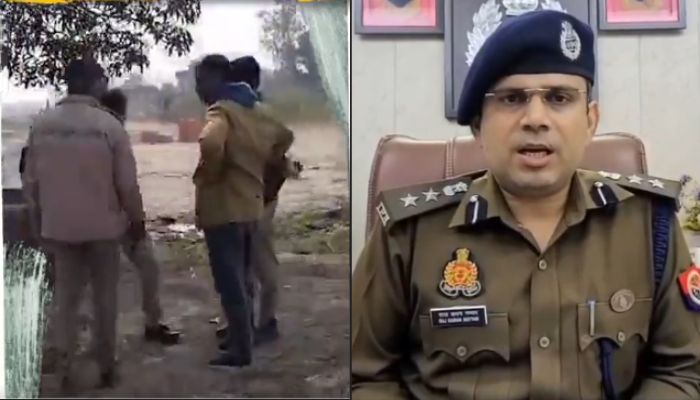
However as per the Police, the attackers were also Dalits, and the incident had nothing to do with caste. Talking about the incident, Basti Police SP Gopal Krishan Choudhary said that the victim and the attackers belong to the same community. He said that both parties knew each other and that the accused persons had been booked.

The SP also said that the SHO of the police station has been suspended after the victim’s family alleged that the police didn’t take prompt action after a complaint was filed against the four accused.

From the police version, it is clear that the four attackers and the victim boy belonged to the same community, which means all of them were Dalits. Therefore, it is completely wrong to label the incident as a caste-based violence. Without the identity of the accused persons, Islamists like Rana Ayyub jumped to claim that it was caste-based violence.

The incident could be the result of some personal enmity, as the victim and the accused knew each other, which will be revealed after the police investigation.

After Tahir Hussain who wanted to ‘teach kafirs a lesson’, AIMIM mulls giving Shahrukh Pathan a ticket: His role in the Delhi anti-Hindu riots, how he lied to court and what we know about his convicted father

Ahead of the upcoming Delhi Assembly elections 2025, Asaduddin Owaisi’s All India Majlis-e-Ittehadul Muslimeen (AIMIM) is planning to field Delhi riots prime accused Shahrukh Pathan as its candidate from one of the 70 constituencies. While the decision regarding this has not yet been finalized, the idea of AIMIM fielding another anti-India Islamist in the Delhi assembly elections is sparking outrage all over the state.

The information regarding this was confirmed by AIMIM Delhi unit president, Shoaib Jamei. He met the family of Pathan who is behind bars at present and indicated that the party was considering fielding Pathan from the Seelampur constituency. However, he said that no confirmed decision about this was taken.

“Yesterday we met the mother of jailed Shahrukh Pathan at his home. A delegation of Delhi AIMIM met his family and discussed the conditions and legal aid that Pathan needs. This small step of ours in the campaign for justice in Delhi will encourage many families whose children have been in jail for years without trial. According to the Supreme Court, bail is the right of those prisoners whose cases are pending. His mother says that the case was registered against her son at the behest of Arvind Kejriwal and she will not forget this,” Jamei shared in a post on Facebook.

Along with Jamei, other AIMIM leaders like Joint Secretary Manzar Shoaib, Asghar Ansari, MNS Nasir, and Nadeem Sheikh also met the family of the prime accused in the Delhi riot case and offered assistance to them to probably get him out of jail.

Pathan open fired at Delhi police officials

Pathan at present is lodged in Tihar jail and is accused of instigating anti-CAA riots in Delhi in the year 2020. He was arrested in the year 2020 on the charges of opening fire at the Delhi Police officials and inciting riots in the national capital during the Anti-Hindu riots. Shahrukh Pathan became the poster boy of the anti-Hindu riots after images of him pointing a pistol at a policeman had gone viral during the violence.

He, therefore, has been charged in two cases. He has been booked under rioting and relevant sections for allegedly pointing a gun at head constable Deepak Dahiya during the riots on February 24, 2020. His name is also included in a charge sheet in connection with the Maujpur incident on February 24th, where violence erupted between pro-CAA and anti-CAA groups and later spread to other parts of Northeast Delhi.

CCTV videos of head constable Deepak Dahiya standing resolute on duty, fearlessly facing the criminal Shahrukh who fired bullets at him had gone viral on social media.

Two policemen named Raman and Deepak and a passerby Rohit Shukla had sustained injuries because of the violence that had broken out at Maujpur Chowk on February 24th. Shukla had then confirmed that there were two groups of people, one of which was shouting ‘Allah­hu­Akbar’ and protesting against CAA and NRC.

While the AIMIM leaders are offering assistance to bail Pathan, it is crucial to note that the Delhi Court in 2023 had rejected Pathan’s bail saying that there was no reason to grant him bail. “Considering the conduct of the accused Shahrukh Pathan in jail during his judicial custody, his conduct before his being arrested, conduct during court proceedings, and most importantly, the allegations against the accused which are being supported by the eyewitnesses and also the video footage, on any of the counts on which bail can be considered, the court sees nothing to set him enlarged on bail,” Additional Sessions Judge Amitabh Rawat of Karkardooma Court was quoted as saying.

During the riot, on the 24th of February 2020, a confrontation broke out between Jaffrabad Metro Station and Maujpur Bridge. There were more than 5,000 people who came face to face in that area. The anti-CAA protestors (Islamist mob) were pelting stones and brandishing guns. When the investigation was carried out, 3 cartridges were found at the spot where Shahrukh Pathan brandished a gun, aimed at the head of a police officer in uniform. 

Pathan first fired a few rounds at the crowd and refused to pay heed to the warnings issued by the police officer. When he advanced, for the safety of the crowd, the police officer stood in his path and did not move. When Pathan was at a distance of 9-10 feet from the police officer, he fired his weapon aimed at the police officer’s head to kill him. The police officer dodged the bullet but continued to stand there in his path so he couldn’t advance further and kill the Hindus. As the police officer refused to move, Pathan pushed the officer and then aimed the gun at his head again. When the police officer issued another warning after being pushed, Shahrukh Pathan fired at the crowd and started retreating.

It was only after sustained interrogation that Shahrukh Pathan revealed his full identity and confessed to his involvement in the crime.

The Delhi Court had later ordered an FIR against Pathan and booked him under Sections 147 (rioting), 148 (rioting armed with a weapon), 149 (unlawful assembly), 186 (obstructing public servant in discharge of public functions), 188 (disobedience to order duly promulgated by public servant), 153A (promoting enmity between different groups on grounds of religion, etc.), 283 (danger or obstruction in public way or line of navigation), 353 (assault or criminal force to deter public servant from discharge of his duty), 332 (Voluntarily causing hurt to deter public servant from his duty), 323 (voluntarily causing hurt), 307 (murder attempt), 505, 120B and 34 of the Indian Penal Code along with Section 27 of the Arms Act.

He lied that he was tortured in jail

It was earlier reported that Pathan during the investigation was not at all cooperative and he also had misled the police. He further had also refused to reveal the identity of other rioters who were involved.

During his time in jail, Pathan had also lied that he was tortured by the jail superintendent who threatened him with dire consequences for pointing a gun at an officer from his caste. “Assistant Jail Superintendent by the name of Rajesh Dahiya slapped Pathan on his face and threatened him with dire consequences for having pointed his pistol at a person of his cast/(Gotra). The police also threatened Pathan saying that they would kill him before the trial concluded and that all this was done amidst the presence of all the other Jail officials,” the counsel of Pathan was quoted as saying back in 2023.

The counsel further claimed that the attack on Pathan was a calculated one, testing the waters for a larger attack. He also stated that Shahrukh Pathan was scared for his life and was living in fear inside the jail, thus demanding release. The court, however, considered the evidence and denied bail, indicating that Shahrukh Pathan and his lawyer had blatantly lied in their application to the court.

Pathan’s father convicted for drug peddling, evidence of collusion with Pakistanis

It is important to note that not only Pathan but his father was also charged by the Delhi Police. Shahrukh Pathan’s father was convicted by a Delhi court on 11th August 2016. In January 2010, Meghalaya Police filed a complaint in Delhi that three Pakistani nationals Abdul Razzaq, Mohd. Saddique and Rafakat Ali who had been brought from Lampur Seva Sadan (FRRO detention centre) on 1st January 2010 to Guru Nanak Eye Hospital for their medical examination had escaped while they were being taken back.

During the investigation to track down the missing Pakistanis, the visitor’s register which was maintained by Meghalaya Police was also checked. The entries in the register made from 28th September 2009 to 2nd January 2010 revealed that two people – Anees Khan and Arbaz Khan – had met Abdul Razzaq and Saleem on 29th December 2009 and 30th December 2009. During interrogation, it was revealed that before absconding in January 2010, the three Pakistanis had after going to Gurunanak Eye Hospital been first taken to Jama Masjid and then one of them (Abdul Razzak) was taken by him to Seelampur near Jaffarbad to collect money from someone. Anees and Arbaz were nephews of Sabir Ali.

It is pertinent to understand here that the three Pakistanis were in India illegally and therefore, were being held at a detention centre. They were given harbor at Jama Masjid from where one of them was taken to Seelampur (near Jaffrabad) to collect money – the very area where the Delhi anti-Hindu riots had broken out in February 2020 – in which Shahrukh Pathan was primarily leading a mob.

Based on this investigation, Sabir Ali (Baldev Singh), Anees Khan, and Arbaz were called to the Special Cell office and inquiries were made from them. During interrogation, it was revealed that Sabir Ali (Baldev Singh) had given money to Abdul Razzaq at Seelampur before he had absconded.

The numbers that were taken from the accused during interrogation were then thoroughly investigated after those detained and questioned – including the father of Shahrukh Pathan – were set free. During the surveillance of the numbers, it was revealed that the accused – including Pathan’s father – were involved in the business of fake currency and drugs. There was also an intercepted call where Sabir Ali had spoken about the international smuggling of drugs.

After this surveillance, when a notice was served to Sabir Ali, Arbaz, and Anees, they refused to answer the notice served by the special cell. The Special Cell then received information about a Charas and Smack delivery that Sabir Ali and his co-accused Sannaullah Mir were about to make. When the raiding party intercepted Ali and Mir, they discovered drugs in their possession. Substantial amounts of drugs were also found on the scooter of Sabir Ali – the substance in the scooter was heroin.

After the subsequent arrest, Mir and Ali were interrogated separately. During interrogation, the father of Shahrukh Pathan, Sabir Ali, confessed that he was in the business of drugs and fake currency notes along with his associates Anees, Arbaz, Jarnail, and Mir. He also disclosed how the police could arrest Jarnail Singh and revealed that on an earlier occasion, Singh had given him 2 lacs and drugs, parts of which were then distributed to the others. He also agreed to lead the police to another accused – Javed. Several of the co-accused were then arrested post-interrogation of Ali.

In 2011, all the accused persons were charged for the offenses u/s 29 r.w.s. 21, 20, and 23 of the NDPS Act, and accused Sabir Ali was separately charged for the offense u/s 21(c), 25A of the NDPS Act and accused Sanaullah Mir was separately charged for the offense of u/s 20 (b) (ii) (C) of the NDPS Act. All the accused persons were also charged for the offenses u/s 489 C r.w.s. 120B IPC.

In court, the prosecution examined 39 witnesses in all to prove its case against the accused. All the accused, including the father of Shahrukh Pathan, took the defense that they had been falsely implicated by the police and that no contraband/counterfeit currency notes had been recovered from their possession or at their instance at any point in time. Among all the accused, the court ‘particularly’ was intrigued by the defense of Sabir Ali alias Baldev Singh. It is pertinent to mention here that Shahrukh Pathan’s father was previously a Sikh named Baldev Singh and had converted to Islam before marrying.

When Sabir Ali started explaining why he was supposedly implicated by the police, he ended up revealing his long illustrious career as a criminal. A detailed report regarding this can be read here.

Following this, Sabir Ali (alias Baldev Singh) was convicted for 10 years with a fine of Rs 1 lac under Section 14 of the Foreigners Act and sections of the NDPS Act.

UAPA accused Tahir Husain AIMIM candidate from Mustafabad seat

The AIMIM’s plan to field Pathan from the Saleempur constituency in the upcoming Delhi assembly elections has sparked outrage given the ongoing grievous charges against him. Notably, this is not the first time that AIMIM is planning to field a candidate with a criminal background. Earlier, on 10th December, AIMIM fielded ex-AAP councillor Tahir Hussain, accused in the larger conspiracy of the Delhi riots 2020 under the Unlawful Activities (Prevention) Act, 1967 as a candidate from the Mustafabad seat.

Tahir Hussain is a former AAP member and is accused of participating in, funding and orchestrating riots in Delhi in the year 2020. In March last year, the Karkardooma court in Delhi framed murder and conspiracy charges against Hussain and ten others for the murder of IB officer Ankit Sharma during the anti-Hindu Delhi riots on 25th February 2020.

The 2025 Delhi Legislative Assembly election for all 70 constituencies is expected to take place on or before February 2025. Hussain and Pathan probably contesting from AIMIM shall, however, be a challenge for the Aam Aadmi Party which seeks to secure a third term in the state.

Meet Laura Loomer, the conspiracy theorist racist who launched attacks against Trump’s AI policy advisor nominee Sriram Krishnan and Indians

As soon as US President-elect Donald Trump announced that Sriram Krishnan would serve as Senior Policy Advisor for Artificial Intelligence at the White House Office of Science and Technology Policy, the American journalist and conspiracy theorist racist Laura Loomer launched an online attack against Sriram Krishnan.

Sriram’s stance on removing the country cap on H1-B visas was misrepresented online, suggesting that he would prefer skilled workers from foreign nations over Americans. Soon after, an online campaign was launched against him with Loomer spearheading the attack.

Calling his appointment “disappointing”, Laura Loomer, in her diatribe questioned the “America First” policy implications of Krishnan’s appointment, and labeled Indians as “third-world invaders” and claimed that the United States was founded by “white Europeans.”

Loomer also made disparaging remarks regarding Indian hygiene practices, saying, “If India was so high skilled, people would stay there instead of flocking to the US.”

Laura Loomer’s comments garnered much-deserved criticism. Probably, the anti-Indian segment of the American right-wing wants the skills of talented Indians but not Indian people.

In response to a post by an Indian immigrant who emphasised how skilled immigrants built America and people like Laura Loomer are propaganda machines undermining America’s competitive edge, Loomer retorted with racist and derogatory comments which have little to do with reality.

“Our country was built by white Europeans, actually. Not third world invaders from India. @Cloudwatch199 You know, it was white Europeans who created the American Dream, and we didn’t create it  so that it could be exploited by pro open border techies like you. PS: why are people in India still shitting in the water they bathe and drink from?  Don’t talk to me as an American citizen about INNOVATION when we actually have running water and indoor plumbing here in America. Perhaps you need to retake your American history class. Do the tech billionaires you work with in Silicon Valley even bother teaching their third world hires about AMERICAN history anymore?  Or are you only interested in your invader supremacist revisionist history?” she said.

Laura Loomer’s recent racist tirade against Sriram Krishnan in particular and Indians, in general, has elicited support from her racist ilk as well as widespread condemnation from those both within and outside the American right-wing fold. Notably, her career has been dominated by her racist and controversial statements, positioning her as a divisive figure even within the far-right circles she seeks to influence.

Laura Loomer’s “Curry” jibe against Kamala Harris

Racist rhetoric has been the recurring theme of Laura Loomer’s socio-political commentary with one of the most outrageous being the one slandering current Vice President Kamala Harris because of her Indian origin. In September 2024, Loomer said on X  that if Kamala Harris is elected president, “the White House will smell like curry & White House speeches will be facilitated via a call centre,” in a prejudiced reference to Harris’ origins.

Unsurprisingly, her statement drew significant condemnation. Despite the outcry, instead of apologising, Loomer maintained that her remarks were intended as humour or political satire.

While Laura Loomer claims to be a big-time Trump and Republican party supporter, the party leaders have time and again condemned her for peddling conspiracy theories. In September, Republican Sen. Thom Tillis called Loomer a “crazy conspiracy theorist”.

“Laura Loomer is a crazy conspiracy theorist who regularly utters disgusting garbage intended to divide Republicans. A DNC plant couldn’t do a better job than she is doing to hurt President Trump’s chances of winning re-election. Enough,” Tillies said.

Master in racist commentary, failure in electoral politics

Laura Loomer’s stint in electoral politics demonstrates that she is only capable of garnering social media attention through her racist rhetoric and cannot garner votes. In the 2020 Florida UD House of Representatives contest, Loomer ran as a Republican but lost. Two years later, she also lost the Republican primary.

Laura Loomer behind the “Haitian cannibals” claim?

During the September presidential debate, Donald Trump alleged that illegal immigrants from Haiti were eating pets in the Ohio town triggering a memefest on American social media. Laura Loomer stated on X one day before the debate that “cannibalistic Haitians are now killing people’s pets and hunting domestic animals on the streets of Ohio”.

“Disturbing reports came out this weekend about Haitian immigrants eating people’s pets in Ohio where Democrats like @SenSherrodBrown and the Biden-Harris regime imported over 20,000 cannibalistic Haitians who are now killing people’s pets and hunting domestic animals on the streets of Ohio.  Just a reminder that Ohio Democrat Senator @SenSherrodBrown voted to extend temporary protective status to Haitians and also voted AGAINST stopping the tax payer funded flights from Haiti to the US!!,” Loomer posted on X on 9th September 2024.

Laura Loomer and her many conspiracy theories

Just two days after US President Joe Biden pulled out of the presidential race in July, Loomer posted on X that he was near death and had started to delegate some of his duties to others. She claimed that “his time is limited” and that his family and staff “are holding on for dear life right now.”

“BIDEN IS DYING AND HAS STARTED QUIETLY DELEGATING HIS AUTHORITY AS PRESIDENT TO THE SECRETARY OF THE TREASURY AND THE SECRETARY OF STATE. In an act that is further evidence that Joe Biden @JoeBiden is dying and @KamalaHarris will be President soon, today while everyone was distracted by the @GOPoversight hearing with @SecretService Director Kim Cheatle, and news of Joe Biden dropping out, today Biden started quietly delegating his authority as President of the United States to the Secretary of the Treasury and Secretary of State. Biden is dying, and he’s dying fast.  Get ready for President Kamala Harris! BOOKMARK THIS TWEET!” Loomer posted.

However, Loomer’s X post got community-noted which said that there was nothing unusual in these texts, this is standard language also used by the Trump White House as well as other past administrations.

Similarly, in July, she claimed in a social media post that President Biden had a medical emergency after landing at Andrews Base. However, it was reported that Air Force One did not land at Joint Base Andrews, but rather at Delaware’s National Guard Base, where Biden was spotted leaving the plane on his own, saluting an officer and answering questions from journalists.

9/11 attack an “inside job”

Laura Loomer has also peddled the conspiracy theory that the 9/11 attacks were an “inside job,” which has been largely debunked but is still propagated by her.

Loomer’s comments inadvertently handing a clean-chit to Jihadis like Al-Qaeda terrorist Osama Bin Laden who masterminded the attack, triggered backlash, particularly when she was spotted with Trump at 9/11 memorial events. 

Covid a ‘scam’

Loomer spread anti-vaccine propaganda and conspiracy theories about the CoronaVirus. She called the pandemic a “scam” and argued that health measures were part of a larger Biden administration’s control tactic. Ironically, Laura Loomer who dismissed Covid as a ‘scam’ and hoped to get coronavirus so she could “prove to people” that even food-poisoning deaths are more serious than Covid, later tested Covid positive in September 2021 and suffered brutal body aches and nausea.

Loomer backed QAnon

Loomer has also shown support for QAnon, a conspiracy theory that alleges elites are involved in child trafficking and Satanic rituals. Although she has not openly adopted all of QAnon’s beliefs, her rhetoric and actions are consistent with many aspects of the conspiracy, particularly her allegations against political and media elites.

When Laura Loomer disrupted Julius Caesar drama and got arrested

Laura Loomer also made headlines in June 2017 when she interrupted a production of Shakespeare’s “Julius Caesar” at the Public Theater’s Shakespeare in the Park in New York City. The show sparked controversy because it depicted Julius Caesar as a Donald Trump-like figure who is slain in a manner similar to Trump’s portrayal on stage.

Loomer was quickly taken down from the stage by security and was arrested by the NYPD.  She was charged with criminal trespass and disorderly conduct. After being arrested, she was released the same night and asked to appear in court later.

Social media bans and Laura Loomer’s theatrics

Back in 2018, Laura Loomer handcuffed herself to Twitter’s New York City headquarters to register her protest against a ban on her on Twitter. It was reported that she attached herself to the building’s front door, blocking the entrance to the building in Manhattan’s Chelsea neighbourhood in a live-streamed protest on Periscope. In the video stream, Loomer  was seen wearing a yellow Star of David on her chest, as many European Jews were compelled to do during the Holocaust, as well as a hoodie with the hashtag “#STOPTHEBIAS.” Loomer was banned from Twitter after claiming that US Senator Ilhan Omar was anti-Jewish and pro-Sharia.

While Laura Loomer has received support from conspiracy theory enthusiasts and racists, her divisive and anti-Indian rhetoric has attracted criticism across the political spectrum. Loomer’s racist and divisive rhetoric has often compelled the Republican leaders to do the damage control. Her statements and actions do more damage to the Republican party than benefit them. Probably, Laura Loomer has become the Mani Shankar Aiyar of the MAGA movement.

India makes strides towards becoming a Malaria-free nation: Country excluded from WHO’s High Burden to High Impact group as cases plummet by 97%

India has achieved a significant milestone in its fight against malaria, with cases plummeting by over 97% since independence. Annual cases have decreased from approximately 75 million in 1947 to around 2 million by 2023, and malaria-related deaths have dropped from 800,000 to just 83 in the same period, as per a press release by the Union Ministry of Health and Family Welfare.

The World Health Organization’s (WHO) World Malaria Report 2024 highlights India’s substantial progress, including the country’s exit from the WHO’s High Burden to High Impact (HBHI) group in 2024. This achievement underscores India’s effective public health interventions and its commitment to achieving malaria-free status by 2030.

A notable aspect of this progress is the reduction in malaria cases and deaths between 2015 and 2023. Cases have declined from 11,69,261 in 2015 to 2,27,564 in 2023, while deaths have decreased from 384 to 83 during the same period. Additionally, intensified surveillance efforts have led to a significant rise in the Annual Blood Examination Rate (ABER), increasing from 9.58 in 2015 to 11.62 in 2023, ensuring early detection and timely intervention.

From 2015 to 2023, numerous states have transitioned from the higher-burden category to the significantly lower or zero-burden category. In 2015, 10 States and Union Territories were classified as high burden (Category 3), of these, in 2023 only two states (Mizoram & Tripura) remain in Category 3, whereas 4 states Odisha, Chhattisgarh, Jharkhand, and Meghalaya, have reduced the case-load and moved to Category 2.

The other 4 States, namely, Andaman & Nicobar Islands, Madhya Pradesh, Arunachal Pradesh, and Dadra and Nagar Haveli have significantly reduced the caseload and moved to Category 1 in 2023. In 2015 only 15 states were in Category 1, whereas in 2023, 24 states and UTs are in Category 1, reporting an API of less than 1 case per 1000 population.

As of 2023, Ladakh, Lakshadweep and Puducherry are in Category 0, i.e. zero indigenous Malaria cases. These areas are now eligible for subnational verification of malaria elimination. Additionally, in 2023, 122 districts across various states reported zero malaria cases, which demonstrates the efficacy of targeted interventions.

The Modi government’s comprehensive strategy includes the National Framework for Malaria Elimination (NFME) launched in 2016, aiming for zero indigenous malaria cases by 2027. Building on this, the National Strategic Plan for Malaria Elimination (2023-2027) emphasizes enhanced surveillance, prompt case management through a “testing, treating, and tracking” approach, and real-time data tracking via the Integrated Health Information Platform (IHIP).

Integrated Vector Management (IVM) has been central to India’s malaria control efforts. Measures such as Indoor Residual Spraying (IRS) and the distribution of Long-Lasting Insecticidal Nets (LLINs) have significantly reduced mosquito populations, disrupting the transmission cycle. Targeted management of the invasive Anopheles stephensi mosquito has further strengthened urban malaria control initiatives.

The government has also focused on strengthening surveillance and diagnostic capacities. The establishment of National Reference Laboratories (NRLs) at the National Centre of Vector Borne Diseases Control (NCVBDC) has ensured high-quality diagnostic services, while localized action plans for high-endemic districts have enabled tailored interventions. District-specific strategies, particularly for tribal and forested areas, have been instrumental in addressing the unique challenges of these regions.

Community integration has played a vital role in India’s malaria elimination journey. The inclusion of malaria prevention and treatment services in Ayushman Bharat health packages has ensured that even the most vulnerable populations have access to essential healthcare. Community Health Officers and Ayushman Arogya Mandirs have been pivotal in delivering these services at the grassroots level.

India’s commitment to capacity building and research has also been a cornerstone of its success. In 2024 alone, over 850 health professionals were trained through National Refresher Trainings, equipping them with the skills needed for effective malaria control. Research initiatives, including studies on insecticide resistance and therapeutic efficacy, have provided critical data to refine intervention strategies.

Collaborations and funding mechanisms have significantly contributed to India’s progress. The Intensified Malaria Elimination Project-3 (IMEP-3) targets 159 districts across 12 states, focusing on vulnerable populations. Resources are allocated for the LLIN distribution, entomological studies, and surveillance systems, enhancing the impact and sustenance of Malaria elimination activities.

Looking ahead, India remains steadfast in its goal to eliminate Malaria by 2030, the ministry’s press release said. The government is committed to achieving zero Indigenous cases by 2027 and ensuring prevention of Malaria re-establishment. By combining strategic frameworks, robust interventions, and community engagement, India is setting a global benchmark in malaria elimination and reaffirming its commitment to public health excellence.

Andhra Pradesh: Tension erupts in Madanapalle after Muslim man assaulted Ayappa devotee and tore his sacred Ayappa mala

0

Tension erupted in Madanapalle in Andhra Pradesh’s Annamayya district after an Ayyappa devotee was attacked by a Muslim youth. Locals allege that the Ayappa devotee Venkatesh was attacked for wearing an Ayappa mala by Ziaul Huq.

The incident took place near the RTC bus stand on 25 December evening, when Venkatesh asked Ziaul Huq to move his two-wheeler as it was blocking the road. Angered by this, the Muslim youth attacked the Hindu youth. Ziaul tore the Ayappa mala Venkatesh was wearing and also tore his shirt. As he continued the assault, locals assembled at the sport and intervened.

Soon the activists of Hindu groups gathered after receiving information about the incident. The people assembled at the place started chanting slogans condemning the attack on the symbol of Lord Venkatesh. The Hindu groups are demanding strict action against the Muslim youth from Bidar for disrespecting Lord Ayappa.

Later police reached the spot and tried to calm the situation. The police nabbed Ziaul and made him apologise by touching the feet of the Ayyappa devotee, helping to calm the anger among the Ayappa devotees. Several other Ayappa devotees were there with victim Venkatesh when police brought Ziaul to apologise.

The incident comes weeks after a bus carrying Ayappa devotees was attacked in Rayachoti town in Andhra Pradesh on 7 December. The bus was attacked by a Muslim mob because of Hindu devotional songs played in the vehicle, alleging that the volume of the song was too high and it was audible from outside the bus.

Bangladesh: Yunus govt appoints HuT’s Nasimul Gani as home secretary: How the terrorist group has been working to establish Islamic caliphate in India

On Wednesday, 25th December, Nasimul Gani, one of the founder members of the terrorist organization named Hizb-ut-Tahrir was appointed as the home secretary by the interim government led by Mohamed Yunus in Bangladesh. As per the reports, Gani had earlier served as private secretary to BNP leader Jamir Uddin Sircar.

After the fall of the Sheikh Hasina government in Bangladesh, the Yunus Government has been constantly highlighting its Islamist approach by honouring people associated with terrorist organizations. It is crucial to note that this particular appointment comes a month after the Yunus government appointed Mahfuz Alam as the state adviser. Alam, who spearheaded the Islamist protests that led to the undemocratic ouster of Sheikh Hasina is also associated with the terrorist organization HuT.

Alam had earlier served as a ‘special assistant’ to Muhammad Yunus and has now been elevated to the position of ‘adviser’ without any designated ministry in the interim government. As per the reports, HuT, along with Jamaat-e-Islami, Islami Andolan, and Ansarullah Bangla Team took over the claimed student protest in Bangladesh that forced Hasina to leave the country in August.

Gani, notably is one of the founder members of HuT who founded the organization in the year 2000 with Kawsar Shahnewaz under the guidance of Syed Golam Maula, the then professor at Dhaka University. The establishment of the terrorist organization happened when the BNP-Jamaat-e-Islami government was in power.

However, later the Awami League government banned HuT in the year 2009. In October this year too, the Indian Government led by PM Modi declared the Hizb-ut-Tahrir organization as a terrorist organization. “The outfit is involved in various acts of terror, including radicalizing the gullible youths to join terrorist organizations and raise funds for terror activities, posing a serious threat to the national security and sovereignty of India. The Modi government is committed to securing Bharat by dealing with the forces of terror with an iron fist,” the Indian Ministry said.

Gani was forced to retire from govt in 2013, the year when HuT became active in planning terror attacks

Nasimul Gani who is closely associated with Mohamed Yunus, was actually a 1982-batch administration cadre officer who joined the President’s department after the recent fall of the Awami League government. Reports suggest that he was forced to retire from public administration ministry in 2013 after serving as an officer on special duty (OSD) for almost 4 years. Interestingly, the members of the HuT have since 2013 become more active, planning terror attacks that have killed dozens of people.

As reported earlier, HuT organization aims to establish an Islamic state and Caliphate globally including in India by overthrowing democratically elected governments through Jihad and terrorist activities by involving citizens of the country, which is a grave threat to the democratic setup and internal security of the country.

It is involved in the radicalization and motivation of gullible youth to join terrorist organizations, such as ISIS, and raise funds for terrorist activities. It is further involved in promoting terrorism using social media platforms and secure apps to attract gullible youth to indulge in an act of terrorism. The organization has been categorized as a terrorist organization by the Indian government by exercising the powers conferred by clause (a) of sub-section (1) of section 35 of the Unlawful Activities (Prevention) Act, 1967 (37 of 1967).

NIA probes exposing anti-India plot in Tamil Nadu

This comes a day after the National Investigation Agency (NIA) filed a chargesheet against two accused persons associated with HuT identified as Abdul Rehman and Mujibu Rehman in Tamil Nadu. The chargesheet was filed in a case linked to terror conspiracy in which the NIA exposed that the organization had planned to conduct terror attacks in several places across Tamil Nadu in India.

“The accused worked with HuT’s self-styled leaders to propagate the group’s aim of establishing an Islamic caliphate in India. They reportedly sought to enforce a Sharia-based constitution written by HuT founder Taqi al-Din al-Nabhani,” NIA said. It said that the accused terrorists appointed youth and fed them with anti-India ideology.

“They also held an exhibition showcasing the military strength of Islamic nations, with the intent of inciting a violent overthrow of the Indian government through jihad,” it added.

NIA Press Release

In October this year, the NIA apprehended the accused individuals in the Tamil Nadu Hizb-ut-Tahrir (HuT) case in Puducherry for propagating disaffection and secessionism by promoting the ideology of the anti-India outfit.

Later, the NIA also conducted searches at the home of the accused in the Tamil Nadu Hizb-ut-Tahrir (HuT) anti-India conspiracy. Extensive searches were performed within the home of another accused Faizul Rahman in Chennai, resulting in the recovery of various incriminating items, including digital gadgets and documents.

The officials also discovered that the accused was actively engaged with other arrested accused individuals in the case to advocate secessionism and seek military support from Pakistan to liberate Kashmir. The conspiracy attempted to establish Khilafat/Islamic rule by overthrowing the Indian government through violent jihad.

About Hizb-ut-Tahrir

Hizb-ut-Tahrir, established in Jerusalem in 1953 by Taqiuddin al-Nabhan is a global pan-Islamic terrorist organization. Over the decades, the terrorist organization evolved from its initial non-violent methods that were chosen to gain influence within Muslim communities, to a more complex approach that involves gathering support from military factions and influential leaders that have the capacity to stage coups.

The group is headquartered in Lebanon and operates in at least 30 countries, including the United Kingdom, the United States, Canada, and Australia.

It advocates for the formation of a universal Islamic caliphate under Sharia rule.

The HuT has a history of encouraging and glorifying attacks on Israel and Jews more broadly. Notably, HuT has been banned in several countries including Bangladesh, China, Russia, Pakistan, Germany, Turkey, Indonesia, and others. Among Arab countries, it is banned in all except Lebanon, Yemen, and the UAE. In recent times, HuT had started expanding its feet in India as well. 

Hizb ut-Tahrir’s plans to expand Islamic and anti-India ideology in India

On June 30th, OpIndia reported that the National Investigating Agency conducted multiple searches at various places in relation to the terrorist organization. Two of its members, Abdul Rehman and Mujibur Rehman, were arrested by the NIA for indoctrinating young people. The trainees were tasked with transforming India from Darul Kufr (Land of Non-believers) to Darul Islam (House/abode of Islam). The agency seized digital devices (cell phones, computers, SIM cards, memory cards) as well as many incriminating materials, including printouts and books containing the philosophies of Hizb-ut-Tahrir, Khilafa, Islamic State, and the proposed Khilafa administration and financial systems.

The case was filed against the culprit for sharing derogatory content on Facebook, according to the Thideernagar Police Station in Madurai. Afterward, it was transferred to the NIA, which re-registered it on 15th April to conduct a thorough investigation into the situation. A search was carried out at Kabir Ahmed’s Mudichur house in Chennai. A police source stated that the search started at five in the morning and went on for more than two hours. Furthermore, searches were executed in Tiruchy, Kumbakonam, two locations in Erode, and other areas. The venues targeted by the authorities were believed to be associated with the Hizb-ut-Tahrir group. Six individuals were detained in Chennai last month on suspicion of having ties to the outfit and were charged under the stringent Unlawful Activities (Prevention) Act.

In May of this year, six HuT members were detained in Chennai for anti-India acts, including propaganda against the Lok Sabha Elections 2024 and democracy. Among those arrested terrorists was Hameed Hussain, a former engineering professor. He led the group. His father and brother were members of the group. Two of the other arrested persons were aged 26 and 33, while one was in his sixties. The group argued that democracy and elections were “Haram” (forbidden by Islamic law) and championed the concept of a Caliphate.

In May 2023, the Madhya Pradesh ATS exposed a HuT module and apprehended 16 of its terrorists. As per the reports, the MP ATS operation lasted four months. An ATS officer infiltrated the gang by befriending a suspect and attending their secret meetings to collect evidence. The officer, acting as a convert to Islam, provided key intelligence, resulting in simultaneous arrests in Bhopal, Chhindwara, and Hyderabad. Some of the detainees apprehended by the ATS allegedly forced others to convert to Islam in order to encourage terrorism.

The NIA then took over the case, and the arrested terrorists Mohammad Alam, Misbah ul Hasan, Mehraj Ali, Khalid Hussain, Syed Sami Rizvi, Yasir Khan, Salman Ansari, Syed Danish Ali, Mohammad Shahrukh, Mohammad Wasim, Mohammad Kareem, Mohammad Abbas Ali, Mohammad Hameed, Mohammad Saleem, Abdur Rahman, Sheikh Junaid, and Mohammad Salman. 

In 2021, after conducting searches at several locations in Tamil Nadu, the NIA made an arrest related to the Madurai Hizb-ut-Tahrir case. Mohammed Iqbal, the person who was apprehended, posted offensive things on his Facebook account “Thoonga Vizhigal Rendu is in Kazimar Street” to make fun of a certain religion and fostered communal disharmony, disturbing law and order. The case was first brought in Madurai under several counts of the Indian Penal Code (IPC) and section 13(1)(b) of the UAPA Act.

A supplemental charge sheet was filed by the NIA in March 2022 against two accused named Ziyavudeen Baqavi, a resident of Kumbakonam in Thanjavur district, and Bava Bahrudeen, also known as Mannai Bava from Mannargudi in Tiruvarur district. The investigation showed that they were HuT members and were involved in radicalizing and enlisting naive youth to create an Islamic State and impose a draft constitution penned by HuT founder and radical Islamic preacher Taqi al-Din al-Nabhani.

In January 2017, NIA said in a press release that they received information about one Adib Khan, a resident of Bengaluru, Karnataka, relating his involvement in illegal activities of ISIS operatives who were working not only in India but also in Sri Lanka. Adib was believed to be a close associate of HuT and was using several social media platforms to interact with his associates. Furthermore, he was also planning to go to Syria via Indonesia to join ISIS.

HuT in 2000s became active in Bangladesh

HuT became active in Bangladesh in the early 2000s. The organization’s primary target audience was educated youth and university students. They leveraged these parts of Bangladeshi society to spread extremist beliefs. Bangladesh’s government then outlawed the organization in 2009 due to its radical ideology and practices. However, the group’s actions were carried out secretly. HuT in Bangladesh focused on local socio-political topics such as corruption and economic inequality. It framed itself as a critic of perceived Western influence, advocating for the establishment of a Caliphate.

In August this year, the Hizb ut-Tahrir (HuT), organized a rally at Baitul Mukarram North Gate in Dhaka and demanded the establishment of the Khalifah in Bangladesh. In the rally, the top leadership of the organization presented a series of so-called “issues” revealing a dangerously radical agency disguised as “religious duty”. The leaders of HuT focused on the alleged oppression by former Prime Minister Sheikh Hasina and portrayed her government as “tyrannical” and in league with the Western powers. They criticized the “secular democratic systems” and called them inherently corrupt and oppressive.

Furthermore, they claimed that only a caliphate based on Sharia law could ensure “true justice and welfare” of all the citizens in Bangladesh. The rhetoric given by HuT was not only inflammatory and quite openly Jihadi but also sought to undermine the political system of the country. They called to kick out the foreign companies and annul the strategic agreements with non-Muslim states.

Notably, it also capitalized on the plight of the Rohingya Muslims displaced from Myanmar. In 2017, the group launched a campaign in the Bangladeshi port city of Chittagong, where they distributed posters calling for Muslims to unite in support of the Rohingya. The posters also urged “devoted army officers” to dethrone the ruling Awami-League government led by Prime Minister Sheikh Hasina, highlighting HuT’s ambitions to influence political change.

The terror group has encountered obstacles throughout its history, including attempts to overthrow regimes in Jordan, Syria, and Egypt in the 1960s and 1970s. HuT experienced a decline following its failed initiatives, but it recovered by adopting a fresh approach that emphasized the importance of both grassroots support and strategic relationships. HuT’s perspective altered further in the 1980s and 1990s, with debates regarding the validity of armed uprisings against “unfaithful” governments.

By the early 2000s, under new leadership, HuT became more aggressive, particularly in response to global events like the US invasion of Iraq, which it used to rally support against Western influence. In the 2010s, HuT attempted to capitalize on the Syrian Revolution, hoping to establish its vision of a Caliphate.

HuT and its activities in other countries

In the United Kingdom, HuT has actively organized political campaigns and protests. In 2015, it called on Muslims to boycott the legislative elections. They also organized a rally outside the Syrian embassy in London condemning civilian massacres in Aleppo.

In March 2019, they organized large prayers and rallies outside the Danish Parliament in Copenhagen in response to a shooting at a mosque in New Zealand. The rally drew several hundred Muslims, demonstrating HuT’s ability to mobilize people. In the United States, HuT leveraged the Syrian conflict to organize anti-government protests. HuT staged two big events centered on the Syrian regime’s and pro-Iranian militias’ siege of Aleppo.

In Australia, their activity has escalated during the last decade. In March 2015, a video surfaced showing Islamic Australian leader Ismail Alwahwah advocating for jihad against Jews during a rally in New South Wales. Later, in November 2015, HuT held a conference to fight forced assimilation. They made a video in 2017 advocating for domestic violence against “disobedient wives”. The video received a lot of criticism. Furthermore, the HuT officially accused the West for a terror attack in Melbourne in June 2017.

In Russia, the Supreme Court banned HuT for its terrorist acts. However, HuT members maintained their actions, which led to their imprisonment. In August 2012, HuT members were detained in Muslim-majority areas for their involvement in terrorist actions. In 2017, the Russian FSB apprehended six Crimean residents on suspicion of being members of the HuT. Later, in June 2019, a Russian court condemned five Crimean Tatars to hard labor for their involvement in the organization.

In Belgium, they openly protested Islam Karimov’s visit to the European Union and NATO in 2011 outside the Uzbek embassy in Brussels.

In Kyrgyzstan, authorities shut down hundreds of HuT websites for promoting terrorism, including provincial web pages. In December 2017, Kyrgyz police arrested eleven accused HuT members, including the organization’s local leader, suggesting the government’s continuous efforts to limit the group’s influence.

In Tunisia after the Arab Spring revolutions, HuT tried to capitalize on the renewed quest for religious identity in the region. In March 2012, HuT organized a much-publicized female conference in Tunisia. However, in September 2016, the Tunisian government asked a military court to outlaw the group. In 2017, it was banned for one month for inciting hatred. Though the ban was lifted, its activities remained under close watch.

The Jordanian government took action on various occasions. In April 2013, HuT held a press conference in Amman that drew hundreds of women, including journalists, and addressed the construction of a caliphate. In 2016, the Jordanian government detained 15 prominent HuT members for protesting against curriculum reforms.

Turkey’s government banned its annual conference after authorities linked the group with the Gülen movement. 58 members were imprisoned.

In Indonesia, it protested against Jakarta’s former Christian governor, Basuki “Ahok” Tjahaja Purnama, accusing him of blasphemy and risking repercussions. The Indonesian government then outlawed HuT for undermining the state’s secular ideology and “causing friction in society.”

The group is at present banned in 16 countries.

260 colleges in Canada involved in human trafficking syndicate, taking money to facilitate illegal immigration: ED

Three years ago a Gujarati family froze to death in January 2022 while trying to illegally cross the US-Canada border in Manitoba after their agents left them in a snowstorm. Now a money laundering case investigation by the Enforcement Directorate against those agents has uncovered an international gang of human traffickers which includes 260 colleges in Canada, as per a report in Times of India.

These colleges reportedly issued student visas to “illegal migrants” to take the Canadian route to the United States.

Those who preferred the student visa path over the ‘dunkey route’ paid approximately Rs 50-60 lakh to agents to secure their visa and go to Canada before being “pushed” into the US. The investigation into Canadian colleges’ financial interactions with “illegal migrants” is ongoing.

“Investigations reveal that to send Indians to the US illegally, the agents arranged their admission in colleges/universities in Canada and sent them on student visas.

Once in Canada, instead of joining the college, they illegally crossed the US-Canada border,” the probe agency said.

On the 10th and 19th of December, the Enforcement Directorate conducted searches at eight locations in Mumbai, Nagpur, Gandhinagar, and Vadodara for agents involved in facilitating illegal migration through Canadian colleges.

On Wednesday, the ED said that two agents based in Mumbai and Nagpur sent about 35,000 illegal migrants abroad annually. The investigation revealed that 1,700 agents or partners in Gujarat and 3,500 across India have been involved in the racket. Despite a multi-agency operation, ED said that over 800 agents are still active.

The ED had previously filed a complaint under the criminal provisions of the Prevention of Money Laundering Act (PMLA) against Bhavesh Ashokbhai Patel, the primary accused in the case, and several other people after receiving a police FIR from the Ahmedabad police.

“A probe revealed that Bhavesh Patel and others had allegedly hatched a well-planned human trafficking conspiracy to send Indians to the US through Canada via illegal channels. As part of the modus operandi, the accused got youths who wanted to go to the US illegally admitted to colleges and universities in Canada,” the ED said.

According to reports, illegal immigration from India has increased along the US-Canada border, with over 14,000 Indian migrants arrested in the last year. As per US estimates, there are around 725,000 undocumented Indians in America.

Interestingly, in may this year it was reported that that two of the three persons accused of killing Khalistani terrorist Hardeep Singh Nijjar entered Canada on student visas. Kamalpreet Singh and Karan Brar arrived in Canada from India’s Punjab on student visas in 2019.  Brar started studying at Calgary’s Bow Valley College on 30th April 2020. He moved to Edmonton on 4th May 2020.

As of December 2023, Canada had over a million international student visa holders. According to the Canadian government, international education contributes $22 billion to the Canadian economy, supporting over 200,000 jobs. In May this year, Indian High Commissioner to Canada Sanjay Verma pointed out that Canada at present has around 427,000 Indian students who inject close to $18 billion into the Canadian economy. 

Bangladesh: 17 houses of Tripura Christian community burnt down in Bandarban district when the villagers were in church for Christmas

There is no end to the attack on religious minorities in Bangladesh which started after the Muhammad Yunus-led interim govt took charge following the fall of the Sheikh Hasina government. In such a distressing incident coinciding with Christmas celebrations, 17 houses belonging to the Tripura Christian community were set ablaze in Bandarban’s Lama Upazila.

Notably, Tripura Christian refers to people belonging to the Tripura community who follow Christianity.

As per reports, the attack occurred in the early hours of December 25, while residents were away attending prayers in a neighbouring village, as there is no church in their village. There was nobody in the village when the attack took place.

The affected village, New Betachhara Para in the Tongjhiri area is located in Ward No. 8 of Sarai Union of Lama Upazila. The villages had gone to nearby Tonggyajhiri village on Wednesday night to participate in Christmas celebrations. The miscreants took advantage of their absence to torch the homes, resulting in the complete destruction of 17 out of 19 houses in the village.

Gungamani Tripura, one of the victims, expressed his devastation, “Our houses have been completely burned to ashes. Could not save anything.”

Notably, the victim families belonging to the Tripura community have been residing in the Tongjhiri Tripura Para area for several generations. But they were forcibly removed from their homes a few years ago when some people claimed that the area had been leased out to the wife of a police officer and planted trees there. However, after the fall of the Awami League government, they came back to the village and started living in makeshift houses.

At around 12:30 am on Wednesday, the villagers attending Christmas payers in the neighbouring village saw a fire blazing in their village and rushed to their village. But by the time they reached, 17 of the 19 houses were completely gutted. All houses in the village were made of bamboo and straw, therefore the houses burnt quickly.

Notably, the villagers have been accused of land grabbing by people who had earlier removed them they resettled in the village. Md Enamul Haque Bhuiyan, inspector (investigation) of Lama Police Station, said there are complaints and counter-complaints of land grabbing in the remote area after August 5, when the Sheikh Hasina govt fell.

The police officer said that no formal complaints had been filed regarding the incident, and action would be taken upon receiving a complaint.

The villagers said that they had been receiving threats for some time, and that is why they left nobody in the village when they went to the church.

The local administration has provided rice, lentils, oil, and blankets to the affected families as relief materials.

This incident is part of a troubling pattern of violence against religious minorities in Bangladesh following the fall of the Sheikh Hasina-led government in August 2024. Since the government’s collapse, there have been a large number of attacks on minority communities across the country.

Number of Spoofed International Calls used in cyber-crimes goes down from 1.35 Crore to 6 Lakhs in just 2 months after DoT launched Spoofed Calls Prevention System

In a major success for the joint efforts of the Department of Telecommunications (DoT) and Telecom Service Providers (TSPs), in the month of December, the International Incoming Spoofed Calls Prevention System identified and blocked 6 lakhs spoofed calls with Indian numbers in a massive dip from 13.5 million in October. This spoof call prevention system was launched on 22nd October this year, after which the number of spoofed calls has gone down by 90% in just 2 months.

The Telecom Department said that within 24 hours of operation of the ‘International Incoming Spoofed Calls Prevention System’, about 1.35 crore or 90% of all the incoming international calls with tempered Indian phone numbers were identified as spoofed calls and blocked from reaching Indian telecom subscribers.

“Within 24 hours of operation of the system, about 1.35 crore or 90% from all the incoming international calls with tempered Indian phone numbers were identified as spoofed calls and blocked by Telecom Service Providers (TSPs) from reaching Indian telecom subscribers. In the latest reports of December 2024, the spoofed calls identified and blocked with Indian numbers have dipped to about 6 lakhs indicating that the system has successfully tackled the issue of cyber-crimes that were being conducted through calls that were being made from abroad, but the CLI [Calling Line Identity] was tempered to look as Indian number,” DoT said in a press release.  

DoT highlights new tactics being used by scamsters to defraud people

The DoT further stressed that fraudsters are now using international numbers for carrying out scams. They are impersonating government authorities by calling from international numbers starting from +8, +85, +65 etc. To tackle this, the DoT said that it has formed a task force. It further stated that the task force has recommended that Telecom Service Providers should display “International Call” to Indian subscribers when a call is made from outside the country. With this, the call receivers would be able to understand that the call is not actually made by Indian government authorities.

“However, fraudsters have now shifted their tactics and are using international numbers for their deceptive practices. It is noted that fraudsters are increasingly impersonating government authorities by calling from international numbers that do not start with +91 but start with numbers such as +8, +85, +65 etc. DoT has formed a dedicated task force comprising of various stakeholders that is actively working to address such spoofed calls. One of the recommendations of the task force was that TSPs should display “International Call” to the subscribers whenever any call from outside the country is received. This will help the users to understand that such calls cannot be from Indian Authorities or organizations like TRAI, Police, Income Tax etc,” the DoT said adding that one of the TSPs, Airtel has implemented the technical solution and has already started displaying “International Call” for all calls received from outside the country.

DoT advises citizens to exercise caution while answering unfamiliar international numbers

The DoT asked citizens that they should show caution with respect to answering calls from unfamiliar international numbers that do not start with +91 and that claim to be from government authorities of India. Citizens are advised to report such suspected fraud communications at the Chakshu facility on Sanchar Saathi.

Source: PIB

Notably, spoofing is the process of changing the Caller ID to make a call appear to be from a different number, which is done by scammers to deceive the recipient. Cybercriminals in India have been using this tactic to commit fraud by impersonating various entities such as government authorities, bank employees and even relatives or friends.

Among the common scams carried out through spoof calls are financial scams wherein fraudsters falsely claim to be from banks or financial institutions, forcing individuals into divulging sensitive information or transferring money under false pretences. Furthermore, impersonation is another major scam in which scammers impersonate police or government authorities in order to obtain money or personal information by threatening service disruption, making false arrests, or engaging in illegal activities such as drug trafficking. Furthermore, callers have threatened victims with legal action and even personal harm unless their demands are not fulfilled. 

In the recent past, numerous incidents of ‘digital arrests’ have been reported wherein scamsters defrauded people by posing as police or government investigators. Just a few days back, a 67-year-old woman and her two daughters were placed under ‘digital arrest’ for 17 days by scammers acting as CBI investigators who extorted Rs 5.5 crore from the victims. The scamsters often use sophisticated AI voice clones and visual aides to deceive their targets.

TRAI’s CNAP

Before the DoT came up with the International Incoming Spoofed Calls Prevention System, TRAI had introduced a calling name presentation (CNAP) service for Indian carriers. The goal of CNAP is to allow people to see the caller’s name (the registered user of that specific number) rather than just a number. It is similar to the services offered by the TrueCaller app. In June of this year, it was reported that various telcos, including Bharti Airtel, Reliance Jio, and Vodafone Idea, have begun CNAP trials.

In light of the growing cybercrime sophistication in the country, the DoT recently mandated that telecom providers Reliance Jio, Airtel, and Vodafone Idea play cybercrime awareness messages eight to ten times daily for the next three months. These pre-call messages, provided by the Indian Cybercrime Coordination Centre (I4C), are intended to inform people about digital arrests and other scams.

Supreme Court restricts ED from accessing digital devices seized from ‘lottery king’ Santiago Martin, ED officials call it “unprecedented”

0

On Wednesday, 25th December, the Supreme Court (SC) restrained the Enforcement Directorate (ED) from using the digital devices seized during searches on “lottery king” Santiago Martin, his family, and employees. The court said that the ED can’t access or copy the content from the digital devices including phones and laptops for investigation.

This is after the ED conducted massive searches at multiple locations in West Bengal, Sikkim, and Tamil Nadu in connection with financial fraud of lottery and the corruption case involving money laundering through lottery tickets to certain influential people. The raid was conducted in November following a complaint filed by Meghalaya Police. The authorities accused the Future Gaming and Hotel Services Private Limited of illegally monopolizing the state’s lottery business.

During the latest raids across 22 locations pan-India, the ED recovered Rs 12.41 in cash along with 17 mobile phones, hard drives, pen drives, and email backups. The SC however directed the ED saying that it had no authority to access the content from the digital devices seized during searches. The court order says that ED can’t access and copy the contents of two iPhone 15 phones and the devices belonging to the employees of the accused.

The Supreme Court’s order, issued by Justices Abhay S Oka and Pankaj Mithal on December 13th also stayed the summons issued by the ED under the Prevention of Money Laundering Act (PMLA) asking individuals to appear for data extraction from their devices.

The advocates appearing for the petitioner argued that unrestricted access to the personal digital devices seized during the raids violated their fundamental right to privacy. They further stated that such devices often store deeply personal and sensitive information. The ED however said that the ruling by the SC was unprecedented but not a major setback.

It said that it already had collected enough evidence including properties worth Rs 622 crore linked to Future Gaming.

The agency is probing a lottery scam case registered in 2012 against lottery baron Santiago Martin and others, in which the Sikkim government was allegedly cheated. The ED had earlier attached assets worth Rs 277.59 crore in the case. They included a large number of immovable properties in Tamil Nadu. On the basis of the charge sheets filed by the Central Bureau of Investigation, the ED had initiated a money laundering probe against Martin and his company, Future Gaming Solutions (P) Limited (presently Future Gaming and Hotel Services (P) Limited and formerly Martin Lottery Agencies Limited).

The agency had then alleged that Martin and others conspired to make wrongful gains. They entered into an agreement with State government officials, in contravention of the Lottery Regulations Act, under which the company could avoid remitting the face value of lottery tickets sold in Kerala to the State exchequer as sale proceeds. An illegal gain of over Rs 910.30 crore was made by inflating the prize-winning tickets’ claims from April 1, 2009, to August 31, 2010, as alleged.

In another case, the Enforcement Directorate in 2022 had also attached properties worth Rs 409.92 crore in the case against Future Gaming and Hotel Services Private Limited and its various sub-distributors and area distributors for West Bengal. The ED probe is based on the cases registered by the Kolkata Police under various provisions of the Indian Penal Code and the Lotteries (Regulation) Act. The attached assets are in the form of bank balance and mutual fund holdings.