Home Blog Page 5875

‘I am Virat Kohli’, says Indi Rae, little daughter of Australian cricketer David Warner

Australian batsman David Warner’s daughter, Indi Rae, wishes to be Indian captain Virat Kohli when she grows up.

In a video posted by Candice Warner, David Warner’s wife, the Australian left-hand batsman’s daughter Indi Rae can be seen batting and repeatedly saying “I am Virat Kohli”.

Candice Warner captioned the video stating, “This little girl has spent too much time in India. Wants to be Virat Kohli”.


Virat Kohli, arguably the greatest batsman of the era, has already amassed over 20,000 runs in international cricket with scoring 69 centuries in international cricket. Virat Kohli also heads the overall batting charts in IPL, having scored a whopping 5,412 runs in 177 matches at an average of 37.84.

Read: Jonty Rhodes loves India and the feeling is mutual

David Warner is also one of the most influential cricketers of the present era. David Warner has also scored over 17,000 runs for Australia with 39 centuries to his tally. Warner is fourth in the list of all-time top run-getters in the Indian Premier League (IPL), accumulating 4,706 runs in from 126 matches, averaging 43.17, the highest in the tournament.

For the first time, Congress mouthpiece National Herald apologizes for article denigrating Hindu sentiments

The Congress mouthpiece National Herald, after publishing an article by Aakar Patel that compared the Supreme Court of India to its Pakistani counterpart, has apologized for another article it published titled ‘Why a devout Hindu will never pray at the Ram Temple in Ayodhya’.


In its apology, the Editor-in-Chief of the National Herald said, “We apologise if the article headlined ‘Why a devout Hindu will never pray at the Ram Temple in Ayodhya’ hurt anyone or any group’s sentiments and feelings. That was not our intention.” The statement added, “The views expressed in the article are the personal views of the author and do not reflect the views of National Herald.”

In the article, the author asked the questions, “Can God reside in a temple built by force, violence and bloodshed? Can prayers be ever addressed in such a temple even if God does decide to reside there?” Sujata Anandan also said, “First, as a devout Hindu – and I am sorry to sound so orthodox – I would want a pure site to build any temple I would pray in. Not one that was previously occupied by a mosque, though I have nothing against mosques and Muslims.”

Read: Congress mouthpiece National Herald’s group editor mocks Arunachal Pradesh culture

Then, Anandan stated, “Second, when the Babri Masjid was indeed demolished, I got a bee in my bonnet thinking no God could reside in a place resonating with the screams of innocents killed over the dispute and, moreover, with the purity of the temple violated by the blood spilt during the conflict.”

“Thirdly”, argued the author, “even if my gods let me down and do come to reside there, would they be able to hear my prayers over and above those screams that I am sure are still resonating round the disputed site and could get trapped within the walls of the temple? I would feel worse than those who build their homes on the ashes of other people’s hopes and aspirations. With that sort of feeling, my prayers would be neither genuine nor answered, I was and still am sure. That is my faith and belief, which has no basis in legal premises or personal ideologies.”

The Congress mouthpiece has made a habit of denigrating Hindu sentiments. National Herald in an article titled, “Are our epics replete with #MeToo sagas?” had argued that “Disregard for women’s consent and misogyny are deeply rooted in our religious, cultural and literary traditions”. Another article published by the Congress mouthpiece had said that India was secular ‘despite’ Hindus.

‘Courts mirror public sentiment, Muslim Community should have seen the writing on the wall’: Lt Gen Zameeruddin Shah

After the historic verdict in the Ram Janmabhoomi case was delivered by the Supreme Court, Lt Gen Zameeruddin Shah, Former Army Vice Chief, appeared on NDTV and said that he was disappointed that the Muslim community had not made an out of court settlement on the Ram Janmabhoomi issue. According to him, that would have been in the best interests of the Muslim community, he said. “This is acceptable to us, we have got no choice,” he stated.


The former Vice Chief of the Army also suggested that a school or a hospital should be built instead of a Mosque. Most significantly, however, he said that what has happened is that “Members of my community have forgotten that Courts invariably mirror the sentiments of the public. In this case, we should have seen the writing on the wall and seen that the Court will mirror the opinion of the public at large. Therefore, we should have gone in for an out of court settlement.”

The opinion of Lt Gen Zameer Uddin is at odds with reality. If courts mirrored the sentiments of the public, then the Supreme Court would have offered a verdict on this matter of critical importance long ago. However, it took decades despite the fact that the country overwhelmingly wanted the dispute to be resolved as soon as possible.

Furthermore, in the Sabarimala verdict as well, the Supreme Court did not take the sentiments of the Hindu devotees under consideration. The verdict essentially ordered the state to desecrate the Sabarimala Temple. Thus, we witnessed the Hindu population of Kerala rising in rebellion against the Secular State. They fought the CPI(M) government, which appeared adamant on desecrating the Sabarimala Temple, tooth and nail and ensured that the Court verdict was not implemented and the Temple was not desecrated despite numerous attempts.

The Supreme Court banned firecrackers during Diwali as well without taking into consideration the sentiments of the Hindu population. It did not take into consideration the numerous jobs that have been potentially lost as a consequence. As a consequence, we once again witnessed Hindus engaging in open rebellion against the Secular State by celebrating Diwali with crackers amidst much fanfare.

In Tripura, the High Court banned Pashubali at Maa Tripura Sundari Temple and other Hindu Temples despite the fact that the practice has religious sanction within Hinduism. Once again, the Court verdict did not ‘mirror the sentiments of the public’ at large. Therefore, for the former Vice Army Chief to suggest that the Supreme Court mirrored the sentiments of the public on the matter of Ram Mandir is at odds with observable reality.

Lt Gen Zameeruddin Shah also said that he ‘hoped’ that the Supreme Court would ‘give teeth’ to the Places of Worship Act, 1991 which, at the moment, ‘just does not have teeth’. “I was expecting this judgment but I was hoping the Supreme Court would give teeth to this Act,” he said. But the Supreme Court has actually given teeth to the act by mentioning it in detail in the judgement. The judgement discusses the Places of Worship Act, 1991 in detail.

In the past, the former Vice Chief of the Army had claimed that lives were lost during 2002 riots because of the crucial time that was lost due to the Gujarat administration. He claimed that had Modi government provided necessary logistical support, the damage and loss to life would have been contained. His claims were invalidated in a note submitted by ACS (Home), Ashok Narayan.

As vice chancellor of AMU, Lt Gen Zameer Uddin had rejected demands of girls to access the Maulana Azad Library by reportedly saying that there would be ‘four times more boys’ in the library if girls are around. Since Times of India reported the incident, Lt. Gen. Shah banned Times of India on the campus.

Congress mouthpiece compares Supreme Court of India to Pakistan’s after Ayodhya judgement

Congress mouthpiece National Herald compared the Supreme Court of India to that of Pakistan following the Ram Janmabhoomi verdict which favoured construction of Ram Mandir in Ayodhya. Aakar Patel, who has found his solace at Congress party’s National Herald, has blamed Pakistan’s judiciary for the country’s instability and chaos.

Aakar Patel’s article in National Herald.

Patel writes about judiciary of Pakistan which according to him gave conflicting judgements that interfered with the existing political system of Pakistan from the days of Ghulam Muhammad to the days of General Musharraf resulting in long term repercussions for the state of Pakistan.

According to Patel, the judiciary in both the countries used ‘precedence’ as a doctrine to rule subsequent judgements, which can have repercussions in India in future just like the neighbouring country Pakistan, which continues to be unstable.

Continuing his rhetoric, Aakar Patel writes that to his mind it appeared that the Ayodhya judgment was also similar to Pakistan’s court’s ‘reliance on necessity’.

Read: ‘India is Secular despite Hindus,’ Aakar Patel claims in Congress mouthpiece National Herald but is India really secular?

Bringing equivalence to Pakistan’s judiciary during country’s political turmoil to Supreme Court of India’s verdict on Ayodhya, Aakar Patel claims that he was absolutely unclear about why the court found it essential to hand over the entire land to the temple after saying that it could not conclude that the Babri mosque was built on a demolished structure.

Comparing the Supreme Court of India to Pakistan’s judiciary, Patel wrote that the Supreme Court of India has ruled exactly what Vishwa Hindu Parishad and BJP wanted from the beginning, even after accepting that installing idols and demolition of the mosque was unlawful.

Pointing fingers at the judiciary, Patel stated that the Indian Supreme Court accepted that breaking down of the mosque, which Patel considered that it was done after BJP had mobilised.

“It has become clear that legally India has done what the Vishwa Hindu Parishad and the BJP were demanding all this time,” said the self-proclaimed human rights activist.

He further added, “What the long-term repercussions of the Ayodhya judgment are, will unfold in time. But there will be repercussions of course. And I hope that the consequences are not going to be as damaging to us as they were to Pakistan.”

Three Generations, One Dream: Here’s why Yogi Adityanath considered the Ram Mandir his life’s mission

Until he was appointed the Chief Minister of Uttar Pradesh, Yogi Adityanath would say that the matter of Ram Mandir was not a political issue for him but his life’s mission. While it is expected of politicians to say such things, the Mahant of Gorakhnath Muth’s words cannot be brushed away lightly given the history of those who preceded him as the head of the revered Muth of the Nath Sampradaya.

Unbeknownst to many, the Gorakhnath Muth has played a critical role in the reclamation of Ram Janmabhoomi in independent India. And to learn its role, we have to go all the way back to 1949.

Mahant Digvijay Nath

The story of the reclamation of Ram Janmabhoomi in Independent India begins on the 22nd of December 1949 when two Murthis of Rama and Sita ‘magically appeared’ within the Babri Masjid. The appearance of the Murthis was interpreted as divine providence that proved the fact that the auspicious site was Rama’s Janmabhoomi. Prime Minister Nehru wanted the Murthis removed but then District Magistrate KKK Nair refused to carry out the orders saying that removing the Murthis could lead to communal violence.

After that, the gates of the structure were locked and the Murthis remained inside. KKK Nair was dismissed from service for his refusal to carry out the orders. Numerous sources and a book published by HarperCollins in 2013, Ayodhya: The Dark Night (The Secret History of Rama’s Appearance in Babri Masjid) by Krishna Jha and Dhirendra Jha reveal precisely how the Murthis ‘miraculously appeared’ within the Babri Masjid in 1949.

The plan was hatched by three friends. Maharaja Pateshwari Prasad Singh, the ruler of the princely state of Balrampur, KKK Nair, the deputy commissioner-cum-district magistrate of Faizabad, and Mahant Digvijay Nath of Gorakhnath Muth. It is said that the chief architect of the plan was the Mahant himself. It is also said that Mahant Digvijay Nath was probably the first to realize that the Ram Janmabhoomi Movement had the potential to unite Hindus under a single banner.

The Murthis were placed inside the Masjid right after a nine-day recitation of Tulsidas’ Ramcharitmanas which was organized by the Mahant himself. Thus, in certain ways, the first move in the Ram Janambhoomi Movement was made by the predecessor of Yogi Adityanath’s Gurudev.

Mahant Avaidyanath

The successor to Mahant Digvijay Nath played a critical role in the Ram Janmabhoomi Movement. He founded the Sri Ramjanmabhoomi Mukti Yagna Samiti (Committee of sacrifice to liberate Ram’s birthplace) in 1984. In the lead up to the eventual collapse of the Masjid, Mahant Avaidyanath organized numerous rallies and it is said that he very effectively furthered the Vishwa Hindu Parishad’s Ayodhya movement that culminated with the demolition of the Masjid.

Senior reporter T.P. Shahi says, “It is believed that the plan to demolish the disputed structure was hatched under his guidance. The Dharm Sansad that was organized in 1989 by the Vishwa Hindu Parishad for the Ram Mandir, it was Mahant Avaidyanath himself who formulated the way forward for the movement. Three years after the Dharm Sansad, the Babri Masjid was demolished.”

In 1990, Mahant Avaidyanath had declared that there would be war for Ram Mandir then, not petitions. The CBI had filed a chargesheet against him along with others such as Balasaheb Thackerey and Kalyan Singh for the demolition of the Mosque. Upon his passing at the age of 95 in 2014, Prime Minister Modi said, “Saddened over the demise of Mahant Avaidyanath ji. He will be remembered for his patriotic zeal and determined efforts to serve society.”

Mahant Yogi Adityanath

In 2010, following the Allahabad High Court verdict, Mahant Avaidyanath had said that he wanted to see a Ram Mandir in Ayodhya during his lifetime. But it was a dream that remained unfulfilled. However, during his last days, whenever he was asked about the Mandir, he would tell people that ‘Chhote Maharaj’ (Yogi Adityanath) was the person who would complete his unfulfilled dream of the Ram Mandir. He would emphasize that the successor he had chosen years ago would complete the job that he couldn’t.

One could call it coincidence or one could deem it his destiny but it is during the Chief Ministerial tenure of Yogi Adityanath that his Gurudev’s dream shall be fulfilled. The Supreme Court verdict on Saturday paved the way for a Bhavya Ram Mandir at Ayodhya that three generations of Gorakhnath Muth had worked towards.

Read-Ayodhya verdict: While the nation celebrates, ‘liberals’ become the rudalis at the ‘death of justice’

In his blog following the verdict, Yogi Adityanath remembered the contributions of his Gurudev. “He used to say that Lord Ram’s virtues of justice, equality, discipline and sacrifice should be the ideals for every political leader,” wrote Yogi about Mahant Avaidyanath, “Following these words of my Gurudev, I consider Uttar Pradesh’s security, peace and Vikas my foremost priority.”

Yogi Adityanath also wrote, “When I took over as CM of UP, the situation of Ayodhya, which had become untouchable because of appeasement politics over the years, pricked my heart Ayodhya’s suffering was like the pain of Lord Rama’s Vanvas. I took an oath to bring back Ayodhya’s glory and develop Ram Janmabhoomi on priority.”

Three Generations: One Dream

The Ram Janmabhoomi Movement saw Hindus of all hues coming together with one single purpose. Great men made great sacrifices so that a Bhavya Ram Mandir could be constructed at the sacred site. In the star-studded cluster of heroes, the three generations of Mahants of Gorakhnath Muth have made critical contributions to the movement.

For Yogi Adityanath, the construction of the Bhavya Ram Mandir will also be the fulfilment of his Gurudev’s dream. It is no wonder then, that Yogi Adityanath considers the Bhavya Ram Mandir his life’s mission. In his last days, his Gurudev placed upon him a great responsibility.

When the Mandir is finally open for worship, the dream that Mahant Digvijay Nath envisaged all those years ago would be fulfilled. Mahant Digvijay Nath conceived the idea, Mahant Avaidyanath nurtured it and the dream will be fulfilled by Mahant Yogi Adityanath as Chief Minister.

Humara Sidhu kidhar hai? Manmohan aa gaya? Watch this viral video of Imran Khan Niazi during Kartarpur Corridor inauguration

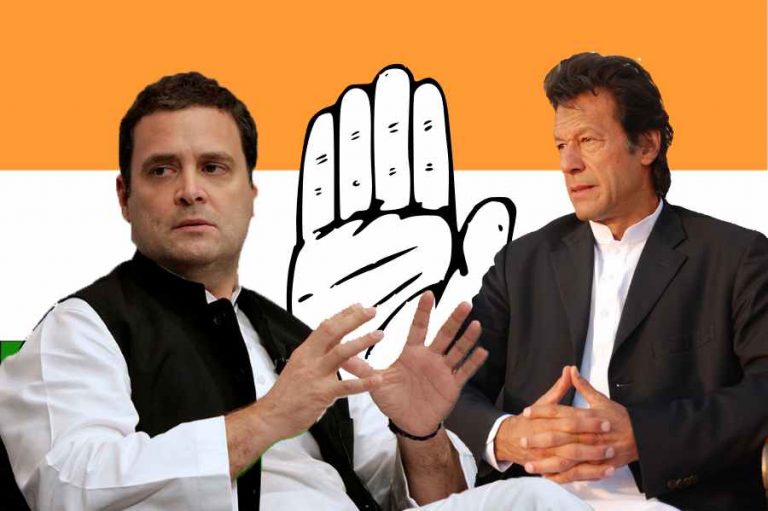
In a video which has gone viral on social media, Pakistan Prime Minister Imran Khan Niazi can be heard referring to India’s former Prime Minister Dr Manmohan Singh by his first name. While waiting in what seems like a bus near the border where Indian leaders and delegates were to enter Pakistan for the Kartarpur Sahib Corridor inauguration, Imran Khan Niazi addresses the 87-year-old Congress MP on first name basis.


Khan starts off with, “Achha, humara woh Sidhu kidhar hai? (Oh, where is our Sidhu)” as people surrounding him burst into laughter. At around 1:23 in the video above, Khan then says, “Manmohan aa gaya? (Is Manmohan here)” A lady accompanying the group then said, “Usko rokenge to.. (if they stop him)” and Khan finished her sentence for him by adding “Achha khasa hero banayenge (then he will be a hero).” The lady then adds that how stopping former PM Singh would be the headlines for all news channels.

Ayodhya: A unique reconciliation, perhaps the first historical-civilisational dispute to have been resolved by judicial process

In a judgment unprecedented in the annals of judicial history anywhere in the world, the Supreme Court of India today (November 9, 2019) brought closure to the 491-year Hindu struggle to reclaim the birthplace of Sri Ram, and in a unanimous verdict announced by Chief Justice of India Ranjan Gogoi, awarded the entire 2.77 acre disputed land in Ayodhya to Ramlalla Virajman and the Ram Janmabhumi Nyas. The verdict, it may be noted, was decided by evidence and not by faith (of either side).

It is pertinent, however, that Ramlalla was held to be a minor deity and a juristic person, and represents a triumph of the legal acumen of senior advocates K. Parasaran and C.S. Vaidyanathan, who represented Ramlalla Virajman.

The five-judge Bench ruled that the Hindu litigants were able to establish that they were in possession of the outer courtyard, while the Muslim side was unable to prove their exclusive possession of the inner courtyard.

Read: Struggle for Ram Mandir at Ayodhya will remain a high point for Hindu civilization

This brings down the curtain on one of the bitterest contests in Indian history, when Hindus refused to renounce claims to the birthplace of Sri Ram, the only avatar of Vishnu who also became king, of a kingdom ruled by a distinguished solar dynasty with a special relationship with the Gods. Although the Supreme Court made it clear that it was treating the case as a title suit (property dispute), and not as righting a historical wrong, the dispute has profound civilisational implications. It is probably the first historical-civilisational dispute in the world to have been resolved successfully by judicial process.

The apex Court granted an alternative five acres of land for a mosque, as compensation to the Sunni Wakf Board, the principal Muslim petitioner, at a suitable and prominent place in Ayodhya, and dismissed the special leave petition of the Shia Central Waqf Board. Coming out of the court, advocate Zafaryab Jilani expressed disappointment and at a press conference of the All India Muslim Personal Law Board stated that a review petition would be filed.

This was soon contradicted by Zufar Faruqi, chairman of UP Sunni Waqf Board, who issued a written statement that he “welcomes and humbly accepts” the verdict of the Supreme Court and emphatically ruled out a review or curative petition against it. Zafaryab Jilani was forced to clarify that he had reacted as secretary of the All India Muslim Personal Law Board and not as counsel for the Sunni Waqf Board.

Read: My last wish before I die is to see a logical end to this case: Ram Lalla’s 92 year old lawyer

This brings down the curtain on nearly 70 years of contentious litigation in independent India and ends a dispute that defied resolution despite repeated attempts at mediation. The AIMPLB, which vehemently opposed the law banning triple talaq, that was fought for and demanded by Muslim women, is once again out of sync with Muslim sentiment.

Almost all political parties and leaders, namely Prime Minister Narendra Modi, Defence Minister Rajnath Singh, Home Minister Amit Shah, Congress Party and its former president Rahul Gandhi, BSP leader Mayawati, Shiv Sena president Uddhav Thackeray, and others, have welcomed the verdict. This lessens the scope for acrimony and inflaming of passions on the issue. RSS Sarsanghachalak emphasised that the verdict was neither a victory for one side nor a defeat for another side, a sentiment echoed by VHP working president Alok Kumar.

The 1045-page judgment is unique in the annals of Indian judicial history for not disclosing the name of the judge who authored the judgment. World over, the convention is that the judge who is assigned the task of writing the judgment on behalf of the Bench gives his name and the names of other judges are appended as concurring with the same. Dissenting views, if any, are also recorded by name. In this case, the entire judgment has to be attributed jointly to Chief Justice of India Ranjan Gogoi, Justice S.A. Bobde (CJI-designate), and Justices D.Y. Chandrachud, Ashok Bhushan and Abdul Nazeer.

Read: The Reclamation Project: Here’s how the great Maratha warriors fought to reclaim Ayodhya, Prayag and Kashi

Given the enormous sensitivity of the verdict, for which political leaders and organisations urged maturity, peace and amity for several days preceding the judgment, it seems logical to credit this determined show of unanimity to Chief Justice Gogoi. It is pertinent that the CJI even met Uttar Pradesh Director General of Police, O.P. Singh, in advance of the judgment, to satisfy himself that peace would be maintained in this sensitive state. While stray incidents from miscreants cannot be ruled out given the fact that many jihadi cells operate in several states, there can be little doubt that sane voices within the Muslim community have broadly conceded the merits of the Janmabhumi case.

The Supreme Court’s verdict includes a 116-page addendum explaining why the disputed site is indeed the birthplace of Sri Ram as per Hindu faith and belief. The authorship of this addendum has also been withheld with the words, “One of us while being in agreement with the above reasons and directions, has recorded separate reasons on – Whether the disputed structure is the birth-place of Lord Ram according to the faith and belief of the Hindu devotees. The reasons for the learned judge are set out in an addendum”.  (page 929)

This addendum cites various ancient texts and scriptures and observes, “it is found that in the period prior to 1528 A.D., there were sufficient religious texts which led the Hindus to believe the present site of Ram Janma Bhumi as the birthplace of Lord Ram”. It concludes: “… that faith and belief of Hindus since prior to construction of Mosque and subsequent thereto have always been that Janmaasthan of Lord Ram is the place where Babri Mosque has been constructed which faith and belief is proved by documentary and oral evidence discussed above”.  Hence it is evident, and not faith, that carried the day in court.

The apex court has asked the Centre to constitute a body within three months, under sections 6, 7 of the Ayodhya Acquisition Act, to hand over the inner and outer courtyard to the Ram Janmabhumi Trust to build and manage the temple. The Nirmohi Akhara, whose suits were dismissed by both the Allahabad High Court as well as the Supreme Court, but was traditionally responsible for the prayers in the temple, has welcomed the fact that the verdict gives it adequate representation in the proposed Trust.

Essentially, the verdict upholds the main judgment of the Allahabad High Court while removing its anomalies. The apex court declared that the Allahabad High Court’s decision to give the Sunni Wakf Board and Nirmohi Akhara one-third each of the disputed property even after dismissing their suits “defies logic” and the entire land has to be considered as a whole. The Sunni Wakf Board was unable to prove its right to the disputed property, “possessory title”.

This is the historical lacuna on which Hindus won the case. For the uninitiated, we may mention that, as established in the Allahabad High Court, the Babri Masjid was built at a time of Muslim supremacy in north India, but the builders omitted to designate it as a Shia or Sunni mosque; in Islam, a mosque can only be denominational. Nor did the rulers ever create a Wakf for the upkeep of the mosque and the mutawalli who maintains it. This also is imperative. Under British rule, the British provided succour to the then mutawalli, which further establishes that the legal procedure under Muslim law for establishing a mosque was not followed. Above all, Muslims were not able to assert the right of adverse possession, as Hindus dispossessed them in 1934 and again in 1949 and 1986.

The Supreme Court accepted the presence of a pre-existing structure, “not Islamic in nature”, beneath the mosque, and that the artefacts recovered by the Archaeological Survey of India “have a distinct non-Islamic nature”. Hence, the mosque was not constructed on vacant land, though it agreed that Muslims never abandoned the Babri Masjid. However, even prior to 1855, Hindus had access to the inner courtyard. It agreed with the Allahabad High Court that the murtis of Ramlalla were placed inside the central dome of the Masjid on the intervening night of December 22-23, 1949, and added that while belief in the birthplace of Sri Ram is a matter of belief, no evidence was placed on record to “discount the belief of Hindus in the place.”

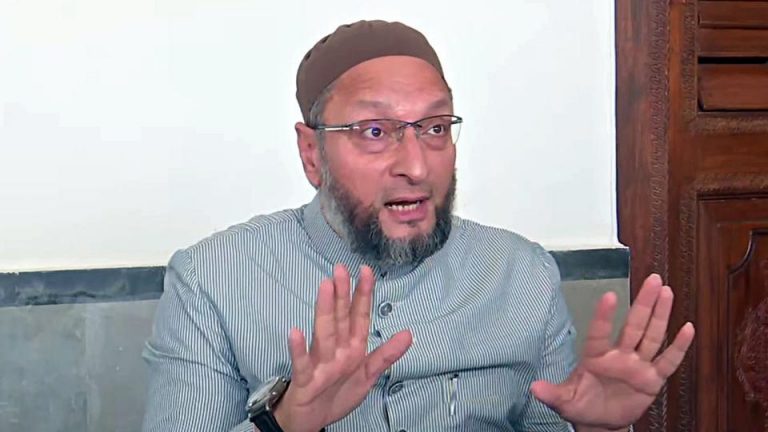
The verdict has been welcomed by some Muslim bodies, including Firangi Mahal, though All India Majlis-e-Ittehad-ul-Muslimeen chief Asaduddin Owaisi grudgingly stated that the verdict of the court “is final but not infallible”. Owaisi said Muslims should reject the offer of five acres of land, but that ball is in the court of UP Sunni Wakf Board.

In an unanimous decision, Congress MLAs decide to support Shiv Sena to form government in Maharashtra: Reports

Amidst the continued BJP-Sena stalemate over government formation in Maharashtra, the Congress MLAs in Maharashtra have reportedly decided to support Shiv Sena in the formation of the government.

According to the report by Times Now, the Congress MLAs who are presently at a resort in Jaipur held a meeting on Sunday and decided to support an alliance with Shiv Sena and Sharad Pawar led NCP. The Congress party has decided to send a letter to the NCP regarding the same.


In a significant development, the Congress legislators in Maharashtra will also be meeting party high command on Sunday in Jaipur to discuss the government formation with Shiv Sena. The Congress party has unanimously decided to support the NCP-Shiv Sena alliance, said one of the 44 newly-elected MLAs of the Congress party, according to Times Now.

Earlier, Shiv Sena had also hinted at the possibility of joining hands with the Congress to form the next government in Maharashtra. Speaking on the government formation in Maharashtra, Sanjay Raut had said, “If nobody is ready to form the government (in Maharashtra), then Shiv Sena can take the lead.”

In an apparent softening of the stand for Congress, the Shiv Sena on Sunday said that while its ideology is different from that of the Congress party, it does not consider the grand old party to be an enemy. The shift in position comes at a time when deadlock between the Sena and ally BJP appears not going away over government formation in Maharashtra.

On Friday, senior Congress leader Milind Deora had voiced similar opinions like the Congress MLAs, stating that the NCP and Congress should now stake claim to form the government with outside support from other parties and independent legislators.

“The Congress and NCP can form govt provided the smaller parties support it from outside. Congress must not compromise on its ideology and value system,” added Deora.

Read- I don’t need Amit Shah and Devendra Fadnavis to install a Shiv Sena Chief Minister in Maharashtra: Uddhav Thackeray

On Saturday, Maharashtra governor Bhagat Singh Koshyari had invited Devendra Fadnavis of BJP to form the next government in the state, if they are willing to do so and have required numbers.

Devendra Fadnavis had resigned from the post of the chief minister a day ahead of his term was scheduled to end today. He had decided to resign as the BJP-Shiv Sena alliance, which won a majority with 161 seats together in the assembly elections held last month, failed to arrive at a power-sharing agreement. The governor has him asked to continue as acting-CM following his resignation.

In the October 21 polls, the BJP won 105 seats while ally Sena won 56 seats. The majority mark in the 288-member state Assembly is 145. NCP and Congress won 54 and 44 seats each.

Ayodhya verdict: This is how the front page of some of the major newspapers across India looked like day after the judgement

On Saturday, the Supreme Court of India delivered one of the most historic judgements in independent India, ending the dispute that spanned centuries by handing over the disputed Ram Janmabhoomi-Babri masjid land to the Hindu parties, making way for Hindu devotees to have a grand Ram Mandir at the birthplace of Lord Ram.

The five-member Supreme Court bench headed by Chief Justice of India, in a unanimous judgement declared that the Sunni Waqf Board, which was a party to the seven-decade-old title suit, should be given an alternate five-acre land within three months at some other place in Ayodhya for the construction of a mosque.

Here’s a look at how newspapers across the country covered the historic decision on Sunday morning.

Telegraph – the ultra-left wing rag, perhaps disappointed with the Supreme Court judgement, as usual, peddled its anti-Hindu agenda by stating that judgement was ‘in the name of ram and site is now “Hindu-stan”.


Telegraph front page

However, the other newspapers were more nuanced and presented clear facts pertaining to the  Supreme Court’s judgement.

Read: The Telegraph wants to win a media rat race to the bottom of the pit with its headlines, but in the end, it will remain a rat

Leading Hindi daily Amar Ujala titled its report as “Ramlalla Virajman” and referred the judgement as to the dawn of Ram Raj.

Amar Ujala front page

Another Hindi daily Dainik Jagran displayed a large portrait of Lord Ram and a representational image of proposed Ram mandir on its front page following the historic verdict of the Supreme Court.

Dainik Jagran front page.

Dainik Bhaskar put out a headline “Ramlalla hi Virajman” and presented a brief report on the SC verdict. Interestingly, the front page had a report on archaeologist KK Muhammad, who was a part of the team of archaeologists that had carried out the first excavation at the site in 1976-77, which confirmed that there is enough archaeological proof of a grand temple below the Babri Mosque.

Dainik Bhaskar front page

The Hindi daily – Hindustan, part of the Hindustan Times group, also displayed a grand temple of Lord Ram at Ayodhya and titled its front-page report with “The road to Ram Mandir is clear”.

Hindustan front page

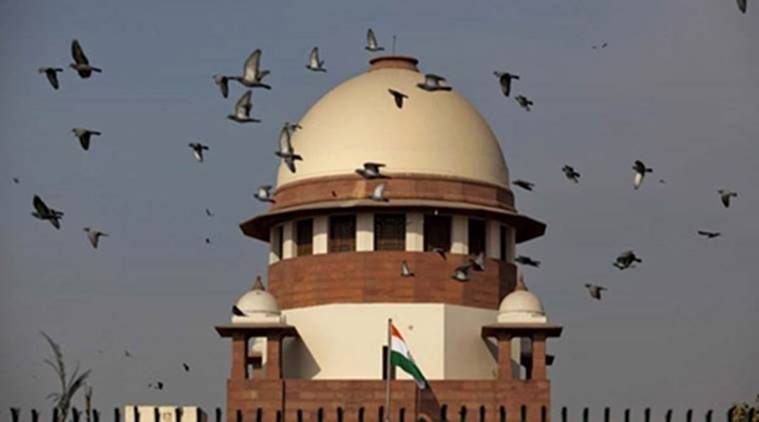
Prabhat Khabar put out an image of Supreme Court on its front page and put a report with the title “Ayodhya Ram Ki”, meaning, Ayodhya is of Lord Ram.

Prabhat Khabar.

Prabhat Khabar also mentioned how the Muslim parties will get a 5 acre land in Ayodhya only for a mosque.

Indian Express

Indian Express, cheekily said that the site over which the dispute spanned over the years will now have a temple in its place while the mosque which was constructed after demolishing the ancient temple will get the 5 acre plot.

Hindustan Times

Hindustan Times had an image of the bricks with ‘Shri Ram’ written, which are at the site in Ayodhya, waiting to be part of a grand temple with a headline ‘Temple set in stone’.

Times of India

Leading English daily Times of India, too, had a word play on the Mandir getting the site which was under dispute since years.

Mumbai Mirror

Mumbai Mirror, a part of the Times Group, referred to the 5 acre plot allotted to Muslim parties as ‘fragile peace’ after the judgement favoured Ram Lalla Virajman.

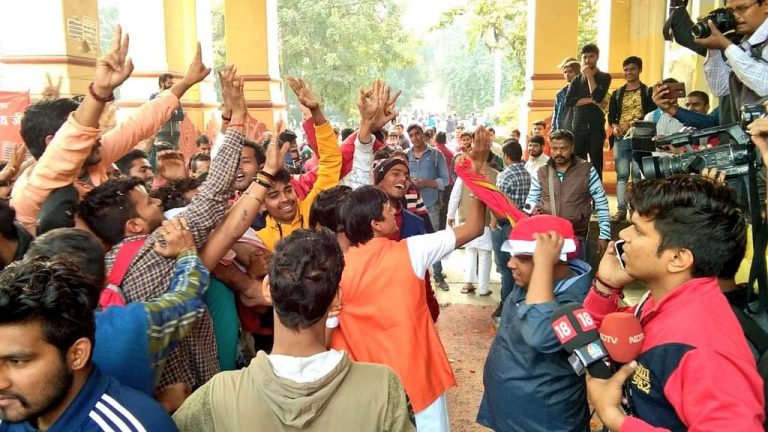
‘Jai Shri Ram’ slogans echoed on campus even as some JNU ‘students’ protested against Supreme Court verdict on Ayodhya

JNU students on Saturday evening protested against the Supreme Court verdict which ruled in favour of Ram Lalla Virajman, thereby clearing way for construction of the Ram Mandir at the place where Lord Ram was born in Ayodhya.


As per a video shared by Navbharat Times, the JNU students can be heard expressing how the Supreme Court judgement on Ayodhya land title case was ‘unfair’. “Supreme Court has legalised ‘Jai Shri Ram’. This is now the perfect slogan. Remember this,” a ‘student’ could be heard saying amidst chants of “Jai Shri Ram” coming from the background.

Read: JNU faculty member Dr Vandana Mishra kept in illegal captivity by protesting ‘students’ inside classroom

He further states, that the Muslim side got 5 acre land which is double the land which was once disputed. “That way one could say the Muslim side won. But it was not question of land. It was question of dignity. Question of right and question of justice. It was never about the land. Post 1992 demolition, whichever riots took place, only Muslims lost their lives. In UP, Mumbai and then in Gujarat. Narendra Modi is a product of that. He is a product of Babri Masjid. The presence state of Indian politics is the product of the same Babri Masjid demolition. Never forget. The same Modiji today addresses the nation on Ayodhya verdict. We should not be disheartened.

Meanwhile, communists parties students had also planned a protest rally in JNU. However, their plans flopped as the venue was filled with ‘Ram Lalla hum aayengey, Mandir wahin banayengey’ slogans instead.


In a historic judgement, ending decades of dispute, the Supreme Court gave a unanimous judgement in the Ayodhya title dispute case and ruled in favour of Ram Lalla Virajman. The SC has asked the government of India to set up a trust which will be in charge of constructing the Ram Mandir. The Muslim parties were given 5 acre land for constructing a mosque.