Home Blog Page 5876

Diwali again: Hindus welcome Supreme Court verdict on Ram Janmabhoomi by lighting up diyas

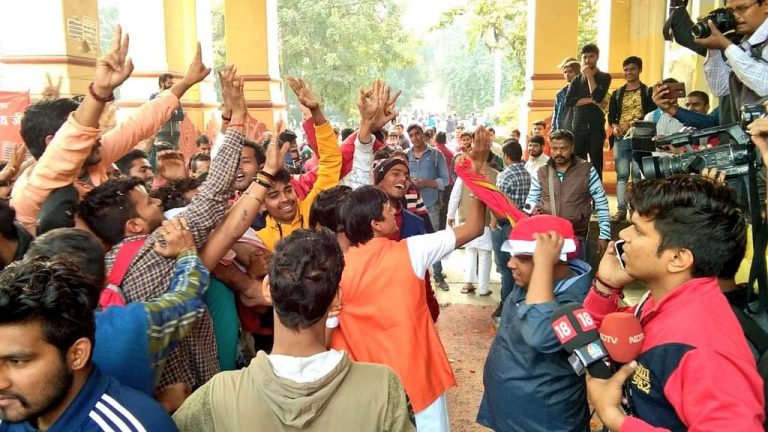
In a historic move, the Supreme Court on Saturday gave its verdict in the long awaited title case of Ram Janmabhoomi-Babri Masjid in Ayodhya, ruling unanimously that a temple be constructed at what was once a disputed property. Following the verdict, the rejoicing Hindus lit up diyas, like in Diwali, to welcome home their lord, after having denied his rightful place for centuries.


For many, it was nothing short of Deepotsav, a festival of lights.


Read: Ayodhya verdict: While the nation celebrates, ‘liberals’ become the rudalis at the ‘death of justice’


For many, the verdict meant that the second exile for Lord Ram has come to an end.


The Supreme Court in its verdict on Ram Janmabhoomi case said that the central government will set up a trust and assign the task of construction of the temple to the same. The Muslim parties were given 5 acre land for construction of the mosque.

Maharashtra Governor asks Devendra Fadnavis to explore the possibility of forming the government

Maharashtra governor Bhagat Singh Koshyari has invited Devendra Fadnavis of BJP to form the next government in the state, if they are willing to do so and have required numbers. A press release issued today by Raj Bhavan said that the governor has asked Devendra Fadnavis, leader of the largest party BJP, to indicate willingness and ability of his party to form the government in Maharashtra. Today is the last day of the current assembly in Maharashtra, which will be dissolved at midnight.


The statement notes that even after 15 days after results were declared following the assembly elections, no single party or alliance has come forward to form the government. “The Governor has therefore decided to explore the possibility of formation of Government and today asked the leader of the elected members of the single largest party, that is BJP, to convey its willingness and ability to form the government to him,” Raj Bhavan said.

Devendra Fadnavis had resigned from the post of chief minister yesterday a day ahead of his term was scheduled to end today. He had decided to resign as the BJP-Shiv Sena alliance, which won a majority with 161 seats together in the assembly elections held last month, failed to arrive at a power-sharing agreement. The governor had asked to continue as acting-CM following his resignation.

BJP and Shiv Sena fought the elections together, and BJP emerged as the single largest party by winning 105 seats, while Shiv Sena won 56 seats. NCP and Congress won 54 and 44 seats each, and the BJP-Shiv Sena alliance has a comfortable majority in the 288-member house. But Shiv Sena demanded a 50:50 power-sharing formula, and rotation of chief minister post after 2.5 years, which was not acceptable to BJP. This led to a bitter public spat between the two parties with several Sena leaders abusing BJP and PM Modi. and Uddhav Thackeray announcing that he is open to alliance with any party.

Finally, Fadnavis resigned yesterday, saying that he was hurt by comments of Shiv Sena. He had said that while Uddhav Thackeray didn’t respond to his calls, he approached NCP and Congress for the formation of the government. Fadnavis had said that from the comments of Shiv Sena it is clear that they don’t want to continue their alliance with BJP.

Sena chief Uddhav Thackeray had refuted the claims of Fadnavis, and had claimed that he can install a Shiv Sena CM in Maharashtra without the help of Amit Shah and Devendra Fadnavis.

As liberals claim South Indians don’t care about Ram, read about the history of Ramayana in South Indian states

The Supreme Court verdict on the Ayodhya dispute has been declared. The judgment has ruled that Muslims will be provided with an alternate piece of land for a Mosque while the Ram Janambhoomi has been awarded to the proponents of a Bhavya Ram Mandir at Ayodhya.

In the aftermath of the verdict, the liberals had a meltdown on social media. It was only to be expected as they mocked the idea of a Ram Mandir for years. To cope with their misery, liberals resorted to their usual narratives on social media. One that they have relied on extensively in recent years is the much exaggerated ‘North-South divide’. Journalist and lawyer Nikhil Kanekal suggested that South Indians are wondering today who is Ram Lalla.


It is not surprising that a liberal isn’t aware of the extent of Rama’s popularity in the southern regions of the country. As elaborated by Historian Meenakshi Jain in her book ‘Rama & Ayodhya’, Ram has always been a revered figure in South India and stalwarts of the Ramayana have composed the Ramayana in their respective languages centuries ago. In this article, we shall elaborate on the pervasiveness of devotion towards Ram in South India.

1. Andhra Pradesh and Telangana

There are three major compositions of the Ramayana in the Telugu language. The oldest was by Chakrapani Ranganatha, which is sometimes attributed to Gona Buddha Reddi, in the 13th century. It was called the Ranganatha Ramayanam and was the first complete Ramayana to be composed in the indigenous metre and was sung widely. The second, composed around the same time as the predecessor, was written by Hulakki Bhaskara and was called the Bhaskara Ramayanam. The third was composed by the poetess Molla from the potter community in the 14th or the 15th century. It was called Molla Ramayanam and it enjoyed a great popularity among the people.

Various other Ramayanas have been lost to the tides of time. Ramakatha by Errana or Errapregada, Annamayya Ramayanam, Ramayanas by Koravi Satyanarayana and Chitrakavi Ananta Kavi and Raghunatha Ramayana by the rule of Tanjore, Raghunatha Nayaka are either no longer available at all or not available in their complete form. The Uttara Kanda, a sequel to the story of Ranganatha Ramayanam, was composed by the sons of Buddha Reddi.

2. Tamil Nadu

Ram finds mention in the earliest of Tamil compositions: The Sangam Literature. The Purananuru, the Ahananuru and the Paripadal collection of verses mention various incidents of the Ramayana. The post-Sangam classics, Silappadhikaram and Manimekhalai, alluded to incidents from the Ramayana.

In the 7th and 8th centuries, Ram became very popular due to the Alvar and Nayannar saints. However, the earliest exclusivist devotion to Ram is found in a hymn of Nammalvar (9th century), the son of a Pandya chieftain. One of the most ardent devotees of Ram, Kulashekhara Alvar, who lived in the first half of the 9th century, is credited with “the foundation of Ram-worship in Tamilnad”. His Perumal Tirumoli confirmed that the Uttara Kanda was widely known in Tamil Nadu by the 8th century.

Read: Secular-liberals hate Lord Ram because he is the biggest roadblock to the ‘Breaking India’ project

However, it’s speculated that a complete Ramayana had already been composed before the 8th century as the famous poet, Perundevanar, referred to Shri Ramakatha and he lived in the 9th century. The Yapparunkalavriti, dated to 9th century, spoke of “Ramayana and Puranasagara” composed in the Tamil Venba metre.

The most well known Tamil rendition came from Kampan, the “emperor of poets”, who is believed to have lived sometime between the 9th and 12th centuries. It is considered the first adaptation of the Epic in languages other than Sanskrit and Prakrit and also the first devotional version of the Ramayana in the various languages in the country that are still living. Kampan considered Rama “a Tamil hero, a generous giver and a ruthless destroyer of foes”. According to him, Rama was on a “mission to root out evil, sustain the good and bring release to all living beings”.

The great Tamil dynasties, the Pallavas, Cholas and Pandyas, are known to have made endowments for the public exposition of the great Hindu Epic as well. In addition to this, several Jain versions of the Ramayana were composed in Tamil during the medieval era.

3. Kerala

It is not precisely known when the Ramayana tradition was established in Kerala. However, it is a popular belief that Parshuram retrieved the land from the sea. Moreover, the Malayalam language is believed to have evolved sometime around the mid-ninth century. Therefore, no Malayalam work has been derived thus far prior to the 12th century.

Ramcharitam by Cheraman, who is identified with a king of Travancore but on insufficient grounds, is considered the earliest Malayalam rendition of the Ramayana. It is believed to have been composed in the pattu genre a little later than Kampan’s version. Rama Kannassa Ramayana, composed from a Bhakti perspective, was composed by Rama Panikkar sometime in the 14th or 15th century.

Ayyipilla Asan’s Ramakathapattu came after Panikkar’s work towards the end of the 15h century. The Ramayana Champu is attributed to Punam Namputiri who is believed to have lived in the second half of the 15th century. The best known, however, is Ezuttaccan’s Attiyatuma Ramayanam, based on Adhyatma Ramayana, in the 16th century.

4. Karnataka

Kavirajamarga by Nripatunga in the 9th century is the earliest available literary composition in Kannada and it has references to earlier poets in addition to excerpts from the Ramayana and Mahabharata. The earliest Ramayana in Kannada, however, was the Jain Chavundaraya Purana which is believed to have been composed in the 10th century.

Sometime in the 11th or 12th century, poet Nagachandra composed the Pampa Ramayana, also known as the Ramachandra-charita Purana. Narahari’s Rama Katha, based largely on the Valmiki Ramayana, was the most important Kannada Ramayana during the Vijayanagara era. In the early 17th century, Virupaksha was commissioned to compose the Valmiki Ramayana in prose by Chamaraja, the Wodeyar King. It was called the Chamarajakoti Vani Vilasa Ramayana.

Hours after historic Supreme Court verdict on Ayodhya, PM Modi addresses nation, says time to leave the past behind

0

Prime Minister Narendra Modi addressed the nation hours after Supreme Court of India, in a historic judgement ending a dispute spanning centuries, handed over the Ram Janmabhoomi site in Ayodhya to the Hindu parties, making way for Hindu devotees to have a grand Ram Mandir at the birthplace of Lord Ram.


Modi began his address by congratulating the 5 judge bench saying that today is a historic day in Indian judiciary as the decades-long justice process is now over. The whole country wished that the matter should be heard daily in the court, which took place and today the decision has arrived. The Prime Minister lauded the bench for patiently hearing all the sides for a continuous 40 days before coming to a unanimous decision.

PM lauded the restraint showed by people saying that the verdict has been peacefully accepted by all. “The whole world believes that India is the largest democratic country in the world, but today the world has also known how vibrant and strong India’s democracy is”, said Modi, revering that this historic day today has marked the commitment of inclusivity.


“After the verdict, the way the whole country including people from every section, every community and every creed has accepted it openly, it reflects India’s ancient culture, traditions and sense of harmony, said PM Modi.

The Prime Minister spoke about the importance of November 9 as this was the day when a pivotal event in world history was marked- the fall of the Berlin Wall, remembered Modi. Reminiscing the event, Modi said that this day marks togetherness and harmony. In case there is any bitterness in the mind of anyone, anywhere, then today is the day to pay attention to it and get rid off it. Fear, bitterness, negativity have no place in new India, said Modi claiming that today is the beginning of a ‘New India’.

Modi said that the judgement today ushers new dawn and every Indian should welcome this new era. “This controversy may have affected many generations, but after this decision, we have to make a resolution that now a new generation will start building a new India”, said the PM, appealing that as a society, every Indian has to work by giving priority to his duty and his obligation. “The harmony between us is very important for our unity, peace and development of the country”.

“We must take all sections together, leaving the past behind,” said Modi as he reiterated the ‘Sabka Saath Sabka Vikas’ message.

The 5-judge bench of the supreme court delivered a unanimous judgement in the Ram Janmabhoomi case. The top 5 senior judges came to the decision after weighing the arguments presented by all sides for 40 days.

The bench said that the Central Govt should within 3 months formulate a scheme envisaging setting up of Trust to build the Ram Mandir in Ayodhya. Possession of inner and outer courtyards to be handed over to the Trust. The apex court also ordered the union government to provide 5 acres of land at an alternate site at a prominent location in Ayodhya to the Sunni Waqf Board to rebuild the Babri Masjid which was demolished in 1992.

It may be noted that while the Ram Mandir will be built by a trust constituted by the central government, the Sunni Waqf Board will build the mosque on the plot given to them by the government at a prominent location in Ayodhya.

Congress leader Navjot Sidhu claims Imran Khan Niazi is greater than Alexander The Great, showers praises on Pakistani PM

0

Speaking at the inauguration of the Kartarpur Corridor in Pakistan, Congress’ motormouth leader Navjot Singh Sidhu got ants in his pants in extolling the Pakistan Prime Minister Imran Khan Niazi. Sidhu showered exorbitant gratitude for the Pakistani Prime Minister, thanking him on the behalf of ’14 crore Sikhs’ for conceiving the Kartarpur corridor project.


Putting Khan on a high pedestal, an effusive Sidhu asserted that it was the first time since the partition that the boundaries between the two countries were dismantled, passionately declaiming that Pakistan Prime Minister had a huge contribution in making it possible.

Sidhu also thanked Prime Minister PM Modi for fulfilling the desires of millions of Sikhs and facilitating their pilgrimage to Kartarpur, where Sikhism founder Guru Nanak Saheb is said to have breathed his last. However, the controversial leader didn’t shy away from taking a dig at the Indian Prime Minister. Sidhu said that he is sending a Munnabhai MBBS style hug to PM Modi.


“PM Modi also reciprocated the gesture but the initiative was put forth by Imran Khan. Alexander the Great had conquered the world with brute force but you, Imran Khan, you have won the hearts of 14 crore Sikhs and the entire world with love,” a gushing Sidhu proclaimed.

Navjot Singh Sidhu has often heaped uncritical admiration for the Pakistan PM Imran Khan while turning a blind to the terrorism emanating from Pakistan. Earlier in March this year, in his unbridled love for Pakistan Prime Minister, Sidhu credited Imran Khan for his ‘kind act’ to return Wing Commander Abhinandan Varthaman, ignoring the fact that they had no other way.

Sidhu had penned an open letter lauding “noble gesture” of Pakistan PM Imran Khan without holding him accountable for his country’s perpetual support to terrorism.

A few days ago, Sidhu took a cue from legendary Tara Singh of movie Gadar and displayed unswerving determination in visiting Pakistan. When he didn’t receive permission for visiting Pakistan on the Kartarpur corridor inauguration, a jittery Sidhu wrote a letter to the External Affairs Minister, S Jaishankar, stating that even if the central government does not respond back in affirmative on this letter, he will go to Pakistan on a pilgrim Visa.

No immediate focus on UCC after Ayodhya verdict, Rajnath Singh was misquoted by media

0

There will not be any immediate focus on implementing the uniform civil code (UCC). Last evening, some media reports had wrongly quoted Defence Minister Rajnath Singh who was cited as having said time has come for UCC.

Hours after the Jam Janmabhoomi site was given to Hindus by the Supreme Court for construction of a Ram Mandir, media houses had reported that union defence minister Rajnath Singh said that time has come for the Uniform Civil Code. He was quoted as having said “aa gaya samay” (time has come) when reporters asked him about UCC. However, news agency ANI that had reported has now deleted the story and tweet. OpIndia regrets having reported the misinformation.

Uniform Civil Code refers to common personal law for all the communities, as opposed to the current situation where every community has their own personal law. Four separate petitions have been filed at the Delhi Court seeking implementation of UCC, and the court will hear the petitions on 15th November. The petitions are seeking farming of a uniform civil court as provided under Article 44 of the constitution, to promote national integration as well as gender justice, equality and dignity of women.

The fist plea seeking UCC was filed by BJP leader Ashwini Kumar Upadhyay in May 2019. After that, another petition was filed by a lawyer for the constitution of a judicial commission or a high-level committee to prepare a UCC. The third petition was filed by Firoz Bakht Ahmed, the chancellor of Maulana Azad National Urdu University and the grandnephew of first education minister Maulana Abul Kalam Azad, while the fourth petition was filed by social activist Amber Zaidi, who in her petition has said that the country urgently needs a UCC.

The High Court has clubbed all four petitions and will hear them together.

Read: Filing PILs for the implementation of a Uniform Civil Code is a bad idea, here’s why

Talking about the Ram Janmabhoomi verdict, Rajnath Singh said that this is a landmark judgement. “I think this will strengthen that the feeling of ‘Sarv Dharma Sambhav’ and relations among people will be better. I appeal people should maintain peace and the verdict should not be taken as a win or loss for anyone,” he said.

In a historic judgement, today the 5-judge bench of Supreme Court headed by CJI Ranjan Gogoi handed over the entire Ram Janmabhoomi site of 2.77 acres in Ayodhya for construction of the Ram Mandir. At the same time, the court asked the government to provide 5 acres of land at a prominent place in Ayodhya to the Muslim parties represented by the Sunni Waqf Board. The apex court has asked the central government to formulate a scheme for the same within 3 months, and also asked to form a board of trustees for construction of the temple.

Note: The report has been updated with latest information.

Kailash Vijayvargiya remembers Kar Sevaks Kothari brothers who laid down their lives for construction of Ram Temple in Ayodhya

0

Hours after the Supreme Court pronounced judgement in the title case of Ram Janmabhoomi, allotting the historical site to Ram Lalla Virajman and said a Ram Mandir should be constructed there, BJP national general secretary, Kailash Vijayvargiya hailed the apex court for increasing the respect of India’s judiciary all across the world by unanimously resolving the decades-old problem. While congratulating the countrymen on this occasion, Vijayvargiya remembered the two Kar Sevaks, the Kothari brothers, who had spearheaded the sacred work of Ram Mandir Nirmaan and willfully laid down their lives in their long quest for glory.


The BJP leader today met Purnima Kothari, the sister of Ram and Sharad Kothari, who were killed in police firing on November 2, 1990, and their bodies were found in a narrow lane near Hanumangarhi in Ayodhya. Purnima had been awaiting the verdict with bated breath as she felt that “it’s only with the construction of Ram Mandir at Ayodhya that my brothers’ soul will rest in peace”.

“We want action against former Uttar Pradesh chief minister Mulayam Singh Yadav for issuing firing order on innocent ‘kar sevaks’ (Hindu volunteers) in which my brothers Ram and Sharad Kothari were killed. They were unarmed and killed by police on the instruction of the chief minister. It’s only with the construction of Ram Mandir at Ayodhya that my brothers’ soul will rest in peace.”

Read: Road to Ram Janmabhoomi, Ayodhya: How Hindus fought for Shri Ram

“It is unfortunate that even after more than 28 years, nothing has happened in this case. Now, we are hopeful that the argument will be in our favour. My brothers were only doing ‘kirtan’ (devotional songs) in the Hanumangarhi area. They were unarmed, but Yadav ordered the security forces to open fire at them. We want justice,” she had said.

The incident which occurred in Ayodhya, 29 years back, left an ineradicable mark in the history of India. The incidents in the last days of October and the 1st four days of November 1990 had left the then UP CM Mulayam Singh completely off balance who left no stone unturned to unleash utmost atrocities on Kar Sevaks who assembled in Ayodhya.

On November 2, 1990, a large group of kar sevaks, including the Kothari brothers, started to gather in front of Hunumangarhi, a stone’s throw away from Babri Masjid that was eventually demolished days later. They started moving ahead but were stopped by police.

All of them sat on the road in protest and started singing ‘bhajans’ (religious songs) when suddenly, the security personnel at the behest of then CM Mulayam Singh, started firing at the crowd and chased kar sevaks across the area. Many people died from head wounds. There was a stampede at the Saryu Bridge, which killed a number of people. According to eye-witnesses, the Kothari brothers mounted a saffron flag atop the Babri Masjid, but however, fell prey to the brutality meted out at the Kar Sevaks.

It was reported then that the police had disposed of many dead bodies, either by cremating them at unknown places or by dumping them into the Saryu River in sacks. The news of the shootings was mostly suppressed from the Indian media then, however, the Chief Minister of Uttar Pradesh was given the sobriquet ‘Mulla’ Mulayam Singh for his pro-Muslim stance during the incident.

Humbly accept judgment, will not file any review or curative petition: Sunni Waqf Board on Ayodhya verdict

The Sunni Waqf Board has clarified that it will not file any review petition against the Supreme Court verdict that paved the way for a Bhavya Ram Mandir at Ram Janmabhoomi in Ayodhya. Earlier, their lawyer had asserted that he was not satisfied with the judgment and the Sunni Waqf Board may file a review petition against it.

“We welcome and humbly accept the verdict of the Supreme Court. I want to make it clear that UP Sunni Waqf Board will not go for any review of the SC order or file any curative petition,” Zafar Farooqui, Chairman of Uttar Pradesh Sunni Central Waqf Board, said in a statement to the press. “Hence, any statement in this regard by any individual, lawyer or organization which mentions that U.P. Sunni Waqf Board will go for a review is not our line,” he added.

Farooqui further stated, “We are grateful to the Honourable Supreme Court for setting aside as ‘erroneous’ the observations of one of the Honourable Judges of the Allahabad High Court (2010), which diluted the provision of the Places of Worship Act, 1991.”

Earlier, Babri Masjid Action Committee member and Sunni Waqf Board’s lawyer Zafarayab Jilani had said that they will study the judgement and consult with senior lawyers to decide whether to file a review petition against the apex court verdict.

When asked about the alternate site given for Muslims, Jilani had said that Muslims can’t accept land in exchange of mosque, as the mosque is ‘owned by Allah’. He said that the Masjid is priceless and it can’t be shifted, adding that the 5-acre land has ‘no value for Muslims’.

Mughal descendant Prince Tucy says he will keep up his promise and donate the first ‘gold brick’ for Ram Temple

0

Yakub Habeebuddin Tucy, aka Prince Tucy, who is the great-grandson of Mughal Emperor Bahadur Shah Zafar welcomed the Supreme Court’s historic decision to hand over the Ram Janmbhoomi site to Hindus to build the Ram Mandir and reiterated his promise to donate the first ‘gold’ brick, for Ram temple construction at Ayodhya.

Tucy, who had rooted for Ram temple, saying ‘Inshallah title will go to Hindu community’ just a day prior to the verdict, greeted the SC’ decision stating that it would finally end the Mandir-Masjid politics.

Yesterday, while speaking to News X, Tucy had said that he is quite confident that the Hindu community will get the title in the land dispute case at Ayodhya, the birthplace of Lord Ram. He had furthered that Waqf Board is not a party to the title suit and if the title of the land comes to Babur (who had reportedly ordered the construction of the mosque where the temple once stood), the title will automatically go to him. “If it comes to Babur’s side, then 100% we will donate it to the government of India,” he had said.

Read: Ayodhya verdict: Mughal descendant Prince Tucy roots for Ram temple, says ‘Inshallah title will go to Hindu community’

On being questioned as to how he is the owner of the disputed land, Prince Tucy said that Babur’s soldier constructed the mosque in the 16th century. During the time of the Mughals, Mir Baqi must have constructed the mosque after destroying the temple because ASI has already proved that. “It is private property. Private property means that property not for the Muslim community. It is only for the soldiers. There is no waqf deed from Babur and Waqf Board has failed to provide any documents in court. It is a baseless case,” he said.

Prince Tucy further stated yesterday that he had also given a statement to the President of India saying that while Babur was a secular ruler, his commander Mir Baqi destroyed the temple and built the mosque. On behalf of his ancestor, he has also apologised to the entire Hindu community.

Read: Prince Yakub Habeebuddin Tucy sends legal notice to Shia leader Waseem Rizvi over Ram Janam Bhoomi movie

Prince Tucy has been maintaining a similar stance on the Ran Janmbhoomi. In the month of August, in an interview with the Times of India, Tucy had promised to present the first brick to build Ram temple at Ayodhya. “It will be a golden brick,” he told TOI in an interview on August 21.

On February 8, Tucy had petitioned the Supreme Court to implead him in the Ram Janmbhoomi-Babri Masjid dispute and had said that he would also hand over the entire land for construction of the temple.

During his last year’s visit, Tucy had pledged the land for the temple and had apologized to the Hindu community for the destruction of Ram temple by placing the ‘charan-paduka’ on his head as a symbolic apology.

A walk down memory lane: The ‘liberals’ and ‘seculars’ who mocked Ram Mandir

In a historic move, the Supreme Court today pronounced judgement in the title case of Ram Janmabhoomi-Babri Masjid case, allotting the historical site to Ram Lalla Virajman and said a Ram Mandir should be constructed there. The Supreme court said that the Central Government would form a trust which will construct the Ram Mandir and a 5 acre land will be given to the Waqf Board for construction of a Masjid. When the judgement was pronounced, many could not believe that the dream of Ram Mandir was finally coming true in their lifetime. Many had given up hopes of seeing a resolution, considering the matter has been dragging on since more than 4 centuries now.

While the believers have always had faith and hope that a grand Ram Mandir will be constructed at Ayodhya, if not now, then in future, the ‘liberals’ and ‘seculars’ have always mocked the Ram Mandir while taking a jibe at Hindus.


Senior Congress leader who was instrumental in raising the ‘Hindu terror’ bogey, referred to the promise of constructing Ram temple as ‘jumla’.


And also said that it is a way to create a communal divide between two communities.

Peaceniks were also busy rooting for a hospital at the Ram Janmabhoomi.


To such people, BJP leader Subramanian Swamy in 2017 had suggested a mental hospital across the Sarayu through which they could see the grand temple.

And of course, Michelangelo, the patron saint of hypocrisy, wasn’t too satisfied with the verdict either.


‘Ram Mandir’ and the delay because of legal tentacles, has also been used multiple times by the ‘liberals’ and ‘seculars’ to mock the faith of Hindus.


Aam Aadmi Party troll Dhruv Rathee has also time and again made ‘Ram Mandir’ jokes because it has been promised by the BJP in its manifesto. The BJP has relentlessly pursued legal options to get the temple built.


Another such jibe has been how ‘Mandir wahin banayenge, par tareekh nahin batayenge’ in a bid to say how the promise has always been unfulfilled.


Shehla had also mocked Ram Mandir when someone had questioned her how will she protest if Article 370 is abrogated.


Shehla had joked as if to say abrogation of Article 370 is as ‘unbelievable’ as construction of Ram Mandir. On 5th August 2019, Government of India abrogated Article 370 and made Jammu & Kashmir integral part of India. On 9th November, 2019, Supreme Court ruled in favour of Ram Mandir.

Read: Blast from the past: These past tweets of Kashmiri politicians daring PM Modi to scrap Article 370 are amusing

Disgraced ex-IPS officer also would regularly mock the Ram Mandir.


‘Journalist’ Rana Ayyub, who passes off fiction as investigative journalism, thinks Ram Mandir is a ‘majoritarian privilege’.


She has also mocked Ram Mandir in the past.


Earlier today, Rana had mentioned how she was in Washington DC and was glued to the television set ahead of verdict. As this Twitter user pointed out, whenever Rana is away from India, good things seem to be happening.