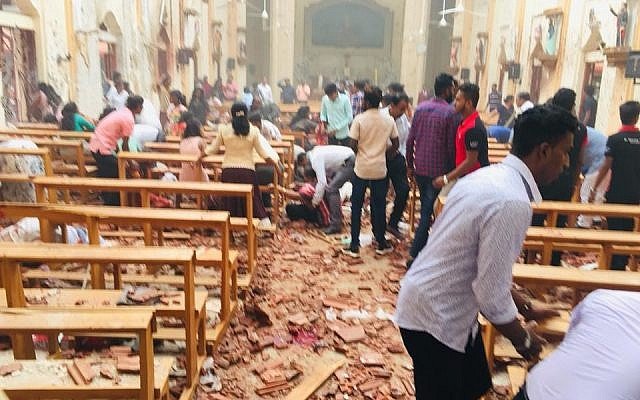
The Sri Lankan Parliament Committee report on the Easter Sunday attack has said that the Indian High Commission was a potential target of the terror attack on the island state that killed over 350 people and left, over 500 injured on 21 April this year.
The 272-page report submitted on Wednesday by the nine-member Parliamentary Select committee referred to intelligence reports suggesting that a hotel frequented by Indians was also a likely target of the terror attack.
The report read: “Parliament cannot recommend the perpetrators of this attack. That power is in the court. The task of the Select Committee was to find out where were the shortcomings, negligence and weaknesses,” Chairman of the PSC and Deputy Speaker Ananda Kumarasiri said in the court.
“The PSC also notes that intelligence information received indicated that the Indian High Commission was one of the potential targets and that it is surprising an intelligence official who is a prominent part within the intelligence apparatus in Sri Lanka was not aware of the possible links between the intelligence information received, source, potential target etc,” the report read.
On April 21, Easter Sunday, the terrorist group NTJ had targeted Easter worshipers and high-end hotels hosting international guests with coordinated explosions. The series of blasts was carried out across 8 locations in three different cities including Colombo. St Anthony’s Church in Colombo, St Sebastian’s Church in the western coastal town of Negombo and a church in the eastern town of Batticaloa were targeted during Easter mass.
Further, three more explosions hit Shangri-La, the Cinnamon Grand, and Kingsbury, all five-star hotels.
The PSC report admits to intelligence failure at several level. It says that the director of SIS (State Intelligence Service) failed to notify the concerened individuals after he recieved the warning on April 4. It also says that the SIS failed to act on intelligence gained after teh April 16 explosion in Kattanakudi.
According to the details which unfolded gradually, the Islamic State (ISIS) had claimed responsibility for the dastardly attack.
It was earlier reported that even India had shared the intelligence input on April 4 that the Islamic group National Thowheed Jamath might carry out attacks in Churches and a hotel frequented by Indian nationals but the country did not pay any attention to the warnings thinking that India was attempting to create enmity between Sri Lanka and Pakistan.
Sri Lanka’s PM Ranil Wickremesinghe has reportedly admitted that they had been warned about possible attacks by an Islamist terrorist group. PM Wickremesinghe stated that despite the warning by intelligence agencies, Sri Lanka ‘failed’ to take adequate measures.
Consequently, Sri Lanka paid a heavy price for ignoring intelligence warnings. India is now providing intelligence assistance to Sri Lanka in the investigation of the Easter terror attacks.
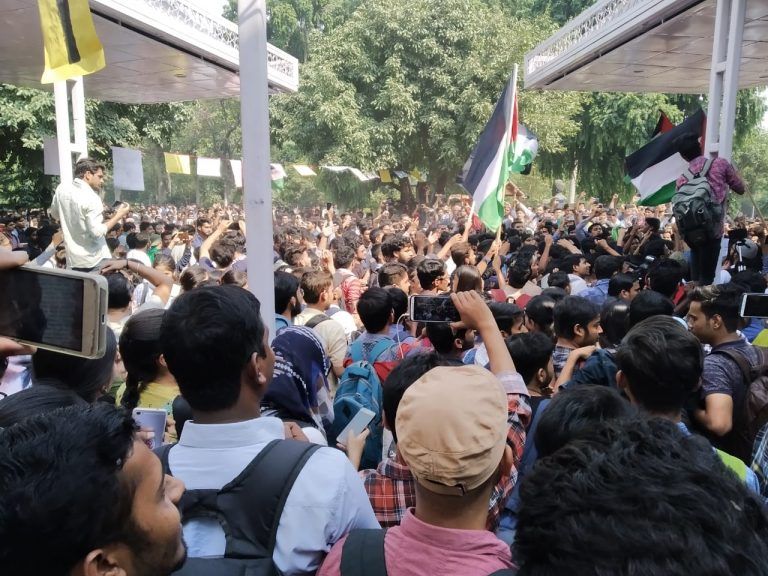
Palestine flags were raised at the Jamia Millia Islamia University during protests against the issuance of show-cause notices by the college administration in response to protests over Israeli participation in an event at the University. The students were protesting after the “Global Health Zenith: Confluence’19” was organised by the Faculty of Architecture and Ekistics in collaboration with Israel as a country partner.
The protests were organised by Leftist organisations such as AISA. The Jamia Millia Islamia University had issued show-cause notices to five students for protesting against allowing an Israeli participant in the event on the campus. Later the notices were withdrawn after the five students submitted their response. In addition, the authorities announced that going forward, no Israeli participation will be permitted during events. “We assure that if any Isareli delegate participates in any programme, we will not allow,” the varsity said.
A scuffle also broke out between the students during the protests. However, it was blamed on the administration. “Protest is our democratic right. The university administration issued show-cause notices to some students who were protesting in a democratic manner. We were protesting against the notice and were attacked by few people under the direction of the university administration,” Mukund Thakur, a student, told ANI.
“The protest has been going on for quite a few days now. The students were attacked by a few people from outside the university. For the India-Palestine relation to remain good, representatives of Israel are not welcomed on the Jamia campus,” another student Fazal Akbar Khan said.
However, one of our sources who happens to be a student at the college told us on condition of anonymity that the scuffle between the students had nothing to do with the administration. We were also told that protests continued even after the administration assured that the show-cause notices would be withdrawn.
On the 22nd of October, the protesting students gheraoed the VC office and prevented anyone from leaving the campus. There was a conference going on at the time with several senior dignitaries present. Some of them were old and suffered from health issues such as diabetes and the like and even they were not being allowed to leave.
Eventually, one of the senior ladies present broke down into tears while requesting them to permit her to leave due to her health issues. Then, some of the students approached those who were preventing her from leaving and demanded that she be allowed to go. However, these students were attacked by the mob and they were forced to retaliate in self-distance. In the ensuing scuffle, numerous students on both sides suffered injuries. However, the blame for this internal feud was placed on the college administration and it was claimed that one faction was sent by the authorities to attack the protesting students.
On the 23rd, Palestine flags were put up across the entire campus of Jamia Millia Islamia. Subsequently, the Police arrived and the demand that henceforth, no Israeli delegation would be permitted into the University was accepted by authorities. It was seen as a victory by the protesting students. However, of the demands that were made, none concerned the students who were injured during the scuffle, some of whom had to be admitted to hospitals. It disgruntled a faction of the protesters, our source told us, and this disgruntled bunch continued with the protest.
Late into the night, this faction beat up some students of the other faction. We are told that some of the internal feuds are also fueled by the fact that there was considerable disagreement within the protesting students regarding the raising of Palestinian flags on the campus. Some believed that it was a step too far and at the end of the day, Jamia Millia Islamia is a government-funded institution.
Our source’s version of events appears consistent with the statements made by university public relations officer Ahmed Azeem. “Today a group of students backed by some student organisations gheraoed the vice-chancellor’s office, besieged the office complex and blocked all exit gates,” he said.
“A number of delegates attending a conference on Mahatma Gandhi at the English department were not allowed to move out of the administrative complex. When English students tried to help the delegates take out their vehicles, protesting students stopped them and a scuffle broke out between the two groups. The protesting students also damaged vehicles parked in the complex,” he added.
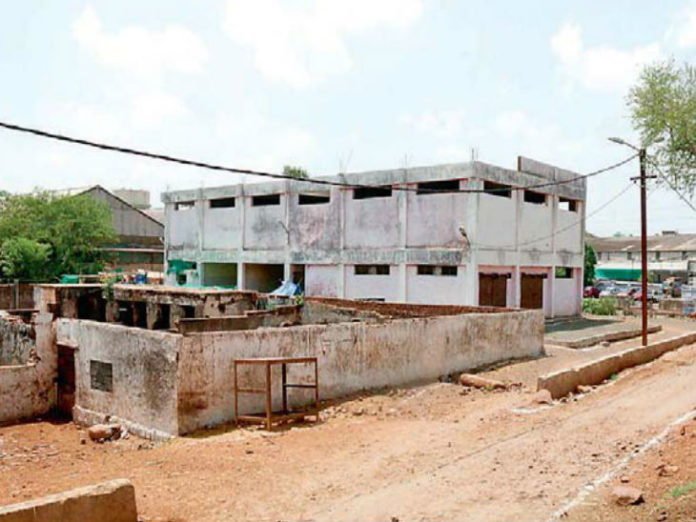
Angered by the carelessness shown by Bhopal Municipal Corporation (BMC) in complying by National Green Tribunal’s (NGT) orders to relocate the Jinsi slaughterhouse to a new location outside Bhopal Municipal Corporation limits, the central bench of the NGT has now ordered for the immediate closure of Bhopal’s only such facility.
The NGT feels that it was the only way to ensure compliance of its previous orders to shift the facility, which BMC has not been taking seriously as the existing slaughterhouse was being allowed to be continued.
Municipal Commissioner Vijay Dutta said the order was received on Wednesday and he has written to the district collector and the state government for compliance. Another senior officer said the government is likely to challenge the NGT order in the high court because “it’s not possible to comply with the order of immediate closure.”
Moreover, the BMC counsel said that BMC does not have the political support to carry out the orders issued by NGT to shift the slaughterhouse.
A Bhopal resident had moved the tribunal in 2014 seeking relocation of the slaughterhouse, in Jinsi locality, arguing that it was polluting a nearby water body. The NGT had ordered the shifting of the slaughterhouse in 2015. Since then, the matter has been stuck due to either administrative or various political reasons.
The latest objection came from the Congress’ side after Digvijay Singh objectedd to the site of the new slaughterhouse, Aadampur Chhawani, on the pretext that it would hurt religious sentiments of devotees who visit a famous temple nearby.
Digvijay Singh’s son and state urban development minister Jaivardhan Singh had responded to the objection and announced that the slaughterhouse will not be built at the new site.
In the latest order, the tribunal noted that it had given sufficient time to the state for searching an alternate place to relocate the facility and extended the date of closure first to June 2016.
It had then extended the deadline to March 31, 2018 in the subsequent hearing and also ordered the state government to deposit a penalty of Rs one crore.
In the next hearing, the tribunal passed another order seeking Rs two crore in performance guarantee and a penalty of Rs 10,000 for each day’s delay in shifting the facility. By June 2019, the recurring penalty reached Rs 45.70 lakh.
However, when construction did not start by July 18, 2019, the tribunal granted time till December 31, 2019, and sought a performance guarantee of Rs five crore and continued the daily fine, dismissing the municipal corporation’s plea for exemption. On that day, the BMC counsel in the presence of BMC commissioner had told the NGT that land for the new slaughterhouse has been identified and earmarked and BMC would undertake the construction of new slaughterhouse on its own because no firm had shown interest in the tenders floated for the purpose.
Issuing the closure orders, the tribunal noted, “On every date of hearing, submissions with different reasons are being made and the fact remains that since 2015, the slaughterhouse is operating at the same place in Bhopal. The respondents are not bothered to expedite the work of the new slaughterhouse,” adding that the tribunal was of the opinion that an immediate closure was the only option to ensure compliance of its previous orders.
It has directed the Bhopal SSP to assist the district administration to effect a closure. While posting the matter to November 7, it also asked the Bhopal district magistrate to submit a personal affidavit at least three days in advance.
Meanwhile, Congress councillor Mohammed Sagar, who had led an agitation against proposed closure, said thousands of people will suffer by the move because the slaughterhouse is a source of livelihood for meat traders as well as those who sell goats and buffaloes.
He alleged that authorities locked the slaughterhouse on Wednesday itself but the police denied doing so.
The incumbent BJP is leading on 7 assembly seats as votes are being counted for bypolls to 11 Assembly constituencies in Uttar Pradesh. The Samajwadi Party is leading on the remaining two seats while the Bahujan Samaj Party and the Congress party is leading on 1 seat each.
The BJP is winning on Iglas, Manikpur, Lucknow Cantt, Ghosi, Govind Nagar and Pratapgarh where BJP’s alliance partner Apna Dal was contesting. Out of the 11 bypolls seats, 8 were previously held by the BJP. The Samajwadi Party and Bahujan Samaj Party are defending one seat each. SP defending Rampur seat which has become a matter of prestige for SP leader Azam Khan who is riding on a sympathy wave after the state government slapped more than 84 cases against him in the last 2 months. On the other hand, the Bahujan Samaj Party is defending the seat of Jalalpur.
The SP is leading on two seats- Rampur and Zaidpur, whereas the BSP is struggling to hold on to its Jalalpur seat. Congress is leading on Gagoh seat while it has managed to rank at the second position in Govind Nagar and Pratapgarh seat.
The BJP had been pretty confident in sweeping the bypolls. Earlier, the deputy chief minister Keshav Maurya announced that the saffron party will make a clean sweep by winning all 11 seats. It is contesting on 10 seats, out of which it is leading on 7 while its alliance partner Apna Dal contested on the remaining 1 seat and is currently leading it.
The results of the Maharashtra and Haryana Assembly Elections are pouring in and contrary to what most pollsters predicted in their exit polls, while the saffron alliance between the BJP and Shiv Sena is doing well in Maharashtra and looks set to win, Haryana has thrown in a surprise.
Although it’s too early to say, it appears that there could very well be a Hung Assembly in Haryana with the Jannayak Janata Party (JJP) having an opportunity to play the Kingmaker. Thus, it perhaps is a good time to look back at the Exit Polls and check how accurate they were.
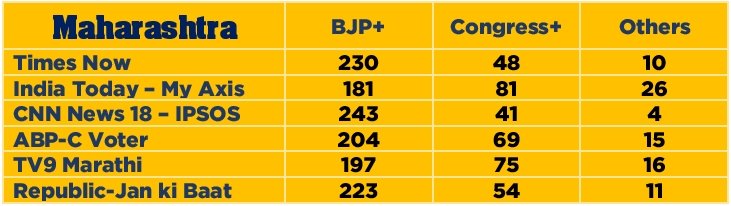
All the major polls had agreed that the NDA was going to win again in Maharashtra. The Times Now gave 230 seats to BJP-Shiv Sena, India Today-Axis polls gave 181 seats to the alliance, News18-IPSOS made the astounding prediction of 243 seats for the alliance, ABP News gave the, 204, TV9 Marathi gave 197 while Republic Jan Ki Baat gave the alliance 223 seats.
On the other hand, the pollsters predicted 81, 41, 69, 48 and 55 respectively for Congress and NCP alliance. It appears while pollsters underestimated the BJP’s performance in the Lok Sabha elections, they massively overestimated that in these assembly elections. However, in Maharashtra, NDA still looks set to win again this time around.
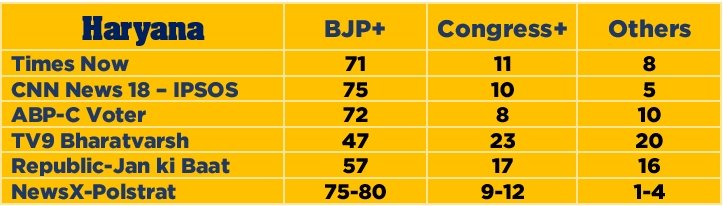
In Haryana, however, it’s a completely different story. While all the pollsters predicted a massive victory for the BJP, it has certainly not been the case. Times Now gave the BJP 71 seats out of total 90, IPSOS gave them 75, ABP News gave them 72, NewsX gave them 75-80! Jan Ki Baat gave them anything between 52-63 while TV-Bharatvarsh gave them 47 which was far more conservative and even that appears to be off-target.
No matter how one looks at it, the currents trends suggest that the BJP is certainly heading for a defeat, and so are the pollsters. Only India Today-My Axis poll can walk out of this with their heads held high. They did predict a Hung Assembly with the BJP predicted to win between 32-44 seats and Congress to win between 30-42 seats. India Today’s predictions stand out in stark contrast to the rest and as current trends suggest, the only ones who got it right.
All in all, the pollsters didn’t have a very good at the office today. It appears they overplayed the ‘non-existent’ opponent card too much. Although it’s certainly true that at the national level, there’s no credible opposition to Prime Minister Modi, however, at the state level, the Opposition continues to wield significant political mileage.
The BJP Haryana chief has refuted the claims of his resignation from party post. He said the news of his resignation is a rumour.
BJP’s Haryana chief Subhash Barala says that he has not resigned from his post and that the news of his resignation is a rumour. (file pic) pic.twitter.com/0pGOIVUWxc
The BJP has failed to perform as it has hoped in the Haryana 2019 assembly elections. The party needs to win at least 46 seats to win the Haryana elections and trends suggest that BJP may not be able to touch the majority mark. It was reported earlier that taking responsibility of the unsatisfactory performance, the BJP state chief Subhash Barala has resigned from party’s state presidentship.
Apart from BJP’ overall performance in the state, Barala’ own achievement’s in his constituency has not been up to the mark, which might have acted like a stimulant compelling the state chief to take up such a step.
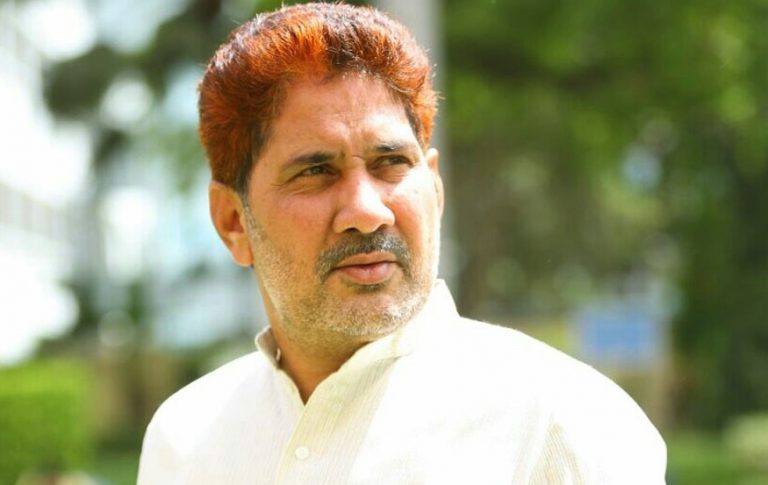
According to reports coming in, Subhash Barala who contested from the Tohana assembly seat in Fatehabad district is currently trailing by more than 20,000 votes. The Jannayak Janata Party’s Devender Singh Babli is leading from the seat.
According to the ECI website data, the voters of Haryana have preferred to vote for NOTA or ‘None Of The Above’ rather than voting for parties like Aam Aadmi Party and the Communists.
The Congress, accused of running a listless campaign amid massive infighting, has reportedly started talks with possible allies.
The Congress has reached out to Dushyant Chautala, whose Jannayak Janata Party (JJP) is less than a year old but was predicted to win enough seats to count. Party president Sonia Gandhi has also reportedly spoken to former Chief Minister Bhupinder Singh Hooda.
Speculations were rife that Congress desperate to gain Haryana has offered Chautala the chief minister’s post. However, sources in the party said the party leadership is not in favour of offering chief ministership to the JJP leader as it has been singed in Karnataka, where its government with Janata Dal-Secular crashed.
Note: The above report has been updated with latest information.
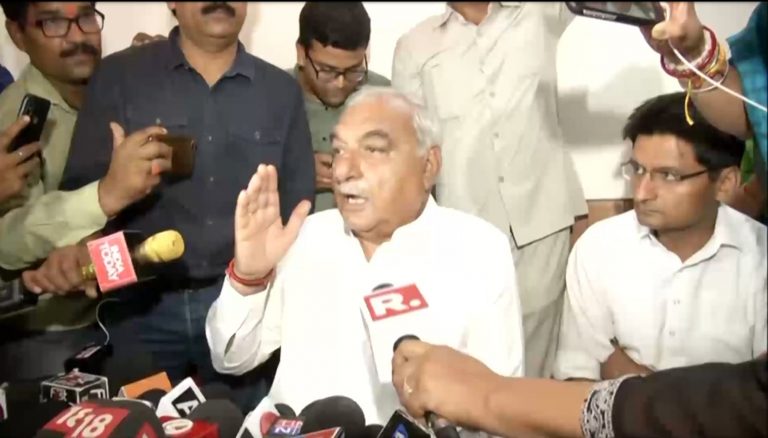
Former Haryana Chief Minister and Congress leader Bhupinder Singh Hooda has claimed that Congress party will form the next government in Haryana. He said that time has come for Congress, Jannayak Janata Party, BSP, INLD and independents to come together to form a strong government in the state.
Bhupinder Singh Hooda said that BJP has lost the mandate in the assembly elections and the Manohar Lal Khattar government in the state should resign by accepting defeat. Hooda also alleged that independent candidates who are leading in the election results are being held up by administration so that they can’t be reached by Congress. He warned the concerned officials to not block any MLA or candidate, and said that he will send a written complaint to the Election Commission.
Former Haryana CM BS Hooda in Rohtak: The time has come for Congress, JJP, INLD, and independents to come together to form a strong government. #HaryanaAssemblyPollspic.twitter.com/VZ8IKe4kdW
Although the final results for the assembly elections are not declared yet, the trends indicate a hung assembly with no party crossing the halfway mark. As per latest trends showing on the EC website, BJP and Congress both were leading in 35 seats each, while JJP is leading in 11 seats. Significantly, 7 independents are also leading, 4 of whom are rebel BJP leaders who were rejected tickets by the party.
JJP leader Dushyant Chautala is emerging as the kingmaker in Haryana, with enough numbers to form a government with either Congress or BJP going by current trends.
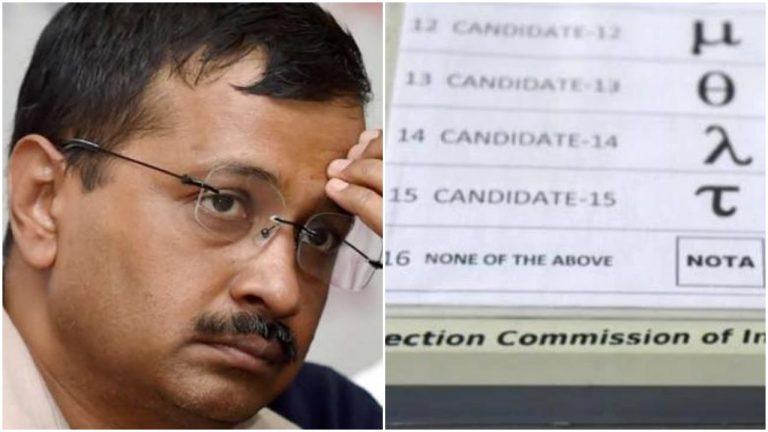
As 2019 Haryana assembly elections are poised to have a tighter finish between the incumbent BJP and the Congress, there is another close battle taking place along the sidelines in which Arvind Kejriwal led Aam Aadmi Party (AAP) is fighting against the NOTA (‘None of the Above’) option and even trailing against it.
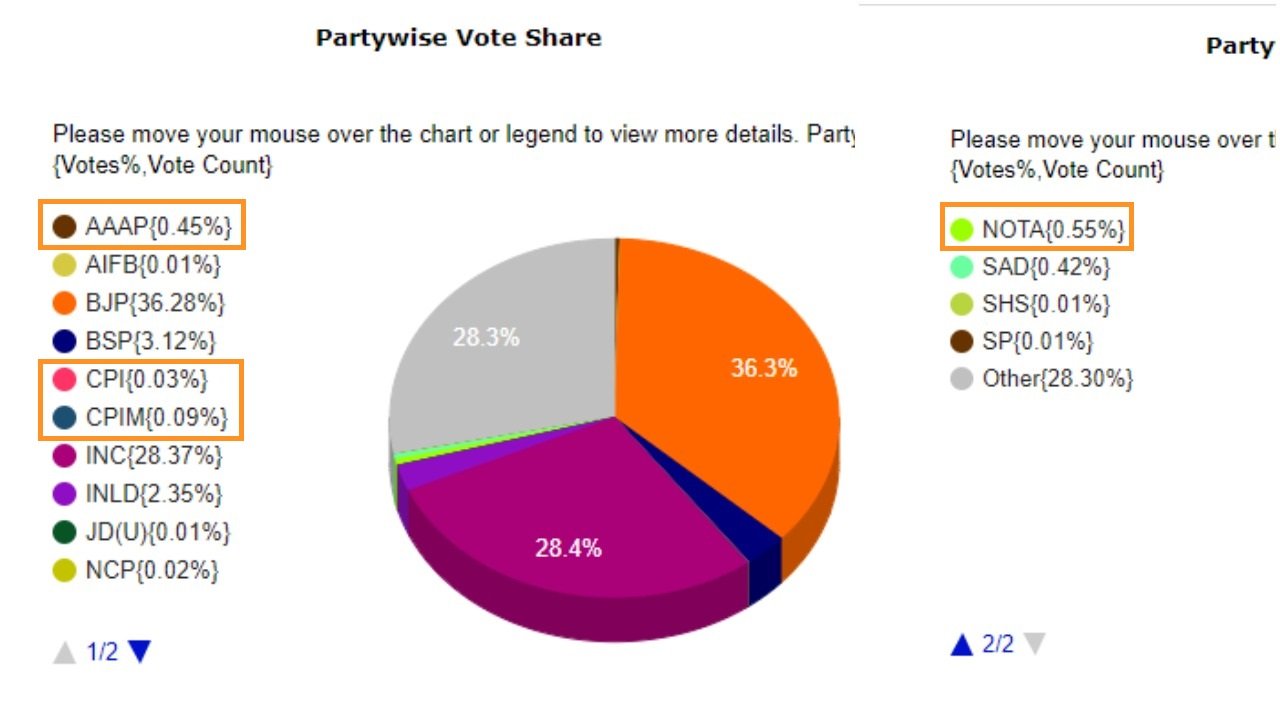
According to the ECI website data, the voters of Haryana have preferred to vote for NOTA or ‘None Of The Above’ rather than voting for parties like Aam Aadmi Party and the Communists.
The ECI data suggests that the NOTA option has garnered more votes with a vote-share of 0.55% while Aam Aadmi party are yet 0.45% of the total votes counted. The two Communist parties – CPI and CPI(M) are currently at 0.03% and 0.09% of votes only.
ECI website data
The Aam Aadmi Party led by Arvind Kejriwal had fielded its candidates on 46 seats in the 90-member Assembly. The Aam Aadmi Party had made promises such as Rs 1 crore to the next of kin of armed forces personnel killed in the line of duty. They had promised to provide 200 units of power for free of cost, besides 20,000 litres free water for each family.
However, it seems that voters of the Haryana are unimpressed with the promises that were made by Kejriwal’s party and has preferred NOTA rather than voting for AAP.
Interestingly, the Aam Aadmi Pary and NOTA have an interesting relationship. Even in 2018, ‘None Of The Above’ had trumped the Arvind Kejriwal-led party as NOTA was given more preference in assembly elections.
The NOTA vote share oscillated between 2.0% in Chhatisgarh and 0.5% in Mizoram, and rest three states got an average of 1.2% NOTA votes. In Chhattisgarh, AAP had got 0.9% of total votes. In Madhya Pradesh too, AAP lost all candidates and failed to outnumber NOTA votes. The AAP got 0.7% of total votes while NOTA received 1.4%.
Even in Rajasthan AAP got 0.4%, while NOTA registered 1.1% of total votes.
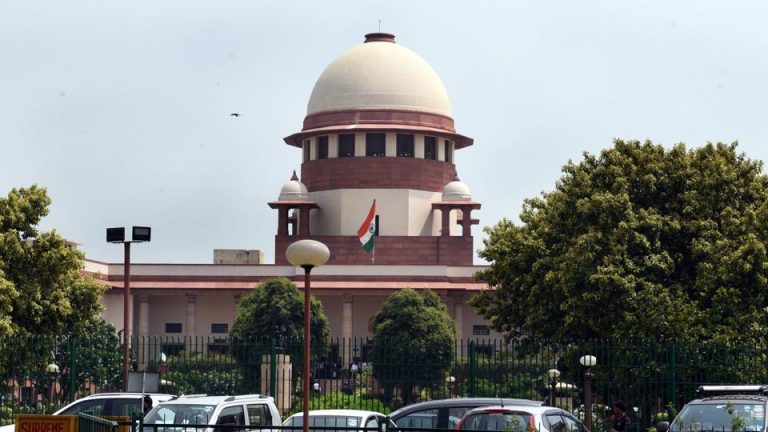
The Supreme Court has asked the Modi government how long do they plan to extend the restriction on communication modes that was imposed on Kashmir after the effective abrogation of Article 370 and bifurcating the state of Jammu and Kashmir in into two union territories: Jammu and Kashmir, Ladakh.
A 3 judge bench headed by Justice NV Ramana asked the Modi government “How many days you want restrictions? It’s already 2 months now. You have to come clear on this and you have to find out other methods”. After saying this, the bench posted the matter for hearing for 5th November 2019.
“You may impose restrictions, but you have to review your decisions. Do you?”, said asked the SC Bench.
“You may impose restrictions, but you have to review your decisions. Do you?” SC to Govt. SG for J&K administration replies that 90% restriction is released&its being reviewed daily. “About Internet restrictions, ultimately people have to have a mode of communication,” SC to Govt
The Modi government, in turn, answered the Supreme Court by saying that 90% of restrictions have been released in the valley and the situation is reviewed every day.
“About Internet restrictions, ultimately people have to have a mode of communication”, said the Bench to the Modi government.
The Bench has agreed to consider the petitions filed by several people about the Modi government’s handling of the abrogation of Article 370. The 3-member Bench agreed to consider the cases of Enakshi Ganguly (child detention), Sitaram Yechury (Tarigami detention), Anuradha Bhasin (against communication blockade), Ghulam Nabi Azad (against JK restrictions), Asifa Mubeen and We The Citizens (against lockdown) etc.
On November 5th, the Supreme Court will also hear on November 5, plea filed by senior Congress leader Ghulam Nabi Azad who had sought a nod from SC to visit his family members and relatives.
The three-Judge Bench also allowed the Jammu & Kashmir High Court Chief Justice to file an additional report on the access of judiciary by people in Jammu and Kashmir in the wake of abrogation of Article 370.
Shiv Sena’s Uddhav Thackeray is addressing the press. He stated that the results of the election are a clear public mandate for the BJP-Sena alliance. thanking voters for support, Thackeray said, “We are not in a hurry, and we are not power-hungry. Whatever is decided, will be followed.”
He stated that during the Lok Sabha elections the Sena and the BJP had agreed on a 50-50 formula and it is time to implement it. He also added that it is important to see who becomes the CM, again fanning speculations that the Sena might demand CM’s post for Aditya Thackeray.
Thackeray also stated that he has been accommodating to the BJP because of the Lok Sabha elections. “But I can’t keep doing that anymore. I have to make sure my party flourishes,” he added.
CM Devendra Fadnavis is also about to address party workers at the state BJP office shortly.
The BJP-Sena alliance is leading in over 165 seats. However, seven sitting ministers have lost their seats. Pankaja Munde, Ram Shinde, Madan Yerawar, Arjun Khotkar, Vijay Shivtare, Bala Bhegde and Anil Bonde have lost.
3.15 PM
Shiv Sena’s Ramesh Mahatre is leading by only 217 votes against MNS’ Raju Patil. In Chandrapur, independent candidate Kishor Jorgewar is looking at a comfortable victory as he leads against BJP’s Nana Shamkule by over 51,000 votes.
AIMIM’s Waris Pathan has been defeated by Shiv Sena’s Yamini Yashwant Yadav in Byculla. Ajit Pawar’s winning margin of 1.62 lakh votes in Baramati may be the highest in the state.
Uddhhav Thackeray is set to address the media at 4. With no single party getting the 145-mark on its own, all eyes are on Thackeray whether they will continue with the BJP but will demand CM’s post or be willing to be wooed by Congress and NCP.
2.30 PM
BJP’s Captain Tamil Selvan is leading Sion Koliwada seat. There is a tough contest going on in Aurangabad-East seat where BJP’s sitting MLA Atul Save is leading against AIMIM’s Gafar Qadri by over 6000 votes. Save is Maharashtra minister of Industry, Minorities and Mining.
As of latest updates, BJP has won 5 and leading in 97 constituencies. Sena has won 5 and leading in 55 seats. BJP’s Manisha Chaudhary has won Dahisar. As per ECI trends, NCP has won 1 and leading in 54 seats. Congress is leading in 44 seats.
2.00 PM
Former BJP leader Gopinath Munde’s daughter Pankaja Munde has lost to her cousin and NCP candidate Dhananjay Munde by over 22,000 votes in the Parli seat.
In Konkan’s Kankavali seat, BJP’s Narayan Rane has lodged a surprise victory. It was one of the few seats where BJP and Sena both had fielded candidates. Uddhav Thackeray had even expressed displeasure and warned Devendra Fadnavis over this.
Addressing the public after a considerable performance, Sharad Pawar stated that the Congress-NCP alliance has worked hard. Pawar’s NCP has performed better than Congress. He also added that leaving NCP and joining other parties have not worked in the favour of defectors.
In a surprise loss for Shiv Sena, Congress’ Zeeshan Siddiqui has won the Bandra-East seat where Sena family home Matoshree is located. Siddiqui has defeated Mumbai Mayor Vishwanath Mahadeshwar. So far, Owaisi’s AIMIM is leading in 3 seats and VBA is leading in 3 seats.
Celebrations have started in the state BJP office.
BJP and Shiv Sena win two seats each as per EC official website. BJP’s Sunil Rane wins from Borivali. 1 independent candidate has registered win. Shiv Sena’s Aaditya Thackeray leading from Worli. BJP is currently leading in 100 seats, Shiv Sena in 59, NCP in 54 while Congress in 41.
1:00 PM
NCP’s Ajit Pawar wins from Baramati reports News18. EC website has not yet confirmed Ajit Pawar’s victory. Pankaja Munde loses Parli seat as per Republic TV. BJP leader in 103 seats, Shiv Sena in 62. NCP leading in 53 while Congress in 40 as per EC website. Celebrations are underway at BJP office in Mumbai as Devendra Fadnavis may return as CM for the second term.
12.30 PM
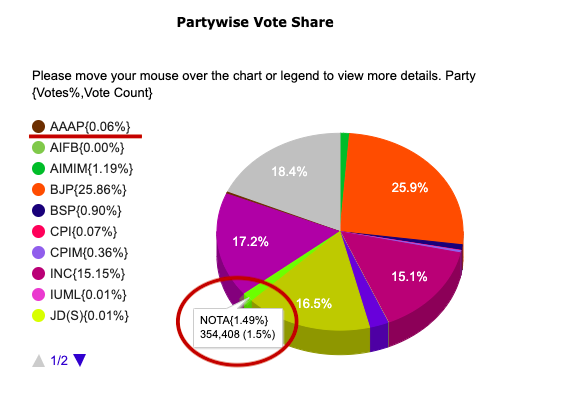
The Aam Aadmi Party is trailing behind NOTA votes in Maharashtra. Raj Thackeray’s Maharashtra Navnirman Sena, which had contested in 101 of the 288 seats, is yet to register a single lead in any of them.
Party-wise vote share in Maharashtra so far, courtesy: Election Commission data
12.00 PM
CM Devendra Fadnavis is leading the Nagpur South-West seat over his Congress rival Asish Deshmukh by over 5103 votes.
CM’s Abhimanyu Pawar is leading in the Ausa assembly seat.
The BJP-Sena alliance is now leading in 167 seats. Speculations are already on whether the Sena will ditch the alliance with the BJP to join with the Congress and the NCP. Experts suggest that as Sena grasps a good number of seats, it might demand the CM post for Aditya Thackeray.
11.35 AM
The BJP’s Chhatrapati Udayan Raje Bhosale is trailing from the Satara constituency Lok Sabha by-polls. He had jumped ship from NCP just months before the elections. BJP had fielded him from the same seat where he was NCP’s candiate in the general elections in May.
#ElectionResults2019 | Shivaji Maharaj’s descendant Udayanraje Bhosale trails in Satara in Lok Sabha bypolls. The BJP had fielded NCP-turncoat from the same seat where the NCP had fielded him in general elections. The bypoll was necessitated after Bhosale jumped ship to the BJP pic.twitter.com/brdoOFnwqd
NCP candidate Shrinivas Patil is leading the Satara seat by over 1 Lakh votes.
As of assembly elections updates, the BJP and Sena are still leading in 166 seats while Congress and NCP are leading in 96 seats.
11.20 AM
As per the latest updates, the BJP is leading on 101 seats and the Sena is currently leading on 64 seats. Congress and NCP are leading on 39 and 52 seats respectively.
BJP’s Pankaja Munde is trailing by 13000 votes behind her cousin and NCP candidate Dhananjay Munde.
10.50 AM
Early trends in the Maharashtra Assembly elections are showing a lead for BJP-Sena alliance in Maharashtra. In the 288-seat assembly, the BJP-Sena is leading currently at 161 seats while the Congress-NCP is leading in 92 seats. Others are leading in 36 seats.
The majority mark is 145 in the Maharashtra assembly.
The Bharatiya Janata Party (BJP), which came to power in the Maharashtra state in 2014 is hoping for a similar outcome with support from its alliance partner Shiv Sena.
As per the latest updates, The BJP is leading in 100 seats while the Sena is leading in 67 seats. Congress is leading in 42 while NCP is leading in 46 seats.