Tej Pratap Yadav, Lalu Prasad Yadav’s son and Aishwarya Rai got married on May 2018, but the couple filed for a divorce a few months after the wedding. Recently, it was reported in the media that Aishwarya had said that Tej Pratap was a drug addict and that she had tried to raise this issue with her in-laws but to no avail.
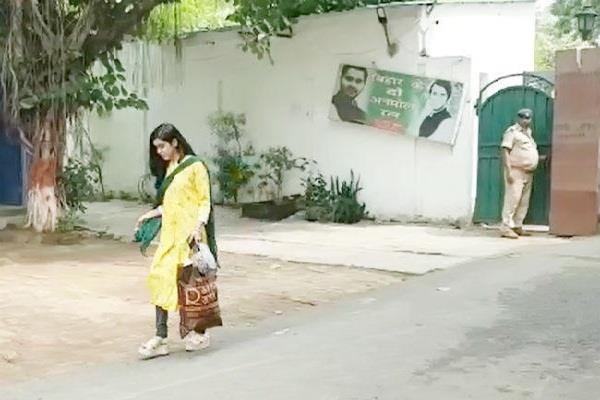
Today, a video surfaced where Rai was seen leaving teary-eyes from her mother-in-law, Rabri Devi’s house.
She is daughter of Chandrika Rai, A Politician and friend of Lalu Yadav. She married Lalu Yadav’s son Tejpratap and now her life is ruined forever!
She was staying with Rabri Devi, her mother-in-law & today she is see coming out of Rabri’s house, crying.pic.twitter.com/30Veu2hDuY
After trouble started brewing in their marriage a few months after the two got married, Tej Pratap’s wife Aishwarya had been staying at the residence of her in-laws. A divorce petition was also filed.
Aishwarya was on Friday is seen leaving her in-laws’ house in her father Chandrika Rai’s vehicle. It is not yet clear as to what transpired that forced Aishwarya to leave her in-laws house.
While Aishwarya Rai is seen exiting Rabri Devi’s house in tears, earlier, OpIndia received a notice from Tej Pratap Yadav to pull down a story that the publication had carried regarding the allegations made by Aishwarya Rai against Tej Pratap Yadav. In that, a submission had been made to the court that since the court had granted an injunction to Tej Pratap, barring the media from reporting on the proceedings of the divorce case since both parties come from reputed and well known political families. The report was subsequently pulled down by the publication owing to the injunctions.
In the notice itself, it is seen that Tej Pratap Yadav has accused wife Aishwarya Rai of leaking information to the media in order to defame Yadav.
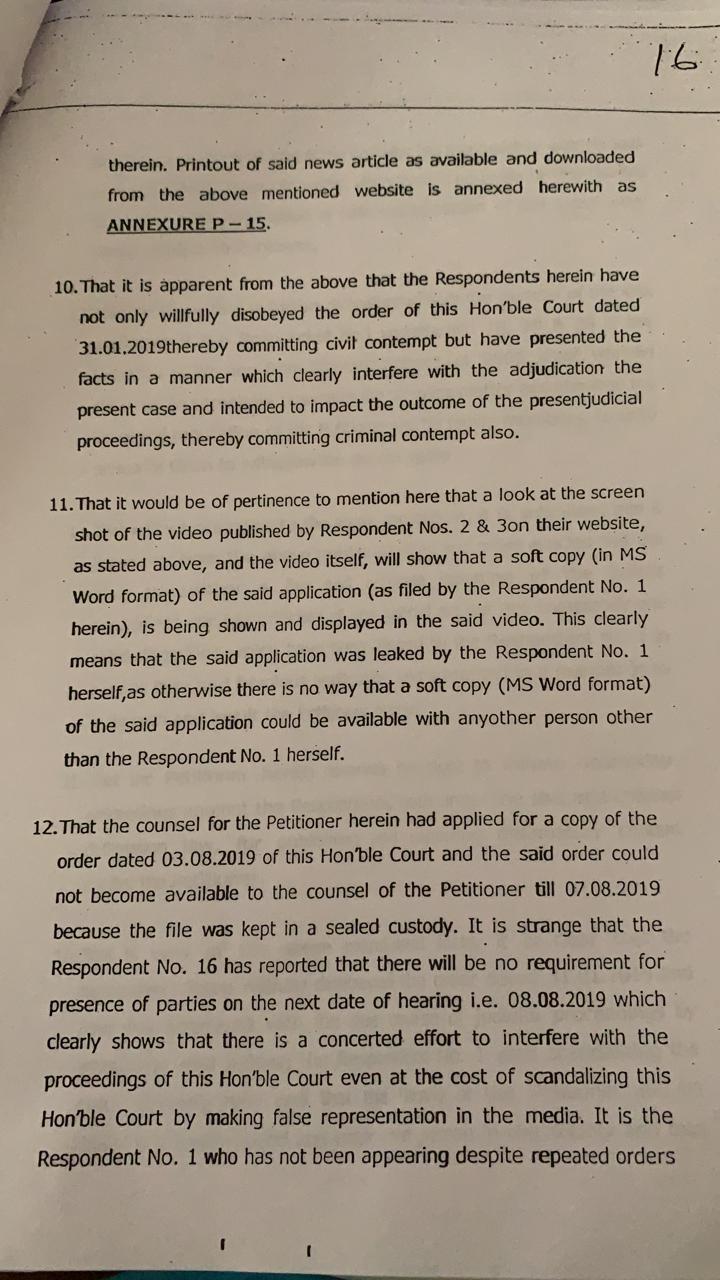
The petition says that Tej Pratap Yadav had applied for a copy of the order dated 03.08.2019 of the Honourable Court and the said order could not be made available to the lawyer of Yadav as it was in ‘sealed custody’
Tej Pratap Yadav’s petition then says that the contents of the order were reported by the media which said that there would be no requirement for the presence of the parties during the next hearing, which was to be held on 8th August 2019. He asserts that there was no way for this information to reach the media other than through Aishwarya Rai. He also says that it is her who has not been appearing despite repeated orders and this information leakage is a ‘concerted effort’ to ‘scandalise the court’. He says that it is thus clear that it was Aishwarya Rai who managed to get the report published in the media. He also alleges that the false representation of the court order by the media amounts to contempt of court.
Tej Pratap Yadav’s representation goes on to say that Aishwarya Rai’s application under section 18, 19 and 26 of the Protection of Women from Domestic Violence Act 2005 itself ‘proves’ that she wants to scandalise the matter and damage the reputation of Tej Pratap Yadav and his family.
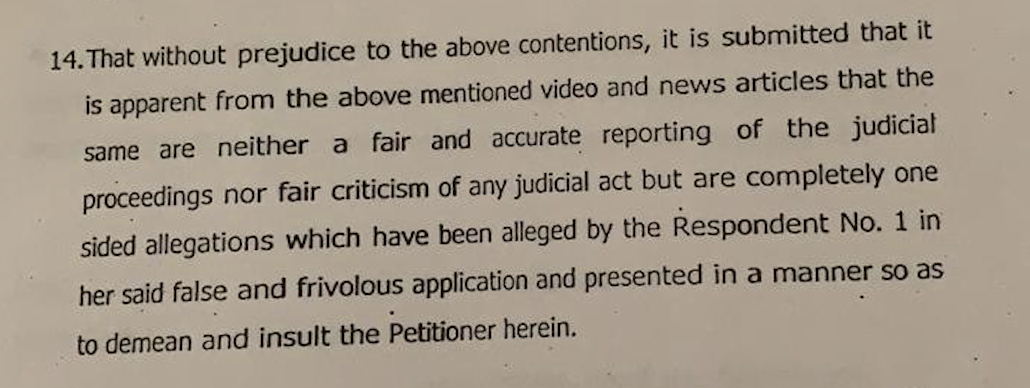
While reserving the right to take legal action against the media, Tej Pratap’s representation says that the articles in the media are not a fair and accurate reporting of the judicial proceedings nor fair criticism of any judicial act but are completely one-sided allegations which have been alleged by Aishwarya Rai to demean and insult Yadav.
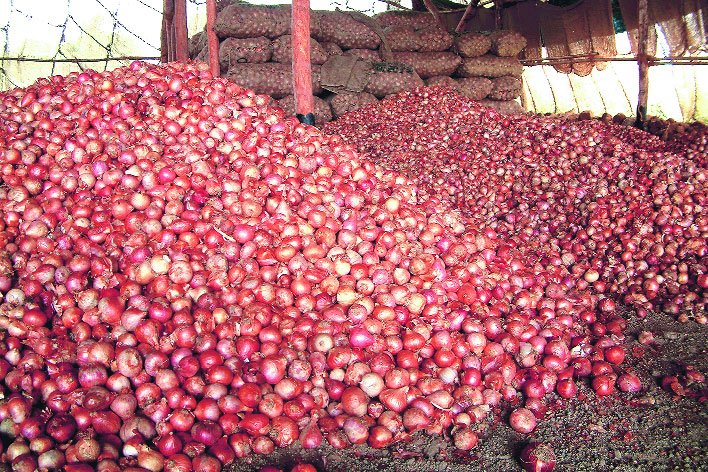
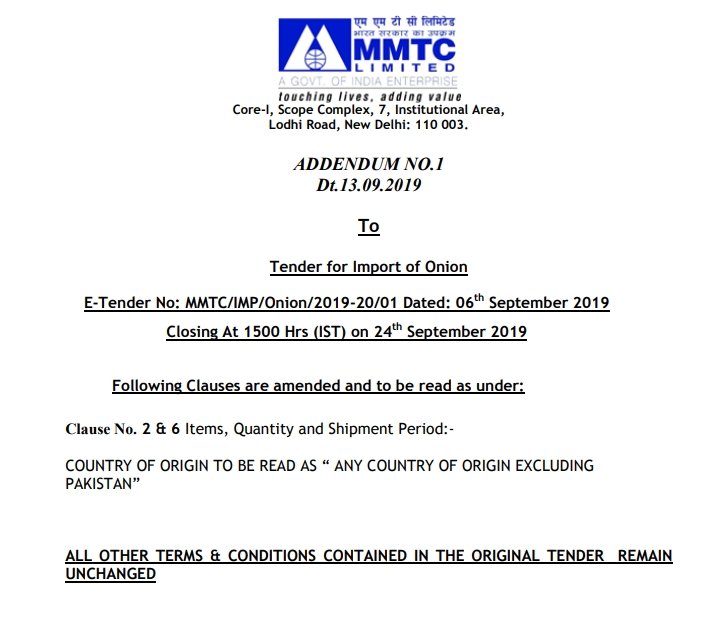
The Metals and Minerals Trading Corporation of India (MMTC) Ltd amended a tender to import onions after it was reported that the original tender had included Pakistan as one of the countries of origin. The state-run trading organisation issued an addendum today to its original tender, specifying that onions should not be imported from Pakistan.
The modification of the tender notice
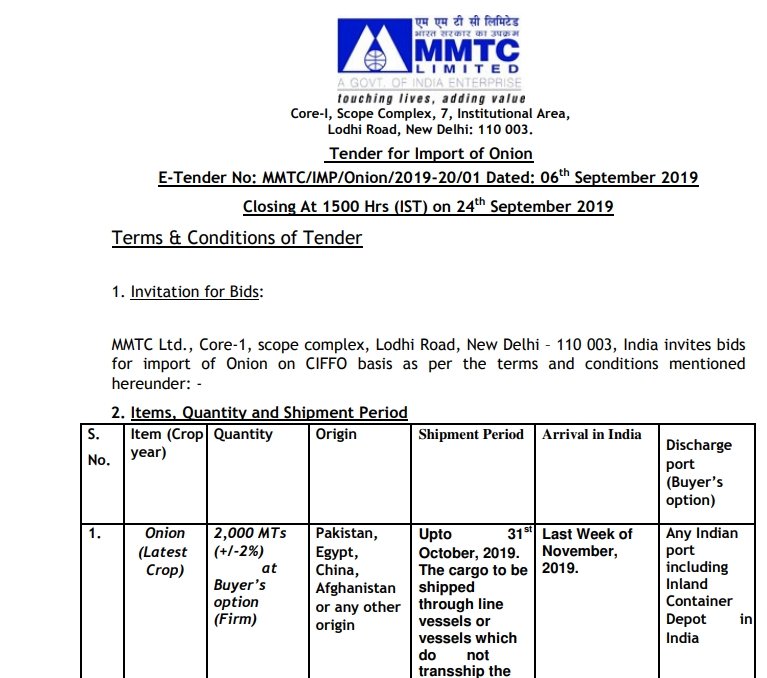
MMTC had invited tenders for importing 2,000 MTs of onion on 6 September, and the origin column in the tender notice mentioned “Pakistan, Egypt, China, Afghanistan or any other origin”.
MMTC Ltd. (Metals and Minerals Trading Corporation of India) has invited bids for ‘import of onion on CIFFO (Cost Insurance and Freight Free Out, international trade), from Pakistan, Egypt, China, Afghanistan & any other origin’.
Although the notice was issued on 6th September, media had reported this today, which had triggered widespread criticism from farmers and on social media. The India Pakistan relation is at a very low point after India abrogated Article 370 and Pakistan went on an overdrive to campaign against India on the global level. Pakistan had also suspended all trade relations with India and downgraded diplomatic ties. While almost all world powers have supported India on the Kashmir issue, China is taking Pakistan’s side. In such a scenario, this was indeed shocking that Pakistan and China were specifically mentioned origins in the tender notice.
The original tender notice
Perhaps after witnessing the criticism, the MMTC Ltd chose to exclude Pakistan from the deal, and issued an addendum to specify that country of origin to be read as “any country of origin excluding Pakistan”. This means the revised tender notice does not specify any country but excludes Pakistan.
In one of the recent measures to stamp out single-use plastic that form a major chunk of waste accumulated in the cities and villages across India, the Modi government has decided to enforce a country-wide ban on single-use plastic and provide a boost to the environmentally-friendly substitutes in order to emancipate the country from this ecological menace.
As Env Min I resisted blanket ban on use of single-use plastics. Plastics industry employs lakhs & the real problem is how we dispose & recycle waste.
The ban will only grab headlines, home & abroad, and mask the Modi regime’s true environmental record.https://t.co/p3f62d2ply
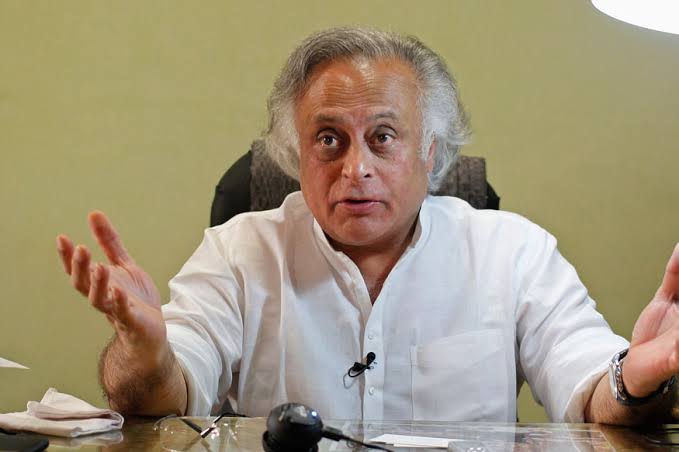
However, for Modi detractors, the more pressing concern is to somehow oppose PM Modi regardless of its benefit and usefulness. Congress leader and former environment minister Jairam Ramesh quoted an article published on the Print and slammed PM Modi’s move to enact a ban on single-use plastic. Ramesh stated that such a move might spell doom for lakhs of people employed by the plastic industry and the government’s focus should be on waste disposal and recycling.
Ramesh claimed that when he was the Environment Minister in UPA regime, he had resisted a blanket ban on single-use plastic because it directly affected lacks of jobs in that industry. According to Jairam Ramesh, as there might be a possibility of job loss, one should turn a blind eye to the environmentally hazardous practices such as production and usage of single-use plastic.
According to a report by the United Nations, the world now produces more than 300 million tonnes of plastic waste every year. A large chunk of it ends up in water bodies and oceans.
The myopic view exhibited by Congress leader ignores the imposing reality of Climate change that is profoundly affecting Earth’s ecology. Single-use plastic not only clogs waterbodies and damages the ecosystem, but it is also killing millions of animals every year, both on land and the seas. It is to this end that PM Modi had insisted on real and concrete steps and working towards restoring the environment and reaffirming India’s commitment to the Paris agreement on Climate change.
Congress seems to have developed a knack of opposing whatever PM Modi proposes, just for the sake of it without delving in details about the outcomes of his proposed measures. Jairam Ramesh has opposed the ban on single-use plastic claiming it may have economic challenges. However, as a former minister for environment, he should be aware that single-use plastic and its ill-effects on the environment cause greater damage to a nation’s climate, health and the livelihoods of people than the short-term impact on jobs which can always be replaced with more sustainable alternatives.
Even Ramesh’s second argument that the government should invest in recycling and waste disposal instead of enforcing a ban on single-use plastic doesn’t hold water. According to the United Nations Environment Programme, plastic can take up to a thousand years to decompose. Even recycling of plastic products is not a panacea for problems related to their wastage. Experts believe that plastic products have an end life and cannot be recycled more than three-four times. In fact, recycled products are often more harmful to the environment because of added chemicals, colours and preservatives.
However, such nuances are perhaps lost on Congress leaders, who in their desperate bid to come back to power feel no qualms in endorsing the degradation of the environment just to oppose PM Modi.
The hostile geopolitical climate could gravely impact China’s One Belt One Road initiative and could end up costing China a whopping USD $800 billion according to a report published by consultancy Silk Road Associates and law firm Baker McKenzie.
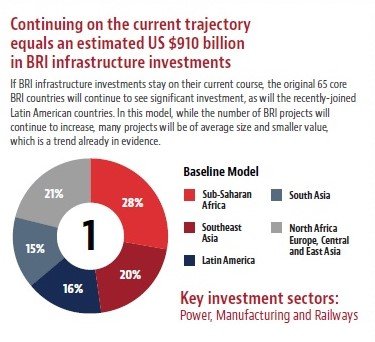
The report published on Wednesday outlines 5 possible scenarios that could unfold in the future depending upon the prevailing geopolitical circumstances. The difference between the projections is stark with the most optimistic forecast, ‘Global Cooperation Model’, predicting an investment of USD $1.32 trillion over the 2020s and the most pessimistic, ‘Uni-polar Model’, pegging investments at USD $560 billion during the same period. If current trends hold, the investment will amount to USD $910 billion.
BRI and Beyond Forecast
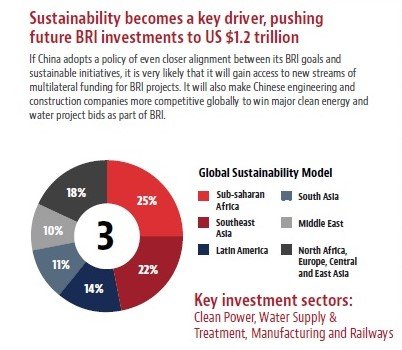
The ‘Global Sustainability Model’ puts more emphasis on climate change and environmental concerns and takes into account the global and local pressures to act on the same and it is speculated that OBOR will be seen as part of the solution. The report says, “If China adopts a policy of even closer alignment between its BRI goals and sustainable initiatives, it is very likely that it will gain access to new streams of multilateral funding for BRI projects. It will also make Chinese engineering and construction companies more competitive globally to win major clean energy and water project bids as part of BRI.” This model pegs investments at USD $1.2 trillion.
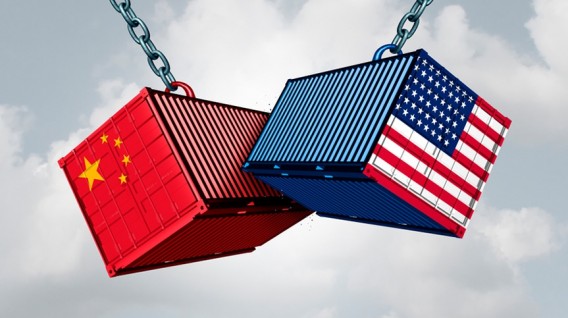
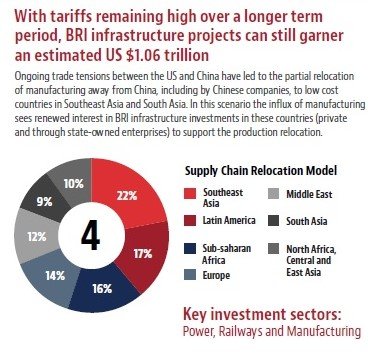
The Supply Chain Relocation model which focuses more on the ongoing trade war between the US and China pegs investments at USD $1.06 trillion. The report says, “Ongoing trade tensions between the US and China have led to the partial relocation of manufacturing away from China, including by Chinese companies, to low‐cost countries in Southeast Asia and South Asia. In this scenario, the influx of manufacturing sees renewed interest in BRI infrastructure investments in these countries (private and through state-owned enterprises) to support the production relocation.”
The great variance between the projections reveals the volatile circumstances that the world is currently in. It could be said with relative certainty that the success of OBOR depends significantly upon the extent to which the Chinese government can work with the Trump administration.
The United States under Trump considers China to be an existential threat to the current world order that is based on Western dominance. Donald Trump has demonstrated his willingness to work with the Chinese government provided that they play the game the rules of which has been set by the West.
Meanwhile, the Chinese consider the game to be already rigged in favour of the West. Therefore, they are unwilling to participate in it. China aims at establishing itself as a global hegemony and OBOR is a crucial aspect of its strategy. If the OBOR initiative is successful, it would mean the entire world opening up to China and the country will be able to pursue its trade relations with much greater effectiveness.
There’s a faction within the USA, with former White House Chief Strategist Steve Bannon being its most prominent face, that considers China to be a civilizational enemy of the West which seeks to undermine Western values and ideals. China, on the other hand, doesn’t ever deny that its values are completely different from that of the West. Bannon draws a contrast between the ‘Judeo-Christian West’ and the ‘Confucian Totalitarian State’ of China.
The battle between the USA and China ought to be seen through the prism of the dominant power in the world up against another that wishes to replace it. While the USA is going through a rough path itself domestically, China, too, has its fair share of contradictions as demonstrated by the recent protests in Hong Kong.
China has used rather subversive methods to propel itself to glory. Donald Trump wishes to put an end to it and has imposed tariffs to force China to adopt fair trade practices. It remains to be seen how that pans out. The one area where China has a distinct advantage over the US is its domestic political setup. The absence of Democracy allows China to set long term goals which it could then pursue without domestic interference.
The US doesn’t have that luxury. It can’t even be said with certainty that its current approach to China would extend beyond Donald Trump. US foreign policy with respect to China could turn a full 180 degree in 2020 should Trump lose his reelections bid or in 2024 when he will be forced to leave office anyway. It’s the one strategy that China has been using against the US.
From the Chinese perspective, if they could sustain their economic growth without signing a trade deal until 2020 with the US and they manage to escape without suffering too much damage, a different US President might have a completely different approach. Waiting out the Trump Presidency and hoping for a more favourable US President appears to be China’s current strategy.
The South China Sea is also another probable area of conflict between the two countries. China has built artificial islands in the region which have been turned into military bases. Not too long ago, a tribunal constituted under Annex VII to the United Nations Convention on the Law of the Sea (the “Convention”) in the arbitration instituted by the Philippines against China rejected China’s claims that it enjoyed historic rights over the South China Sea.
The tribunal also ruled that China had violated international law by causing “irreparable harm” to the marine environment, endangering Philippine ships and interfering with Philippine fishing and oil exploration. China, true to its character, refused to recognize the Court’s authority. The US and other countries such as France and the United Kingdom ahs responded by conducting Freedom of Navigation Operations in the regions.
Most recently, if reports are to be believed, the USA is considering selling High-Mobility Artillery Rocket System (HIMARS), a multiple rocket launcher used by the United States and other nations, to the Philippines. China finds itself at odds with a host of other countries in the region such as Malaysia, Vietnam and Brunei.
The ongoing trade war between the US and China also have long term repercussions for India as well. The US cannot afford to antagonize China and India at the same time. Thus, we have seen the two countries cooperate significantly more since Trump’s election as President. The tensions between the two also give India more leverage with respect to Pakistan which has reduced itself to being China’s vassal state.
The one area where India has failed thus far to capitalize on is the economic front. For instance, Thailand has floated a 50% tax cut for manufacturers looking to flee China and relocate their businesses elsewhere amidst the Sino-American Trade War. Apart from tax breaks, a change in labour rules has also been proposed to attract foreign investment. India hasn’t seen such initiative as yet.
India stands to gain significantly from the trade war should it play its cards right. China and India have been rivals for long and India could really make significant gains while the Chinese have their backs against the wall. The current global political climate is also well suited for geostrategic realignments. It’s an era of chaos and the next few decades could very well determine the future world for decades to come if not centuries.
Dangal actress Zaira Wasim, who ‘retired’ from Bollywood as it was taking her away from Islam, is back in the Bollywood with the film The Sky Is Pink which is slated to be released on October 11. The trailer of Priyanka Chopra, Farhan Akhtar starrer film was released on 10th September. Zaira plays the role of Priyanka Chopra and Farhan Akhtar’s daughter who is terminally ill.
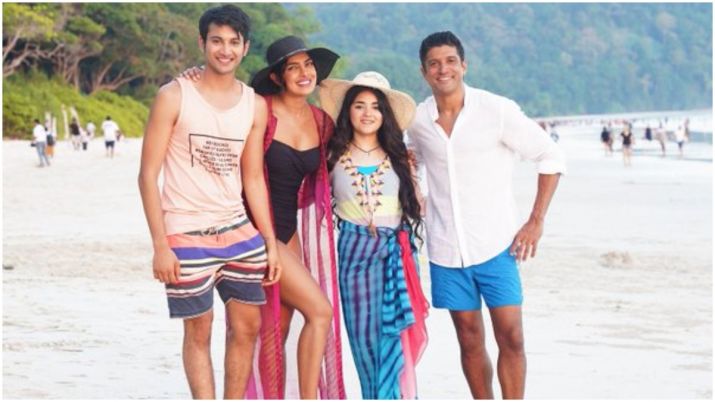
Soon an image of Zaira with rest of the film cast members on a beach became viral, where many wondered if she has returned to Bollywood after quitting it for Islam. However, the image is from prior to the announcement of her ‘retirement’ from Bollywood. Zaira has been keeping away from the promotional events for the movie as well. Hence, in absence of Zaira’s involvement in film promotion ahead of its release makes it quite clear that she has indeed quit Bollywood for good.
In June, in a six-page letter posted on Instagram, Zaira had said “Bollywood took me away from Islam” and cited the interference on her religious practices as the reason for this decision. She said that she wasn’t truly happy with her line of work despite her fame and success. It was only while trying to adjust to the new lifestyle did she realized that her career had impacted her relationship with religion.
The Sky Is Pink, directed by Shonali Bose is inspired from true story and revolves around Aisha Chaudhary (Zaira Wasim) who was diagnosed with pulmonary fibrosis. Priyanka Chopra and Farhan Akhtar play her parents and the movie spans over 30 years highlighting their ups and downs through their lives. The film also stars Rohit Saraf in a key role.
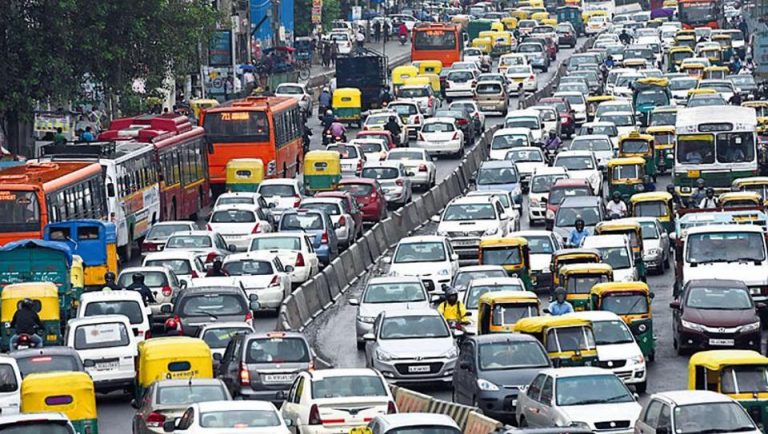
A typical day when I hit roads in my car in the Capital. The roads themselves have three types of variations. One is in the neighbourhood which teems with shops, cows, pedestrians, vehicles of all shapes and sizes. Here you could find our Virat Kohlis and Saina Nahiwals of future under the benign doting glances of their parents on the balcony. Schools-buses come every afternoon in the weekdays; alien cars make a stop in front of floors which rent young lives that celebrate weekends with booze, music and dance. Navigation requires yogic-contortions. Baring smiles on ladies who occupy a patch of the lane for their daily round of gossip is a daily act. Here are no traffic lights.
Out of my sector are the big, bad roads. Traffic here is always slow, a bane of our municipal corporations who hadn’t accounted for a future of burgeoning cars, lakhs of flats and millions of residents. Now there is a scramble to collect the daily waste, roads dug to wire our homes with competing WiFis, multiple gaps in dividers for vehicles to switch over from left to right and vice-versa. Not that it matters to we the citizens: We simply opt for the wrong side of traffic flow, braving ugly glances, gesticulating hands and showers of the curse. How does it matter when a second of time and an ounce of fuel has been successfully saved?
All this before you hit your first traffic lights of the day. They usually take-offs half a week. You can’t blame them either: We the traffic are colour-blind to their signals. It’s indiscreet to press on accelerators when it’s Green; It’s too idealistic to stop on Reds unless and until shrivelled beggars and their acrobat sons and daughters fulfil your idea of charity or desperate men with fake editions of Sidney Sheldon and Irving Stone in your face reflect your educated background.
The next hour is a tribute to your ever-growing vocabulary on abuses. English swear-words are too polite. They are no match to our Punjabi and Hindi lexicons. The worst ones are reserved for the two-wheelers who swarm around your vehicle; darting from left and write, brushing your bumpers, navigating a gap you thought didn’t exist between two cars. Invariably you are forced to move out of right-most lane where the slowest of the vehicle is lording over the lane meant for the fastest. There are three-wheelers who couldn’t care less if their iron frames scratch your newly-painted car or goods carriers who move slower than a bicycle and make your swerve wildly to the hail of abuses in the background.
The irony is, all of these troubles could actually be your work to the others. You too jump traffic lights; you too speak on your mobile as you drive; you too drive against the traffic once in a while and it’s been ages since you submitted your car for a pollution check. You too subdue the traffic police with your rank and position if a folded 100-rupee note isn’t a good-enough grease to his palms.
So you too are part of the problem. Other traffic violators have turned you into one. Or it could be you who has turned others into traffic violators. Daily we hit the roads, daily we come back cursing the jungle that is out there on the roads. We are not wrong too when we curse the rogue mobike-rider who you nearly killed or one who ran a scratch across the length of your car. You also swear at the governance which leaves huge potholes and unmanned traffic lights out there. Submerged roads could test out the lungs of your car; or worse you could have an idea how a submarine floats under the water.
So, on the terrifying jungle out there which could maim or kill you and your dear ones, all the stakeholders- people, traffic planners and regulators—are guilty. Planners don’t ha ave vision for future; Enforcers are corrupt and we the people have turned monsters on the road. Like millions of gods we have on different aspects of our lives, we need to invent a traffic Ganesha too for our wellbeing.
Let’s now view the new whip which has angered most in this country. Most of us are either dipping deep into our pockets or crowding the Pollution Control centres on gas stations. We find the measures too draconian what if our registration, insurance and pollution papers are not in order. We aren’t counting the benefits which discipline would bring on our roads and provides umbrella against pelting hefty medical bills.
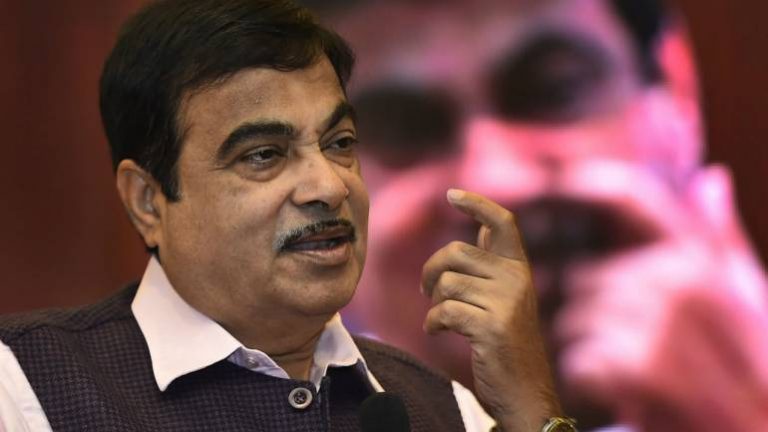
At the outset, there is every reason to applaud the transport minister Nitin Gadkari. He has been vocal on the Motor Vehicles Amendment bill for more than two years. He spent months in consultations with the states before finalizing and winning the ascent from the Parliament. He has shown a bloody mindedness ignoring populism and discomfiture within his own ranks.
Three states go for elections in next three months and are all headed by BJP—Haryana, Maharashtra and Jharkhand. But for Haryana, the other two aren’t willing to face people’s wrath. Gujarat has brought down the fines by almost 90 per cent; Karnataka and Uttarakhand would implement the Act but reduce the fines to just a slap on the wrist. Assam, Uttar Pradesh and Tripura haven’t even implemented it.
Non-BJP states have only poured scorn on the new Motor Vehicles Act. Congress, which runs Madhya Pradesh, Chattisgarh and Punjab have put the new Act on hold. Rajasthan would implement it but the fines would be reduced to a minimum.
There is no second-guessing the “non-BJP” states of West Bengal, Kerala and Odisha. West Bengal chief minister Mamata Banerjee is vocal that she wouldn’t implement the Act and burden her people. Kerala initially implemented the bill but now has put it on hold. The Odisha government of Naveen Patnaik has announced a three-month moratorium on the new Act. Interestingly, the Delhi government of Arvind Kejriwal is all in support of the Act.
It’s clear populism and politics would finally prevail over prudence. Our dharnas, noise and cribs matter to politicians. Asking us to wear seat belts, ride with helmets, follow zebra-crossing is too much of an ask. As it is to the tilted-heads on mobikes, using shoulders to attend calls on their mobile-phones.
Is this the entire truth? Doesn’t a couple with two small children, an old mobike and a few thousand rupees for a salary have a compulsion of their own on roads? Don’t we have faulty traffic signals? Don’t poor people buy a spluttering vehicle for a pittance only because it’s without papers? Don’t we have bus-stops right after the traffic-lights? Does the new Act take into account the last man on the road?
Good governance is one thing; populism is another. One leaves us with standardized conduct out on the streets; the other leaves us with chaos and anarchy. Good governance is never a zero-sum game: A few would always suffer in a society of extreme disparity. We have always longed for a government which governs for the good of the people. Now that we have it, we should strengthen and not weaken it.
Almost two weeks after the controversial event where Hindus were served buffalo meat at the ‘Urs’ event in Mohoba’s Salat village, some Hindu villagers are reportedly planning to meet UP CM Yogi Adityanath when he tours Chitrakoot today.
As per a report in Amar Ujala, local MLA Brijbhushan Rajpoot has urged the villagers to meet and discuss the issue with the CM. The Salat village in Mahoba area was in the news when local Hindus, who donate money for a ‘Mazar’ in the village and participate in the annual ‘Urs’, were outraged after they were served buffalo meat in this year’s Urs.
On August 31, the Hindus were served biriyani laced with buffalo meat at the annual Urs. Reports stated that Hindus in the village actively participate in the event every year and vegetarian dishes are cooked for them. But the organisers of the event admitted that the ‘buffalo meat’ found in the ‘Baba ka Prasad’ was a mistake.
Following the outrage, cases were registered against 43 people who were a part of the organising team. Charkhari MLA Brijbhushan Rajpoot has been pursuing the issue and had insisted the government’s action on the case.
As per reports, the Mazar of the Peer Baba is on encroached forest land and recently, the DFO had reached there with a team to demolish the illegal boundary wall. Local villagers, including Hindus, who are a majority in the village, allegedly opposed the demolition. The DFO has stated that the Mazar itself is quite old but the boundary was recently built on forest land.
Reports stated that it was mostly the Hindus of the village who had donated money for the construction of the Mazar. The organisers of the Urs are reportedly protesting against the forest department’s move to examine the records and demolish the boundary.
Reports say that while some of the villagers in Salat have ‘forgiven’ the perpetrators behind the buffalo meat incident, some are still angry over it and are considering the MLA’s proposal to meet the CM.
MLA Brijbhushan Rajpoot has stated that the Mazar has been built on forest land and he is waiting to see if the boundary wall is demolished as per departmental order on 14 September.
Today the Delhi CM Arvind Kejriwal announced that odd-even scheme for vehicles will come in Delhi after Diwali, as a measure to curb pollution. From November 4 to December 15, odd and even-numbered vehicles will be ply on Delhi roads only alternate days. Kejriwal announced that the scheme will be implemented only if the pollution level crosses the danger mark, otherwise, it will not be enforced.
Air pollution is a big problem in Delhi, especially during the dry season in the November-April period. Both the central and state governments have been implementing various measures to curb air pollution in the area. The Odd-Even scheme was first implemented in January 2016, and repeated in April 2016. Only private cars driven by men were subject to this rule. Private vehicles driven by women, and two-wheelers were exempted from the rule. Commercial vehicles bearing yellow number plates didn’t come under this rule.
Delhi government wanted to implement the Odd-Even rule in November 2017, but it was cancelled at the last moment after the National Green Tribunal passed on order saying that women drivers and two-wheelers would not be exempted from the rule. The Supreme Court had stayed the order late, but the rule was not enforced as the air pollution didn’t go below the dangerous mark that year.
When the rule was implemented in 2016, the rule managed to reduce the traffic congestion in Delhi by a great extent, allowing the vehicles on the road to enjoy a much better drive on relatively free roads. But it didn’t achieve its main objective, reduction in air pollution levels.
In fact, for the period January 1 to 15 in 2016, when it was implemented for the first time, the level of several pollutants had gone up compared the previous period. Studies had found that concentration of particulate matter (PM) 2.5 and black carbon had gone up during the period when Odd-Even was in force. After the scheme had ended, the level of PM2.5 had gone up even further, but black carbon level had come down marginally.
A later study published in Current Science had confirmed that air pollution had increased during the periods when half the private vehicles were kept off roads in Delhi. The study had found that the level toxins emitted by vehicles had gone up in the air sample collected by them.
The study had concluded that the exemptions allowed in the road meant that the rule was ineffective. Although private vehicles didn’t ply on roads based on their numbers, the number of exempted vehicles had actually gone up during the restricted period, from 8 am to 8 pm. Delhi government had actually introduced more buses for public convenience, and more two-wheelers, autos and taxis on the roads. Daily average number of vehicles on Delhi roads increased by 10% during the odd-even period. Many people also evaded the rule by driving their before 8 AM and after 8PM on the days their cars were banned.
Central Pollution Control Board had also said that Odd-Even had no impact on pollution. In a report submitted to the NGT, the board had said that air quality in Delhi during the odd-even implementation period in April 2016 was found to have deteriorated. During the second phase of the rule in April, the air pollution had gone up by 23%.
Air pollution is caused by several factors, but for a long time, only few of them have been targeted by governments and activists. In recent years, vehicles and Diwali crackers were the main target. But just like Odd-Even didn’t control pollution, banning of Diwali crackers last year in Delhi was also didn’t yield any result. Only recently the authorities have woken up to other major pollutants, like stubble burning and road dust.
Although this year women-driven cars and two-wheelers are not exempted, it will not apply on commercial vehicles. And as half the two-wheelers will also go off the roads, the demand for public transport will go up even more compared to last time. Therefore, the success of the scheme remains a question this year also.
In a big blow to the Nationalist Congress Party (NCP) in Maharashtra, Chhatrapati Udayanraje Bhosale, the descendant of Chhatrapati Shivaji Maharaj is all set to quit the party to join the Bharatiya Janata Party (BJP) in New Delhi on Saturday.
According to reports, Bhosale will be reaching New Delhi along with Maharashtra Chief Minister Devendra Fadnavis. He will be inducted into the BJP in presence of PM Narendra Modi and BJP president Amit Shah.
However, amid all these speculations of Bhosale joining BJP, the Satara MP met NCP supremo Sharad Pawar at his residence in Pune on Thursday. The meeting between the two leaders came two days after Bhosale, who is a descendant of the warrior King Chhatrapati Shivaji Maharaj had met Chief Minister Devendra Fadnavis in Mumbai.
Bhosale is one of the four NCP Member of Parliament elected from Maharashtra in the 2019 Lok Sabha elections. He had earlier said that he will make a decision based on what was in the interest of the people of his constituency at a given time.
Chhatrapati Udayanraje Bhosale, who is the descendant of Chhatrapati Shivaji Maharaj is the 13th holder of the title of Chhatrapati. He has been representing the prestigious Satara Lok Sabha seat for the last three tenure by winning successive elections in 2009, 2014 and 2019.
Recently, Udayanraje Bhosale’s cousin and NCP’s Satara MLA Shivendrasinh Bhosale had also quit the party to join the ruling BJP ahead of the Maharashtra assembly elections.
The NCP is crumbling as the party has been the most affected by the desertion of its senior leaders. Just before the 2014 Lok Sabha elections, NCP lost one of its strongest leaders, former Deputy CM VijaySinh Mohite Patil along with his son RanjitSinh in March 2019. In a recent major setback, NCP’s poster boy and Mumbai Unit Chief, former minister Sachin Ahir joined hands with BJPs’ ally Shivsena on July 25.
Almost 6 days later, three-star NCP MLAs Sandeep Naik from Airoli, Navi Mumbai, Vaibhav Pichad of Akole, Ahmednagar and Shivendra Raje Bhosale of Javali, Satara along with firebrand Women’s Wing Chief Chitra Wagh joined BJP on July 31.
On Wednesday, former state minister and NCP’s Navi Mumbai strongman Ganesh Naik also joined the BJP. A flock of 60 NCP corporators from Navi Mumbai Municipal Corporation also shifted to BJP with Ganesh Naik.
This sudden exodus of leaders from NCP is a huge jolt for the party and it is possibly staring at a collapse if the same trend continues in the days to come.
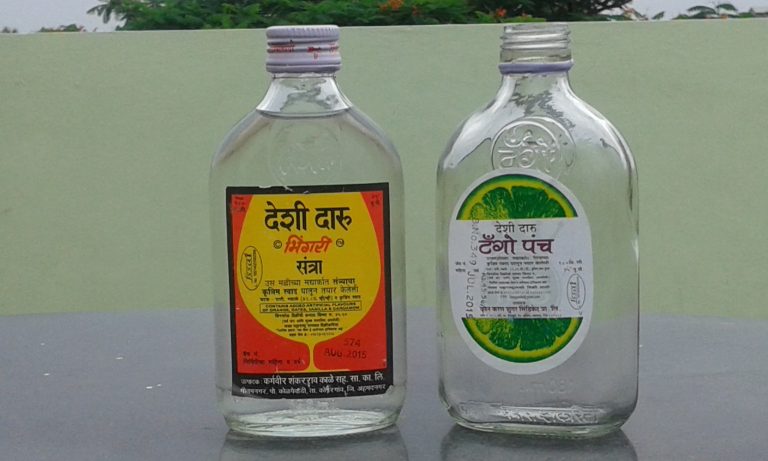
Villagers in Shikarapara village in Jharkhand held protests after three Muslim youths were found drinking alcohol near Shiva temple. As reported by Jagran, an FIR was registered and on Irfan Ansari was arrested. Two other men, Dakhtarwa Miyan, who hails from West Bengal, and Gudda Miyan, who hails from Shikaripara village are on the run.
The incident took place on Wednesday night and the villagers reportedly gathered last night to decide on the ‘shuddhikaran’ of the temple.
As per the report, some tribal men saw the three Muslim youths drinking alcohol outside the Shiva temple and alerted the villagers. As soon as villagers came, the men tried to escape but one was caught who was later handed over to police. As soon as the news spread, people started gathering. Extra police force from neighbouring village was also called in to avoid any untoward incident.
The village panchayat, under the leadership of Sunita Hembram and panchayat secretary Kabil Ansari decided that after consultation with Pandits, a shuddhikaran (cleansing) of the temple should be carried out.