The Indian High Commission in London suffered another attack on Tuesday after protests over the abrogation of Article 370. A 10,000 strong mob of British Pakistanis marched in London in the ‘Kashmir Freedom March’. The building has suffered damages as several windows and window panes have been smashed by the attackers.
The protesters carried Khalistani flags as well. They chanted slogans such as ‘Azadi’, ‘Time for UN to act on Kashmir’, ‘Stop War Crimes in Kashmir’ and ‘Stop Shelling in Kashmir’. This was the second such attack on the Indian High Commission in London after the attack on Indians celebrating Independence Day on the 15th of August.
The violent crowd reportedly hurled shoes, eggs, tomatoes, stones and smoke bombs at the embassy building. Before the march started, a PoK flag was allegedly put in the hands of the Mahatma Gandhi statue at Parliament Square.
The mob also included some MPs from the Labour Party. “You can try and silence a Parliament but you cannot try and silence a people. We will continue to protest on the streets of our cities and at the UN until we have delivered justice to the people of Kashmir”, said British Labour MP Liam Byrne, who was heading the march.
Byrne is campaigning to “seek restoration of Kashmir’s special status, to ensure demilitarisation, restoration of communication and to immediately allow full access to human rights observers” in Kashmir. As we have noted before, Byrne is the elected representative of a constituency that has a significant Muslim population of Pakistani heritage.
Meanwhile, London Mayor Sadiq Khan condemned the incident and urged the Police to take action on the matter. Only two people have been arrested so far.
I utterly condemn this unacceptable behaviour and have raised this incident with @metpoliceuk to take action.
Indian-origin Tory MP Shailesh Vara raised the matter of the attack on the Indian High Commission on Independence Day in the UK House of Commons on Tuesday. He made it clear that the Indian diaspora was attacked by “another community”, hinting clearly at the violent mob of Pakistani origin.
Foreign Secretary Dominic Raab said in response, “Any violence is deplorable. It shouldn’t be conducted in this country, or anywhere else for that matter, at any individual communities. What we now need to do is try and reduce those tensions but also, on a positive side, build up confidence-building measures to allow proper dialogue between the communities in Kashmir and also between India and Pakistan.”
Almost immediately after being released from jail custody, one S Ansari allegedly kidnapped and raped a 6-year-old minor girl near Anand Nagar in Oshiwara, Mumbai on the intervening night of August 31 and September 1.
The 30-year-old ‘sex addict’ Ansari is a petty thief who has more than a dozen cases registered against him. Ansari has been divorced twice for making unreasonable sexual demands from his two wives. The arrested accused has been booked under relevant sections of the Indian Penal Code and Protection of Children from Sexual Offences (POCSO) Act.
On August 31, the victim was playing outside her house in Anand Nagar in Oshiwara when Ansari, who was known to the victims family, lured the girl by offering her chocolates and put her in an auto-rickshaw and took her to the BMC ground where he raped her. Ansari, who was the minor girl’s neighbour, fled the spot leaving the girl bleeding.
As per a DNA report, a police constable from Oshiwara police station found the minor crying while wandering on the road. He took her to the police station where the girl’s parents had already lodged a Missing Persons complaint. She was then taken for a medical examination which revealed that the minor was mercilessly raped.
However, other media houses have reported that after the girl reached home and narrated her ordeal to her mother, the family rushed to Oshiwara police station early on September 1, at 7.30 am and registered a case of rape and sexual assault against Ansari. Police booked Ansari and began the investigation.
A police official also said that the victim was threatened with harm if she told anyone about the incident.
Zone 9 DCP Paramjit Singh Dahiya said that the police went through CCTV camera footage to nab Ansari. The footage showed a man wearing a red T-shirt walking with the girl. “We suspected it was a food delivery guy and 10 to 15 of them living in the area. In another footage, we could see ‘Matrix Imagine’ written on the T-shirt and were able to zero in on him with the help of locals,” the police said.
According to police, Ansari also has a criminal record in a Delhi police station where he stole two vehicles. He was also arrested three months ago in Mumbai for stealing Rs 3 lakh from a house where he worked as household help.
Ansari was produced in court on Tuesday and remanded to seven days in police custody.
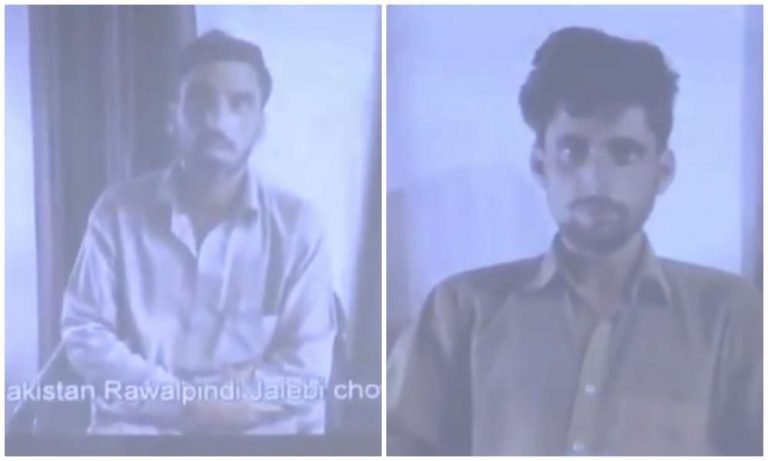
Two Pakistani terrorists, associated with terror organisation Lashkar-e-Taiba were nabbed by the Indian Army on 21st August this year. The Indian Army today released their video confession.
#WATCH SRINAGAR: Indian Army releases confession video of two Pakistani nationals, who are associated with Lashkar-e-Taiba, and were apprehended on August 21. #JammuAndKashmirpic.twitter.com/J57U3uPZBl
A Pakistani terrorist Khalil from Jalebi Chowk, Rawalpindi confesses that he ‘works as a mujahideen’. Mujahideen literally means jihadi. He confesses that he is associated with the Lashkar-e-Taiba. “I have taken a one-week training in Kacherban (Jammu & Kashmir). Nazeem was with me and even he is trained. We both started working together on the same day and it has been five years since we are working (as terrorists). We have planned that we will cross the border and join other mujahids,” he says. He even gave out names of other terrorists associated with him.
Another terrorist, 20-year-old Mohammad Nazeem, in his confession says that he is also from Rawalpindi in Pakistan. He, too, confesses that he is a terrorist associated with Lashkar-e-Taiba. “I took training from LeT. Along with me, Mubbasir, Muddasar and Khalil also underwent training with me in Kacherban,” he says. Nazeem reveals that Pakistani army personnel were also involved in helping them cross over the border.
He said that while he and Khalil were caught by Indian Army, there are still 10-15 mujahids being trained in Kacherban with help of Pakistani army waiting to infiltrate into India and carry out terror attacks.
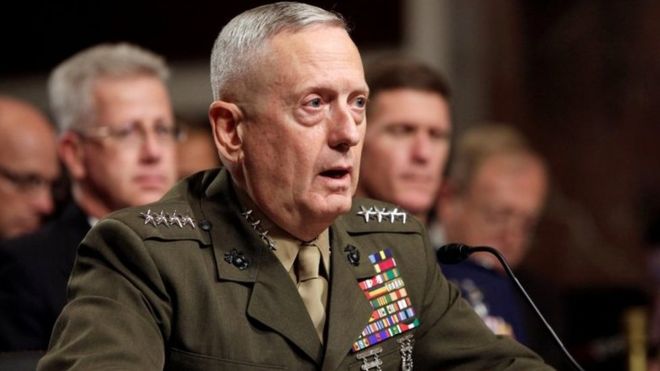
In an interview at The Council on Foreign Relations, former Defense Secretary Gen. James Mattis reiterated that Pakistan is the “most dangerous” country in terms of the USA’s foreign policy. He cited the extent of the radicalization of Pakistani society and its nuclear weapons as reasons for his view.
“Of all the countries I’ve dealt with, I consider Pakistan to be the most dangerous, because of the radicalization of its society and the availability of nuclear weapons,” Mattis has written in his autobiography “Call Sign Chaos”. He said, “We can’t have the fastest-growing nuclear arsenal in the world falling into the hands of the terrorists breeding in their midst. The result would be disastrous.”
Gen. James ‘Mad Dog’ Mattis had very harsh words to offer for the Pakistani establishment. He said that “they don’t have leaders who care about their future”. “We could manage our problems with Pakistan, but our divisions were too deep, and trust too shallow, to resolve them,” he wrote further. It is this lack of trust that prompted former US President Barack Obama to not inform Pakistan of the US Navy SEALs raid that found and killed Osama bin Laden in May 2011, according to Mattis.
The former US Defense Secretary also slammed the Pakistani establishment for its obsession with India. He says that Pakistan “views all geopolitics through the prism of its hostility toward India” and that has also shaped its policy on Afghanistan as the “the Pakistan military wanted a friendly government in Kabul that was resistant to Indian influence”.
Ever since Donald Trump assumed the seat of the US President, American policy on Pakistan has seen a decisive shift. Recently, the US had slashed its aid to Pakistan by a further $440 million. Last year the USA had canceled military aid worth over 300 million USD.
Before that, the Pentagon had slashed aid worth 1 billion USD, citing Pakistan’s failure to crack down on terror outfits. During Imran Khan’s visit to the US recently, Donald Trump had said to his face that the US has cut down aid to Pakistan because “Pakistan was not doing anything for the US, they were being really subversive”.
Consistent with USA’s drift away from Pakistan, Indo-US ties have seen a greater convergence between the two countries on various issues under the Trump administration.
Ministry of Home Affairs has denied reports that Assam has been put under the Protected Area category in the wake of the situation after the publication of final NRC.
Today Assam Tribune had reported that Assam has been placed under protected area category by the Ministry of External Affairs and the Ministry of Home Affairs following the controversy generated by the National Register of Citizens (NRC). At present several states in North East are in Protected Area or Restricted Area categories, and visitors, including journalists, have to obtain permits before visiting such states.
The report also stated that all foreign journalists working in Assam have been asked to leave the state. It also claimed that a female journalist working with Associated Press (AP) was escorted by the Assam police to the airport and put on a flight to Delhi. The news report was also published by The Quint quoting the Assam Tribune report, which said that now foreign journalists will need permission to report from Assam.
Amidst reprts that GOI has declared Assam a protected area post #NRC and therefore asked foreign journalists to leave , @HMOIndia clarifies, “No such order issued.The info is incorrect.” MEA tells @SiddiquiMaha as per permit rule82 foreign journos were always restricted in all NE
But now the Home Ministry has said that this is fake news, saying no decision to put Assam under protected area category has been taken, and no restrictions on foreign journalists entering Assam has been imposed.
In North East, Arunachal Pradesh, Manipur, Mizoram and Nagaland states are declared as Protected Areas, and Indian citizens willing to visit these states need to obtain an Inner Line Permit, while foreign visitors need to obtain a Protected Area Permit, before entering these states.
On September 4th 2019, The Mumbai Mirror published a report headlined “Bajrang Dal workers barge into Christian Prayer meet at Worli School” which detailed how activists from Bajrang Dal ‘disrupted’ an ‘innocent prayer meet’ being held inside the school premises.
The Mumbai Mirror report
The report claimed that Bajrang Dal suspected that the prayer meeting was a front for religious conversion and after they barged in, they first video recorded the event and then, called the police.
However, the Mumbai Mirror report was less an endeavour in fact-finding and more on subtly furthering the agenda that the Christian prayer meet was disrupted due to hate.
In the report, Mumbai Mirror writes:
“Rather than book the activists for harassment or trespassing, the police acted on their complaint and issued a notice under Section 149 (unlawful assembly) of the IPC to Allen Salins, a pastor from Mangalore who was the chief guest at the program”.
The Mumbai Mirror report states, in no uncertain terms that the police should have booked the Bajrang Dal activists for harassment and trespassing, but instead, acted on their complaint and issued a notice under Section 149 to Allen Salins, the pastor heading the prayer meet.
The report states that the police told the New Life Fellowship Organisation that they should have taken permission from the police. In fact, the police had also warned the activists that they should have approached the police and not disrupted the event on their own.
The Mumbai Mirror report quotes Bajrang Dal Activist Dinesh Shrivastava as saying that such events promote superstition and religious conversion. However, in an attempt to tarnish and paint Dinesh as a religious, irrational nut, it also quotes his ‘WhatsApp status’.
“Incidentally, Shrivastav’s WhatsApp stats reads: Dharmyudha main nimantran nahi bheje jate. Jo veer hai woh khud ranbhumi main chale aate hain! Jai Shriram”.
Legal Rights Observatory (LRO) accuses Mumbai Mirror of bias and being economical with facts
Now, Legal Rights Observatory, an activist group and accused the publication of being economical with facts and running an agenda against the activists who merely wanted to ensure that peace is maintained and superstition is not used against the citizenry.
Hello @MumbaiMirror@alka_MIRROR we never expected balanced reporting from Ur paper but Worli incidence is serious matter n by any means it’s nt what U reported today. Come out of Ur cocoon to get 360 degree view! https://t.co/oENPRkDnlp
Legal Rights Observatory, on 2nd September, had lodged a complaint with National Commission for Protection of Child’s Rights and raised an issue regarding the event being held in school premises.
On September 1, 2019, The New Life Fellowship mission, an evangelist group has arranged a program at Mumbai Municipal School, Worli Mumbai.
The program caused tensions in the area triggering police intervention (Please see police notice in the attachment). With this letter, we want to request NCPCR to investigate the event on the following basis,
1) Whether that school forced/ requested students to attend this program on Sunday?
2) Whether school forced/ requested parents to attend this evangelist program?
3) Whether the New Life Fellowship mission earlier arranged the same type of program in a school on school days? And any such program violated Right to Education of school kids?
Also with this email letter, we want to request NCPCR to issue advisory citing this issue to,
1) Chief Education Officer of Mumbai Municipal Corporation,
2) Mayor- Mumbai Municipal Corporation,
3) Mumbai Police Commissioner,
4) Commissioner Mumbai Municipal Corporation, to take utmost precaution to avoid misuse of school infrastructure for programs like this; which are spreading superstitions and inculcating unscientific notions on the tender minds of school kids.
Legal Rights Observatory further said that the event that Mumbai Mirror reported comes under the ‘Black Magic Act’ and was not merely a prayer meeting as being portrayed in the report.
Hello @MumbaiMirror@alka_MIRROR prayer n spreading superstitions r very different things. Worli program which U reported today comes under “Black Magic Act” on which we hv already moved complaint to @CPMumbaiPolice. Plz keep spreading lies which makes Our task easy! https://t.co/Z74OcvqT3g
Alka Dhupkar, who had filed the report in The Mumbai Mirror, however, said that Dinesh, the Bajrang Dal activist had issued a statement and in the statement itself, nothing about superstition or black magic was mentioned.
This is a statement of Dinesh Shrivastav, Bajrang Dal,Dadar district coordinator. He doesn’t say a word about ‘superstition’ or Black magic act in it. He was under impression that religious conversions were happening here which he couldn’t confirm to police. We hv reported facts. pic.twitter.com/6mysnB2Ulj
What is intriguing, however, is in the report filed by Dhupkar itself, Dinesh is quoted as saying that such events promote superstition. Why then did Dhupkar not probe further is a mystery.
Legal Rights Observatory on its part says that they are in the possession of a video where it is clearly evident that this was no ordinary prayer meeting and that it was encouraging superstition. They say, “We have video of applying magic tactics on participants n we will submit it to police as follow up of our complaint. The case is very strong n police would definitely lodge FIR against organisers after going through it. Please report that angle too!”.
OpIndia has seen the video in question when it got in touch with representatives of Legal Rights Observatory and it can be clearly seen that the pastor puts his hand on the heads of women (including juvenile participant) and they can be seen screaming as if being cleansed or exorcised. Such sights are not uncommon when it comes to certain Christian gatherings and one could easily argue that they come under superstition and black magic act. For legal reasons, LRO has at this time refused to make the video public so the juvenile participant who is allegedly being tortured is not pressurised by the pastor or organisers of the event.
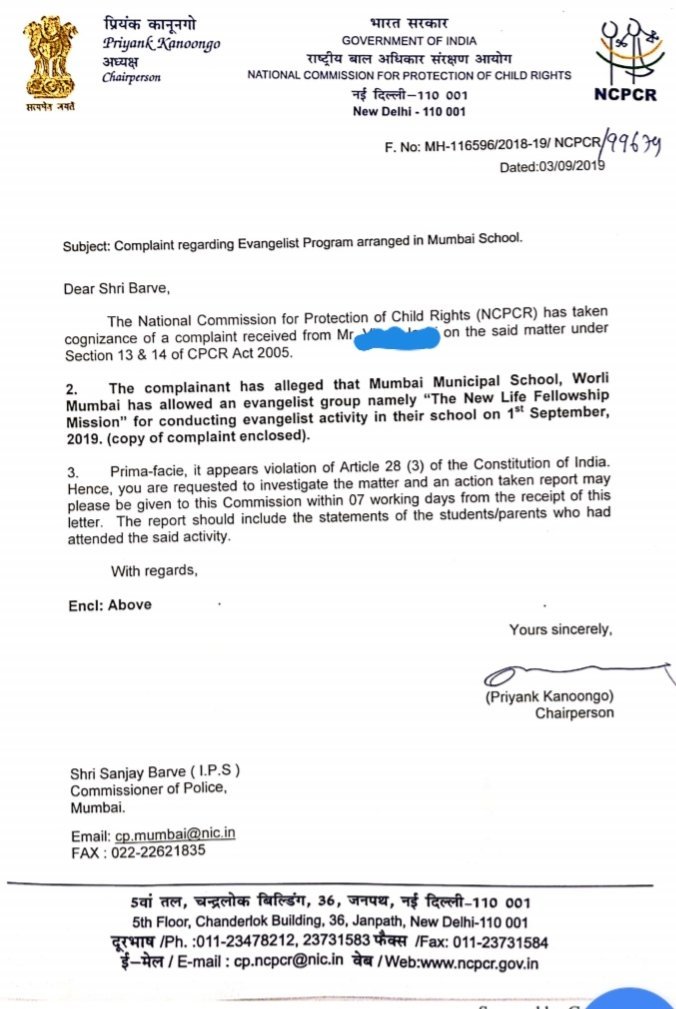
Child Rights Commission takes cognisance under Article 28 (3) of the Indian Constitution
Further, on 3rd September 2019 itself, Child Rights Commission had issued a letter to the Commissioner of Police, Mumbai on the Worli incident.
Complaint by LRO
The letter issued by NCPCR says that prima facie, it looks like the event violated Article 28 (3) of the Indian Constitution and hence, the police is requested to investigate the matter. The letter also mentions that a report must be given to the Commission within 7 working days and that the report should include statements from the students and parents who attended the said activity.
Article 28 (3) of the Indian Constitution states, “No person attending any educational institution recognised by the State or receiving aid out of State funds shall be required to take part in any religious instruction that may be imparted in such institution or to attend any religious worship that may be conducted in such institution or in any premises attached thereto unless such person or, if such person is a minor, his guardian has given his consent thereto Cultural and Educational Rights”.
Suspected torture of juvenile at Worli program
Today, LRO has filed a complaint in the matter. The complaint says:
To,
Chairman,
NCPCR,
New Delhi,
Subject:- Complaint about the incidence of suspected torture of juvenile at Worli program arranged by The New Life Fellowship Mission.
Sir,
We have earlier lodged a complaint with Mumbai Police Commissioner against program held at BMC school Worli on September 1, 2019, in which The New Life Fellowship Mission spread superstitions and black magic tactics.
Yesterday we have accessed a video in which a juvenile participating in the same program is screaming due to unknown reasons (Please find attached video). We suspect that the unknown juvenile present at the venue is either being exposed to inhuman torture or beating or sexual harassment which made her scream/ cry in deep pain for help.
So, with this complaint we request you,
1) To immediately order Mumbai Police Commissioner to constitute all-woman police team headed by a high ranking woman police officer as investigation officer (IO) to investigate actually what happened at that program with that screaming juvenile,
2) To immediately report the incidence to the National Commission for Woman- NCW if the victim is woman,
3) To fix the responsibility of incidence on a police officer under whose jurisdiction the program was conducted and summon him to Delhi to record his/her statement,
4) To seek a report from Home Secretary of Maharastra regarding other such programs conducted earlier by The New Life Fellowship Mission.
We hope NCPCR would act to investigate the matter with urgency.
Grave omission by Mumbai Mirror: No mention of alleged police high handedness
As mentioned earlier, the Mumbai Mirror report mentions categorically that the police did not ‘take action’ against the Bajrang Dal activists. In fact, it goes on to insinuate bias on the part of the police when it says that instead of booking the activists for harassment and trespassing, it issued a notice to the pastor. However, the allegations by LRO are diametrically different.
In an email complaint, Legal Rights Observatory has categorically charged the Mumbai Police within action against the evangelist program.
Request for action against Mumbai Police officer for inaction against evangelist program arranged by The New Life Fellowship Mission which spread superstitions.
To, Commissioner of Police, Mumbai Police,
Subject:- Request for action against a concerned police officer who let arrange program spreading superstitions at Worli BMC school and threatened those who objected the program.
Sir,
On September 1, 2019, The New Life Fellowship Mission had arranged a program at Worli BMC School. That program was to spread Christianity by using superstitions. Local responsible people visited the venue to object them on 11.00 am and called the police. The police officer who visited spot spoiled the time from 11.00 am to 8.00 pm. Also the officer threatened those who objected the program with dire consequences and didn’t lodge FIR against The New Life Fellowship Mission under “Anti-Superstition and Black Magic Act”.
After much tensions, local police officer warned program organizers in a written letter (Please find attached letter) but that was just cosmetic action to pacify sentiments.
With this letter We request you to; 1) Investigate the officer who visited the spot for his behaviour,
2) To order concerned police officer to lodge FIR against The New Life Fellowship Mission and headmaster/ principal (Who let the program in their school building) under “Anti-Superstition and Black Magic Act” for actively/passively spreading superstitions.
If Mumbai Police failed to act swiftly then we would approach state home minister and home secretary to ensure action.
The complaint says that the Mumbai Police threatened the activists who raised alarm and even treated them with high-handedness. The complaint also alleges that the Mumbai Police refused to lodge an FIR against the program and its organisers under the Anti Superstition and Black Magic Act.
Questions that need answering
It is evident that the Mumbai Mirror report has glaring loopholes and ommissions, whether because the journalist did not get in touch with LRO, who has been filing the complaint or because of the inherent bias of the report herself.
Why did the reporter feel compelled to introduce her bias in the report by mentioning the activist’s WhatsApp status etc? Was it necessary to the facts of the case?
Why did the reporter not get in touch with LRO to get the full picture of the complaints being filed?
Even after being informed of ommissions, why has the Mumbai Mirror report not been updated?
With its skewed reportage, is Mumbai Mirror endorsing religious events and alleged superstition and torture inside government-run and funded schools?
Why was this event being held at a government-run school and not the Church?
Ramesh Solanki, a member of Shiv Sena’s IT Cell, has filed a complaint against Netflix with Mumbai police for allegedly defaming Hindus and India. The complaint accuses the global streaming site of painting an “inaccurate picture of Hindus and India globally”.
The complaint further says that almost “every series on Netflix India is with the intention of defaming the country on a global level. It is with deep rooted Hinduphobia that the platform is portraying the nation in a bad light.”
The complaint cites Sacred Games and Leila as two series on the platform which paints an inaccurate portrait of Hindus and India. Apart from them, the complaint also mentions comedian Hasan Minaj and the series Ghoul.
The complaint objects to the Sacred Games’ portrayal of the sacred chant ‘Aham Brahmasmi’ in a negative light which suggests that it “radicalizes people to indulge in war against humanity.” Leila depicts a dystopian future where fascist Hindus have taken over the country. In this dystopian future, where the country is called Aryavart, people from lower castes and Muslims are oppressed and persecuted by a Saffron regime.
The complaint accuses Minaj of peddling false propaganda against the abrogation of Article 370. It says, “The artist and all his content, including anti-India material is still hosted on the platform.” Ghoul is a horror series that depicts a dystopian future where Muslims are persecuted by a fascist Hindu state where the Indian Army is shown carrying out the evil designs of the regime.
Solanki requested the authorities to look into the matter and take appropriate action against Netflix. The US digital streaming platform has been on troubled waters ever since the release of the second season of Sacred Games. BJP Delhi spokesperson, Tajinder Bagga, too, had filed a complaint against Anurag Kashyap, the director of Sacred Games, for allegedly hurting religious sentiments.
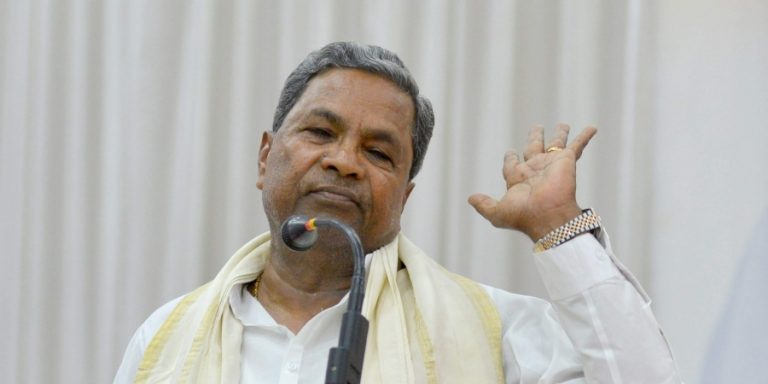
Former Karnataka Chief Minister of Karnataka, Siddaramaiah has yet again caused controversy after he got angry and slapped an aide in the presence of media, reports ANI.
According to the reports, senior Congress leader and former Karnataka CM Siddaramaiah slapped a man, reportedly an aide of Congress leader for requesting him to speak to someone on a phone call. Siddaramaiah who is on a visit to Mysuru and Kodagu had landed in the Mysuru airport on Wednesday morning.
#WATCH: Congress leader and Karnataka’s former Chief Minister Siddaramaiah slaps his aide outside Mysuru Airport. pic.twitter.com/hhC0t5vm8Q
In the video shared by ANI, as Siddaramaiah walked out of the airport premises after addressing the media, a party worker, Ravi, wearing a white shirt was seen talking to him. A visibly irritated Siddaramaiah slapped him hard on his cheeks and moved ahead.
Reportedly, Ravi, a Congress party worker, was speaking to someone on a mobile phone. Then, Ravi requested Siddaramaiah to speak to that person on his phone which irritated former Karnataka CM. Refusing to speak, he slapped Ravi.
This is not the first time that Siddaramaiah has shown his anger on ordinary citizens. In a despicable instance of outraging a woman’s modesty, former Karnataka Chief Minister Siddaramaiah in January had snatched at the dupatta of a woman, pulling it away from her body, in an attempt to intimidate her. Later, he had clarified that the reaction was unintentional.
At the event in Mysuru, the woman in the video was trying to register a complaint with former CM Siddaramaiah regarding the absence of his son Yathindra, an MLA of Varuna constituency. As the aggrieved lady took the name of his son Yathindra, senior Congress leader Siddaramaiah lost his temper. He had reacted by getting aggressive and berating the woman suggesting that the complaint made it seem as if his son had committed a great crime.
In 2016, former Chief Minister Siddaramaiah had slapped a senior government official in Ballari after he had allegedly mistaken the officer for a person from the angry crowd.
Hyper activist Kavita Krishnan who doubles up as a freelance protestor who has mastery over peddling fake news has been exposed yet again for not only spreading false propaganda but also for standing in support of a notorious fake news peddler Mohammad Asif Khan, who has a history of propagating communally sensitive fake news.
The saga started after Md Asif Khan, a notorious fake news peddler and an Islamist, shared misleading reports pertaining to the road-rage incident that occurred in Delhi on August 31st. A 23-year-old youth named Sahil Singh had died following a brawl. However, Khan went on to claim that the 23-year-old was killed by a mob after they mistook him to a Muslim.
He is 23 yr old Sahil, from Delhi.
Recently he was thrashed by a mob in Delhi.
He was brutally beaten up by a mob bcz during a scuffle mob mistook him as a Muslim when his friends call his name.
His family taken him to hospital but he was dead by then.
However, no such reports or records exist suggesting that 23-year-old Sahil was killed by a ‘mob’ after they had allegedly thought that he was a Muslim. In fact, Khan resorted to fake news after he said that a ‘mob’ had killed Sahil after the road-rage incident.
According to the reports, the Delhi police after the incident has arrested only two people including a juvenile after they had attacked Sahil. Sahil had succumbed to injuries after a drunk man and his juvenile son had allegedly stabbed him.
Shockingly, Md Khan chose to refer two individuals as a ‘mob’ and invents a new storyline claiming that he was killed for having a Muslim name.
As Khan resorted to spreading communally sensitive fake propaganda, strangely, The Wire journalist Rohini Singh, who herself has a history of propagating fake news, called out Khan for ‘spreading propaganda and stirring the communal pot’ and advised him to read the report he himself had shared, while stating that there was neither a ‘mob’ nor it was a communal incident.
If you are done spreading propaganda and stirring the communal pot like always maybe you should read the report you are quoting. The ‘ground report’ brings out two different versions of the parents of the victim. https://t.co/VDKbIRnSZp
As the attempts to communalise the death of a 23-year-old youth was thwarted by their own, Kavita Krishnan, who is an apologist for Khan jumped into the conversation to attack fellow Rohini Singh for exposing Khan. Citing a Quint report, Krishnan claimed that Asif has never to her knowledge, been irresponsible or spread fake news.
Amusingly, The Quint report, which is supposedly a ground report, also quotes the victim’s mother, Sangeeta, who said that Sahil had gone to help his friend’s brother who got into a scuffle with someone. The parents, as per The Quint report, thought there is a communal angle to the unfortunate incident because “entire lane is saying that a Muslim has been killed”. The report also mentions that the police has ruled out communal angle. The police has mentioned that the perpetrator was inebriated and the scuffle broke out over passing through the lane.
A war of words soon began between Rohini Singh and Kavita Krishnan. Rohini Singh targetted Krishnan for supporting Asif Khan and asserted that it was not the first time that Asif has been indulging in fake news. She also stated that The Quint report carried a conflicting version of the parents who are themselves not sure whether Sahil was killed because he was mistaken to be a Muslim.
I feel you are quick to jump in without verifying things yourself Kavita. Not the first time. Kindly read the report quoted by Asif himself. The parents have conflicting version, they ‘believe’ he was killed because he was mistaken to be a Muslim. They aren’t sure. https://t.co/oal3hYtPQh
Kavita, however, maintained that Asif Khan is not a purveyor of fake news.
Sadly, communal violence against Muslims isn’t a narrative. It’s a reality that @imMAK02 documents tirelessly. It’s a hard job to do, very triggering and tough. Even if he ever overstates something, he corrects it, every time. He’s no proponent of fake news. Peace & out.
Soon, social media users also pointed out to the repeated instances in which Mohammad Asif Khan had indulged in fake news propaganda after Kavita Krishnan claimed that Khan had never shared any fake news.
Never. Really? posting here a recent one, he has been caught hundred times doing this. pic.twitter.com/miglOyskn6
After social media users exposed lies and half-truths peddled by Asif Khan, an angry Khan put up bizarre defence claiming that he never indulged in any fake News. He went on to claim that deleting a fake post after getting exposed cannot be referred to as propagating fake news.
Hey Bhakt, this is not called fake News. I was asking police to take action on that video.
I was NOT GIVING information, I was SEEKING information that is why tagged 3 Police handle.
In an attempt to save her comrade, Kavita Krishnan yet again jumped into the conversation to put up outlandish justifications to declare what constituted fake news. Ironically, Krishnan who has caught peddling fake news several times, went to on to redefine fake news.
According to Krishnan, fake news mongers do not tag police handles and ask them to act. She said that fake news peddlers do not delete tweets once they realise it is old. Krishnan claimed that Asif had gotten her to delete her mistaken tweets many times and in return, she had asked him to delete his overstated tweets many times. Hence, Asif Khan is no ‘Fake News Monger’.
No. Fake news mongers don’t tag police handles and ask them to act. They don’t delete tweets once they realise it’s old. Asif has gotten me to delete my mistaken tweets many times. I’ve gotten him to correct/delete his overstated tweets many times. HE IS NO FAKE NEWS MONGER.
Apparently, if you tag police, you are absolved of the responsibility and repercussions of spreading fake news.
There has been an increasing trend where fake ‘hate crimes’ are peddled to show ‘rising intolerance’. There were a series of incidents where Muslim victims claimed they were beaten up and forced to chant ‘Jai Shri Ram’. While there were some unfortunate incidents which, there were quite a few where these ‘hate crimes’ were found to be fake after police investigation. Moreover, there has also been a trend where ‘liberal’ media promoted ‘hate crime trackers’ take liberties to understate a hate crime if the victim is a Hindu and perpetrator is a Muslim.
Ahead of Delhi assembly elections, the Aam Aadmi Party (AAP) on Tuesday launched a new ‘I love Kejriwal’ campaign, inviting people to support and once again elect Arvind Kejriwal as the Chief Minister of Delhi.
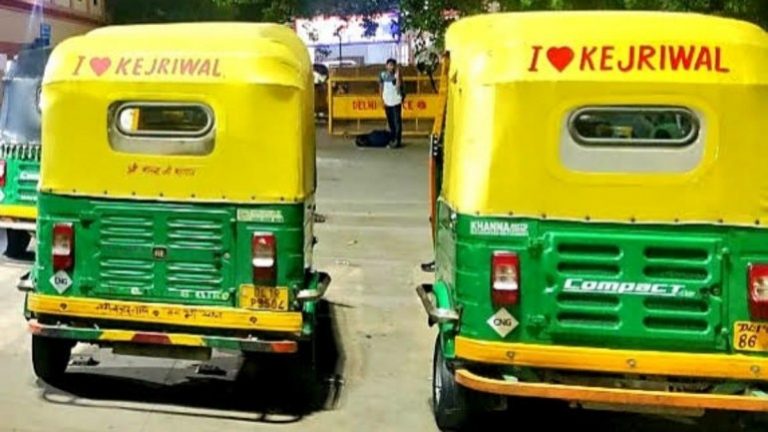
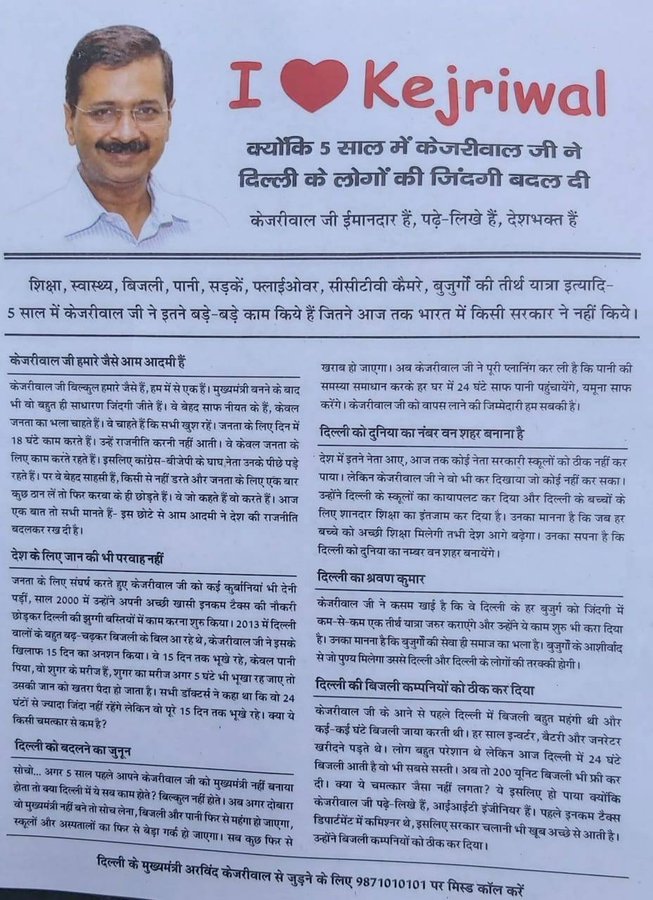
According to reports, the Aam Aadmi Party will paint the slogan “I Love Kejriwal” behind auto-rickshaws and distribute pamphlets among the public. The party has decided to distribute pamphlets in the capital detailing the work done by Kejriwal.
Speaking to the media, AAP leader Gopal Rai said the ‘I love Kejriwal’ campaign will be run along with the ‘Jan Samvad Yatra’ where the party leaders were taking feedback from people in each of the 70 assembly constituencies on AAP government’s work in the last four-and-a-half years.
“We are appointing booth level in-charges in every constituency in Delhi. It will be his or her responsibility to ensure that ‘I Love Kejriwal’ campaign and the pamphlets reach every street and block,” Rai said.
Rai said that the campaign was inspired by the Delhi auto drivers who had started writing ‘I love Kejriwal’ on their autos to express their love for the chief minister. The party has also launched a campaign asking people who wish to support Kejriwal in the upcoming elections to give a missed call on a number to participate in the campaign.
The pamphlet being distributed by AAP lists the ‘achievements’ of Kejriwal. It says Kejriwal is ‘Padha Likha'(educated) and a Desh-Bhakt (patriot). It praises Kejriwal by insisting that he is an Aam Aadmi like all voters, he can lay down his life for the nation, he is Delhi’s ‘Shravan Kumar’, and he has ‘rectified’ the electricity supply companies of Delhi because he is educated and an ‘IIT Engineer’.
Image courtesy: @AAPExpress on Twitter
Earlier on September 1, the AAP had launched a 35-day-long “Jansamvd Yatra”, which aims to reach two constituencies per day. During the yatra, AAP leaders and MLAs communicate with the public about the Delhi government work on water, power and health and seek suggestions.
Taking a dig at the campaign, BJP said it was a “desperate attempt” by AAP to check the failing popularity of the CM. Delhi BJP chief Manoj Tiwari said that the ‘I love Kejriwal’ campaign proved that there was no one in Delhi who loved Arvind Kejriwal anymore and added that the results of the 2017 municipal polls and recent Lok sabha elections had shaken the Aam Aadmi Party.
“It is unfortunate that Kejriwal does not love anyone but himself. Had he loved Delhi the contractual employees would have been regularised, the city would not have become number one in pollution, those living in unauthorised colonies would not have faced so many problems and the poor would have got the benefits of free treatment up to 5 lakh rupees under the Aayushman Bharat scheme,” Tiwari said.