A substantial section of the media has painted Rahul Gandhi as a progressive, liberal and young leader in India’s political landscape. Now, I don’t want to question their wisdom and I want to avoid getting into political rhetoric on the subject; if they believe he has “come of age” I believe they may have facts to support their assessment.
However, I also have some facts that I would want to present that may make one wonder how progressive and how liberal the Indian National Congress led by Rahul Gandhi is. The answer to this very apparent when one considers their opposition or rather hesitation to sit in the parliament house and vote for the triple talaq bill. While Rahul Gandhi is busy lecturing in colleges on “Women-Empowerment” he needs to be reminded that it was his father who overturned the Shah-Bano judgement and devoid the Muslim women of their basic rights. It is logical then, to expect the Congress to stage a walkout on the triple talaq bill, after all, why would they undo what was the result of their politics of appeasement.
However, Rahul Gandhi has reinforced his misogynist thoughts when he made the statement that the Prime Minister asked a “woman” to defend him. Someone should have told Rahul Gandhi that women defend not just the Prime Minister but every Indian. We come from a land that worships warrior Goddesses like Durga and Kali and our freedom has been protected by women of valour like Rani Laxmibai. You can’t blame him for his ignorance, though, but you must blame him for such a regressive statement. I am yet to see feminists move on to streets and ask for an apology, but then again, I don’t need them to fight this battle for gender equality as they only dilute it with their selective outrage. In fact, many of them hail him as the “most” progressive politician in India.
This most “progressive” leader of India is so proud of being born as a Man that he’s resorted to publicly asking people to “Be A Man” on Twitter, I wonder what it does be to “be a man” or “be a woman”. Isn’t the liberal discourse fighting to break these gender stereotypes? Maybe the fight is not to break such stereotypes but to bring back certain people in power, it seems.
It is not just misogyny; the Congress, its leaders and sympathizers are also some of the most intolerant individuals in public discourse. In fact, their favourite button on “Twitter” is the block button that they use every time someone presents them with facts, data or asks them a question.
This also shows the “elite” mindset that persists amongst them, which forces them to not be considerate of diverse sets of views. But all of this is in contrast with what Rahul Gandhi says or portrays in public life; underneath the hugs and “politics of love” is a great PR campaign that’s trying to rebrand the most regressive party as a torchbearer of the liberal discourse. Interestingly, my liberal friends seem to have no problem with this as these liberal friends represent the ecosystem that has benefited from the rule of Congress.
But irrespective of these branding and PR efforts, the facts will remain the same and when people judge them on facts: they’d realize the truth. The masks are off Rahul Gandhi as he represents everything that has been wrong with the society since decades and when you scratch underneath the surface, you’d find the “regressive party of the so-called progressive leader”.
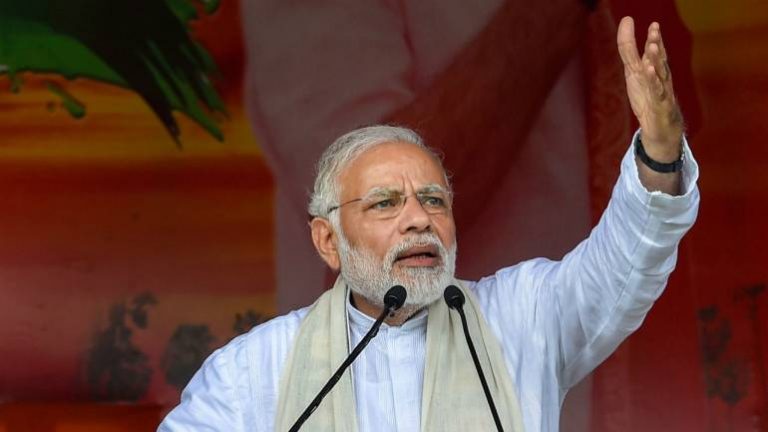
PM Modi while addressing the crowd of more than 12,000 delegates and office bearers on the second day of the National Convention at Ramlila Grounds in New Delhi mounted a blistering attack on Congress and the purported grand alliance-Mahagathbandhan. Modi alleged that the opposition has no vision and their only purpose of coming together is to defeat one man-Modi.
राजनीति विचारों पर की जाती है। गठबंधन विजन पर बनते हैं। लेकिन ये पहला अवसर हैं जब ये सब राजनीति दल सिर्फ एक व्यक्ति को हराने के लिए एकजुट हो रहे हैं : पीएम मोदी #NaMoAgainpic.twitter.com/QLbJA8N5Tk
Modi called into question the intention of the political parties forming the grand alliance. He termed the opportunistic grand alliance as an endeavour to deprive the country of strong governance provided by the BJP. Calling the entire Mahagathbandhan as a ruse to fool people, Modi said that those political parties who questioned Congress’ work-ethics are now forming an alliance to deceive the people of this country.
Modi also highlighted how this grand alliance seeks to form a helpless government in which rampant corruption will occur unabated, kickbacks will be received for defence deals, farmers will be swindled in the name of farm loan waivers and national security will be jeopardised.
वो मजबूर सरकार चाहते हैं ताकि रक्षा सौदों में दलाली खाई जा सके, हम मजबूत सरकार चाहते हैं जिससे देश की सेना की हर जरूरत को पूरा कर सकें। वो मजबूर सरकार चाहते है ताकि किसानों की कर्जमाफी में भी घोटाला कर सकें, हम मजबूत सरकार चाहते हैं जिससे देश का किसान सशक्त बनें : पीएम #NaMoAgainpic.twitter.com/QwFXsWhfm2
PM Modi also spoke about how Congress president Rahul Gandhi and other Congress leaders who are out on bail in the National Herald case signify the subversion of the system caused by Congress and its dynasty system. He proclaimed that Congress not only gobbles up public money but it expropriates government land as well.
Slamming Congress for casting aspersions on the integrity of government institutes like CBI, Election Commission, CVC, CAG, and Army, PM Modi claimed that Congress thinks only they are right, rest all organisations are wrong. Modi said that Congress leaders have faith in dynasty politics and not in the democracy.
जमानत पर बाहर घुमनें वाले इन नेताओं को न कानून पर विश्वास है, न सत्य पर भरोसा है, और न ही इनको संस्थानों पर विश्वास है। इनको राजशाही पर भरोसा है, लेकिन हम लोकशाही को मनाने वाले लोग हैं : पीएम मोदी #NaMoAgain
Regarding the Ram Mandir issue, PM Modi alleged that Congress is deploying its battery of lawyers to impede the justice. According to him, Congress is least interested in resolving the dispute and wants the dispute to carry on forever. On the chronic agrarian distress, Modi said that the Congress leadership fools the farmers by promising incentives such as farm loan waivers which never reaches them. Whereas his government has taken the necessary steps to alleviate farm distress and are committed to double farmers’ income by 2022.
In a reference to the alleged middleman Christian Michel, PM Modi said that his government has extradited the middleman for being involved in suspicious defence deals while the earlier regimes provided chartered planes to foreign middlemen to escape. Modi also zeroed in on Congress for Michel’s involvement in alleged parallel negotiations for Eurofighter to sabotage Rafale deal. Earlier he had questioned whether the Rafale deal did not go through during the UPA era because of the dealings with ‘Michel mama’.
Most prospective allies, including SP and BSP, dread Congress as a partner in the approaching 2019 General Elections. They know of the mauling of HD Kumaraswamy (JDS) by its partner Congress in Karnataka even though the faithful Lutyens’ Media are doing their best to keep the sensational news under the wraps.
None of the English mainstream media has taken note of the story which mentions Kumaraswamy almost “cried” while listing the ills of partner Congress recently. Only if this news was in “The Wire” or even little-known “Caravan” magazine, the English MSM would’ve fallen over each other in reserving the columns.
The report says Kumaraswamy has dropped enough hint that his Karnataka government may not last beyond the coming Lok Sabha elections.
Addressing his party’s MLAs and MLCs, Kumaraswamy was virtually in tears, alleging that he was functioning like a clerk and not like a chief minister because Congress is interfering in everything.
“He is sad. He almost cried. Told us that the Congress was behaving like a big brother. Forcing him to sign all kinds of orders. They forced him to expand the Cabinet and even appointed chairpersons to government-run boards and corporations without his approval. He feels that it is getting tougher with each passing day,” said an MLA who was present in the meeting.
Kumaraswamy apparently told his partymen that Congress leaders always expect him to behave like their subordinate. The JDS supremo and former Prime Minister HD Deve Gowda were present in the meeting.
The JDS is looking for 12 Lok Sabha seats in the 2019 elections while Congress is offering them just six which has led to serious friction in recent weeks.
JDS and Congress bitterly fought against each other in the Karnataka assembly elections of last year but joined hands in an opportunistic manner to keep BJP out of power. BJP had won 104 out of the 228 seats but Congress (80) and JDS (37) buried their hostility to form the government with Kumaraswamy as chief minister.
But no sooner had Kumaraswamy assumed his post, Congress began humiliating him in no uncertain manner. The English mainstream media meanwhile kept admonishing Kumaraswamy instead of questioning Congress on their arrogance.
All big players have watched the unfolding saga of betrayal in Karnataka and are hedging their bets against an alliance with the Congress.
Samajwadi Party (SP) and Bahujan Samajwadi Party (BSP) have decided to go together in the critical Uttar Pradesh and have turned their back on the old national party, now creaking under its own sloth and arrogance.
Mamata Banerjee didn’t even deign to congratulate Congress after its win in three assembly elections recently. She is carrying a personal hurt against Rahul Gandhi for ignoring her offer to contest the Tripura state assembly elections together. “I don’t know who advised him and influenced him,” Mamata had then said curtly.
Telangana chief minister K. Chandrashekhar Rao (KCR) is already firming up Federal Front which he plans to field in 2019 general elections. He is doing the rounds of the county, knocking at the doors of Odisha chief minister Naveen Patnaik and Delhi’s Arvind Kejriwal but apparently can’t stand Congress.
The arrogance of the Congress is sickening. Congress spokesperson Abhishek Sanghvi warns SP-BSP alliance that they ignore his party at their own risk in Uttar Pradesh. Congress leader Gaurav Gogoi chuckled at the “sleepless nights” of Mamata’s leaders in the wake of his party’s win in recent assembly elections.
There are cautionary voices within Congress, like the one of AK Antony, twice defence minister and thrice Kerala chief minister, who has openly stated that Congress is not strong enough to take on BJP in 2019 general elections. But the hubris of Congress knows no limits and it’s in-your-face arrogance is becoming difficult to ignore for the potential allies.
In his speech to party workers on the 2nd day of the National Convention of BJP held in the Ramlila grounds in New Delhi, PM Modi reiterated his government’s commitment of providing all-encompassing measures to address the lingering farm distress. Attacking Congress, Modi claimed that in the past who were invested with the power of resolving agrarian distress simply treated farmers as a ‘vote bank’ and allowed the problem to snowball into a national crisis.
PM Modi stressed that instead of ‘vote bank’, his government wants to empower farmers to become energy producers as well as grain producers.
जब हम किसानों की समस्या के समाधान की बात करते हैं तो पहले की सच्चाइयों को स्वीकार करना जरूरी है। पहले जिनके पास किसानों की समस्याओं का हल निकालने का जिम्मा था, उन्होंने शॉर्टकट निकाले, उन्होंने किसानों को सिर्फ मतदाता बना रखा।
हम अन्नदाता को ऊर्जादाता भी बनाना चाहते हैं : पीएम
Talking about his government’s initiatives to relieve farmers of the distress, PM Modi claimed that it was the BJP government which implemented recommendations of the Swaminathan Committee along with providing them with 1.5 times the MSP of the crops. Modi also asserted that because of his government’s formulated policies, prices of pulses which shot through the roof during the UPA regime are now under control.
PM Modi also said that the BJP government in last 4 years has bought 95 lakh MT of the farm produce in pulses and oilseeds whereas the UPA-II bought only 7 lakh MT of pulses and oilseeds from the farmers. He also added that their efforts to alleviate farmers’ distress will continue and by 2022 his government will work to ensure that the farm income is doubled.
यूपीए सरकार ने अपने आखिरी पांच साल में किसानों से 7 लाख मीट्रिक टन दलहन और तिलहन की खरीद की।
हमने बीते साढ़े चार साल में 95 लाख मीट्रिक टन उपज किसान से खरीदी।
Taking a jibe at Congress and its brand of dynasty politics, Modi alleged that all the schemes launched by his government such as Ayushhmann Bharat, Bharat Mala, Sagar Mala, Ujjawala Yojana aren’t named after him. He also declared that for him, the party is bigger than an individual and the nation comes above a political party.
Earlier, PM Modi had said how Congress party is fooling India’s farmers with farm loan waiver lollipop. PM Modi had also lambasted Congress claiming that it had offered a similar incentive of farm loan waiver during 2008 election campaign as well but it didn’t fulfill its promise then and it won’t fulfill it now.
Months ahead of the crucial Lok Sabha elections, Prime Minister Narendra Modi has sounded the poll bugle by slamming the opposition parties, especially Congress party for their alleged role in dubious defence deals as he referred to middleman Christian Michel’s alleged attempts to scuttle Rafale deal to favour Eurofighter.
While addressing the second day of the BJP National Convention at Ramlila Maidan, Prime Minister Narendra Modi went on to attack Congress party and its president Rahul Gandhi for deliberately creating controversies to scuttle to defence deals and attempting to jeopardise the national security.
Referring to the extradition of fugitive Christian Michel to India, PM Modi said that the government has arrested the middleman for involving in dubious defence deals while earlier there were planes stationed for foreign middlemen to escape the country.
“Chowkidar rukne wala nahi hai….Abhi yeh shuruwat hui hai. Chowkidar ek ko bhi chhorne wala nahi hai (This guard is never going to stop. What has begun is just a tip of the iceberg. This guard will not spare a single wrongdoer on corruption – either in India and overseas),” the Prime Minister said addressing the BJP National Convention.
Interestingly, PM Modi dropped the ‘Michel’ bomb by saying that the middleman was not only involved in Helicopter deal (AgustaWestland scam) but also he was lobbying for a fighter aircraft deal, in an apparent reference to the reports of Christian Michel’s lobbying for Eurofighter against the French Rafale.
PM Modi also targetted Congress Party by saying that it was in a hurry to protect the middleman fearing that he may disclose details regarding his involvement in various defence deals. The fighter aircraft deal (Rafale) under UPA could not take place because this middleman (Christian Michel) was negotiating for another manufacturer, said PM Modi.
“Dheere dheere se parda khool raha hai (Slowly, everything is becoming clear),” Prime Minister said in reference to media reports that Michel was lobbying for Eurofighter over Rafale.
This is the second time that Prime Minister Narendra Modi is bringing the reference of Christian Michel to target the Congress party. Earlier he had questioned whether the Rafale deal did not go through during the UPA era because of the dealings with ‘Michel mama’.
Recently, the Finance Minister had hinted that while the bidding process for the MMRCA was going on during the UPA government, a parallel backroom deal was going on with Eurofighter for probable bribes. Rafale and Eurofighter Typhoon had entered the final round of bidding, among the initial 6 contenders, but eventually, Rafale was selected in 2012 on technical parameters.
The United States of America’s first Hindu House representative, Tulsi Gabbard, has announced her campaign for the Presidency in 2020. She is the first US member of Congress to have taken her oath on the Bhagavad Gita.
When we stand together, united by our love for each other and for our country, there is no challenge we cannot overcome. Will you join me? #TULSI2020https://t.co/bymLSiaRkF
Gabbard has an interesting profile that could pose her at odds with much of the Democratic voter base. She is not as averse to President Donald Trump-like other leaders of her party. She is anti-interventionist, emphasizes bipartisanship and was not depressed when Trump defeated Hillary Clinton like much of her voter-base.
Another aspect of her personality that is expected to come under close inspection is her Hindu identity and her warm relationship with and opinions of Prime Minister Narendra Modi. During her visit to India, she had gifted Narendra Modi her personal copy of the Bhagavad Gita.
“It is said that the greatest gift you can give someone is that which is of the greatest value to you because it is a personal sacrifice to give up something which is very dear to you. So my presenting of my personal Bhagavad Gita to the Prime Minister was my way of expressing just how deep my affection and love is for India, for the Prime Minister, and for the people of India who he represents,” she had stated in her Facebook post in September 2014.
Gabbard had vocally opposed the US government’s decision to deny Narendra Modi a VISA following the 2002 Gujarat riots in which Modi was accused by opposition parties of personal involvement. She had called it a “great blunder”.
In November 2013, she opposed a House resolution that demanded “religious freedom and related human rights to be included in the United States-India Strategic Dialogue and for such issues to be raised directly with federal and state Indian government officials.” She said it would hamper the relationship between the two countries.
Gabbard condemned the resolution, saying the “417 weakens, rather than strengthens, the friendship between the United States and India. The resolution runs counter to all the hard work that the American people, particularly those in the Indian American community, have done to improve the relationship.” “Throughout history, India as a nation has been home to many religions, and has protected many as well, including Tibetan Buddhists, Jews, Christians, and Muslims,” she added in a statement.
The Hindu Congresswoman has also not shied away from using the term ‘Islamic Terrorism’. She had lambasted the Obama administration’s refusal to use the term. In one interview, she stated, “the vast majority of terrorist attacks conducted around the world for over the last decade have been conducted by groups who are fueled by this radical Islamic ideology.” She has repeatedly insisted that refusing to use the term “Islamic Terrorism” scuttles the ability to deal with the issue effectively.
Despite her Hindu background from a mixed-race family, Gabbard is a paradox in the Democratic party. Her stance on several issues also have changed over the years. Although she is now pro-same-sex marriage, she had resolutely campaigned against it in the past. In her faith, she belongs to the Bhaktivedanta school of thought popularized by Swami Prabhupada who, in the increasingly liberal American society, popularized an ultra-conservative movement.
Gabbard’s stance on Pakistan will also be music to the ears of Indians. “People within the Pakistani government continue to provide tacit and overt support for terrorism. This is not new – this pattern of attacks has been occurring now for the past 15 years, and it must end. That’s why I’ve continued working in Congress to cut back US assistance for Pakistan and increase pressure on Pakistan to stop this violence. In the past, the US government took steps to increase pressure on Pakistan, and it’s time to revisit that approach,” she said in a statement.
The first Hindu to run for President, Gabbard has regularly defended India against elements in the States who accuse our country of religious bigotry while excusing the real bigotry displayed by Islamic countries. She spoke about India, “To my knowledge, [discrimination against Muslims] does not exist in India. If India were to enact government policies that punish their citizens simply for being a ‘minority religion,’ I would condemn that.” She said this was in contrast with countries like Pakistan, Saudi Arabia and Iran where it is government policy to discriminate against people of other faiths.
All in all, Gabbard has the necessary identity to appeal to the Democratic voter base. She is a woman, she belongs to a religious minority, she is of mixed African descent and is symbolic of the ‘women power’ that the Democrats endorse. Other things that go in her favour is her charming personality and the genuine success that she has achieved during her long political journey that began when she 21 years old.
Her detractors would focus on her close ties to Hindus and her favourable opinion of Narendra Modi and the Bharatiya Janata Party. In fact, Ram Madhav from the BJP had even attended her marriage ceremony which was conducted as per Vedic rites. She also has close ties with Hindu American Foundation the critics of which accuse it of peddling the ‘Hindu Nationalist’ agenda. Her bipartisan attitude in an era where the Democrats have become increasingly partisan may also dampen her chances. And especially, her refusal to publicly denounce Trump may work against her even though she has severely criticized the POTUS when his policy did not align with her views.
Could it be that the first Woman to be the President of the United States also be the country’s first Hindu President? Only time will tell.
An 18-year-old girl who left her family about nine months ago to marry a man of her choice has returned to her home in Barmer. The girl had alleged that her husband, a resident of Jammu and Kashmir’s Srinagar, forced her to eat cow meat and read namaz.
The young woman had also alleged that Gulzar, a resident of Jammu Kashmiri who worked in a café in Barmer, was blackmailing her with an edited photo. When he called her to Jammu and Kashmir, she went there out of the fear. There he intimidated her and forged false documents of marriage. He also pressurized her to eat beef, and to pray namaz. The victim claimed that other members of his family too had expressed lustful intentions towards her.
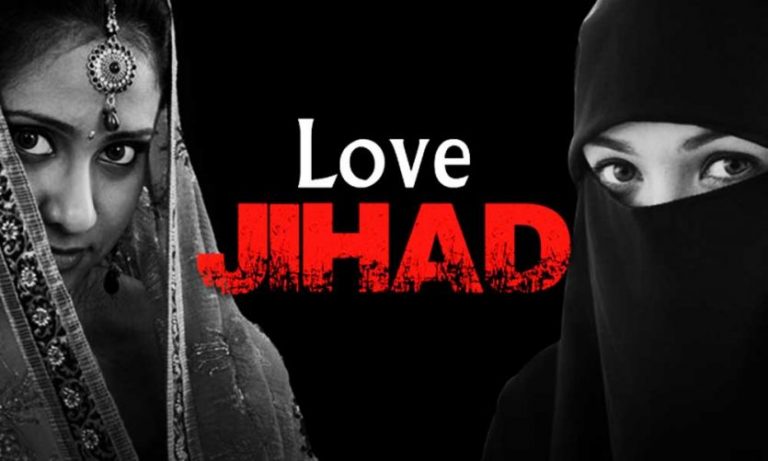
As per the girl’s complaint, she got the wind of how Gulzar and his brother were preparing to sell her in Dubai, she ran away from Srinagar and came to Barmer. After this incident, the victim’s family has now demanded protection from the police while describing a threat to their life. The family has levelled a serious charge of ‘Love Jihad’ against the perpetrator. Days after she heard Gulzar and his brother Iqbal talking about selling her to Dubai, she stole some money from Gulzar’s wallet and booked a flight ticket to Ahmedabad. After landing in Ahmedabad, she called her relatives in Barmer and described her ordeal to them.
The girl went missing from Barmer on March 16, 2018, while she was on her way from Barmer to Vadodara on a bus. She alighted the bus in Ahmedabad and took a connecting flight to Srinagar via Delhi. The family had also accused Gulzar of kidnapping their daughter and pressuring her to convert into Islam.
A case has been registered in Kotwali police station. Gulzar, on the other hand, had claimed that he has married the girl with her consent and has furnished a video uploaded by him on Facebook corroborating it. After this, the girl’s father filed a petition in the High Court challenging the veracity of the video and documents furnished by Gulzar. According to the father of the victim, the dates on which the marriage documents have been issued, the girl was in Barmer and Vadodara. The girl has also claimed that the video uploaded by Gulzar was shot under coercion and was edited at least 20 times.
Today is their day. The much-anticipated press conference of Mayawati and Akhilesh Yadav sitting side by side. Promising that their big alliance will unseat Modi by denying him Uttar Pradesh.
We’ll see.
There is a moment of clarity here for every Indian. Remember our intellectual class? Our liberals? The ones who pretend they want to ask the big questions: about freedom of expression, about poverty, about social justice, about the environment. They are the ones who are celebrating today what they think is a victory over Modi.
What kind of politics do Akhilesh Yadav and Mayawati represent? On one side, an ex-Chief Minister who rose to power as a privileged dynast. He lived it largely on public money while his term lasted. When he was voted out, he took with him even the tap fittings from the bungalow that the people of Uttar Pradesh had given him. On the other side, another ex-CM who built statues of herself all over the state. With public money. Who wears thick garlands made of bundles of cash.
But liberals will applaud this. They will applaud anything as long as an opponent of Modi is doing it.
What else can our liberals applaud? Let me show you. Here is Akhilesh Yadav interviewed by Ravish Kumar at NDTV Yuva Conclave from 2018.
Akhilesh: The controversy that you are talking about, that a mail came out, I said to that man yesterday that it is my fault that I did not file an FIR and send you to jail.
NDTV Yuva Conclave audience : (Applause.)
Ravish Kumar: You will send people to jail now, you will also do what others do?
Look at fearless reporter Ravish as he challenges Akhilesh Yadav on the matter of sending a critic to jail. Gently scolding him. And even in his scolding, Ravish inserts ‘whataboutism’ by asking Akhilesh is he will “also do what others do”.
Meanwhile, NDTV Yuva Conclave audience is applauding at the prospect of youth icon Akhilesh sending a dissenter to jail.
Wait, this is going to get a lot worse. Akhilesh is going to say much worse stuff and the applause from the NDTV Yuva Conclave audience is only going to get louder. Let’s continue.
Akhilesh: I called a big journalist from Delhi to Lucknow. I told him ‘You have taken the money and referred to me as Aurangazeb in your writings. I am ready to pay you twice as much, you should have told me.’
Nice! Akhilesh Yadav boasts openly that he is ready to bribe journalists. Honest journalist Ravish Kumar, who is sitting right in front of him and holding a mike, is barely audible.
Of course. Let’s go on.
Akhilesh: But I let that man also go. This is the mistake I made. I should have also pulled out a sword like Aurangazeb and killed the man on the spot.
NDTV Yuva Conclave Audience: Massive round of applause.
Yes, massive applause for an ex-CM saying he should have pulled out a sword and murdered a critic!
Thankfully, Ravish Kumar, somewhat embarrassed, meddles at this point.
Ravish: You are talking of violence now.
NDTV Yuva Conclave Audience: (Applause for Akhilesh Yadav continues)
Ravish: (repeating) You are talking of violence. How can you talk like this?
I’ll tell you Ravish why Akhilesh has the courage to talk like this. Because the NDTV Yuva Conclave audience is applauding him and egging him on. And because he knows he has the license of “secularism” to say whatever he wants.
If ever there was a time for blackening the screen, for shutting down the broadcast immediately, this would have been it. But Akhilesh Yadav knew that Ravish would never do that. That’s why he was talking like this.
Can you believe it still goes on? And gets worse?
Akhilesh: I am speaking out of anger because somebody compared me to Aurangazeb!! And I told that man… I will tell you his name someday if you ask me in private … aur … (inaudible).
NDTV Yuva Conclave audience : (Laughter then applause)
Even Ravish was smiling. The audience was laughing. To them, this context is really really funny. Believe it or not. They just can’t stop laughing and applauding. Remember Akhilesh just spoke of killing a person!
Ravish: But please don’t talk about killing somebody.
Very well Ravish. Thanks for the sage advice. I will remember your big smile right before you said this.
If you watch Ravish Kumar’s show, you will think he hasn’t smiled in five years. All because of internet trolls who post insulting comments about him. But for Akhilesh Yadav’s words, he smiles, before gently reprimanding him.
Who cares about dissent? Who cares about free speech? What about intolerance?
Imagine if Modi had spoken like this. About people who have compared him to Aurangazeb and Hitler and much worse. Or for that matter, if any BJP leader or any family member of any BJP leader or any business partner of any family member of any BJP leader had spoken like this. It would have been news for days. It would have been in international media as well, raising alarm over growing “intolerance” in India.
But for Akhilesh Yadav they applaud.
In this laughter and applause from the NDTV Yuva Conclave audience lies the key to understanding Indian secularism and Indian liberalism. That there is really no such thing. Only some self-interested partisans who use these high sounding words to justify their politics. And to grovel before a Dynasty.
One of the biggest ironies of the manufactured debate on the pricing of Rafale deal is that no one from Indian English mainstream media (MSM) has tried to do a dispassionate analysis and present a complete picture. This is not to say that they’ve not presented data or analysis on the subject. However, what has happened is that either part numbers or analysis has been done or number has been presented in a manner so as to further a point-of-view and a certain agenda. But for the gravity of the subject, it is almost comic that these disparate numbers when looked at together, do give a fairly accurate picture.
In this analysis, I use publicly available data, shared by various newspapers and reporters at a different point in time, to present a comparison between the old and new Rafale deal. Considering that the old deal had 18 Rafale aircraft in flyaway condition and the new one includes all 36 aircraft in a flyaway condition, the price comparison is between these two sets.
Unless required, I have stuck with Euro or Dollar figures. The problem with using Rupee figures is the exchange rate issue. Wherever the sources used in the report have used Euro and Rupee figure using a certain exchange rate, both have been shared as such.
Data Point 1: Fantasy Deal Size – $ 10.4 billion
When the Medium Multi-role Combat Aircraft (MMRCA) deal was announced, for some reason, the deal size was expected to be $ 10.4 Billion. If I assume the average Euro/Dollar exchange rate for 2007 (0.7), this deal comes out to be Euro 7.6 Billion.
Considering 126 aircraft order, this works out to be Euro 60.3 Million per aircraft. Or, $82.5 Million per aircraft. As analysis later-on will show, this is an absolutely absurd number for a full deal covering the unit cost, weapons, logistics, maintenance and other heads.
When we compare this value with what was the winning bid (~Euro 20 Billion; more on this later), we realize how grossly unprepared Ministry of Defence (MOD) under UPA-1 and UPA-2 was for this deal.
Simply because if the actual expenditure is going to be more than 2X of your estimate, how are you going to properly budget and pay for the deal?
Is it any wonder that then Raksha Mantri under UPA-2 had said in February 2014 that UPA-2 did not have money that year for the deal [1]? And that it will have to go into the next financial year?
Data Point 2: The French Connection
While undertaking an internal review of the whole Rafale program, the French Senate in 2013-2014 presented detailed break-up of the costs involved (at 2013 prices).
The total Program Cost has been divided into two broad categories:
Development Cost – The money spent on Research & Development of the program and to bring the aircraft to a level at which it can be inducted into the French Air Force/French Navy
Unit Flyaway Cost – The cost of producing a single unit of each type of Rafale aircraft without considering the weapons, logistics, maintenance and other add-ons. Just the plain Rafale fighter.
Key numbers from the French Senate report are as follows:
Total program cost: Euro 45.9 Billion
Total Flyaway Cost for 286 planned jets: Euro 20.8 Billion (refer to the table above)
Average per unit flyaway cost: Euro 72.9 Million
Total Development Cost (1-2): Euro 25.1 Billion
Average per unit development cost: Euro 87.6 Million
Average total cost (flyaway + development) per unit: Euro 160.5 Million
There are three major takeaways from the above numbers:
Per unit flyaway cost mentioned above is the lowest which the vendor (Dassault) was giving and this is available only to the French Air Force and French Navy. The same type of Rafale being sold to any other country would be more expensive than the deal available to French armed forces.
The development cost per unit is 20% higher than per unit flyaway cost. This is because the development cost is spread across a smaller number of aircraft which were planned to be inducted into the French armed forces. This tells you why French defence equipment, as compared to the US, are more generally more expensive.
A part of the above development cost can be expected to be loaded onto the price of Rafale being exported to countries like Egypt, Qatar and India.
One more point – Assuming India was to get 126 fighters at an average flyaway cost per unit of Euro 72.9 Million. The total cost for only the aircraft would’ve been Euro 9.2 Billion. This is 21% higher than the initial estimated price of Euro 7.6 Billion for the whole deal (aircraft, weapons, maintenance, logistic, support) in 2007.
Shows how far off the mark initial estimates were!
Data Point 3: The Escalation Clause
The present government has claimed that the flyaway cost of the Rafale jet in 2015 is 9% cheaper than the flyaway cost of Rafale mentioned in 2007 RFP. How could this be?
In a news report written by Sushant Singh [2] in The Indian Express and dated 1st March 2018, the following explanation was given for this by government ‘sources’:
The per unit flyaway cost of Rafale fighter in 2007 bid, which was opened in 2011, was Euro 79 Million.
It further adds and I quote:
“As per the in-built escalation formula, the 2007 bid for each of the 18 Rafale would have amounted in 2015 to Euro 100.85 million (Rs 765.4 crore at 2015 exchange rate of 1 Euro = Rs 75.90), sources said. Similarly, the 2007 bid price for every Eurofighter would in 2015 have worked out to be Euro 102.85 million, higher than that of the Rafale.
In comparison, the price of each of the “bare” 36 Rafale bought in 2016 was Euro 91.7 million (Rs 696 crore at the 2015 exchange rate), lower than both the earlier Rafale and Eurofighter bids”
Looking at the figures given above, it can be surmised that the 2007 bid price increased at the rate of 3.1% per annum (compounding).
Another reference to this escalation clause can be found in an interview by Finance Minister Arun Jaitley to rediff.com on 29th August 2018 [3]. While the finance minister does not mention the exact price and escalation percentage, he gives clear indication that such a mechanism existed and how it worked.
I quote the relevant parts of the answers given by him.
(a) Exhibit 1:
Arun Jaitley:
The basic price was, let us say X.
The basic price X had an escalation clause that till such day each aircraft is delivered, the price will keep escalating.
If in 2012 they had come to an agreement, the first would have been delivered in 2017.
From 2007 to 2017 the escalations would have gone up, along with a foreign exchange variation.
So there is India specific add-ons and the foreign exchange variants.
Let us first see the basic price of the aircraft without add-ons.
Is the Congress party aware that if you take the 2007 L1 offer and the escalation clause without the add-ons, the price negotiated in 2015-16 is cheaper?
How did this arise?
Point (7) mentioned above is exactly the methodology mentioned in the report by Sushant Singh in The Indian Express, which has been quoted earlier.
(b) Exhibit 2:
Interviewer– The price that the NDA government negotiated is cheaper than the 2007 one with escalations. How can that be possible?
Arun Jaitley: That is factually correct. I am making an assertion.
Interviewer– Even an apple costs more than what it did six years ago.
Arun Jaitley:
To the apple, you add the escalation.
So 2007 price, plus, let us assume this contract is signed in 2016.
From 2005 to 2016, take the basic price, the escalation and the foreign exchange cost.
In 2015, the Indian prime minister and French president agreed that you will have 36 fully-loaded aircraft being given to India.
They will not be manufactured in India, and these will be given on terms cheaper than the 2007 terms, better terms.
I am asking a basic question, you can take the simple aircraft and the fully loaded aircraft.
The 2007 offer had both.
What was negotiated from 2015 to 2016 and finally executed in 2016, with the escalation and the currency variations, the basic aircraft price turns out to be 9 per cent cheaper.
During the recent debate in the parliament on the Rafale deal, the Finance Minister had repeated this very argument again. In addition, the Finance Minister also stated that the loaded/weaponized aircraft was 20% cheaper in the new deal when compared to the escalated price of 2007 winning bid.
To summarize –
The flyaway cost in 2007 Dassault for Rafale was – Euro 79 Million (this is an important figure and we’ll return to it again)
Per annum escalation in fly-away cost – 3.1%
2015 escalated value of 2007 flyaway cost – Euro 100.85 Million
The flyaway cost in 2015 deal – Euro 91.7 Million.
By benchmarking the 2015 deal flyaway cost with 2007 cost (after factoring into account escalation), the government is claiming 9% saving.
Weaponized aircraft in 2015 deal is 20% cheaper when compared with the escalated cost of 2007 winning bid.
Data Point 4: The New Deal
While the government has refused to give the exact break-up of the Rafale deal citing security reasons, the broad price break-up of the deal has been in the public domain. And has been shared by many journalists.
Writing in Business Standard, dated 27th November 2017, Ajai Shukla had presented a break-up of the Rafale deal. I below reproduce the price break-up table from his blog [4]. For presentation purpose, I’ve modified the format a bit:
From the above figures, the weighted average flyaway cost of 36 aircraft comes out to Euro 91.7 Million.
This is the same figure mentioned in the report carried in the Indian Express mentioned earlier. Hence, we’ve corroboration of this figure from multiple sources.
Further, if we consider the cost of fighters, India specific enhancements and weapon systems, we find that per aircraft value comes out to be Euro 158.4 million.
Per aircraft deal for the entire contract comes out to Euro 218 million.
Data Point 5: The Old Deal!
The entire debate has been around what the Congress claims the price was as per the old bid, price as per the new deal and how Narendra Modi government has grossly overpaid for the aircraft. This argument, taken to its logical conclusion, insists there is corruption in the deal.
Now, common sense would tell you that since UPA-2 government never managed to close a deal, there is no benchmark price available to undertake apple-to-apple comparison. However, common sense seems to have been the first casualty in this politically manufactured, and patently wrong and absurd, controversy.
However, that has not prevented resourceful journalist like Ajai Shukla to first, get hold of details of the winning bid by Dassault and using that as a benchmark for the price obtained in 2015 deal.
I again quote Ajai Shukla from his blog entry dated 9th November 2018 (this piece also appeared in Business Standard) [5]:
“Two senior defense ministry officials who were directly involved in contract negotiations with Dassault from 2012 onward, have revealed to Business Standard that Dassault’s winning bid amounted to Euro 19.5 billion for 126 Rafale fighters.
The Euro 19.5 billion quote averaged out to Euro 155 million per aircraft.
In comparison to that Euro 155 million average cost per Rafale, the National Democratic Alliance (NDA) government’s September 2016 purchase of 36 Rafale fighters for Euro 7.8 billion works out to Euro 217 million per Rafale – exactly 40 per cent higher than Dassault’s 2012 quote.
It is not clear how the NDA government – including Defense Minister Nirmala Sitharaman and Finance Minister Arun Jaitley, backed by senior IAF officials – has claimed that the 36-Rafale contract with Dassault in 2016 cost the IAF nine-20 per cent less than Dassault’s 126 Rafale offer”
From the above report:
Dassault’s winning bid in 2007: Euro 19.5 billion
Per Plane (for 126 planes): Euro 155 million
If we use Euro 79 Mn as per unit Flyaway Cost (from Indian Express Report), we get total Flyaway Cost for 126 planes – Euro 9.95 billion
Balance Cost (for services, maintenance, weapons, other add-ons) – Euro 9.5 billion
Balance Cost/Aircraft – Euro 75.8 million
Ajai Shukla uses the overall per unit number (Euro 155 million) to compare with the overall per unit cost of the new deal.
For some reason, Ajai Shukla does not mention the escalation clause which we’ve come across earlier. As we’ll see later, this escalation has a massive impact on the actual pricing and benchmarking the two deals.
The article goes on to make other assertions as well. Which in my considered opinion are quite ludicrous. But we won’t be going into them in this article.
Summarizing the Numbers
First, let’s summarize the key figures which we’ve come across so far. I’ll use them to undertake a detailed analysis later on.
Analysis
The most important takeaway from the Indian Express report, interview of Arun Jaitley and recent parliamentary debate are that there was an escalation clause in the winning bid submitted by Dassault in 2007. Because of this winning bid, the basic flyaway cost of an aircraft rose from Euro 79 million in 2007 to Euro 100.85 million in 2015. Working backwards, the escalation comes out to 3.1% per annum.
Escalation in flyaway cost
Does the escalation apply to only flyaway cost?
Considering the figures at hand, the 2007 winning bid numbers can be divided into two broad categories – Flyaway Cost /aircraft and Balance Cost/Aircraft.
We’ve already applied the price escalation to Flyaway Cost/aircraft. What about the price escalation for the balance part? Does it apply to the other components of tender?
The balance component of the 2007 bid would’ve consisted of ammunition, spare parts, logistics, training and other paraphernalia. Common-sense tells you that the price of all these items will also see an escalation. Just like the cost of producing a new aircraft would increase over time, cost of producing ammunition and spare parts would also increase.
And there is enough precedence within India of price increase in defence contracts with time being the deciding factor. For example, when India first envisaged interest in the US made M-777 ultra-lightweight howitzers, the same were offered in 2010 at $647 million. However, the deal could not go through because of myriad reasons. When the deal was revived in 2013, the price had increased to $885 million. However, the deal was not concluded by the UPA-2 government. After the NDA-2 government came in 2014, it revived the negotiations and concluded the deal in 2016 at $ 750 million.
Therefore, if we apply the same escalation per annum, 3.1%, to the overall 2007 Dassault bid, we have the following increase till 2015:
The escalation in overall 2007 deal for 18 aircraft to be made in France
The per unit flyaway cost increases from Euro 79 million in 2007 to Euro 100.9 million in 2015
The per unit balance cost increases from Euro 75.8 million in 2007 to Euro 96.7 million in 2015
The overall per unit cost increases from Euro 154.8 million in 2007 to 197.6 in 2015
Price Benchmarking
While the government has already claimed and proven that the flyaway cost in 2015 is 9% cheaper than 2007 cost, we also compare the overall per unit cost between these periods.
The overall per unit cost in 2015 deal is Euro 218.1 million
This is only 10.2% higher than the overall price per unit of 2007 deal. And not 40% as claimed in the report by Ajai Shukla.
Another important aspect is the comparison of price break-up between the two deals. The following graphs show the same.
What we see is that in the new tender, a larger percentage of money has been committed towards India specific enhancements, spare parts, ammunition and logistics support.
High upfront investment in spares and logistics support means better sustenance and operations of the Rafale fleet by the IAF.
Especially on PBL (Performance-Based Logistic front), the current deal has a better provision as compared to the earlier deal. To quote the Indian Express article mentioned earlier:
“The IAF told us that because we were buying only 36 Rafale and not 126, they needed them to be more potent. Meteor missiles, 75 per cent serviceability and some special requirements were insisted upon by the IAF.
It even asked for two separate maintenance support flights for redundancy. These imposed additional costs which were not even thought of in 2011. They are two separate packages,”government sources said.
While in the earlier deal, the high flyaway cost meant that the balance component of the deal was compromised to some extent.
However, as we shall see in the subsequent section, the biggest benefit is that we’re getting a fighter aircraft with enhanced features.
So, why does the new deal cost a bit more? Because we’re getting the F3R standard Rafale!
Simply because we’re getting a better plane with more potent systems, capabilities and weapon suite.
While the government has claimed that the two aircraft in both the deals are same, this statement is both true and false.
It’s true because the baseline aircraft is the same while the reality is that we’re getting the F3_R standard aeroplane. Compared to this, the earlier deal involved F3 standard aeroplane.
So, what does F3R standard involve? In the words of Dassault [6]–
In January 2014, the F3R standard development contract for the Rafale combat aircraft was announced. The F3R standard is an evolution of the Rafale “F3” standard. It is part of the on-going process to continuously improve the aircraft in line with operational requirements. It will enable Dassault Aviation to integrate the following equipment and weapons onto the Rafale:
The European Meteor long-range air-to-air missile produced by MBDA. This high-performance missile will achieve maximum effectiveness thanks to the “active array” radar which equips all production Rafale aircraft delivered since mid-2013. The first guided firing of a Meteor was conducted from a Rafale in April 2015. Qualification firing was performed in April 2017, paving the way to service entry.
The Thales Talios new-generation targeting and laser designator pod. Primarily used for air-to-ground strikes, in daylight or darkness, this pod will further enhance the high degree of precision that the Rafale has achieved since its first engagements (in 2007 in the Afghan theater).
F3R also includes upgrades to Rafale sensors and to systems ensuring total interoperability.
A November 13, 2018 report by Janes [7] says this about the F3R upgrade:
The Direction Générale de l’Armement (DGA), the French procurement agency, on 9 November announced that it had qualified the new-generation F3R standard for the Rafale combat aircraft on 31 October, in line with the January 2014 contract awarded to Dassault Aviation, Thales, MBDA, and Safran.
Earlier in October, the DGA launched the F3R upgrade for all 144 Rafales in service. The first 10 Rafale F3Rs, four of which will be delivered by the end of 2018, will be used by the French Air Force and French Navy to fine-tune the upgrade, as already begun by DGA testing teams.
Like previous versions, the F3R involves major software and hardware upgrades, according to the DGA. The agency said two new capabilities would “change the game”in combat aviation: the use of the MBDA Meteor beyond-visual-range air-to-air missile together with the Thales RBE2 electronic scanned array (AESA) radar, and the Thales TALIOS long-range airborne targeting pod improves target detection, reconnaissance, and identification, day and night, for high-precision air-to-ground strikes.
France had committed Euro 1 billion for R&D towards F3R standard in 2014; at the time of writing this article, the French Navy had received its first Rafale jet upgraded to F3R standard.
Basically, we’re a getting a much more evolved fighter aircraft at a marginally increased overall cost as compared to the earlier deal.
It is important to note that had a deal been signed with Dassault basis 2007 RFP (when we were getting F3 standard Rafale), India would’ve had to pay over and above the bid to upgrade its aircraft to F3R standard.
And just how capable and potent is the METEOR air-to-air missile? As Shiv Aroor wrote on his website [8]
India’s Rafales will operate the MeteorBVRAAM, which enters service with the French Air Force soon. France’s Direction Générale de l’Armement (DGA) announced two weeks ago that a final live guided firing of the Meteor from a Rafale had been successfully conducted at the Biscarrosse missile test range near Bordeaux in southwest France.
In twin loadouts with the SCALP cruise missile that India has opted for, the two weapons give the IAF an unprecedented stand off air-to-air and air-to-surface capability in conflicts on either front with Pakistan and China.
The timing of Rafale deliveries to India is such that the Meteor will be concurrently operational with both the French and Indian air forces.
Rafale with Meteor AAM and Scalp Air-to-ground missileRafale firing a Meteor air-to-missile
Meteor missile is today the most potent medium-range air-to-air missile. Given the capability, it is also a very expensive missile as compared to other medium-range air-to-air missiles
Conclusion
The data available in the public domain clearly shows the present deal represents a beneficial deal for the country and the Indian Air Force. A dispassionate analysis brings forth the fact that we’re getting a more capable fighter aircraft at a very competitive price.
However, with narrow political interests guiding the discourse on the subject, by both political parties and many ‘analysts’, the true picture has got lost. And deliberate misinformation is being peddled.
I hope this article can dispel some of the myths surrounding the deal, counter the misinformation and present a more complete picture.
After Supreme court gave a nod to National Green Tribunal’s decision to reopen the copper smelting plant in Tuticorin, Vedanta group has announced welfare projects worth Rs 100 crore for the residents of the district. This scheme was also promised by Sterlite to the panel of NGT hearing the pleas for reopening of the plant. According to reports, the welfare schemes will be rolled out in the district in the span of the next 3 years.
According to reports, the announcement was made in an event organized by Sterlite plant’s stakeholders and local residents. There are 6 projects that will be undertaken during the rollout scheme.
The scheme includes a multi-specialty hospital, equipped with 100 beds, operation theatre, a maternity ward and also a child care facility. It will reportedly benefit around 1.5 lakh people in need of medical facilities. In addition to this, an announcement has been made that group will also be opening a school for around 1500 students.
A desalination plant will be installed to meet civil and industrial, needs. Vedanta group has also announced that, in order to boost women empowerment, it will launch a scheme for 5000 women, and provide them with microcredit and also help in enhancing skills. In addition to all of this, Sterlite plant has announced a ‘Green Tuticorin’ initiative, under which 10 lakh saplings will be planted in the district.
At an event organised by Sterlite Copper, the group asserted that so far, they have contributed around Rs 564 crore under Corporate Social Responsibility (CSR). Vice-President of Sterlite Copper D. Dhanavel has said that some projects will take more time than others. But he has assured that school and hospital will be ready in next 12 months. Dhananvel also said that welfare schemes have been made in accordance with the opinions revied by local residents.
Earlier this month, Supreme Court had refused to stay The National Green Tribunal’s order and had set aside the plea of state government against reopening of the plant. The Sterlite plant was accused by NGOs and pressure groups of contaminating the local environment by discharging various harmful waste, an allegation that the company claimed was baseless. In May 2018, 12 protestors had died in police firing when the protests had turned violent.
This had promoted Tamil Nadu’s AIADMK government to permanently ban the copper plant. However, the order was reversed by NGT’s order, which said that the Vedanta group was denied proper time to defend the case.