At an IIT Madras event on Monday which was attended by Union Minister Nitin Gadkari and Union Minister of State Pon Radhakrishnan, the IIT students sang a Sanskrit song Maha Ganapathim, by late poet Muthuswami Dikshithar. This song was sung at the start of a foundation stone laying ceremony for setting up of a National Technology Centre for Ports, Waterways and Coasts, at the institute.
This act of singing a Sanskrit song though has angered various Tamil Nadu politicians, who called it a Sanskrit and Hindi imposition. DMK’s working president MK Stalin asked the centre to stop infringing upon the cultural identity of Tamils and Tamil Nadu. He also questioned why Tamizhthai Vazthu the Tamil anthem was not played. To take things a step further he called the act of singing a Sanskrit song as a “deliberate bid to sideline Tamil in the centrally-funded secular institute of higher learning”.
CPI(M)’s state secretary K Balakrishnan too condemned this act and called it another form of imposing Hindi and Sanskrit. PMK leader S Ramadoss in light if the matter has decided to demand that the Tamil anthem is made mandatory at all functions in IIT Madras. MDMK leader Vaiko alleged that “they” are trying to destroy all languages and cultures, and are imposing their idea of Hindi and Hindu Rashtra”.
While the shrill outcry of Tamil politicians was in full flow, IIT Madras’s director Ramamurthy came out to publicly defend the student’s actions. He stated that being an engineering college they don’t have any trained music team and generally ask students to voluntarily sing the invocation songs.
Hence had Tamil students sung the song it would have been in Tamil, and so on had the students been from Maharashtra or Bengal. There is no set instruction from either the institute or the authorities regarding which song should be sung.
As a result of this statement by the IIT director, it can be inferred that unlike the allegations by the Tamil politicians, there was no conscious effort to “impose” Sanskrit at the cost of Tamil, and the song was merely a choice of the students.
Even though IIT Madras is a very premier and exclusive institute to impart technical education, it has in recent days started to be infested with local and parochial politics.
The institute was riddled with the whole beef debate back in May 2017 when members of Ambedkar Periyar Study Circle were known to have organised a beef festival, which resulted in a controversy.
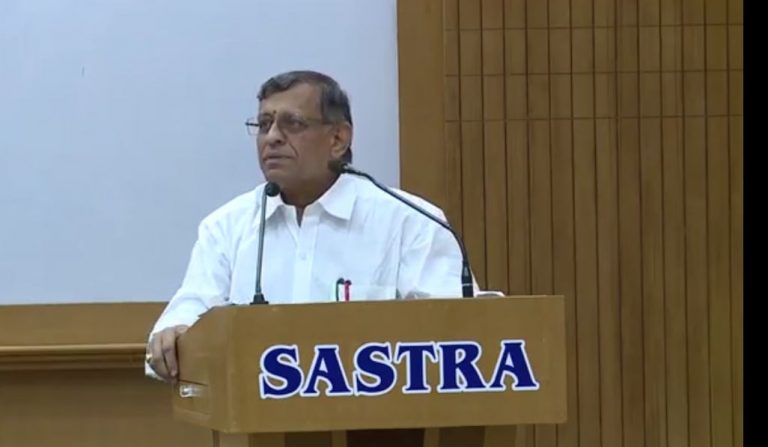
While delivering the second Cho S. Ramaswamy memorial lecture at the Sastra University, the well-known economist and thinker, S Gurumurthy outlined the theme of his talk with this quote.
“It is already becoming clear that a chapter which had a Western beginning will have to have an Indian ending if it is not to end in self-destruction of the human race. At this supremely dangerous moment in human history, the only way of salvation is the ancient Hindu way. Here we have the attitude and spirit that can make it possible for the human race to grow together into a single family”
Arnold Toynbee, British historian
Mr Gurumurthy was talking about the topic ‘World and India 4.0′ wherein he traced the history of the world, India and the dominant philosophical ideas that have shaped the world. He also addressed the confidence deficit and mental submissiveness of the modern English educated Indian.
Mr Gurumurthy cited less known studies about India and highlighted the deficiencies of modernity as defined by westerners. He pinpointed as to how the Indian model scored over ‘modernity’ as we know it. India’s social capital is a vital asset that will not only fuel growth but also catapults it to world leadership according to Gurumurthy.
The word ‘Hindu’ has been communalised and politicised
While quoting scholars like Toynbee and Will Durant, Gurumurthy says that the Hindu thought process has been appreciated, western scholars. He reasons that Hinduism has the ability to absorb diversity and differences. If the world keeps on focusing on differences and not commonalities, people will fight and kill each other, he observed.
He also mentions Will Durant’s book ‘A case for India‘, which was written at the instance of Gandhi. The book, he said, summarised how Britain had drained India. He asked students in the audience to read such books which are out of the syllabus to steal knowledge. Taking forward Will Durant’s ideas, he went on to say that India will have to give a living example to the world.
How the world perceives you and how you perceived the world constitutes the conflict between the Indian mind, the Indian way of doing things and what the world needs and expects from you. So there is a correlation between India and the world. India has a message to give to the world not in the textbook form but in a living form. You cannot learn character, integrity and behaviour from libraries. You have to see living examples. So India has to give a living example. That is why the world 4.0 has an intimate nexus with India.
Indian education system produces an inferior mindset
While speaking on the education system and psychology of Indian minds, he remarked how the entrepreneurship in a society is dependent on the kind of individuals it produces. He spoke about the entrepreneurship culture in Tirupur (Tamil Nadu) where industrialists who have passed 5th- 9th standard are successfully running businesses.
Education is a barrier to entrepreneurship. [..] Entrepreneurship is an adventure. Only a confident society can produce entrepreneurs. The society which our educational institutes, intellectuals & our public discourse produces is an inferior society. It suffers from serious inferiority complex.
Mr Gurumurthy summarised the story of world diamond business which has been captured by Indians. He used it to explain how confidence can lead to entrepreneurial success even if a person or region was not well versed in English. We are simply not aware of these stories he remarked.
India is rising, on that, there is no doubt. India is rising in spite of us. We have done nothing for the rise of India. Particularly, the English educated people have done nothing for the rise of India, except to abuse India. ‘It is a rotten country, it is a corrupt country, it is a useless country’. This is the certificate English educated people have given to India for the last 50-60 years, but still, India is rising. Have you ever read any English newspaper and got respect for India? […]The English discourse, disrespects, demeans and devalues India. But India is still rising.
The West’s idea of modernity will lead to economic collapse
Mr Gurumurthy analysed the impact of the western concept of individuality and freedom. He said that it not only affects society but also the economy in total. Subordinating the family to individual freedom had irreversible and grave implications to macroeconomics according to Mr Gurumurthy.
You know the west developed the idea of individualism. Individualism is supposed to be the chief element of modernity. I go back to modernity. When I say modernity, it is the modernity of individualism. The individual is supreme. The individual is supreme not only in the context of the state. Individual freedom, individual rights, individual liberty. But the individual is supreme even to the family. The individual is more important than the family. This element came as the supreme value of modernity. That son or daughter need not bother about parents. The parents need not bother about son or daughter. The brother need not bother about the sister. Sister need not bother about the brother. Nobody needs to bother about anybody. This supposed to be individualism. This is almost an animal kingdom. You know what is the end result of this? The entire family architecture of the west has collapsed.
Today in the west 41% of babies born are born to unwed mothers. And half of them are to school going girls. 41% of the children don’t have the father’s name. [..] In 1998, an American sociologist wrote a book ‘A fatherless America is emerging.’
You may say it is cultural regeneration, it is a spiritual regeneration it is a social regeneration. It is not just that. It is a kind of economic regeneration that no economist expert can reverse. Certain things can be reversed. If a stock market falls it can be reversed. An industry goes down it can be reversed.
Mr Gurumurthy pointed said that in 1960, the savings level in American families was 80% and share of corporate savings was 20% of the total national savings. Today share of corporates in saving is 120% and American families are at negative savings of 20%. This is because all of them have been given credit cards to spend, he said. 30 crore Americans of whom only 20 crore Americans are economically active have 120 crore credit cards. The whole society has been converted into a borrowing society as a result of this. Nobody takes care of parents or nobody needs to take care of parents. He went on to conclude his analysis as below :
In just 50 years it is gone. You can destroy these norms. You cannot rebuild them. As a result of this entire responsibility to take care of parents, infirm people and unemployed people have passed on to the government. This is called social security and health security. The government takes care of people who cannot take of themselves or those who have nobody to take care of themselves.
You know what these [people are called]? Unfunded. Unfunded means, you have had expenditure but you don’t have a single rupee for that. That is what is called unfunded. The total commitment to future liability because of health and social security is measured today at 68 trillion dollars. America’s GDP is 18 trillion dollars. 68 trillion dollars is the unfunded liability against which America doesn’t even have even one dollar. The entire cultural collapse is leading to an economic collapse.
How long can a society move on like this? But in India is family superstructure takes care of all these people.
This analysis not only makes an Indian proud but also secure about the future. He also criticised modern feminism, sexual freedom for women as presented by feminists with great detail. Mr Gurumurthy also analysed Doklam, Pakistan and other contemporary issues in his speech. He said that a brave and fearless India can lead the world and also protect itself. In fact, the whole speech is filled brilliant analysis that cannot be carried in a single article. You can watch it completely below :
Ashton Sequeira, an NSUI leader (District Secretary) has been arrested among 5 others for stealing and attempting to sell antiquated idols of Jain Tirthankaras worth crores of rupees.
The Kundapura police in Udupi district arrested them when a team of policemen went to the village following information regarding attempts to sell antique idols. The police arrested Nevil Wilfy Mascherenhas, 36, Anil Potrado, 34, Austin Sequeira, 28, John, 57, and Anila, 45. They have been booked under Section 379 (theft) of the IPC and Section 25 of the Antiques and Art Treasure Act, 1972.
The police have seized four brass idols of Jain Tirthankar, mobile phones, a cash counting machine and Rs 40,000 cash from the persons arrested.
The police say that the idols may be worth several crores but the actual value of the idols would be determined by the Archeological Survey of India.
Many photographs of Ashton Sequeira have gone viral with Congress leaders. Here is a poster of Ashton with the tallest leader of the Congress party.
A photograph that has gone viral is one where Ashton Sequeira is seen taking a selfie with Karnataka Chief Minister Siddaramaiah.
Here’s another photograph of Ashton with Minister of Energy in the Government of Karnataka and senior Congress leader D K Shivakumar.
The Congress party, however, hasn’t distanced itself from Ashton or commented on these developments.
With Congress party has been recently embarrassed several times after the Nirav Modi scam landed at their doorstep and their MLA’s son, Nalapad, ended up assaulting a man to the inch of his life. This development right before the state of Karnataka goes to election might dent the parties image.
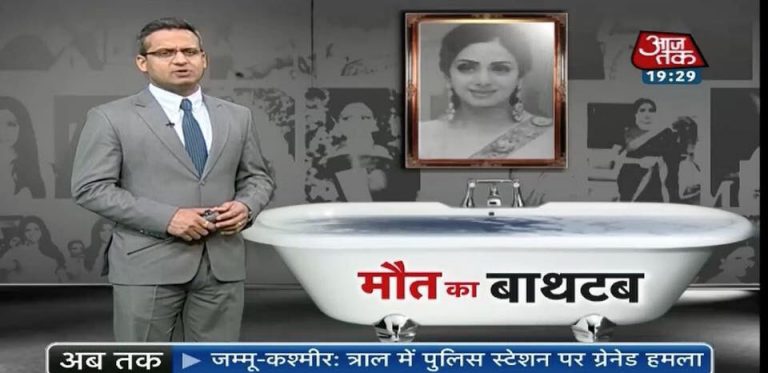
Sunday morning we woke up to untimely demise of actor Sridevi. Even as the condolence messages from fans were pouring in, India media decided to lower its bar in vulture journalism by not only floating bizarre conspiracy theories around her death, but also coming up with graphic representation of how she may have died.
Here are some of the best (or worst, whichever way you see it) graphics. Here, on TV9, the graphic shows Boney Kapoor looking at his dead wife in a bathtub.
Aaj Tak was most creative in terms of coming up with the caption. Notice the touch of Sridevi’s photo in a frame above the ‘Maut Ka Bathtub’? Classy.
But ABP news takes the cake when it comes to sensationalizing Sridevi’s death. ABP News had created dramatized graphics for the last 15 minutes of Sridevi’s life, which she probably spent in the bathroom. Remember, there is no concrete evidence on how exactly she died as matter is under investigation. But why let facts come in way of drama?
Unbelievable. ABP News has added the classy touch of a wine glass on the bathtub. The anchor has landed in this graphic bathroom to reconstruct how Sridevi might have died.
ABP News again. The news channel which depends on social media for news. And of course, we know how reliable social media is as a source.
Did Boney Kapoor, Sridevi’s husband have ulterior motives in ‘surprising’ his wife for a dinner date? Because, clearly, all surprises in the world need to have ulterior motives.
Again, how dare a husband take his wife out for a dinner date? What an outrageous and criminal idea!
But was he even there during her last moments despite his idea of giving her a surprise and taking her out for dinner? What kind of evil husband would even do that, right?
And then there is Times Now. It should contemplate turning itself into an investigating agency.
They have dimensions of bathtub and Sridevi’s height and are discussing how can someone who is 5’6” die by drowning in a bathtub which is 5′ wide and 13” deep.
We are not sure how Sridevi died, but last night we all witnessed how the Indian media died.
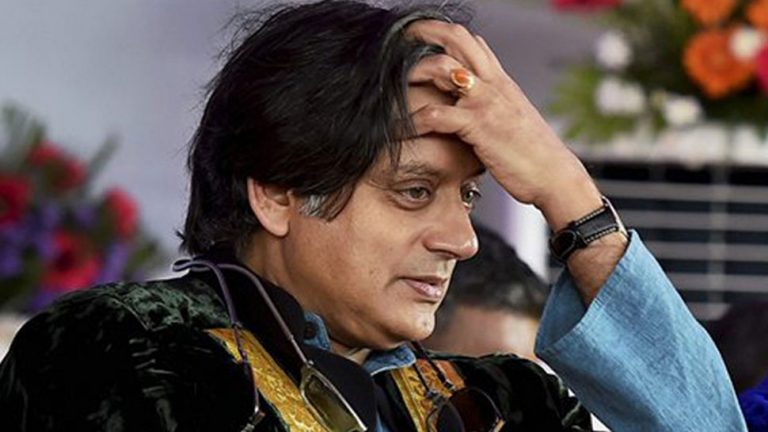
Shashi Tharoor has been marketing his book ‘Why I am Hindu’ very actively on social media. He is quite vocal about his interpretation of his version of Hinduism and argues why RSS and his political counterparts are not true representatives of Hinduism.
However, a controversial line in a court judgement has raised questions on his claim of being a ‘Hindu’. In the judgment [pdf] delivered by High Court of Kerala in Ernakulam on 27th May 2015, the judge writes (emphasis added) :
1 st respondent (Shashi Tharoor) denies all the allegations in the petition. He asserts that he has made true and correct disclosure of all the assets which belongs to him as on the relevant date and the allegations to the contrary are untrue. He disowns any assets having been inherited by him consequent on the death of his wife. He also would point out that as on the date of filing of nomination, he had no spouse and therefore the question of disclosure at that point of time did not arise. He disputes that he and his wife late Sunanda Pushkar are Hindus.
The snapshot of the controversial line and link to the judgement were shared on Twitter by Rajya Sabha member Subramanian Swamy (who shared it in November last year) and columnist Anand Ranganathan (who shared it earlier today):
However Shashi Tharoor retaliated by threatening columnist Anand Ranganathan, who is also a scientist, with a court case. He said that it was a ‘complete lie’ and threatened the Anand with a court case if he did not withdraw the ‘fake document’.
But Anand Ranganathan stumped Tharoor by citing the original link to the court order that is uploaded on the website of the Kerala High Court. He also demanded an apology from Shashi Tharoor.
Here you go, @ShashiTharoor. Here is the original High Court of Kerala (https://t.co/yKL6PgloXi) document. Justice Bhavadasan’s words: That you dispute the fact that you are a Hindu.
Meanwhile, Ananth Krishna Subhalakshmy, a law student has also pointed out that the an argument submitted to a constitutional court place on record cannot be disputed.
You can’t dispute an argument that you submitted to a constitutional court and which has been placed on record through a judgement. If Shashi Tharoor is willing, let him submit the original affidavit that he filed in the case in public domain.
— Ananth Krishna Subhalaksmy Chittayal (@Ananth_Krishna_) February 26, 2018
He further added that all submissions made by the advocate have to be made with the knowledge for the client and the affidavit Tharoor submitted has to have been attested by him. Therefore, legally Tharoor has assented to the submission. Ananth added that this was a case where Tharoor’s election as MP could have been struck down for misrepresentation on his affidavit.
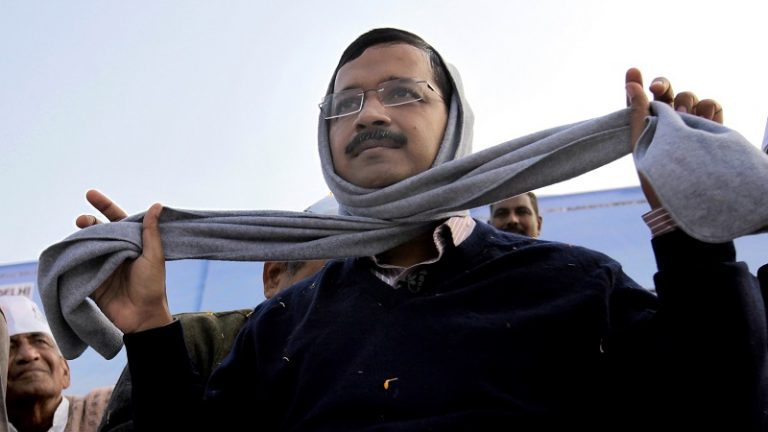
It is also important to note that Arvind Kejriwal could not dissociate himself from arguments made by Ram Jethmalani in a defamation case filed by Arun Jaitley.
It remains to be seen whether Shashi Tharoor will clarify about his religion and his arguments in public domain. Does he really believe that someone has uploaded a ‘fake document’ on a High Court website, or is he accusing judges of attributing to him arguments he never made?
Tharoor had not clarified by the time this report was published.
UPDATE: Shashi Tharoor has conceded that the document or the High Court judgment was indeed not ‘fake’ (though he didn’t apologise to Anand Ranganathan for falsely accusing him of producing ‘fake document’). He claimed that there must have been a ‘typographical error’ in the court order or the judge put that line by “accidental slip”.
The Pakistan Army (PA) strategy against India calls for ‘offensive-defence’, also known as the Strategy of Riposte. This strategy calls for the armour heavy Strike Corps of Pakistan Army to seize initiative and attack across a narrow front. This is aimed at both unhinging Indian offensive plans in other sectors as well as seizing territory for later bargaining at the negotiating table. The holding Corps of the Pakistan Army are expected to absorb and delay the Indian offensive. And while the armour divisions are concentrated in the Strike Corps, holding corps have also evolved Corps Reserves centred around independent armour brigades and mechanized brigades for countering Indian offensive as well as for counter-penetration.
While it can be correctly argued that the Pakistan Army has broadly followed ‘offensive-defence’ strategy as witnessed in the 1965 war, General Mirza Aslam is credited with crystallizing this strategy. The strategy was demonstrated during the 1989 army exercise ‘Zarb-e-Momin’, which was the biggest exercise of the Pakistan Army at the time. And followed the massive Indian Army exercise of late 196-early 1987 ‘Brasstacks’.
The Pakistan Army is faced with a dilemma – creating strong armour/mechanized strike elements against a much larger adversary while also maintaining enough resources for absorbing/countering Indian offensive. And this needs to be done with less than 1/10th resources of its main adversary. This dilemma becomes still more acute when a comparison is done between the mechanized resources of the two armies.
As against Pakistan Army’s 2 x Strike Corps, Indian Army has 3 x Strike Corps. Further, while Holding/Pivot Corps in both armies have independent armoured brigades, not only are Indian armoured formations bigger in terms of armoured regiments and no of tanks, IA also has a unique formation known as RAPID – Re-organized Army Plains Infantry Division. Each RAPID has an armoured brigade apart from 2/3 infantry brigades. The armoured brigade has 2 x armoured regiments + 2 x mechanized regiments. This structure greatly increases the fire-power of a division in question. There is an offensive and defensive RAPID.
Take IA’s 10 Corps for example – It has 1 x independent armored brigade (3 x armored regiments + 1 x mechanized infantry regiment) and 2 x RAPIDs ( 4 x armored regiments + 4 x mechanized infantry regiments). In all, this single ‘Pivot’ Corps has almost the same number of armoured regiments as a Strike Corps of Pakistan Army!
Though over past decade, PA has raised new armour regiments and armour brigades and mechanized more infantry battalions, armour and mechanized elements in IA have also seen expansion.
To offset IA’s superiority in the armour/mechanized assets, the Pakistan Army undertakes the following measures:
The smaller size of formations: The size of armour formations (brigades/division) in PA is relatively smaller as compared to India. For example, armour division of Pakistan and India consist of 5 and 6 armoured regiments, respectively. Indian independent armored brigades have 3+1 structure – 3 x armored regiments + 1 x mechanized infantry battalion. Pakistan Army has 2+1 structure. There is also likely slight variation (2-3 tanks) in a number of tanks held per armoured regiment with IA having a higher number.
Anti-Tank battalion: Pakistan Army has dedicated anti-tank battalions which are classified as Light Anti-Tank (LAT) battalion and Heavy Anti-Tank (HAT) battalions. These AT battalions are in addition to the anti-tank guided missiles (ATGM) held at an individual infantry battalion level.
(A) Anti Tank Battalions
Anti-tank battalions are a relatively cheap and cost-effective option to counter a superior mechanized force. It relieves the armour from undertaking defensive tasks and allows the higher formation to preserve its own armour for offensive and counter-penetration tasks. And wherever required, it helps to strengthen the existing anti-tank capabilities.
(A.1) Light Anti-Tank Battalions (LAT)
During the 1965 war, some infantry battalions, at the scale of one battalion per division, were converted into Reconnaissance & Support Battalions (R&S). These battalions had about 60% manpower as compared to standard infantry battalion but were equipped with much higher firepower. Apart from their standard role of reconnaissance, these units were also used to hold the ground through fire-power and act as screening forces.
Sometime in the early 90s, the R&S battalions with Infantry divisions were converted into anti-tank battalions. Pakistan Army today has dedicated LAT battalions. LAT battalions are held at Division HQ level and are most likely allocated to infantry brigades under the division at the scale of 1 x LAT Company/Brigade.
The LAT battalions are equipped with Bakhtar-Shikan anti-tank guided missiles; these missiles are mounted on a 4 x 4 vehicle. However, during 2017 Pakistan Day Parade, an APC mounted contingent of Baktar-Shikan missiles from 27 Baloch Regiment was mentioned as LAT battalion. It is likely that some LAT battalions, especially which are part of partially Mechanized Divisions of PA are mounted on M-113 APCs or locally produced Pakistani versions of the same.
Example of some of the LAT battalions are as under:
21 Punjab (LAT) battalion
23 Punjab (LAT) battalion
26 Punjab (LAT) battalion
19 Baloch (LAT) battalion – this is also the parent battalion of Special Service Group (SSG)
(A.2) Heavy Anti-Tank Battalions (HAT)
Pakistan Army also has the concept of Heavy Anti-tank (HAT) Battalions which are being held at Corps HQ level. This includes the two Strike Corps – Army Reserve North (ARN, I Corps, Mangla) and Army Reserve South (ARS, II Corps, Multan). Apart from HAT battalions, there exist Independent HAT Companies as well.
While I don’t have the details of the exact number of such battalions (I do have names of some battalions), it highly likely that most Corps facing eastern border have a HAT battalion. And some divisions (mechanized ones in Strike Corps or those in sensitive sectors where large Indian armoured offensive is expected) also have HAT Companies.
The HAT battalions and companies are equipped with TOW ATGM missiles and the same is mounted on M-113 APCs or Pakistan’s versions/derivatives of this venerable armoured personnel carrier. Considering the relatively limited number of TOW missiles imported by Pakistan, some HAT battalions are also equipped with Baktar-Shikan missiles.
Example of some of the HAT battalions are as under:
39 Azad Kashmir (Heavy Anti Tank) battalion or 39 AK (HAT) battalion
40 AK (HAT) battalion
226 AK (HAT) Company
227 AK (HAT) Company
M-113 APCs of 39 AK (HAT) battalion. The formation sign on the APCs is that of 1 Corps or Army Reserve North (ARN). The number 87 next to the ‘Up Arrow’ sign means this vehicle entered PA in 1987!(source: defence .pk)
Contingent of 228 AK (HAT) Independent Company with M-113 APC and TOW-2 ATGMs from 2015 Pakistan Day Parade. Formation sign on the APCs looks like that of Jhelum based 23 Division under Rawalpindi based X Corps. (source: internet)
(A.2.1) M-901 Improved Tow Vehicle
In the early 80s, Pakistan Army also imported 24 M-901 Improved Tow Vehicles from the USA. These are dedicated TOW missile platforms based on M-113 APCs. Each vehicle has 2 x ‘ready to fire’ missiles along with 10 reloads. The reloading is done under the armour.
All of them are concentrated under Multan based 2 Corps or Army Reserve South (ARS). ARS is Pakistan Army’s premier armour and mechanized heavy strike formation. Given the number of units, these are most likely held by a single HAT battalion.
Pakistan Army officer standing in front of M-901 ITV. The formation sign on the vehicle is that of Multan based 2 Corps or Army Reserve South. (Source: defence.pk)
(A.3) Organization Structure
While I do not have the details of the organizational structure of such anti-tank battalions (LAT or HAT), one can draw a fairly good approximation considering two main points as mentioned below:
(a) Most formations below a brigade have company, platoon and section structure. And the number of companies, platoons and sections varies as per the role & nature of the unit.
(b) A missile launcher along with ready-to-fire missiles and the first set of reloads will constitute a basic fire unit.
Keeping the above two points in mind, the following deductive reasoning can be applied:
In case of LAT battalion, it is a division level asset.
Each infantry division in PA generally has 3 x infantry brigades (some divisions are larger)
Therefore, an assumption can be made that each LAT battalion will most likely provide 1 x LAT Company per brigade with 1 x HQ Company.
Therefore, a LAT battalion most likely has five (05) companies – 1 x HQ Company, 3 x LAT Companies and 1 x Support Company (for technical support to LAT companies). If each LAT Company has organic technical support elements than the technical support company can be ruled out. Then each LAT battalion has four (04) companies
Each LAT company further likely has between 2 or 3 missile platoons
Missile platoons will be further broken down into missile sections. Each platoon likely has 2 or 3 missile sections.
Each missile section is equipped with 1 x missile launcher and with 1 ready-to-fire missiles and 3 reloads + 4 x reserves for a total of 08 missiles per section/launcher.
The above argument about the number of launchers and missiles can be summarized as such:
CASE 1
3 x Missile Companies with 3 x Missile Platoons/Company and 3 x Missile Sections/Platoon
3 x 3 x 3 – 27 launchers
@ 8 missiles/launcher – 216 missiles
CASE 2
3 x Missile Companies with 3 x Missile Platoons/Company and 2 x Missile Sections/Platoon
3 x 3 x 2 – 18 launchers
@ 8 missiles/launcher – 144 missiles
A similar structure likely exists in case of HAT battalions. The only difference being, the companies will be allotted to divisions under the Corps.
(B) Anti Tank Missiles
Pakistan Army employs three main types of ATGMs. These are as under: (1) Baktar-Shikan:
Baktar-Shikan missile with complete firing post. Notice the BGM-71 TOW inspired tripod
This is the licensed produced copy of Chinese HJ-8/Red Arrow-8 ATGM. Employed by infantry and anti-tank battalions.
A version of the missile has also been adapted for use by AH-1 ‘Cobra’ helicopter gunships.
The Stockholm International Peace Research Institute (SIPRI) Arms Transfer database shows that a total of 23,350 HJ-8 missiles were contracted in 1989. And these were license manufactured between 1990 and 2016
However, other credible sources say that PA tested first home-produced Baktar-Shikan in 1997. It is quite likely that production began in 1997.
A 19 year period (1997-2016) to produce these number of missiles means a per annum production rate of ~1,229 missiles. This is unlikely to be the case.
Two things could’ve happened. One, an initial batch was procured off-the-shelf from China and Pakistan devoted its interest to produce the missile locally; and that initial production was at a low rate. Secondly, local production and subsequent induction picked steam after 2001 when the US funds started flowing. This is because until September 2001 event happened, Pakistan defence overall was in a bad shape due to lack of funds.
(2) BGM-71 Tow-2:
Used by Heavy Anti-Tank Battalions/Companies and AH-1 ‘Cobra’ helicopter gunships
The SIPRI database documents three instances of TOW missiles being ordered by Pakistan; these were in 1981, 2004 and 2007.
Considering the missiles ordered from the USA in 2004 and 2007, the number of TOW-2 missiles ordered (and supposedly held) by the PA is 5,205. I’ve not considered the 1,005 missiles ordered in 1981 and received between 1983-96 because these are beyond their shelf life; these were most probably exhausted in training.
TOW-2A missiles are a precious resource and this explains why HAT battalions are held at Corps HQ level or in Independent HAT Companies allotted to few important Divisions.
The use of Baktar-Shikan on AH-1 ‘Cobra’ gunships most likely stems from the lack of enough quantity of TOW missiles and their price. The topsy-turvy nature of US-Pakistan relationship would be another factor; post-1998 nuclear test, Pakistan did not have access to most US systems including TOW-2 missiles. Baktar-Shikan was a good alternative.
(B.1) Baktar-Shikan
Baktar-Shikan missile is Pakistan’s licensed copy of the Chinese HJ-8 or Red Arrow-8 anti-tank guided missile.
It is second generation, wire-guided, semi-automatic command-to-line-of-sight (SACLOS) anti-tank missile.
The missile consists of four components. These are (data in parenthesis is weight in Kg):
Missile inside missile case – 25 kg (missile only is 11.2 kg)
Tripod – 23 Kg
Guidance unit – 24 Kg
IR Goniometer – 12.5 Kg.
IR Goniometer – As per army-guide.com, “the IR goniometer is mounted on the left side of the launcher and, as well as serving as a day sight, also receives and modulates IR signals from the missile and feeds resulting deviation signals to the guidance unit. A night device can also be fitted.”
Apart from use by the infantry on the man-pack basis, the missile is mounted on 4×4 vehicles and Armored Personnel Carriers (APC). APC consist of imported M113 APCs as well as locally manufactured modification of M113 APC by Heavy Industries Taxila (HIT). The base modification of M113A2 APCs is called ‘Talha’ while a Baktar-Shikan mounted version of ‘Talha’ APC is called ‘Maaz’.
Each Maaz APC has a single missile firing post with further 8 reloads. It is said that the missile firing post is retrieved inside the turret for reload. It has a crew of four people.
Maaz APC with Baktar-Shikan anti-tank missile firing post.Configuration of the 4×4 vehicle mounted Baktar-Shikan missile firing post (Source:armyrecognition.com)Configuration of the 4×4 vehicle mounted Baktar-Shikan missile firing post (Source:armyrecognition.com)
As is evident from the weight of each sub-component, Baktar-Shikan is not exactly a man-portable missile. The total weight of the system (missile + firing post) is close to 85 Kg. It can be carried on the man-pack basis and would be man-portable only for very short distances.
The data available about the missile weight and weight of encased tube (with the missile inside) is 11.2 Kg and 25 Kg, respectively. I’ve not come across the reason for such high weight of the empty missile tube (~14 Kg). Generally, the empty missile tube weighs about 1-2 Kg.
Only in case of AT-5B ‘Spandrel’ or ‘Konkur-M’ (used by Indian Army) does the missile tube weigh ~10 Kg because the tube has a gas generator. This gas generator ejects the missile from the tube before the main motor kicks-in.
But in case of HJ-8/Baktar-Shikan, the missile tube is ejected backwards and there is considerable back-blast. This rules out any device to eject the missile.
The picture shows the empty missile tube travelling backwards; considering the back-blast and distance covered by the missile case, they are rear to the missile firing post has to be clear. (Source: tribune.com.pk)
This becomes more clear in the excellent video below of PA troops firing the missile from a 4×4 vehicle. Source of video (https://youtu.be/4GPShUqOZpk)
Further, as the picture below shows, given the dimensions of the firing post, the soldier has to be in kneeling position to fire the missile. This is because of the position of the aiming device. While the elevated missile firing post gives better line of sight, it is also a bigger target and exposes the missile pilot during the entire phase of missile flight.
PA soldier firing the Baktar-Shikan missile. Notice the size and dimensions of the missile firing post and location of the aiming device. The missile is also the HJ-8A version without a tandem warhead. (Source: defence.pk)
Another image of Pakistan Army’s missile team firing the missile with missile pilot in kneeling position. This one is also the HJ-8A version (Source: tribune.com.pk)
The missile has also been adapted for use on AH-1 ‘Cobra’ helicopter gunships. The video below of Pakistan Army exercise dates from 2006. As the commentary says, it involves adaptation of Baktar-Shikan missile and demonstration of night-firing by AH-1 helicopter gunships.
The weight aspect of HJ-8 flows from the design philosophy where HJ-8 was meant to mirror heavy western ATGMs like BGM-71 ‘TOW’ and Euromissile HOT. The most visible impact is the heavy tripod of HJ-8 or Baktar-Shikan missile which copies from the American TOW missile. It has given the missile 360-degree swivel capability.
Another aspect of HJ-8 missile borrowed from French MILAN anti-tank missile is that fact that the missile tube (in which the missile is encased) is pushed back when the missile is fired. Though, the rearward travel of HJ-8/Baktar-Shikan missile tube seems to be much higher as compared to Milan missile.
(B.1.1) Missile Variants
The basic HJ-8 missile has evolved over the years. The picture below shows this evolution with various models of HJ-8 leading to HJ-9. PA at this stage does not operate HJ-9.
The basic HJ-8A missile was followed by an HJ-8C missile in the early 90s; HJ-8C missile featured a probe in-front with a precursor charge followed by main HEAT warhead.
This was meant to neutralize the Explosive Reactive Armour (ERA) which had started proliferating on Soviet origin tanks.
The HJ-8E missile is a further improvement on HJ-8C with range increased from 3,500 meters to 4,000 meters. This missile was ready by late 90s and is supposed to have improved guidance system, thereby increasing the kill probability.
Evolution of HJ-8 series of anti-tank missile
Considering that Baktar-Shikan is licensed copy of HJ-8 missile, it is but natural that Pakistan Army will also induct the progressive versions of the same missile.
Pakistan started displaying a tandem warhead version of Baktar-Shikan missile from 2002 onward. This tandem warhead version is most likely to be a licensed copy of HJ-8E missile with tandem warhead and enhanced range.
The new missile launcher also has the option of attaching a thermal imager to allow for acquisition and targeting of enemy mechanized assets at night. As per army-guide.com, “system can be fitted with a PTI- 32 thermal imagers which can detect tank-sized targets at a range of 4,000 m and identify tank size targets at a range of 2,000 m”
While it is likely the tandem warhead version will start replacing/supplanting the pure HEAT warhead versions in the PA service, the exact numbers and status of such a program are not known (at least to this author).
Tandem warhead version of Baktar-Shikan missile displayed during IDEAS 2014. Most likely to be a version of the HJ-8E missile. (Source: armyrecognition..com)
Malaysia had placed an order for Baktar-Shikan missiles in 2001 which as per SIPRI database was completed in the 2002-2003 period. As the picture of the missile below with a probe in front shows, Malaysia operates the tandem warhead version of the missile.
Malaysian Army APC mounted Baktar-Shikan missile in action. Notice the probe in front of the missile; this makes it most probably the HJ-8E version. The picture also captures the massive back-blast. (Source:malaysiandefence.com)
Interestingly, in the 2014 International Defense Exhibition and Seminar (IDEAS) exhibition, Pakistan had also displayed the ‘Light’ version of the Baktar-Shikan missile. This is based on on the NORINCO HJ-8L version. HJ-8L version is an attempt to develop a genuine man-portable ATGM which consists of a much smaller & lighter firing post (smaller tripod and guidance cum aiming device). It retains the same missile. The total weight of this system is said to be under 25 Kg.
However, apart from redesigned and new guidance units and imaging tools, it is highly likely that Chinese have also developed a new missile case. This is because with the older missile+missile tube itself weighing 25 Kg, the overall weight of the missile+firing post cannot be under 25 Kg.
Baktar-Shikan ‘Light’ with a relatively smaller and lighter tripod. The imaging scope is missing.
Chinese HJ-8L with targeting sight. (Source: Internet)HJ-8L – missile pilot aims, fires and guides the missile from a prone position. (Source: Internet)
The above layout is quite similar to the Russian heavy KORNET-E anti-tank missile.
HJ-8 missile variants have seen considerable use in Syria by various forces. These missiles have been credited with taking out many modern MBTs in the civil war.
The video below, from 2013, is a compilation of use of HJ-8 missile in Syrian Civil War.
(B.2) BGM-71 TOW-2A
TOW-2A equipped M-113 APC of the Pakistan Army
Tube Launched, Optically Tracked, Wire Guided or ‘TOW’ is the most famous of US anti-tank missiles and one which has been produced the most.
It is a heavy anti-tank missile with the heaviest warhead amongst land-based anti-tank missiles. The missile weighs about 22 kgs with the whole firing post including the missile weighing close to 90 kg.
Guidance is Semi-Automatic Command to Line of Sight (SACLOS) meaning the missile pilot has to keep tracking the target till impact. The guidance signals are transmitted through wires (wire-guided) or one-way secured radio-frequency link (RF). The RF-based guidance does not make the missile ‘fire & forget’. It simply replaces the wire as a medium of delivery guidance.
From its first version in the early 1970s, the missile and attached paraphernalia have undergone the continuous upgrade. At present, there are two main avatars of the missile, along with variants of these two dominant types. The details of the same are as follows:
Different versions of TOW missiles (TOW-2B ‘Aero’ is not shown):
Source: army-technology.com
TOW-2B ‘Aero’ – compare the front section with standard TOW-2B shown above.
Internal diagrams of TOW-2A and TOW-2B. TOW-2B ‘Aero’ differs from TOW-2B only in terms of the shape of front section. In case RF versions, the rear section of the missile has RF receiver instead of wire-dispenser
As discussed earlier, Pakistan Army acquired various versions of BGM-71/TOW missiles in three tranches. These details of the order are as follows (Year of Order/Quantity/Usage):
1981 – 1,005 – To be used on AH-1 ‘Cobra’ helicopters and M-901 ITV
2004 – 2,007 – TOW-2A variant; to be used on AH-1 ‘Cobra’ helicopters
2007 – 3,198 – TOW-2A-RF variants
The Defence Security Cooperation Agency (DSCA) notification about the 2007 sale of TOW-2A missiles gives the following break-up of the order:
The Government of Pakistan has requested a possible sale of 2,769 Radio Frequency (RF) TOW 2A Missiles, 7 RF TOW 2A Fly-to-buy Missiles, 415 RF Bunker Buster Missiles, 7 RF Fly-to-buy Bunker Buster Missiles, upgrade of 121 TOW Basic/TOW-I launchers to fire TOW II configuration for wire-guided and wireless missiles, TOW Data Acquisition Systems, gunner aiming sight, testers, cameras, spare and repair parts, technical support, support equipment, personnel training and training equipment, technical data and publications, U.S. Government and contractor engineering and logistics support services, and other related elements of logistics support. The estimated cost is $185 million.
Given the quantity of missiles ordered and likely to be held (5,205), TOW-2A is a precious resource for Pakistan Army.
The stock is most probably divided between the Pakistan Army’s Army Aviation Corps (AAC) which operates the AH-1 Cobra helicopter gunships and the Heavy Anti-Tank (HAT) battalions.
(3.0) Lessons for India
The Arab-Israel war of October 1973, known as the Yom-Kippur war (or the Ramadan War as per the Arabs) offers insight into the tank versus anti-tank missile scenario. It has lessons for India because the adversary (Pakistan) intends to use ATGMs to blunt India’s superior armour capabilities.
The 1973 war is a landmark event because it became the proving ground of two new weapon systems in modern warfare – anti-tank guided missile (ATGM) and anti-aircraft missile. The success of these two systems forced a major rethink in tank warfare and air combat in terms of tactics, the design of weapon system and development of measures & counter-measures.
Egyptian Army employed thousands of Soviet Union supplied 9M14 ‘Malyutka’ (NATO reporting name: AT-3 ‘Swagger’) ATGM. While the Israeli intelligence and its general staff were aware of this weapon system with Egyptians, they did not consider it as an effective counter-measure to their armour. This faulty assessment caused the Israeli heavily – Israel Defence Forces (IDF) lost about 800 tanks in this war with Egyptian ATGM teams accounting for 20%-25% of the total losses. But the real impact of ATGM was felt in the initial days of the war when the Israelis were completely taken by surprise by the ATGM and the efficacy of Egyptian anti-tank defences. During first two days of the war, Israelis lost about 260 tanks – the bulk of these losses were on account of ATGMs.
But the anti-tank teams were highly effective because the Egyptians employed innovative anti-tank tactics. In the words of one Israeli tank commander[1] who led the initial counter-attack against the Egyptian Army:
“We were advancing and in the distance, I saw specks dotted on the sand dunes. I couldn’t make out what they were. As we got closer, I thought they looked like tree stumps. They were motionless and scattered across the terrain ahead of us. I got on the intercom and asked the tanks ahead what they made of it. One of my tank commanders radioed back: ‘My God, they’re not tree stumps. They’re men!’ For a moment I couldn’t understand. What were men doing standing out there—quite still-when we were advancing in our tanks towards them? Suddenly all hell broke loose. A barrage of missiles was being fired at us. Many of our tanks were hit. We had never come up against anything like this before….”
Another example of how much thought Egyptians had given to anti-tank warfare based on ATGM is given below[2]:
“According to one report, the Egyptians, with an abundance of SAGGERs, established a defence that lured the Israeli Defence Forces (IDF) into a Kill Zone which optimized the potential of both SAGGERs and RPG-7s. The IDF tankers saw Egyptian tanks in the far distance and closed to do battle; however, they were unaware of great numbers of camouflaged RPG-7s and SAGGERs forward of the Egyptian tanks”
This is shown in the image below (taken from the same document):
The Israeli Armoured Corps did evolve tactics to counter the Egyptian anti-tank teams; these tactics meant the armour advancing under the cover of artillery and with supporting infantry (mounted on APC/IFV and dismounted). ATGM placed a restriction on the free reign which the armour had against the infantry.
But the widespread use of anti-tank missiles did not make the Main Battle Tank (MBT) obsolete. In words of a CIA Report[3] on analysis of 1973 Arab-Israel War done in 1975:
“Antitank weapons like the Sagger and RPG-7 took a heavy toll of Israeli armour. But they did not render the tank obsolete. The initial impression created by the Egyptian use of antitank missiles was artificially reinforced by the inappropriate tactics used by the Israelis in the first few days of the war
“Antitank weapons like the Sagger and RPG-7 took a heavy toll of Israeli armour. But they did not render the tank obsolete. The initial impression created by the Egyptian use of antitank missiles was artificially reinforced by the inappropriate tactics used by the Israelis in the first few days of the war. It is probably safe to say that no large, modern army will again make the mistake of using unsupported tanks against massed infantry.
The Israelis rediscovered some ancient principles in seeking a response to the antitank weapon threat posed at the beginning of the October war. Foremost, the Israelis found that no single weapon can long dominate the battlefield. Victory requires the use of a balanced force with much complementary offensive and defensive elements. The battlefield, in short, is a complicated environment and no one weapon or arm of service can function effectively on it without the active aid and cooperation of others. This is reassuring for the Israelis since the effective and flexible use of mobile forces under difficult circumstances is precisely the area in which they hold the greatest comparative advantage over the Arabs”.
The same report also adds the following about Israeli adaptation to this new threat in course of the war:
“Despite all the problems, however, the Israelis once again proved the importance of flexibility in maintaining their superiority. The most striking example of this is provided by the Israeli response to the Arab–particularly Egyptian–antitank weapons. By 8 October the Israelis had recognized the flaws in their armour tactics and adopted a defensive procedure under which they waited for the Arab armour to attack and then took the Arabs under fire from extreme range. This made it difficult for the Arabs to bring their antitank weapons forward. This change of tactics by the Israelis took maximum advantage of the longer range of most of their tank guns and the superiority of their long-range tank gunnery.
The Israeli attack on 8 October appears to have been the last attempt to use tanks in the unsupported 1967 style and even then the Israelis may have been drawn in by their initial success. Within four or five days after the beginning of the war, the Israelis were adopting tactics which reduced the threat from Arab antitank weapons to manageable proportions. This adjustment in the midst of combat provides a fair measure of the flexibility of Israeli leadership and the thoroughness of low-level training.”
(4.0) Conclusion
Pakistan Army possesses strong anti-tank capability which will be a challenge to Indian mechanized formations in any future conflict.
The main objective of these anti-tank formations is to prevent a break-out by Indian armoured formations. Using speed, mobility, terrain familiarity and stand-off range of their missiles, they intend to blunt Indian mechanized offensive.
With the ability to engage targets at night, they can spring a surprise on any advancing armour column. Working in conjunction with some armour and/or AH-1 ‘Cobra’ gunship helicopters will make for a formidable force.
They will play an important role in next Indo-Pak war. And like the Israelis in 1973 war, Indian Army will have to evolve tactics to counter them. And while Israelis were taken by surprise, Indian Army knows the existence of this capability.
Apart from counter-tactics, Indian Army also needs to invest in a technological solution like Active Protection Systems (APS) for its main battle tanks.
(This article was written by Rohit Vats who tweets at @KesariDhwaj, the original article can be read on his blog)
Talk began about Hyperloop: a travel of future, when Billionaire entrepreneur Elon Musk shared a white paper [PDF] on Hyperloop Alpha in August 2013. In the white paper, Musk talked about developing a 350 miles (563 Km) long tube from Los Angeles to San Francisco equipped with a special indoor environment inside where the Capsules (or Pods, as he refereed those vehicles) will travel at an almost sonic speed of one Mach or 1220 kmph.
This Hyperloop technology was expected to reduce the travel time from 6 hours for a car or a 90 min for a flight to mere 30 minutes. Further the cost of travel was also expected to reduce from a $100 by flight to a mere $20. This proposed concept to revolutionise the transportation industry took the world by storm. Within a year, many start-up firms emerged (including Hyperloop One, Hyperloop Transportation Technologies, Arrivo, etc.) around the proposed concept, taking up the charge to transform the travel of future into reality.
In September 2017, the Andhra Pradesh Government junked the Metro project in Vijayawada and signed up an MoU with Hyperloop Transportation Technologies for introducing the futuristic Hyperloop in the capital city Amrawati. The proposed Hyperloop will connect the city of Vijayawada and Amrawati and will cover a distance of 25 km between them in just 5 minutes.
The Andhra government had back then claimed that a feasibility study will be carried out regarding the project and now reports have emerged claiming that the project might indeed turn into a reality if everything turns out well. The expected project cost though is yet to be disclosed.
As per Denver Post report in September 2017, the Transportation department of Colorado had agreed to develop a Hyperloop connecting Cheyenne, Denver & Pueblo with Vail. The project covering about 576 km was expected to cost $24 Billion or Rs 1.56 Lakh Crores. With the physical, economical and commercial viability of Hyperloop yet to be proven, the question arises whether Hyperloop be an instant reality or transport of Future.
In his whitepaper, Elon Musk charted out the whole plan at a cost of $6 Billion for Hyperloop capable of moving around 15 Million people per year between Los Angeles & San Francisco at a speed of 760 Mph. This when amortised for 20 years, gives an approximate ticket price of $20 (INR 1300). However, as per the current trends as seen in the recently proposed project in Colorado, the project seems to be costing $24 Billion for almost the same length, which makes the Ticket price at almost 80$ (INR 5200). This is almost four times of what Musk calculated. Also, as per Arabian Business, the Hyperloop from Abu Dhabi to Dubai, having a length of 93 Miles, has a whooping cost of $5 Billion which is in line with the Colorado Project.
Most recently, even Sir Richard Branson announced that a deal was struck with the Maharashtra government for the construction of Hyperloop route linking Mumbai to Pune, a distance of 150 km, which would reduce the time of travel from 3 Hours to just under 25 minutes. It is expected to have a capacity of 150 Million passenger trips per year and will be completed in a time frame of approx. 6 to 7 years.
However no official announcement was made regarding the cost of the project but it was stated that it will be well in range of regular airfare. If a simple interpolation of cost is done in line with the Colorado Project or with Abu Dhabi to Dubai route it can be said that the given project may cost approx. $5 Billion or Rs 33,000 crores. However if its capacity is taken as per the white paper, then the 150 Million capacity sounds highly exaggerated.
As per Musk’s white paper, the Hyperloop capacity was pegged as 15 Million for 350 Miles at a speed of 760 Miles per hour. For Pune it will be much lesser due to lower speed and distance. The continuum of pods travelling at a gap of 10 minutes too will be lower as compared to the conditions in white paper, which pegs the maximum capacity at 8-10 Million.
If this capacity is amortised for 20 years with an 80% capacity, the price per head arrives to be approximately Rs 2000-2500 with various cost of operations and maintenance or capital not considered. Seeing these trends, it can clearly be said that what Musk proposed may be technologically viable, but financially its going to be almost double the cost of High Speed Rail considering the financial costs.
The startups which have emerged have tested the Hyperloop idea of a low pressure tube with capsules supported on air cushion being accelerated or decelerated by magnetic linear accelerators. Hyperloop One seems to have been in the fore front of these tests. They have carried out three test as on date, as listed. The first one on 12th May 2017, the second one on 2nd August 2017, and the third one on 15th Dec 2017, all at Nevada desert:
The speed test carried out by Hyperloop one
From the tests conducted by Hyperloop One, it can be seen that they have successfully carried out test for pods running a few hundred meters and have achieved a maximum speed of 240 Mph approximately. Even the Pod designed by SpaceX has been tested only up to 220 Mph. But the required speed of the proposed project is 760 Mph and no test has been able to achieve anything close to that till date.
Further, the low pressure tube has only been tested up to 437 meters. Tubes with low pressure running for miles with turns and gradients are yet to be tested and established as safe. Even adverse situations and possible response to them like drop air pressure, earthquake, temperature, thermal expansion and its effects needs to be tested. And the list of so many ‘things to be tested’ goes on.
So finally, based on the available trends, with so many tests/hypothesis yet to be proven, it seems it is too early to say that Hyperloop is a go-to mode of transportation and High Speed Rail might still be the thing in the near future. However, with the issues resolved, it can undoubtedly revolutionise the industry and transform itself from the Travel of Future to the Travel of the Present.
The Delhi police had booked AAP MLA Naresh Balyan for making inflammatory remarks and openly calling for an assault on government officials. An FIR under the relevant sections of Indian Penal Code has been filed at the Dabri police station in Dwarka against the MLA. He represents the Uttam Nagar constituency in Delhi.
The FIR has been lodged on the complaint of a policeman who was on duty in JJ Colony in Bindapur where Naresh Balyan made the remarks.
#WATCH: While addressing a rally in Uttam Nagar, AAP MLA Naresh Balyan says, ‘jo Chief Secy ke sath hua, jo inhone jhootha aarop lagaya, main to keh raha hu aise adhikariyo ko thokna chahye, jo aam aadmi ke kaam rok ke baithe hain aise adhikariyo ke sath yahi salook hona chahye.’ pic.twitter.com/BDamX7TJGe
Naresh Balyan made these remarks trying to justify the alleged assault on the chief secretary of Delhi at the CM’s residence last week. He said that government officers who create delays in public work should be thrashed.
The Aam Aadmi Party had tweeted that they condemn the remarks of Naresh Balyan but had not taken any actions against him.
Strongly condemn statement made by MLA Naresh Balyan; all govt officers need to be treated respectfully. Aam Aadmi Party govt believes in working in collaboration with them for Delhi’s development! – @AtishiMarlenapic.twitter.com/k8ojzqvny8
Naresh Balyan being booked comes as fresh trouble for Delhi CM Arvind Kejriwal as earlier today the joint forum of government employees have demanded an apology from Kejriwal. The had called the assault on chief secretary Anshu Prakash a ‘conspiracy’ and demanded that the CM must issue a formal apology for the incident.
The Delhi police had entered the CM’s residence to examine the CCTV cameras last week. They had informed that they were running forty minuted behind the time. The time difference in the cameras corroborates with the chief secretaries statement that the assault had happened at around midnight because AAP supporters had tried to refute his claims showing images CCTV footage which showed the chief secretary leaving the premises at 11.30.
AAP MLAs Amanatullah Khan and Prakash Jarwal are in the police custody on allegations of assault on the chief secretary. Their bail plea was dismissed by the court on February 23. Today Prakash Jarwal has applied for bail on which decision has been reserved.
The AAP government in Delhi is going deeper into troubles. As the IAS association also has come up against the Kejriwal government and its leaders are facing charges, it remains to be seen how long it will last.
India’s premier military R&D agency, DRDO, has successfully tested the combat unmanned aerial vehicle (UAV), Rustom-2, on Monday at Chitradurga, Karnataka.
They said in a statement, “DRDO successfully flew its Rustom 2 today at its Aeronautical Test Range(ATR) at Chalakere at Chitradurga. This flight assumes significance due to the fact that this is the first flight in user configuration with higher power engine. All parameters were normal. Secretary Deptt. of Defence (R&D) & Chairman DRDODr. S. Christopher, Director General of Aeronautical System Dr CP Ramanarayanan, DG Electronics & Communication SystemsMs. J Manjula along with senior scientists witnessed the flight and congratulated Rustom team.”
Rustom-2 is the latest addition to the Rustom lines of unmanned aerial vehicles which includes Rustom-1, Rustom-H and Rustom-C. The drone will be used by all three wings of the Indian Armed Forces primarily for intelligence, surveillance and reconnaissance operations. The drone has an endurance duration of 24 hours. The drone has been developed by the Aeronautical Development Establishment (ADE) of the DRDO in collaboration with Hindustan Aeronautics Ltd. and Bharat Electronics Ltd.
Punjab CM Captain Amarinder’s son-in-law’s loan “scam” seems to be the gift which keeps on giving. Earlier today, the official twitter account of the Congress party on Monday attacked the Modi government for another “fresh banking scam” emerging under its watch. The link which Congress posted though mentioned that Gurpal Singh, who is one of the accused, is actually the son-in-law of Congress leader and current Punjab CM Amarinder Singh. Eventually Congress deleted the tweet.
The above though may be a minor embarrassment to the Congress as compared to the details of the alleged fraud. The party and its leader who project that they are “pro-farmer” as opposed to “suit boot ki BJP”, may find it tough to defend their position in this case.
1. The CBI registered a case against Simbhaoli Sugars Limited, its Chairman Gurmit Singh Mann, Deputy Managing Director Gurpal Singh and others in connection with an alleged bank loan fraud of Rs 97.85 crore. Gurpal Singh is Capt Amarinder’s son-in-law.
2. The probe focuses on two loans taken by the company — Rs 97.85 crore which was declared fraud way back in 2015 and another corporate loan of Rs 110 crore which was used to repay the previous loan.
3. According to the FIR, Oriental Bank of Commerce (OBC) sanctioned a loan of Rs 148.60 crore to the company in 2011. The loan was sanctioned for financing 5,762 sugarcane farmers based on a tie-up agreement under an RBI scheme. According to an MoU, out of the price to be paid by Simbhaoli Sugars Limited to the farmers, loan liabilities were to be adjusted and the remaining amount was to be paid by the company to the growers.
4. CBI spokesperson Abhishek Dayal claims that the loan money was “dishonestly and fraudulently diverted by the company for its own needs”
5. The account turned NPA on March 31, 2015 and was declared alleged fraud by the bank to RBI on May 13, 2015 for an amount of Rs 97.85 crore.
6. OBC has alleged that in addition to the above NPA, the bank, under multiple banking arrangements, sanctioned another corporate loan of Rs 110 crore to the company on January 28, 2015 to pay its outstanding loan of Rs 97.85 crore.
7. The CBI FIR states that the second loan was declared NPA on November 29, 2016, within 20 days of demonetisation
Thus, via the first loan, Capt Amarinder’s son-in-law’s company is alleged to have siphoned off money meant for farmers, and the second loan taken to repay the first, became an NPA within 20 days of demonetisation.
Based on the above, the CBI has invoked sections dealing with criminal conspiracy, cheating and provisions of Prevention of Corruption Act against the accused. It has also carried out searches at eight premises, including the residences of directors, factory, corporate office and registered office of the company in Delhi, Hapur and Noida on Sunday.
Both the above loans can prove to be a major source of embarrassment for Congress. Firstly, the CBI alleges that farmer’s money was swindled, and secondly, one of the loans failed within days of demonetisation, which Rahul Gandhi and Congress claim had no impact on crooks. For the time being, Gurpal Singh has followed in the foot-steps of another infamous Congress son-in-law.