Home Blog Page 770

American media house CBS downplays ISIS crimes after Israeli forces rescue a Yazidi woman trafficked to Gaza and held as a sex slave for 10 years

0

On Thursday (4th October), the Israeli authorities informed that a Yazidi woman named Fawzi Amin Sido who was abducted from Iraq by ISIS in 2014 at the age of 11 and trafficked to the Gaza Strip has been rescued. The officials said that the woman has been reunited with her family. While Sido could regain freedom after a decade of sexual abuse, torture and other unspeakable atrocities, US media outlet CBS News blatantly attempted to downplay ISIS sex crimes.

The CBS News article and relevant X post suggested that the Yazidi woman was ‘stranded’ in Gaza, even though she was trafficked from Iraq into Gaza by ISIS terrorists and held in captivity by Hamas terrorists there, forcefully married and turned into a sex slave of the Islamic terrorist.
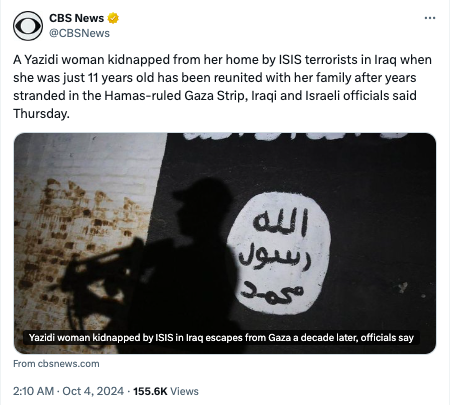
According to Israel’s foreign ministry, Sido was separated from her family in 2014 during ISIS attacks on Yazidi villages in Iraq, as the terror organisation infamous for its brutality grabbed control of huge sections of the nation. She was eventually sold to a Gazan man who was visiting Iraq at the time. Sido was recently retrieved and returned to her house by Israeli security officers.

The Israel Defence Forces stated that Sido was rescued in a sophisticated operation organised by the IDF’s COGAT, the US Embassy in Jerusalem, and “other members of the international community.”

The IDF stated that the “terrorist who had been holding her” was recently killed in an Israeli attack during the fighting in Gaza, allowing her to flee to a hiding spot in Gaza.

“A???? ???? ???? ? ?????? ?? ????????? ?? ????, ? ??-????-??? ?????? ????? ???? ?? ? ????? ????????? ?????????? ???? ???? ??? ??????? ??? ???????? ?? ??? ?????? ?? ????. In an operation coordinated by the IDF and led by @cogatonline @USEmbassyJLM and other international actors, Fawzia Amin Sido was freed from captivity and returned home to Iraq.  At 11 years old, Fawzia was trafficked by ISIS to a Hamas terrorist in Gaza, who was presumably killed during IDF strikes. She fled to a hideout in which she was rescued in a secret mission through the Kerem Shalom Crossing,” the IDF said.

The Israeli Defence Forces further stressed that the case of the Yazidi woman rescued from Gaza proves that the Palestinian Islamic terror group Hamas and ISIS are inter-connected and committing crimes against humanity. The IDF also reiterated its resolve to “dismantle” Hamas and ISIS as well as free hostages from Hamas captivity.

“This is further proof of the connection between Hamas and ISIS, as well as the crimes against humanity committed by the terrorist organization in Gaza. We will continue to act to dismantle the Hamas-ISIS terrorist organization and free all hostages in Hamas captivity,” the IDF said.

The Yazidi genocide and enslavement of women by ISIS

Back in 2014, the Islamic terror outfit ISIS began mass killings of Yazidi people in Sinjar, an area in northern Iraq. ISIS jihadis targeted Yazidis for their religious identity and killed thousands of people and abducted Yazidi women and children.

On the 3rd of August 2014, ISIS launched a deadly attack on Sinjar wherein thousands of Yazidi men who refused to convert to Islam were killed, while women and children were kidnapped. According to reports, around 5,000 Yazidi men were murdered during the initial days of the ethnic cleansing of Yazidis. As per a UNHCR report from 2016, “at least 3,200 Yazidi women and girls remain captives of ISIS, the majority of them held inside ISIS-controlled areas of Syria.”

On how the Yazidi captives were transferred to ISIS-controlled locations, the UNHCR report said: “Regardless of where the Yazidi families were captured, ISIS fighters swiftly ordered the separation of males and females, except boys who had not reached puberty,12 who were allowed to remain with their mothers. Within an hour, those who survived capture were forcibly transferred to temporary holding sites. ISIS operational commanders communicated these primary transfer locations, located within the Sinjar area and in the Hasakah governorate in Syria, to their fighters and checkpoints by walkie-talkies and mobile phones. Secondary transfers were later conducted in an organized manner, with buses and large vehicles moving captured Yazidis to designated holding sites in Mosul, Tel Afar and Baaj, deeper inside ISIS-controlled territory.”

Notably, among the most harrowing part of the ISIS onslaught against Yazidis was that the ISIS jihadis enslaved Yazidi women and girls. ISIS blatantly justified the enslavement and sexual torture of Yazidi women citing Islamic beliefs. ISIS says that Yazidis are Mushriks or polytheists and Islam does not tolerate polytheists, thus their enslavement and abuse is permitted. It is pertinent to mention that Islam has a concept of “Maal-e-Ghanimat”, in this, the Ghanima implies “spoils of war” which may include land, wealth, cattle, women and children. ISIS captured almost 6,000 Yazidi women and girls whom they called Sabaya [slaves] and subjected them to brutal sexual assault, with many being sold in slave markets or “Souk Sabaya” as “war booty” or offered as ‘rewards’ to ISIS terrorists. The Yazidi women were sold multiple times.
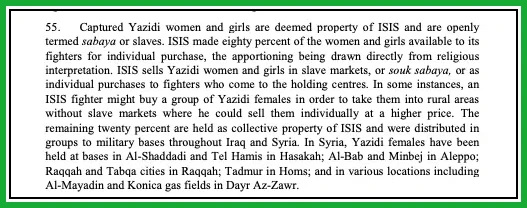
Excerpt from UNHCR report titled: “They came to destroy”: ISIS Crimes Against the Yazidis”

There have been reports that some Yazidi women were trafficked to various places, including Gaza, and used as sex slaves by ISIS sympathisers. While the exact numbers of those transferred to Gaza are uncertain, it is widely reported that ISIS trafficked Yazidi women across borders, including into Syria and territories outside Iraq.​

Cybercrime claims a life: Woman in Agra dies of heart attack after scam call from Pakistan claiming her daughter’s sex scandal

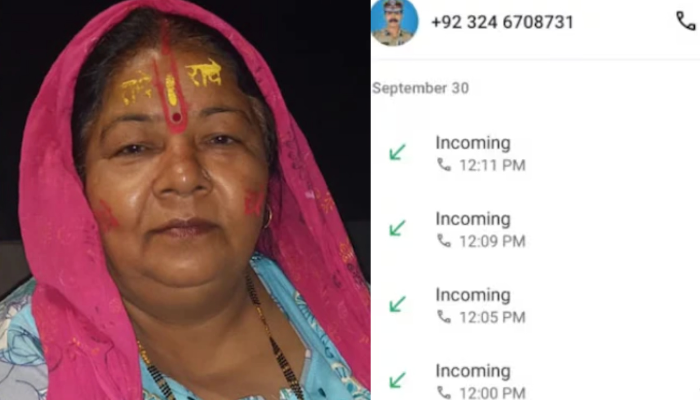
A woman in Agra, Uttar Pradesh tragically passed away from a heart attack after an extortion call with false claims. On 30th September, Malti Verma (58) received a WhatsApp call from a man acting as a police official. He claimed that her daughter had been taken into custody in connection with a sex trafficking case. He threatened to release an explicit video of her daughter if Rs 1 lakh was not paid to him. The woman told her son about the incident and asked him to send the money right away for the sake of her daughter.

The man claimed that he called her to make sure the family would not have to endure the anguish of having their daughter involved in a case involving a sex racket and forwarded a number to which the amount was to be transferred. Her son, Divyanshu, grew sceptical after hearing about the incident and discovered that the caller was a Pakistani who was impersonating a police officer to demand money from their family.

He revealed, “My mother taught in a government girls junior high school in Agra’s Achnera. After she got the call from the man, she panicked and called me. I asked her for the number from which she had received the call. When I checked the number, I found that it had a +92 (country code for Pakistan) prefix and told her it was a scam. She was still very anxious and started feeling unwell.”

Furthermore, he informed her that he had spoken to his sister, who was attending college and doing well. However, the woman’s health was severely impacted by the occurrence. It was around 4:00 pm when she got home from school and began to feel unwell. She was taken to a nearby hospital but was pronounced dead. Divyanshu stated, “I reassured her and also told her that I had spoken to my sister, who was in college and was fine. My mother’s health kept deteriorating, however, and when she came back from school, she said she was feeling some pain. We gave her something to drink but things got worse and she died.”

Malti Verma’s daughter said, “I got a call from my brother who asked me where I was. He told me to give him a video call after I informed him that I was in college.”

In a video that went viral online, people were seen racing to the woman’s house to assist after she had a heart attack. They carried her out to a car so that she could be taken to the hospital.

Malti Verma received a call on her WhatsApp account at approximately 12 pm while she was at her school, according to the Agra police. The man with the khaki outfit and peak cap informed her that he was a police officer and her daughter was caught in a sex racket. He then hung up. “Fifteen minutes later, Verma received another call and the man told her that if she wanted to save her daughter and the family, she would have to deposit Rs 1 lakh in a specific account,” according to Additional Commissioner of Police Mayank Tiwari.

When the woman’s daughter did not answer her phone, she called her son instead. “At around 2.30 pm, she returned home and saw her daughter. By 2:45, her condition worsened and died 15 minutes after she reached home. This was the first such case in Agra,” the official conveyed.

He mentioned that the family submitted a complaint on 3rd October and added, “The family has complained that Ms Verma died of a heart attack. The cause for this, her husband has said, was that she had received a call stating that her daughter had been caught in a sex racket and the caller had demanded Rs 1 lakh from her. She was cremated on Tuesday (1st October) and we received the complaint today. We are investigating the number from which the call came and will take action.”

Pune: Woman gang-raped by three men posing as ‘human rights activists’, friend assaulted; suspect Pathan arrested

Three men posing as ‘activists’ of a human rights organisation gang-raped a 21-year-old woman in Pune on Thursday. The incident occurred in Bopdev Ghat in Pune on Thursday night when she was on a late-night walk with her friend. A case has been filed at the Kondhwa police station and a suspect named Pathan has been arrested in connection with the case.

According to reports, one of the accused approached the duo in a car posing as an ‘activist’. He told them that the area was off-limits and clicked pictures of the couple. Another accused then threatened the duo and forced them into their car. They took them to a different location where the woman was gang-raped and her friend assaulted. Reports quoted a senior police officer saying that the three men had restrained the man with a rope, took the woman to a secluded area, and gang-raped her.

The three accused then left them and fled from the scene. Traumatised by her predicament, the woman was quickly rushed to a nearby hospital by her friend, where the assault was confirmed by medical examination.

Commenting on the incident, Joint Commissioner of Police Ranjan Kumar Sharma noted that the location where the crime took place is secluded and lacks proper lighting. He also confirmed that the police were notified in the early hours of Friday, and 10 crime branch teams have been deployed to track down the accused.

A suspect named RK Pathan has been arrested in connection with the case. The police said he posed as an ‘activist’ of a human rights organisation and forced the 21-year-old woman into the car claiming couples were not allowed to loiter in the neighbourhood. The police have intensified the manhunt to arrest other accused in the case.

Supreme Court refuses to stay demolition of Dargah and other illegal structures at Gir Somnath in Gujarat, seeks govt reply on contempt petition

0

The Supreme Court on Friday asked the Gujarat Government to file the reply on plea seeking contempt proceedings against the official concern in relation to alleged demolition of the Dargah and other places in Gir Somnath by Gujarat authorities.

The Supreme Court, however, refused to stay the demolition but clarified that if they find there is contempt of its order in this matter, then it will not only send the alleged erring officials to jail but also order to restore the structure.

A bench of justices BR Gavai and KV Viswanathan made these observations when it was hearing a plea.

The top court listed the matter for October 16 for further hearing. Eventually the top court was inclined to issue notice but Solicitor General Tushar Mehta intervened and said that the eviction proceedings were initiated in 2023 and the land belongs to the government.

SG Mehta also said that the structures were next to a water body and after following the procedure, this action was taken. After hearing the SG, the top court said that it won’t issue notice but seek a reply from the state.

Senior Advocate Sanjay Hegde and Advocate Anas Tanwir, appearing for the petitioners, urged the top court to maintain the status quo. However, the court was not convinced. In the meantime, it made it clear that it will pass the order, which will apply equally to all.

Summast Patni Musslim Jamat has filed a petition through advocate Anas Tanwir and sought to initiate contempt proceedings against Gujarat authorities for wilful and deliberate contravention of the order dated September 17.

On September 17, the top court directed that till the next date of hearing, there shall be no demolition anywhere across the country without seeking leave of this court. However, on September 17, the court clarified that its order would not be applicable if there is an unauthorised structure in any public place, such as a road, street, footpath, abutting railway line or any river body or water bodies, and also to cases where there is an order for demolition made by a court of law.

The organisation said that Gujarat authorities have carried out an early morning illegal demolition of centuries old Muslim religious places of worship, including mosques, eidgahs, dargahs, mausoleums and residential places of Mutawallis of the said dargahs, on September 28, 2024, without issuing any notices for such demolition and without granting any opportunity of hearing.

“The respondents herein, by carrying out the said demolitions, have blatantly defied the aforementioned order, thereby lowering the majesty of the court in the eyes of the general public relaying utter disrespect to the orders of the court,” the petitioner said.

The petitioner, which is a trust representing the Patni Muslim community of Prabhas Patan, sought to protect religious sites that have significant historical and spiritual importance.

“These include Haji Mangroli Shah Baba’s tomb, dargahs, mosques, and graveyards that have been used and revered by the local Muslim community for over a century. The tomb and surrounding graveyards have existed since the time of the State of Junagadh, with the matter of their ownership and usage being resolved as early as 1903 by a legal resolution passed under the supervision,” the petitioner said.


(This news report is published from a syndicated feed. Except for the headline, the content has not been written or edited by OpIndia staff)

Fact-check: Congress govt in Himachal Pradesh claims no toilet tax was imposed, here is how they are denying their own notification

In a rather absurd turn of events, the Congress government in Himachal Pradesh issued a notification stating that a “toilet seat tax” would be levied on the residents of urban areas. Soon after, the BJP joined by netizens criticised the Congress government over its desperate and bizarre toilet seat tax. While a face-saving move from the Congress government and CM Sukhvinder Singh Sukhu was expected, the Himachal Pradesh government resorted to blatantly lying about their own notification.

Sharing a news report about Rs 25 toilet seat tax being levied on the residents of urban areas, Union Minister Nirmala Sitharaman said: ‘Unbelievable, if true! Whilst PM Modi ji, builds Swachhata as a people’s movement, here is Congress taxing people for toilets! Shame that they didn’t provide good sanitation during their time, but this step will shame the country.”

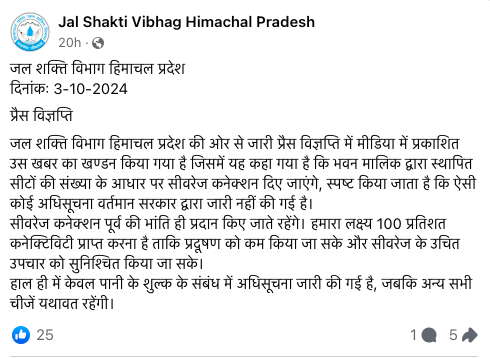
As outrage erupted over the controversial tax notification, the Himachal Pradesh government issued a press statement ‘refuting’ the media reports which said that sewerage connections will be given based on the number of seats installed by the building owner. The Congress government ‘clarified’ that “no such notification has been issued by the present government. Sewerage connections will continue to be provided as before. Our aim is to achieve 100 percent connectivity so as to reduce pollution and ensure proper treatment of sewerage.”

The press statement further claims that the recent notification in question has been issued “only regarding water charges, while all other things will remain unchanged.”

Meanwhile, CM Sukhvinder Singh Sukhu said: “We are charging only Rs 100 per water connection…there is no such thing as a toilet tax in Himachal,” Sukhu told reporters. “This is far from facts. Since there are elections in Haryana, they (BJP) talk about Hindu-Muslim and sewerage but there is nothing like that. It is completely false.”

Did the Congress government impose a toilet seat tax in Himachal Pradesh?

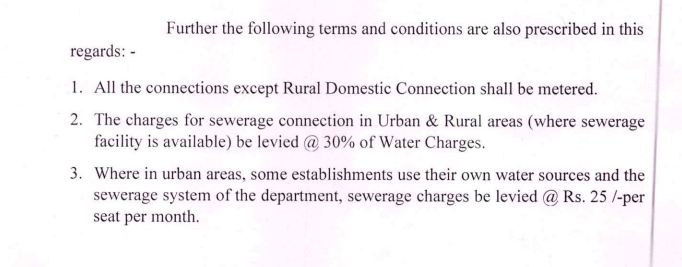
While the Congress government has outrightly denied levying toilet seat tax, its own notification exposes their lies. In a notification dated 21-09-2024 and signed by Raksha Sharma, the deputy secretary (Jal Shakti) to the government of Himachal Pradesh, it is clearly mentioned that in urban areas where residents use their own water sources and the sewerage system of the Jal Shakti department, a tax of Rs 25 per seat per month would be levied.

“Where in urban areas, some establishments use their own water sources and the sewerage system of the department, sewerage charges be levied @ Rs. 25/-per seat per month,” the Jal Shakti Department’s notification reads.

Source: Himachal Pradesh Jal Shakti Vibhag

Thus, it is evident that the Congress government in Himachal Pradesh is lying about its own notification in a desperate attempt to escape embarrassment and criticism. While taking a U-turn or backtracking on a decision taken after outrage is not new, by denying their own notification, the Congress party is setting a wrong precedent in Himachal Pradesh.

Notably, Himachal Pradesh has been grappling with a financial crisis compelling the government to take desperate measures. Last month, it was reported that the Congress government introduced a milk cess and an environment cess on consumers. In addition, the state government legalised cannabis cultivation for medicinal and industrial purposes citing its potential as an economic asset. In July, the Congress government decided to discontinue the free electricity scheme for income-tax payers.  

Matthew Perry death: Doctor pleads guilty to distributing ketamine to actor, agrees to surrender medical license

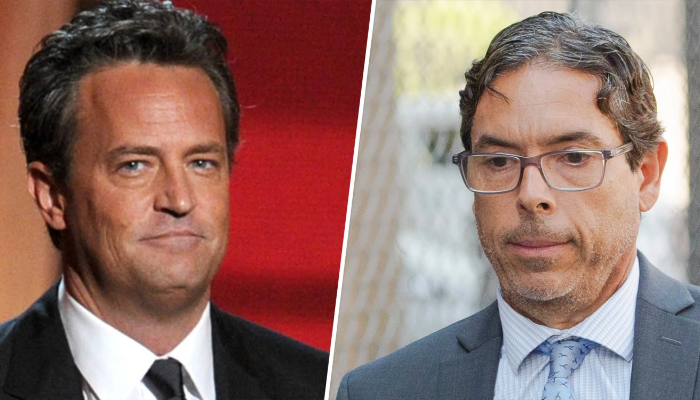
On 2nd October, 54-year-old Dr Mark Chavez from San Diago entered a guilty plea in a Los Angeles court to conspiracy charges about the drug-related demise of actor Matthew Perry. He changed his plea regarding his involvement in distributing the surgical anaesthetic ketamine. Perry, the star of the NBC sitcom Friends, received ketamine lozenges after he sold them to Dr. Salvador Plasencia (42), who ran a ketamine clinic.

A month before his passing, Perry discovered Plasencia, who then reportedly asked Chavez to get the medication on his behalf. The latter indicated that he might be open to creating a ketamine clinic if Plasencia asked him, provided there was no “shady stuff.” “The doctors preyed on Perry’s history of addiction in the final months of his life last year to provide him with ketamine in amounts they knew were dangerous,” U.S. Attorney Martin Estrada revealed while announcing the charges on 15th August.

He will be sentenced on 2nd April 2025 and could spend up to 10 years in prison but the plea enables him to plead guilty to a lesser charge in exchange for his cooperation with the investigation. Chavez who will remain out on a $50,000 bond had already given up his passport and agreed to turn over his medical license, among other conditions. Ketamine was identified in high quantity in the 54-year-old actor’s blood during a post-mortem test, which concluded that the drug’s “acute effects” were the reason for his death. It is used to treat pain, anxiety, and depression.

Chavez acknowledged in his plea deal that he used a fake prescription to get ketamine from a wholesale distributor as well as from his old clinic. He professed to provide nine ketamine lozenges and twenty-two 5-millilitre vials of ketamine. Perry’s aide, Kenneth Iwamasa, allegedly collaborated with the two doctors to give the actor about $50,000 worth of ketamine in the final weeks of his life, according to the prosecution. The two doctors texted one other, reportedly debating how much they might charge Perry for vials of the medicine.

Their texts read, “I wonder how much this moron will pay” and “Let’s find out.” The pair traded at least four vials of ketamin when they met that same day in Costa Mesa, which is midway between Los Angeles and San Diego. Prosecutors informed that Plasencia requested Chavez to continue supplying the drugs so Perry would have a “go-to” source after selling them to Perry for $4,500. Perry began seeking more ketamine than his doctor would provide.

According to Matthew Binninger, Chavez’s attorney, his client was “accepting responsibility” and “incredibly remorseful” for his patient’s overdose. Plasencia, a medical professional from Santa Monica who goes by “Dr P,” has entered a not-guilty plea to one count of conspiracy to distribute ketamine. According to the indictment, Chavez got the ketamine by “writing a fraudulent prescription in a patient’s name without her knowledge or consent, and lied to wholesale ketamine distributors to buy additional vials of liquid ketamine that Chavez intended to sell to Plasencia for distribution to Perry.”

Five people including Chavez are accused about Perry’s death who was found dead in his backyard jacuzzi in his Los Angeles residence in southern California on 28th October 2023. Other people charged concerning Perry’s death include Erik Fleming (54), a friend of the actor who the authorities referred to as a “street dealer,” and Kenneth Iwamasa (60), the actor’s live-in personal assistant. Both are awaiting punishment after entering guilty pleas. Jasveen Sangha (41) dubbed the “ketamine queen” and a suspected drug dealer, is also charged but has pleaded not guilty.

According to a medical examiner’s report, Perry was receiving ketamine infusion therapy to address depression and anxiety. However, at the time of his death, the amount of ketamine in his body was dangerously high, around the same amount required for general anaesthesia during surgery.

“We allege each of the defendants played a key role in his death by falsely prescribing, selling or injecting the ketamine that caused Matthew Perry’s tragic death. Perry’s journey began with unscrupulous doctors who abused their position of trust because they saw him as a payday to street dealers who gave him ketamine in unmarked vials,” highlighted Drug Enforcement Administration chief Anne Milgram.

Perry has battled addiction for many years since his days on “Friends,” when he rose to prominence as Chandler Bing and became one of the biggest performers of the time. He appeared in ten seasons of NBC’s smash sitcom with Jennifer Aniston, Courteney Cox, Lisa Kudrow, Matt LeBlanc, and David Schwimmer. The show ran from 1994 to 2004.

Maharashtra Deputy Speaker Narhari Jhirwal jumps from third floor of Mantralaya, lands on safety net

0

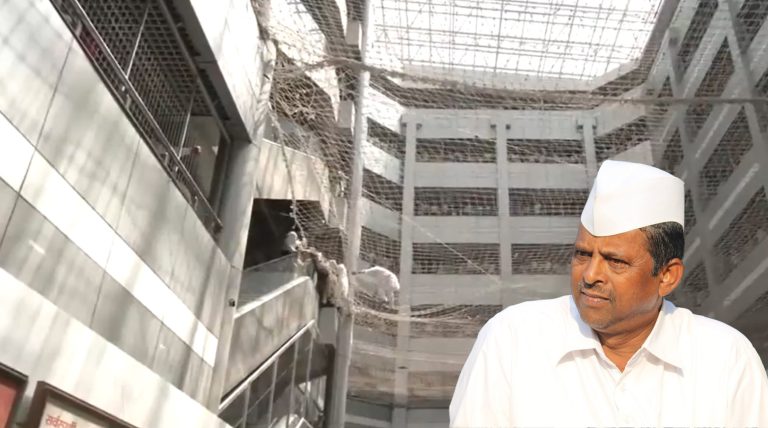
Nationalist Congress Party- Ajit Pawar faction MLA and Deputy Speaker of the Maharashtra Assembly Narhari Jhirwal jumped from the roof of Maharashtra’s Mantralaya on Friday and landed on a safety net.

He allegedly jumped from the third floor of the Mantralaya, the administrative headquarters of the Maharashtra Government in Mumbai.

Jhirwal has been opposing the reservation for the Dhangar community from the Scheduled Tribe quota.

Visuals of the incident shows the MLA along with three other people climbing back inside the building after the safety net blocked their fall from the third floor. Police personnel were also seen in the video footage.

MLAs from the tribal community of Maharashtra protested in the Mantralay on Friday even as a cabinet meeting headed by Chief Minister Eknath Shinde began. Deputy Chief Minister Devendra Fadnavis, Deputy Chief Minister Ajit Pawar and other ministers present for the meeting.

Dhangar community in Maharashtra, which have reservations under the OBC category, are agitating in Pandharpur demading Scheduled Tribe reservation, claiming they are the Dhangad community already listed in the Constitution.


(This news report is published from a syndicated feed. Except for the headline, the content has not been written or edited by OpIndia staff)

‘First murder of 2024’: Instagram post of Delhi minor gets him arrested for shooting Dr Javed Akhtar dead, says was hired by husband of a nurse

0

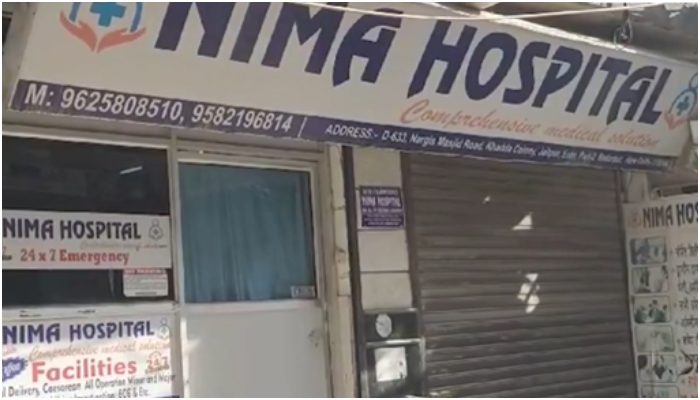
On Friday, 4th October, the Delhi Police revealed a shocking update on the murder case of Dr Javed Akhtar who was shot dead in Nima Hospital late on the night of Wednesday. As per reports, two teenagers who committed the crime were hired by the husband of a nurse working in hospital.

At around 1.45 am on Wednesday, two individuals entered the cabin of Dr Javed Akhtar, a Unani practitioner, and fired bullets at point-blank range.

The Delhi Police have arrested one of the accused persons who reportedly confessed to the police that they were hired by the husband of a nurse to kill the doctor. The Doctor allegedly had an affair with the nurse, and therefore her husband got Dr Javed Akhtar killed.

The minor accused further revealed that he was in love with the nurse’s daughter and that the nurse’s husband had promised him that he would get him married to his daughter if he murdered the doctor.

“The husband suspected an affair between the nurse and Dr Akhtar. The accused teen was in love with the nurse’s daughter. So, the husband promised he would get his daughter married to him if he killed Dr Akhtar,” a Delhi Police officer told the media.

According to a senior police official, the minor also took money from the husband’s ATM account. The police are now questioning the nurse and her husband to verify the claims.

As per police, the accused initially said that he killed the doctor over a monetary dispute, but later revealed the actual motive after further questioning. CCTV footage and eyewitness accounts confirmed that they shot him immediately after entering his cabin without any provocation, confirming that it was a targeted killing.

Notably, police tracked down the suspect through his Instagram account, where he posted a photo with a pistol and boasted, “First murder of 2024.” This led the police to nab him in Hapur. The second accused is still at large and a search operation is on to nab him.

A police officer said, “The police obtained clues about one of the suspects from his Instagram account. After the murder, he posted a story in which he was holding a pistol and claimed to have committed the first murder of 2024”.

“Southern Range Crime Branch has apprehended one juvenile in connection with the murder of Dr Javed Akhtar. The apprehended juvenile admitted his involvement in the crime. Efforts are ongoing to apprehend the co-accused. A team has been dispatched for further investigation,” an official from Crime Branch said.

As reported earlier, two individuals entered Dr Akhtar’s cabin and fired bullets at point-blank range. Reports stated that the two boys had earlier visited the same hospital for a wound dressing. They came back later and asked to meet Dr Akhtar for a prescription.

While inside the doctor’s cabin, they shot him dead. Hospital staff rushed to the doctor’s cabin hearing gunshot wounds and found him in a pool of blood. The boys are said to be teenagers of around 16-17 years. Dr Akhtar was a Unani medicine practitioner.

Nima Hospital is a small nursing home near Nargis Masjid in Khadda Colony under Kalindi Kunj PS area. It is a three-bed setup.

Galathea Bay notified as a major port: Read how Congress is opposing the development of Andaman and Nicobar Islands citing ‘environmental concerns’

0

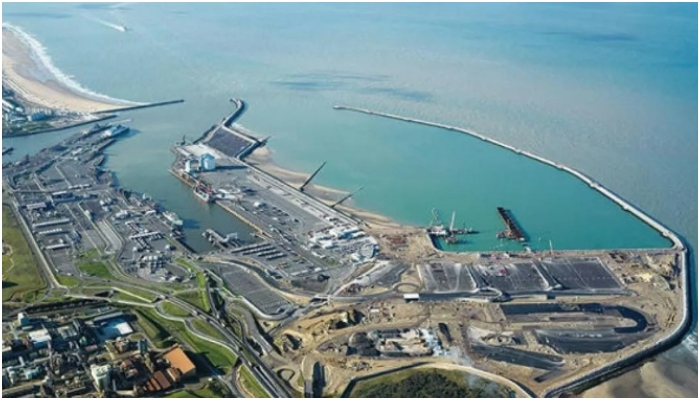
In a significant development leading to the infrastructural growth of the Andaman and Nicobar Islands, the Narendra Modi government has formally recognized Galathea Bay, an international transhipment centre as a ‘major port’. A lot of controversy has been happening over the issue in the past month with the opposition parties led by Congress joining hands with environmental experts claiming catastrophic ecological and human consequences due to the project. However, the government has decided to go ahead with it. It is believed that this action places the Rs 44,000 crore mega project under the administrative control of the Ministry of Ports, Shipping, and Waterways, thus rendering it capable of receiving central funding.

The facility will be developed in four phases, with Phase 1 scheduled to be completed in 2028 and capable of processing 4 million TEUs (twenty-foot equivalent units). When fully developed by 2058, the port is supposed to handle up to 16 million TEUs. This comes one year after the government sought proposals for the transhipment port. For decades, inadequate facilities at India’s ports, along with a lack of deep drafts have hampered maritime logistics. This has lately begun to change, but the absence of a centre for transhipment in the country continues to erode productivity.

What is a transshipment hub and why project at Galathea Bay is important?

As per the reports, almost all major ports on India’s east coast and a few on the west coast lack appropriate depth. Most of these ports have drafts ranging from 8 to 12 meters. In comparison, the depth of berths and waterways in large international ports ranges from 12 to 20 meters, or even higher in some cases. This severely restricts the size of vessels that can enter an Indian port. As a result, relatively small vessels with cargo capacities ranging from 25,000 to 75,000 tonnes, have to operate at these ports disallowing larger vessels, such as Capsize ships, which can carry 165,000 to 180,000 tonnes.

This limitation is becoming more difficult to deal with as the size of boats around the world increases every few years. Transferring a specific cargo or container in a single large vessel is less expensive than transferring it in several smaller ships due to economies of scale, particularly for freight-sensitive goods. Dredging, which is the removal of silt and other material from the ocean floor near channels and ports, can help increase and maintain draft. However, this procedure is expensive, particularly when used to significantly increase a port’s draft, and it has several limits. The other option is transhipment.

Transhipment is the process of unloading goods from one ship and loading them onto another vessel for transport to the final port of discharge. In India, arriving cargo is unloaded from large ships at a transhipment hub and loaded onto smaller ships, which are then transported to ports that cannot accommodate large boats due to their low draft.

Outbound merchandise from Indian ports that cannot handle large vessels is unloaded from small ships at the transhipment hub and transferred to larger ships heading for the destination port. Cargo can travel a significant portion of the journey between the origin and destination ports on a large vessel using this method.

India should no longer rely on foreign ports

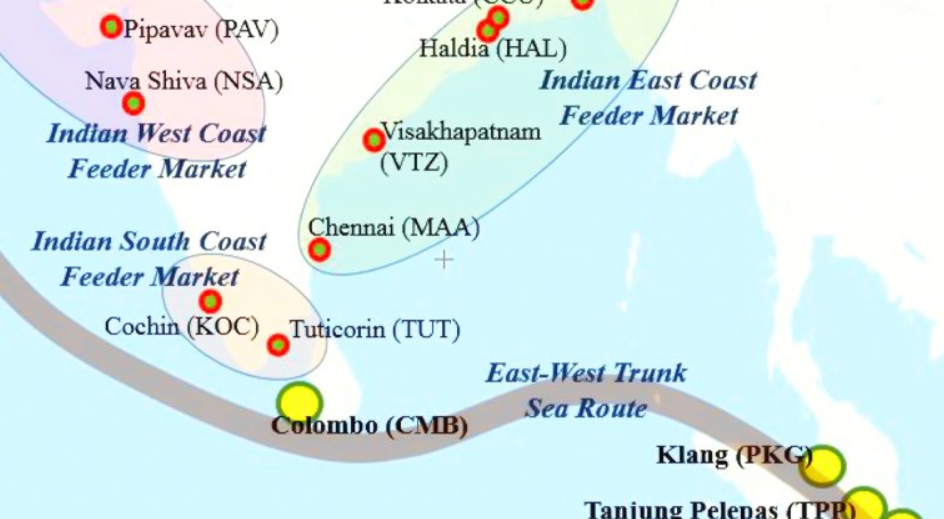
At present, Colombo and Singapore, along with certain other important ports in the region, such as Dubai, serve as transhipment hubs for cargo bound for Indian ports. Nearly 25% of all containers coming from India are transshipped through foreign ports. Colombo, Singapore, and Klang (Malaysia), all foreign ports, handle approximately 80% of this.

This reliance on foreign ports is undesirable for a few reasons. According to research on the Ministry of Shipping’s Sagarmala portal, Indian ports lose Rs 1,500 crore in potential revenue each year from transhipment handling of cargo that originates or is bound for India.

As per a report on the Sagarmala portal, this translates into an estimated total loss of Rs 3,000-4,500 crore to the economy (assuming an economic multiplier of 2-3x for ports). The loss is even higher if the opportunity to handle cargo emerging from other countries in the region is considered. Transhipment increases the costs faced by the Indian sector. Besides that, the unavoidable cost of the feeder journey to and from Indian ports to the transhipment hub, and the cost of handling the shipment at the hub (loading and unloading) is also incorporated into the transshipped cargo.

In India, this is paid at foreign ports. If transhipment hubs are constructed in India, much of this will go to Indian ports, resulting in employment development. Further, as Chinese influence grows through enormous investment in port facilities in the Indian Ocean as part of the Belt and Road Initiative, reliance on foreign ports poses a potential national security risk.

The Chinese already operate a portion of the Colombo port, which accounts for more than 40% of Indian transhipment. Beijing operates the International Container Terminals at Colombo Port, contributing to 40% of total container movement in the island country in 2019. It has also spent billions of dollars on port infrastructure, including new business and residential zones known as Port City Colombo.

Image- Logistics Insider

About the transshipment hub being built at Galathea Bay

Despite India’s public concerns, Sri Lanka has been obliged to make concessions to China, such as allowing its intelligence-gathering ships to dock. With Colombo growing reliant on Beijing for debt relief,  the need for New Delhi to reduce this dependence has never been greater. Galathea Bay on Great Nicobar Island, where the proposed transhipment hub may be built, has a depth of 18 to 20 meters, making it suitable for huge ships. The bay has a rocky floor preferably suitable for the project. 

The island borders the East-West Sea Route, one of the world’s busiest maritime commerce routes, and is roughly equidistant from the present transhipment hubs of Colombo, Port Klang, and Singapore. The island is approximately 8 nautical miles away from the route. According to this news report, the shipping diversion time to the proposed port will be less than an hour, while it is four hours to Kochi and eight hours to Thoothukudi. The East-West Sea Route serves some of the fastest-expanding global economies, including Vietnam, Indonesia, Myanmar, and Bangladesh.

It is strategically located near the mouth of the Malacca Strait, which connects the Indian and Pacific oceans. Every year, around 100,000 vessels travel through this tiny stretch of water, accounting for roughly one-quarter of global trade.

The projected port can compete with the Port of Singapore for cargo originating in and headed for Bangladesh and Myanmar. Currently, over 70% of cargo from Bangladesh and Myanmar is transshipped through Singapore. The Great Nicobar Island is closer to Bangladesh and Myanmar than Singapore, reducing the distance travelled on the feeder route to the transhipment hub and so lowering costs.

Why the said project is being opposed

The Indian National Congress, India’s major opposition party, has joined environmentalists and former officials in criticizing the development of the Great Nicobar Island, claiming it could have catastrophic ecological and human consequences. Despite unresolved disagreements over clearances given, the national government is moving forward with the project.

Great Nicobar’s holistic development plan includes building an international container transhipment port along with an airport, gas, and solar power plant, and township on the isolated island costing Rs. 81,000 crore and roughly a million trees.

Legal proceedings in a case challenging the project’s environmental clearance disclosed that the National Centre for Sustainable Coastal Management (NCSCM), an autonomous body assigned to supporting coastal management, concluded that the project no longer fell in a no-go fragile coastal zone, potentially facilitating port development at the hands of the centre. 

A beforehand mapping effort by the NCSCM had discovered that elements of the project, including the port, were located in the ecologically most sensitive CRZ 1A zones, where most development activities are forbidden. The NCSCM’s recent conclusion, however, notes that the project area is located in the CRZ 1B zone, an intertidal zone where ports and harbours are permitted.

Considering the continuing case in the National Green Tribunal, T. K. Ramachandran, secretary of the Ministry for Ports, Shipping, and Waterways, informed the media on August 4th that there was no hurdle in its implementation, and that the government would proceed with the project.

In a letter to Environment Minister Bhupender Yadav on August 10th, Congress leader Jairam Ramesh urged existing clearances for the project should be suspended and thoroughly and impartially reviewed, including by the Parliamentary committees concerned. Ramesh identified various flaws in the procedures that laid the groundwork for the project, including violations in getting approval from indigenous communities.

A petition filed by environmentalists stated that the project violated coastal area laws

In late July, the Andaman and Nicobar Islands Integrated Development Corporation Limited (ANIIDCO) submitted an affidavit to the National Green Tribunal based on which the NCSCM revealed its conclusions. The project’s implementing agency, ANIIDCO, was responding to a review petition filed by Ashish Kothari, an environmental activist.

The petition argued that the project violated the Island Coastal Regulation Zone announcement in 2019 since about seven square kilometres of the project fell in a CRZ 1A region. This includes 0.63 square kilometres of port and port reclamation, 0.6 square kilometres of airport, and the majority, 5.84 square kilometres, of projected townships. The petition asked that the project exclude these areas.

According to the notification, CRZ 1A regions shall be protected from large development since they contain mangroves, corals, coral reefs, and sea grass, and serve as nesting sites for birds, turtles, and other delicate ecosystems. CRZ 1B areas are likewise ecologically fragile, however, they are intertidal zones that allow for the construction of ports and harbours under particular conditions.

Last year, the National Green Tribunal acknowledged that there were some unanswered deficiencies in the government’s approach to the development project. It formed a High Powered Committee (HPC) led by the Union Environment Ministry to review the environmental clearance granted to it. The HPC’s results were never made public for security concerns. However, in its affidavit, ANIIDCO stated that the HPC approved the results of a ground-truthing investigation conducted by the National Centre for Sustainable Coastal Management, which concluded that the project did not fall under the 1A category.

The proposed port can compete with the Port of Singapore for cargo originating in and bound for Bangladesh and Myanmar. Singapore handles more than 70% of all goods from Bangladesh and Myanmar. The Great Nicobar Island is closer to Bangladesh and Myanmar than Singapore, reducing the distance travelled along the feeder route to the transhipment hub and so saving prices.

Odisha: Mohammad Masoom Khan occupied 100 acre forest land to build Islam Nagar, built NREGA road and other infrastructure with the help of BJD govt

The name of a man linked to Biju Janata Dal (BJD) has emerged in a case of illegal occupation of forest land in Odisha. As per reports, Mohammad Masoom Khan seized around 100 acres of forest land in the tribal-dominated Motu area of the Malkangiri district and established Islam Nagar. Khan reportedly had support and encouragement from the previous BJD government as his illegal actions created a vast empire. Moreover, allegations of cooperation between the BJD and Masoom Khan have surfaced. The forest department’s Malkangiri division has launched a probe in response to these developments.

Masoom Khan is believed to be close to former Lok Sabha MP and senior BJD leader Pradeep Kumar Majhi. Khan has participated in multiple political events arranged by the party and pictures of him have recently gone viral on social media. He is also seen with Majhi in many photographs doing the rounds online.

The forest department has now initiated action by taking appropriate measures. The local ranger was alerted and given instructions to carry out an investigation and submit a report after receiving the complaint, according to Priyanka Mahuka, the Assistant Conservator of Forests in the Malkangiri district. The results of the local ranger’s inquiry will indicate whether further action needs to be taken.

BJP demands action against the accused, terms it land jihad

Bharatiya Janata Party (BJP) Malkangiri MLA Narsingh Madkami charged that BJD leaders assisted Khan. He stated that over 100 acres of forest land had been encroached upon and brought up the name of former Nabarangpur MP Pradeep Majhi and his close association with Khan. According to Madkami, the BJD leader has engaged in illegal acts to create Islam Nagar in the Motu region. He stated, “Violating the Forest Act, more than 100 acres of forest land has been encroached by local BJD leader, Mausam Khan, a close associate of former Nabarangpur MP Pradeep Majhi, to establish Islam Nagar in Motu area in the tribal dominant Malkangiri district.”

He hit out at BJD leaders and added, “It is shocking that the name of traditional Baribancha village has been renamed as Islam Nagar. Several illegal buildings, warehouses, roads and ponds have been constructed in the illegally acquired area by using the Mahatma Gandhi NREGA (National Rural Employment Guarantee Act) fund. Furthermore, large transformers have been installed by the electricity department. All these illegal activities occurred during the previous BJD Government’s regime.”

The BJP MLA demanded a thorough investigation into the matter and maintained that the responsible parties must face severe consequences. According to local BJP leaders in Malkangiri, political backing is required to cut trees, take over 100 acres of forest land and erect massive high-rise structures. Furthermore, they highlighted that similarly, political support is necessary for the construction of a sizable reservoir using funding from the Agriculture and Fisheries Department, a road under the Mahatma Gandhi NREGA scheme, and a sizable transformer installed by the Electricity Department.

They asserted that the BJD, specifically former MP Pradeep Majhi, have completely shielded and fostered this massive criminal operation. The BJP leaders accused that the administration has disregarded these acts for political purposes and aided as well as abetted this unlawful venture. “We implore Mohan Majhi’s administration to look into this case thoroughly and take decisive action against individuals involved, especially in light of the recent change in government,” they expressed.

Anil Biswal, the state spokesperson for the BJP, clarified that the issue pertains to land jihad. He underlined that strict measures are being put in place by the BJP governments in Uttarakhand and Assam, who have taken a tough stance against it. He assured that the Odisha government will follow the same policies as the BJP-led administrations in Assam and Uttarakhand.

He suspected that it was a long-term plan to create Islamnagar by forcibly occupying forest territory in a predominantly tribal region and promised that the administration of Chief Minister Mohan Majhi would safeguard the interests of the indigenous people. He further noted that this occurrence shows that, in spite of their commitments to support tribal interests, Congress and BJD are actually anti-tribal.