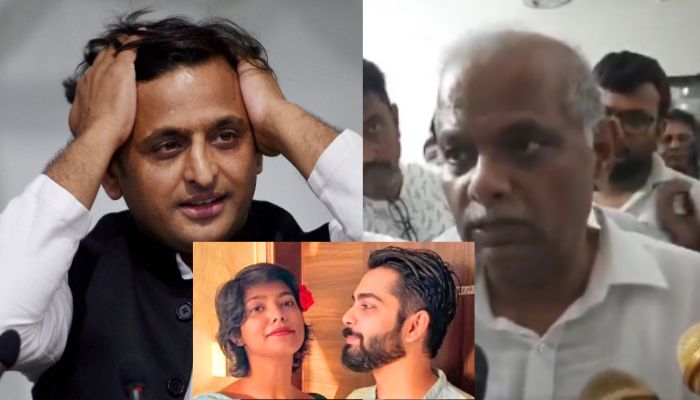
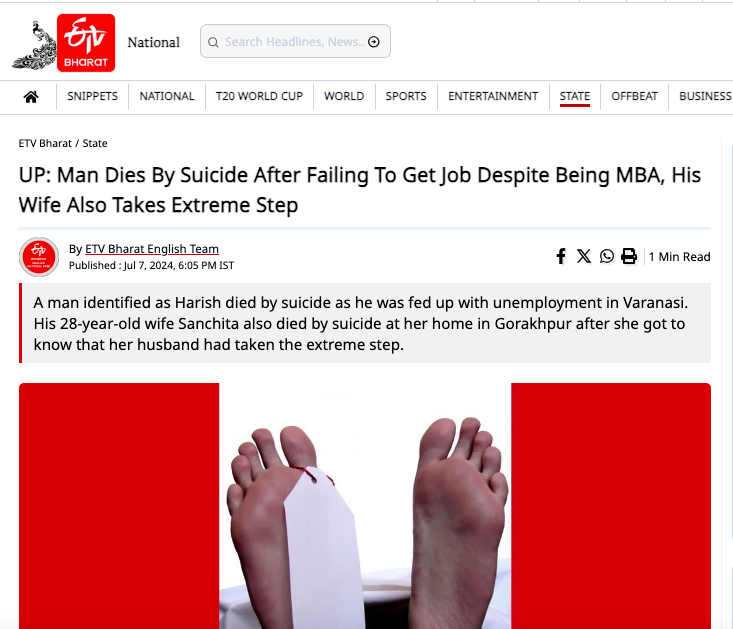
In a shocking incident in Uttar Pradesh, fashion photographer Sanchita Sharan allegedly committed suicide after receiving information that her MBA graduate husband Harish Bagesh hanged himself in a hotel room in Varanasi. While the reason for Harish’s alleged suicide remains a mystery, Samajwadi Party supremo Akhilesh Yadav resorted to using the couple’s tragic end for his political gains.
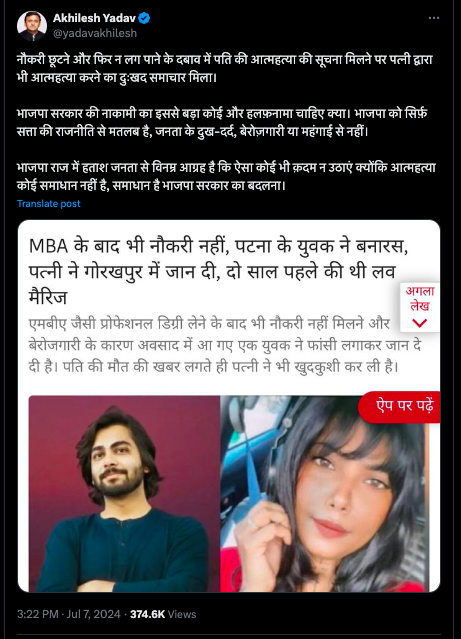
Akhilesh Yadav claimed that 28-year-old Harish Bagesh committed suicide due to the pressure of losing his job and failing to get another. Yadav went on to drag the ruling BJP into this to claim that the couple’s suicide is an affidavit of BJP’s failure in Uttar Pradesh and that it is not concerned about unemployment or inflation.
In an X post on 8th July, the Samajwadi Party leader posted, “After receiving the news of the husband’s suicide due to the pressure of losing his job and not being able to get another, we received the sad news of the wife also committing suicide. Do we need any bigger affidavit than this for the failure of the BJP government? The BJP is only concerned with the politics of power, not with the pain and suffering of the people, unemployment or inflation. This is a humble request to the people who are frustrated in the BJP rule, that they should not take any such step because suicide is not a solution, the solution is to change the BJP government.”
Similar claims were made by several social media users and opposition-friendly ‘journalists’ including one Ranvijay Singh. In an X post, Singh claimed that Harish committed suicide after getting fed up with unemployment. “This is Sanchita and Harish. They got married 2 years ago. Harish had done his MBA, then he lost his job. Despite a lot of searching, he could not find a job. Now the news is- Harish, fed up with unemployment, committed suicide in Banaras. Upon hearing this news, wife Sanchita committed suicide at her home in Gorakhpur. In the year 2022, 15,783 people in the country committed suicide due to unemployment.
ये संचिता और हरीश हैं
2 साल पहले इनकी शादी हुई. हरीश ने MBA किया था, फिर नौकरी छूट गई. बहुत खोजने पर भी काम न मिला.
अब खबर है- हरीश ने बेरोजगारी से तंग आकर बनारस में आत्महत्या कर ली.
ये खबर जानकर पत्नी संचिता ने अपने घर गोरखपुर में आत्महत्या कर ली.
Sanchita Sharan’s father refutes Akhilesh Yadav’s “suicide over unemployment” claims
Speaking to the media on Monday, July 8, deceased Sanchita Sharan’s father Dr. Ram Sharan refuted the claims made by Akhilesh Yadav and said that the Samajwadi Party leader is doing politics over the couple’s suicide. Sharan said that Harish was doing a job in Mumbai and had around Rs 1 lac per month salary and that it was he who called Harish back to Gorakhpur since the old couple (Sanchita’s parents) were alone here and their son was residing in the UK.
“This is Akhilesh Yadav’s pure politics. This [unemployment] had nothing to do with this [incident]. Harish was doing a job and had a salary above Rs 1 lac in Mumbai. I brought him back here since here two old people [Dr. Sharan and his wife] were alone. My son is residing in UK. So I asked Harish to come here and do some work. So this [Akhilesh’s claim] is baseless…” Ram Sharan said.
Speaking about incidents before Harish’s alleged suicide, Ram Sharan said that Harish Bagesh informed Sanchita on Friday (5th July) that he was leaving for Patna, and Sanchita dropped him off at the railway station the following day. He said that the couple last talked on Saturday evening.
On Sunday morning, police told the family that Harish was found hanged in a hotel room in Atal Nagar Colony, Sarnath, Varanasi. When Sanchita received information about Harish committing suicide, she called him.
Dr Sharan informed the police that as he was about to depart for Varanasi, Sanchita told her father that she could not live without Bagesh and jumped from the building’s second floor.
Superintendent of Police (city) KK Vishnoi said on Monday that the bodies had been sent for post-mortem examination. The officer said that further action in the case will be taken based on the findings of the autopsy report.
Notably, some media reports had also claimed Harish committed suicide due to frustration over unemployment. These reports claimed that the deceased couple could not find a new job after returning from Mumbai where Harish worked in HDFC Bank while Sanchita was residing in the city for the last twelve years. Reports say that while Sanchita’s family had no objection to the couple’s union, Harish’s father was not happy about it.
It has been claimed in media reports that Harish for some reason had slipped into depression and the couple became addicted to drugs. It is said that Sanchita was also unwell and had reportedly developed drugs addiction. This had caused further emotional distress in their lives in addition to financial crunch. The police found narcotics [ganja], cigarettes, a lighter, a mobile, a purse and the rope used for hanging in his room.
Notably, Harish and Sanchita had tied the knot in 2022. The duo studied in the same school and fell in love when they were in 11th standard.
While the investigation in the case is ongoing, by attributing the suicide to unemployment and consequently blaming the government, Akhilesh Yadav is politicizing a personal tragedy. This seems to be an attempt to leverage the situation for political gain rather than expressing concern for the affected families. Speculative statements can mislead the public and add to the grief of the bereaved families. Anyone, especially opposition leaders should await the results of a thorough investigation before attributing causes to such tragedies.
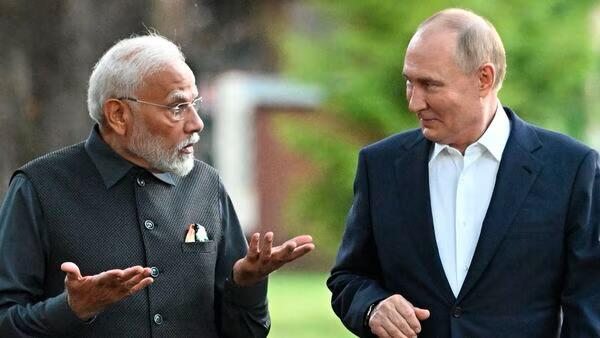
Russia has reportedly agreed to release and facilitate the return of all Indians fighting for the Russian army in Ukraine. This breakthrough followed Prime Minister Narendra Modi’s discussion with President Vladimir Putin during his visit to Moscow, an IANS report quoting sources said.
PM Modi, currently in Moscow for a two-day visit, raised the issue at a private dinner hosted by Putin on Monday evening, the report said. Nearly two dozen Indians had reportedly been coerced into fighting in the war against Ukraine after being deceived by agents promising high-paying jobs.
In March, the Indian government announced they had “strongly” addressed the matter with Russian authorities to expedite the discharge of these individuals. “Strong action has been initiated against agents and unscrupulous elements who recruited them under false pretences,” officials stated.
Reports indicate that four Indians have died in the conflict, while 10 have returned to India. Approximately 35–40 Indians are believed to still be in Russia. The situation of Indians forced to fight in the Ukraine war remains a significant concern for New Delhi.
Recent reports have highlighted the plight of Indians who fell victim to job fraud and were coerced into joining the Russian army, which accepts foreign recruits. Some of these individuals have shared their experiences on social media, pleading for government intervention.
India’s Foreign Ministry has been working diligently to repatriate those misled by agents. Foreign Minister S. Jaishankar emphasised that this issue is of “very deep concern” for India, and has been in talks with Russia for several months to make progress.
Earlier this year, two Indians from Gujarat, Ashvinbhai Mangukiya and Mohammad Asfan, were reported killed in the Ukraine conflict, with two more deaths reported in June. India has consistently maintained that recruiting Indian nationals into the Russian army during a conflict is incompatible with the India-Russia diplomatic partnership, calling for the early release and return of these individuals, and demanding an end to such recruitments in the future. The breakthrough during PM Modi’s visit is expected to bring significant relief to the families of those still in Russia.
PM Modi arrived in Moscow on Monday evening, marking his first visit to the country since the war against Ukraine began. Russia’s First Deputy PM Denis Manturov welcomed him at the airport. The Prime Minister is scheduled to hold bilateral talks with Putin on Tuesday and attend the 22nd India-Russia summit in Moscow. This visit is PM Modi’s first since his re-election for a third term, as he balances maintaining a longstanding relationship with Moscow while strengthening Western security ties.
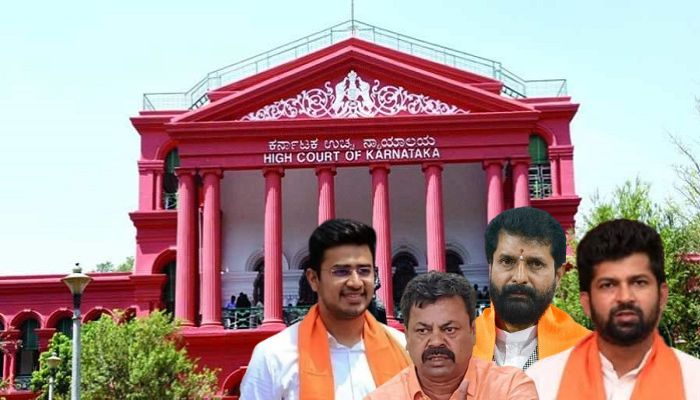
On Tuesday (9th July), the Karnataka High Court dismissed a PIL filed by a civil contractor against state BJP leaders for allegedly making hate speeches. The court came down heavily on the petitioner observing that the PIL appeared to be “politically motivated”. The court also slammed him for misusing the platform of the High Court and wasting the court’s time by filing such pleas, as reported by Live Law.
Notably, the petitioner Mohammed Khaleeulla had stated that he came across the alleged speeches through social media platforms. Through his petition, he sought action against state BJP leaders including MP Renukacharya, CT Ravi, Tejasvi Surya, and Prathap Simha for allegedly making hate speeches.
The Karnataka High Court today dismissed a PIL filed by a civil contractor, seeking action against several state BJP leaders for allegedly making Hate speeches.
Petitioner claimed he came across the alleged speeches through social media platforms.
The division bench headed by Chief Justice NV Anjaria heard the petition. According to the bench, the allegations were too general and lacked authentication. Additionally, it pointed out that the PIL appeared to be “politically motivated” and slammed the petitioner for “misusing” the platform of the High Court.
While dismissing the plea, the court asserted, “Why are you misusing the platform of the High Court by filing such petitions? Why are you wasting the time of courts by filing such petitions with omnibus prayers?”
The bench noted that filing of such a petition smacks of political motive other than public interest and a petition of this nature cannot be entertained as PIL.
Petitioner Mohammed Khaleeulla had approached the court relying on the guidelines issued by the Supreme Court in connection with hate speeches in the ‘Tehseen Poonawalla’ case.
In his petition, Khaleeulla had also urged that the bench issue directions to the government to broadcast on TV, radio, and other media platforms and official websites of the State Home Department and Police that hate speech, mob violence, and mob lynching shall invite serious consequences.
The petitioner further urged that the government should take suo-moto action and register cases against individuals who allegedly make hate speeches and create enmity between the two communities.
In his plea, Mohammed Khaleeulla wanted that a designated court in each district should try hate speeches and lynching cases daily and they should conclude the trial within 6 months from the date of cognizance, as stated in the Supreme Court guidelines.
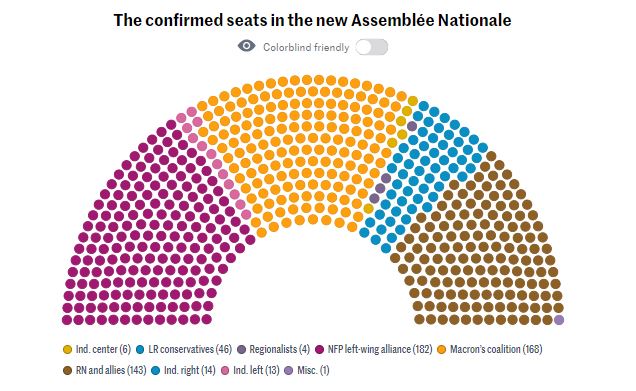
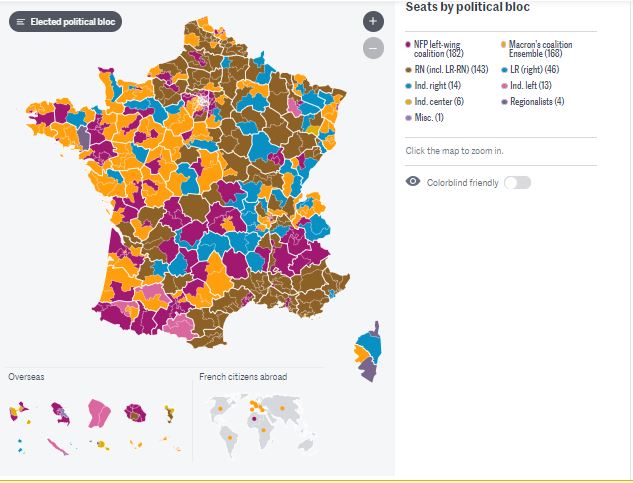
The snap elections in France have resulted in a surprise win for the hurriedly stitched-together leftist umbrella alliance, the National Popular Front (NPF). According to a CNN report, NPF has won the largest share of seats and secured 182 seats. However, the leftist group fell far short of the coveted 289 seats, the halfway mark in the 577-member National Assembly. President Macron’s Centrist Ensemble Alliance came in second place, winning 163 seats. In a shocking reversal of the first-round victory for the resurgent conservative bloc, Marine Le Pen’s National Rally and allies won 143 seats.
(Image Source – Le Monde)
(Election results across France and its oversees territories, Image Source – Le Monde)
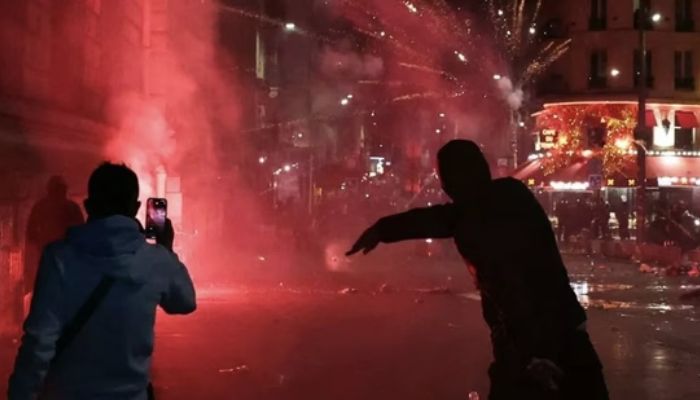
Despite the shock victory for the left supported by them, Antifa extremists have carried out large-scale violence in several prominent areas and streets in France, especially in Paris. Hordes of Antifascist group (Antifa) – Jeune Garde (“Young Guard”), leftist, and pro-Palestine demonstrators carried out acts of vandalism, rioting, and arson. They clashed with riot Police in several areas to celebrate NPF’s victory, and to celebrate the shocking upset for the National Rally and its allies which was earlier projected to take the lead in the National assembly.
Islamists and Antifa celebrate election victory in France with looting, devastation and attacks on police. They want to destroy France. pic.twitter.com/KSb9uPy3qp
Reportedly, many ‘victory gatherings’ by NPF supporters saw more Palestinian flags than French flags with the mob chanting Pro-Palestinian slogans. The celebrating mobs also ransacked and defaced several iconic places with Antifa graffiti in Paris.
Extremist groups in France carry out violence in garb of protecting democracy, the constitution, and rights of the minorities
It is pertinent to note that the Antifa group ‘Young Guard’ and leftist mobs had earlier threatened to carry out large-scale violence and rioting if the conservative parties won the snap elections.
Hours before the results were announced, in anticipation of left-wing violence following a win for National Rally and its allies, several high street stores in Paris and elsewhere were seen boarding up their stores with wooden, plywood, or metal frames to protect their shops from theft and vandalism. However, as per reports, the extremist groups carried out violence throughout the week, and post-election verdicts. Ironically, the left-wing violence continued under the garb of ‘protests’ to “safeguard” virtues like minority rights, democratic values, the constitution, and the country, France, from conservatives that were gaining unparalleled popular support.
Macron’s tactic alliance with Leftist bloc holds the “dam” against Marine Le Pen’s imminent victory
French President Emanuel Macron had been urging the voters to reject the conservative forces ever since he called a snap election in the country. During the three-week campaign, he focused his attacks against the political extremes, particularly the right/conservative. Macron went further to claim that the conservative alliance could set France on a path to civil war. On Wednesday (26th June), the Macron government banned multiple extreme right and radical Muslim groups including a group called Jonas Paris, which it said claims to support France’s Muslim community but instead promotes violence, hate, and discrimination toward non-Muslims, women, and LGBTQ+ people.
Despite the divided yet highly rhetorical election campaign by centrist and leftist blocs against Marine Le Pen’s National Rally-led conservative force, the latter won big in the first round. Across France, 76 candidates secured seats in the first round, including 39 from Le Pen’s National Rally, 32 from the leftist New Popular Front alliance, and two candidates from Macron’s centrist list.
Notably, National Assembly elections in France are held in two rounds. After the conservative bloc secured nearly 1/3rd of all the votes polled and became the largest group in the first round, a major victory for the National Rally-led conservative alliance was projected as an imminent outcome. Sensing the threat from Le Pen’s victory in the first round, Macron’s centrist Ensemble alliance reportedly extended tactic alliance to the leftist bloc, NPF.
Incidentally, Macron helped the left in achieving the Front républicain – French phenomenon when voters united forces to defeat the conservative bloc. Immediately after the announcement of the results of the first round on 30th June, France Unbowed founder Jean-Luc Mélenchon announced that the “NFP had a plan” – building a “front” or “dam” against the conservative bloc which was largely followed by Macron’s alliance as well.
As per French media, both the centrist and leftist alliances issued appeals to their voter base to elect better-placed political rivals so that they could keep the National Rally out of power. According to a report in Le Monde, around 218 candidates who made it to the second round, didn’t compete in the second round. These included around 130 candidates from the left alliance and 82 from the Macron-led centrist alliance Ensemble. Reportedly, this included several Cabinet Ministers who abandoned the race to stop National Rally’s victory.
During the campaign trail, Macron’s party leader and French Prime Minister Gabriel Attal said, “I need to prevent the National Rally from achieving an absolute majority in the National Assembly because it would be — and I say it from the bottom of my gut — it would be terrible for the country and the French.”
Ironically, while Macron claimed to be against extremists on both sides of the political spectrum, his party ended up helping the ultra-left, Antifa, and extremist elements on many seats.
FRANCE ??
Raphaël Arnault, the French Antifa leader classified as a state threat by security services, has been elected as a Member of Parliament. pic.twitter.com/z3AnTSfwsh
Evidently in the Avignon constituency, Antifa leader Raphaël Arnault defeated the outgoing National Rally MP Catherine Jaouen with the help of a tactic alliance. Arnault is an S-listed candidate, a classification which is reportedly used for persons who could be a security threat to the nation and are kept under strict watch. He is the founder and spokesperson for the anti-fascist movement “La Jeune Garde” which is notorious for violent and antisemitic attacks in recent years.
✅ Les 30 juin et 7 juillet, mobilisation générale ! Nous pouvons changer la vie et écrire l'histoire ! pic.twitter.com/Bd69ZBY0Wy
— La France insoumise ? #NouveauFrontPopulaire (@FranceInsoumise) June 14, 2024
Arnault was the controversial candidate from La France Insoumise (France Unbowed) and the New Popular Front in the constituency of Avignon. Philippe Pascal, a candidate supported by the rest of the left and who came third with 18.27% of the vote, extended his support to the Antifa leader.
‘Our victory has been merely delayed’: National Rally leader Marine Le Pen
Despite getting fewer seats than expected, the conservative party has won the largest number of seats in its history. Party president Jordan Bardella slammed the Republican Front as a “disgraceful alliance” that was cooked up behind closed doors to keep his party from power.
As for Marine Le Pen, she will be running again as the National Rally presidential candidate in the 2027 elections. It has only taken her party closer than ever to the president’s office. She said, “Our victory has been merely delayed.”
Speaking to his supporters near Stalingrad Square, Jean-Luc Mélenchon, the leader of France Unbowed, said that the results came as a “huge relief for the overwhelming majority of people in our country.” He called upon Macron to form the government with the support of the left bloc as they are “ready to govern”.
However, Macron and his aides have asserted that they will be “waiting for the National Assembly to organise itself” before the President makes any decisions as to who he’ll appoint as the country’s next prime minister.
Political instability in France could lead to an economic downturn and the spread of radical extremism
While the results of the snap elections have given a hung assembly, France can’t call a new election for at least another year. However, after becoming the largest bloc, leftist group, NPF could start implementing its ‘economic policy’ which could throw France behind by several years, if not decades.
Notably, the left bloc was to do away with President Macron’s pro-business reforms. It promised to raise the minimum wage, scrap Macron’s pension reform, lower the retirement age, and put a price cap on basic goods to fight France’s worsening cost-of-living crisis. Incidentally, their plan would be financed by overhauling the tax system in France. This will include reinstating the wealth tax that was abolished by President Macron. Additionally, they would levy a windfall tax on corporations to pay for an increase in social spending.
The leftist agenda, however, could upset high-networth individuals, forcing them to leave the country to avoid high tax rates.
Meanwhile, on the foreign policy front, the NPF has pledged to “immediately recognize” a Palestinian state, and push for a cease-fire in Gaza.
The NPF will double down against Marine Le Pen and placate its Antifa and leftist vote bank
The NPF alliance will also double down against Marine Le Pen who was gaining popular support for her anti-immigration stance. Incidentally, she had also promised to raise consumer spending power, slash immigration, and take a tougher line on European Union rules. She also wanted to boost police powers and curtail the rights of French citizens with dual nationality to work in some defense, security, and nuclear industry jobs.
However, her opposition succeeded in stopping her from what they believed she could have done to curtail the civil liberties of several ethnic groups and build hostility to France’s Muslims. According to reports, Le Pen recently spoke about a potential ban on the Muslim headscarf.
She said that she is still in favour of banning the headscarf in public but that the official decision warrants “presidential authority.” She said, “There are a number of issues regarding Islamist ideologies and the headscarf is only one of them.”
Already, the leftist with the support of the centrist bloc has gained huge success in mainstreaming leftist and Pro-Palestine extremists as well as bolstering the Antifa group, Young Guard.
Chaos, in-fighting between NPF and possible “Cohabitation” phase in France
It is pertinent to note that the New Popular Front (NFP) did not exist a month ago. While it has become the largest political front, it has several contradictions and infighting among the alliance partners including on key issues of the Prime Ministerial post.
Notably, the NPF coalition includes several political parties namely the far-left France Unbowed party; the more moderate Socialist Party; the green Ecologist Party; the French Communist Party; the center-left Place Publique, and other small parties. It was formed just a few days after President Macron called a snap parliamentary election.
Regarding the PM post, NPF leader Raphael Glucksmann publicly said that he does not want the divisive NPF leader and founder of the largest party in the bloc, France Unbowed, Juan Mélenchon in the role. Incidentally, he himself has ruled out running for the post but media reports have included him in the race.
Similarly, Greens leader Marine Tondelier, herself a strong performer throughout the campaign, has also said Mélenchon will not be in the running.
Apart from the PM post, the NFP alliance partners have a range of issues and insurmountable disputes regarding governance.
It is pertinent to note that France could be heading towards a phase known as “Cohabitation” in France when the President and Prime Minister hail from different parties/alliance blocs. Pertinently, while calling for snap elections, Macron had ruled out the possibility of stepping down from the presidential post before his term ends in 2027, which means he will continue to remain the French President for the next three years when his second and final tenure ends.
Evidently, the National Assembly is more powerful in France on issues of legislation. During the period of ‘Cohabitation’, the President enjoys power over issues like Foreign Policy, defense, and issues concerning European Union, however, he has no or lesser power on domestic issues. However, leaders from Macron’s party have repeatedly said that they would refuse to work with France Unbowed, saying it is just as extreme — and therefore as unfit to govern — as the National Rally.
Since the beginning of the Fifth Republic, France has seen a period of cohabitation thrice. Once during socialist president François Mitterrand, between 1986 and 1988. Then again between 1993 and 1995. The third time it happened under President Jacques Chirac between 1997 and 2002. But on all three occasions, the right or the left had an absolute majority in the Assembly, unlike this time.
France which had been known for leading Europe is heading towards not just political instability but also a major upheaval in its economic and social order with fissures and conflict between the growing extremist groups leading to more protesting and rioting. Amidst concern about rising extremism and violence in Europe, France could end up becoming the den for radical elements under the regime of a pro-immigration leftist bloc.
While the rising Right groups in Europe have taken a tougher stance against immigration of criminal elements, France which had been marred by radical attacks, and terror threats at its major centers, could see increased instances of such attacks including blasphemy-related Charlie Hebdo like cases and increased censorship on Freedom of Speech. Additionally, the P5 member of the UN could go insular during the period of “Cohabitation” and divided Parliament, leading to the diminishing stature of the country on the global stage.
Indian news agency Asian News International (ANI) has filed a Rs 2 Crore defamation suit against online encyclopedia Wikipedia in Delhi High Court saying that Wikipedia has been allowing defamatory edits to ANI’s page on the platform. The Delhi High Court issued summons to Wikipedia in the case on Tuesday, July 9.
The Wikipedia entry for ANI says,”The news agency has been criticized for having served as a propaganda tool for the incumbent central government distributing materials from a vast network of fake news websites and misreporting events.” Following this, ANI filed the defamation suit saying that the description is defamatory and that the platform was not allowing edits on its page to change the description.
Appearing on behalf of ANI, Advocate Sidhant Kumar submitted, “They have closed my (ANI’s) page for editing by anyone and can only be edited through their representatives.” He argued that Wikipedia is allowing only selective edits on their page.
Sidhant Kumar submitted, “This malicious conduct of the Defendants ex-facie establishes their ulterior motives of defaming Plaintiff by publishing false and misleading content against Plaintiff.”
The plea argued that Wikipedia has tarnished the reputation of ANI among general public and the industry leading to harassment of the plaintiff from the public. It further added that damage continues to be inflicted on the ANI page with false and defamatory content without the ability to modify or edit the same.
.Hearing the plea, Justice Navin Chawla issued notice on ANI’s interim relief plea as well and listed the matter for further hearing on August 20.
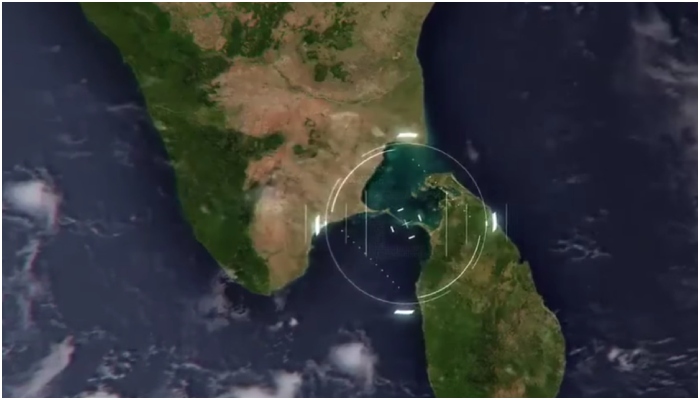
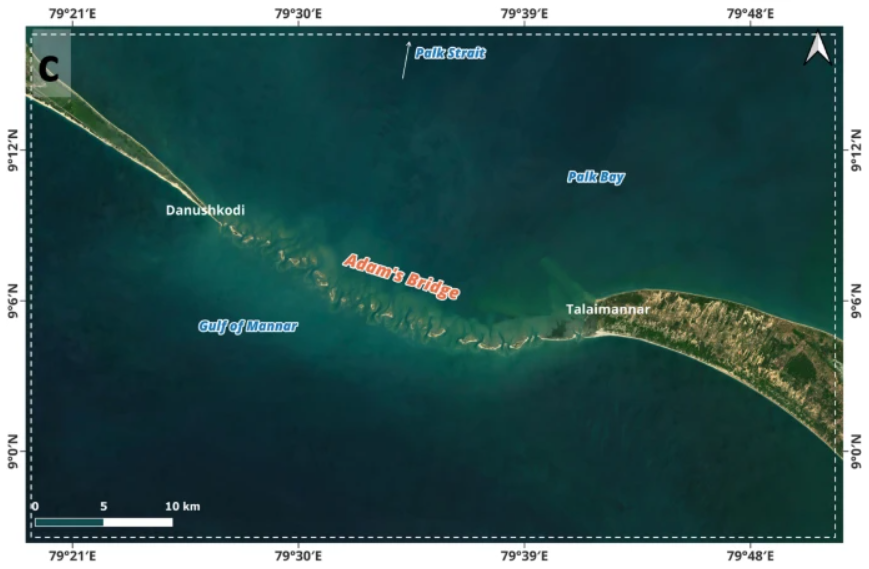
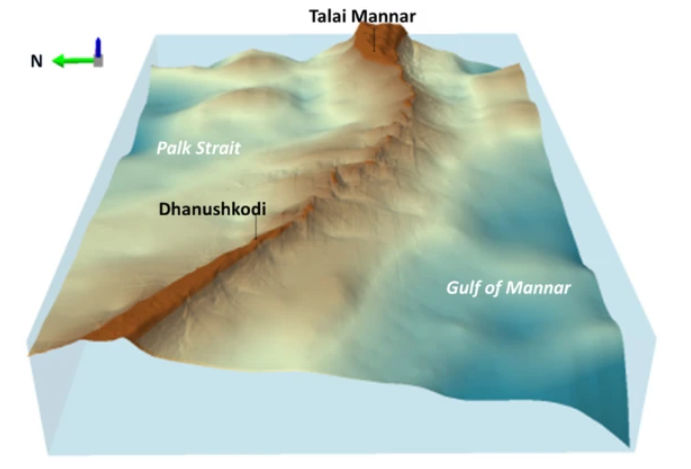
Scientists from the Indian Space Research Organisation (Isro) have created the most precise undersea map yet of Adam’s Bridge widely known as the Ram Setu, proving the submerged ridge as a “continuity” from Dhanushkodi in India to Talaimannar in Sri Lanka.
The surveying exercise used a US satellite to reflect laser beams off the sea floor, demonstrating that 99.98 percent of the Ram Setu, a 29-kilometer stretch of limestone shoals, is buried in shallow waters.
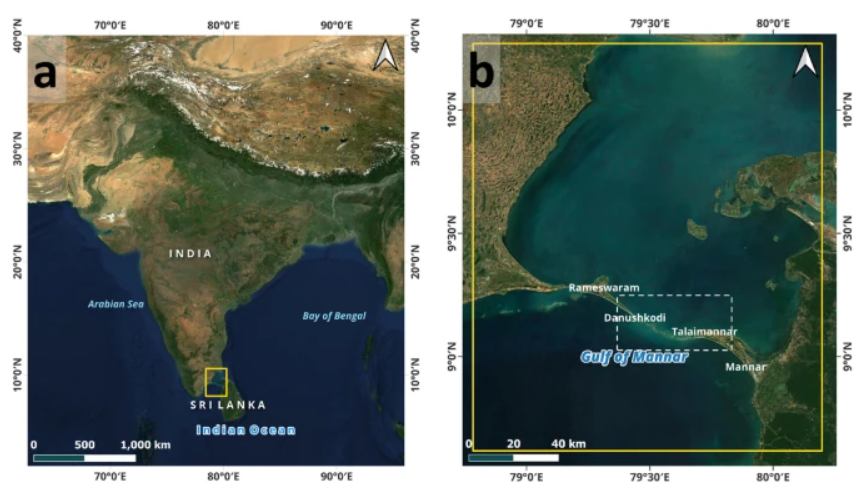
As per the reports, the research is the first to provide precise details about the underwater sections of Adam’s Bridge. Giribabu Dandabathula, a scientist with Isro’s National Remote Sensing Centre in Jodhpur regional center, and his associates described their findings in an issue of Scientific Reports.
Image- nature.com
The submerged structure was named Adam’s Bridge by an East India Company mapper. The structure, called by Indians as Ram Setu, is mentioned in the Ramayana as a bridge constructed by Ram’s army in order to help him reach Sri Lanka, Ravana’s kingdom, to get back his wife Goddess Sita.
Further evidence from geology reveals that the now-submerged range was once a land route between India and Sri Lanka. Persian navigators in the ninth century AD referred to the bridge as Sethu Bandhai or a bridge over the sea. Temple records from Rameswaram indicate that the bridge was above sea level until 1480 when it was demolished by a powerful storm.
Earlier satellite-based observations revealed the undersea construction, although they were primarily focused on exposed sections of the bridge. The sea in the area is extremely shallow, ranging from one to ten meters deep in parts, making navigation and ship mapping of the ridge difficult.
The researchers used ICESat-2 data from October 2018 to October 2023 to generate a 10-meter resolution map of the full length of the submerged ridge, which is sufficient to capture details of the size of a train coach.
Image- nature.com
According to their findings, the ridge is around 8 meters above the seabed over most of its length. However, only around 0.02 percent of the volume is accessible or visible; the rest is submerged. Limestone is formed from the fossils of sea life. Over millions of years, marine animals’ shells and skeletons accumulate on the ocean floor, pushing down on one another to form solid rock.
Their research also discovered 11 narrow passages, only a few meters wide, that allow water to flow or be exchanged between the Gulf of Mannar on the southwest side and the Palk Strait on the northeast side of the hill.
Image- nature.com
The experts believe that these tiny channels, or gaps along the ridge’s axis, play an important function in shielding or conserving the structure from the force of wave action. The bridge is constantly exposed to the energy of high waves from both sides: the Gulf of Mannar and the Palk Strait.
During the southwest monsoon, summer monsoon currents bring water from the Arabian Sea into the Bay of Bengal, whereas during the northeast monsoon, winter monsoon currents transport Bay of Bengal waters into the Arabian Sea via the Palk Strait and Adam’s Bridge.
According to the Isro team, the shallow canals allow for free flow or interchange of water between the Gulf of Mannar and Palk Strait, which helps to lessen the impact of waves on the ridge.
It is believed that India and Sri Lanka were formerly part of an ancient supercontinent known as Gondwanaland, which separated and drifted northward as an isolated huge island landmass in the Tethys Sea before colliding with the supercontinent Laurasia between 35 million and 55 million years ago. Over millions of years, sea levels have risen and decreased, drowning and exposing the ridge.
Although the “Right to Education” is one of our fundamental rights, we have observed our media to be mostly silent on this issue. Most unfortunately, it has been seen on multiple occasions that they focus on building up narratives for certain political parties during a crisis like a recruitment scam. The ongoing crisis of transparency in different national-level examinations is extremely heartbreaking to witness, but the more torturous part is the media’s role in turning it into a political battle. This narrative can certainly help certain political houses to obscure their monumental defeat for the third time in a row, but it will not solve the crisis. It is important to bring academic reforms similar to the economic reforms that the then Prime Minister Narasimha Rao did in 1992.
The University Grant Commission (UGC) was established by an Act of Parliament in 1956 to maintain the standards of teaching, examination, and research in universities. Since its establishment, UGC has brought different regulations at different times to maintain the quality of teaching in universities. Most notably, in 1989 UGC introduced the National Eligibility Test (NET) which was supposed to be a mandatory requirement for the recruitment of Assistant Professor (erstwhile Lecturer) as reflected by the UGC notification on 28th October 1991.
It is understandable that a huge number of students surely enrolled in PhD programs before the NET was introduced in 1989. It was presumably the main reason why UGC exempted candidates from the NET qualification who completed their PhD on or before 1993. In UGC 2000 regulations, qualifying NET was also set as a prerequisite to recruit an Assistant Professor. Before introducing NET in 1989, anyone with a good academic record could join as an Assistant professor in Colleges or Universities, and it is needless to state that those recruitments were mostly biased. To mitigate the biased nature of the hiring and to maintain the quality of teachers, UGC presumably made NET qualification a mandatory criterion in academic recruitment.
UGC’s rigid stand on NET led to two narratives that were further exploited to design the framework to destroy India’s university-level education system. First, one examination can neither determine the eligibility of teaching in universities nor that of doing meaningful academic research. With this logic, the second narrative placed into the context that it would be an injustice not to allow PhD degree holders to teach in universities for not qualifying NET. With these false narratives, UGC was forced to bring a regulation in 2009 that should be considered as the biggest organized crime in university recruitment. In 2009, UGC regulations simply naturalized the backdoor recruitment in universities.
First, they removed the mandatory NET requirements for recruiting Assistant Professors. Second, they endorsed an alternative to NET, namely the Research Eligibility Test (RET). This RET is usually organized by respective Universities and without any reservation it could be logically asserted that this RET has a high probability of being biased and to some extent may promote the exploitation of the candidate. Some substandard students can do free labor in a lab for a year or two to enroll into a PhD. They usually get the RET questions before the exam. The UGC 2009 regulation normalized this corruption to promote substandard students to obtain the highest academic degree and further to get placed in the universities.
The whimsical decision of UGC regarding NET or RET in 2009 can only vouch for their lack of research behind policy making. Cracking a joint entrance examination only allows one to be admitted to medical colleges, which does not allow someone to become a physician. Similarly, cracking one examination like NET must not be the criteria to recruit faculties in universities. We need highly trained people as faculties in universities to nurture the country’s future generation and that training only can be acquired during a PhD. Correlated to this, the next obvious question is – what would be the criteria to enroll in a PhD program? It would be almost impossible to screen applicants without their performance in a national-level entrance examination. UGC might prefer to adopt NET or any national-level test score to allow students to enroll into the PhD programs in UGC-recognized institutes. It won’t be too hard to understand this simple matter for our policymakers or our ministers. So, why don’t they simply implement these changes for recruiting faculties in universities?
The reader may be utterly surprised to know while the Cambridge graduate Prime Minister Dr. Manmohan Singh’s UPA government approved the framework of corruption designed by UGC to recruit faculties, the tea-seller Prime Minister Narendra Modi’s NDA government did not only rectify that but also made some necessary changes in the UGC policy to keep the academic integrity and transparency high in faculty recruitment. In 2019, the education minister Prakash Javadekar declared that NET is going to be the mandatory requirement for doing PhD in India from 2021 and it was further announced that a PhD degree is going to be the minimum requirement for recruiting faculties in universities from the same time. Also, PhD holders from the top 500 global Universities were supposed to be given equal chances to apply for faculty positions in Indian Universities.
Surprisingly, the UGC chairman in last year has taken down both these changes and reverted back to the old policy. In addition, other important changes from the 2019 announcement were not at all implemented to shortlist candidates for faculty recruitment in universities. As a result, the aim of the announcement in 2019 went in vain. Many eminent academic places of learning in India, for example, Homi Bhabha National Institute (HBNI), Indian Institute of Science (IISc), Tata Institutes of Fundamental Research (TIFR), and some other prestigious institutions usually organize nationwide Ph.D. entrance tests to maintain their high standard. Does UGC believe that PhD holders from those institutions are not trained enough to teach in universities? Nobody even heard about the NET outside India. So, does UGC believe that PhD graduates from top-ranked Universities around the world are not trained enough to teach in universities? I am raising this question as UGC still provides 7 points extra for qualifying NET during shortlisting candidates. While the competition is just for 1 or 2 vacancies, 7 marks can completely change the dynamics in the shortlisting process. In addition, chances of scoring more in publications or post-PhD research experience are completely handcuffed as UGC utterly failed to understand that a publication in a Q1 journal and a publication in a UGC-care list journal CAN NOT be treated equally. So, this type of barrier in faculty selection is neither in favor of quality nor in favor of integrity.
It would be oversimplified to imagine that this jeopardy in university recruitment was an accidental outcome; rather, it vouches for the predominant existence of a political nexus in Indian academia who have been using universities as the place to promote their political ideology. To recognize this political nexus, people need to remember that the present congress party is the remnant of the Indira Congress which was transformed in 1968 by debunking the Nehru Congress. Nehru’s efforts and goodwill to promote India’s higher education is still unquestionable. However, post-1969, Indira Congress became a mere tool of the then-Soviet Union’s KGB to promote cultural Marxism. Things became easier for cultural Marxists to take control with the uprising of the Communist party in West Bengal, probably the most dominant cultural state. While the University College London graduate Jyoti Basu was busy artistically setting the left regime in WB by promoting the rampant killing of innocents, the country was under the dictatorship of Indira Gandhi. One possibility is that a large number of culturally trained Marxists (precisely left-authoritarian) were placed in Indian academia during this time frame. This assumption can be justified by the number of professors who are sympathetic to anti-Indian activists inside different university campuses.
This left-authoritarian lobby could not breach the barrier to take total control of academia due to the resistive force put by some stalwart Scientists and Professors until the early 2000s. The fall of Vajpayee led NDA government in 2004 again opened up the door for them. However, they were helpless due to the gigantic presence of the Missile Man of India – APJ Abdul Kalam as the president of the country. With the farewell of the country’s most loving and respectful president, this left-authoritarian lobby finally succeeded in bringing the UGC 2009 regulations to fulfill their dream.
In 1940, the general secretary of the Communist Party Gangadhar Adhikary documented his concepts to break down India into pieces which is commonly known as the “Adhikari thesis”. This left-authoritarian lobby has been since working with this aim. That’s why we have witnessed the Azadi slogan raised in the JNU or Jadavpur campus. We have also seen how left-authoritarian activists have been using different university campuses to openly support terrorists who have been trying to destroy our country. In the last 10 years, we saw many communist student leaders contested in elections by saying that they are doing PhD to make an impression that they are highly educated. In reality, they have been doing PhD for more than a decade. These entire left-authoritarian ecosystems are the biggest beneficiaries of UGC 2009 regulation.
Due to this “Sarkar to unki hai lekin system Hamara hai” type ecosystem in central universities in India, reforms might sound too fancy to bring back the transparency and integrity in university recruitment. What we need today is a surgical strike to dismantle this left-authoritarian lobby. Needless to say, who else except Modi can deliver this for the country’s welfare?
The Islamic Republic of Pakistan has shut down its first ‘breast milk bank’ in Karachi within 12 days of its inauguration, following fatwas from Islamic clerics and organisations.
The said milk bank was launched on 12th June this year after more than a year’s work put up by doctors at the Sindh Institute of Child Health and Neonatology (SICHN) in collaboration with UNICEF.
Despite being in constant discussion with Jamia Darul Uloom Karachi and addressing all their concerns before the inauguration, SICHN was taken aback when the Islamic seminary withdrew its approval for the breast milk bank.
The Human Milk Bank, recently inaugurated by Sindh Health Minister Dr. Azra Pechuho alongside officials from UNICEF and the Pakistan Pediatric Association, aimed to provide breast milk to premature babies unable to receive sufficient nutrition from their mothers. – ?Freepik pic.twitter.com/2xrMIOSUKD
Jamia Darul Uloom Karachi claimed that the hospital would not be able to adhere to the strict conditions laid down by it. Thus, the milk bank could not deposit even one ounce of milking in 12 days of its operation.
While speaking about the matter to The Guardian, Pakistan Ulema Council Chair Hafiz Muhammad Tahir Mehmood Ashrafi said, “The objective of the doctors who wanted to set up the human milk bank may be in good faith, but we concur with Jamia Darul Uloom Karachi, and do not think it needs to be encouraged.”
As a result, the Sindh Institute of Child Health and Neonatology (SICHN) had to shut down its operations in less than 2 weeks, reported The Jerusalem Post on 25th June this year.
Pakistan has high neonatal mortality rate
While speaking about the development, Dr Syed Rehan Ali of SICHN lamented, “The milk bank was one way of reducing our dismal neonatal mortality rate.”
Health Minister of Sindh province, Dr Azra Pechuho, stated, “If we want our premature babies to survive we have to have human milk banks in all our obstetric and paediatric hospitals.”
Reportedly, Pakistan has one of the highest neonatal mortality rates in the world with 42 deaths per 1,000 live births.
In Madhya Pradesh’s Indore, an IT student and her family shifted to another colony after persistent harassment by a Muslim youth named Adnan. However, the accused followed the victim to her new residence and continued to harass her to accept his advances. When the victim’s father and brother reached Adnan’s house on Friday (5th July) to confront the accused, the duo were attacked by Adnan’s brother Arshad with an iron rod.
Subsequently, the victim’s family contacted Bajrang Dal and filed a complaint against the accused persons. The local police have booked the accused duo under sections of molestation and assault.
The IT student told the police that she resided in Gurukul Colony in the Rau area, where the accused Adnan used to stalk her and also sought her mobile number. Upon refusing, he threatened to hurl acid at the victim. After this, the victim informed her father about how Adnan was harassing her. Subsequently, the victim’s father spoke to Adnan’s father about this, who assured to send Adnan away from the area. However, Adnan’s misdeeds continued. Frustrated over this, the victim and her family shifted to another colony. Soon after, Adnan found out her new address and reached there as well.
On Friday, the victim informed the police that when she boarded a city bus to reach her coaching in Navlakha, accused Adnan started following her. When she reached her coaching, the accused forcibly held the victim’s hand and began pressurising her to talk to him. “When I took out my phone to call my father, Adnan ran away,” the victim said.
After returning to her home, the victim informed her father and brother about the incident, who then went to Adnan’s house. Here they met Adnan’s brother Arshad, who brutally attacked the father-son duo with an iron rod.
Later, the victim’s family reached out to Bajrang Dal activist Ram Dangi and others for help. The Hindu activists then nabbed Adnan and Arshad and turned them over to the police. The police registered an FIR against Adnan and Arshad under BNS sections of molestation and assault. The police are currently interrogating the accused Muslim youths.
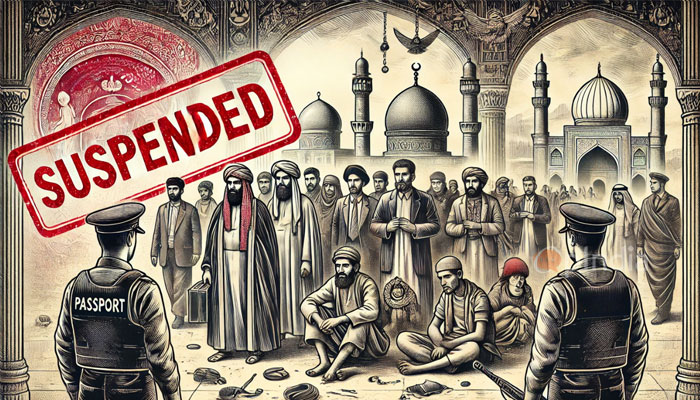
On 6th July, the Pakistani government decided to block the passports of over 2,000 beggars. Beggars from Pakistan have been travelling to countries like Saudi Arabia, Iran and Iraq disguised as pilgrims where they become the reason for international embarrassment for their home country. As per the Dawn News TV report, the Pakistani citizens involved in begging abroad will face a passport suspension for seven years. The government sources quoted by Pakistani media claim it is part of a broader effort to address the tarnished reputation of the country on international platforms.
Notably, there are “agents” operating in Pakistan who send these beggars abroad. Reportedly, these agents will also face passport suspension as part of the campaign against those who exploit the “vulnerable economic conditions” of the poverty striken country.
Most of the beggars from Pakistan travel to Saudi Arabia, Iran and Iraq posing as pilgrims visiting shrines. However, after landing in those countries, they start begging outside these shrines. The Ministry of Interior and the Ministry of Foreign Affairs have reportedly drafted a policy which is now in its final stages to address the issue comprehensively.
Interestingly, in September 2023, the Ministry of Overseas Pakistanis informed the Senate Standing Committee that a large number of beggars were being illegally smuggled to foreign countries. The Secretary revealed as many as 90 of the beggars apprehended in Saudi Arabia and Iraq hail from Pakistan. As these beggars often end up in prison, it has resulted in overcrowding of foreign prisons, an issue that has been raised by both Iraqi and Saudi ambassadors.
In October 2023, 16 individuals including women and children were offloaded from a flight at Multan airport on suspicion of planning to beg while holding Umrah visas. In December 2023, nine beggars were offloaded from Multan airport.
Pakistan’s economy is in shambles. The Pakistani government itself has been “begging” for funds from Saudi Arabia, China and the IMF repeatedly as it fails to manage the economy. The political unrest, Islamic terrorism, and halted trade with India along with bad economic decisions have put Pakistan in the worst conditions in terms of economy. Notably, a few years back, the government had to start selling donkeys to China. There were reports that malls, businesses and shopping complexes were ordered to shut down early to save electricity. Amidst this economic crisis, Pakistan has continued to fund terrorism against India, which raises questions about its priorities.