

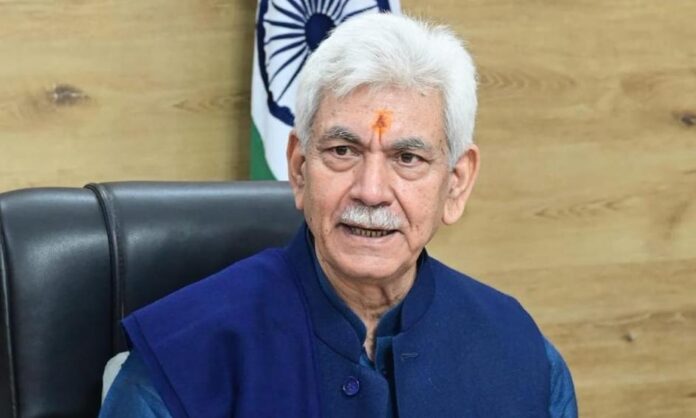
In a decisive crackdown on terror-linked elements embedded within the system, the Jammu and Kashmir Lieutenant Governor’s administration on Tuesday (January 13, 2026) terminated five government employees for their alleged links with militant organisations, invoking the extraordinary provisions of Article 311(2)(c) of the Constitution. The action, approved by L-G Manoj Sinha, allows dismissal without a departmental inquiry in the interest of national security.
With the latest round of dismissals, the number of government employees terminated for terror links has climbed to 85 since 2020, underscoring the scale of terror infiltration into the state apparatus.
Officials said the decision was taken solely on the basis of detailed inputs and dossiers prepared by central and local security agencies, which concluded that the employees posed a direct threat to public order and India’s sovereignty.
Those dismissed include Mohammad Ishfaq, a government school teacher; Tariq Ahmad Rah, a laboratory technician; Bashir Ahmad Mir, an assistant lineman; Farooq Ahmad Bhat, a Forest Department field worker; and Mohammad Yousuf, a driver with the Health Department.
Security agencies stated that Ishfaq was in regular contact with Lashkar-e-Taiba (LeT) commander Mohammad Amin alias Abu Khubaib. Arrested in April 2022 from the Marheen area, Ishfaq allegedly continued to radicalise fellow inmates even while lodged in jail.
Rah, employed in a hospital in Anantnag since 2011, is the nephew of Hizbul Mujahideen “divisional commander” Amin Baba alias Abid. His links reportedly surfaced during a State Investigation Agency (SIA) probe into Amin Baba’s escape to Pakistan in 2005. Though Rah was arrested under the Unlawful Activities (Prevention) Act and later released on bail, intelligence inputs suggested he re-established terror contacts soon after.
Bashir Ahmad Mir, who joined the Public Health Engineering department in 1988 and was regularised in 1996, was described as an active overground worker of the LeT in Gurez and Bandipora. According to the report, Mir facilitated terrorist movement, provided logistical support and shelter, and passed on sensitive information about security forces.
“Individuals like Mir, who remain embedded in government services while aiding terrorist networks, pose a grave threat to national security,” the agency assessment noted.
Farooq Ahmad Bhat, a Forest Department employee posted in Anantnag, was accused of actively supporting Hizbul Mujahideen and informally assisting a former legislator with alleged Hizb links. Mohammad Yousf, appointed as a driver in 2009 and posted in Bemina, Srinagar, was found to be in regular contact with terrorists, particularly Pakistan-based Hizbul Mujahideen handler Bashir Ahmad Bhat.
Proclamation orders against absconders
In a parallel operation, the Counter-Intelligence Kashmir (CIK) wing of the Jammu and Kashmir Police executed proclamation orders against three absconding individuals accused of involvement in “serious anti-national and unlawful activities”.
The proclaimed offenders have been identified as Mubeen Ahmad Shah, a businessman from Buchwara in Srinagar; Aziz-ul-Hassan alias Tony Ashai, an architect from Jawahar Nagar; and Rifat Wani from Trehgam in Kupwara district.
The proclamation warned that failure to appear before the court within the stipulated period would result in the attachment of both movable and immovable properties in accordance with the law.
Police said the case relates to grave offences that threaten public order, communal harmony and national integrity. Investigations, they added, revealed a “well-orchestrated conspiracy” allegedly carried out at the behest of secessionist forces operating from within and outside the Valley.
During the probe, investigators found that the accused had projected themselves as journalists, freelancers and operators of news portals, while allegedly running a coordinated digital propaganda operation. By exploiting platforms such as Facebook, X (formerly Twitter) and WhatsApp, they are accused of systematically circulating fake, exaggerated, secessionist and misleading content to fuel unrest.
The CIK reiterated that freedom of expression cannot be weaponised against the nation. “Any attempt to mask unlawful, secessionist or communal activities under the guise of journalism or online activism will invite swift, relentless and legally robust action,” the agency said.
