

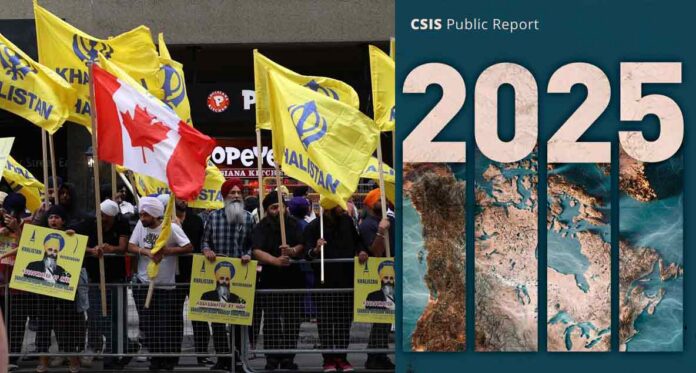
The Canadian Security Intelligence Service (CSIS) has released its Public Report 2025, an official annual document that reviews the evolving national security landscape facing Canada during the year. Published in March 2026, the report outlines key threats including foreign interference, espionage, cyber security challenges, and violent extremism. Its purpose is to promote transparency by informing Canadians about CSIS operations, threat assessments, and mitigation efforts while highlighting partnerships with domestic and international allies. The 2025 edition underscores Canada’s need to adapt to geopolitical shifts and protect its sovereignty, democratic institutions, and social cohesion.
A significant portion of the report focuses on the persistent national security risks posed by the Khalistani movement in Canada, particularly through Canada-based Khalistani extremist (CBKE) groups. While stressing that non-violent advocacy for Khalistan separatism remains lawful political activity in the country, the document makes it clear that a small but active subset of extremists continues to exploit Canada as a safe haven for activities that threaten both Canadian interests and public safety.
The report marks the 40th anniversary of the Air India Flight 182 bombing, the deadliest terrorist attack in Canadian history, which killed 329 people, most of them Canadians. It recalls that the suspects were members of CBKE groups operating from Canadian soil. Despite the passage of four decades, the legacy continues to shape CSIS priorities. Critically, the report states, “Ongoing involvement in violent extremist activities by CBKEs continues to pose a national security threat to Canada and to Canadian interests.” However, the report says that there were no CBKE related attacks in Canada in 2025.
According to CSIS, these extremists primarily use Canada to promote their agenda, raise funds, and plan violent acts directed mainly towards India. Some Canada-based Khalistanis maintain strong connections with Canadian citizens who unwittingly or otherwise leverage legitimate Canadian institutions and community networks. Funds collected from community members are reportedly diverted to support violent activities abroad. The report notes: “Some CBKEs are well connected to Canadian citizens who leverage Canadian institutions to promote their violent extremist agenda and collect funds from unsuspecting community members that are then diverted toward violent activities.”
The assessment makes a distinction between non-violent Khalistan supporter and violent extremists. It says, “Some Canadians participate in legitimate and peaceful campaigning to support the Khalistan separatist movement. Non-violent advocacy for the creation of a state of Khalistan is not considered extremism. Only a small group of individuals who use Canada as a base to promote, fundraise, or plan violence primarily in India are considered Khalistani extremists.”
The Khalistani issue is also linked to broader foreign interference concerns. The report claims that India is one of the main perpetrators of foreign interference in Canada, including transnational repression (TNR) activities aimed at countering perceived threats to its domestic stability, such as Khalistan separatism. These tactics allegedly involve surveillance, harassment, and coercive measures targeting members of the Indo-Canadian community who support the movement.
CSIS further claims that India has historically cultivated covert relationships with Canadian politicians, journalists, and members of the Indo-Canadian community, to exert its influence and advance its interests. It states, “This has included transnational repression (TNR) activities, such as surveillance and other coercive tactics meant to suppress criticism of the Government of India and create fear in the community.”
CSIS warns: “Given the presence in Canada of supporters of the Khalistan separatist movement, Canada must remain vigilant regarding potential TNR activities. India acts to counter perceived threats to its domestic stability, including Khalistan separatism. In Canada, advocacy for Khalistan separatism is lawful political activity.”
The report also says that out of the 12 groups added as terrorist entity under the criminal code in 2025, one was the Lawrence Bishnoi Gang.
The report claims that such interference undermines social cohesion, erodes trust within communities, and strains India-Canada diplomatic relations. By using Canada as a base for extremist planning and fundraising while facing counter-measures from India, the Khalistani movement creates a complex security dynamic that CSIS continues to monitor closely, it says.
Overall, the CSIS Public Report 2025 states that various evolving forms of violent extremism are becoming increasingly difficult to address and even understand, with secret and anonymous online radicalisation challenging investigators’ ability to keep pace. The report added that such extremism is “motivated by an increasingly diverse range of beliefs and convictions.”
CSIS says it remains committed to countering this through intelligence gathering, threat reduction measures, and close collaboration with partners, while upholding the right to peaceful political expression. Notably, in the last year’s report too, CSIS had acknowledged that Khalistani extremists are using Canadian soil to promote, fundraise, and plan violence in India.
