

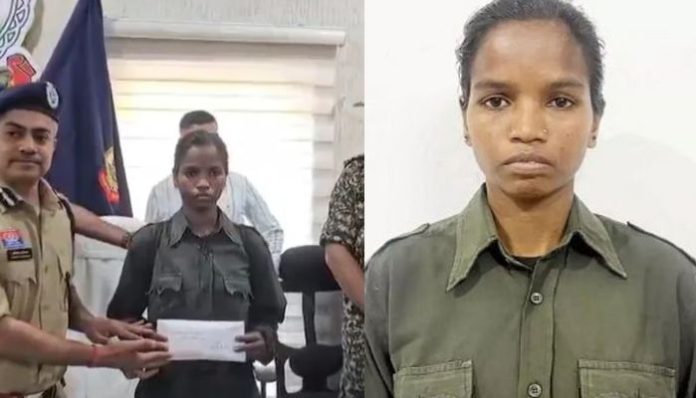
India moving towards complete eradication of left-wing terrorism or Naxalism. Maoists are either getting eliminated by security forces or are voluntarily surrendering. On Thursday (5th November), a hardcore woman Maoist named Kamla Sodi, carrying a reward of ₹17 lakh surrendered before the police in Khairagarh-Chhuikhadan-Gandai (KCG) district of Chhattisgarh.
KCG Superintendent of Police Lakshya Sharma said that Kamla Sodi was active in the Maaad division of Bastar and the Madhya Pradesh-Maharashtra-Chhattisgarh (MMC) zone of the banned CPI (Maoist).
VIDEO | Khairagarh: Female naxalite Kamala Sodi carrying a reward of Rs 17 lakh bounty surrenders in Chhattisgarh.
— Press Trust of India (@PTI_News) November 6, 2025
Kamla Sodi (30) had been active in the Maaad division of Bastar and the Madhya Pradesh-Maharashtra-Chhattisgarh (MMC) zone of the outlawed CPI (Maoist)
(Full video… pic.twitter.com/pfXIhQgV9B
The police said that Kamla Sodi chose to surrender before the police after being impressed with the government’s new surrender and reahabilitation policy.
For the last 14 years, Kamla Sodi was involved in the organisational work of the CPI(M), including recruitment, propaganda, and planning attacks on security forces. Originally from Aarlampalli village in Sukma district, Kamla Sodi was wanted by the police in Chhattisgarh, Maharashtra and Madhya Pradesh. The police of the three states had jointly placed a reward of ₹17 lakh on her arrest.
Marking a major milestone in the ongoing anti-Naxal operation of the security forces, around 80% of the Naxals active in the Abujhmad region of Chhattisgarh have laid down weapons.
The Modi government adopted zero-tolerance policy towards Naxalism
The Modi government has set March 2026 as the target to completely eradicate Left-Wing Extremism from the country as part of its zero-tolerance policy towards Naxalism. The government launched Operation Kagar in January 2024, a multi-pronged strategy combining aggressive military operations, enhanced coordination between Central and State forces, and development efforts to address the root causes of Naxalism. Under this operation, around 1 lakh para-military troops, including the Central Reserve Police Force (CRPF), its elite CoBRA units, District Reserve Guards DRG), and state police, have been deployed in the left-wing terrorism affected areas. These security personnel are equipped with modern technology like drones for information gathering, AI for intelligence gathering, and satellite imagery, among others. The security forces have been undertaking operations in the Naxal-infected Dandakaranya region spanning multiple states.
Apart from neutralising Naxal leaders and urging Maoist cadres to surrender, the government is also carrying out development work in Naxal-affected regions to connect them to the mainstream. The government has constructed 11,503 kilometres of highways in Naxal-affected areas. The minister added that 20,000 kilometres of rural roads were built. In the first phase, 2,343 mobile towers were installed, and in the second phase, 2,545 towers were set up. The work of installing 4,000 mobile towers is still ongoing. Shah mentioned that the entire Naxal-affected region will be equipped with mobile connectivity by December 1st.
