

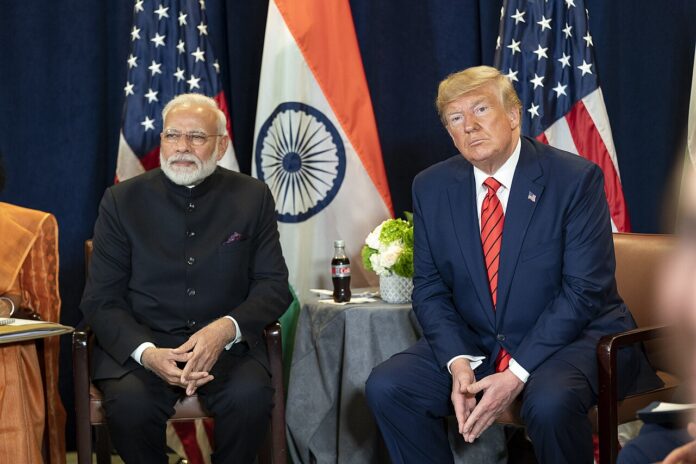
Former Australian Prime Minister Tony Abbott has criticised US President Donald Trump for what he described as the “gratuitous alienation” of India, calling Washington’s handling of relations with New Delhi one of the major mistakes of Trump’s foreign policy so far.
Speaking to NDTV, Abbott said he did not consider himself an unconditional supporter of Trump’s diplomatic approach and cited several specific decisions he believes unnecessarily strained ties with India.
‘Gratuitously alienating India’
Abbott argued that a series of moves by the Trump administration created avoidable friction with India, a country widely regarded as a critical strategic partner for the United States in the Indo-Pacific.
“I am not a universal admirer of the Trumpian foreign policy,” Abbott said. “One of the biggest mistakes that President Trump has made up till now has been gratuitously alienating India.”
According to Abbott, the tensions stemmed from three developments: punitive trade tariffs imposed on Indian goods, Trump’s controversial claims about mediating between India and Pakistan, and the decision to host Pakistan’s powerful army chief, Asim Munir, at the White House.
Abbott noted that the optics of welcoming Pakistan’s military leadership were particularly problematic given Islamabad’s long-standing accusations of supporting cross-border terrorism targeting India.
“Pakistan undoubtedly has sponsored terrorism against India and has been doing so intermittently for a long time,” Abbott said, explaining why the meeting was viewed negatively in New Delhi.
Trade tensions and partial reset
Relations between Washington and New Delhi had already been strained by trade disputes earlier in Trump’s presidency. The US had imposed reciprocal tariffs of 25 per cent on several Indian products, along with an additional 25 per cent levy tied to India’s continued purchases of Russian oil.
The measures were framed by Washington as pressure on India to reduce its energy imports from Russia amid the ongoing Ukraine conflict.
However, tensions eased earlier this year when Trump announced a new trade arrangement with India in February. Under the agreement, the United States reduced tariffs on many Indian goods after India reportedly signalled a willingness to scale back oil purchases from Moscow while the war continues.
The deal was presented by Trump as evidence of his strong personal rapport with Indian Prime Minister Narendra Modi, whom he has often referred to as “one of my greatest friends.”
Abbott on the Middle East conflict
Abbott also weighed in on the ongoing war involving Iran, the United States and Israel, saying it was too early to predict whether the fighting would lead to regime change in Tehran.
“We can’t say for sure whether there will be a regime change,” he said, cautioning that the Iranian leadership still retains significant support within parts of the population.
At the same time, Abbott suggested that the conflict has severely weakened Iran’s military capabilities and nuclear programme. According to him, the most likely outcome could be an Iranian regime that survives but with far less ability to project power abroad.
“The worst outcome that we could have from this is a defanged Islamist theocracy,” Abbott remarked, arguing that whatever government eventually emerges in Tehran will likely have diminished offensive capacity.
He also said the intensity of the conflict appears to be shifting. Iranian attacks have reduced in frequency, while American and Israeli strikes have intensified, largely targeting regime facilities rather than civilian infrastructure.
Escalation continues in the region
Despite these assessments, the conflict remains volatile. In the hours following Abbott’s remarks, Iran reportedly launched fresh missiles and drones toward Israel and several Gulf countries hosting American military bases.
Explosions were heard in Israel as its air defence systems intercepted incoming projectiles, while Gulf states, including the UAE, Kuwait, Qatar, Bahrain and Saudi Arabia, reported attacks linked to the widening regional confrontation.
Abbott’s comments highlight the complex geopolitical landscape Washington faces, balancing crises in the Middle East while maintaining strategic partnerships in Asia, particularly with India, which many Western allies view as central to the Indo-Pacific security architecture.
