

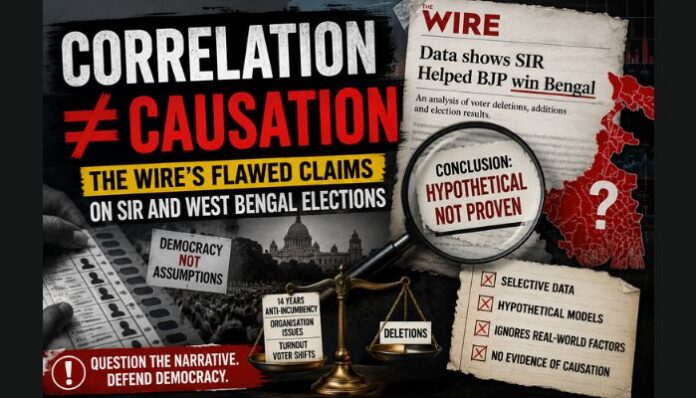
A fallacy means a flaw or mistake in reasoning. There are 230+ fallacies in this world. And one of the famous fallacies which people often use is the correlation-causation fallacy. It is the incorrect assumption that because two variables move together, one causes the other. But why are we talking about this fallacy here? Last night, The Wire published an article titled “Data shows SIR Helped BJP win Bengal”, which portrays how SIR was helpful for the BJP in winning the West Bengal elections, but the article is based on the correlation-causation fallacy and a fairytale. In this article, we will examine how these claims are not only false but also misleading.
Correlation is not causation
Throughout the article, The Wire’s argument is built around one statistic that deletions exceeded the victory margin in many constituencies. Based on the statistical overview, the article strongly argues that the Special Intensive Revision (SIR) favoured the BJP in the West Bengal elections. However, this argument gets weakened and shows how illogical it is – Just because two things happened together does not simply prove that one caused the other. The fact that voter deletions occurred doesn’t prove the BJP’s victory, and the article can’t establish that the deletions would have changed the result. At best, it is a hypothetical possibility, but not a proven fact.
The article repeatedly compares the large number of deletions with narrow victory margins to create the impression that the outcome is heavily altered. But the article never proves the argument or puts any factual data that actually shows how “SIR helped BJP? It does not establish that the deleted voters would have actually voted, whether they were genuine or even existed. Whether the turnout patterns would remain identical. Most importantly, the article explicitly states that “This does not prove that every such result changed because of SIR.” Basically, a kind of disclaimer that the arguments we are making don’t even make sense to us. This admission significantly weakens the article, which confidently claims that “Data Shows SIR Helped BJP Win Bengal,” yet the body is based solely on hypothetical modelling, assumptions, and statistical possibilities rather than direct evidence of causation. This article completely ignores other factors such as 14 years of anti-incumbency, organisational strength, candidate selection, government issues, polling turnout patterns, and shifting voter loyalties.
The article depends on hypothetical models
After establishing statistical overlap, the article moves into “What if”, a fairytale section where the writer starts to make different scenarios with the wrong basic information. These models are speculative exercises, but not evidence of manipulation. Let’s debunk the first simulation. In this model, the writer assumes a worst-case scenario in which she claims that what if every deleted voter had voted for the runner-up (i.e., TMC) and every newly added voter had cast their ballot for the winner. If the SIR had not happened and the party had been operating under the worst-case electoral scenario described above, these 87 seats could have remained with the party that won them five years prior. Basically, the TMC has won those 87 seats and also won the elections. But this scenario raises some questions. How do we know the deleted voters were genuine people who are still alive? If we still agree to find actual data, another question arises: why are we assuming that all the deleted voters will support the TMC, not the BJP, Congress, or the Left? And also, will each of the single deleted voters vote ? This assumption is politically loaded and unrealistic. The conclusion depends entirely on the assumption itself. If the assumption changes, the result changes too. The model effectively builds its conclusion into its own premise. This was the first simulation; let’s debunk the second one. In the second case, The wire later uses a softer model based on 2021 voting patterns. The writer starts with another “what if” moment, arguing that if a “no-SIR counterfactual model” were used. In simple words, if the SIR had not happened and the deleted voters had voted as in the 2021 assembly election, then only 11 seats would have been flipped. First, on what basis can one assume that all the voters will vote in the same way as they did in the last election? Second, if true, the BJP’s tally falls from 207 to 198, the TMC rises from 80 to 91, and the BJP won the election with a majority in West Bengal. If the BJP still wins even after the hypothetical restoration of deleted voters, then the SIR alone cannot explain the election outcome. The article itself ultimately undermines the idea that SIR was solely responsible for Bengal’s political shift. By adding phrases like “mathematically decisive”, rewritten outcomes, “electoral factor in itself”, doesn’t make the argument stronger or logical. Such language creates the impression of proven electoral manipulation, even though the analysis itself is speculative. Simulations may highlight statistical vulnerability, but hypothetical modelling cannot be treated as conclusive evidence of democratic distortion.
Selective presentation of data weakens the narrative
Data manipulation is the word that completely explains the wire’s article. The Wire repeatedly focuses on constituencies where high deletions coincided with BJP victories. However, it underplays an equally important reality that TMC won several seats with extremely high deletions. In the 20 Assembly seats that recorded the highest voter deletions, TMC won 13, BJP won 6, and one seat was won by Congress. If the SIR or voter deletions were systematically designed to damage the TMC and benefit the BJP, then TMC’s continued dominance of most of the highest-deletion constituencies creates a serious contradiction in the overall narrative..
The Hypocrisy of The Wire’s revealed in how it talks about the seats, selectively emphasising where the BJP gained, but not giving attention to the seats where voter deletions happened in large numbers, and the TMC still won. It actually reveals how transparent the SIR process was and is portrayed as unfair by the left ecosystem. Data is being filtered through a political narrative rather than being examined consistently. Large deletions alone cannot explain electoral outcomes. If the same phenomenon produces victories for multiple parties, then deletions by themselves cannot be treated as direct evidence of partisan engineering. Electoral outcomes vary because of local candidate strength, caste and communal equations, anti-incumbency, organisational machinery, turnout behaviour, and regional political trends. Therefore, it is wrong to isolate a single factor and treat it as decisive, as this oversimplifies the election.
Data analysis loses credibility when contradictory evidence is acknowledged only selectively while reinforcing a preferred political narrative, which the Wire did here.
Bengal’s political shift started before sir
The Wire’s analysis largely treats the Bengal verdict as a consequence of the voter list revision. But this ignores the broader political transformation that has been unfolding in the state for more than a decade. For decades, West Bengal was politically dominated by the Left, then by the TMC, with little presence of the BJP. However, during these years, West Bengal’s growth declined from a per capita income of 127.5 per cent of the national average to 83.7 per cent. West Bengal used to account for 27 per cent of industrial output; now it accounts for only 4 per cent. Not only has West Bengal faced economic growth, but it has also faced several violent incidents during this time. But the political dominance steadily began to change after 2014, when the BJP expanded its vote share and emerged as an increasingly relevant force in the state. The transformation became even more visible during the 2019 Lok Sabha elections, where the BJP won 18 parliamentary seats in Bengal and firmly established itself as the principal challenger to the TMC. This shift occurred years before the 2026 SIR exercise. The BJP’s growth in West Bengal is defined through the sustained organisational expansion on the ground. The party is heavily involved in booth-level networks. cadre building, and grassroots mobilisation across districts that had historically remained outside its influence. Over time, it successfully expanded its support base in border districts, rural Hindu-majority regions, and areas witnessing growing communal polarisation. Alongside this, anti-incumbency against the TMC also became a significant political factor. Allegations of corruption, recruitment scams, political violence, and controversies such as Sandeshkhali contributed to growing dissatisfaction in several parts of the state. In such a political climate, electoral shifts cannot be automatically attributed to voter list revisions alone.
By framing the Bengal result largely through the lens of SIR, The Wire tried to justify the crimes of TMC and its goons. Elections are shaped by changing voter preferences, organisational strength, ideological consolidation, and public perception. Treating every major BJP gain as primarily the result of administrative voter deletions, a fake narrative is pushed in the media, where people want to focus on the headline rather than the details. Putting a Headline like “Data Shows SIR Helped BJP Win Bengal” without presenting any facts and making assumptions shows how the left wing is so desperate to prove every election won by the BJP as a fraud or rigged. This desperation is visible in this article.
Conclusion
The Wire’s article raises important questions about the scale of the SIR exercise in West Bengal, but it does not conclusively prove that voter deletions decisively helped the BJP win the election. Much of its argument relies on statistical overlap and hypothetical simulations rather than direct evidence of electoral manipulation. The central assumption is that the deletions exceeding victory margins automatically altered outcomes, which overlooks the many political factors that shaped Bengal’s verdict, including anti-incumbency, the BJP’s long-term organisational growth, polarisation, and shifting voter preferences. Even the article itself admits that it cannot determine how deleted voters would have actually voted and that the BJP would still remain ahead even in its own “no-SIR” model. Electoral roll revisions deserve scrutiny in any democracy, but suspicion alone cannot be treated as proof. Statistical possibility may raise questions, but it cannot substitute for concrete evidence of electoral distortion. Ultimately, Bengal’s verdict was shaped by broader political realities, not hypothetical arithmetic alone.


