

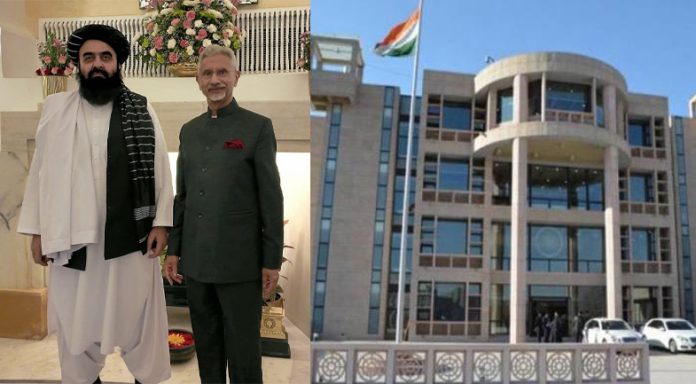
In a significant step towards normalising relations with Afghanistan under Taliban rule, India’s External Affairs Minister S. Jaishankar announced today that the country will upgrade its technical mission in Kabul to full embassy status, effectively reopening diplomatic operations after a four-year hiatus.
The announcement came during a high-level meeting in New Delhi between Jaishankar and Afghanistan’s Acting Foreign Minister Amir Khan Muttaqi, marking the first official visit by a senior Taliban leader to India since the group’s 2021 takeover. Muttaqi’s six-day trip, facilitated by a UN sanctions committee exemption, represents an ease bilateral ties, with discussions focusing on regional stability, counter-terrorism, and humanitarian aid. The minister is accompanied by Afghan trade and foreign ministry officials.
“I am pleased to announce today the upgrading of India’s Technical Mission in Kabul to the status of Embassy of India. India is fully committed to the sovereignty, territorial integrity and independence of Afghanistan,” Jaishankar said. He further added, “Closer cooperation between us contributes to your national development, as well as regional stability and resilience. To enhance that, I am pleased to announce today the upgrading of India’s Technical Mission in Kabul to the status of Embassy of India.”
“India has a deep interest in the well-being and prosperity of the people of Afghanistan,” Jaishankar stated in opening remarks, emphasizing New Delhi’s commitment to inclusive governance and countering terrorism in the region. He took a veiled reference to Pakistan’s role in Afghan instability, highlighting the need for Afghanistan to prevent its territory from being used for cross-border attacks. The meeting also involved talks with National Security Advisor Ajit Doval, signalling broader strategic engagement.
This development comes against the backdrop of India’s longstanding support for Afghanistan, including over $3 billion in aid since 2001 for infrastructure, education, and health projects. The opening of the embassy is expected to facilitate direct consular services, trade resumption, and enhanced people-to-people contacts. However, India maintains a non-recognition policy towards the Taliban government, in line with most of the world.
Background: The 2021 Closure
India’s embassy in Kabul, along with consulates in Jalalabad, Herat, and Mazar-i-Sharif, was shuttered in August 2021 following the rapid Taliban offensive that culminated in the capture of Kabul on August 15. The closure was prompted by the chaotic U.S. withdrawal, escalating security threats, and the Taliban’s consolidation of power, which led to the evacuation of Indian diplomats and staff.
In the following months, Taliban forces reportedly ransacked the embassy premises, symbolizing the abrupt end to two decades of robust Indo-Afghan partnership under previous governments. Since then, India has operated a limited technical team in Kabul to manage humanitarian assistance, including wheat shipments and medical supplies, without formal diplomatic presence.
