

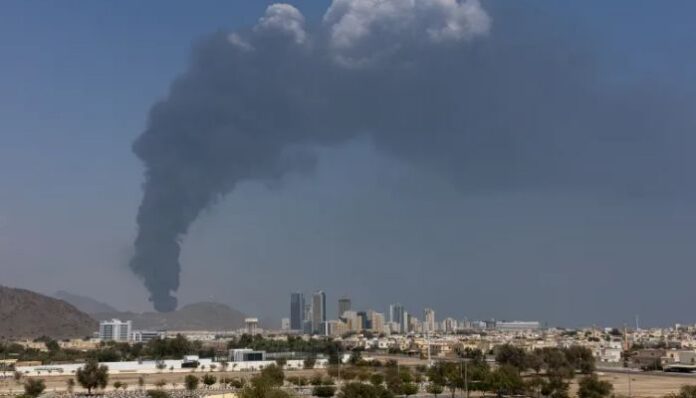
On Monday, 4th May, Iran launched a fresh wave of missile and drone attacks on the United Arab Emirates (UAE), marking the first such strike since a ceasefire had come into effect in April. The UAE confirmed that its air defence systems intercepted multiple threats, but the attack still left three people injured.
Air defences activated, injuries reported
According to UAE authorities, a total of 12 ballistic missiles, three cruise missiles and four drones were fired from Iran towards different parts of the country. Most of them were intercepted mid-air, preventing larger damage. However, debris and impact from the attack caused moderate injuries to three individuals.
The UAE strongly criticised the strikes, calling them a serious escalation and a violation of international law. Officials said civilian areas and facilities were targeted, and held Iran fully responsible for the consequences.
Fujairah oil facility hit, fire breaks out
The attack also impacted energy infrastructure. A drone strike triggered a large fire in an oil industrial zone in the port city of Fujairah. Sources said the site included a terminal partly owned by Vitol Group. Emergency teams rushed to control the blaze while authorities assessed the damage.
At the same time, alerts were sent to residents across Dubai and Abu Dhabi, asking people to move to safe locations. As a precaution, schools across the country switched back to online classes for several days.
Rising regional tensions
The latest strikes came as tensions between Iran and the United States increased again. Just hours before the UAE attack, Iranian drones targeted a tanker linked to Abu Dhabi National Oil Company near the Strait of Hormuz.
Meanwhile, the US had begun a humanitarian effort to help ships stuck in the Gulf region pass safely through the strait. Iran warned that it would strike US forces if they approached the area and asked commercial ships not to pass without permission.
Fragile ceasefire under pressure
The renewed attacks have raised concerns about the stability of the ceasefire that had been in place since early April. The UAE said it “will not tolerate any threat” to its sovereignty and reserved the right to respond.
Background of the War
The conflict began on 28th February, 2026, when the United States and Israel carried out coordinated strikes on Iran under operations named “Operation Epic Fury” and “Operation Lion’s Roar.” These attacks aimed to weaken Iran’s military setup and destroy its nuclear and missile capabilities. The strikes also led to the killing of top Iranian leadership, including Supreme Leader Ayatollah Ali Khamenei.
In response, Iran launched large-scale missile and drone attacks across the region, targeting Israel and Gulf countries, including the UAE. Since then, the conflict has led to heavy casualties, especially in Iran and Lebanon, where fighting with Hezbollah has also intensified.
