

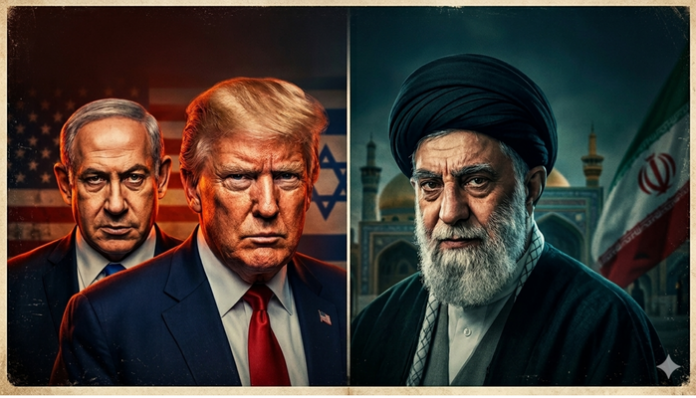
The conflict further escalated after the US-Israeli strikes on Iran killed its Supreme Leader, Ayatollah Ali Khamenei. After this, Iran responded more aggressively, drawing several other Middle Eastern countries, which were US allies or had US military assets, into the conflict. Iran launched air strikes on many countries in the Gulf region, including Saudi Arabia, the United Arab Emirates, and Qatar, which has adversely affected global trade and fuel supplies.
Here is a timeline with details of all the events that have unfolded so far in the US-Israel-Iran war:
The Why and How of the current conflict
Prior to the 1979 Iranian Revolution, relations between Israel and Iran were cordial and Iran was the second Muslim country to recognise Israel in 1948. However, following the 1979 Revolution, the Iranian political landscape changed drastically with the overthrow of the Shah’s regime. The Ayatollah Ruhollah Khomeini regime that replaced the Shah in Iran was openly hostile towards Israel. The same hostility towards Israel continued in the Ayatollah Ali Khamenei regime as well.
Iran nurtured several terrorist groups, such as Hamas, Hezbollah and the Houthis, in the Middle East, which abhor Israel’s existence. It has also been aiding proxy wars against Israel. In addition to that, Iran has been violating the terms of the Joint Comprehensive Plan of Action (JCPOA), which set limits on its nuclear programme. The Iranian nuclear programme, which Israel views as a threat to its existence, has been a major factor behind Iran’s ongoing conflict with the US and Israel.
Iran’s current military hostilities with the US and Israel began last year when Israel warned Iran that the latter’s nuclear enrichment efforts could attract military action. Subsequently, on June 13th, 2025, Israel launched a 12-day war against Iran, during which it attacked Iran’s nuclear facilities, killing its senior commanders and nuclear scientists. Justifying its strikes on Iran, Israel said that the country was closer than ever to obtaining nuclear weapons.
Iran responded with ballistic missile strikes on Israel. This was followed by the US military striking between June 21st, 2025 and June 22nd, 2025, on Iranian nuclear facilities in Fordow, Natanz and Isfahan. On June 23rd, 2025, Iran struck a US air base in retaliation in Qatar, which was followed by the announcement of a ceasefire by the US.
A timeline of the fresh US-Israel-Iran conflict
As an extension of last year’s military action against Iran, the US and Israeli defence forces launched fresh strikes on Iran on February 28th, 2028, under two separate coordinated military operations, viz. ‘Operation Epic Fury’ and ‘Operation Lion’s Roar’ (aka ‘Roaring Lion’). Israeli Defence Forces’ (IDF) Operation Lion’s Roar aims to completely annihilate Iran’s nuclear and ballistic missile capabilities. On the other hand, the US military’s Operation Epic Fury has a broader objective of weakening Iran’s military infrastructure and disabling its terror funding.
February 28th, 2026: The Killing of Khamenei and other Iranian leadership, Iranian strikes on Gulf countries
The US and Israel launched a coordinated strike against Iran, killing Iran’s top leadership, including its Supreme Leader Ayatollah Ali Khamenei and some of his family members. The Iranian casualties included Iranian Defence Minister Nasirzadeh, the Chief of Staff of the Iranian Armed Forces, Abdol Rahim Mousavi, and the head of Iran’s paramilitary Revolutionary Guard and security adviser Ali Shamkhani. Several sites across Iran, such as Tehran, Qom, Kermanshah, Isfahan, and Karaj, were targeted by the US and Israeli forces. While people opposed to the Khamenei regime celebrated Khamenei’s death, widespread protests were witnessed among the Shia Muslims in India against his death.
Responding to the US-Israeli strikes, Iran launched missile and drone attacks on Israel and the US military bases, such as Al Udeid Air Base in Qatar, and the US Navy’s 5th Fleet headquarters in Qatar. Iran also attacked the Middle Eastern countries of Saudi Arabia, Bahrain, and Kuwait.
Iranian missiles hit several parts of Abu Dhabi, including the Al-Dharfa US Base in the Southern part of the city. Similarly, 5 major blasts caused by Iranian strikes shook Dubai, leading to the closure of its airspace, which left many passengers stranded. One of the blasts damaged the Dubai International Airport, injuring four people. Zayed International Airport in the UAE’s Abu Dhabi also suffered damage. The landmark Burj Al Arab hotel also sustained severe damage and was engulfed in flames after debris from an intercepted drone struck the building.
March 1st, 2026: IRGC attack vessels in the Strait of Hormuz, UAE warns Iran against attacking its neighbours
The US and Israel launched strikes on hospitals and the Islamic Republic of Iran Broadcasting (IRIB) headquarters in Tehran. They also targeted sites in Natanz city in the Isfahan province. Israeli forces bombed Beirut, Lebanon, killing the head of Hezbollah’s intelligence chief, Hussein Makled. Iran’s Revolutionary Guard (IRGC) attacked vessels near the Strait of Hormuz, a critical oil shipping route. This affected global trade and energy supplies. The attack damaged several tankers and disrupted maritime traffic. This led to crude oil prices shooting up globally. While the petrol and diesel prices in India remain stable, the prices of Liquefied Petroleum Gas registered a surge.
After Iranian strikes on Gulf countries, the UAE warned Iran against targeting its neighbours. Anwar Gargash, the diplomatic advisor to the UAE President, said that Iran’s attack on the Gulf countries is a “miscalculation”.
The same day, the UK Prime Minister Keir Starmer gave the US permission to use RAF bases in Cyprus to tackle the growing threat from Iran. As the conflict in the Middle East escalated, Prime Minister Narendra Modi spoke with the President of the United Arab Emirates, Sheikh Mohamed bin Zayed Al Nahyan, and condemned the attacks on the UAE.
March 2nd, 2026: Iran blocks the Strait of Hormuz, Israel attacks Hezbollah
In retaliation for the killing of the Iranian Supreme Leader, Ayatollah Ali Khamenei, Hezbollah launched strikes on Israel. In addition to that, Iran launched airstrikes on the US embassy in Kuwait and at the Bahrain port. Explosions caused by Iranian missiles were also reported in Jerusalem, Dubai, Abu Dhabi in the UAE, Doha in Qatar, and Manama in Bahrain. Notably, Iran completely blocked the Strait of Hormuz, followed by Qatar announcing a full halt to the production of liquefied natural gas (LNG) and associated products.
The conflict further escalated as Israel launched a wave of airstrikes on the Hezbollah-controlled southern suburbs of Beirut in Lebanon and ordered evacuations. Israeli Defence Minister Israel Katz declared Hezbollah chief Naim Qassem a “target for elimination”. The statement came after Hezbollah launched strikes on Israel.
March 3rd, 2026: Iran continues to hit several regions in the Middle East
Iran attacked the US embassy in Riyadh, Saudi Arabia, with a drone, while hitting several sites in the region. Subsequently, the US State Department ordered a precautionary evacuation of non-emergency personnel and family in Kuwait after an Iranian strike in Kuwait, Bahrain, Iraq, Qatar and Jordan. Meanwhile, the US and Israel continued to launch strikes on Iran, particularly targeting its nuclear facilities and missile infrastructure. Israel also carried out strikes in Lebanon, targeting Hezbollah.
As the conflict in West Asia continued to deteriorate, PM Modi had telephonic conversations with Crown Prince and Prime Minister of Saudi Arabia, Mohammed bin Salman, King of Bahrain, Hamad Bin Isa Al Khalifa, and King Abdullah II of Jordan. He expressed his concern over the situation and reaffirmed India’s support for peace, security and well-being of the people in the Middle East.
March 4th, 2026: US sinks Iranian ship, Trump directs DFC to provide insurance for maritime trade
Iran denied attacking Turkey, a NATO member, after a ballistic missile entered its airspace. Meanwhile, the US and Israel continued to launch airstrikes in Iran, and Israel bombed multiple parts of Lebanon. Apart from that, a US submarine sank an Iranian warship, IRIS Dena, in the Indian Ocean Region, resulting in the death of 87 people out of 180 people onboard.
As the war in West Asia escalated, US President Donald Trump directed the United States Development Finance Corporation (DFC) to provide immediate political risk insurance and financial guarantees for maritime trade moving through the Gulf. The announcement came after concerns were raised regarding the security of keyshipping lanes amid the conflict.
As the Iranian ship came under the US attack near Sri Lanka’s coast, an attempt was made by the leftist media portals and the Congress ecosystem to suggest that India was supporting the US in attacking Iran. The leftist media portals and the Congress ecosystem widely shared a false statement made by former US Army Colonel Douglas Macgregor on a US news channel, where he claimed that the US was using Indian naval bases to attack Iran. However, the Indian Ministry of External Affairs intervened and strongly rejected the claims as “fake and false,” adding, “We caution you against such baseless and fabricated comments.”
March 5th, 2026: Azerbaijan accuses Iran of firing drones in its territory
As the US-Israel-Iran war entered its sixth day, Azerbaijan accused Iran of firing drones at its territory and ordered its southern airspace closed for 12 hours. Two drones reportedly landed on an airport and close to a school. The Azerbaijan government warned Iran that the attack would “not remain unanswered.” Following the previous day’s attack on the Iranian ship, Sri Lanka began offloading the 208-member crew of a second Iranian vessel, the IRIS Bushehr, off its coast.
The United States said that it sank more than 30 Iranian ships during the ongoing war.
March 6th, 2026: Israel continues strikes on Hezbollah sites in Beirut
Israel continued to attack Hezbollah in Beirut’s southern suburbs in a wave of airstrikes, after asking people to evacuate. According to the Israeli military, 26 waves of strikes were carried out overnight in the southern suburbs in Beirut, with targets including Iran-backed Hezbollah militia command centres and weapons.
March 7th, 2026: The US military claims to have hit 3000 targets in Iran
On the eighth day of the conflict, the US military’s Central Command said that it had struck over 3,000 targets in Iran and destroyed 43 Iranian warships since the beginning of the conflict on February 28th. US President Donald Trump asked Iran to surrender unconditionally.
On the other hand, Iran’s deputy foreign minister, Saeed Khatibzadeh, said that the European nations that they will become “legitimate targets” for Iranian retaliation if they join the US and Israel, as Iran continued to attack, Qatar, Kuwait, Saudi Arabia and the UAE.
In response to Israel’s strikes in Beirut, Hezbollah fired rockets at multiple locations in northern Israel. Besides, Iran’s ambassador to the United Nations, Amir-Saeid Iravani, accused Israel and the US of recognising “no red line” and committing war crimes and crimes against humanity.
Meanwhile, the UK extended support to Saudi Arabia as Prime Minister Keir Starmer spoke with Saudi Crown Prince Mohammed bin Salman. Qatar’s Hamad International Airport partially resumed operations via dedicated emergency routes. As flight disruptions occurred across the Middle East due to the ongoing conflict, Indian retail giant Lulu Group sent dedicated chartered cargo flights carrying fresh food supplies to the United Arab Emirates. The shipment was part of several more such shipments being arranged by the Group for transporting to the Gulf country.
March 8th, 2026: Bahrain accused Iran of striking a desalination plant
On the ninth day of the conflict, Bahrain accused Iran of striking a desalination plant, as the Iranian President vowed to intensify attacks on the US sites across the region. Meanwhile, Israel carried out strikes at various sites in Iran, where an oil facility was attacked, and in Lebanon.


