

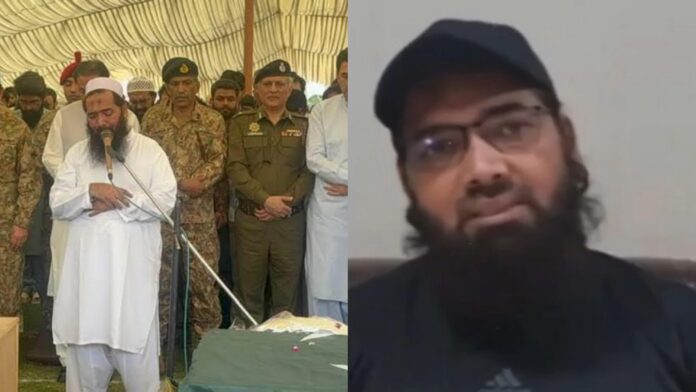
In a rare and striking public admission, a senior Lashkar-e-Taiba (LeT) commander has openly acknowledged that India’s Operation Sindoor struck at the very heart of the Pakistan-based terror organisation, destroying its nerve centre in Muridke and dismantling what he described as the group’s headquarters, a report published by NDTV said.
Hafiz Abdul Rauf, a US-designated global terrorist and a key operational commander of LeT, told a gathering that the Indian strike carried out on the night of May 6–7, 2025, had reduced the Markaz-e-Taiba complex to rubble. Referring to the site in Muridke, long projected by Pakistan as a religious and charitable centre, Rauf admitted that it had been completely flattened.
“What happened on May 6–7 was a very big attack. That place is no longer a mosque. Today, we cannot even sit there. It is finished; it has collapsed,” Rauf said, offering the clearest confirmation yet from within LeT that India’s operation hit its intended target.
The admission is significant not only for its candour but also because of who made it. Rauf is no marginal figure within the organisation. He has been directly involved in training terrorists and coordinating their launch from Pakistan Army-backed pads in Pakistan-occupied Kashmir.
In the immediate aftermath of Operation Sindoor, he had led funeral prayers for terrorists killed in the strikes, images that had gone viral at the time. His latest remarks strip away years of denials and carefully crafted ambiguity surrounding Muridke’s true purpose.
Operation Sindoor was launched by India following the April 2025 terror attack in Pahalgam, Jammu and Kashmir, in which 26 civilians were killed. The attack was carried out by LeT operatives operating under the banner of The Resistance Front (TRF), a front organisation used to mask Lashkar’s direct involvement. Subsequent investigations revealed that the attackers were equipped with Chinese-made weapons and gear, pointing to an increasingly sophisticated supply chain sustaining Pakistan-based terror groups.
Rauf has now publicly acknowledged that Chinese weapons and equipment were used by Pakistan and LeT during the confrontation that followed, reinforcing India’s claims about external support networks. But his speech went well beyond confirming material losses or weapon sources.
In an extraordinary disclosure, Rauf claimed that Pakistan has granted “open freedom for jihad,” asserting that recruitment and training of terrorists is easier there than anywhere else in the world. “The state has decided, that’s why we are able to do this,” he said—remarks that directly bolster New Delhi’s long-standing allegation that terror groups in Pakistan operate with institutional backing rather than mere tolerance.
Rauf also lavished praise on China, claiming that Beijing supported Pakistan during the post-Pahalgam escalation, which he referred to as “Bunyan-e-Marsous.” According to him, China provided near-real-time intelligence on India during the confrontation. In a pointed aside, he suggested that Western aircraft had been rendered obsolete, claiming global demand was now shifting toward Chinese fighter jets and military equipment—remarks that appeared designed as much for strategic messaging as for internal morale.
The broader context makes Rauf’s confession even more revealing. On January 15 this year, a passing-out ceremony for newly trained terrorists was held at the Markaz-e-Taiba complex, the very site Rauf now says has been destroyed. The event was attended by Rauf himself, Hafiz Saeed’s son Hafiz Talha Saeed, and Lashkar deputy chief Saifullah Kasuri. The ceremony was a brazen display of continuity, suggesting that despite Operation Sindoor, jihadist infrastructure was being rebuilt, relocated, or sustained under official indulgence.
Throughout his address, Rauf mixed grievance with triumphalism and religious rhetoric. While acknowledging the scale of India’s strike, he claimed divine intervention had protected the group. “Allah saved us, Allah helped us,” he said, even as he conceded that the confrontation had reverberated far beyond the region. He claimed Pakistan possessed intelligence “down to the last detail” and that the exchanges “echoed all the way to America and Europe,” portraying the episode as a global moment rather than a bilateral clash.
A video of Rauf’s remarks lays bare what has long been debated in diplomatic circles: that Pakistan continues to provide space, sanctuary, and support to terror groups even months after a major international crisis. This time, however, the confirmation has not come from intelligence dossiers or official briefings, but directly from the mouth of a Lashkar commander, an admission that may prove far harder for Islamabad to dismiss or explain away.
