

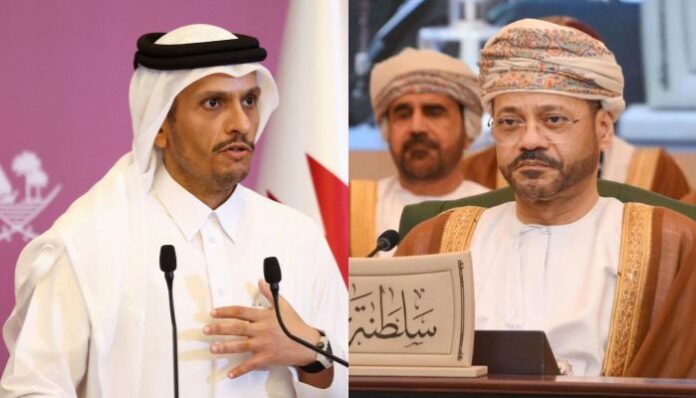
The ongoing war between the United States, Israel, and Iran has come under sharp criticism from the key countries of the Gulf region. Oman has accused the United States of losing control of its foreign policy, while Qatar has called for an immediate end to the war due to the significant economic loss it has suffered.
Oman’s Foreign Minister Badr Albusaidi, who helped mediate the recent talks between the United States and Iran over the nuclear deal, said the war could have been avoided. He termed the war a “catastrophe” and a “grave miscalculation.”
In an article for The Economist magazine, he said the United States had allowed itself to be drawn into a war that is not in its interest. He added that neither the United States nor Israel would be able to reach its objective.
According to Albusaidi, diplomatic talks held in Geneva in February had brought the US and Iran close to a meaningful nuclear agreement. Iran had reportedly agreed to make significant concessions in return for a nuclear agreement, including limiting uranium enrichment and allowing US participation in its civil nuclear programme. A final round of talks was set for Vienna, but within 48 hours of this, US and Israeli strikes on Iran began.
He blamed Israel’s leadership for influencing the US decision, claiming Washington acted on the assumption that Iran’s leadership would collapse quickly. However, Israeli Prime Minister Benjamin Netanyahu rejected this, saying no one dictated anything to the US President.
Oman has taken a strong step, calling these attacks by the US and Israel illegal and a clear violation of international law. Albusaidi further stated that if the war continues, it might lead to a prolonged ground war in the US, which President Trump had earlier promised to avoid.
The war is now affecting the wider Gulf region, especially the energy infrastructure.
Qatar calls for an immediate halt after Ras Laffan attack
Qatar has openly called for an immediate and unconditional end to the war. It is the first energy producer among the Gulf countries to take such a stance.
Prime Minister Sheikh Mohammed bin Abdulrahman al-Thani said, “This war needs to stop immediately. The aggression needs to stop immediately,” adding strong remarks that “we all know who benefits from this war.”
His statement came after Qatar’s key Ras Laffan LNG facility was hit by missile strikes, reportedly linked to Iran’s retaliation. The attack damaged around 17% of Qatar’s LNG export capacity, leading to an estimated $20 billion annual loss. Officials said repairs could take up to five years.
Qatar is a major source of liquefied gas for the world, producing 20% of the world’s liquefied gas, and the war has already caused prices to rise in Europe and Asia.
The conflict has also spread beyond Qatar. Iran has targeted areas near Saudi Arabia’s Red Sea port of Yanbu, while gaining control over the Strait of Hormuz, a key global oil route.
Although several countries, including Saudi Arabia, the UAE, and Egypt, had issued a joint statement earlier, they stopped short of calling for an unconditional ceasefire. Qatar’s direct and strong position highlights growing concern in the region as the war shows no signs of slowing down.
