

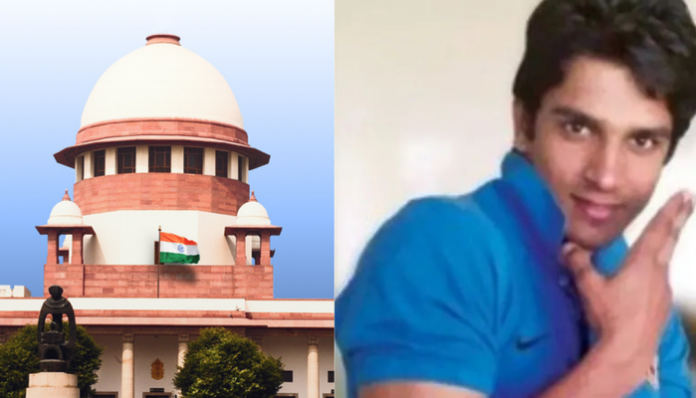
In a landmark judgment, the Supreme Court on Wednesday (11th March) upheld a patient’s right to die with dignity by allowing him passive euthanasia. A bench of justices JB Pardiwala and KV Viswanathan passed a first-ever order granting permission for the withdrawal of the life support of Harish Rana, who has been in a vegetative state for the past 13 years.
Harish Rana has remained in an irreversible permanent vegetative state since 2013 after falling off the fourth floor of a paying guest accommodation. Rana, a student of Punjab University, suffered serious brain injuries and was put on life support. He has been confined to a bed and is surviving on Clinically Assisted Nutrition (CAN), with a tracheostomy tube for respiration and a gastrojejunostomy tube for feeding. He has been in a vegetative state with 100 percent disability and quadriplegia, requiring continuous medical assistance for breathing, feeding and daily care.
“Harish Rana, presently aged 32 years, was once a young, bright boy. He met with a tragic life-altering accident after a fall from the fourth floor of his paying guest accommodation. His brain injury left him in a condition of Persistent Vegetative State (PSV) with 100% quadraplegia… Medical reports show that his medical condition has not improved in the past 13 years,” the Supreme Court noted.
“It must be ensured that it is withdrawn with a tailored plan so that dignity is maintained,” the bench said, allowing the removal of Rana’s life support. The court noted that while it is the duty of a doctor to treat a patient, “that duty no longer sustains when the patient has no hope of recovery”. The court directed AIIMS Delhi to grant admission to the patient in palliative care so that the medical treatment can be withdrawn.
The Apex Court acknowledged the love and selfless care shown by Rana’s parents, who have been taking care of him over the years. “His family never left his side… to love someone is to care for them even in the darkest times. Our decision today does not neatly fit in logical (lines), but love, life and loss,” the court said. “You are not giving up your son, you are allowing him to live with dignity, ” Justice Pardiwala said.
Noting that CAN is a medical treatment, the Court said that its removal is subject to the decision of primary and secondary medical boards. In October 2024, the Union Health Ministry issued draft “Guidelines for Withdrawal of Life Support in Terminally Ill Patients”. The guidelines stated that the withdrawal of support in terminally ill patients should be based on a “considered decision” taken by doctors. The Supreme Court set up a medical board at the Noida District Hospital to consider the option of passive euthanasia for Rana in November 2025. The primary and secondary medical boards recommended the removal of CAN for Rana, as it was not in his best interest.
Rana’s parents had moved courts seeking to remove his life support as his condition didn’t improve even after treatment for a decade. They argued that their son had been living in a persistent vegetative state for over a decade with no hope of recovery and that continuing treatment was only prolonging his suffering. They had moved Delhi high court, requesting the constitution of a medical board to examine Rana’s condition. However, the high court declined the plea, saying that case did not fall within the scope of passive euthanasia.
The family then filed a petition at the Supreme Court in 2024 seeking withdrawal of life-sustaining treatment, including clinically assisted nutrition and hydration.
