

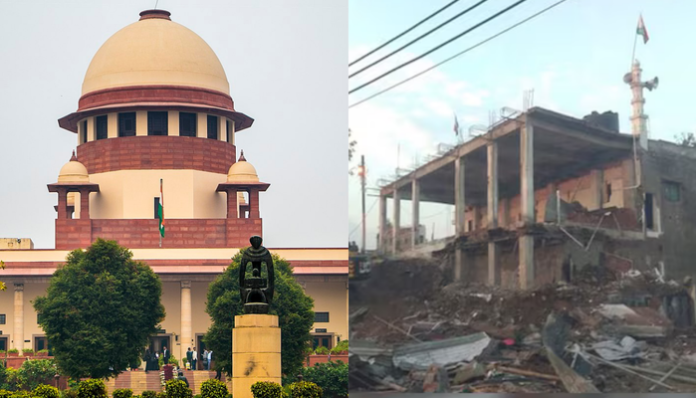
The Supreme Court on Friday (7th November) dismissed an appeal challenging a Madhya Pradesh High Court order, which upheld the demolition of the Takiya mosque in Ujjain.
Agreeing with the High Court’s ruling, the top court observed that the land on which the mosque stood was lawfully acquired for the expansion of the Mahakal Lok complex, a major redevelopment project linked to the Mahakaleshwar Temple, one of the 12 Jyotirlingas.
A bench of Justices Vikram Nath and Sandeep Mehta dismissed the special leave petition filed by 13 residents, who used to offer namaz at the mosque. The petitioners contended that the 200-year-old mosque was notified as a waqf in 1985 and was being used as a place of worship.
They alleged that the Madhya Pradesh government demolished the mosque “illegally and arbitrarily” for the expansion of the parking area for the adjoining Mahakal Temple.
They argued that the demolition of the mosque amounted to a violation of the Places of Worship (Special Provisions) Act, 1991, the Waqf Act, 1995 (now Unified Waqf Management, Empowerment, Efficiency and Development Act, 1995), and the Right to Fair Compensation and Transparency in Land Acquisition, Rehabilitation and Resettlement Act, 2013.
Appearing for the petitioners, advocate MR Shamshad said, “This is a case that warrants immediate intervention”. He challenged the High Court’s reasoning that the right to practice religion has no connection with any particular place.
However, the apex Court did not accept Shamshad’s contention and said that the High Court’s reasoning was sound. “No, the high court has given sound reasoning that compensation shall be paid if warranted. There is nothing in it. You have your remedies under the law,” the Supreme Court said.
Regarding the petitioners’ allegation that the compensation was wrongly disbursed to encroachers to “create a false case of acquisition”. The High Court had noted that the compensation was assessed and disbursed by the land acquisition officer to those found entitled. The Supreme Court said that the petitioners were free to use available legal avenues for seeking compensation. “You have a remedy under the Act for that,” the Court said.
Before being dismissed by the Supreme Court, the petition against mosque demolition was first rejected by a single judge and later by a Division Bench of the High Court.
