

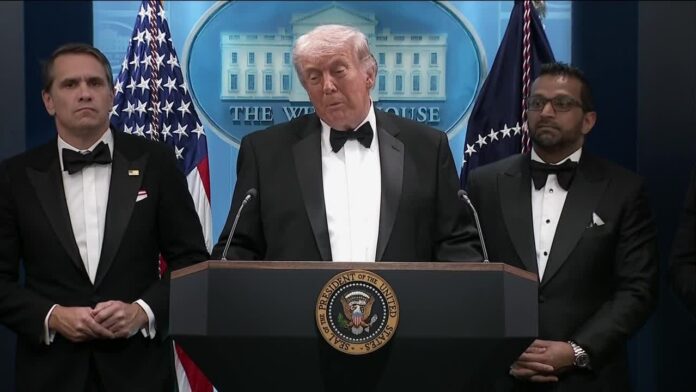
In a moment that blurred the line between bravado and admission, US President Donald Trump openly likened American naval operations to piracy while boasting about their profitability.
Speaking at a rally in Florida, Trump described how US forces intercept vessels suspected of carrying Iranian oil. “We land on top of it… we took over the ship, the cargo, the oil. It’s a very profitable business,” he said, drawing cheers from the crowd. Then came the line that has since sparked global backlash: “We’re like pirates… but we’re not playing games.”
Trump on US Navy Seizing Ships:
— Acyn (@Acyn) May 2, 2026
It’s a very profitable business. We’re like pirates. pic.twitter.com/erWDQmJWnw
That statement has quickly become a diplomatic flashpoint because it echoes, almost word-for-word, what Iran has been accusing Washington of all along.
Iran wasted no time in reacting. Foreign Ministry spokesperson Esmaeil Baghaei condemned the seizures as “armed robbery on the high seas,” accusing the US of violating international law.
This is the outright legalization of piracy and armed robbery on the high seas.
— Esmaeil Baqaei (@IRIMFA_SPOX) April 27, 2026
Welcome to the return of the pirates — only now, they operate with government-issued warrants, sail under official flags, and call their plunder “law enforcement.”
The United States must be held fully… pic.twitter.com/5xACMKs45M
Baghaei argued that Washington is effectively legitimising piracy under the cover of enforcement. “The world is witnessing the return of pirates,” he wrote, framing the operations not as strategic enforcement, but as outright theft dressed up in legality.
The criticism followed US interceptions of two tankers allegedly transporting Iranian crude, incidents that have further escalated tensions in an already volatile region.
A Dangerous Maritime Standoff
At the heart of the crisis lies the Strait of Hormuz, a narrow but critical artery through which a significant portion of the world’s oil supply flows.
Iran has tightened its grip on the strait, allowing only its own vessels to pass freely, while the US has imposed a parallel blockade on Iranian ports. The result is a high-stakes maritime standoff with global economic implications.
The United States Central Command confirmed that dozens of vessels have already been redirected to enforce compliance. Meanwhile, Pentagon chief Pete Hegseth has made it clear the blockade will continue “as long as it takes,” with senior military officials stating it applies to all ships, regardless of nationality, heading to or from Iranian ports.
