

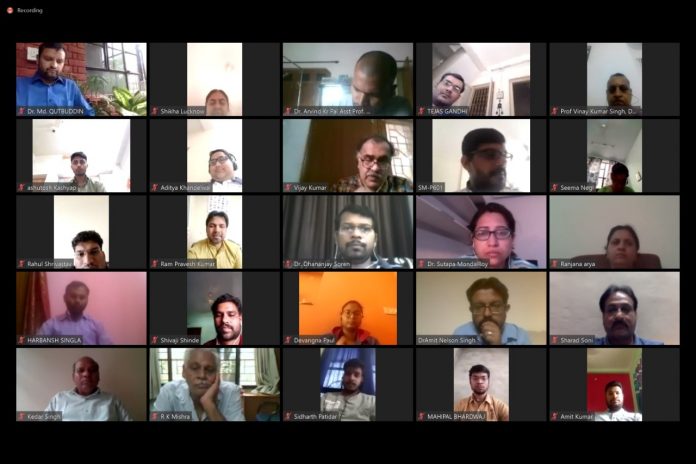
The Jawaharlal Nehru University organized an international webinar on the Coronavirus Pandemic to discuss the challenges and the recent developments on its preventive measures. Over 1000 participants across the globe registered, and hundreds of them successfully attended the webinar through online mode.
The meeting was inaugurated by the Vice-Chancellor of Jawaharlal Nehru University, Prof. M Jagadesh Kumar, who praised the initiative and discussed the role of digital medium in the modern-day education system. Prof. Kumar emphasized that digitization of the education system will gain further importance in the post-COVID era, and JNU will be leading the movement, which will be an efficient way to make education available to all. The organizing committee, comprising conveners Prof. Gobardhan Das, Special Center for Molecular Medicine, JNU, Dr Arnab Bhattacharya, School of Computational & Integrative Sciences, and Coordinator Dr Saurabh Kumar Sharma, School of Computer & Systems Sciences of JNU ensured seamless two-days lectures of the webinar. Leading scientists across the globe, including from countries like China, Italy, the USA, and India, presented their research related to characterization and preventive measures for COVID-19.
The first speaker of the first day on 25th April was Prof Gobardhan Das, Special Center for Molecular Medicine, JNU. He discussed his ongoing research on BCG vaccine that can be effective to combat the current outbreak of COVID 19. He presented some interesting data analysis done by the group of Dr. Arnab Bhattacharya in support of his claim. Prof. Debprasad Chattopadhyay, Director, ICMR-NITM, then discussed the traditional medicine approach to counter the pandemic.
Prof Yufang Shi from Shanghai, China, joined the webinar as a speaker and discussed the immune responses in COVID-19 patients. He explained how China handled the COVID-19 Pandemic and also explained specifically the importance of lockdown.
Prof Arun Kharat from School of Life Sciences, JNU, discussed the Indian scenario of the coronavirus pandemic and possible means to halt the rapid progression. He explained the comparative study within the Indian state and How India is fighting with this COVID-19 in comparison to the whole world. Following it, Dr RK Brojen Singh from School of Computational and Integrative Sciences, JNU, discussed the complexity in SARS-CoV-2 genome data through the price theory of epidemic by using Mathematical Modelling.
The second day of the webinar commenced with a note from Prof. Rana Pratap Singh, Rector, and also the Pro Vice Chancellor of the Jawaharlal Nehru University. Prof. Singh, who is a distinguished cancer biologist, presented a compact overview of how coronavirus is causing death in humans. This has set the tone for the second lecture of the session given by Prof. Saumitra Das, who is a virologist of international repute and also the current director of the National Institue of Biomedical Genomics (NIBMG). Along the line, Prof. Vibha Tandon, a professor at the Special Centre for Molecular Medicine, JNU, discussed the experimental methods to identify small molecules as a potential drug of the coronavirus infection. Prof. Neel Sarovar Bhavesh (Group Leader, ICGEB) depicted various molecular biological aspects of in silico discovery of coronavirus drugs through an illustrative presentation.
Prof. Enrico Bucci (Director, Research Integrity Solution), who joined the webinar from the USA talked about the origin of the SARS-CoV-2 epidemic and its potential transmission from bats to humans
Prof. Gerry Melino, the Editor in Chief, Nature Cell Death, and Differentiation journal, was the last speaker of the session, who joined from Italy and presented an excellent lecture on a comparative study highlighting the differences in COVID-19 scenarios in Italy and China.
The webinar ended successfully with a vote of thanks from the convener Prof. Gobardhan Das and Dr. Arnab Bhattacharya.
Overall, the webinar received very positive response from its huge number of participants. Altogether, the organizers received over 1000 registrations for the two-day long webinar, among which around 300 were faculty. Approximately 800 students joined from the various 84 national, international universities and institutions such as JNU, IITs, DU, BHU, Canadian Institute for Genomics and Society, Shanghai Institute of Biological Sciences, China, NPRC Texas, University of Rome, Italy etc.
The webinar was organised in collaboration with ‘Labify’ which is a web-based application and helps research labs to keep a record of project funds and compliance documents.


