

Amid rising fiscal deficits and public debt, Maldives remains at “high risk” of external and overall debt distress, the International Monetary Fund (IMF) said in its report.
This comes after an IMF mission led by Piyaporn Sodsriwiboon visited Male from January 23-February 6 to discuss recent economic developments and the country’s policy priorities.
The report has highlighted that the Maldivian economy expanded by 13.9% in 2022 and is estimated to grow by 4.4% in 2023
“Following the pandemic-induced contraction, the Maldivian economy expanded by 13.9% in 2022 and is estimated to grow by 4.4% in 2023. As tourist arrivals are expected to rise further, growth is projected at 5.2% in 2024,” the report stated.
The global financial agency further pointed out that, amid elevated fuel prices and strong import demands, the current account deficit in 2024 is projected to remain ‘large’.
“Without significant policy changes, the overall fiscal deficits and public debt are projected to stay elevated, and the Maldives remains at high risk of external and overall debt distress. Amid elevated fuel prices coupled with continued strong import demands, the current account deficit in 2024 is projected to remain large, albeit gradually narrowing over the medium term.
The Maldives is highly vulnerable to climate change risks, with potentially severe economic costs due to floods and rising sea levels,” the report added.
According to the IMF, sustained fiscal consolidation, accompanied by tighter monetary and macro-prudential policies, is needed to reduce vulnerabilities and restore the sustainability of public finance and debt.
The Maldives is also “highly vulnerable” to climate change risks, with potentially severe economic costs due to floods and rising sea levels, as per the report.
The Global Financial Agency has suggested strengthening institutions to support climate adaptation and mitigation efforts that can help enable access to additional climate financing and deliver on the climate pledges.
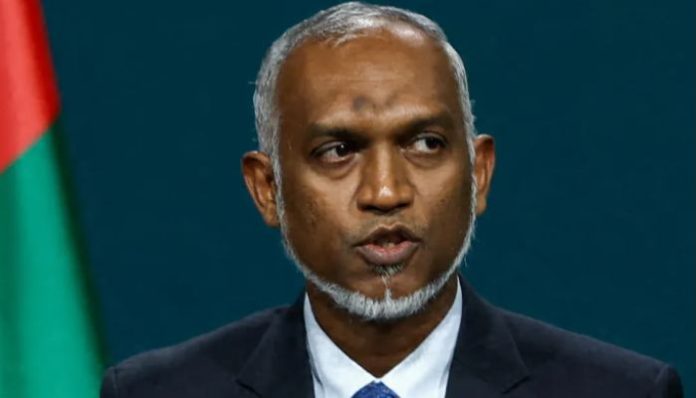
Earlier on Monday, Maldives President Mohamed Muizzu addressed the parliament in a session completely boycotted by the opposition.
Muizzu “underscored the necessity for the Maldives to fortify its military capabilities across terrestrial, aerial, and maritime domains as part of a comprehensive defence strategy.”
The President also said that the “Maldivian government has officially communicated that it will not renew the agreement enabling foreign nations to measure and map the Maldivian oceans and coastlines.”
Muizzu also stated that diplomatic negotiations were underway for the withdrawal of Indian troops. He detailed that, as agreed in the last negotiations, the military personnel on one of the three aviation platforms would be withdrawn before March 10, 2024, and the military personnel on the remaining two platforms would be withdrawn before May 10, 2024.
Notably, the removal of Indian troops in the Maldives was the main campaign of Muizzu’s party. Currently, there are around 70 Indian troops, along with Dornier 228 maritime patrol aircraft and two HAL Dhruv helicopters, stationed in the Maldives.
The second meeting of the high-level core group between the Maldives and India took place in New Delhi last week. The third meeting is expected to take place later this month.
(This news report is published from a syndicated feed. Except for the headline, the content has not been written or edited by OpIndia staff)


