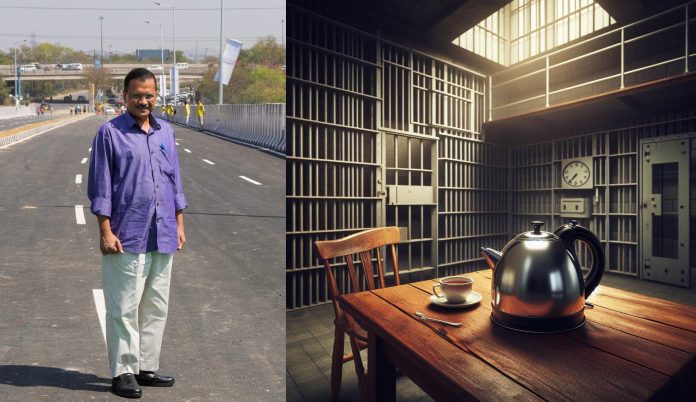
The Rouse Avenue Court on Wednesday allowed Arvind Kejriwal’s plea and directed Tihar jail authorities to provide an electric kettle to him and a table and chair for reading books, etc.
The Special Judge, Kaveri Baweja, on Wednesday allowed Kejriwal’s application
in view his medical condition and noted that electric kettle was required for heating water and for having tea, which he requires at frequent intervals.
The same court on April 1, 2024, sent the Delhi Chief Minister to judicial custody till April 15 in the excise policy money laundering case.
The Court on April 1, had directed Tihar Jail Authorities to allow Kejriwal to carry prescribed medicine, books, one table and chair, religious locket and special diet as prescribed by the doctors, as per Jail manual.
Kejriwal, through his lawyers, moved an application and sought permission to carry several books, including Bagwad Geeta, Ramayana and a book titled ‘How Prime Minister Decides’, authored by Neerja Chaudhary
Kejriwal was arrested on March 21 by the Enforcement Directorate in relation to the excise policy case and has spent 10 days in ED custody, after court direction.
Kejriwal was arrested by the central agency on charges of corruption in relation to the case. It is the first time in independent India that a serving Chief Minister has been arrested. The move came after Kejriwal skipped multiple summons by the investigation agency, nine in total, calling them “illegal.”
The case pertains to alleged irregularities and money laundering in framing and implementing the Delhi excise policy 2022, which was later scrapped.
While Kejriwal was not named in the FIRs registered by the ED or the Central Bureau of Investigation in the Delhi excise policy case, his name first found a mention in the ED’s chargesheet, wherein the agency claimed that he allegedly spoke to one of the main accused, Sameer Mahendru, in a video call and asked him to continue working with co-accused and AAP communications-in-charge Vijay Nair.
Nair was among the first people to be arrested by the CBI in the case, in 2022. Subsequently, former deputy chief minister Manish Sisodia and Rajya Sabha MP Sanjay Singh were arrested in connection with the case.
This news report is published from a syndicated feed. Except for the headline, the content has not been written or edited by OpIndia staff)