

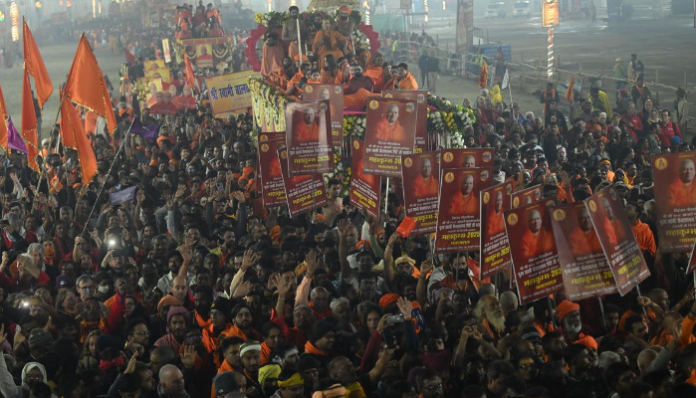
With Crores of devotees from all over the world seeking moksha (spiritual emancipation) with the sacred dip, the Mahakumbh celebrated its third “Amrit Snan,” on 2nd February, on the auspicious occasion of Basant Panchami. Amrit Snan is the grandest and most sacred ritual of the Mahakumbh Mela.
Saints and sages, including Naga sadhus from different akharas, started their ceremonial march towards the Triveni Sangam (confluence of Yamuna, Ganga and Saraswati rivers) at the crack of dawn. The Naga sadhus attracted attraction at the Mahakumbh because of their unique rituals. They demonstrated their proficiency with spears, swords, and tridents while leading several akharas in the holy bathing ritual.
Mahakumbh 2025
— Shishir?? (@ShishirGoUP) February 2, 2025
Basant panchami.@UPGovt pic.twitter.com/5bz58UCtDV
The Mahanirvani and Atal Akharas finished their rituals by 5:40 am, rather than 6:15 am as they did on Makar Sankranti on 14th January, amid mounted police personnel closely monitoring Sangam Nose. They left their camps for the bathing ghats at 4 am. Sadhus of akharas were required to finish their rites by 3:55 pm after arriving at the bathing ghats in processions. Once they departed, regular devotees were permitted to take a dip at Sangam Ghats. The third “Amrit Snan” featured captivating processions led by “Mahamandleshwars” (chiefs) of several akharas.
The mela authorities worked with the senior sadhus of the akharas to determine a bathing timetable in order to guarantee a mishap-free event. Every akhara had a forty-minute window to visit the holy waters, and by 8.30 am, the first procession had finished their rite and headed back to their camps. The akharas and the Uttar Pradesh government advised people not to prioritize reaching the main confluence point, stating that all ghats carry equal importance, following the stampede at the Sangam Nose, which many perceive to have higher spiritual significance.
The akharas of three sects take dip in sequence
According to tradition, the three akharas belonging to Sanyasi, Bairagi and Udaseen sects took the sacred dip in a specific order. According to the timetable made public by the Kumbh Mela officials, the Sanyasi sect’s akharas kicked off the “Amrit Snan,” formerly known as the “Shahi Snan,” at 4 am. Panchayati Akhara Mahanirvani, Shambhu Panchayati Atal Akhara, Taponidhi Panchayati Sri Niranjani Akhara, Sri Panchayati Akhara Anand, Panchdashnam Juna Akhara, Panchdashnam Avahan Akhara and Panchagni Akhara led the revered procession.
The first procession concluded the ritual and headed back to their camps within the 40-minute window that each akhara has been allotted to visit the divine waters. The Bairagi sect’s akharas, whose bathing ritual started at 8:25 am, were next in line. All India Shri Panch Nirvani Ani Akhara, All India Shri Panch Digamber Ani Akhara, and All India Shri Panch Nirmohi Ani Akhara were among the procession. Each group’s turn ended at 12:35 pm and then the last group entered the holy waters.
The Udaseen sect, which consists of Shri Panchayati Nirmal Akhara, Shri Panchayati Akhara Bada Udaseen Nirvana, and Shri Panchayati Naya Udaseen Akhara were the last to conduct the “Amrit Snan.” The ascetics will finish their rituals and head back to their tents by 3:55 pm, after beginning their march towards the river at 11 am.
#Mahakumbh
— PIB India (@PIB_India) February 3, 2025
Witness the divine spectacle of the Amrit Snan at the Triveni Sangam, a confluence of sacred rivers, on the vibrant occasion of Basant Panchami (03 Feb 2025) during the #Mahakumbh2025 in Prayagraj ?✨ pic.twitter.com/aO7EHZtm7n
On the way to the Sangam region (Sector 3) for Amrit Snan, akharas crossed the Ganga from Triveni Marg (Sector 20) via Pontoon Bridge No. 6 Triveni Dakshini and Pontoon Bridge No. 7 Triveni Madhya. Only the Khalsas, Mahamandaleshwars and Acharya Mahamandaleshwars on the list that was provided to the Mela administration were permitted to bathe with the akharas, per the directive. Likewise, the number of locations and cars heading for snan were meant to match the passes that the Mela police have granted.
Bathing was at the designated Sangam Ghat by turning left from Triveni Marg Akhara Marg crossing. Additionally, parking spaces for akhara vehicles was created in the Sangam region. Following their bathing, akharas will head back to Garg (Sector 3), where they will turn right off the Akhara Vapasi Marg, bridge the Ganga across Pontoon Bridge No. 3 Mahavir Ji Dakshini and Pontoon Bridge No. 4 Mahavir Ji Northern, and enter Sector 20 afterwards.
Mahakumbh 2025: More than 6.22 million devotees take holy dip on 'Basant Panchami'
— ANI Digital (@ani_digital) February 3, 2025
Read @ANI Story | https://t.co/jK3N9AnBQM#prayagraj #devotees #trivenisangam #BasantPanchami pic.twitter.com/ebLmOJbWi9
16.58 lakh devotees had taken the holy bath by 4 am and 62 lakh till 8 am, bringing the total number to 34.97 crore (35 crore per other reports) since 13th January. This number included 6.58 pilgrims and 10 lakh Kalpvasis. The administration of Uttar Pradesh expected almost 5 crore pilgrims on 3rd February alone as 1.20 crore people already took part in the ceremony during Basant Panchami, taking the final number to over 6.22 millions. It is anticipated that the overall number will surpass 50 crores with 23 days left in the Maha Kumbh.
Zero-error arrangements for Mahakumbh by state government
Preparations were personally overseen by Chief Minister Yogi Adityanath for the Amrit Snan, who sent additional personnel, medical staff and resources to ensure a “zero-error” event. According to senior Superintendent of Police (SSP) Rajesh Dwivedi, a three-tier structure was put in place to guarantee that the holy event proceeds successfully. On 2nd February, mela police implemented a seven-point special scheme to control the influx of pilgrims and devotees swarming to Ganga ghats to perform rituals and take holy dips, following chief minister Yogi Adityanath’s directives.
A one-way traffic system, a no-vehicle zone in the mela region, restrictions on vehicles entering Prayagraj limits, a diversion strategy using barricades and holding zones, and no ghat crowding were all part of the seven-point special program. The mela police also stationed joint teams of paramilitary and mela police at 28 static locations to control the flow of devotees in order to guarantee the safety and security of the people who flock to the Ganga ghats.
Mela officials asserted that the flow of devotees at all 44 ghats in Parade, Arial and Jhunsi carried on after the beginning of Basant Panchami at 9:14 am. Special 20 teams and Jal police were in charge of controlling the stream of devotees at the ghats. Two senior IAS officers, who were members of the team that successfully carried out the 2019 Ardh Kumbh, have also been deployed by the government.
Mela Adhikari Vijay Kiran Anand has joined Ashish Goyal and Bhanu Chandra Goswami, who have extensive experience in Prayagraj administration, including a thorough understanding of crowd control and inter-agency coordination during the 2019 Ardh Kumbh. The three of them participated in the mega mela six years ago. The Additional Director General of Police, Bhanu Bhaskar, is personally in charge of the crowd control measures in the area.
यह सनातन संस्कृति का 'अमृत काल' है…
— Yogi Adityanath Office (@myogioffice) February 3, 2025
हमारी आध्यात्मिक चेतना के उत्कर्ष का 'नव विहान' है…#बसंतोत्सव_महाकुम्भ pic.twitter.com/9ZYmD2RgZH
“A strict surveillance is being maintained at all ghats, including Sangam Nose and Eravat Ghat, and cops are strictly asked to regulate the flow of devotees,” informed Rajesh Dwivedi and added, “With Panchami tithi beginning from Sunday morning, devotees from across the states started thronging ghats and taking holy dips since sunday morning.” He asserted that eloborate security measures are in place for “Amrit Snan.”
Vigilance was focused on Akhara Marg to prevent devotees from entering, and police troops were used to enforce strict barricading. Senior police and administrative authorities are examining arrangements in static sites, such as the city, mela area, and border areas, in addition to keeping an eye on the ICCC’s (Integrated Command and Control Centre) arrangements. 2nd and 3rd February were challenging dates for the mela administration with no VIP protocol to anyone and every preparation was made to ensure Basant Panchami “Amrit Snan.”
After realizing the massive size of the gathering, Mela police are also using the pontoon bridges in a methodical way. Devotees are being urged to take a holy dip at the ghat nearest to their entry point and return from there without traveling towards Sangam Nose. Notably, a total of 44 ghats, totaling 12 kilometers were built. However, mela police are using equipment like ropes, whistles, loudspeakers, roadblocks, barriers, and watchtowers to control the flow of worshipers.
“With millions of devotees continuing to flock to ghats, elaborate security arrangements are in place for Basant Panchami (being celebrated on both Sunday and Monday). A strong posse of 40,000 policemen, including paramilitary personnel and equipped with all modern gadgets, are assigned duties at static locations,” Rajesh Dwivedi conveyed.
He added that no one is permitted to remain or sleep on the ghats and that temporary holding areas, parking lots, and overnight stay arrangements have also been put in place to help control the crowd. Furthermore, to handle the enormous number of devotees, the infrastructure at each of the 44 ghats is being strengthened. There are amenities like river barricading, Jal police, watchtowers, better lighting, conspicuous signage, restrooms, changing areas, and thorough cleaning procedures.
#WATCH | #MahaKumbh2025 | Saints and devotees take a holy dip at Triveni Sangam as flower petals are showered on them from a chopper, on the occasion of Basant Panchami.
— ANI (@ANI) February 3, 2025
The last 'Amrit Snan' of Maha Kumbh 2025 is taking place today on the occasion of Basant Panchami. pic.twitter.com/GbOH68AO0R
Devotees are frequently reminded via the public address system to maintain vigilance, avoid rumors, and swiftly report any issues to the on-duty police officers. A committed crew of traffic police, mela cops, and specialty physicians has been stationed around-the-clock to help devotees in an emergency. At the same time, the SSP urged people to comply with the authorities and should spend less time on ghats and proceed directly to the parking lot or destination after the dip and rites.
Police also asked pilgrims to refrain from jostling and to exercise patience on the pontoon bridges and barricading. There are plans to reduce traffic on the roads leading into and out of the Sangam area. Police encouraged people to avoid obstructing traffic and stopping on roadways rather than in designated holding areas. 2,500 buses have been deployed by the Uttar Pradesh State Road Transport (UPSRTC), which will run from four makeshift bus stops to guarantee the orderly and seamless return of devotees.
The biggest allotment consists of 1,500 buses at Jhunsi, 600 at Bela Kachhar for passengers traveling to Lucknow, 300 at Nehru Park for those traveling to Kanpur, and 100 buses for tourists traveling to Mirzapur and Banda. Devotees will also be transported to the temporary bus stations and important sites close to Maha Kumbh by 550 shuttle buses that will run every two minutes.
Medical arrangements by the government
Chief Minister Yogi Adityanath has ordered all doctors in Mahakumbh Nagar and the whole Prayagraj division to ensure the safety and well-being of devotees, placing the entire medical infrastructure on high alert. An official statement regarding the same was also released.
It read, “Over 1,200 medical personnel are fully prepared in the Maha Kumbh Nagar to provide immediate assistance. The entire medical force will remain stationed at the fairground and will only be relieved after February 6. Additionally, a backup plan has been put in place to address any emergencies. At Swarup Rani Nehru Hospital, 500 staff members have been put on standby, most existing patients have been discharged, and 150 beds have been reserved for emergencies. Sixty resident doctors have been placed on 24-hour alert mode, 30 CT scan machines are ready, along with MRI and ultrasound facilities, ensuring all necessary tests can be conducted. A 200-unit blood bank has also been set up at SRN Hospital, and all facilities are linked to an alarm system for quick response.”
“In case of need, patients will be transferred to Swarup Rani Nehru Hospital or Tej Bahadur Sapru Hospital (Bailey Hospital). Medical teams across Prayagraj, the division, and Mahakumbh Nagar are fully prepared. The chief minister has instructed that no doctor or medical staff should leave their post until February 5. Over 1,200 doctors and paramedical staff have been deployed for the event,” Dr Gaurav Dubey nodal officer for medical services at the Maha Kumbh stated. According to the administration, preparations have been made to provide doctors and medical workers at Swarup Rani Nehru Hospital with lodging and meals in order to guarantee their prompt availability.
Commencing on 13th January, the auspicious occasion that takes place once in 144 years is scheduled to end on 26th February.


