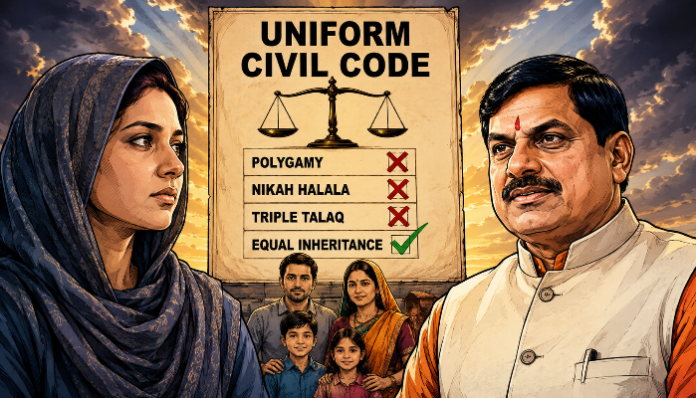
On 19th July (Sunday), the Madhya Pradesh government approved the Uniform Civil Code (UCC) bill at a special cabinet meeting in Jagdishpur close to Bhopal. It has been drafted by a six-member committee and is going to be tabled in the legislative assembly during the five-day monsoon session commencing on Monday. The bill exempts the state’s tribal population and would not apply to Scheduled Tribes or Particularly Vulnerable Tribal Groups (PVTGs) residing in protected areas not to interfere with their “unique cultural heritage and traditional lifestyle.”
It seeks to uphold the interest of women and children in marriage, divorce, inheritance, succession and live-in relationships across all communities. The proposed law has banned practices like polygamy, triple talaq and nikah-halala. Chief Minister Dr Mohan explained that the objective is to secure women’s dignity, ascertain equal rights, foster social harmony and enhance national unity by putting an end to discriminatory behaviours.
आज मध्यप्रदेश की कैबिनेट ने समान नागरिक संहिता (UCC) विधेयक, 2026 को सर्वसम्मति से स्वीकृति प्रदान की है…#UniformCivilCode #UCC #cabinetdecision pic.twitter.com/enw6YgisNj
— Dr Mohan Yadav (@DrMohanYadav51) July 19, 2026
Marriage and divorce
Yadav informed, “Under the marriage provisions, only one marriage is permitted while a spouse is alive, with divorce valid only through legal procedure and court decision. The minimum age for marriage is set at 21 years for men and 18 years for women, and registration of marriages is mandatory across all levels, from panchayat to municipal corporation.” Such unions beyond these age limits will be prohibited.
'समान नागरिक संहिता' : एक नए युग का प्रारंभ
— Dr Mohan Yadav (@DrMohanYadav51) July 19, 2026
– नारी सशक्तिकरण एवं सम्मान की दिशा में महत्वपूर्ण कदम
– सभी विवाहों का पंजीयन अनिवार्य
– महिलाओं को संपत्ति में पुरुषों के समान अधिकार
– विवाहित व्यक्ति के लिव-इन संबंध में रहने पर 5 वर्ष तक की सजा#UniformCivilCode #UCC… pic.twitter.com/3Et3PgRN5x
The sub-divisional magistrate (SDM), municipality, or village panchayat is set to handle the process in rural regions while Madhya Pradesh’s e-Municipality portal would take care of it in urban areas to guarantee marital rights, alimony and legal protections for women.
The initiation of a second marriage is contingent upon the legal termination of the first marriage. An official conveyed, “Verbal divorce or decisions made by informal panchayats have been declared completely illegal. A marriage can be dissolved only on clear and statutory grounds prescribed by law.”
The bill read, “Accepting, promoting, or forcing degrading or humiliating conditions such as ‘nikah halala’ for remarriage to the same spouse after divorce will be treated as a punishable criminal offence.” It is also forbidden to get married based on invalid consent or within forbidden degrees of relationship (unless custom permits).
Yadav stated, “If a married person enters a live-in relationship, the law provides for punishment of up to five years. Religious freedom is safeguarded, with individuals free to follow their rituals, worship methods, and ceremonies without compulsion, and no religion has been demeaned.”
Live-in relationships
The couples must submit a “Statement of Live-in Relationship” to the registrar within one month and the age criteria is the same as that for marriage. Otherwise, non-compliance could lead to incarceration of up to three months or a fine of Rs 10,000. Likewise, false data might prompt a penalty of Rs 25,000 and three months in jail. A punishment of Rs 25,000 and up to six months in jail could result from a failure to present the necessary statement, even after being notified by the registrar.
A woman can also file for maintenance in a court of competent jurisdiction after her male live-in partner deserts her. The details about the start and end of the live-in relationship will be sent to their parents or guardians and the local police. “The proposed UCC will ensure that whether it’s Ram (Hindu), Rahim (Muslim), Ravindra (Sikh) or Robin (Christian), their marriage, divorce, inheritance and succession are governed by a common civil code,” Yadav reiterated.
Inheritance rights
The recommended legislation also offers equal authority and inheritance rights to both sons and daughters irrespective of their marital status. “The code has removed the term ‘illegitimate’ from the legal framework. Children of married or unmarried parents whether biological, adopted, or born through surrogacy or Assisted Reproductive Technology (ART) will enjoy equal legal status,” the officer underscored.
Additionally, widowers and widows will be recognised equally in the deceased’s estate. The surviving mother and father will be considered as Class I heirs, obtaining equal parts of their departed child’s assets with the spouse and offsprings. Three categories, Class I, Class II and other relatives shall progressively acquire the property of a person who passes away intestate (without a lawful will).
For previous generations, a “right of survivorship” and a “unit system” is created. If someone is found guilty of killing the property owner or helping in the act, they will never be able to inherit. According to the escheat principle, the property will be handed over to the state in the absence of an authorised successor.
Any adult of sound mind can hand over 100% of their property, including inherited and self-acquired, to any individual through a will under the secular framework which has eliminated limitations on obligatory succession, such as Islamic law’s one-third rule. The Indian Succession Act of 1925 will regulate the procedure.
Overwhelming support for the bill from Muslim women
According to the chief minister, the bill does not breach the fundamental rights. He outlined that all of the state’s districts and divisions were consulted by a committee led by former Supreme Court judge Justice Ranjana Prakash Desai before to its preparation. He added that political parties including Aam Aadmi Party (AAP) and the Left along with social groups from other religions were also involved in important state-level talks in Bhopal, but Indian National Congress did not participate.
Yadav charged, “I don’t know what the Congress sees in the Hindu-Muslim votes. They always have a dilemma over one nation, one symbol and one law.” He also highlighted that the consultations showed strong support among Muslims, with 40% of males and nearly 80% of women wanting the adoption of a unified law.
He added, “Some Muslim brothers faced opposition, many emphasised that just as Hindu daughters deserve safety, so too should their own sisters and daughters.” They declared that the law would protect their mothers and sisters. Yadav remarked, “For us, whether Ramchandra or Rahim, everyone deserves equality. This law is a major step in that direction,” pointing out how the move is intended to grant equal opportunities and rights to all people of all faith.
Yadav stressed that the government solicited opinions from the general public at the district and state levels, even though the bill could have been adopted directly in the legislative assembly. He characterised the decision as both a “major and historic step” toward assuring “equality, equity, justice and secularism” for all people and a tribute to the state’s illustrious past.
'समान नागरिक संहिता' : एक नए युग का प्रारंभ
— Dr Mohan Yadav (@DrMohanYadav51) July 19, 2026
– नारी सशक्तिकरण एवं सम्मान की दिशा में महत्वपूर्ण कदम
– सभी विवाहों का पंजीयन अनिवार्य
– महिलाओं को संपत्ति में पुरुषों के समान अधिकार
– विवाहित व्यक्ति के लिव-इन संबंध में रहने पर 5 वर्ष तक की सजा#UniformCivilCode #UCC… pic.twitter.com/3Et3PgRN5x
The aforementioned official expressed, “Respecting constitutional safeguards, this law will not apply to Scheduled Tribes (such as Bhil, Gond, Korku, Baiga, Sahariya, and Bharia) covered under Articles 342 and 366 (Clause 25) of the Constitution. Furthermore, communities whose traditional rights are protected under Part XXI of the Constitution have also been specifically exempted.”
Meanwhile, Yadav connected it to the spirit of sacrifice and patriotism ingrained in Jagdishpur’s soil, recalling the bravery of Rani Kamalapati who stood up for her dignity during trying times. He stressed, “Henceforth, there will be no special laws for specific groups in the state. People of all faiths will live under a unified legal framework. Whether it concerns live-in relationships or any other aspect of life, everything will be governed by the same set of rules.”
The UCC has been a significant agenda for the Bharatiya Janata Party (BJP) which initiates its implementation after gaining power. Goa has historically adhered to it. Uttarakhand, Gujarat and Assam have officially enacted it whereas states like Maharashtra, West Bengal and Rajasthan formed expert committees to design their respective regulations.