

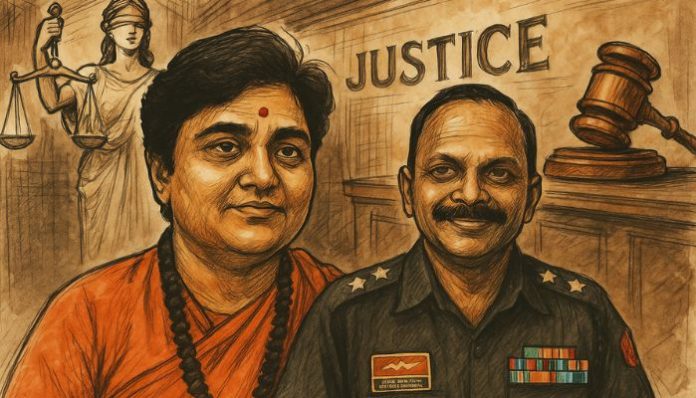
On 31st July, an NIA Court acquitted all accused in the Malegaon blast case, including Sadhvi Pragya and Lieutenant Colonel Purohit. This marks the second case in less than two weeks where the Anti-Terrorism Squad (ATS) of Maharashtra Police’s investigation during the UPA era fell flat in court. Earlier, on 22nd July, all 12 accused in the 7/11 Mumbai Blast case were acquitted, raising serious doubts over the investigative capabilities of the then ATS teams.
In the 7/11 case, the accused walked free because the ATS failed to prove their guilt in the Mumbai High Court. Notably, 5 out of 12 were sentenced to death and the remainder were sentenced to life imprisonment in the case by the lower court. Despite the presence of evidence including material used to build bombs, jihadi literature, etc., the investigating agency heavily relied on confessions recorded under MCOCA, which were found to be insufficient by the High Court as there was no supporting evidence. Furthermore, important evidence such as CDRs was destroyed by the investigating agency citing procedure. Had it been preserved, the agencies could have established the movement of the accused at the place of the blasts.
In the Malegaon blast case, a “Hindu terrorism” narrative was built and Sadhvi Pragya, Col Purohit and others were made scapegoats. ATS, as well as the National Investigation Agency that took over the investigation in 2011, failed to provide any substantial evidence against the accused in court, leading to the acquittal. In this case, the real perpetrators are still unknown, as the narrative was attempted to be built around so-called “Hindu terrorism”.
Almost two decades of legal battles have fallen flat and the families of the victims continue to seek justice.
Mumbai train blasts 2006: What happened, and how ATS messed up the case
On 11th July 2006, Mumbai’s Western Line suburban train system was ravaged by seven near-simultaneous pressure cooker bomb explosions between 6:24 PM and 6:35 PM. A total of 187 people lost their lives and over 800 were injured during the evening rush hour. The initial investigation quickly attributed the attack to a conspiracy involving Pakistan-based terrorist organisation Lashkar-e-Taiba and SIMI operatives.
The terrorists from Pakistan allegedly infiltrated India via Nepal and Bangladesh. Within weeks, the ATS arrested 13 men accused of orchestrating the terrorist attack. During the investigation, MCOCA provisions were imposed alongside IPC sections. In 2015, a special MCOCA court convicted 12 of those arrested. Five were sentenced to death and the rest received life imprisonment.
The verdict leaned heavily on confessional statements purportedly made by the accused. Eyewitness identifications were conducted months after the blasts and there was some unverifiable circumstantial testimony. The lack of a forensic trail, call-data records, travel logs and irrefutable material evidence connecting the accused to the bombs made the case weak in the High Court.
Despite loud assertions of dismantling a Pakistan-based terror ring, the ATS’s prosecution rested on shaky ground, constructing the narrative through associative inference rather than substantive proof. The court also raised serious doubts about the authenticity and voluntariness of these confessions by highlighting an unusual pattern.
Several confessions shared identical content, including the sequence of names and descriptions of events. The Bench noted it was “shocked” by the extent of similarity and even suggested that portions appeared to have been “copied”. The court observed that it was “beyond the realm of reasonable imagination” that such identical narration would occur naturally.
The verdict has been challenged in the Supreme Court. Though the apex court has stayed the High Court judgment, it clearly stated that the accused do not need to surrender as they were already released following High Court verdict. The High Court judgment came 19 years after the blasts and it is unclear how many more years it would take for the apex court to give verdict in the case.
The Malegaon 2008 acquittals: From explosive allegations to evidentiary collapse
Nearly 17 years after the deadly blast that shook Malegaon, a special NIA court in Mumbai acquitted all seven accused in the 2008 Malegaon bomb blast case. The explosion occurred on 29th September 2008 using an improvised explosive device strapped to a motorcycle, detonated near a mosque. Six people were killed and at least 100 were injured. Now, following the acquittal of the seven accused, the question is, who was really behind the bomb blast?
Among the accused were high-profile names such as former BJP MP Sadhvi Pragya Singh Thakur, Lt Col Prasad Purohit, Major (retd) Ramesh Upadhyay, Ajay Rahirkar, Sudhakar Dwivedi, Sudhakar Chaturvedi and Sameer Kulkarni. All of these seven walked free after years of incarceration and legal battle.
The judgment decisively dismantled the prosecution’s case. The court ruled that no cogent material was presented against any of the accused. Specifically, the court noted that the ATS failed to produce any evidence that the motorcycle used in the blast belonged to Pragya Thakur. The judge observed that she had become a Sadhvi at least two years prior to the blast and the prosecution failed to establish her link to the plot.
In a scathing rebuke of the case handling, the court remarked that “no material was brought on record” to show that explosives were ever stored at Col Purohit’s residence. It added that even basic investigative procedures were ignored: the sketch of the alleged storage room was never drawn, and the forensic samples were found to be contaminated. The court further rejected the ATS’s narrative around Abhinav Bharat, a right-wing organisation allegedly founded by Thakur and Purohit, saying there was no evidence that the group used its funds for terror activities.
The case has long been surrounded by political and procedural controversies. Initial investigations were conducted by the ATS under the late Hemant Karkare. A chargesheet was filed in January 2009 that claimed a broad conspiracy aimed at targeting the Muslim community. The ATS had invoked MCOCA against all 12 original accused and claimed that “conspiracy meetings” had taken place in Bhopal, Indore and other locations. It argued that Thakur had provided the motorcycle and Purohit had supplied RDX to avenge attacks on Hindus.
The case was handed over to the National Investigation Agency (NIA) in 2011. A supplementary chargesheet was filed by the NIA in 2016 in which the agency withdrew all charges against Sadhvi Pragya. The agency told the court that there was no crucial evidence linking her to the attack. Furthermore, the NIA accused the ATS of “torturing witnesses” into making statements against her.
Despite the clean chit by the NIA, the special court initially refused to discharge Pragya citing ATS-collected materials that could not be ignored. Special Public Prosecutor Rohini Salian accused the NIA of going soft on Thakur. Salian was later removed from the case.
The judgment acquitting all accused exposed the deep fissures within India’s counter-terror apparatus. From the ATS’s controversial investigation and the NIA’s contradictory findings to prosecutorial reshuffles and public allegations of bias, the Malegaon 2008 case became emblematic of what happens when terror investigations are compromised.
How Congress fuelled the ‘Saffron Terror’ narrative
The acuittals in Malegaon blast have once again cast a harsh light on the political invention of the “Saffron Terror” theory. It was an idea vigorously championed by Congress leaders during the UPA regime. One of the most prominent voiced behind this narrative was Digvijay Singh who repeatedly described the RSS as a “bomb-making factory”. He blamed RSS for spreading terrorism in the country.
In 2008 and the years that followed, he sought to link the RSS and affiliated Hindu organisations to series of blasts including Malegaon, Ajmer Sharif, and even the Samjhauta Express.
This narrative was more than political posturing. In 2010, Home Minister P Chidambaram formally referred to “saffron terror” in an address to intelligence officers, while in 2013, Sushilkumar Shinde escalated the rhetoric by alleging that the RSS and BJP were running “terror training camps.” These statements, made from high offices of power, triggered a political firestorm and deepened communal divisions.
The narrative went global when WikiLeaks revealed that Rahul Gandhi, in a 2009 conversation with then US Ambassador Timothy Roemer, described “radical Hindu groups” as a greater threat than Islamist outfits like Lashkar-e-Taiba. Former NSA MK Narayanan also reportedly discussed “Hindu extremist groups” with then FBI Director Robert Mueller the same year.
While the Congress party often tried to distance itself from such remarks, the damage was done. Years later, as courts acquit the very people accused under these theories, the so-called “saffron terror” campaign now appears to have been a politically motivated detour, one that derailed investigations, weakened national unity, and undermined faith in the justice system.
What was lost – National security and credibility
The collapse of the two cases has shattered public trust. While in one case the conviction was overturned due to lack of evidence, in the other case innocent Hindu leaders, Army officials and a Sadhvi were dragged into a cooked-up case.
With these two judgments, broader institutional damage has been pronounced. It is evident that the ATS’s methodology repeatedly failed judicial norms and forced the courts to stage interventions over planted evidence, confessions obtained under duress, and coerced witness statements.
The losses are multifaceted. Victims’ families will continue to wait for justice, as one case remains in legal limbo and in the other, the real culprits are walking free. Closure has been denied. Public faith in an agency once heralded for dismantling terror networks is now deeply eroded. The ATS, once a symbol of counter-terror effectiveness, now appears compromised by politics, communal framing, and procedural shortcuts.


