

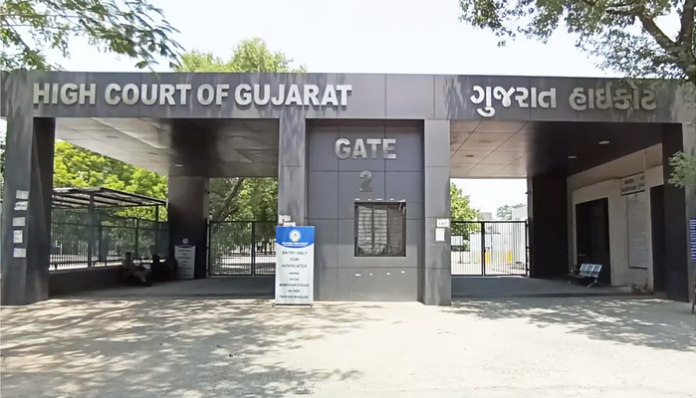
The Gujarat High Court on October 1, 2025, dismissed a batch of applications filed by several accused in a case of religious conversion of Hindus to Islam, citing that prima facie offences were made out against the accused/applicants.
A Bench of Justice Nirzar S Desai was hearing the applications, which sought the quashing of the FIR filed against the accused in 2021 under Sections 120(B), 153(B)(1)(C), 153(A)(1), 295(A), 506(2), 466, 467, 468 and 471 of the Indian Penal Code, Section 3(2)(5-A) of the Scheduled Castes and Scheduled Tribes (Prevention of Atrocities) Act, Section 84C of the Information Technology Act, 2000, and the relevant provisions of the Gujarat Freedom of Religion Act, 2003.
The court rejected the arguments that they could not be made the accused in such a case since they were themselves converts from another faith. The Court said that prima facie the accused did not appear to be victims since they had themselves influenced and pressurized others to change religions. Three of the accused were originally Hindus who later converted to Islam.
The former Hindus along with others named in the case are accused of alluring Hindu villagers in Bharuch’s Amod to change their religion by promising them new houses, food-grain, cash and jobs.
Background of the case
An FIR was filed on November 14, 2021, at the Aamod police station in Bharuch city against several people on the complaint of a person named Pravinbhai Vasantbhai Vasava. Initially, 9 individuals were accused in the FIR, but after the investigation was carried out, the number of accused reached 16.
In his complaint, Pravinbhai Vasantbhai Vasava said that he was converted to Islam in 2018 through allurement and his name was changed to Salman Vasant Patel. He said that one Abdul Aziz Patel used to teach him how to chant Kalma by taking him into an Ibadatgah made in a Government premises. He added that one day he was taken to Surat, where he was made to put his thumb impression on a paper by misrepresentation, and thereafter his name was changed to Salman Vasant Patel on his Aadhaar Card.
He accused Shabbirbhai Bakerywala and Samadbhai Bakerywala of converting another man named Ajitbhai Chhaganbhai Vasava (converted to Abdul Aziz Patel)to Islam by promising to provide him financial assistance and construct a house for him. After they provided him financial assistance, Ajitbhai Chhaganbhai Vasava converted two Hindu men, Mahendra Jivanbhai Vasava (name changed to Yusuf Jivan Patel) and Raman Barkat Vasava (name changed to Aiyub Barkat Patel). “Thereafter, all three persons together, along with Shabbir Bekriwala and Samajbhai Bekriwala, started alluring the other Hindu villagers of the village, and by giving them the temptation of constructing a new home, food-grain and cash, tempted them to convert to Islam,” said the complainant.
The complainant said that Abdul Aziz Patel received financial aid for religious conversion from one Hasan Tisli. He added that Hasan Tisli, Abdul Aziz Patel, and another person named Fefdawala Haji Abdullah, a foreign national, converted around 100 persons belonging to 37 Hindu families to Islam by offering them money. The complainant also said that Abdul Aziz Patel used to teach him Kalma in an Ibadatgah, which he had constructed by demolishing his house built using government aid. He further stated that the accused were part of a nationwide conspiracy to convert Hindus to Islam, and they were receiving huge financial aid for the same from abroad. When the complainant opposed the accused, they threatened to kill him, and therefore, he decided to approach the police.
The High Court refused to treat the accused as ‘victims’ of religious conversion
One of the grounds for challenge to the FIR was that the applicants were themselves victims of religious conversion and not the offenders. Describing their implication in the case as a misconception, the applicants claimed that the complainant and all other converts had converted to Islam of their own free will and not under any pressure or allurement, which is required to attract an offence.
Rejecting the contention the High Court noted, “…considering the fact that after their conversion to Islam, it is alleged that those persons also indulged into activity of pressurizing and alluring other persons as alleged in the FIR and as can be seen from the papers available on record, it is their further act of converting further people around 100 in numbers of 37 families to Islam would prima facie make out an offence against them and, therefore, I do not see any reason to interfere with the trial”.
“However, on account of their act of influencing and pressurizing and alluring other persons to convert to Islam, as can be seen from the FIR as well as statements of the witnesses, of course, those allegations are prima facie in nature for which today, upon examination of material produced, the Court is of the view that conversion of the victims indicates that a prima facie offence is made out. Therefore, it cannot be accepted that those persons who are arraigned as accused who are originally Hindus and subsequently were converted to Islam, can be said to be the victims on account of allegations made in the FIR as well as the material collected during the course of investigation by way of charge-sheet papers,” the court noted in the dismissal order.
Dismissing the petitions, the court said, “on account of their act of influencing and pressurizing and alluring other persons to convert to Islam, as can be seen from the FIR as well as statements of the witnesses, of course, those allegations are prima facie in nature for which today, upon examination of material produced, the Court is of the view that conversion of the victims indicates that a prima facie offence is made out. Therefore, it cannot be accepted that those persons who are arraigned as accused who are originally Hindus and subsequently were converted to Islam, can be said to be the victims on account of allegations made in the FIR as well as the material collected during the course of investigation by way of charge-sheet papers.”
Application of an accused dismissed on the ground of his non-cooperation in the investigation
The High Court dismissed the petition of accused Fefdawala, who lives in the United Kingdom, on the ground that he did Regarding the the application of accused the High Court noted that he did not cooperate with the authorities in the investigation and therefore, the court made it a ground for the dismissal of his application. The High Court pointed out that Fefdawala visited India 25 times before the registration of the case against him and has not visited even once thereafter. “…the applicant has visited India 25 times and, therefore, the Police Authority had insisted the aforesaid accused persons to come down to India and to participate in the investigation by extending his cooperation. However, the applicant has not come to India once thereafter and therefore, looking to his conduct, the petition filed by Mr. Fefdawala may be dismissed on the ground of his conduct itself without being considering the same on merits,” the court said.
“He did not prefer any anticipatory bail application and except the present petition for quashing, at no point of time, as per the records, he has shown any willingness to cooperate in the investigation. The applicant was served with a Summons under Section 41-A of CrPC which was though responded, but the applicant has chosen not to remain present and made himself available for extending cooperation in investigation,” the court added.


