
India’s importation of Russian oil has led to significant turmoil in international diplomacy, particularly concerning United States as President Donald Trump imposed a 50% tariff, including an additional 25% for failing to comply with his demand to cease purchases. The White House and its officials implied a range of pressure tactics to influence New Delhi which did not relent.
Trump even claimed that Prime Minister Narendra Modi assured him he would halt energy purchases from Moscow, last month. However, Ministry of External Affairs (MEA) countered that no phone call took place between the two leaders. Now, preliminary ship-tracking data provided by Kpler and OilX suggested that India’s crude oil imports from Russia have grown in October relative to the prior month, serving as further evidence of the Modi government’s resolute stance in the face of persistent pressure from Washington.
According to Kpler data, India’s intake of Russian oil increased from 1.44 million barrels per day (bpd) in September to approximately 1.48 million bpd in October, reported Reuters. OilX estimated the supplies to be at the same level and disclosed that September imports were 1.43 million barrels per day. Russian-exported oil from Kazakhstan was not included in the figures.
Furthermore, India’s main refiner resumed the consumption of Russian oil, acquiring five cargoes for December arrival from non-sanctioned firms, according to the media house. According to one of the trade sources, Indian Oil Corporation (IOC), the nation’s largest refiner, purchased roughly 3.5 million barrels of ESPO (Eastern Siberia-Pacific Ocean) crude oil at prices equal to those from Dubai for delivery at a port in eastern India in December.
Anuj Jain, head of finance at IOC earlier mentioned that Russian oil continues to be available on the spot market at a discount of $2 to $3 a barrel to Dubai for transport to Indian ports, based on the media outlet. “We never stopped it (buying Russian crude). We are already buying for October, November,” he expressed and added, “There was a dip in buy because our inventory levels were high, so we wanted to optimise our inventory levels also. That was one of major factors.”
Procurement of Russian oil experiences monthly variations
The buying patterns varied each month and have not been uniform or similar. The ship monitoring data conveyed that the imports of climbed up during the first half of October, reversing a three-month decline in arrivals that occurred during July and September as refineries resumed operations to fulfil festival demand.
The imports fell from more than 2 million barrels per day in June to 1.6 million barrels per day in September. However, early October analysis pointed to a recovery as shipments of Russian grades, including Urals, to India increased due to shipping flexibility and new discounts amid weak demand in Western markets.
Global trade analytics company Kpler’s initial findings indicated that October shipments were tracking at about 1.8 million barrels per day up about 250,000 bpd from the previous month. Additionally, Indian refiners attested that they never received orders from the government to stop importing Russian oil.
India’s acquisition of Russian oil increased to 2 million barrels per day, in August as refiners maintained a focus on economic factors in their procurement choices. Russia accounted for up to 38% of the 5.2 million barrels of crude oil imported daily in the first half of August, per global real-time data and analytics provider Kpler. The imports grew from 1.6 million barrels per day in July to 2 million barrels per day.
Notably, the Trump administration issued an official notification slapping tariffs of up to 50%, which included a 25% penalty for obtaining Russian oil during the same month. According to the Helsinki-based Centre for Research on Energy and Clean Air, India received €2.9 billion worth of crude oil from Russia in August as compared to €2.7 billion in July.
IOC chairman Arvinder Singh Sahney outlined, “Neither we are being told to buy nor told not to buy. We are not making extra effort to either increase or decrease the share of Russian crude.” He further asserted, “Russian oil accounted for about 22% of the crude processed by IOC in April-June and the volumes are expected to remain the same in the near future.”
Trade sources and data unveiled that Indian appetite for fuel usually drops during the monsoon season and hence the country’s imports of Russian oil fell in July after soaring the month before as some refiners suspended purchases because of lower discounts, outlined Reuters. India grabbed 1.5 million barrels of Russian oil per day in July, a 24.5% decrease from the previous month.
34% of India’s total imports of 4.44 million bpd in July came from Russia. Reliance, the operator of the largest refining complex in the world, cut its purchases of Russian oil by almost 19% in July from a high base in the previous month, owing to the data which contributed to the decline.
Russian oil imports see steady increase for sometime
India’s imports of crude oil from Russia soared to an 11-month high in June, as domestic refiners expanded their purchases to boost stockpiles amid heightened geopolitical tensions between Israel and Iran, based on analysts. According to Kpler vessel tracking data, Russian oil imports to India were at the highest point since July 2024 in June, totalling 2.08 million barrels per day (bpd).
These were between 2.1 and 2.2 million barrels per day between 1st and 19th June, maintaining Russia’s share of India’s total crude imports at above 35%. “While India’s global imports of crude oil dropped by 6% in June, Russian volumes saw an 8% month-on-month rise to their highest levels since July 2024,” pronounced a European think tank named the “Centre for Research on Energy and Clean Air.”
According to Kpler, the sustained availability of Russian crude oil at lower prices than international benchmarks caused India’s imports to climb to a 10-month high of 1.96 million bpd in May, per a report in The Times of India. India, bought about 5.1 million barrels per day of crude during the month. Russia remained India’s largest supplier, making up more than 38% of all imports.
April witnessed a nine-month peak in Russian oil supplies to India, reported The Indian Express. Kpler stated that India’s imports of Russian oil increased 2.1% in April compared to March to 1.92 million barrels per day, despite the fact that overall oil imports plummeted 7.3% sequentially to 4.88 million bpd. The proportion of Russian crude in India’s oil import basket surged from 35.7% in March to 39.3% in April.
The data from analytics firm Kpler highlighted that India’s imports of Russian oil, primarily Urals crude, were 1.54 million bpd in March after dropping to 1.1 million to 1.2 million bpd over the preceding three months, revealed Reuters. Sources noted that greater supplies were available for Asian markets as a result of Turkey’s biggest oil refiner’s decision to stop importing Russian oil.
According to the sources, Russian oil discounts were down from approximately $2.50 to $3 per barrel last month to between $2.60 and $2.80 per barrel to dated Brent for cargoes loading in March for delivery to Indian ports in April.
The International Energy Agency informed that India has become the largest purchaser of seaborn Russian crude oil, acquiring 1.9 million barrels per day in the first nine months of 2025 or about 40% of Russia’s total exports after Western sanctions over 2022 Ukraine war. Domestic refineries then turn this crude into fuels like petrol and diesel.
Factors influencing the evolving purchasing behavior
The shift in buying trends is apparent not only each month but also over the span of years. Ministry of Commerce and Industry informed that Russia was India’s top supplier of crude oil in 2024-2025, contributing around 36% of all imports, according to International Journal for Multidisciplinary Research. However, this was not always the case as Russia’s proportion of the nations that export crude oil to India was less than 1% in 2009-10.
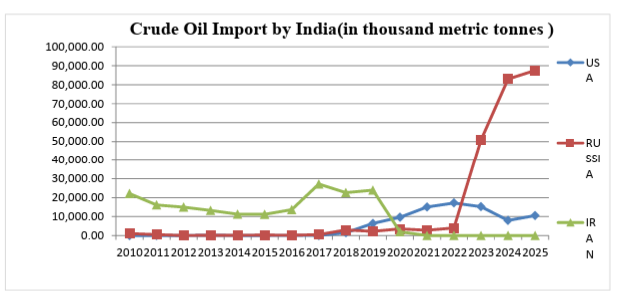
Only over 2% of crude oil imports came from Russia even in 2021-2022. The change was triggered by two factors. The first was the US embargo on Iran, which led to Iran’s percentage of India’s overall oil import basket to drop precipitously. The war between Russia and Ukraine which began in 2022 was the second reason. Diplomacy, energy trade flows and global energy dynamics transformed as a result of the conflict.
The previously mentioned reason was instrumental in India’s energy acquisition from Russia. Likewise, commercial, logistical and geopolitical factors contribute to India’s monthly fluctuations in its purchases of Russian oil with the economic considerations of Indian refiners playing a major role.
India’s Ministry of External Affairs explained its position on importing Russian crude oil in light of shifting dynamics in the world oil market. The altering dynamics of the global oil market have an impact on India’s decisions on its acquisition of crude oil. New Delhi stresses flexibility in energy procurement to satisfy the requirements of its 1.4 billion people and is even contemplating the effects of recent US sanctions on Russian oil corporations. The necessity to obtain reasonably priced energy from a variety of sources motivates Modi government’s strategy.
IOC head Sahney emphasised that Russian crude oil is bought for economic reasons. “We continue to buy, purely based on economic considerations, that is to say if the pricing and characteristics of the crude make sense in our scheme of processing, we buy,” he clarified.
Additionally, the reductions have narrowed to $1.5 per barrel which has resulted in lower imports in July, according to Vetsa Ramakrishna Gupta, Director (Finance) at Bharat Petroleum Corporation Ltd (BPCL). The discount fell substantially to $2.70/barrel in August while it was as high as $40/barrel.
Sahney pointed out that the discounts on Russian crude grades, such as Urals, could cause monthly fluctuations in purchase volumes and stressed that Indian Oil has not been told to cut or boost purchases in reaction to the US tariffs. It is clear that the US tariffs did not play any role and although the current sanctions on Russian oil companies could have an impact, the main impetus for these decisions is the economic feasibility.
More underlying reasons affecting the variations
Turnarounds or periodic maintenance are carried out in Indian oil refineries, which might temporarily lower their processing capacity and intake of crude oil. Monthly and refinery-specific variations in these maintenance schedules cause swings in the total demand for Russian crude.
Provisional government data showed that the crude throughput of Indian refiners fell 4.4% month over month to 5.27 million barrels per day (22.29 million metric tonnes), in August.
“Refinery throughput declined in August compared to July, primarily due to seasonal monsoon-related disruptions, scheduled maintenance shutdowns, and one of the refineries operating at reduced capacity,” voiced Prashant Vasisht, vice president and co-head of corporate ratings at Investment Information and Credit Rating Agency (ICRA).
India imported 18.6 million metric tonnes (MMT) of crude oil in July, a dip from 19.4 MMT the previous year, according to figures from the government’s Petroleum Planning & Analysis Cell (PPAC) owing to scheduled refinery maintenance shutdowns alongside relatively lower demand from the monsoon.
The availability of shipping and insurance services, among other logistical issues might be affected by sanctions or other market conditions, resulting in inconsistency. The Eastern Maritime Corridor between Chennai and Vladivostok serves as a prime example of a new route that would eventually affect viability as well as reliability and the same stands true for the Northern Sea Route.
The availability of shipping and insurance services, among other logistical issues might be affected by sanctions or other market conditions, resulting in inconsistency. The Eastern Maritime Corridor between Chennai and Vladivostok serves as a prime example of a new route that would eventually affect viability as well as reliability and the same stands true for the Northern Sea Route.
Indian refiners are aggressively diversifying their crude oil sources, looking into choices from other regions of the world to improve energy reliability and adaptability. This increases their pool of suppliers and inevitably also causes the monthly share of Russian oil to vary.
According to the Indian Ministry of External Affairs, protecting the interests of Indian customers in a volatile energy environment is New Delhi’s top priority. MEA spokesperson Randhir Jaiswal declared, “Ensuring stable energy prices and secured supplies have been the twin goals of our energy policy. This includes broad basing our energy sourcing and diversifying as appropriate to meet market conditions.”
Contracting for oil usually occurs four to six and even eight weeks as well as months before delivery. The volumes that arrive weeks later are determined by decisions made during these deals which are based on the pricing and conditions that are in effect at the time, adding to the monthly disparity in imports.
There are evidently numerous aspects and circumstances that account for the varying quantities of Russian oil arriving in India. Some play a critical role while others are secondary, yet they all impact the imports in one way or another.