

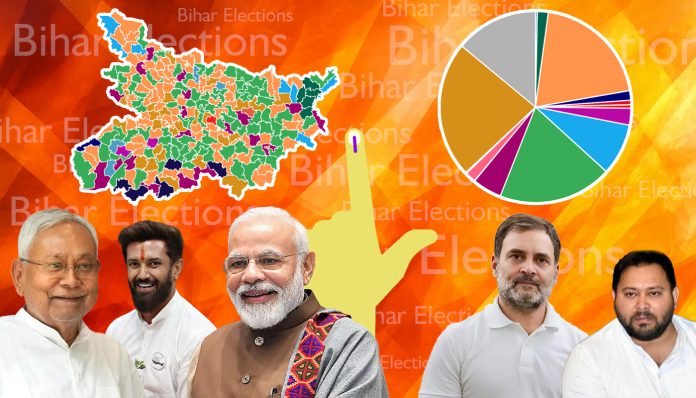
NDA has returned to power with a landslide victory in Bihar, with the alliance winning 202 out of 243 seats. The opposition Mahagathbandhan, on the other hand, won just 35 seats, with Congress reducing to seats. Rashtriya Janata Dal managed to win 25 seats.
While there is a huge difference in seats won by the two alliances, the vote share numbers tell a different story. As per the results, RJD had the highest vote share at 23%, as the party secured 1,15,46,055 votes. Next was BJP with 20% share and 1,00,81,143 votes, and JD(U) won 96,67,118 votes, a 19.25% share.
This ‘discrepancy’ has made some people to question how RJD won 25 seats despite winning the highest number of votes. Some of them also alleged that this is ‘vote chori’, that RJD should have won based on vote share.
Suraj G Naik of Congress Sevadak called it “pure #VoteChori in Bihar, not victory”, asking people to make him understand the issue.
Someone please make me understand how on earth is this possible –
— Suraj G Naik (@yoursurajnaik) November 14, 2025
RJD – 18 million votes – 25 seats
BJP – 9.6 million votes – 91 seats
JDU – 9 million votes – 83 seats
"This is pure #VoteChori in Bihar , not victory" pic.twitter.com/tOB39nFAFp
Another person called it ‘vote chor’, ‘gaddi chor’.
RJD- 1.8 करोड़ वोट – 25 सीट
— Sandeep Singh (@ActivistSandeep) November 15, 2025
BJP – 96 लाख वोट – 91 सीट
JDU- 90 लाख वोट – 83 सीट
“ये चोरी है, जीत नहीं ”
वोट चोर, गद्दी छोड़
Similar posts were made by many ther social media users. Some called it manipulation of numbers by the Election Commission, while others asked to explain the’magic/mystery’.
Gems of Election Commission ?
— D (@Deb_livnletliv) November 14, 2025
Vote share ?
RJD: 23.07 %✅
BJP: 21.92 %
JDU: 18.51 %
Seats ?
BJP: 84
JDU: 76
RJD: 35❌
Party with maximum vote share gets the least number of seats…in the Mother of Democracy.#BiharElection2025 pic.twitter.com/djyroj6oHL
When the vote share stayed the same, how did the seats suddenly #skyrocket?
— Bole Bharat (@bole_bharat) November 15, 2025
Is this public support or political engineering?#GlobeTrotterEvent #BiharElection2025 #BirsaMunda #SanatanDharma pic.twitter.com/9YrR6NdkPM
ये कौन सा गणित है कोई समझाएगा? ?
— Kashish (@Kkashish_k) November 14, 2025
वोट सबसे ज़्यादा RJD को और सीटें सबसे कम!
Vote share
RJD: 23.08 %
BJP: 21.21 %
JDU: 18.96 %
Seats RJD: 28 BJP: 90 JDU: 81
मतलब चुनाव गणित का खेल है वोट का नहीं#BiharElection2025 #ElectionUpdates #NitishKumar #VoteChori #Lalu… pic.twitter.com/R8Y10y4ENz
वोट और सीटों का ग़ज़ब खेला !
— Bhagat Ram (@bhagatram2020) November 14, 2025
वोट सबसे ज़्यादा RJD को और सीटें सबसे कम!
Vote share ?
RJD: 23.07 %
BJP: 21.92 %
JDU: 18.51 %
Seats ?
RJD: 35
BJP: 84
JDU: 76#BiharElection2025 pic.twitter.com/TDI7wMwAdS
However, despite sounding confusing at first glance, there is no foul play in the results, and this is how India’s election system has been working since the adoption of parliamentary democracy. Two factors are important in terms of Indian elections, first is, results depend on the numbers in individual constituencies, and India has First-Past-The-Post (FPTP) system.
The Election Commission website has detailed results of all the constituencies, where the votes secured by each candidate in every constituency can be seen. In each constituency, the candidate that won the higher number of votes won the election. The winning margin does not matter, it can be 1 or 1 lakh, the result is same, candidate with higher votes wins.
As most seats in India see multi-cornered fights with several candidates, the winning candidate generally gets around 30-35% of the vote. There is no requirement of 50 % + 1, and there is no proportional adjustment afterwards, which is followed in some other countries.
The total votes a party gets across the entire state matter far less than how efficiently those votes are distributed across the constituencies the party actually contests. This is why a party (or alliance) can poll fewer total votes than its rival yet win many more seats, or vice-versa. The phenomenon is not unique to India, it happens regularly in the UK, Canada, and every other country that uses FPTP.
However, multi-party competition and seat-sharing alliances make the distortions especially visible in Indian state elections. In most western countries, there are only 3-4 major countries, therefore this phenomenon is less visible.
The reason why RJD polled more votes is that they contested in far more seats. Even through they didn’t win most of the seats, they got substantial number of votes in those constituencies, hiking up the total vote number for the party. While RJD contested in 143 seats, BJP and JD(U) contested in 101 seats each. This means, votes of 42 additional seats were added to RJD’s total vote, making a direct comparison with BJP or JD(U) in terms of total vote meaningless.
An analysis of average votes per seats makes it clear, as it shows that average vote per seat of BJP and JD(U) are much more than RJD’s, explaining the difference in seats won.
| Party | Seats Contested | Seats Won | Votes Polled | Vote Share | Average Votes per Contested Seat |
|---|---|---|---|---|---|
| BJP | 101 | 89 | 1,00,81,143 | 20.08% | 99813.30 |
| JD(U) | 101 | 85 | 96,67,118 | 19.25% | 95714.04 |
| RJD | 143 | 25 | 1,15,46,055 | 23.00% | 80741.64 |
| Congress | 61 | 19 | 43,76,479 | 8.71% | 71745.56 |
There several factors that disconnect vote share from seat won in Indian elections. A party that fights fewer seats but concentrates its efforts and loyal voters in those seats will usually record a higher average vote per contested constituency and therefore win more of them. If a part contests in all the seats, even in those where it can’t win, it will still win some votes in those seats. This will increase the total votes polled by the party, but not the seats won.
Another factor is that among opposition parties, RJD has performed much better compared to its allies. This means, even on seats it lost, it came second with significant number of votes. This increases the vote share for the party without increasing the seats won.
Another issue is unequal distribution of voters across constituencies. The number of voters in different constituencies vary widely. Therefore, when a party loses a seat with high population with low margin, a large number will be added to its vote share, without any impact on the final result.
It can be seen that RJD contested 42 more seats than BJP and JD(U), but got only 14 lakh more votes than BJP and 18 lakh more than JD(U). As RJD’s vote was spread over many more constituencies, its average vote per seat it fought was lower than BJP and JD(U). The gap of average 15,000-20,000 votes is significant.
Another issue in Bihar was that there were much more ‘friendly fights’ in the MGB compared to NDA. Therefore, while the entire NDA vote went to a single candidate in most of the seats, the MGB votes were split among 2-3 candidates from the alliance in the same seats.
All these make it clear, there is no mystery why RJD won only 25 despites polling highest vote share in Bihar. This happened because that is how India’s election system works. RJD candidates lost their individual seats, and that is the only thing that matters, not the total votes won by the party.
If any candidate or party thinks there is foul play in the counting process or the declaration of results, they can file petitions. It is notable that the entire election process including the counting is done in presence of agents of candidates and parties, and therefore they require some strong reason to contest the results.
During the SIR exercise in Bihar and then the polls, no petition was filed against the processes, despite the noise created around them by Rahul Gandhi and others. Similarly, it is expected that almost no RJD or Congress candidate will appeal against the results, and the ‘vote chori’ allegations will remain in political rallies, press conferences and social media.
Therefore in conclusion, there is no ‘mystery’ over how RJD won so few seats despite wining highest number of votes in total, and it does not point to any ‘vote chori’ or any wrongdoing. This is as per the electoral system adopted by the constituent assembly, and will remain in place unless the constitution is changed and India adopts and different election method.


