


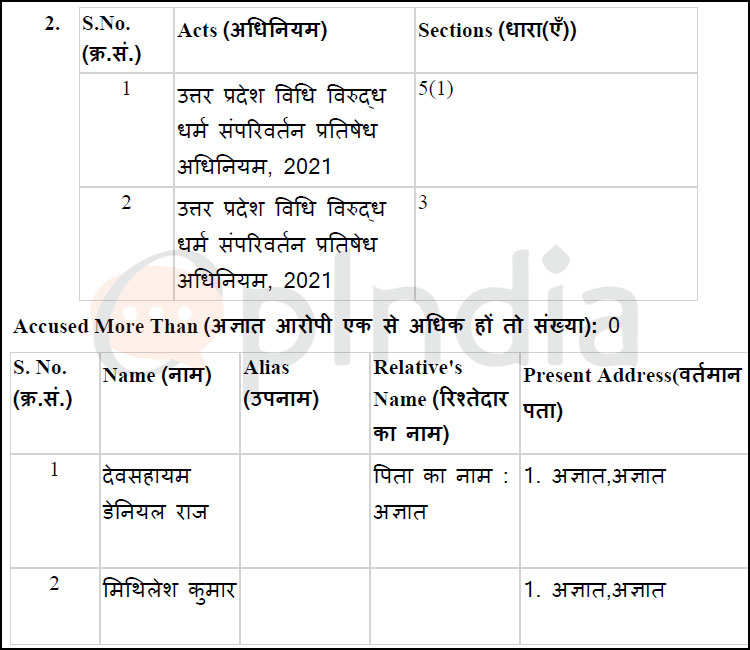
On 28th January, the Allahabad High Court granted bail to Dev Sahayam Deniyal Raj, a Tamil Nadu resident accused of coercing Hindus to convert to Christianity. He was involved in a conversion racket in the Ahraura police station area of Mirzapur, Uttar Pradesh, and was booked under Sections 3 and 5(1) of the Uttar Pradesh Prohibition of Unlawful Conversion of Religion Act. OpIndia accessed relevant court documents in the matter.
In its judgment, the High Court recorded that Deniyal Raj had been in jail since 30th September 2025. The court granted bail after noting the nature of accusations, the severity of punishment in the event of conviction, the nature of supporting evidence, and a reasonable apprehension of witness tampering. The court clarified that bail was granted without going into the merits of the case.
The court directed his release on personal bonds and sureties, subject to standard conditions such as not tampering with evidence, not intimidating witnesses, and appearing before the trial court on all dates.
The key observation in the judgment was a legal objection to the very initiation of proceedings. The court relied on a recent Supreme Court ruling interpreting who is authorised to set the law in motion under the unamended statutory scheme. During the hearing, counsel for the accused argued that the FIR was lodged on the complaint of a person who was neither the aggrieved individual nor an immediate family member or blood relative. Thus, the prosecution itself was unsustainable.
The Mirzapur FIR and what it says
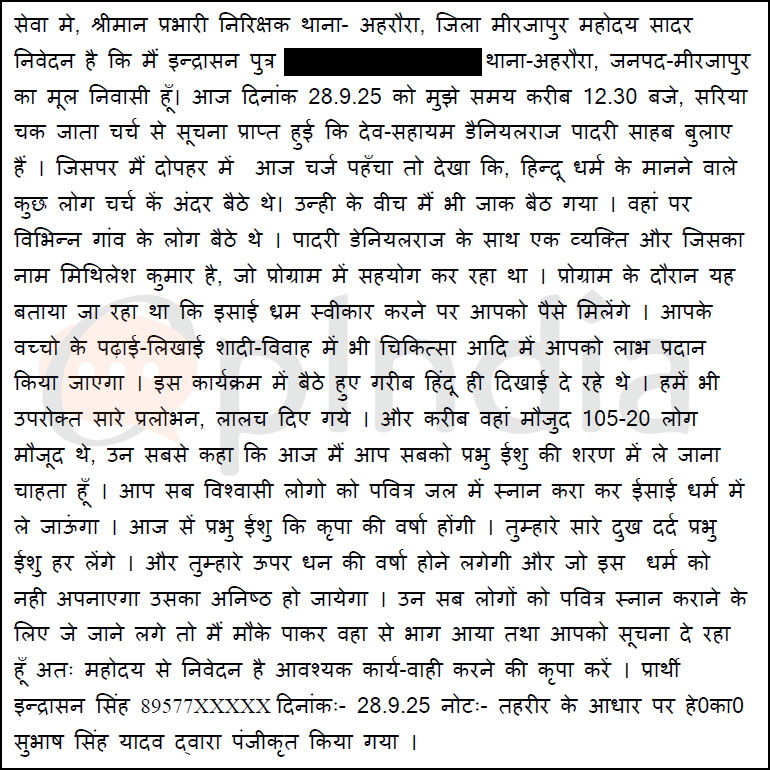
The FIR in the matter was registered on 28th September 2025 at Ahraura police station in Mirzapur based on the complaint of Indrasan. In his complaint, he stated that he received information around 12:30 pm from a church referred to in the FIR as Sariya Chak Jata Church. When he went there, he found Hindus from different villages seated inside. Dev Sahayam Deniyal Raj, the main accused, was holding the prayer meeting, and another accused, Mithilesh Kumar, was assisting him during the programme.
During the prayer meeting, Hindus present in the church were asked to accept Christianity, claiming that it would bring financial benefits and assistance, including claims relating to children’s education, marriage, and medical treatment.
He further stated that an attempt was made to persuade those present to accept Jesus and that a baptism related process was being spoken about. After observing the meeting, the complainant left and approached the police to file a complaint.
Based on his complaint, police registered an FIR and swung into action. Deniyal Raj and his four associates were arrested by the police. According to media reports, he was involved in the conversion of 50–70 Hindus to Christianity. Furthermore, he had made a list of 500 Hindus whom he wanted to convert. He had eight associates working for him. Notably, during questioning, he revealed that he was appointed as field incharge of Indian Missionaries Society, Tamil Nadu.
आर्थिक रूप से कमजोर वर्ग के लोगों को शैतानी शक्तियों से मुक्ति दिलाने व आर्थिक मदद आदि का प्रलोभन देकर धर्म परिवर्तन कराने वाले 05 अभियुक्त की गिरफ्तारी के सम्बन्ध में #सोमेन_बर्मा #SSP_Mirzapur की बाइट –#UPPolice #Mirzapur https://t.co/qMNWelaZSr pic.twitter.com/pYMagj5vry
— Mirzapur Police (@mirzapurpolice) September 30, 2025
According to police, they started surveying the region in 2012. In 2023, they came to the area and by 2024, they started converting people to Christianity.
Why the Sessions Court rejected bail and what it recorded
On 30th October 2025, the Sessions Court in Mirzapur rejected Deniyal Raj’s bail plea. The court noted that the prosecution opposed bail, stating that the accused and his associates committed the offence by offering inducements and allurements to convert Hindus to Christianity. The court noted the gravity of the offence and declined to grant bail.
The Sessions Court’s judgment was crucial because the court noted that the prosecution placed on record that the accused was linked to three other cases, all related to unlawful religious conversions. It was not a casual detail but a critical factor when assessing bail in offences that are alleged to be organised, repeat, and network driven.
The Sessions Court therefore rejected bail after considering the case diary and available documents, holding that sufficient grounds for bail were not made out.
The High Court order and the gap that raises concern
The High Court judgment stated that the applicant argued that he had no criminal antecedents and that nothing incriminating was recovered from his possession, along with the argument about the informant not being an aggrieved person or relative. It also records that the State opposed bail. Despite this, the High Court allowed the bail plea. This is where the bail grant becomes controversial and, from a public interest perspective, problematic.
The Sessions Court order is on record, and it specifically recorded that there were similar cases against the accused, making him a person of interest with criminal history relating to unlawful conversions. The High Court order, on the other hand, recorded the applicant’s plea that he had no antecedents, but does not reflect engagement with the Sessions Court’s finding on repeat involvement.
That gap matters because bail decisions are not purely about time spent in custody. They are also about the likelihood of repetition, tampering, influence, and the broader pattern behind the offence.
When a trial court records that an accused is connected to multiple similar cases, it strengthens the prosecution’s argument that the offence is part of a continuing pattern rather than an isolated incident. Ignoring that dimension at the bail stage undermines the very rationale behind stricter bail conditions in special statutes.
Why courts must treat organised conversion cases with stricter scrutiny
The key issue in such cases is inducement-based conversions. When such conversions are executed through organised networks, they are not spontaneous acts. They are operational exercises that involve recruitment, persuasion, repeated contact, resource flow, and on ground mobilisation.
The FIR and the Sessions Court record both point towards inducements, including money, education support, marriage related help, and medical assistance being used as persuasion tools. Where courts have material suggesting repeat involvement, the bail stage becomes critical.
It has to be noted that bail is not an acquittal, but it does shape ground reality. It gives room for networks to regroup, influence witnesses, change local dynamics, and continue outreach under different covers.
The matter is even more sensitive as demographic change is not an abstract discussion point. It is a real outcome when targeted conversion activity focuses on poor, economically weak, and socially vulnerable communities.
The ideological messaging may be packaged as healing or welfare, but the end result is a change in religious composition in micro pockets over time. The law exists precisely because the State considers inducement-based conversions a public order and social harmony issue, not merely a private faith choice question.
The bottom line
This bail order is not just about one case. It is about whether courts will treat organised inducement-based conversion cases with the seriousness that the statute demands. The Sessions Court rejected bail after recording the statutory threshold and the fact that the accused was linked to three other similar cases. The High Court granted bail while noting the legal objections relating to who can initiate prosecution and after recording standard bail considerations.
For a law framed to curb inducement driven conversions, judicial scrutiny at the bail stage becomes the first real test. When repeat conduct is recorded on the trial court record, bail orders need to reflect deeper engagement with that reality. Otherwise, the signal that goes out is not about safeguarding liberty. In reality, it directly affects social stability and demographic balance over time, even if bail is not granted on the merits.


